Feeds:
Posts
Comments

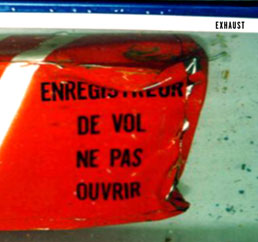
may20014SOUNDTRACK: EXHAUST-Enregistreur [CST021] (2002).

exhaust2While Exhaust’s debut was a mixed affair, their follow up really showed some great improvement.  The band feels more unified, there aren’t any single songs that were remixed (which stand out in a bad way), rather the remixing was done throughout the songs.  And, best of all there’s a lot more of that spooky bass clarinet.

The album feels more organic, “Gauss” opens with waves of music setting a mood until about a minute into track 2 “Behind The Water Tower” when the drums kick in the atmospherics gains urgency. “Voiceboxed” has a feeling of contemporary Portsihead which is neat from an album that came out almost a decade earlier.  This one has some samples of commercials , but they’re a little low in the mix so its hard to make them out. Although the spoken word part that swirls around your head is very cool and a little startling. (Headphones are a must for this album). There’s also a funny standup routine (yes, in the middle of the song)—wonder who it is.

“Ice Storm” opens with a sampled piano & a lot of static.  It morphs into a lengthy play/commercial/PSA by Heathrow Wimbledon and is called “The Maternal Habitat.”  I can’t find anything else about it online.  It’s rather fun to listen to, although when the skit is done, the music becomes strangely slow and the last two minutes (of 9) go on too long.  It bleeds into “Dither” which is mostly sampled voices and more commercials.  I love this Negativland kind of pastiche

“Behind the Paint Factory” mirrors “Water Tower” in that the drums kick in after 2 minutes and the song sounds great.  “My Country is Winter” is mostly tape manipulations including a screaming guitar solo that runs around your head.  “Silence Sur la Plateau” returns to that sort of ominous Portishead vibe with the sound of loud crinkling plastic as its main “music.”  There’ also a lengthy silence in the track which seems rather pointless to me.  The album ends much like it began with “Degauss” which is mostly clarinet solo and atmospheric sounds

It’s much better than their debut but still feels like they could have made a tighter album if they’d gotten rid of some (but not all) of the nonsense.

[READ: December 1, 2012] “The There There”

I have enjoyed Nelson’s stories in the past, and I feel like it’s time to find a collection of hers (and I see she has a lot, too).

What I especially enjoyed about this one was the way the title was used in the story and also the way it encompassed the main character in a way that was unrelated to the way it was used in the story.  In the first instance, the family is on vacation and they overhear some tourists asking “Where the hell are we?” while standing in front of the Colosseum.  The son explains that’s “like not seeing the Grand Canyon until you fell in it, like it’s the there there.”

The story is about a family–a mother, a father, and two sons.   It opens with the sons and the mother discussing the perfect murder.  The husband disapproves of the discussion but only indicates this with a cleared throat.  We see that Caroline, the mother, was imagining her husband when she was describing her murder.

While the story is basically about the mother (although told in third person), it flits back and forth to the other family members and how their behavior affects her.  First we see that their oldest son, having gone off to college, has fallen in love with his landlady–a woman with children older than him.  Caroline is appalled at this especially when Drew reveals that she’s not all that pretty, that he would have chosen one of those daughters. Continue Reading »

may20014SOUNDTRACK: EXHAUST-Exhaust [CST004] (1998).

exhaustExhaust’s self titled album was another early release from Constellation (disc number 4).  At this point Godspeed You Black Emperor had not defined the label’s sound yet (correctly or incorrectly), so we get Exhaust.  Aidan, who is 1-Speed Bike, which did not have very good drums, is the drummer for Exhaust.  And man, the drums are awesome here.  The drums are again, loud, and they have a great live feel to them–the beats are funky and different and while they anchor what’s going on they in no way keep things settled.

The rest of the band includes a bass, a guitar, a bass clarinet and samples.  The samples just aren’t loud enough anywhere on the album.  It’s a shame–you simply can’t really hear them, which I guess is the point, but then what’s the point of having them?  So the first song, “A History of Guerrilla Warfare” is interesting (again, those drums!), but it’s in song two “Metro Mile End” when that bass clarinet comes out that it totally rules. The third song “Homemade Maggot Beer” is a 20 second hardcore song with just drums and feedback.  Song 4 “We Support Iran in Their Bid to Win the 1998 World Cup” is a remix by 1-Speed Bike, and after listening to the full length 1-Speed Bike, it sounds like it– a little dull, a little slow and nowhere near as dynamic as the album.  And it has such a good title too.

“Two Years On Welfare” has louder samples–you can hear a kind of political rant going on, but it seems like it could have been used better.  But around 1;30 the sounds get really interesting.  Track six, “This Is Our (Borrowed) Equipment” is another 1-Speed Bike remix, and it is mostly drums again.  “Wool Fever” makes good use of harmonics and drums although it goes on a bit too long.  The 8th song, “A Medley Of Late Night Buffet Commercials” is the final 1-Speed Bike remix.  Unlike the others I really like this one.  True, I wish the song was more akin to what the title says, but the drums are funky and hammering and sound great.  “Winterlude” is 40 seconds of squealing radio sounds before the final track reintroduces us to that great clarinet.  “The Black Horns Of H2T” reminds us how good this album can sound.

So it’s a mixed bag, but the highs are definitely high.

[READ: April 14, 2014] “Humor”

This article appeared in the December 1958 issue of Harper’s magazine.  Mark Twain made over 100 contributions to the magazine (geez).  I have often thought that Twain is an author I need to read more of.  But when I hear he has contributed over 100 articles to Harper’s alone, my mind reels at the output.

Anyhow, this is an article about repetition in the art of humor.  Interestingly, he relates a story that happened forty years before writing this.  So the occasions of the joke he tells was in 1918!  Woah.

The article talks about the first and second lectures that he ever gave.  The first was a success but he was concerned about the second as he had very little in the way of humor to warm up the audience.  He decided to make use of an anecdote that everyone in San Francisco had heard many times and were undoubtedly sick of.  It had been overdone as long as five years ago.  But he decided that he would simply tells the very overdone story over and over until people started to laugh (the precursor of Saturday Night Live, obviously). Continue Reading »

gorey SOUNDTRACK: 1-SPEED BIKE-Droopy Butt Begone [CST014] (2000).

1speed1-Speed Bike is a remix project by Adian Girt who has played in Godspeed You Black Emperor and Exhaust for Constellation Records.  This is his first release as 1-Speed Bike.  He has released several more on other labels but I haven’t heard any of them.

The most interesting thing about this disc are the titles of the songs.  And those titles are so clever that it gives one high hopes for the album.  I don’t know who Mauro and Elwy are (track 1) but the rest are certainly interesting if not confrontational.

1. The Day That Mauro Ran Over Elwy Yost
2. Seattle/Washington/Prague 00/68 Chicago/Nixon/Reagan Circle-Fighting Machine
3. Yuppie Restaurant-Goers Beware Because This Song Is For The Dishwasher
4. Just Another Jive-Assed White Colonial Theft
5. Why Are All The Dogs Dying Of Cancer?
6. My Kitchen Is Tiananmen Square
7. Any Movement That Forgets About Class Is A Bowel Movement

But what’s disappointing is that the album is comprised almost entirely of a drum machine and some other sounds.  The drums are very very loud in the mix, and there’s very little variation in each song (which befits a remix, I suppose).  And yet, the “musical” section is largely nonexistent.  There’s a lot of spoken word stuff, which is fun, but it also seems randomly thrown on there. The disc opens with him asking someone to be quiet because he has to flush the toilet.  There’s a lengthy declaration of love for his family and war against capitalism.  And that everyone else can fuck off if they don’t want to hear him talk politics.

There are samples sprinkled around the disc, but most of them are inaudible or played with so much that it renders them hard to figure out.  There are some interesting sounds in “My Kitchen is Tienanmen Square,” but the rest is kind of dull.  The end of the last song offers a voice mail message that gives you the title of the album.

Overall, not an exciting debut for 1-Speed Bike.

[READ: April 12, 2014] The Strange Case of Edward Gorey

I bought this book many years ago when I was on an Alexander Theroux kick (which actually means I wanted to read some of his books but did not, although I do hope to).  Anyhow, this book has been staring at me for some time so I decided to just dive in.  I actually know precious little about Theroux except that his novel are supposed to be weird or difficult or something.  I know slightly more about Edward Gorey, although little more than his drawing style (which I love) and his sense of humor (which I share).

So this book is a sort of a biography of Gorey by Theroux.  Theroux was one of Gorey’s close friends.  This is saying something because as a rule Gorey was rather a recluse and didn’t much like people (he did like cats, though).  The book is not a proper biography–a biography of his works or even of his life.  It is more of a biography of the man and his quirks.  There’s very little about his childhood, and not a lot about his books (except for Theroux’s admiration).  But mostly its about what it was like to hang out with Gorey–and to delight in the baroque and fun turns of phrase that Gorey used.

We learn a lot about what he liked (soap operas, classic movies [Metropolis, M, Sunrise, Gold Digger series], obscure horror films [The Town That Dreaded Sunrise, Women of Straw, Suspiria (at least I’ve heard of that one)], TV shows [The X-Files, The Golden Girls, Matlock, Buffy the Vampire Slayer] and of course, classic literature [he was well versed in many original languages].  We also learn what he most assuredly did not like.  He did not like Star Wars, he did not like Mel Brooks, he did not like Robert Altman or Woody Allen [Gorey was a film critic for a time].  And as for our foremost actress, Meryl Streep, he has this to say:

“Oh please!” said he, every time she opens her mouth, the critics insist Dostoevsky’s speaking!” He paused. “And who’s even dippier is Glenn Close. Sexless as a teabag. Neither man, not woman, nor in-between! Julia Roberts’s face looks like it’s made of rubber — remember those Snap, Crackle and Pop cartoon faces? And of course Streisand. God help us, I won’t even go to see.”  Gorey loathed her with a passion, even more than John Waters does.  I once heard him fulminate for a good half-hour on the impossible stupidity of her 1962 hit, “People,” a song that, with its mawkish, politically correct soul-sharing, shrinkingly embodies to a T everything that Edward Gorey utterly loathed:  “Pee-pull, pee-pull who need pee-pull are the luuu-kiest pee-pull in the wooooooorld!.”  I cannot honestly think of a single sentiment that would have driven Edward Gorey battier faster than the flaccid lyrics of that song with its, to him, canasta-closeness, hideous interconnectedness, and ultimate meaninglessness.

He also hated Andrew Lloyd Webber, the Marquis de Sade’s writing, right-wing talk show hosts, every movie Al Pacino ever made [Of Bobby Deerfield he cried out during the movie, “oh for Christ’s sake…what is this in aid of?”] and Martha Stewart.  And while he had great disdain for Barbra Walters and Maya Angelou, he was especially appalled by “the invincible vulgarity of the preposterous Kathie Lee Gifford and the host of miniature faces she was constantly pulling” (20) saying: “her facial contortions would be excessive on Daffy Duck” (44).

One thing to note about the book.  As you can see form the page numbers above, similar sentiments about Gifford are on page 20 and 44.  Theroux tends to circle back onto the same topics a number of times.  So the same names tend to pop up three or four times (Buffy comes up at least 3).  It feels like Theroux (who published this soon after Gorey died) wrote it in fits and just needed to get down as much as possible.  And while the book feels repetitive, it never feels flaccid or like it’s full of padding.  It just feels like a huge outpouring of information.  Or like an essay collections by a person who tends to revisit similar material.

Interestingly, the book isn’t necessarily for fans of Gorey.  I honestly haven’t read any of his works in years, but I found this book funny and strangely cathartic (if you like bitchy, opinionated scholar-types).  If any of the above appeals, you’ll get a kick of out Gorey, whether you like his drawings or not.  The book is also full of Gorey’s drawings (although nothing new), from his books and from some of his posters.

I was also intrigued by the fact that Gorey, clearly no friend of people, did not shy away from the outside world.  He lived on Cape Cod and New York City where his number was in the phone book the whole time.  He walked around Manhattan in a big beard and fur coat (until he gave up the coat for animal rights reasons).  When he moved full time to Cape Cod, he lived in a residential area and did not turn away any fans (he always had manners even if he knew the whole thing was kind of silly).  And apparently his house was simply chock full of fascinating geegaws and gimcracks.

For all of his proclamations about others, he did not have a large ego about his own work.  And the book gives the impression that he was just an opinionated guy who knew what he liked and was happy to share his thoughts with others (or his cats).

I just found out that Theroux reissued this book in 2011 and updated it from 68 pages (my version) to 168 pages.  I don’t know how much has changed.  In looking online it seems like maybe all he has done is make the original pictures larger, but there may be other textual changes as well.
 

polinaSOUNDTRACK: SOFA-Grey [CST002] (1997).

greyIt’s not nice to compare bands to other bands, because it seems like they are copying the original. But since I just mentioned Slint the other day, I thought it worthwhile to mention Sofa today. They have similar sensibilities—noisy guitars, spoken/screamed vocals and a decidedly quiet feel.

I love the way this disc opens with the song “On/Off”—it has a simple bass with syncopated drums. And then the buizziest buzz saw guitar thrown in counterpoint notes. And then the singer comes in, sounding like Joy Division never went away.  The song builds into a cool noise and then backs off again. But song two, “CH. 2 Chi.” changes everything—a blistering punk song with super fast chaotic drums and fast vocals. The guitars are again punctuating rather than keeping melody. And when it plays the two high chords it adds incredible tension. “Monotone” begins a simple song of two notes (and some great noisy guitars). The vocals are less Joy Divison and more spoken punk. But each verse adds something new to the music, which gets more complex. “Current” has a more conventional post-rock sound—buzzy guitars and quiet vocals. It’s a good calming moment.

“80 000” has a slow menacing vibe. It builds a few times into some really noisy chaotic sections, where the guitars are willfully out of tune—and all the while the spoken word lyrics are quiet enough to make you lean in closer. “Red Lake” is another slow number (they could maybe have used a faster one by this point), but I really like the riff and the way the guitars play off of it. And there’s an actual hummable chorus too.

The fast noise comes back on “Comma” with a frenetic guitar line and pummeling bass. Even the stop/start of the chorus are frenetic. And when the song occasionally slows down, the guitars still punctuate with astonishing noise. “The Fence” opens with a cool bass riff and simple but interesting drums. “Travel” is a slow song that opens with just guitar notes and spoken/sung lyrics. I don’t care for these more atmospheric songs (especially when they push 6 minutes) but the band does it well. “Stress” follows this. This is the shortest song on the disc just under 3 minutes of furious mayhem. “Medicine Hat” ends the disc with another slower song, but this one has a lot of interesting components, like the bass and guitar line that interweaves throughout the song.

This was Constellation Records second release (Ian, who plays guitar, co-founded Constellation).  Sofa broke up around the time of this release, which is a shame as it was a good one. I’d like to hear more from them (they have some earlier records with unknown availability).

[READ: April 5, 2014] Polina

This was a simple and enjoyable graphic novel about a young ballerina who grows up in the world of ballet.  (I admit I was attracted to the title because I thought it might be about Olympic figure skater Polina Edmunds who I remembered primarily because the name Polina which was unusual to me–it is not about her).

It is a bout a fictional ballet dancer.  When we first meet young Polina, she looks so tiny in the back seat of the car as she is driven to class.  And her teacher, Mr Bojinsky looks like such a large man next to her–with his full beard and large hands.  He is an intimidating figure and all of the girls are afraid of him.  And yet, it is an honor to be even considered by him.

So when Polina unexpectedly gets chosen for his class, she is elated and fearful at the same time.  At first Bojinsky seems really mean and the way his hand more or less covers her whole chest as he gets her into place portended all kinds of things.  But rest assured, and perhaps this is a spoiler, but if is, it is one that I would like to know–nothing bad like that happens to Polina.  Phew. She is not molested, or raped or left dying in an alley. It’s not that kind of story.  Rather, it is the story of a young girl trying to make it as a dancer. Continue Reading »

SOUNDTRACK: stickman2JUSTIN ROBERTS-“Pop Fly” (2008).

popflyThis is a wonderful pop song from Justin Roberts.  Roberts is regarded as a top-notch children’s song writer.  I hadn’t heard him before, but i was totally sold by this one.

It’s a poppy almost dancey song–it certainly makes you want to move around, anyway.  There’s a catchy acoustic guitar and a fast beat and Roberts’ voice is really solid and warm.  Interestingly I didn’t even realize this song was about baseball when I heard it on the radio (I missed the song title).  I was totally hooked by the pa pa pa pa pa pa chorus.

And there’s a great third section of the song that changes the mood but not the tempo.  This reminds me a bit of Ralph’s World, but a bit…more full, perhaps?  Or maybe like something from Phineas and Ferb.  I’m going to have to check out more from him.

Oh, and the video, while cheaply made, is quite funny when the chorus kicks in.

[READ: April 8, 2014] Stickman Odyssey, Book 2

I enjoyed Book 2 of this series more than Book 1. It felt like it had a little more plot and was a little less slavish to the original myths.  or maybe I just like quests.

The story starts in the middle, with Nestor having captured Zozimos and having tied him up for failing to avenge Sticatha (which was Nestor’s plan all along).  He says that Zozimos has been doing nothing all this time. But Zozimos says no, he has been on an epic adventure.

Which brings us to where book one left off.

Praxis (the strongest man in the world) Atrukos (a guy who looks like a frog) and Zozimos set off to find a piece of the sky.  In book one, Praxis had knocked a piece of the sky out when he hurled a cyclops at it.  He wanted to retrieve it to prove to his love that he was actually a worthwhile person.  This story is left all of a sudden (in a very funny way) so they can help Atrukos with the witch who cursed him before Book 1 even started.  That’s when Nestor captured Zozimos, as he was on his way to help Atrukos. Continue Reading »

stickman1SOUNDTRACK: DANNY WEINKAUF-“Archaeology” (2014).

noschoolDanny Weinkauf is one of the Band of Dans that plays with They Might Be Giants.  In 2014 he successfully funded a Kickstarter campaign to create his solo album, No School Today.  (I knew nothing about the Kickstarter campaign).

The album comes out this month and I have to say I really like what I’ve heard so far.  This song has been played on Kids Corner a lot.  It’s very catchy and reminds me of good indie pop music.  There’s even a feel of 70s British pop (or like Davy Jones singing).  It’s super catchy.  The chorus and the oft-repeated “arc” “arc” “arc” before “archaeology” can be a bit much at the end of the song, but for the most part this is a real winner.

Danny also wrote “I am a Paleontologist” from They Might Be Giants Here Comes Science album, so his bona fides are good.  And the lyrics are clever and smart, too:

Archaeology It’s human evolution From the Caveman to you and me analyzing their solutions (yeah now)
/Archaeology the secrets they left for us We can study activities Of those who came before us

[READ: April 7, 2014] Stickman Odyssey, Book 1

While I was looking for Stickdog books for C., I came across Stickman.  There are two books in this series (with book two being set up for a third, but no sign of it yet).

This book is a kind of spoof of Homer’s Odyssey, but not really. It is set in the time of the ancient Greek gods and some of those gods make appearances.  Even the style is done in a generically Homeric epic storytelling style.  But none of the characters from Homer appear.  This is an alternate reality of sorts.  The Great Whirlpool exists (shades of Scylla and Charybdis), but so does Candy Island and a place called Odonoros and Stickman’s home world of Sticatha (which made me laugh once I pronounced it correctly).  So, you don’t need familiarity with Homer to appreciate this, indeed, it kind of confused me at first because I wasn’t sure if I should be looking for parallels.

Stickman’s name is the awkward Zozimos (which I want to be significant but can’t figure out any reason why it would be).

The gods do play with the humans, though.  On the second page we see that Athena wields a giant pen and makes Zozimos a raft while he is struggling in the ocean.  Days later he lands on what he thinks is Sticatha, but no, he lands on an island with fair maidens.  He tries to charm one of them, Asteria, but is immediately grabbed by a golem and dragged to jail.  The evil King Marnox imprisons every castaway who lands on the island–he has his reasons.

But Asteria is mad that her father is locking up all of these eligible men, so he brings Zozimos out of the jail for him to tell his story.  And it is…epic! Continue Reading »

[ATTENDED: April 4, 2014] Black 47

b47logo I was a fan of Black 47 when they first came out (even though my Irish friends dismissed them out of hand.  What with the “Bridie!” and the “Fiddlee diddlee deidely dee!” and, yeah, Larry Kirwan’s voice, they were just too much for actual Irishmen.  But Irish-Americans loved them.  And now 25 years after they burst onto the scene with “Funky Cieli,” they are calling it quits.

As far as I can tell Kirwan is the only original member left in the band (I’m not inclined to do the research on that).  Actually, I didn’t even realize they were still together.  But they have been releasing albums over the years–some of which have been lauded and other not so much.  (Kirwan has also published some books and is a host on Sirius FM).  They have a brand new going-away album called Last Call, and if the live versions of the songs were any indication, they sound quite good.  And Kirwan is just as political as ever: “If you’re Irish you have to be political.”

I actually saw Black 47 back in, oh, 1993.  I remembered the show, but had misremembered the venue.  It wasn’t a concert, it was a small club in Allston, Mass.  I don’t seem to have any photos.  The bar was packed, I could barely see the band, and I’m not even sure if the people there were there to see the band.  I don’t even know if there was a cover charge.  So it only seems fitting that this concert, one of their last on their farewell tour, should also be free.  As part of the Princeton University’s Fund for Irish Studies, the band played a free 90 minute set in the tiny Berlind Theater.

I have seen a few theater shows there, so I was a little surprised that the sound wasn’t great (well, mostly Kirwan’s lyrics were hard to understand, but that may be a common problem for him), but my seat was great–a few rows back in dead center. Continue Reading »

balfourSOUNDTRACK: SLINT-Spiderland (Remastered) (1991/2014).

slint2Slint is an overlooked band except by those who think they are really super important.  Slint played what would eventually be called post-rock before people called it that–they had spoken vocals and dark guitar, loud and quiet riffs and intense building sections (and on this album no songs under 5 minutes).  Some riffs were super catchy, indeed, many of the songs on Spiderland have super catchy sections, and yet there is something that resists you casually getting into them (probably those spoken lyrics).

I’ll even say that I tend to forget about them.  They get lumped in with other Steve Albini produced bands (Albini produced their first album, but not Spiderland, and since Albini’s band was Shellac, they are even close in the alphabet), but they don’t really sound like Albini’s output.  They’re much warmer and, dare I say ,emotional–the screamed vocals are incredibly passionate.  Plus, they only released one album before they broke up (this one was after the breakup), so their legacy is bigger than their output.

So I’m thrilled about this reissue if only so that it will give them a wider audience. And you can hear the entire two hour spectacle before it come out at NPR.

At the same time I didn’t notice a huge difference in the production.  It sounded great, but then I haven’t listened to it in a while so it’s hard to compare.  The deluxe package is a behemoth: the box comes with the album, outtakes and demos on 180 gram vinyl and on CD. It also includes a 104-page book with never-before-seen photos, lyrics, and a foreword by Will Oldham and Breadcrumb Trail, a 90-minute documentary about the making of Spiderland with interviews with the band, James Murphy, Steve Albini, David Yow, Ian MacKaye, Matt Sweeney and others.  Since it retails at about $150, I won’t be buying that.

slintI did listen to the whole thing and again was reminded of how great the album is.  The bonus material is, well, a little disappointing.  You get three more early versions of “Nosferatu Man,” one of which is an instrumental.  Two demo versions of “Washer” and “Good Morning, Captain” (one is an instrumental kind of goof).  There’s three versions of a song called “Pam” which didn’t make Spiderland, so that’s interesting.  Then there’s another outtake called “Glenn” and two post Spiderland songs called “Todd’s Song” and “Brian’s Song.”  They’re all good, but are in various stages of construction.

Perhaps the most interesting bonus track is the live (from Chicago 1989) version of Neil Young’s “Cortez The Killer.”  But I have to admit that vocally, they just can’t handle it.  The music sounds good, but the singer just never seems to be in tune, but nor is he talking it either.  It was a little disappointing (especially compared to Built to Spill’s live cover).

So if you are a die hard fan of this unheralded band, this is a worthy addition (especially for the book and movie).  Otherwise, enjoy the original, it’s a great album.

[READ: April 7, 2014] Balfour and Meriwether in The Incident of the Harrowmoor Dogs

I was immediately attracted to the cover of this novella–two men in bowler hats and button down shirts wielding weapons in front of a spooky background.  What’s not to like?  Especially when the book is tiny (80 pages).  I grabbed it and brought it home to read.

That’s when I learned that Balfour and Meriwether appear in other books and that this was “the first novella-length work” about the pair.  Did that mean that there was a lengthy series and this is the first short piece about them?  Indeed, no.  There are two other stories about them which are both shorter (these first two stories have been collected in one book).  And according to Abraham, he has no plans to write more, but that doesn’t mean he won’t.

So this is a fun and surreal adventure story set in England in the 1880s.  It is taken from Meriwether’s Diary (written in 1920).  Meriwether acknowledges that God the Creator has made many beautiful things but He has also made some abominations that walk the Earth.

And that leads us into this story of subterranean creatures and British political dealings with them. Continue Reading »

  9SOUNDTRACK: UNIVORE-“Vampire” (2013).

univoreI never watch the ads that come before Youtube videos.  But this came on as an ad and I was utterly mesmerized by it.

I didn’t even know what it was for.  Turns out that Univore is a band and “Vampire” is one of their songs.  The 1 minute ad video was actually the whole thing.

It’s got a simple buzzy synthesized riff, backing vocalists singing “Oh yea” when appropriate and an occasional deep voiced man saying “vampire.”  The video is of an older gentleman (who a little research suggests is Marco Casale) dressed like a vampire running around a small green space on a campus.  The whole video looks like it took 15 minutes to film.  It is weird and wonderful.

I still know nothing about Univore, which may be for the better, but I did enjoy this video.

[READ: April 6, 2014] Grantland #9

I’m surprised that there aren’t better cover images online for these books.  For #8 i had to use one with a big flash in the middle of it and this one is the illustration from the Grantland website.  The books are quite pretty so why uses these pale imitations?

So this issue proved to be a lot better about weird typos and “we just took this from the web and pasted it and never bothered to check to see if there was anything weird” problems.  So thanks for at least running it through Spellcheck.  The only other thing left is to either remove the lines that talk about attached links/images if they are not there or to include the url or make up a tiny url (but that would be actual work!).  Oh, and please make sure all of the footnotes are included.

I have given up on ever finding out how these things turned out several months after the fact–I’ll just happily live in ignorance of reality there.

This issue was taken from during basketball’s downtime which was a nice change (even though the still managed to talk about basketball).  There was more pop culture and some wonderful articles about team nicknames and mascots–something I absolutely love.  So this is one of my favorite issues overall.  Continue Reading »

march2014SOUNDTRACK: VALENTINA LISITSA-Chasing Pianos: The Piano Music of Michael Nyman (2014).

Inym,an don’t listen to a lot of classical music, but I do like it. I also enjoy some modern composers, in particular I have a strong fondness for Michael Nyman. Yes, yes, he’s a soundtrack composer, blah blah, but I find his music to be very pretty and often delightfully eccentric.   His music reminds me of Phillip Glass, in its repetitive nature, but he goes beyond the minimalism that Glass was trying to create by implementing inventive melodies and expansive sounds.

 Valentina Lisitsa is a 44 year old Ukrainian pianist and she tackles music from throughout Nymans’ soundtrack career.  Nyman came to prominence with The Piano, which is a beautiful score.  And this is where this album starts out.

I’m not going to talk about each piece.  Rather, the album overall has a consistent feel–piano versions of Nyman’s music.  Nyman isn’t the most difficult composer, but he has his own style and so the entire album has a nice flow (although it does get a little slow by the end).

She plays songs from eleven of his soundtracks (which I’ve listed at the end).  Many of them get only one track, but Wonderland gets two and The Diary of Anne Frank gets 5 cuts.  I actually don’t know either of those two scores.  The bulk of the disc is, unsurprisingly, from The Piano which has ten cuts here.

I actually know his older soundtracks a lot better, so it was interesting to hear these piano versions of many of these familiar tracks.  Like “Time Lapse” from A Zed & Two Naughts and “Chasing Sheep is Best Left to Shepherds” (ne of my favorite pieces by him) from The Draughtman’s Contract.

Stripping down Nyman has an interesting effect because you can really hear how pretty the melodies are.  Although the real pleasure I get from his songs is the weird embellishments he puts on them, like the interesting sounds (horn and didgeridoo?) in “Here to There” from the Piano (which are absent here).

Although it has the feeling of a piano concerto the end (with several songs from The Piano in a row) is a bit samey.  It was smart to end the disc with a reprise of the opening.

There’s also songs from Drowning By Numbers, Carrington, The End of The, Man with a Movie Camera, The Claim and Gattaca

[READ: April 3, 2014] “On Nudity” and “The Trees Step Out of the Forest”

I am linking these two essays because I read them very close to each other and they are almost diametrically opposed in their content. And I thought it would be an interesting contrast.

“On Nudity” is a very simple essay about nudity. When Norman Rush was a kid–9 or 10–his father was really into nudism. He always wanted to go to nude beaches, he was very lax with nudity around the house and he tried to get his wife to join him. She was reluctant. Indeed, she didn’t really seem to like her husband very much and it seems they only got married because she was pregnant (and he may not have thought that was a good enough reason, to be honest).  She tried her best to make him unhappy because of this, and that seemed to involve declining his nudity bug.

So there were copies of Sunshine and Health (the premiere nudist magazine) hidden in the house (although Norman knew where they were), and yet, despite this access, he couldn’t get enough.  Rather than sating his needs, he was more obsessed than ever.  He wanted the real thing, whether it was getting his cousin to play strip poker or trying to spy on women in changing rooms.  He talks about the various hings he did just to get a peek of flesh.  And as the essay comes to close he apologizes to the two women whose privacy he invaded by spying on them.  The guilt about what he did to these women made him stop, although the women likely never knew what had happened to them. Continue Reading »