SOUNDTRACK: マキシマム ザ ホルモン–“え・い・り・あ・ん” (2013) [MAXIMUM THE HORMONE-“A.L.I.E.N” (2013).
This Japanese band has gained some ground in the United States (having two of their songs used in the anime Death Note). They are a heavy, heavy metal band which explores many different genres.
This song begins with a heavy metal guitar riff. When the song proper starts, it is clearly a heavy song sing in Japanese. The second vocalist (who screams like Yamantaka Eye with John Zorn) screams in an unmistakably Japanese way. And at 1:15, the song slows down into a very heavy almost mosh.
So far so good. The first big surprise comes at 1:44 when the song is hijacked by a funk metal bass line and the follow up section is a less scary sounding but still heavy metal.
And then it’s back to the speed and noise once more, complete with a pause and a “Go!” and then a series of “He!y Hey! Hey!” metal chants.
But the real surprise comes at 3 minutes when the whole song slows to a sweet section with whispered vocals by the (female) drummer? And then the entire song switches to a sweet song–delicate guitar and super sweet vocals with the new lyrics “Stop Stop Winny Upload.” The boys come back in, but now they are playing along to this poppy (but guitar heavy) “Stop Stop Winny” section.
This runs on until the end of the song which has the band members conversing in Japanese (about what, I have no idea).
It is one of the most jarring songs I’ve heard, combing at least five genres in its 5 and a half minutes (and several of their other songs do this too (check out “Yoshu Fukushu”).
This is to say nothing of the video, which opens with the band playing in a live setting. The guitarist has long hair and a beard and sings the first verses. The short-haired singer sings the really fast growly stuff and the bassist has a nifty side shave.
As the funk metal stuff starts, the band switches to a studio scene in which, why not, they all grow extra heads and limbs.
The Stop Stop Winny section switches from a segment with the drummer in a wedding dress singing gently. And then the final section shows the band in a psychedelic set with little kids and balloons.
It’s fantastic.
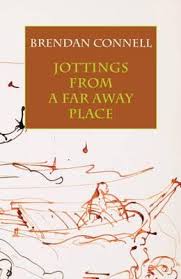
[READ: November 13, 2015] Jottings from a Far Away Place
Brendan Connell has this new book coming out (on December 1st) from the wonderfully named Snuggly Press. (I love that it says This is a Snuggly Book) on the title page verso.
Connell has written all kinds of books in his career but this one is something of a new style in his vast oeuvre. The title word “Jottings” is a giveaway because so many of the parts of the book are very short–notations, indeed, jottings, that may or may not relate directly to the rest of the pieces. I found the book a little challenging to read at first because of this. However, when I wrapped my head around what was going on, it really gelled. And when I read it a second time, with this in mind, it worked beautifully.
Connell has created a kind of labyrinth of a book in which some fragments lead to dead ends, but other fragments lead to longer stories. And when you hit on the right path you are rewarded with a longer story that is as well written (Connell’s eye for detail is, as always, exceptional) as it is interesting. But unlike the mythological labyrinth, there is no Minotaur if you take a wrong path–rather there is just a fragment that forces you to think about where it might belong. Continue Reading »
A year ago I would have said I know nothing about music from Mali, but the shows at NPR have given me a greater appreciation of it. And, while I wouldn’t say I’d have been able to pick this out as music from Mali, I definitely recognized the style of the what I’m going to call fiddly guitar that seems to be prominent in Mali music.
You can really hear how good guitarist Drahmane Toure is with the way he keeps up the constant soloing and fiddly bits. It brings a cool distinctive sound to the otherwise steady rhythm from the bass and percussion (which looks like a beautifully carved salad bowl covered in duct tape).
The rest of the band includes an acoustic guitar, a bass backing singers and some other instrument that i can’t figure out.
Of course, this show is meant to celebrate singer Khaira Arby, the queen of desert rock. And she is fine. I don’t really have much to say about her. She sings perfectly for this music, and sounds almost more like a prayerful singer than a professional one.
[READ: December 27, 2013] Diary of a Wimpy Kid: Old School
Clark said that this book was the best Wimpy Kid yet (a claim he has made before, so this must be really great). My story about this book is that I knew the cover was black and I know basically what the back cover looks like, so when we saw Age of Ultron this summer, imagine my surprise to see that the boy was reading this book (which didn’t come out until last week). Movies are magic.
Anyhow, this book begins in September with some hilarious snark about “the good old days.” I love Greg’s reaction, “I think they’re just jealous because MY generation has all this fancy technology and stuff they didn’t have growing up.” And now Greg’s mom’s big kick is to get everyone to unplug. To unplug and reconnect with the community. Continue Reading »
Olof Arnalds is from Iceland and she sings in Icelandic. She sings a kind of experimental folk, although in this Tiny Desk it is just her and a partner, Davíð Þór Jónsson, playing acoustic guitars.
And playing acoustic guitars keeps these songs pretty grounded. Arnalds is a classically trained violinist, but she sticks to guitar on two of the tracks.
“Innundir Skinni” is a beautiful melody and our first exposure to Arnald’s voice, which is certainly unconventional. Her voice is quite high and really rather lovely, just more Icelandic than Western. Although even though she sings in Icelandic, anyone can sing along to the “la la la” part.
On “Surrender” she plays a churango made from an armadillo shell. It brings a beautiful delicateness to this song. I love the staccato chorus
“Crazy Car” sung in English as a duet, in which their accents and non-English delivery (especially Davíð’s) is most notable. The end, when she sings a different vocal melody is lovely.
Her voice might be off-putting to some, but I always like to hear someone with a bit of character.
[READ: November 10, 2015] Diary of a Wimpy Kid: The Long Haul
This has been my favorite Wimpy Kid book so far. I tend to like the ones that focus on a single long event and the whole family more than lots of little episodes at school. So this book, which follows the Heffley family on a summer road trip was perfect for me.
I also love the way Kinney taps into real things but modifies them just enough to make them somehow even funnier. Like the way he creates the magazine Family Frolic (but uses the font of Family Fun magazine) and describes it perfectly–showing idealized family moments which no family can ever hope to recreate. There’s also the hilarious way that trying to surprise kids with a trip can backfire (Manny is so excited to visit their aunt, that they have to delay their real trip to Disney World).
I also enjoyed the use of Flat Stanley (from the book by Jeff Brown) and the hilarious way he changed Captain Underpants to Underpants Bandits (by Mik Davies, rather than Dv Pilkey) which allowed him to make his own underwear jokes. Continue Reading »
SOUNDTRACK: THE RED RIVER-Tiny Desk Concert #97 (December 13, 2010).
The Red River are a ten piece band (whom I have never heard of). They have two keyboardists, a drummer, a violist, a french horn player and guitars and vocals. But in this Tiny Desk, the band decided to remove all of their instruments, save for the guitar, and to sing four of their songs more or less a capella (such is the coolness of the Tiny Desk).
The first song “Milk n’ Honey” is completely a capella and they kind of make each other laugh at a few moments (where maybe their instruments might have covered up some unsightly notes).
“Morning Routine” begins with just guitar and duet vocals. Again, they seem to be trying to make each other laugh when after the line “the kitten cries,” the lead singer makes some kitten noises. The chorus of backing vocals sounds wonderful here.
For “St. Bernard’s Lily” the nine players all do body percussion to provide the beat while Bill Roberts plays guitar and sings. The band does some great backing vocals (especially in the do do do do do doooos). The final song “Dirty Dave” is dedicated to him. Roberts says they miss him very much then quickly points out that he’s not dead, he just couldn’t make it on that tour. The song has a pretty melody and when the band sings the chorus together its really beautiful.
Lyrically the songs are about the mundane, which is what makes them rather interesting. I can’t quite imagine what their full band sounds like given this stripped down version.
[READ: November 12, 2015] The Secrets to Ruling the School
I saw this book when I was in Chapters Bookstore in Toronto. I was happy to see it again in my library, so I checked it out.
The premise of the book is familiar–getting by in Middle School–although this book takes it a few steps further. Not just getting by in Middle School, but actually ruling it.
And the structure is cool. You are the person who will soon rule Middle School. And you will be tutored by Max Corrigan. Max meets you on your first day. He’s a clean cut kid with a binder full of information. He is the school’s Welcoming Committee. But as soon as you open his Official New Student packet, you see that Page 2 describes the school as The Worst Place in the Entire World. And that Max will help you survive bullies, tests, hall passes, psycho teachers and even ditching class.
And his plan is simple–makes friends with every clique in school as quickly as possible. Continue Reading »
I have mentioned a much more recent Tiny Desk concert from Yolanda Kondonassis in which she duetted with Jason Vieaux (from 2015). This show is just Kondonassis and her harp.
And it is absolutely gorgeous.
Kondonassis plays three distinct styles of music to show the variety of music a harp can make. It is amazing to watch her play as well. She closes her eyes and simply knows where everything is, absorbed in the music.
Her first piece is by Domenico Scarlatti: “Sonata in A Major, K. 208,” which is considered a rather “traditional” harp piece (I love hearing her do the “fast notes” a the end of each section.
She introduces the second piece by saying that she wanted to compose a piece and through meeting a Chinese composer wound up arranging this traditional Chinese piece called “Small River Flowing.” And it is amazing to hear the Chinese melodies immediately from the high notes. But perhaps my favorite part of this song is that she hits the low bass notes to make them ring out almost like a gong. I have never seen anyone do this before with a harp.
She says the final piece is by Carlos Salzedo: “Chanson dans la nuit” which crosses over into almost world music. And in a short time, it really shows off all of the different sounds and colors that the harp is capable of. She’s absolutely right. While the song begins with some very traditional sounding harp music, she seems to also play some harmonics (who even knew you could do that on a harp) as well as some sounds of just her nails running across the strings–bringing a fascinating texture–as well as some very fast, loud chords and indeed, actual percussive sounds as she taps on the body of her (truly beautiful looking) harp. The song is not as pretty as the others since there is so much going on, but it’s a wonderful song and it’s great to watch her play it.
I never knew I wanted a CD of harp music before, and now I do.
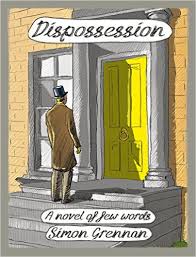
[READ: November 12, 2015] Dispossession
This graphic novel has a fascinating origin. It is based on the novel John Caldigate by Anthony Trollope. And in fact, it follows that story pretty faithfully. However, it eschews massive amounts of the book (the original is quite long) and also adds a subplot of Wiradjuri peoples (which includes dialogue in Wiradjuri translated into English by Cheryl Riley). There’s also a Postface (which is very helpful for explaining the origin of the story and how Grennan modified the original) by Jan Baetens and Ortwin de Graef.
The subtitle, A Novel of Few Words, proves to be accurate. For the most part, each page has six panels, and the only words are sparse dialogue. Grennan really has the story move quickly through these images, which tend to jump ahead pretty quickly.
We first meet John Caldigate. Caldigate is a wealthy man, soon to be heir to his father’s fortune. But he is unsatisfied in England. And he decides to sell off his inheritance and to set off for New South Wales with his friend Ned. There they will seek their fortune in the gold mines.
There is a woman he has left behind, Hester, the daughter of a local family. She is certainly desirable, but it’s unclear how Caldigate feels about her because he wishes to find his fortune elsewhere.
Then the men set sail for Australia, two bachelors on a lengthy sea voyage. Aboard the ship is Mrs Smith, a divorced actress who is also heading to Australia. Mrs Smith is considered somewhat disreputable aboard the ship–and several people warn him against her. But he cannot be denied. Continue Reading »
SOUNDTRACK: DAVE BIDINI—The Paramount Moncton, NB [audience & soundboard recordings] (July 29, 2007).
This final show has two different recordings at the Rheostaticslive site, an audience recording and a soundboard. The soundboard recording is cleaner and I suppose better, but the audience recording is a little more fun because you can hear the audience responding to Bidini’s comments and jokes.
For the reading he asks if people want London or Finland, and so he reads Finland. He reads the funny story about trying to get a cheap 30 pound flight to anywhere only to get hit with a huge fine for having too much stuff. The section ends with a funny moment when a Finnish audience member compliments him: Your voice is excellent! Dave is excited since that’s not something he hears to often. The man follows up with: “You pronounce English very well.”
He plays seven songs all on acoustic guitar. Three of the songs are Rheostatics classics: “Fat,” “Me and Stupid” and “My First Rock Show.” I feel like hearing “Me and Stupid” in this setting really let me get the lyrics better–I never really understood the middle section. All three songs sound good in this format.
The “solo” songs are the same four: “Song Ain’t Good,” “The List” “The Land is Wild” and “The Ballad of Zeke Roberts.”
While talking to the crowd he mentions seeing signs on the road: “Free PEI Spuds for Cheap Trick” and “Red Sox nation welcomes Aerosmith.” He mentioned them in the previous days’ show as well, but in this show it sounds like someone claims to have written them (or at least seen them) but we never learn what they are all about.
He sounds great and the audience is responsive. Of the three, I like this show the best.
[READ: November 10, 2015] Home and Away
My triumvirate of Bidini books ended with this one.
I had never heard of the Homeless World Cup (which is kind of the point of the book, that no one has). But as you can imagine, knowing that that’s what this book is about you can be prepared for a pretty sad book.
Bidini follows a small group (4 players, including one woman) of Canadian homeless soccer players as they travel to Australia to play in the 2008 Homeless World Cup.
We meet the four players on the Canadian team and learn all about how they became homeless (a variety of reasons, but drugs feature prominently). These people were able to get above their bad situation, most of them through the joy of playing soccer–a cheap game even for the homeless.
The Homeless World Cup gathers homeless players from around the world to play in small venues on a small pitch. Continue Reading »
SOUNDTRACK: DAVE BIDINI-The President of Mount Allison’s House, Sackville (July 28, 2007).
Until I looked it up, I didn’t know what Mount Allison was, nor why he would be playing at the President’s house. I’m still not sure why he was playing there, but as part of his solo mini tour, Dave graced the beautiful house.
For this show he read for 17 minutes and played 5 songs. He plays “My First Rock Show” as the only Rheos song. And then plays the same four “new” songs as in yesterday’s post: “Song Ain’t Good,” “The List” “The Land is Wild” and “The Ballad of Zeke Roberts.”
He explains the Zeke Roberts song a bit more. He spent a few days in Ghana and went to a Liberian refugee camp (all documented in the book Around the World in 57 1/2 Gigs) which is how he learned about Zeke Roberts.
He talks about staying locally in the Marshland Inn and the scary doll in his room (and also how he hopes to have his picture among the famous people who have stayed there).
For the reading portion he talks about the guys he played with in China: Alun Piggins, drummer Jay Santiago and guitarist Dwayne Gale. He talks about the scene where they get massages (very funny). There’s another excerpt in which they meet some people on the street where a baby is playing with a lighter. The band starts taking pictures and then—eventually one of the adults puts an unlit cigarette in the baby’s mouth, and much hilarity ensues.
Overall though, this reading gets pretty dark as he gets into fight with Jay about Rush, and he feels bad that the Rheos had broken up especially when he sees the up and coming band The Wombats loving their set.
As for the music in this set, it is too loud and peaks a lot in the recording. There also seems to be a hornet pestering him. It’s probably the least interesting of the three shows.
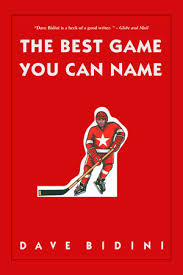
[READ: November 7, 2015] The Best Game You Can Name.
This book is about hockey. Specifically it is about Bidini’s rec team the Morningstars and their quest for another championship (and how after winning two years in a row, they were the main target for all the other teams). Much like how his book On a Cold Road included quotes and stories from musicians, this book includes quotes and stories from former NHL players (I didn’t really recognize any of their names, but then I wasn’t a hockey fan in the 70s and 80s).
So each chapter talks a bit about his team and then has several stories about a specific topic from the hockey guys.
He begins by talking about his athletic renaissance in his 40s (after having given up on professional hockey). I enjoyed the stories from the hockey players who loved playing so much as kids that they would spend hours and hours and hours on the ice. I also liked them saying that you could still become a pro if you only started playing at 15 unlike today when kids are starting at age 5. Continue Reading »
SOUNDTRACK: DAVE BIDINI-The Upstairs, Sydney, Nova Scotia (July 26, 2007).
After the Rheostatics broke up, Dave Bidini did a solo tour and then wrote a book about it. This is that book. And this show is from the mini-tour he did as promotion for the book. I don’t know too many details about this tour.
I wrote notes about these shows before I read the book (which I recently found and tread). But I’m going to leave in some of the notes I took about the audio portion for posterity.
I gather he was in town to promote his book and was invited to do a few shows as well. So these three shows from the Rheostaticslive site include a short reading from the book and then many songs. This show has two readings and 8 songs (and runs over an hour).
He opens with a description of the book and the tour of china with a band they called the Rheos Not Rheos. They were asked over and over to play The Beatles. They played at the Sculpting in Time café. Dave hung out with the Chinese singers Dirt Star and Airbag (who were also in a cover band that played Radiohead).
For the music, it is just Dave an his acoustic guitar (and a tuner). He plays three Rheos songs “My First Rock Show,” “Me and Stupid” and “Horses” (to much applause).
He plays four new, solo songs “Song Ain’t Good,” “The List” “The Land is Wild” and “The Ballad of Zeke Roberts.” All of these would appear on the debut Bidiniband album which would come out in 2009.
“The List” is a diatribe against Canada: Tim Horton’s, Stephen Harper, Zack Werner, and Chad Kroeger. He says that it was inspired by taking a close look Tim Horton’s bacon and wondering just what it was. And the mention of Chad Krueger gets a big reaction from the crowd. The Zeke Roberts song is about a Liberian singer who was killed. “The Land is Wild” is about Bryan Fogarty, a hockey played who died (it’s not the most upbeat concert I’ve heard).
There’s an extra song “Moncton Hellraisers” (you can watch a video of this one).
He ends the show with second reading and there’s a drunk guy who keeps shouting and interrupting. I feel bad for Dave, but he handles it well—different than a rock show obviously. This section involves meeting a TV show producer (of a show called Super Girls) and the Chinese version of the Spice Girls (who sing for them). He also mentions going to an all night record shop and finding a copy of the Toronto band The Diodes. He plays their song “Tired of Waking up Tired” for the employees.
If nothing else, this book will introduce you to a lot of little-known bands.
It’s interesting to hear him in such a casual setting. He sounds good and the audience is really responsive.
[READ: November 5, 2015] Around the World in 57 1/2 Gigs
This book chronicles Dave Bidini’s solo tour after the Rheostatics broke up. He explains that it was Tim Vesely who wanted to break up the band (no doubt inspired somewhat by Dave and Martin’s harsh critiquing of the songs Tim wanted to submit to their final album 2067). Nevertheless, Dave was devastated and angry and unsure what to do, especially since they were planning to gig China for the first time. So he decided to do it himself. A world tour unlike any other.
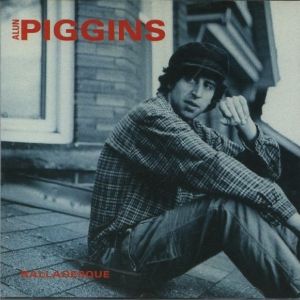
He scheduled a few gigs in Finland. And he decided to invite his friend Alun Piggins along. Piggins has been in a number of bands and has released several solo albums. He seems notable for being a little crazy (with wild hair). And I automatically respect him for making this album cover. When Dave asked Alun what to do about being a solo artist (Dave hadn’t really played solo before). Alun gave him some comforting advice and then said that with his band The Quitters, they would play “our loudest song then tell the crowd, “‘Thank you and fuck off.'”
The two would play separate shows on a double bill and occasionally duet on Rheos songs. They decided to tour Finland. They flew into London and were only staying for 24 hours. He wanted to try to get a gig before they left for Finland. They scored one at the last minute in the Maple Leaf Tavern (which had never staged a live show before) and was themed in Canadian kitsch. He talks about one man bands like Bob Log III “probably the superstar of all one man bands” (his song “Boob Scotch” is surprisingly straightforward). He says he spent most of his 35 minute set worrying an doesn’t recall too much about it.
Then they set out for Finland. First stop Hämeenlinna ( enjoyed typing out all these Finnish towns). Continue Reading »
SOUNDTRACK: LOS LOBOS-Tiny Desk Concert #90 (November 10, 2010).
I don’t really know all that much about Los Lobos. I frankly got sick of them because of “La Bamba” (which came out 20 years ago!) and I don’t think I’d ever heard much else by them. So I wound up enjoying this Tiny Desk much more than I anticipated.
The one big problem with this tiny desk is that the drummer is playing one of those plastic mail bins and it sounds awful. Especially on the first song. I think anything would have had a better drum sound than that.
I really enjoyed the first song “Burn It Down.” It has a propulsive minor key structure and an excellent bass line. I would never have guessed it was Los Lobos, but that may be because it’s not the singer I most associate with them (he sings on the next two songs).
“Yo Canto” is a cumbia, sung by a different guy (in Spanish) who also plays lead guitar. The mail bin sounds better on this song because of the placement (and use of) a cowbell. The singer sounds amazing. I rather like the riff that underlines the song.
Those two songs are from their then latest album. And the band sounds really good all these years on.
The final song is “Don’t Worry Baby.” It has the same singer as the middle song (this time in English) although it is a pretty standard blues song that I found just okay. It also features a bunch of saxophone. I didn’t realize that it was from their major label debut in 1984! and is something of a classic.
So three songs, all of them enjoyable, from a band I didn’t really think I’d enjoy. The funniest part is just before the show stops and someone asks, “Okay, where’s the beer?”
[READ: October 1, 2015] How to Skin a Lion
This book sounded awesome–I love outdated things that we can laugh about now (because I’m a superior git, of course).
But this book proved to be not all that funny. The outmoded advice wasn’t treated comically exactly (well, some was), rather it was looked at rather seriously–some as good advice that still stands, some as crazy advice that is way outmoded and a few things that are, yes, just comical.
Cock-Starkey (insert joke here) says that this is a collection of materials from the vast archives of the British Library. It culls from medieval manuscripts, Victorian manuals and self-help guides from the early 20th century. She explains that the book aims to reveal the secrets of lost arts, remind us of how modern conveniences have changed our lives, recall the complexities of etiquette, highlight changing attitudes and beliefs and furnish us with still useful tips and guidance.
Although she also points out that readers should be advised that some pieces of advice contained herein have stood the test of time better than others. Continue Reading »
SOUNDTRACK: BLACK DUB-Tiny Desk Concert #89 (November 8, 2010).
Black Dub is the collaboration between Daniel Lanois and Trixie Whitley (daughter of Chris Whitley).
I think I might have been more excited about this if I hadn’t seen Daniel Lanois’ other performance on Tiny Desk, where he came across as kinda jerky. I also had not heard of Whitley (who was 23 at the time).
Whitley has a huge voice (especially given how tiny she is). It’s big and brash and bluesy in a Janis Joplin sorta way. And she’s really passionate about what she’s singing–look at her face, for crying out loud). But it’s actually too bluesy for my liking. And it almost seems over the top given Lanois’ simple acoustic guitar strumming.
They play four songs, “Surely” which pushes five minutes; “Silverado” which has a nice duet between Whitley and Lanois to start (and then I feel like she adds too much during her section); “I Believe in You.” For the final song, Whitley straps on an electric guitar and plays a rocking riff (I enjoyed the accidental feedback that Lanois created). Her voice works a little better with the extra volume of the guitar. Although the song builds and buildups and never really goes anywhere.
I just never got into this Concert.
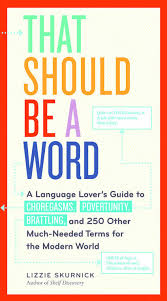
[READ: July 1, 2015] That Should Be a Word
I heard a big hyped review of this book, so I was really excited when Sarah brought it home. But I wound up being a little disappointed by it.
I imagine that since these items come from her newspaper column, it might be more fun to read a few at a time rather than all at once. Because while I enjoyed the premise, I got tired of the punny schtick after a few sections. And that’s a shame.
The one major gripe I have is that nowhere in the book does it ever acknowledge the pioneering work of Rich Hall and Sniglets, the guy who really spawned the idea of creating words for every day things. Skurnick does things differently of course, but I feel like at least a nod to the man would have been nice (especially since she is–admirably–so into the whole retro thing).
The premise behind this book (and the column is that Skurnick (and readers, I gather) create words for things that don’t exist. But the real premise is that the newly created words are sort of punny based on two other words (which Sniglets didn’t do). Continue Reading »
 SOUNDTRACK: マキシマム ザ ホルモン–“え・い・り・あ・ん” (2013) [MAXIMUM THE HORMONE-“A.L.I.E.N” (2013).
 This Japanese band has gained some ground in the United States (having two of their songs used in the anime Death Note). They are a heavy, heavy metal band which explores many different genres.
 But the real surprise comes at 3 minutes when the whole song slows to a sweet section with whispered vocals by the (female) drummer? And then the entire song switches to a sweet song–delicate guitar and super sweet vocals with the new lyrics “Stop Stop Winny Upload.” The boys come back in, but now they are playing along to this poppy (but guitar heavy) “Stop Stop Winny” section.
 This is to say nothing of the video, which opens with the band playing in a live setting. The guitarist has long hair and a beard and sings the first verses. The short-haired singer sings the really fast growly stuff and the bassist has a nifty side shave.
















 I Just Read About That...