Feeds:
Posts
Comments

serafinaSOUNDTRACK: JACKIE EVANCHO-Tiny Desk Concert #130 (May 23, 2011).

jackieI’d never heard of Jackie Evancho, even though she apparently was viral for a while.  Jackie was (at the time of this taping) 11 years old.  And she has an amazing operatic voice.  Not like, oooh, the 11 year old can sing, but like holy cow, that voice comes out of an 11 year old?

Her voice is beautiful in the audio format, but you really have to watch that voice come out of this adorable little girl (while she sings Handel’s “Ombra Mai Fu”) for it to really blow your mind.  Especially when she giggles at the end.

For what I am sure are licensing reasons, there is only one video available, but there are three songs available to download.  “Lovers” comes from The House of Flying Daggers (one of her favorite movies).  If you have watched her sing, it is staggering to imagine her singing this song (which is intensely grown up).

The third song is Sarah McLachlan’s “Angel” and she sounds so much more “mature” than McLachlan’s more passionate version.  It is uncanny to watch this girl sing.

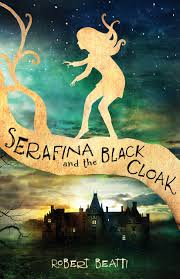
[READ: December 6, 2015] Serafina and the Black Cloak

I saw this book reviewed and it was talked about as being the next big franchise for Disney.  Since our library had it in I thought I’d read it before it took off.

To my knowledge it hasn’t taken off yet, but I’m glad I’m ahead of the curve.

This book has many dark elements including a very violent, scary opening that I feel makes this an unlikely children’s book series.  Maybe tweens, but certainly not for young readers.

I brought the book for Sarah because it is set in Biltmore Estate (Sarah’s mom had just visited there and Sarah would like to go).  I think she was intrigued until I read the next paragraph which talked about a lot of supernatural elements (she was intrigued for different reasons then).

So Serafina is the daughter of the man who works on the “Edison machine” in the basement of Biltmore.  He doesn’t want the Vabnderbilts’ to know he lives there and doesn’t want them to know about Serafina at all.  All Serafina knows is that her mother is dead and her pa is all she has left.  So he hides her and tells her she is the CRC, the house’s chief rat catcher.  Despite her living conditions, she doesn’t feel any ill will towards the Vanderbilts.  She has never really interacted with them so she has no opinion of them.  She just thinks they are fascinating.

Serafina has very keen senses, especially in the dark–she can catch mice an rats like no ones business and she thinks that everyone else is loud and clumsy.  She also has amber eyes and only four toes and she is able to move her body into uncannily small spaces.

Her father, protective of her and of his livelihood, tells her to never go out except at night.  And she must also never go into the forest which is magical and dangerous. But Serafina is constantly drawn to the forest,

Then one night she hears someone walking around and a little girl scream.  The man is in a black cloak and she watches as he grabs the girl, says she won’t be hurt and then proceeds try to…do something to her.  Serafina tries to help, but she is thwarted and soon the little girl  screams and is gone.

She tries to tell her pa but he doesn’t believe her–he doesn’t want to hear anything about supernatural nonsense.  He even gets mad that she was out and about.  Finally when word gets out that the girl is missing, the house organizes a search party and Serafina runs into a boy, Braeden (a terribly unlikely name for the time, I must say).  Braeden is the nephew of the Vanderbilts.  Braden is an orphan , and his aunt and uncle have taken him in.  But he is a loner and spends more time with his horses and dog.  He is intrigued by Serafina because she is obviously a loner too.

They wind up going on a coach ride together only to get trapped in the woods.  That’s when Braeden believes what Serafina has seen (because he has seen it too).  And they know they have to capture this man in the black cloak.

But how can the two people who aren’t even supposed to talk to each other work together on such a thing.  And who can the evil person be?  An outsider or one of his uncle’s friends?

The mystery wasn’t set up as a mystery–we learn who we think is the bad guy about half way through the book.  But there’s still the matter of catching him.  And then learning the secret of the cloak.  And the secret of the forest.

I also enjoyed the part about the catamount.  I have a personal funny story about catamounts and have never seen them in a story before.  I’ve also never heard of them as having mystical powers (or that the name was derives from Cat-a-mountains) either.  Which was cool.

Although there were elements of this story that were kind of samey to other stories like this, there was much originality.  And by the end of the story I was totally hooked.

And best of all, the ending feels like an ending, not a set up for a part 2.  I can’t quite imagine how they will make a series out of it, but I’ll certainly read book two if it comes out.

pipbartrSOUNDTRACK: TURTLE ISLAND QUARTET-Tiny Desk Concert #111 (February 26, 2011).

turtleTurtle Island Quartet (there’s no explanation for their name) are a quartet who play an interesting hybrid/jazz crossover. This is most evident in cellist Mark Summer’s playing.  Half the time he bows the strings but the other half he plays like an upright bass (including a percussive elements when he slaps the strings).

“Model Trane,” the opening tune is a John Coltrane-inspired piece, propelled by Summer’s running bass lines Despite the more classical set up (and three violins) it feels very jazzy.  It runs about 4 and a half minutes.

The band leader is David Balakrishnan who has written most of the songs.  He describes the second song, “Monkey Business,” as “loosely based on a sardonic view of Darwin’s theory of evolution.”  I don’t quite know what that means (it’s an instrumental after all), but it’s neat the way the music is all over the place stylistically.  The most notable moment comes when they quote (and fugue) “Strangers in the Night.”  Although other parts of the song remind me of the music in Bugs Bunny cartoons.

The final song has the funny title “Groove in the Louvre.” He says it was inspired by Django Reinhardt.  I don’t know enough Django to know if that is evident here, but there is plenty of soloing going on.  There’s jazzy fiddles (Balakrishnan plays a baritone violin on this song).  There is very jazzy bass (and even a bass solo on the cello) as well as classical elements.  The song is 8 minutes long.

They are definitely an unexpected quartet.

[READ: June 1, 2015] Pip Bartlett’s Guide to Magical Creatures

Pip Bartlett is a young girl (yes I was surprised that Pip was a girl, especially since it didn’t say so until nearly the end of the Prologue).  She can speak to magical creatures–unicorns, silky griffins, fuzzles–but no one believes her (because no one else can).  This is a drag because she loves magical creatures and her Aunt Emma is a veterinarian of magical creatures (people know magical creatures exits, they just don’t think people can talk to them).

The Prologue sets up that Pip loves unicorns but she never really encounters them.  Pip is an authority on magical creatures because she has read (and carries with her) Jeffrey Higgleston’s Guide to Magical Creatures.  She has actually been annotating it as she learns more stuff than is in the guide.  (The guide is good it’s just incomplete).  Then on field day, a classmate brings in four of her show unicorns.  Pip talks to them and discovers that they are incredibly vain and show-offy.  One of them demands that she ride her so that she can show off as much as the other unicorns.  So Pip does (against her better judgment) and all chaos reigns.  Pip is then sent to live with her Aunt for the summer.

As mentioned, Aunt Emma is a vet for magical creatures, and Pip is pretty excited to see them all.  Emma’s daughter Callie is less than thrilled.  She works in the vet’s office for long thankless hours.  And she is crabby when Pip sees her.  Within a few minutes, a couple of exciting things happy, though. Continue Reading »

gryphosnSOUNDTRACK: FLACO JIMENEZ-Tiny Desk Concert #250 (November 12, 2012).

flacoFlaco Jimenez has been playing button accordion for almost six decades.  He’s played with The Rolling Stones, Bob Dylan, Dr. John, Los Lobos, Willie Nelson and Ry Cooder.  His grandfather started playing an accordion in cantinas and family parties along the Texas/Mexican border around the late 1800s. Then Flaco’s dad, Santiago Jimenez Sr., carried on the family tradition when he released his first record in 1936.

The accordion that Flaco uses is so tiny and yet he is all over the place with it–fingers flying everywhere.  The NPR site describes his longevity as lying in the short bursts of improvisation in between verses.  He will actually not playing anything for a measure and then fly when it’s his turn.   He is accompanied by bajo sexto player Max Baca, who keeps a great rhythm and accompaniment.

They play three songs.

  • “Margarita”  was written by Flaco’s dad in “nineteen hundred and throw it away.”
  • “La Paloma”  is a fun instrumental.
  • “Cada Vez Que Cae La Tarde”  sounds German (many of these original melodies were but they had changed the lyrics to Spanish).

Before this final song he asks if they want a honky tonk (he plays a little riff), but he changes his mind and says lets polka.

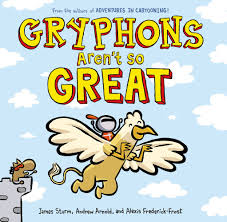
[READ: December 9, 2015] Gryphons Aren’t So Great

I hadn’t kept up on my plan to read all of the First Second books, so as the year draws to an end, I decided to grab a few of the kids books, which I figured would be quick and would allow me to check off a few on the list (since they keep publishing more, I have to keep up).

I found two books by the creators of Adventures in Cartooning, a series of book which I haven’t read but which look like a lot of fun.

These two books are tiny graphic stories for very little kids–the art and story are very simple.  And they are both really fun.

Gryphons Aren’t So Great continues the story of the knight (actually the two stories are completely separate and can be read in either order).  As this story opens, the knight is riding Edward super fast down a hill.  When they get to the end…they jump! Continue Reading »

knights SOUNDTRACK: RENAUD GARCIA-FONS-Tiny Desk Concert #238 (August 27, 2012).

renaudRenaud Garcia-Fons plays the double bass.  He was born in France to a family with roots in the Catalonia region of Spain, and he’s fluent in French, Spanish and English.  He easily switches between classical, jazz and flamenco.  And he plays the double bass in a way that I’ve never seen before.  As “Aqua Jan” opens he is tapping the strings with his bow, creating a very cool hammering effect and what sounds like very fast picking (but with a bow).  Then the song switches to a more traditional bowing style and Renaud’s fingering is amazing to watch.  He returns briefly back to the bouncing bow at the end.

The second song is “Hacia Compostela.”  Compostela is a holy place in the north of Spain.  It is a song about going to holy city.  He opens the song with some harmonics (which he loops).  It never occurred to me you could do harmonics on a double bass.  And then he’s on to some lovely fretless bass playing.  Then it’s on to some more bowing–very high-pitched and almost electronic sounding–it’s very cool.   Back to some incredibly fast bowing and amazing finger work.  The loops (I’m not sure when he was recording them, but they kept changing), add some great bass notes and some sort of percussive elements too).

The final song, “Rock Wandering” he introduces as saying that since most of you are standing, I w ill play something that is dancing.

It opens with more of that tapping style (and feels like rock chords the way he plays it).  He makes them looping backing chords as he just goes to town with the virtuoso playing on the strings.  He gives any guitarist a run for his money on the solos.  It’s astonish to watch.

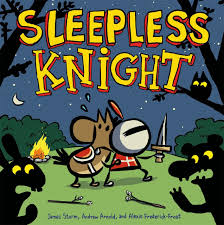
[READ: December 9, 2015] Sleepless Knight

I hadn’t kept up on my plan to read all of the First Second books, so as the year draws to an end, I decided to grab a few of the kids books, which I figured would be quick and would allow me to check off a few on the list (since they keep publishing more, I have to keep up).

I found two books by the creators of Adventures in Cartooning, a series of book which I haven’t read but which look like a lot of fun.

These two books are tiny graphic stories for very little kids–the art and story are very simple.  And they are both really fun.

Sleepless Knight is the story of the knight (who is a little stick figure kinda guy with a knight’s helmet on) and his horse Edward.  As the story opens they are planning for the best camping trip ever!

Poor Edward is laden down with so much stuff (including a cactus and a scooter).  And while the knights considers that maybe he over packed, it doesn’t stop him from filing up a huge sack full of stuff.

After a brief hike, they stop to camp (the visual joke is very funny). Continue Reading »

1965 SOUNDTRACK: TIME FOR THREE-Tiny Desk Concert #291 (July 27, 2013).

time for 3Time for Three are a string trio who play many types of music.  There are two violinists Zachary De Pue and Nick Kendall with a double bassist Ranaan Meyerand.  And over the course of their three songs (all original) they play classical, jazz, bluegrass and just about everything in between.

“Banjo Love,” features two contrary violin solos which get support from Meyer’s expressively propulsive bass.  It opens with the two guys strumming the violins before breaking into some lovely bowed playing.  Both violinists switch off solos (the blond player is a bit faster and more “showoffy” (but great)).  There’s even a bit of a bass solo after which the three guys all make a big grunt before continuing to the end of the song.

They say they are honored to be on the Tiny Desk series and compliment them on their new offices.

“Sundays” is a slow piece that features lots interesting bass parts behind the slow violin melodies.

They have funny stories about the origins of their songs.  “Don Don” is so named because the baseline goes don… don.  This has more of a bluegrass fiddle feel than a classical feel.  It’s super fast and fun with perfect slides and solos to really keep the song moving.

The notes say that they wished the guys played more, and I do too.  Interestingly I see that they have covered Daft Punk and Kanye West, so I guess they’re up for just about anything.

[READ: December 8, 2015] The Complete Peanuts 1965-1966

A whole bunch of ideas that I think of as BIG PEANUTS ideas come along in this book.  May of 1965 introduced the Daisy Hill Puppy Farm and Snoopy’s desire to meet his siblings.   In July of 1965 we get the first instance of snoopy at the typewriter writing “it was a dark and stormy night.”  We see Charlie Brown refer to the tree as a “kite eating tree” for the first time.  In July 1965 it’s the first time I can recall seeing the phrase “jelly bread.”  It’s the first appearance of Snoopy as Beau, the World War 1 flying ace (Oct 1965).  And in September 1966 we get the first appearance of Peppermint Patty!

The pop culture references seem to have dimmed somewhat too, although in January 1965, Linus cries “Annette Funicello has grown up!”

The “Happiness is” quotes are fewer, although Lucy squeezes Snoopy and says “Felicitas est parvus canis calidus,” which is Latin for “Happiness is a Warm Puppy.”   Of course later when he kisses her she freaks out “get some disinfectant, get some iodine” and he says “next time I’ll bite her on the leg.”

Linus’ blanket also takes on a mind of its own in March 1965 actually hissing at and attacking Lucy. Continue Reading »

[ATTENDED: December 10, 2015] A Christmas Carol

xmasLast night we attended McCarter’s production of A Christmas Carol for the second time (first time was two years ago).  We went specifically because it is the last time that they are doing this particular performance of the show (it has been the same for 16 years).  Next year they will be doing something entirely new.

We were pretty staggered by the pricing (last time we got super cheap seats but they were pretty far into the corner which ruined some of the magic).  But there was a Black Friday special and we had awesome seats (the woman next to me was mad that we paid literally half her price, muhahaha, Scrooge alert!).  But wow, what seats!

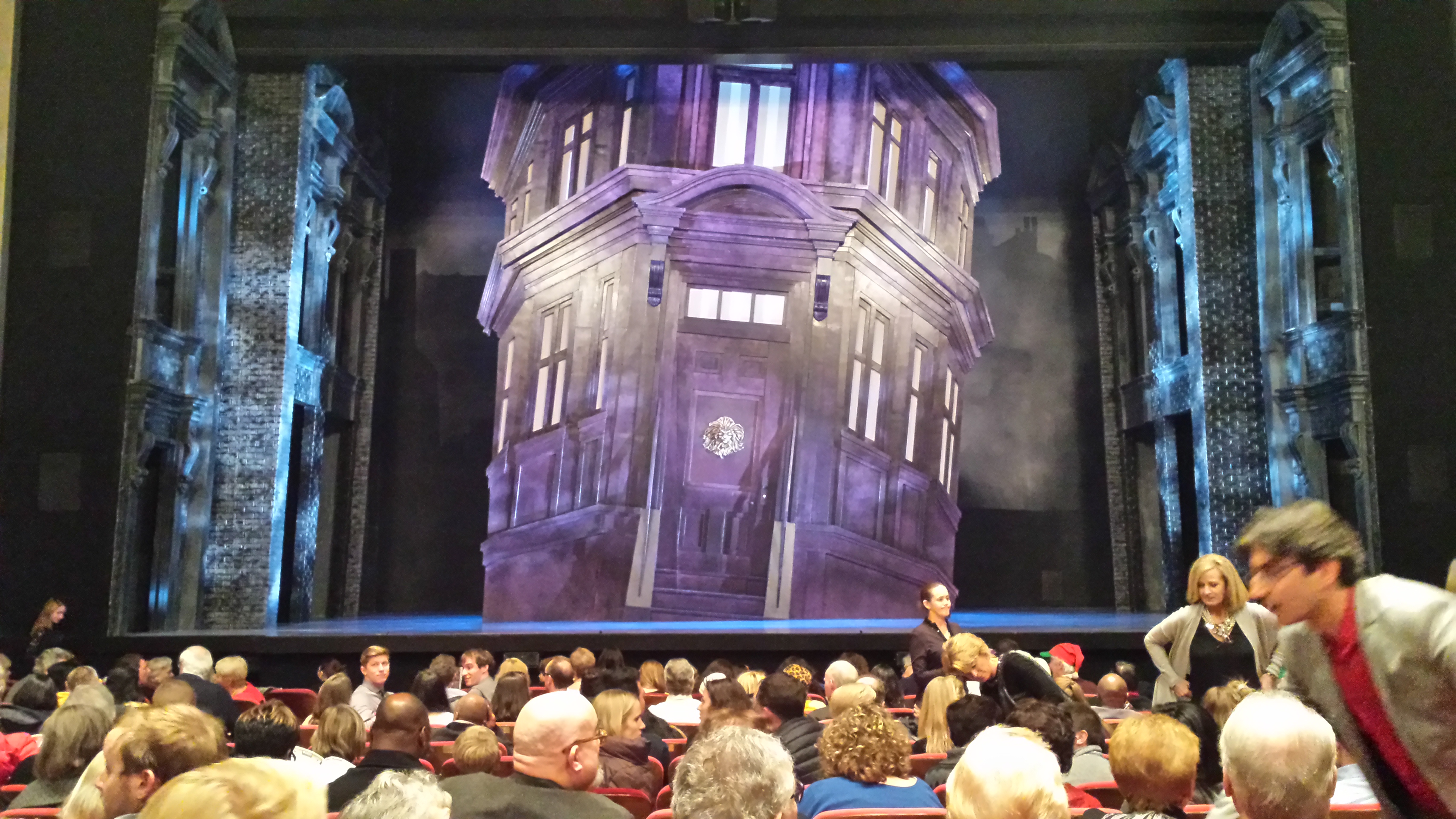
The show felt more magical and more moving than last time (I was a blubbery mess by the end).  It was awesome to see that the entire set was crooked (a great, disconcerting effect).  And to really see the sets come forward and the spirit of Christmas future as soon as he came out, those were very cool moments.  T. asked if we can sit in the front row next year.

2015-12-10 20.47.46It was also interesting to see who was different in the cast this year.  I recognized a few returning members–James Ludwig is awesome as Fred, Scrooge (Graeme Malcolm) was the same (and was awesome–I loved the way he did little things, like kick a rug into place, which were “accidents” but were totally in character).  And there were clearly some new faces and new actors.   You can see the whole cast at the McCarter site.

And I just read (in New Jersey Stage) that apparently many in the cast are quite well known:

Boasting a gigantic list of Broadway, regional and international credits, the cast of A Christmas Carol includes Leah Anderson, Allison Buck, Billy Finn, Kathy Fitzgerald, Nike Kadri, David Kenner, January LaVoy, James Ludwig, Bradley Mott, Anne O’Sullivan, Sari Alexander, Gabriel Bernal, Andrew Clark, Jean G. Floradin, Heather Gault, Michael John Hughes, Sophie Lee Morris, Gregory Omar Osborne, Patrick Roberts, Daniella Tamasi, and Arielle Taylor.

I just re-read what I had written two years ago and found that I felt exactly the same.  So for the rest of the post I am going to keep everything the same (with a few updates).

It’s like a Christmas tradition. Continue Reading »

juiaSOUNDTRACK: AVI AVITAL-Tiny Desk Concert #239 (September 12, 2012).

aviAvi Avital plays a mandolin. But he doesn’t ply bluegrass. Indeed, much like the Punch Brothers covering Debussy, Avital uses the mandolin to play more classical type of music.  He is the first mandolinist to be nominated for a Grammy in the Best Instrumental Soloist category.

He has had this mandolin for about thirteen years and he loves it.  He has been using the same Israel lutier since he was 17, exchanging them until he found this one.  And he can really play the heck out of it.

He plays only two songs in the ten minute concert, but they really showcase his skills.

“Nigun” was written by Ernest Bloch in 1923 for violin and piano.  NPR says Avital’s arrangement, like the original, pivots between the ecstatic and the introspective, rising in intensity (and pitch) until finally disappearing in a mist of quietly plucked notes.  If you think of the mandolin as just strumming along to pop songs, you’ll be blown away by this.  He plays notes that I suspect were never meant to be played…sliding all the way down to the highest high notes on the highest strings.  I don’t know that it sounds better than a violin, but it is pretty neat.

“Bucimis” is a raucous Bulgarian folk tune in the odd meter of 15/16. “It’s almost 4/4, but not quite,” he says. “I can play it, but I can’t dance it.”  This song is absolutely wild, especially at the end.  While the first song was pretty, this song showcases just what you can do with a mandolin.  It’s intense.

[READ: June 19, 2013] Julia’s House for Lost Creatures

I don’t normally write about kids picture books (if I did my whole blog would be about them as we read so many).  But this one gets a special mention because a) it was published by First Second and b) I love Ben Hatke’s drawing style so much.

This is a delightful story which you have to start on the title page.  It shows a giant turtle with a huge house on its back.  And on the next page the text says “Julia’s house came to town.”

Julia puts in a mailbox and settles in by the sea. Continue Reading »

[ATTENDED: December 7, 2015] Punch Brothers

punchChris Thile is a member of Nickel Creek whose last album I loved.  He’s also appeared multiple times on Tiny Desk Concerts (with several different bands).  And that’s where I saw Punch Brothers for the first time.

Punch Brothers are five guys–Chris Thile (mandolin), Gabe Witcher (fiddle/violin), Noam Pikelny (banjo), Chris Eldridge (guitar), and Paul Kowert (bass).  They play a sort of bluegrass, but with a lot of elements of classical music (their debut has a classical suite on it and now they cover Debussey live).  Other labels given to the band include “bluegrass instrumentation and spontaneity in the strictures of modern classical” as well as “American country-classical chamber music.”

That all goes a long way to not really describing what the band sounds like.

The five guys stood around one old timey microphone (like in the poster).  ANd they blew us all away. Continue Reading »

[ATTENDED: December 7, 2015] Gabriel Kahane

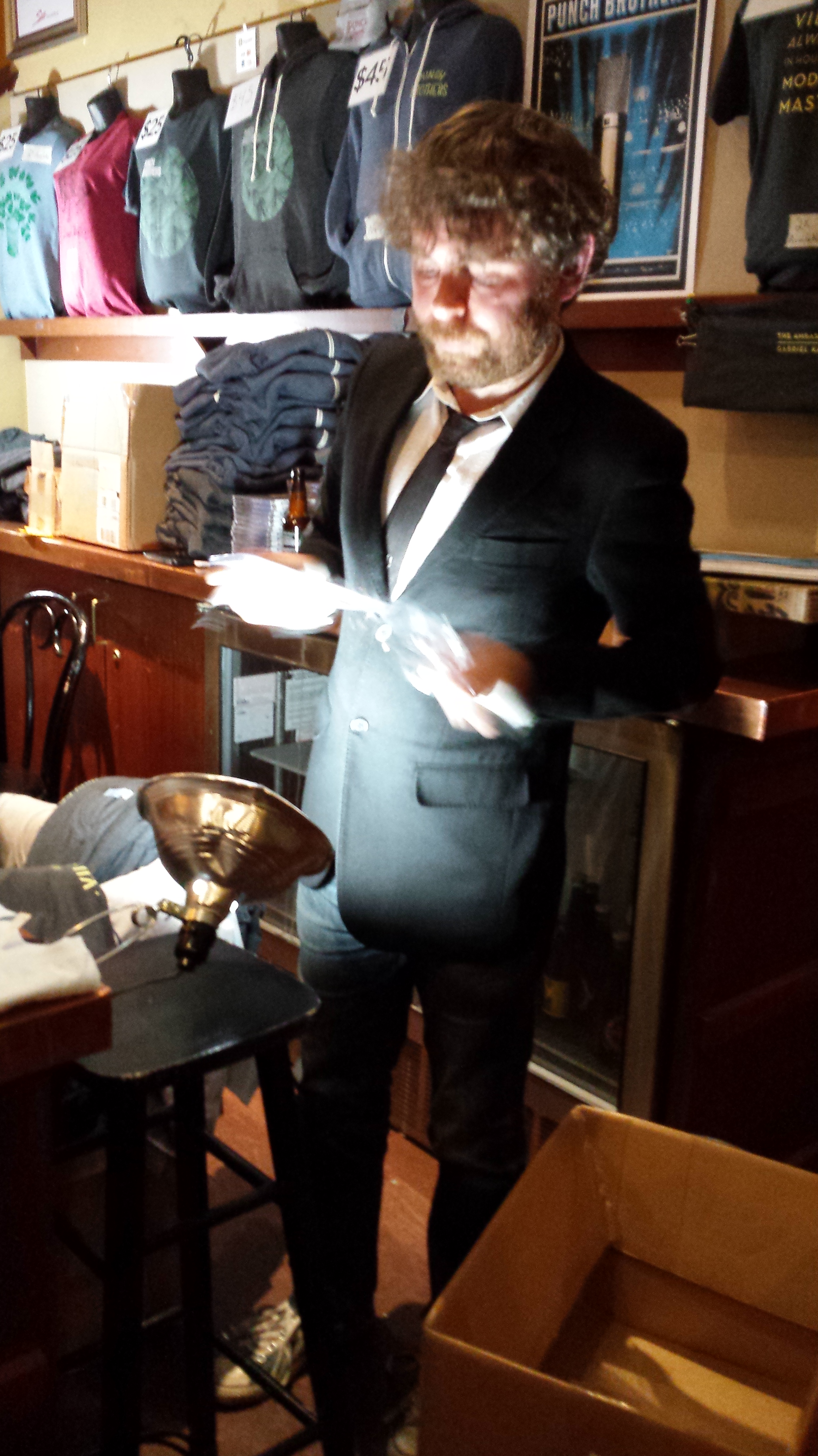
2015-12-07 20.42.05After seeing Punch Brothers on NPR’s Tiny Desk Concert, I found out that they were playing at State Theatre in New Brunswick (a great venue that often has amazing bands, but also has seats so its, you know, dignified).

I found out the day before the show that the opening act was Gabriel Kahane.  I was under the impression that I had never heard of him.  Well, technically I had never heard of him, but I had heard him as he has done arrangements for Loudon Wainwright III and Sufjan Stevens.  And, it turns out he wrote a song that Punch Brothers sing on their new EP.

Anyhow, I got to the stage about one minute late, so I missed the proper introduction.  I walked in as Kahane was standing on stage with his guitar.  And what he played sounded…nice.  He has a pleasant voice and was playing interesting chords.

I anticipated 40 minutes of pleasant, if unremarkable, solo songwriting stuff.  Then he sat at the piano. Continue Reading »

smmaSOUNDTRACK: PROTOMARTYR-Tiny Desk Concert #492 (December 4, 2015).

protoPromtomartyr’s Under Color of Official Right has been one of my favorite albums of the last few years.  Joe Casey’s vocals are more or less spoken (and angry) while the music is propulsive and rocking.  Sometimes punk, sometimes something else entirely.  It’s a weird pairing but it worked wonderfully.

I hadn’t heard their new album yet–I am a little afraid that they’re going to mess with the perfection of their second album–but as soon as I saw they did a Tiny Desk Concert I had to check it out.

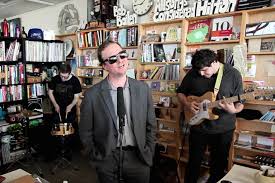
“Singer” Joe Casey stands at the front.  He wears a suit and sunglasses (evidently he has some stage fright issues) and he barely moves.  And then there’s the rest of the guys–each wearing all black, looking like the backing band for someone else entirely (the bassist has super long blond hair).  And yet, man, do they play great together.

The band plays three songs.  The first two are from their new album.  “Why Does It Shake?” has a cool interesting bass line and sharp, occasional guitar chords along with drums that are mostly played along the rim.  The song unexpectedly slows down for a middle section.  And all along, Casey asks his tough, threatening lyrics.  The song is over 4 and a half minutes, perhaps one of their longest tracks.

The second song, “”Devil In His Youth” is a fast propulsive song with a great catchy riff that leads to the simple spoken chorus of “the devil in his youth.”  This song is much more familiar in terms of Protomartyr songs and is only two and a half minutes long.

The final song comes from their debut album, No Passion All Technique (which is hard to get and which I’ve never heard). The song doesn’t sound drastically different from the others, but you can hear a different tone, perhaps a little less abrasive?

Naturally for a curmudgeonly band, they don’t play anything from the album I love, but this set is really good nonetheless.  And yes, it may be time to investigate the new album.

[READ: October 28, 2015] Super Mutant Magic Academy

I saw this book when we were visiting Toronto and I wrote down the title to check it out.  I didn’t know anything about it, and didn’t realize that I knew the work of Jillian Tamaki from several great graphic novels

I also had no idea that this was actually a long in progress webcomic that Tamaki has put into book form.

And finally, I didn’t expect it to be a series of one page funny strips that tell an overarching story. Continue Reading »