Feeds:
Posts
Comments

SOUNDTRACK: ALISA WEILERSTEIN-“Prelude from Bach’s Suite No. 5” (Field Recordings, February 16, 2012).

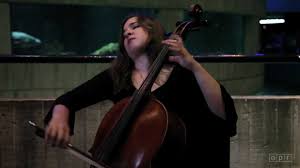
One thing I love about the Field Recordings series is the wonderfully unexpected places they have the performers play.  Like this Field Recording [Alisa Weilerstein: Playing Bach With The Fishes] which is set at the National Aquarium in Baltimore.

Strategically positioned above a tank full of stingrays, Weilerstein unpacked her cello to serenade the sea creatures — and dozens of pleasantly surprised aquarium visitors — with music by Johann Sebastian Bach. She chose the Prelude from Bach’s Suite No. 5 for unaccompanied cello. The music’s tranquil power and meandering melodies became an extraordinary soundtrack to the majestic rays as they roamed through the water, rising occasionally to catch a note or two.

The music is sublime–sad and powerful but ever so fluid.  And the setting is just perfect–you can almost see the fish appreciate it.

[READ: February 2, 2018] “Four Fictions”

Breytenbach confounds me with his stories.  This is a collection of four really short pieces and while I enjoyed parts of some of them, overall they were a big huh?

Race
This appears to be a race through the sea?  On foot?  A tractor charges into the waves and a Jeep follows. The route will take them through the sea to Germany and back to Stockholm.  Their friend Sven is running in the race (he’s from Lapland).  When the race is over he still has to run through the house to the balcony.  When they gather for the results , how many drowned, etc, the story ends with another man removing his top hat and his hair looking sunken and dry.

What? Continue Reading »

SOUNDTRACK: MOUNTAIN MAN-“Sewee Sewee” (Field Recordings, February 2, 2012).

Until recently, had I posted this I would have said that Mountain Man features Amelia Meath from Sylvan Esso.  Now I can say that and I can say that Mountain Man, of whom Id never heard, has a new album out.  How about that.

I don’t know much about Mountain Man, but this song is quite pretty.  It opens with someone snarkily commenting “Mountain Man live from the dungeon, take one.”

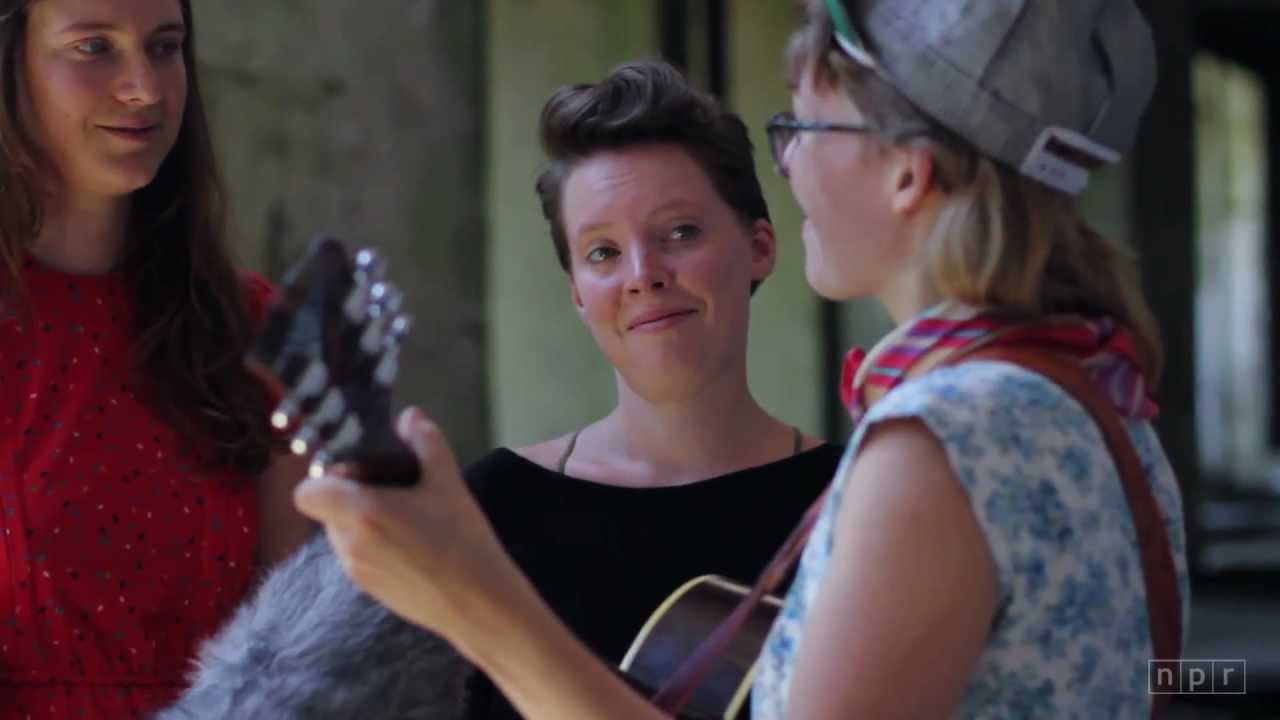
The song is a beautiful two-minute ballad with wonderful harmonies sand quiet acoustic guitar.  But all focus is on their voices as they intertwine beautifully.

Amelia Meath is the only person I know from this band and I know of her as somewhat goofy, so it’s amazing to see her (looking so young) being very intense while she sings her parts.

The Vermont trio Mountain Man fit an awful lot of moony harmonies into this all-too-brief performance of “Sewee Sewee.” Mountain Man’s three members — Molly Erin Sarle, Alexandra Sauser-Monnig and Amelia Randall Meath — sang and stared sweetly into each other’s faces.

Then as soon as the song is over Amelia gets very silly again.  I assume it’s her who starts rapping Li’l Mama’s “My Lip Gloss” (“my lipgloss is popping, my lipgloss is cool”) as the camera goes dark.

This Field Recording [Mountain Man: A Choir of Angels] was the second one done at the Newport Folk Festival, and it’s clear they are having fun exploring the abandoned grounds.

As a gaggle of videographers, musicians, industry types and hangers-on stepped gingerly through tall brush to enter a dilapidated section of Fort Adams in Newport, R.I., you couldn’t blame us for feeling like unwitting participants in a horror movie. Standing amid hundred-year-old rubble as the 2011 Newport Folk Festival clattered merrily in the distance, we were either going to capture two breathtaking minutes of music or get eviscerated by maniacs as part of The Newport Witch Project. Thankfully, we made it out with the footage you see above.   If the scene above once seemed destined to devolve into a grisly horror movie, at least we had a choir of angels on hand to escort us into the afterlife.

I haven’t heard their new album but I wonder if their voices still sound amazing together after 8 years apart.

[READ: January 7, 2017] “Honey Bunny”

This is a story about a girl who has left (fled?) Colombia and is now doing and possibly selling cocaine in America.

She is apparently buying her supply from a guy named Paco.  Inexplicably, the coke is cut with all kinds of weird things–plant leaves, bug wings, rabbit fur?

All along she keeps eyeing an orange suitcase in her apartment. Continue Reading »

[ATTENDED: November 8, 2018] Tenacious D

I loved the first Tenacious D record and enjoyed the goofy film The Pick of Destiny.  It amuses me to no end that kid-favorite Jack Black is in one of the most vulgar comedy-metal bands ever.  I could barely find 30 seconds of curse-free material to show my kids.

I also didn’t realize that the band toured at all.  This is mostly just an oversight on my part, because it’s obvious that they do and have toured several times as a duo and a full band.

Well, S. and I were super excited to see them, even if I haven’t listened to their more recent stuff and she apparently only knew “Tribute.”  But hey it’s Jables and Rage Kage!

The crowd was very male (S. noted) and very tall.  We arrived later than we wanted to and were a little further back than was practical for people of our heights.  We probably should have moved to the side, especially when a group of really loud people moved in around us.  But we stuck it out and waited for the show to begin.

Opening act Wynchester told us we’ve never seen a show like this.  And they were right. Continue Reading »

[ATTENDED: November 8, 2018] Wynchester

Initially we thought that we might not be able to go to this show–S.’s schedule seemed like it would conflict most unjustly.  Then we thought that we might miss Wynchester but still manage to see Tenacious D.  But it all worked out and we got a decent location not too far from the very packed stage.

I had never heard of Wynchester, and I was surprised to see them described as a country band (very much unlike Tenacious D).  But it all made sense when I read that Wynchester was fronted by Kyle Gass Band vocalist Mike Bray and Tenacious D electric guitarist John Konesky.  Knowing that it was Konesky playing lead explains some of the really impressive soloing and riffage on these songs.

Wynchester came out and played some fun alt-country/country rock songs.  The songs were funny but not comedy songs.  “The Gospel of Good Times” was a good, fun opener about, well, spreading the gospel of good times. Continue Reading »

(Field Recordings, January 12, 2012). 

This is a lengthy Field Recording [Mantra: Post-Minimalist Percussion In Aisle 12].  It has some interruptions by one of the guys.  Then he talks about how they have set up the board–suspending it on pegs.

There’s something primeval about guys banging on wood. But the New York percussion group Mantra takes such primitive pounding to a surprisingly refined level. For composer Michael Gordon’s mesmerizing new work — Timber, written for six two-by-fours — Mantra set up a public performance of the piece in the lumber department of a big-box hardware store in Alexandria, Va. Who knew 60 inches of processed pine could sound so good?

It’s unclear how long the piece is since there are constant interruptions.   Although it does run for about 2 and a half minutes uninterrupted.

For the most part the six players play a constant rhythm that creates overtones and resonances.  It’s a little monotonous until one of the starts to play a slightly different rhythm.  And by the end, there’s a couple of different rhythms that make it sound even better.

It’s a neat piece and would be fun to walk unto a hardware store and see that.

[READ: January 22, 2018] “Elf-Cio”

This is from a children’s book called Elves for Dignity.  It was published by a worker’s cooperative in Buenos Aires–one of 170 worker-run businesses in Argentina. The piece was translated by Burke Butler.

Once upon a time there was a greedy and merciless King.  One morning he awoke with the idea of converting one of his palaces into a hotel.  He hired a legion of elves whom he considered selfless and docile. They all abandoned their markets and farms to serve the King.

They worked night and day to ensure the splendor of the hotel. Continue Reading »

SOUNDTRACK: GIL SHAHAM-“Partitat No. 2 “Gavotte en Rondeau” by J.S. Bach” (Field Recordings, January 12, 2012).

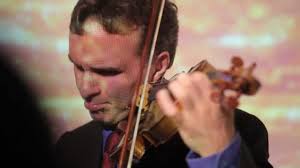
This was the very first Field Recording posted on the NPR site back in 2012 [Gil Shaham: A Violinist’s Day At The Museum].

Shaham plays Bach in the Hirshiorn Museum.

As Gil Shaham wandered through the back offices of the Hirshhorn Museum and Sculpture Garden in Washington, D.C., he said he felt “like Ben Stiller in Night at the Museum.” For this impromptu Bach mini-recital, the violin superstar momentarily became part of the art, bathed in the modish lighting and projections of a multimedia installation during the performance.

He is introduced with the rather amusing:  “A world famous, world renowned violinist who, by the way, starts every morning with a bowlful of Cap’n Crunch.  He told me that.”

I love that this first Field Recording was, like many of NPR’s best things, a spontaneous idea:

A crowd packed the exhibit room to watch as Shaham launched into Bach’s third partita. After the performance, the violinist greeted fans in the museum, many of whom were headed to his concert at the Kennedy Center that night. He seemed surprised and delighted that the guerrilla concert, announced only on local classical station WETA and Twitter that day, drew so many people willing to hear Bach in the afternoon.

[READ: January 22, 2017] “Are We Not Men”

Boyle’s stories aren’t usually as fanciful as this.  But I loved it just as much as many of his other more down to earth stories.  I particularly enjoyed that it was set in the future, although there was no real statement of that until late in the story.  There were hints, which seem obvious in retrospect, but which at first just seemed like hyperbolic or metaphorical.

Like “the dog was the color of a maraschino cherry” or that the lawn incorporated “a gene from a species of algae that allowed it to glow under the porch light at night.”

The story opens with the cherry-colored dog killing an animal in the narrator  Roy’s front yard (on that grass).  He wanted to chase the dog away because it might ruin his grass.  Then he noticed that what the dog had killed was his neighbor Alison’s pig.  She loved that pig and anthropomorphized it.  To try to salvage the pig, he ran up to the dog waving his arms.  It immediately latched onto his forearm instead.

As Roy fights with the dog, the dog’s owner, well, the daughter of the owner, came running across the street.  She looked like a teenager but was actually 11 or 12.  When the girl says, “You hit my dog,” he replies that she bit him.  The girl says Ruby would never do that–she’s just playing.

Amid this horrorshow of blood and violence and death, and a sprinkling of genetic splicing, Boyle throws in a very funny experiment gone wrong.  Crowparrots were a modified bird which blended crows with the invasive parrot population.  It believed that the experiment would turn the parrots into carrion eaters.  But instead it made their calls loud and more frequent.  And they mimicked, so they “were everywhere, cursing fluidly, (“Bad bird! Fuck, fuck, fuck!“).” Continue Reading »

SOUNDTRACK: DAVID WAX MUSEUM-“Born With a Broken Heart” (Field Recordings, January 12, 2012).

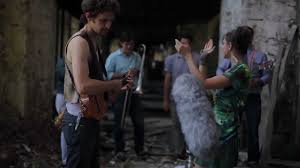
This was the third Field Recording in the series [David Wax Museum: Folk Among The Ruins] and it seems to have started a trend of recording musicians in the ruins at the Newport Folk Festival

The video opens with the band climbing through a broken down house.  Then the music starts with David playing the charango and Suz Slezak clapping.  It’s a catchy fun song with handclaps, wonderful vocal harmonies and oohs.

Two minutes into the song a tenor horn adds some depth and bass to the music, making it sound much bigger.  Around three minutes the whole horn section is playing along with a kind of mariachi feel..

At the end of the song you can hear cheering–presumably for the festival itself and not them, but it seems apt as well.

[READ: November 15, 2017] “The Hotel”

I feel like this is an excerpt.  If it’s not an excerpt than I don’t know what.

It’s basically about a woman who lands at an airport.  She is discombobulated from all of the flights and transfers (which seems unlikely but whatever).  The story starts with no explanation at all as to why the woman has flown from Dublin to New York to Milan.  She is now at a layover in Germany or Switzerland or Austria (the signs are all in German).

She can’t read the signs.  It’s very late. The airport seems to be closing down.  Her next flight is leaving in 5 hours.  She figures she will need to be back at the airport in four.  So instead of camping out at Gate 19, she decides to go to look for a hotel.  By the time she checked in , she would get max three hours sleep.  It’s just not worth it in my opinion, but whatever. Continue Reading »

SOUNDTRACK: NICHOLAS PHAN-3 by Britten (Field Recordings, November 20, 2013).

This was 2013’s last Field Recording [Britten Goes Back To Brooklyn With Nicholas Phan].

In addition to providing some powerful vocals and introducing many (including me) to Benjamin Britten’s more down to earth songs, this Field Recording also provides a lot of historical information.

Composer Benjamin Britten, whose 100th birth anniversary falls on Nov. 22nd [2013], is so deeply associated with his native England that he’s on a new 50-pence coin issued by the Royal Mint. This British cultural icon felt so strongly his music should be of a particular place that he set down roots in the seaside town of Aldeburgh, England and stayed there for nearly 30 years until his death in 1976. But he had a surprising two-year sojourn living far from home — in a boisterous, bohemian group house in Brooklyn.

Coaxed to the borough in 1939 by a friend, poet W.H. Auden, Britten and his longtime partner, tenor Peter Pears, moved into 7 Middaugh Street in Brooklyn Heights (an address long claimed by the Brooklyn-Queens Expressway). Their housing situation there could only fairly be described as bohemian. Along with Auden, the house’s revolving cast of residents included novelist Carson McCullers, composer and writer Paul Bowles, and burlesque dancer Gypsy Rose Lee.

So in hopes of evoking something of that 1930s Brooklyn boho vibe, we invited an extremely fine young American tenor Nicholas Phan (pronounced “paan”), who’s become a champion of Britten’s vocal music, to return to Brooklyn on Britten’s behalf, accompanied by harpist Sivan Magen. We shot this Field Recording at 70 Fox House, a communal house in the Fort Greene neighborhood not all that far from where Britten and Pears lived and made their own art.

Amazingly Britten was still writing in the 1970s, and he made arrangements for these in 1976.

Witty and surprising, these songs are full of odd — but beautifully moving — harmonies and textures. It’s a perfect match for Britten and Brooklyn.

The first, “Lord! I married me a wife” is as funny as the title suggests.  Phan sings with great passion and exasperation: “I married a wife, she made me work in the cod rain and snow.”

“She’s like the swallow” is a prettier song with lovely harp playing to accompany it

“Bird Scarer’s Song” is a very different piece, with fast plucked harp that sounds more like piano than a harp and Phan singing aggressively and, yes, frighteningly.  With a big “Ha!” at the end.

[READ: November 5, 2018] “Backpack”

I have enjoyed several of Tony Earley’s stories, but I see that he hasn’t had a piece published in the New Yorker in several years.

Well, this one was great.

It is set up with something specific in mind.  John goes to various stores, buys several slightly questionable items, pays cash, and then heads home.

John is a professor, happily married for decades with a daughter just out of college.  But it is clear he is up to something.

From the items you can kind of imagine what he has planned. It is clear he is going to do harm to someone–either himself or someone else.  And when his wife leaves for the day, John shaves his head and shaves his beard (except for a Fu Manchu mustache), puts on sunglasses and a pirate bandanna and assumes the identity of Jimmy Ray Gallup. Continue Reading »

SOUNDTRACK: ANNA VON HAUSSWOLFF-“Funeral for My Children” (Field Recordings, November 4, 2013).

I remember exploring this Field Recording back in 2013 when it came out.  There is something otherworldly and magical about the pipe organ, even if it is played in a rather fast and clearly secular way like in this song.

One of my [Bob Boilen’s] most surprising discoveries of 2013 is an artfully poppy pipe-organ record called Ceremony, by Swedish singer Anna von Hausswolff. Though she doesn’t consider herself an accomplished pipe organist, von Hausswolff quickly learned the instrument’s power, as well as some of its subtleties.

I talked about this song back in 2013 and felt that the percussion was more interesting than the music.  I don’t feel that way now, although perhaps this live version is different.

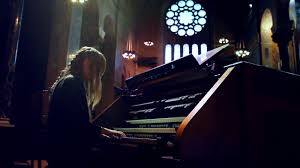
When we learned that von Hausswolff was coming to New York City this summer, we started scouting for a church with a pipe organ that could accommodate a small video crew and some secular music. We found Christ Church, a United Methodist church on Park Avenue with a gracious staff who helped us make this work. [Anna Von Hausswolff Finds A Pipe Organ In New York City].

The recording opens with church bells and chimes, which Anna is playing gently on the organ (you can see the switches she presses to get sounds–how high tech!).  Then the drum comes in.  It is a simple beat on a floor tom–click click boom–a martial rhythm to offset the lofty pipe organ.

Once we were set for a location, we lit some candles and moved the pipe organ (not the pipes) into a position that allowed us get the best view of von Hausswolff while keeping percussionist Michael Stasiak distant enough so as not to bury the sound of her voice. In the process, we captured a beautiful rendition of “Funeral For My Future Children,” a song on Ceremony originally recorded at another church — this one in Gothenburg.

It almost comes as a surprise when Anna starts singing as you don;t often hear vocals with a pipe organ.  But her voice has the power and inflection to match this illustrious organ and that thumping drum.  I love when the sound of the organ changes about 4 and a half minutes in–the solo just adds a whole new depth to the piece.  And when she hits a high not just before that, it’s amazing.

[READ: January 18, 2018] “Jack”

This is an excerpt from Robinson’s novel Home.  It’s set in Gilead which is the title of a previous book of hers, so I assume it is some kind of continuation of the town, if not the family.  I’ve never read anything else by her.

Since this is an excerpt rather than a short story it takes a long time for much to happen.  But her writing is pretty great and everything that she writes is rather compelling.

The story opens with Glory, the youngest of six children arriving at her childhood home.  She is greeted by her father who is shockingly frail and thin and… old.  She is moving back home to take care of him now that he is by himself.

The story quickly flashes back to her childhood growing up in the house.  A house that seemed somehow too large, too ungainly for the neighborhood it was in.  How had it changed so much since she left? Continue Reading »

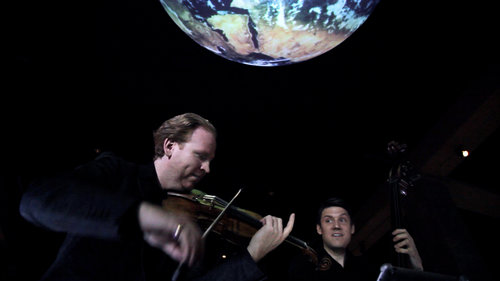
SOUNDTRACK: DANIEL HOPE-three pieces (Field Recordings, August 21, 2013).

The only thing I like more than a Field Recording set outside, is one set in an unlikely building, like the way this Field Recording [Daniel Hope’s Earth And Sky Expedition] is set in the American Museum of Natural History.

When Daniel Hope was a boy, the only thing he loved as much as his violin was his telescope. Gazing into the night sky, he pondered the vastness of space. Now a grown man, Hope still has a penchant for wonder and discovery — especially when it comes to music.

In his latest album, Spheres, Hope returns to the spirit of those early astronomical adventures. His idea, he says, is “to bring together music and time, including works by composers from different centuries who might perhaps not always be found in the same galaxy.” The unifying factor is the big question: Is there anything out there?

What better place to play with that ancient query than the Rose Center for Earth and Space at New York’s American Museum of Natural History. We invited Hope and jazz bassist-composer Ben Allison into the “performance crater” in the Hall of Planet Earth.

As if the Hall isn’t interactive enough — with its glowing orbs and 4.3 billion-year-old zircon crystal — we wrangled afternoon museum-goers to participate in our own Earth and sky expedition. Equipped with small flashlights, they became the twinkling stars surrounding Hope and Allison in the darkened room.

The music seems to live and breathe in the space, as each of the three pieces (spanning four centuries) reverberates a unique voice. “Imitation of the Bells,” with its rippling arpeggios and tolling bass line, comes from the long forgotten Johann Paul von Westhoff, a German violin master who crisscrossed Europe a generation before J.S. Bach. In “Berlin by Overnight,” from contemporary Max Richter, Hope’s violin asteroids whiz past while Allison’s bass propels through outer space. And finally, the otherworldly beauty that is Bach’s “Air on a G String” floats in a safe, gentle stasis.

It’s neat watching the little kids swing their flashlights around while the older kids watch on, bored, from the balcony during “Imitation of the Bells.”  Hope’s violin is flying in a flurry of activity while the bass keeps things grounded.

I’m not sure that I have heard many violin pieces performed with a bass accompaniment.  The bass doesn’t add a lit of melody to the violin work, but it adds a very cool feeling of grounding and rhythm especially in “Berlin by Overnight.”  The piece feels very contemporary with a cool, fast, Glassian kind of repetitiveness.  And the bass adds occasional notes (that feel like rock bass notes, he plucks so hard) to keep the pace going.

The bass is much more pronounced on the familiar J.S. Bach: Air on a G String.  I feel an imperceptible sitting up straight once the first notes ring out of the violin.  But I keep coming back to the bass.  The violin melody is so pretty and so familiar that it’s interesting to listen to the way the bass plays off those notes.

[READ: February 9, 2018] “The Botch”

I have not enjoyed Means’ stories in the past.  They’re usually pretty violent and just not my thing.

This one was a bit more enjoyable until the end.  The only problem with it per se was that it was about a bank robbery and I feel like there’s not much you can say about a bank robbery that hasn’t been said in films and stories already.

But there’s some interesting tweaks.  It is set around the Great Depression–tommy guns and wise guys.  And the mastermind behind the scheme has thought out everything ahead of time.  There is a repeated refrain of “the idea is” which I kind of liked.  Although for some reason it bugged me when it was switched to just “idea being,” which I know is how it would be said, but it bristled. Continue Reading »