Feeds:
Posts
Comments

Archive for the ‘Yuck!’ Category

SOUNDTRACK: BILL CALLAHAN-“Santa Maria” from Score! 20 Years of Merge Records: The Covers(2009).

I don’t often listen to songs that are as simple and straightforward as this one.  It’s an acoustic guitar with occasional piano and Callahan’s deep voice.  The melody is enjoyable and the vocals are crystal clear.  (Callahan is from Smog, a band I know of, but whom I don’t really know).

The original of this song is by Versus on their Afterglow EP.  I’ve liked Versus for a long time–their mix of male/female vocals and rockin’ guitars is always exciting.  But I didn’t remember this song at all.  It turns out that it’s kind of a slow, brooding number, something I probably wouldn’t have paid a ton of attention to back when I was rocking out more.

I prefer the Versus version as there’s more interesting tricks afoot, although Callahan does some cool subtleties by the end of the song that really bring out some interesting twists to the song.

[READ: April 16, 2012] “Our Raccoon Year”

I’ve read a few pieces from Paul Theroux, and I’ll say that this piece really surprised me.  While I wouldn’t try to categorize all of Theroux’s writing, I would say that a domestic story about raccoons is one that I would not have expected.

The story opens with the narrator, a young boy, telling us that his Ma decided to go away.  Their Pa explained that she was where she wanted to be “with her friend.”  Given the circumstances, and the fact that Pa was a well-respected citizen (and attorney), Pa was given custody of the narrator and his brother. He was the first man to be given custody of children after a divorce in their region and it only upped people’s opinions of him.

That’s a neat conceit for a story.  So it’s surpising when he says that it also began their “raccoon year” which means it was their year of dealing with raccoons. (more…)

Read Full Post »

[WATCHED: March 15, 2012] The Wolf Knife

Ever since the advent of Wholphin, McSweeney’s short film DVD series, The Believer’s annual Film Issue has included films that do not belong on Wholphin–typically longer films, which is a cool way to see things you normally wouldn’t.   This year’s issue includes a feature-length film by Laurel Nakadate, The Wolf Knife.

Readers of this blog know that I love the McSweeney’s empire.  I read McSweeeney’s and The Believer, Grantland and Lucky Peach.  They’ve gotten me to enjoy things I never thought I would.  I also really love Wholphin–the films are weird and cool and unexpected.

So you can imagine how disappointed I was to be so disappointed by The Wolf Knife.  The introduction to the film in the magazine is by Deb Olin Unferth.  She made it sound amazing (even though she admits that people did walk out during the first fifteen minutes in some screenings).  And yet, after going through what some critics have said she concludes: “to some [seeing the film] might sound like the best possible use of ninety minutes of their lives.”

Oh how wrong this was. (more…)

Read Full Post »

SOUNDTRACKTV ON THE RADIO-New Health Rock (2004).

I was not aware that this EP existed (I guess technically it’s a single).  It came out after their original EP but before their first full-length.

The title track is a rocking number with all kinds of cool keyboard noises strewn about.  This is clearly early template TV on the Radio.  “The Wrong Way” will appear on Desperate Youth, Blood Thirsty Babes and it shows a new noisy sound for the band–lots of horns and a reluctance to allow silence appear, there’s sound filling up every space.  The final song, “Modern Romance” feels like a B-side.  It is kind of slow and meandering.  There are a few interesting sonic bits but mostly they are overshadowed by a kind of monotony.

Not essential listening for the TV on the Radio fan.

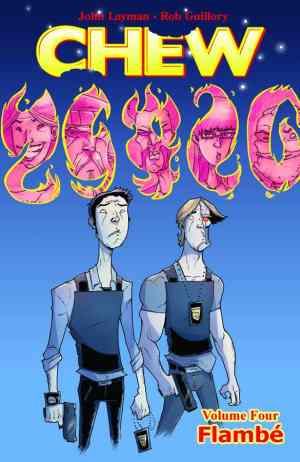
[READ: December 29, 2011] Chew: Volume Four

It was delightful to get volume four of this series so quickly after finishing volume three!

As with previous issues, this one starts out with a quirky opening.  A series of shots of a chicken restaurant (Mother Clucker’s) thirty-five years ago, then twenty-five, then fifteen and then five (nice clientele drawings over the years).  And then finally we see it today, after the ban on chicken–a wasteland.

But this story introduces an entirely new element (which goes through the arc of the book.  Lights from (presumably) an alien life form fill the skies.  They spell out words in a language that absolutely no one can understand.  And it is so vexing that money is taken away from the FDA (the people who are fighting the chicken war) and put into NASA.

This first chapter also introduces a new kind of character: a man who is voresophic–if he is eating he is unbelievably intelligent. Of course, if this was your gift, how long would you be able to stay slim?

Chapter Two jumps us right into a NASA space station.  Just as it explodes.  A quick cut to a school (where Tony Chu’s estranged daughter goes) reveals a more down to earth problem.  Since the letters have appeared in the sky people have been acting weird.  And one technologically savvy boy, who has been picked on most of his school life is looking for revenge.  But is he responsible for the space station explosion as well?

Chapter three is wonderful for a couple of reasons.  First, Chu and John Colby are getting assigned increasingly dangerous missions (because their boss wants them dead).  It culminates in a hilarious scene at the USDA (a furious female army). Chu and Colby are the last resort.  If everyone else fails, they have a fall back so dangerous that it is classified.

Chapter four is amazing for opening with a series of scenes that are gruesome and awful and, as the narrator boxes keep repeating, never actually happen.  And that is because Tony Chu has been assigned to work with his twin sister Toni Chu–NASA bigwig and (unknown to anyone else, fellow Cibopath–she doesn’t tell anyone so she’s not treated like a freak like her brother).  It’s great to see the two of them work their magic.  And while I wouldn’t want it to replace the Chu/Colby team, it would be fun to see future pairings of these two.

Chapter five (this is the first book with five chapters!) opens with a wonderfully long sequence of Agent Mason Savoy (he never went away, he’s always in the background) sampling something amazing.  And we get several wordless pages of him processing what he has just ingested.

But the more amazing thing is that suddenly the letters in the sky simply disappear.  And there seems to be a cult leader who predicted this, right down to the minute.  The cult leader ingested scads and scads of gallsaberries when she was adrift at sea and it led her to the Truth.  And she has lots of followers who are willing to drink her Kool-Aid.

The book ends with two wonderful cliffhangers.  The first one is (mild spoiler, but not really since it will be dealt with in the next book) that their actions lead Chu and Colby to get fired.  The second one is that Mason Savoy has learned a special secret about one of Tony Chu’s relatives (remember we saw them all in that cool scene from the last book?).  And he takes advantage of that knowledge.

The series isn’t over by a long shot.  Awesome.

A couple other things, first off–welcome back Poyo!  I loved the faux story they created about his background and then the negation of said story.  Also, this books reintroduces the vampires that were mentioned early in the story and then kind of hidden.  I love when stories pick up threads like this.  And a final quick nod to all of the excellent little jokes in the margins of the pictures.  I read them all and I love them…keep them up!

For ease of searching I include: flambe

Read Full Post »

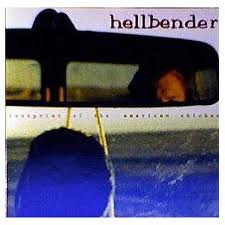
SOUNDTRACK: HELLBENDER-Footprint of the American Chicken (1996).

This disc opens with a funny quote from a movie I have never heard of called Highway 61 (thank you, internet, back in 1996, know one would have known where “Lady, you can’t cheat at bingo. If you could, I would, but you can’t. I won because I was lucky – lucky to wind up in a town full of losers!” came from).

This disc fees like a progression from Hellbender’s debut–mostly in production values, but also in song textures and vocals.  The band is still angry, still aggressive, playing choppy punk (although with most songs clocking in at over 3 minutes it’s a different kind of punk).   Al Burian, the lead vocalist is still angry–and still hard to understand, he sounds very much like California punk circa the mid 80s.

But the thing that impressed me is that on some songs there’s another singer (I assume Wells Tower, or maybe it’s Burian’s “other singing voice?”).  He is more melodic, less screamy and he really lets you hear the lyrics.

So the first song (shouty singer) has a great title “Unsolicited Anthem for the Portand Hipsters,” but I have no idea what the words are except the chorus of “It’s raining again.”  But “Tourist Trap” has some great lyrics (as well as more melodic sound):

“The quiet Americans who are my friends/ laugh at the loud ones on the other end/ of the room/ and watch them spend and spend/ acting rude/ being defeated by foreign food/ being defeated by waiters who pretend/ not to speak/ a word of their language.  We draw the line between us and them as best we can

It goes on like this with some more great imagery and then it ends with a cool detuned chord.  This song is a major highlight on the album.

The disc continues with a mix of faster, harder songs and slightly more melodic ones.  As on their debut, they throw in some nice drums breaks and great dynamics to keep the songs from becoming predictable.

“New Wounds” is more melodic, almost, but not quite, poppy with a cool guitar riff and interesting lyrics “Stay up all night counting cancers as if the counting could cut them out”

“Until It Peaks” sounds like yet another singer (man I wish I had liner notes…or could find anything about this album online anywhere…come on people!).  “Half Driven” has some interesting backing vocals and some cool “ticking” sounds instead of drums. “Pissant’s Retrospective” has a new sound for the disc: scratchy guitars.  That “third” vocalist is also singing again.   And at 5 minutes long, it stands out for having a slow instrumental section for the last minute or so.

I also really like the lyrics to “Dumb Waiter.”  It opens with a false intro (I love that) and more cool lyrics:  “cross the street which separates losers from jocks…this is just like high school again.”  I also like the chorus “I’m not lighting candles. I curse their darkness.”

The final song “I Thermostat” features three vocals at once–a harmony vocal and another voice singing a third line.  Very cool.  This album shows some major progress for the band.  They released one more disc before breaking up.

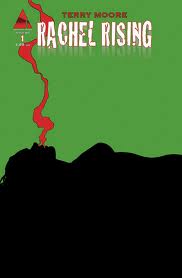
[READ: January 31, 2012] Rachel Rising

My subscription to Terry Moore’s Echo ran out with issue 27 and I never got around to renewing it.  So I totally missed the ending.  I ordered the last issues from him but, gah, 28 is sold out, so I need to wait to finish it.  But when I was on the site I saw that he has a totally new series cooking called Rachel Rising.

There were very dark tones in Moore’s most famous work, Strangers in Paradise.  And Echo is all about nuclear annihilation, so he’s clearly no stranger to darkness.  But wow, Rachel Rising a dark, dark work.

The opening sequence (a stunning words-free nine pages) shows a woman rising from the earth.  She’s beautiful and not at all zombie-like, although the whites of her eyes are dark and she has clearly been strangled.  She stumbles home (actually she gets a ride from a concerned guy whom she totally ignores) and tries to figure out what the hell happened.

We see a brief flashback of her visiting her friend Jet at the garage where she works.  But when she goes to visit Jet’s house, her housemates (or whatever they are) not only say that Jet isn’t home, they say that Jet is out playing a gig like she does every Thursday.  But Rachel thinks it’s Tuesday.  So what the hell happened to her?

In Issue two she visits her Aunt Johnny who works at a mortuary. Terry doesn’t hold back with some of these scenes.  Johnny thinks that Rachel is a figment–she gets visited by lots of ghosts in her line of work.  Rachel convinces her to go look at the site where she was buried.

In the meantime, we get another storyline.  A young girl in pigtails is visited by a woman in white.  I have to say that this is a confusing development.  The woman in white looks a lot like Rachel and I can’t decide if I’m suffering from “a lot of Terry’s characters look alike” syndrome or if this is supposed to be Rachel in another incarnation, or what.  Anyway, we don’t see what the woman tells the girl, but several pages later when that storyline resumes, we see that the woman has had a powerful impact on the girl’s behavior.

In Issue 3, Rachel visits Jet at her gig.  While they are all in the bar, Rachel and the woman who looks like Rachel but is in white both interact with a couple who are getting married soon.  Both women say things that are not very nice about the institution of marriage.  Although Rachel’s seems unintentional, the woman in white’s seems deliberate (and we notice smoke coming off of her finger).

A little later when there is an accident, Rachel is involved and the woman in white is a witness.

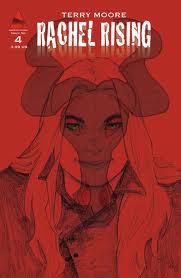
In Issue #4 the storylines collide somewhat.  Rachel is at the hospital after her fatal accident.  But she soon wakes up–to the astonishment of Johnny and Jet who saw that she was dead.  Doctors said she was pronounced dead at the scene.  But Rachel has a pulse, a very faint one, and Jet and Johnny are simply at a loss.

Meanwhile, the young girl (who we find out is named Zoe) is finishing up the act that she started in Issue #2 (which includes stealing her sister’s car even though she is waaay too young to drive).  She drives out to the field where Rachel was buried.  There she runs into the man who was supposed to get married.  As we’re starting to get into the plot here, I’m not going to say anymore, except that violence abounds and it’s fairly clear now that Zoe and the woman in white know each other from some kind of past experience.

Issue #4 came out in December.  I have no idea how long the series is expected to run, but it seems like it’s got a long way to go.

This is a very dark series…Terry seems to be exorcising some demons here.  But man is it good.  Terry’s art is (as always) beautiful.  And (as always) he creates real women and gives them good roles.  And as with everything that Terry has done, I cannot wait to see where he goes with this series.

My only word to Terry is that for as long as I have been reading him, he uses “it’s” instead of “its” I hope someone will correct him someday.

Read Full Post »

[LISTENED TO: January 12, 2012] Girl with Curious Hair
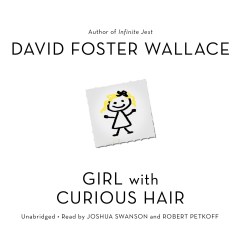
I saw a placeholder on Amazon for this audio book in early 2011.  And then I promptly forgot all about it.  My friend George just asked if anyone had heard it yet, so I decided to check it out.  I downloaded it through Audible.com.

And here’s my two cents about Audible.  Although it was free (for a 30 day trial), it was a lot of work.  The entire book (14 hours) downloaded in two files.  Each was about 7 hours with no breaks or chapters of any kind–just two huge 7 hour files.  Okay, I often download stuff and bring it into Audacity to make my own chapter breaks.  But you can’t import this file into Audacity because it is its own proprietary format and doesn’t want you to put it in MP3 format.  So, I had to burn it to CD (but not in MP3, only in WAV) and then put the CDs back in to iTunes to import them as MP3.  From there I could import them into Audacity and put tracks where I wanted.  That’s a lot of work to save $29.

I’m also going to say that I didn’t want a membership to Audacity because it costs $15/mo and the savings aren’t really that good anyhow.  Even kids books are about $10 each.  Oh, and just see how many hoops they have you go through to try and cancel.   Heavens to Betsy.

And but so on to the actual audiobook.

The book was read by Robert Petkoff (who is Reader A below) and Joshua Swanson (who is reader B below).  I don’t know anything about them, but their websites will give you more info about them.

I found the readings to be simply wonderful.  They were impassioned and articulate and dealt with some of DFW’s tongue twisting word choices with ease.  They also handle DFW’s dialect and accents with ease.  And while Swanson has a much much broader range of voices to play around with (his women voices are far superior to Petkoff’s), Petkoff also pulls of some amazing voices, especially in “John Billy.”  I never questioned what was happening.

Some of these stories are challenging and I admit I found them difficult to read.  But the audio versions seemed to really clarify things.  (There are all kinds of reasons why this could be so, but I’m not going to delve into that, for there lies madness).  Nevertheless, this was a great way to hear these stories.  Especially the ones that had heavy dialect.

“Little Expressionless Animals” [Petkoff] (90 minutes)
Petkoff sounds uncannily like Kyle McLachlan–no bad thing.  Although Petkoff doesn’t work too hard trying to do different voices, he puts in enough distinction to make the characters distinguishable.  (We have been listening to a lot of kid’s audio books, and the narrators of those are amazing with the kind of vocal acrobatics they can do!).  Petkoff is more subtle, but it is also effective–it’s not just a straight voice, which I think might get confusing especially in the dialogue scenes.

There is a hint of Alex Trebek’s voice when doing Alex Trebek, but he’s definitely not trying to mimic the voices of the celebrities.  For the most part, the voices are slight variations of the main narrator.  Indeed, during the later Faye and Julie dialogue section, he does slight differences between their voices to help distinguish the characters.  Which is quite helpful in the story.

This story works very well in audio book format.

One of the things that I loved about this story this time was really piecing together all of the various compnents.  Inclduing things like the revealtion of why Julie does poorly on the subject of animals.  It’s quite obvious when the story ends, but through the whole story you keep wondering, what is it about the animals?  I’m aslo intrigued at the number of gay characters in the book.

And, of course, this story has a major obsession with pop culture, especially TV.  And knowing (from interviews) that DFW sais he would just get sucked in to watching TV all day if it wa svailable, his tone (as is Petkoff’s) is perfect when dealing with the TV issues.

“Luckily the Account Representative Knew CPR” [Petkoff] (18 minutes)
Petkoff sounds slightly differnt than in “LEA.”  Since thist story has no dialogue, there’s not a lot of differentiation in the story.  His deadpan delivery is perfect for all of the details in the story. Although at the end, his “Help”s are quite empassioned, letting you know there’s a little bit more going on.

“Girl with Curious Hair” [Swanson] (50 minutes)
Swanson’s voice is of a much higher timbre, and it’s kind of fun to have two different voices in this book.  This story benefits quite well from an audio format.

The story is deliebrately flat and, I have to admit, is not terribly easy to read.  Swanson handles the flatness very well, he reads it incredibly deadpan and yet he puts enough inflection in it to keep it from being monotone.  I have to assume it wasn’t easy to read this.  I think that he has really made this disturbing character quite real.

Obsevrations about the story.  Hearing this story out loud was more shocking than reading it.  The explicit sex is pretty shocking for DFW and the revelation about what happened to Sick Puppy when he was a kid is prodoundly distrubing, especially when it is read in this non-inflected voice.  It was uncomforatble and very effetcive.

There were times when I wondered about the believability of the charcter.  The use of the word negro, the utter flatness of him. I realize that he is quite damaged, but at times it seemed like maybe this story was too much.  Which is a bit of a surprise, as I find DFW’s charcatersto be very real.

“Lyndon”  [Swanson] [1 hr 45 min]
I didn’t really enjoy “Lyndon” when I read the story.  It’s a little long and had many different things going on.  I kept wondering about Lyndon himself.  About what made DFW write a story based around Lyndon Johnson, around jhis life and politics.

But hearing this story read aloud, with the Swanson’s various voices and accents and newspaper stories all differentiated really brought this to life.  I felt like it was so much more vibrant and alive and passionate in this audio version.  I read in my post that i found the ending quite moving when I read the story, but it felt even more so, with Lady Bird’s quiet, dignified delivery, here.

Observations on the story.  How odd that he chose to make this story that is about a real, and quite famous and well studied person.  I don’t know a thing about Lyndon, so I have no idea how much of this is true (the few LBJ quiotes I looked up seem faked).  I don’t think I spent enough time thinking about the main character when I read the story.  Boyd is so fully realized and amazing that Lyndon is really superflous.  This is awonderfully emotive story.  And Swanson really does an amazing job.

“John Billy” [Petkoff] (1hr 10 min)
I thought “John Billy” was a real challenge to read.  The dialect is pretty crazy.  And the story is not exactly easy to begin with.  But much like Swanson in “Lyndon,” Petkoff’s voices are outstanding here.  The main voice of John Billy is great–he handles the accent and the crazy word choices that John Billy has with ease.  The story flows perfectly.  It’s really impressive.

And while the voice of Glory Joy isn’t wonderful (Petkoff’s women are just softer versions of his voice), he more than makes up for it with the amazing transformation of Simple Ranger.  In the reading, it is clear that Simple Ranger “grows younger” from a quiet, hard to hear older to a youthful loud charcater.  And Petkoff takes that literally so you can really hear him change into a man with a “curious plus haunting voice that was not…of his gravelly, gray-lunged voice somehow, his own, somehow.”  And then, later in the story Ranger’s voice changes again when he “whispered, the big sharp clear new Ranger in a smooth new clear young voice.”   But nothing prepared me for the voice of T Rex Minogue. It is stunning.  It’s an amazingly processed voice that is as malevolent as it is “mechanical.”  It’ s masterful.

As for the story itself, the whole saga of C.Nunn Jr is bizarre and wonderful, a crazy hyperbole of a story.  It also seems crazily over the top hearing it aloud (like in “GwCH”).  The whole story’s end with C Nunn’s eyes is preposterous (what is it with people’s eyes in this book?).  And yet it feels like the nonsense is there as a balance for the heaviness.

The story is funny and silly but by the end it gets incredibly dark and thoughtful.  It’s a challenge to listen to, especially the end, but I think it benefits from an audio version.

“Here and There” [Swanson] (55 min)
I found this story somehow more confusing while listening than when reading.  There’s so much back and forth with voices and the whole conceit that this is some kind of fiction therpay doesn’t really translate easily here.  I also found some of the more academic sections to be kind of dull in his reading.  It’s a challenge to read aloud and keep interesting, I’m sure, but I found this story to be the least successful of the collection.

“My Appearnce” [Petkoff] (58 minutes)
This is written in frist person from a woman.  Petkoff, who has quite a deep voice conveys a woman very well.  This is a great reading for this story.  He does “versions” of David Letterman and Paul Schaffer.  They are not impersonantions by any means, but he has the tone down perfectly.   The male voices whispering in her ear are done in a very simple whisepred voice.  Very effective.

This is a great story and the audio is also wonderful.

“Say Never” [Petkoff and Swanson] (42 minutes)
Petkoff does a very good job with the accents in this story.  Labov’s heavy Jewish accent is very impressive.  And although Mrs Tebof is not very different from Labov, it is different enough to convey the accent and the tone.   He also does Lenny’s voice, which is the bulk of the story.

Swanson also comes in this story as well, doing the voices of Mikey and Louis (two very distinct voices, even if they are both a little Hollywood Gangster from the 40s).  I would have been interesting to hear them interact more in the book somehow.

I was struck by this story more in the listening than the reading.  There’s something about hearing people say these things that makes them more shocking.  Especially the note that he sends to his family (talking about his wife’s lack of sex drive–gasp!).  This is another one of DFW’s stories that ends before something big happens.  It’s funny how many of his stories seem like preludes.

“Everything is Green” [Petkoff] (3 minutes)
It’s also amazing that this whole story is only 3 minutes and thirty seconds long.  Petkoff reads this story in a perfect DFW deadpan style.  He even does May Flys voice with a (slight) accent.

“Westward the Course of Empire Takes it Way”  [Swanson] (6 hours)
Swanson does an amazing job with this difficult story.  There are nearly a dozen charaters in here and he manages to keep them all separate and distinct.  It’s really great.  This is especially true late in the story, when they are in the car on the way to Collison.  He has six people in the car and he manages to make sthem all unique:  J.D. is dark and gravelly while DeHaven has a kind of Midwestern Stoner tone.  Tom Sternberg is neurotic and aggressive at the same time.  D.L. is snotty and presumptuous (although it may be Swanson’s weakest voice, it really conveys the character well).  Magda is exhausted.  And Mark is a solid late teenager.

Let’s not froget the pissed off Fertilizer salesman, the Avis clerk and the bartender.  And the narrator of course.

This story is also fairly complex and hard to follow (when reading).  There so much going on what with the narrator’s interruptions and the metafiction.

What I really noticed this time is how the parts that are not metafictional, the actual narrative of the story is really good, really strong and emotional.  Not to say that the more meta- sections of it are bad, they just don’t have the same kind of impact.  Of course, the whole point of the story is to play around with meta-fiction, so I’m not entirely sure how successful it is in that regard.

Nevertheless, it’s a fascinting look at youth in America.  And I have to say that it really works as a foreshdaowing of issues that he would explore more in his later stories and IJ.

Some things I notice din this listen.  DFW uses the word “plus” instead of “and” a lot.  It’s a fascinating word choice, and one that I think virtually no one uses.  Sometimes it’s effective and other times it’s very clunky.  I never noticed it while reading but it’s very obvious when listening.

I just read my review of the short story collection, which I think was kind of brief.  I feel like I got a lot more out of the book this time around. Of course this is my second reading so that makes sense as well.  It’s also interesting how I enjoyed some stories more and other stories less.

Overall though, this is an excellent audio book.

Read Full Post »

This is not the right cover for the issue. I couldn't find it online!

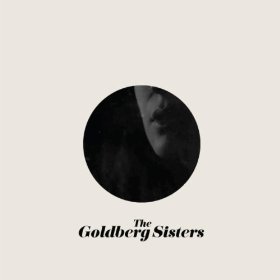
SOUNDTRACK: THE GOLDBERG SISTERS-The Goldberg Sisters (2011).

I don’t often make lists of “Best” records or anything like that.  But I’m making an exception for this.  This was easily the best album that I had low expectations for.  That sounds like half a compliment but it’s not.  I really didn’t expect much from this album when Adam Goldberg promoted it on Craig Ferguson’s show.  But when I checked out the video for “Shush” I was really impressed.  So I bought the CD.

And I have to say that it is really, really good. 

I need to get this out of the way because it will influence the whole write up otherwise.  Adam Goldberg is an actor, a very good, very funny actor.  And this is just one of his music projects.  It was not an entirely solo affair, but Goldberg plays guitar, piano, harmonium, keyboards, key sitar and melodica.  And of course, he sings as well.  I was more or less expecting an at-home-sounding demo, maybe, or some standard rock-n-roll like many other side projects.  But the album is lush and full, complete with cool psychedelic effects on certain tracks and there’s even clever wordplay. 

Goldberg has a soothing, slightly feminine singing voice (I would not have expected that from his speaking voice).  And his backing vocalists really complement him well. 

The disc opens with “The Room” a simple acoustic guitar and a very nice complementary piano (which reminds me of some of Radiohead’s acoustic moments).  The long instrumental ending is quite intense.  “Mother Please (The World Is Not Our Home)” has questionable lyrics, but a really great sound.  There’s cool spoken words deep in the mix, which bring a creepy effects to the song.  It runs very long, but there’s lots of parts and a cool coda.

“Shush” is still outstanding after all of these listens.  It has a kind of Bowie/Beatles/90’s revival of same feel.  This kind of song only works if the production is right, and Goldberg’s is perfect.  “Don’t Grow” opens with cool fiddle strings and Goldberg’s slightly sinister whispered vocals.  It’s 7 minutes long (see, psychedelic) and features a really pretty denouement with tinkling pianos and everything.

“You’re Beautiful When You Die” is a weird little interlude–muffled piano and dark, dark lyrics.  I could probably do without it, but it’s only 2 minutes so I’ll deal.  It’s made up for by “Erik Erikson” a great rocking acoustic number that reminds me of The Smashing Pumpkins (in vocal style). 

“Third Person” returns to that Beatles-y style with a folk song with full instrumentation.  And “The Difference Between” has some cool backing vocals which elevate this simple piano based song into something more.  “Skin of the Patriot” is a slow piano ballad.  It’s not my favorite song on the disc, but it leads into the wonderfully upbeat ender “The Heart Grows Fonder” (which features a surprising and surprisingly effective melodica solo).  It runs about five minutes (of an 11 minute track).  The ending 90 seconds are a goofy riff on The Beatles’ “Revolution.” 

So overall this album is really enjoyable.  There’s one or two misfires and it could use a wee bit of editing, but man, am I glad I bought this.  And I can’t wait to see what Goldberg does next.

Watch the Ferguson bit here (wait for the hilarious awkward pause at 10:30)

Find out more at his wonderfully named website: Adam Goldberg Dillettante.

[READ: January 6, 2012] “Two Midnights in a Jug”

This is the final individual story that Karen Carlson recommended to me (the rest are all in anthologies that I’ll have to check out).  She writes: “Because it’s a grim, tough read, it might take a second read to get past the oppressive weight and find the delicate art. And it doesn’t hurt to look into the background of the writer a bit; he isn’t writing about these people by accident. A little Willie Nelson might work [for the soundtrack].”

Karen’s comments sound a little defensive!  But I admit I was pretty turned off in the beginning of the story.  I’ll also admit a personal bias of mine is that I don’t really like to read stories about the rural poor or folks in the Ozarks.  I know, it’s not very nice, but it’s true. 

So, this story is set there.  And it opens with just about every stereotype I hate about the region: single wide trailer that borders a hog farm, neon orange muumuus, coon hunting and a repossessed house.  Things are even worse than my stereotypes though, because the plumbing is unconnected and their toilet sits over a bucket.  Which they cover with lime after every use and which they have to empty daily.  Good god.

Oh and the hog farm?  They had so much hog shit that they decided to burn it.  Well, the fire has been raging for a month.  And the only thing worse than the smell of hog shit is the smell of burning hog shit.  And the only thing worse than burning hog shit is having the ashes from the hog shit fall onto your property and into your trailer every day for a month. 

Oh yeah, and Cordell, the man of the trailer, accidentally shot their hound, Trixie last time he was hunting.  She’s okay but had to have a leg removed.  Jee.  Sus.

I seriously almost stopped reading. (more…)

Read Full Post »

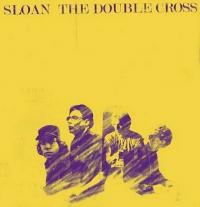
SOUNDTRACK: SLOAN-The Double Cross (2011).

Sloan never fail to make enjoyable punky pop songs.  Surely it has something to do with having four songwriters in the band (which must minimize clunkers).  I can never decide who my favorite songwriter of the group is as they all do fairly varied work.

“Follow the Leader” is a fast rocker (with a very cool guitar solo bit and a nice acoustic break in the middle).  While “The Answer Was You” is a bouncy piano-based song that starts out fast and then settles into one of the more recognizable Sloan voices (I wish I knew who was who–even after twenty years I have never quite determined who was singing what).  This song also has a great third part, minor keys and very dramatic structure.  It’s the first of several songs that hover around the 2 minute mark, as well.

“Unkind” is a simple guitar based song and man is it catchy, with a chorus that sticks with you.  “Shadow of Love” is a great fast rocker and even at only 2 minutes long it has several great parts.  “She’s Slowing Down Again” has some great bah bahs and a strong chorus.  “Green Gardens, Cold Montreal” actually slows things down, with a gentle acoustic ballad.  But it’s followed by one of their screaming punk tracks, “It’s Plain to See,” simply put, it’s two minutes of adrenaline.

The album changes somewhat with “Your Daddy Will Do,” a catchy disco song.  Yes, disco.  How else do you explain those keyboards riffs?  And man is it catchy.  “I Gotta Know” may be the stupidest song they’ve recorded yet.  How many times is the phrase “I gotta know” repeated in 82 seconds?  Still, you can’t deny how catchy it is.  “Beverly Terrace” returns to that cool pizzicato piano that they do so well.

“Traces” is the longest song (almost 5 minutes) and is one of the longer Sloan songs in general.  It feels like  an old classic rock song for many reasons (including Doors-y keyboards), and yet it doesn’t feel retro at all.  Neat trick, that.  The disc ends with “Laying So Low,” a piano ballad with a great catchy melody.  It slows the album to a nice ending.

12 songs in 33 minutes.  Multiple genres, multiple styles, multiple singers.  All of it wonderful.  Just an other typical Sloan album. Great jobs guys, here’s to twenty more years.

One word to yeprock records, though.  If you offer “free bonus” songs for purchasing their album, I would suggest in the strongest possible terms that the four bonus songs should not be one song each from their previous records.

[READ: December 29, 2011] Chew: Volume Three

We were quite excited to get this book–we were on the Hold list forever at the library.  So I’m surprised to see it came out back in 2010!  I assumed it was much newer than that.  I guess there’s a Volume Four out already (yes it came out, and they have just published issue 22 in single issues).  Volume three covers issues 10-15.

This mini-arc, as they call it, isn’t so much of an arc as a continuation of the awesome story line.

For those in the dark, read the first two posts.  But in a nutshell, Tony Chu is a Cibopath, which means that anything he tastes he knows the entire history of, be it vegetable, meat (ew) or, since he is a cop, human (bleagh, but hey it’s a comic book, right?).  His partner, John, is part machine now, having been practically blown up and then put back together.  And, as we start Chapter One (Issue #11), Tony is out on his first date with Amelia Mintz (alright, they got together!).  Amelia Mintz is a Saboscrivner which means she can write about food so wonderfully that you can literally taste it. (more…)

Read Full Post »

SOUNDTRACK: MY MORNING JACKET-“Our World” (2011).

This song comes from the The Green Album, the grown- up-bands-cover-the-Muppets album.  I can’t remember if I knew this song to begin with or if I have just listened to this record enough that it sounds so familiar.

Although MMJ have been getting into some crazy electronic and heavy music as of late, this is a very mellow song.  It opens with a banjo!  And while more instruments come in, it stays pretty true to what you’d think the Muppets would sing.

(Aha, thanks internet.  It appeared in Emmet Otter’s Jugband Christmas).   It’s a really pretty song (Paul Williams knew his way around a ballad, huh?) and this is a very nice cover.

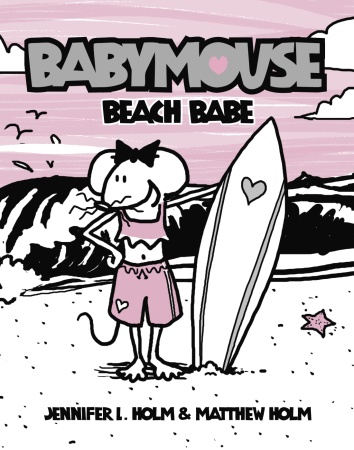
[READ: April 16, 2011] Babymouse: Beach Babe

This the third Babymouse book opens with Babymouse dreaming (of course).  But this time she’s dreaming of surfing!  And she can hang ten (and other surfing lingo) with the best of them.  Until a card says “Too Terrible to See.”  But when she wakes up she has wonderful news…it’s the last day of school!

We also see, to my understanding, the first real encounter with Squeak, Babymouse’s little brother.  When Babymouse runs for the bus, Squeak follows her calling out her name.  She tells him to go home and we see poor Squeak by the side of the road, looking dejected.

But we’re soon back at school, and during the film strip, Babymouse imagines she is the Little Mermaid.  But when she wakes up, the bell rings and school’s out for the summer!

When her parents tell them they’re going on vacation, she has an instant flashback to their terrible vacation last year (and the lack of “facilities” at the camp ground).  But this vacation is going to be different–they’re going to the beach!  And she is super excited…until the drive takes for-

ev-

er.

There’s even a surprising dream sequence about all the trees that she sees on the way down.

When they finally arrive, there’s all the usual beach fun and danger (sunburn!) and Babymouse gets to try her hand at surfing like in her dreams.

It was right around this time that I guessed that the beach that Matthew Holm was drawing was at the Jersey Shore.  And indeed, it is.  The end credits say that the Holms used to vacation at the Jersey Shore.

The book ends with that other classic childhood trauma–having a younger sibling and getting tired of playing with him or her on vacation.  When Babymouse complains about Squeak once too often, he takes it very personally.  And suddenly the story becomes a little frightening and quite touching.

For a snarky series, this one is surprisingly moving.  I wonder if having this book third helped establish that sensitive side of Babymouse (which seems to be missing in later books).  Good for you Babymouse!

Read Full Post »

SOUNDTRACK: SUFJAN STEVENS-The Age of Adz (2010).

Sufjan Stevens has released a bunch of albums of beautiful orchestral rock.  It is multi-layered and complex with classical elements and all kinds of cool instruments.

And this album starts out with a beautiful acoustic guitar melody and Sufjan’s delicate vocals.  Although it is a far more stripped down song than usual, “Futile Devices” seems like it is heading in the standard direction.  But anyone who heard Sufjan’s Christmas album number VIII knows that he has been having some fun with electronics.  And they show up with a vengeance on track two, “Too Much.”

All of the multilayered noise that was once orchestral and (some might say) precious has been replaced by a cacophony of gorgeous electronic noises.  The beginning of the song reminds me of the sounds in Skinny Puppy’s “Stairs and Flowers” (how many Sufjan Stevens reviews mention Skinny Puppy?).  The song is nothing like Skinny Puppy once the vocals kick in–it’s catchy and delicate–but those electronics underpin the whole thing, bringing his pastoralia into the twenty-first century.  When I first reviewed this song I didn’t like it but once you get absorbed by Sufjan’s world, it’s an enticing place to be,

“Age of Adz” takes this electronic nonsense even further with an 8 minute brew of strange sounds and choral voices.  But he always manages to throw in some catchy parts, no matter how strange the song gets.

For me one of the highlights of the disc is “I Walked” it features one of my favorite Sufjan things–falsetto vocals in a beautiful but unexpected melody.  And this song has them in spades.  “Now That I’m Older” has a very disconcerting sound–his voice is slowly warbled and mournful.  It’s a beautiful melody that is alienating at the same time.

“Get Real Get Right” returns to his earlier style somewhat (there’s more layers of music, although the electronica is still in place).   “Vesuvius” is a beautiful song and “All for Myself” is another of those great falsetto tracks that I like so much.

“I Want to Be Well” eventually turns into a manic electronic workout in which he repeats the chorus “I’m not fucking around.”

But nothing compares  to “Impossible Soul” a twenty-five minute (!) multi-part suite of electronic chaos.  It’s a fantastic song complete with autotune (used to very cool effect), repeated swelling choruses (it’s like a Polyphonic Spree tribute), electronic freakouts, and acoustic comedowns.  All in a positive, happy message.  I can’t stop listening to it.  “It’s not so impossible!”

Sufjan continues to impress me.

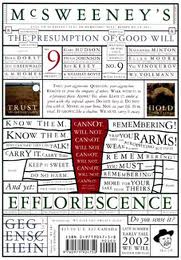
[READ: November 10, 2011] McSweeney’s #9

After the excesses of McSweeney’s #8, I was excited to get to the brevity (and urgency) of McSweeney’s #9.  This one is a paperback and looks like the first couple of issues.  The cover is mostly text with a hodgepodge of phrases and pleas.  You get things like: Thankful, Emboldened, The (Hot-Blooded/Life-Saving) Presumption of (Perpetual/Irrational (or More Likely, Irreducibly Rational) Good Will, Efflorescence, Our motto this time: We Give You Sweaty Hugs,” Alternative motto: ” We Are Out Looking,” GEGENSCHEIN (no more), and the promise: “We will Do Four This Year.”

This is the kind of issue that makes me love McSweeney’s.  There are some wonderful short stories, there are some nice essays and there are some dark moments all centered vaguely and tangentially around a theme.  There are some great authors here, too.

The back cover image is called Garden Variety by Scott Greene and it’s a fantastic painting.  You can see it here (navigate through the 2000-2004 paintings, but I have to say I really like the style of all of his work.

There are no letters and no nonsense in this issue.  So let’s get to it. (more…)

Read Full Post »

SOUNDTRACK: LONELY ISLAND-Incredibad (2008).

Since I enjoyed the second Lonely Island album, I figured I’d check out the first one as well.  I mean it had “Lazy Sunday” on it after all.  But in this case my initial instincts we pretty correct. There are a  few songs on here that are funny and worth the time–and you’ve heard them all already.  The rest are filler–mildly funny songs that are too long by half (even when they are under two minutes).

The opening song, “Who Said We’re Wack” is only a minute and change and it overstays its welcome after about fifteen seconds.  Although, as I’m finding with a lot of the tracks, there are little bits that are funny, like the “raise your hands in the air” bit of this song.  “Santana DVX” is an amusing little skit about Carlos Santana making his own champagne.  Again, kind of funny, but not that funny.  And worse yet is that they keep reusing the joke throughout the disc.  “I’m on a Boat” is like the demo version of “I Just had Sex.”  It’s the same premise, with the same repeated joke, but you can get a lot more mileage out of having sex than about riding a boat.  At this point I have to wonder how many of these songs were skits (I don’t watch SNL as a rule) and I wonder if they are funnier with visuals added.

“Jizz in My Pants” is the first really funny thing on the disc.  The best part is that it starts out so seriously and then the absurdity gets faster and faster.  It’s very clever.  Although musically it sounds like The Flight of the Conchords might do it better.  “Sax Man” features the mighty Jack Black, and it’s funny, but I have to say that having the sax man play more bad notes (and not synthesized ones) as opposed to all that silence, and maybe having Black get even angrier would have been much funnier.

“Lazy Sunday” is still a highlight, a funny track with, and I think this is the key, new lyrics in every verse, not simple repetitiveness as humor (the old SNL standby).  And of course, “Dick in a Box” is still hilarious (oh, Timberlake, I can’t hate you).

However, that repetitiveness is a problem on “Like a Boss” (although parts of it are very funny) or “Boombox” (is boiled goose supposed to be funny?) although at least the chorus is catchy.  “We Like Sportz” is amusing but I feel like they aren’t dorky enough.  

Then, why does “Dreamgirl” turn into an ad for Chex Mix?   I know it is “sponsored by Chex Mix” but why?  It seems lazy.   And I simply don’t understand “Punch You in the Jeans” or “The Old Saloon” they just seem like stupid filler or in the case of “Jeans,” an attempt at at catchphrase generator or something.   

As on their follow-up, the skits are lame: “Normal Guy” is awful and “Shrooms” is boring.  But at least there’s only two skits.

Finally “Space Olympics” seems like a funny concept but what happens to the song?  It has potential to be a really amusing concept about actual space olympics, but it drifts off into a completely different direction.  Where’d the focus go? 

“Natalie’s Rap” on the other hand is focused, brutal and unexpected.  It is really, really funny.

All in all, this is an excellent place to hear a few good tracks and a whole lot of filler. I’m really happy that the sequel was so much better as it speaks to the possibility of even better stuff in the future.

[READ: October 30, 2011] Chew: Volume Two

As Sarah wrote in her post, I was pretty happy to have Volume Two of Chew in the house after finishing up Volume One (I’m only bummed that I don’t have Volume Three!!).

Volume Two continues the adventures of our favorite cibopath (see the previous entry for the explanations of all of these awesome ideas).  As the book opens we see that Tony Chu’s former partner, John Colby is back.  We knew he was still alive, but we didn’t know how alive he might be–after all, he had a cleaver in his face last time we saw him.  But he has been repaired, with the latest in technology, by the FDA.  And now Chu and Colby are back together, bickering as ever with new superpowers (the scene where Colby shows off what he can do is awesome). 

Chapter Two (Issue Seven if you’re keeping track), introduces Lin Sae Woo.  When I mentioned last time that Guillory draws grotesque characters, I had her in mind.  Lin Sae Woo is an aggressive, angry woman and she is drawn to reflect that. But she also has an absurd body shape.  Her breasts are preposterous–not even superhero large, stupidly large and the rest of her can barely keep up.  I can’t even decide if she’s supposed to be sexy, she is so ridiculous.  But she makes a formidable foe (even if she’s on the same side as Chu). (more…)

Read Full Post »

« Newer Posts - Older Posts »