This is one of those CDs that I used to see all the time back when I shopped at Tower Records in Boston. Either they had a lot of copies of it or it was always at the front, or something. But I never forgot the title of this EP, which I only purchased a few years ago.
The title is funny because it is indeed a merging of Built to Spill and Caustic Resin. But it’s not a split single with the two bands playing. Rather, it is Doug Martsch from Built to Spill playing with the three guys from Caustic Resin James Dillion on drums, Tom Romich on bass and Brett Netson on guitar and vocals on “Shit Brown Eyes.” (Remember how Doug was planning to have different musicians on each album?).
The EP has four songs totaling about 25 minutes.
“When Not Being Stupid Is Not Enough” is over 9 minutes long. It opens with a lot of instrumental stuff until about 3 and half minutes when the title lyrics come in as does the organ. By 5 and half minutes the song doubles in speed and builds with some great soloing.
“One Thing” has loud and screamed vocals from Martsch (probably the only BtS song like that). There’s a lot of wild psychedelic keyboard work in the middle of the song which alternates with a lengthy guitar solo. They pack a lot of jamming into five minutes.
“Shit Brown Eyes” was written by Caustic Resin. It’s a fairly conventional sounding song. There’s lots of guitar work and dual vocals. It’s a little chaotic, but there’s more beautiful soloing toward the end.
The final song is a cover of Kicking Giant’s “She’s Real.” The song is also fairly conventional (I don’t know the original) but they stretch it out to 8 minutes. It has a slow and mellow opening. There’s a lengthy fairly quiet guitar soloing section and then the end has a rocking section repeating “be my, be my baby” (but not a cover of the original).
This is an interesting EP, and might serve as an introduction to Caustic Resin (who I don’t really know) more that Built to Spill. It’s certainly not their best album, but “When Not Being Stupid Is Not Enough” is really fantastic.
[READ: July 20, 2015] Kick-Ass
I really enjoyed the movie of Kick-Ass. I knew it was from a comic book but I’d never seen the book before. And then I walked right past it in the library and had to check it out. This book collects issues 1-8 of the first series.
The movie is changed in different ways (made more “upbeat” mostly) but the story line is pretty consistent. Dave Lizewski is a fairly normal kid. He’s not a jock, but he’s not picked on either. He likes comic books but isn’t a major geek. He crushes on a hot girl and she won’t give him the time of day–pretty standard fare. But he wants something more. And he wonders why no one has ever tried to become a super hero for real. Obviously there’s no magic or superpowers involved, just a costumed avenger helping people? Why not?
So he decides to do it. He puts on a scuba suit an and a mask and heads out. Now, unlike every superhero, he has no major back story. His mother is dead, but from an aneurysm, so there’s no revenge. And his dad is pretty cool, so there’s no struggle there. He just wants some excitement. And he finds it. He runs into some kids spray painting on a wall. He has no fighting skills, and he gets the crap beat out of him. And as he flees, he is hit by a car. He winds up in the hospital, barely alive. (more…)
SOUNDTRACK: BUILT TO SPILL-There’s Nothing Wrong with Love (1994).
This is the second Built to Spill album. They moved to a new indie label (Up Records) for this one. For this album the line up changed to Brett Nelson, on bass and Andy Capps on drums.
For this album there aren’t too many long songs. In fact many are 3 minutes or less. And overall, the feel is more lo-fi, less experimental. And yet it still sounds very much like Built to Spill.
“In the Morning” is pretty and catchy with some interesting guitar work that is downplayed in the mix. I like the rather surprising ending. “Big Dipper” is insanely catchy with two separate styles of guitar solo at the same time.
“Car” is even catchier–one of their great early songs. It’s got a great riff and verse. And the strings add a lot to the song. “Fling” opens with acoustic guitar and strings. It’s a pretty song and only 2 and a half minutes. “Cleo” is another slow song with some bursts of guitar greatness.
“The Source” has loud and quiet elements—big acoustic guitars and some crazy jamming moments towards the end.
“Twin Falls” is a stripped down and honest song. It’s just him and his acoustic guitar (with some electric guitar soloing over the top) singing an honest, sweet ballad.
“Some” has slow and heavy elements as it tells a story about a guy. It’s the longest song on the dis and one of the few where Martsch just lets loose on guitar and wails (for a long time). “Distopian Dream Girl” has a kind of sloppy feel to it (with the lead guitar being especially sloppy). The lyrics about his stepfather looking like David’ Bowie are very funny. I love the way the mildly catchy verse turns into a big catchy chorus.
“Israel’s Song” has a groovy bass line unlike anything else on the disc. And the disc proper ends with “Stab.” The song opens slowly with some quiet electric guitar but it builds for 5 and a half minutes (the second longest song on the disc). By 2 minutes, the song has become a heavy guitar song getting faster and faster until it breaks into a slow guitar picked section with strings. As the song returns to that heavy fast section, it adds a long guitar solo–combing all of the elements of Built to Spill in one song.
Although this album isn’t as “experimental” as the first and doesn’t have too many weird sounds on it, they haven’t lost their sense of humor. There is an unlisted track which is a “preview” of the next Built to Spill record. It contains several snippets of “songs” that will appear next (a decent variety of styles, too). Of course, none of these songs appear on the record and the date that they give for when it will come out is also false. It’s pretty darn funny. This album tends to get overlooked because their next full length was on a major label, but it’s still really solid.
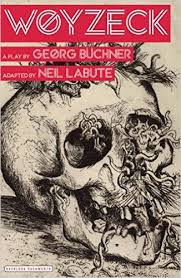
[READ: September 26, 2015] Woyzeck
Karl Georg Büchner died in 1837 at the age of 24. In his short life he wrote 4 plays and all kinds of nonfiction. Woyzeck was unfinished and has been adapted many times for the stage and film. And now it is LaBute’s turn.
Neil LaBute is one of the most misanthropic filmmakers I know of. His films are super dark, (occasionally funny–but always dark) and he’s not afraid to address controversial issues. So he seems like the perfect person to adapt (and add to) this play.
In the lengthy introduction, LaBute comments that if you didn’t spend time looking for buried treasure as a kid “your childhood may have been even worse than mine and therefore I want to spend no time imagining it.” He says that Woyzeck is such a treasure. (more…)
Rheostatics are reuniting for 3 shows at the Art Gallery of Ontario in a few weeks. And I am going to see them!
So it’s time to listen to a few shows from eleven years ago. This show doesn’t even mention a club, but that’s ok. It’s a fun gig in Nova Scotia. The quality of the recording is not great–it was recorded in the audience and you can hear a lot of audience chatter (and consequently the band is not as clear as could be).
Their final album 2067 is out in just a few months from this show, and they play a few songs from it: “Marginalized” and “The Tarleks.” Later, Martin describes “Aliens” as “The Tarleks Part 1.” They also play “I Dig Music” a fun jazzy number. There’s a drum break in the middle and drummer MPW says that he was trying to play the intro from Rush’s “Lakeside Park.”
There’s a wild middle section in “Satan is the Whistler.”
This show has lots of banter, and there’s a discussion about an audience member mocking The Headpins. And later when a fan says his friend was kicked out, Dave gets mad at the bouncers and seems genuinely concerned for the friend and offers to go get him.
After they play “My First Rock Show” they ask MPW about his first rock show. The discussion devolves into a discussion of John Cage’s smell (Old man vegan smell).
For “Take Me in Your hand” a fellow named Reid does guest vocals.
During the encore they play a version of happy birthday to someone whose birthday it is which is followed by a scorching version of “Rock Death America.”
As the encore winds down Dave says “dim the lights, chill the ham,” which I assume is a nod to fellow Canadians Shadowy Men on a Shadowy Planet and their 1991 album. Martin (I assume) also starts playing around with a voice modulator as the song ends.
If the audio was better this would be an amazing show.
[READ: July 20, 2015] “So You’re Just What, Gone?”
I’ve enjoyed most of Taylor’s stories, even though his protagonists tend to be unpleasant. But this story felt entirely too insubstantial for me to get beyond the grossness of it.
Charity is a high school student. She is flying with her mother to visit her grandmother. She doesn’t want to go and doesn’t want to be with her mom. She’s pleased when she and her mom are separated on the plane (five plus hours of freedom!).
She winds up sitting next to a guy who tries to be chatty with her. She wants none of it, but when she wakes up mid-flight to find that she has been sleeping on the guy’s shoulder, she feels a little bad and actually talks to him. When Mark asks her if she gets bored and then says she is pretty, you know things are creepy.
When Mark he grabs her inner thigh and squeezes it and then gives her his business card, well, you just know the guy is a shit. (more…)
SOUNDTRACK: LAURA VEIRS-Tiny Desk Concert #49 (March 1, 2010).
I have decided to contradict myself. I simply cannot keep up with the regular release of Tiny Desk Concerts (sometimes 3 a week), so I’m going to focus on these older recordings for a while and occasionally devote a week or two to new ones. we’ll see how that works out.
I only know Laura Veirs’ name, but not really anything she’s done. So I wasn’t really sure what her “solo” work would sound like. Well, she has a delightful voice and she writes really pretty songs.
She also offers one of the most dramatic screw ups I’ve seen in a live performance. She opens her song “Carol Kaye” with this lovely melody–just her and her guitar. And then after about a minute, her band comes in with a beautiful harmony–in the wrong key! The introduction of their voices is so dramatic (to go from her gentle voice to this huge chorus) was really amazing. So much so that I didn’t quite realize they were in the wrong key at first. Turns out that Laura put her capo on the wrong fret and it wasn’t until the keyboardist played the right note that they all sounded off. And his mouth drops opens as he stares at Laura. She laughs and says “you looked like this terrified Muppet.”
They play the song again, this time perfectly–and the harmonies are truly lovely. As is the violin that swirls throughout the song.
“When You Give Your Heart” is another lovely song in which Viers’ voice and the violin play the same lilting melody.
“Sun is King” has some more lovely (that’s the word to describe her, clearly) harmonies–she has picked a tremendous backing band. And they sound great in this small setting.
It’s hard to believe that the whole set (miscue and all) is only ten minutes long.
[READ: May 1, 2015] House of Leaves
I read this book when it came out in 2000. I had the “2 Color” edition which the t.p,. verso explains has as features: “either house appears in blue or struck passages and the word minotaur appear in red (I had the blue version). No Braille. Color or black & white plates.”
The Full Color edition (which is the same price, amazingly) differs in this way:
The word house in blue, minotaur and all struck passages in red
The only struck line in Chapter XXI appears in purple
XXXXXX and color plates
So basically the full color edition isn’t really that big a deal although the three or four full color plates are much nicer.
Why do I have both? Well, I bought the two color when it came out and then I won a free book at the library and there was this full color edition, so I brought it home. I was amused to find that the previous owner had deciphered a clue in the back of the book (the first letters of sentences spell out a secret message). She (it looks like woman’s handwriting) wrote out the secret message, which I appreciated as I didn’t feel like figuring it out.
ANYWAY.
This book had a huge impact on me when I read it. Although I forgot a lot of the details, the overwhelming effect of the book has stayed with me an I never forgot the central conceit of a house that opened secret passages and expanded or contracted at will. For, make no mistake about all of the accolades, this is a horror story. One accolade, from Bret Easton Ellis: “One can imagine Thomas Pynchon, J.G. Ballard. Stephen King and David Foster Wallace bowing at Danielewski’s feet, choking with astonishment, surprise, laughter awe.” [Ellis will not be bowing apparently, and actually I can’t imagine Pynchon bowing before anyone]. It’s a very cool horror story with all kind of textual experimentation and twists and turns, but it’s still a pretty damned scary story.
The experiments are many and varied and they begin right from the start, as the title page lists Mark Z. Danielewski’s House of Leaves by Zampanò with an introduction and notes by Johnny Truant. The forward from the editors notes: “The first edition of House of Leaves was privately distributed and did not contain Chapter 21, Appendix II, Appendix III or the index.
DakhaBrakha are a band from Kiev, Ukraine. There are four members, one man (unsure how he is dressed because he plays the accordion which covers his body) and three women. The women are dressed in fetching white gowns (with lovely detail work done on them) and gigantic woolen “farmer’s hats.”
The women play drums, (with what looks like a wooden spoon), bongos a horn instruments that sounds a bit like a kazoo (I wish NPR gave more details here) and a cello. They also provide most of the singing.
The first song, “Sho Z-Pod Duba”features bowed cello. It opens with the male yelling quite loud and some wild yipping and shrieking from the women by the song’s end.
The second song, “Torokh” features lead vocals by the middle woman (the one with the kazoo). But it also features interesting backing sounds and hums from the other two women. The cellist (who is plucking the strings like an upright bass) also sings a partial lead vocal. When the kazoo (which isn’t a kazoo at all, and is more like a penny whistle with some kind of vibrating piece on it) kicks in, the song goes utterly bonkers for a few measures. The male singer starts yelling and the song is just insane until it stops and slowly builds again.
The end of “Torokh” and a lot of “Divka-Marusechka” has the women singing in the style of Le Mystère des Voix Bulgares (Bulgarian folk harmonies). This song is the most unsettling of the three because the accordion and cello play an incessant drone that is a two note lurch. The male sings lead while the females sing harmony and dissonant harmonies as well as a bird call kind of sound. The end has one of the women signing an almost hip hop style while the other sings a higher, faster lyrics (all of which is in Ukrainian, so I have no idea what they are saying).
It is a strangely familiar music and yet it is also disconcerting. I listened to it three times and I loved blasting it in my car–t woks great at loud volumes. I also want to get one of those hats.
This is a collection of three short stories from Irish writer Keith Ridgway. They are quite dark and explore the criminal underbelly.
“Never Love a Gambler”
In this story we meet a family, the father of which is a gambler. We meet his son and wife as they talk tough to the loan shark’s thug. The son is pretty tough, standing up to Mossie, who gets the whole bar quiet when he walks in. Mossie explains that he has been round to their house and they have some lovely things, but he can’t find the gambler himself. They tell him that they don’t know where he is and then set out to try to find him. In the meantime, they find a filthy homeless dog and a boy who is waiting to be picked up by his dad. And they go on a quest together. The stories converge in a dark but funny (but actually very dark) way. (more…)
Karl Ove mentions many bands in this book, but the deLillos are the only Norwegian band that he plays. They sing in Norwegian and play sprightly, jangly guitar pop–they would fit in very well with some of the lighter alt bands from the late 80s and early 90s.
I have no idea what they’re singing about (well, the title translates to “love” so I guess I know what they are singing about.
The singer has a high, delicate voice and there’s some interesting harmonies. I really like the way the song transitions from verse to chorus with the picked guitar notes–very catchy.
It comes from their second album, Før var det morsomt med sne (Beforeit was funin the snow), which along with their first was quite popular and was reissued with a bonus disc in the 90s. Having said that I see that Amazon has one copy of the disc and no album cover listed. Worse yet, I can’t find many other songs online (Spotify lists the album, but I can’t get it to play).
Sorry, deLillos (even searching for you gives us more Don DeLillo than you guys).
[READ: June 24, 2014] My Struggle Book Four
I started including the British edition page numbers because at my work we received both editions of the book, and I received the British one first so I grabbed it and started reading. I noticed the page numbers were quite different (the British book is taller and the print is quite bigger, although this doesn’t explain why the previous books have fewer pages).
I had been interested in the differences between editions from the get go. I had enjoyed the American editions, but I enjoyed reading this British edition more (bigger print?). But when I noticed on one of the pages that the word “realise” was spelled as I typed it, it made me wonder if the American edition changed that to the American spelling. [Actually, I see that Don Bartlett lives in Virginia, so perhaps he translates it into American first]. While I wasn’t about to go into a deep inspection of the topic, when I saw the American edition on a shelf at work, I had to do a little comparison.
And what I found out was that even though Don Bartlett is the (amazing) translator for both editions, someone (perhaps Bartlett himself?) is translating the American into British (or vice versa). I looked at a couple of pages and noticed these changes from British to American:
BRITISH EDITION = AMERICAN EDITION
Pack it in, now = Give it up, now
roll-up = rollie [about hand rolled cigarettes]
looked daggers at = gave her a dirty look
a complete prat = completely useless
is that possible? = really?
to cook and wash up = cooking and doing the dishes
I had got = I’d gotten
had penned = had written
and yes, realised = realized.
Other than select phrases, every word is exactly the same. So somebody goes through the books and changes them to British english idioms and spellings. That’s fascinating.
I also see that this is the first book I had not read an excerpt from first. Not that it would have made any difference as to whether I read the fourth one. I couldn’t wait to get my hands on it.
So book four is set in Håfjord, a town in Northern Norway near Finnsnes (a five hour flight away–okay I had no idea Norway was so big!). Karl Ove is 18 and has decided to become a grade school teacher there for one year. The tax breaks are great if you teach, and he plans to teach and write his masterpieces and then get out. He has no interest in teaching, but the town is small (most grades are 3-7 students), so he figures it can’t be too hard.
As in most of Karl Ove’s books, the stories jump around and flash back and do not stay all in this one time, but it is largely set in this locale.
My first thought was that I have never read a story with as much semen (both nocturnal emission and premature ejaculation) in my life. It is a strange take away from the book, but there it is. Karl Ove is 18 and really wants to have sex for the first time. About 3/4 of the way through the book he reveals that he never masturbated (it just never occurred to him, apparently, and at 18 he’s too old to start–what!?). As such, he seems to have wet dreams every night. And every time he gets near a woman, he has an orgasm too soon. He is horny all the time–it’s a bit disconcerting.
And since I mentioned that, I don’t know if Karl Ove’s life is typical of Norway, but I am shocked by the number of women who take their clothes off around him (he may have never had sex, but he was about to on at least a half-dozen occasions). And he says that all through school (from around age 13 and up) it was common place for the boys to lift up the girls’ shirts and kiss and or fondle their breasts. It is mind-boggling to me. And the 16 year olds all seem to be having sex all the time–this may be skewed from Karl Ove’s perspective, but that’s what I now believe happens in Norway.
But while sex is the main theme of the book–sex, sex sex, there is more to it.
Karl Ove’s parents have split up and his father has started drinking in earnest. The dad has remarried and has just had a baby. Incidentally, I was also shocked to read that Karl Ove’s father, who is an abusive stodgy old man who is cranky and mean and abusive and all the stuff that we read about in the other volumes was only 43 at the time that Karl Ove was 18. So the old man who I pictured as a gray-haired curmudgeon in this book is actually younger than me. Great.
In Håfjord, Karl Ove is teaching kids who range from age 13 to 16. It’s disconcerting to read about him thinking lustful thoughts about his students, until he reminds us that for most of the students, he is only 2 years older than them. I am pleased to say that he behaves himself (except in his mind) with all of the students. There’s even a really interesting flash forward to eleven years later when he runs into two of them again.
He proves to be a pretty decent teacher it seems. The kids mostly like him (the girls all think he is hot) and he is young and tries to make it fun (he himself hated school and everything about it). He even seems to help out an awkward boy (although that is never resolved). We see him teaching, trying to interact with the kids and generally being a pretty good guy.
Until the booze comes out.
For in addition to semen, this book is chock full of alcohol. Before graduating from gymnas (high school), Karl Ove basically stopped caring about anything. He spent most of his time drunk. It is astonishing the amount of drinking he does–it’s practically like an Amish Rumspringa how crazy he goes. But even in this retrospective look, he talks about how much he likes it, how it loosens him up and makes him less nervous.
But really he just spends most of his time drunk, hungover or sick. He even got into the hash scene for a while. He was living with his mom at the time and she was appalled at the way he acted–especially when he threw a party which trashed their house. She even kicked him out for a time.
He seemed to be over the drink in Håfjord, but it turns out that there’s precious little else to do except drink up there, especially when it grows dark for most of the day. So there is much drinking–he only misses class once or twice because of it but he comes very close a lot.
The irony that he is appalled at his father’s drinking, while drinking so much himself, is apparently lost on him.
The other main preoccupation with Karl Ove is music. He talks a lot about his great taste in music (he reminds me of me–a little insufferable). Back when he was in gymnas, he spent a lot of time discussing his favorite bands and favorite songs. He got a job (at 16) writing reviews for a local paper (holy crap, jealous!) and then later gets a job writing a column for another paper. For the previous book I listed a lot of the bands he mentioned, and I wish I had written them down for this one. U2 features prominently (this is 1987, so I’m guessing Joshua Tree), but also Talking Heads, a Scottish post-punk/new wave band The Associates and their album Sulk which he describes as “an utterly insane LP.” he and his brother really like The Church and Simple Minds (before they got so commercial). He also has a whole thread in which he makes connections with albums:
Briano Eno, for example, started in Roxy Music, released solo records, produced U2 and worked with Jon Hassell, David Byrne, David Bowie, and Robert Fripp; Robert Fripp played on Bowie’s Scary Monsters; Bowie produced Lou Reed, who came from Velvet Underground, and Iggy Pop, who came from the Stooges, while David Byrne was in Talking Heads, who on their best record, Remain in Light, used the guitarist Adrian Belew, who in turn played on several of Bowie’s records and was his favorite live guitarist for years. (64).
He also specifically raves about “The Great Curve” from the Talking Heads album, and of course, he raves about the first Led Zeppelin album as well.
Music is a huge part of his life (and he dresses accordingly too). It’s unclear whether the kids think this is awesome or not, but he may be a bit too much for some of the locals. The locals are mostly fishermen (which makes sense), and Karl Ove is a bit intimidated that he is so wimpy compared to them–one of the women even teases him about his tiny arms.
But his main focus is writing. He writes a few shorts stories (to my knowledge he has never published any of them). We see some excerpts and they seem fine–he fancies himself Hemingway. But he also mentions a bunch of Norwegian authors (I love when he does that). Sadly again, not too many of them have been translated into English. [I really hope that some mega fan creates a database of all of the bands and authors he mentions]. He also talks briefly about his first novel which alludes to his time teaching here. I happened to read a small summary of said novel (Out of the World) and feared that it spoiled what was going to happen. But, in fact there does appear to be a difference between his fiction and non-fiction.
The book moves very quickly–from party to party, from failed sexual attempt to the next, even from his staying up all night long trying to write. And most of the time he comes off as kind of a dick–he is also very self-critical, which somehow tempers that dickishness.
As with the other books I cannot figure out exactly why I am so addicted to his writing. I brought the book home on Thursday night and finished it (all 548 pages of it) Monday night. This really completes the picture of himself as he moved from childhood to adulthood and really lays the foundation for whatever is to come next. Early in the book he talks about the books that he loved at that age, books that talk about the move from childhood to adulthood. And thus, this book becomes something of a bildungsroman as well. Although whether or not Karl Ove actually grew up at the end of this book will have to wait until volume 5 (which I have to assume is still another year away as there is no information about it online at all!).
For ease of searching, I include: Hafjord, For var det morsomt med sne.
Last week, a Tiny Desk Contest winner was announced. This week, All Songs Considered posted ten runners up that they especially liked. And I want to draw extra attention to a couple of them.
Diana Gameros doesn’t do anything flashy or fancy in this video. She simply plays the acoustic guitar (amazingly) and sings. And man, does she have a beautiful voice. Even more impressive is the way her guitar begins as delicate finger-picked melody in the verses and then transforms into a rollicking Spanish guitar style beauty for the chorus—the way she uses her right hand for the chord playing is great.
This is an absolutely beautiful song, and I was happy to read that she was recently featured on Alt.Latino.
I’m not sure what relaxing location she is in, but it’s nice little room. And even her cat—Lulu—seems to have enjoyed the song.
[READ: February 26, 2015] “My Saga Part One”
I didn’t know that Karl Ove had written this piece for the New Yorke Times magazine until someone brought it to my attention. I was pretty excited to read it because Book Four of My Struggle isn’t due out until April and I think I’m going through Karl Ove withdrawal.
This first part of the story (because of course it would have to be in two parts) was, I have to admit, a little disappointing. It features everything that I’ve come to expect from Karl Ove–minutiae, history, shock at people who are unlike him, and a general misanthropy. But it almost feels like Karl Ove lite–like the Times asked him to write a piece like My Struggle, but, you know, more suitable for a newspaper. Which may even be how they phrased it. Of course, it may also be the translation. Unlike the books, this was translated by Ingvild Burkey. It’s not that the translation is bad, it seems perfectly fine to me, but the story isn’t as compelling in some way, and perhaps Don Bartlett knows how to capture Karl Ove’s voice better? (more…)
SOUNDTRACK: ENORMODOME-“I’m Gonna Love You” (Tiny Desk Contest Runner-Up 2015).
Last week, a Tiny Desk Contest winner was announced. This week, All Songs Considered posted ten runners up that they especially liked. And I want to draw extra attention to a couple of them.
I know very little about these bands, so I don’t know if they are on the trend (opposite of yesterday) of two guys playing really loud music. And man, they rock the office. Sometimes a gimmick makes you want to watch a video, but the song has to be good for you to watch it more than once.
This video was filmed in the office of the Mayor of Flagstaff–what a good sport! I love that they have his employees coming around and working as usual while these two guys are making an unholy racket.
I’ve been very impressed with most of the two person bands who really make a very full sound. And this one is no exception. I was sure there were more than two guys playing along. And their voices gel nicely. The only weak spot is during the solo, when the rest of the guitars drop out so it’s a little too spare. But aside from that the song is a great rocker. I like the simple blues riff, but I really like the way the middle section (before the solo) messes with that riff somewhat–it’s very cool.
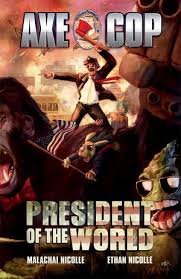
[READ: February 22, 2015] Axe Cop Volume 4
Like Volume 2, Axe Cop Volume 4 is a full length story. This one pushes the idea that came up in a previous book that Axe Cop is President of the World. For the writing of this book Malachai was 8 years old. It was at this point that I started to wonder how different the stories of an 8-year-old would be from those of a 5-year-old. Since my son is nine, I know that he understands the logic of storytelling a bit more and he even understands the internal logic of stories, so I assumed that Malachai’s stories would be more linear and less surreal.
And of course, the nature of a big graphic novel like this is that it must be linear and coherent.
I liked that the book opened with something we hadn’t seen before–Axe Cop is having a recurring nightmare about a talking gorilla.
But then we get down to business. As president, Axe Cop is going to live in the Gold House in the real Washington (not DC). But his real business comes down to one question–since he got rid of all the bad guys, the people want to know if they will ever come back. Axe Cop talks to God (!) and is told that they will come back in 1 million years, but until then it is time for peace in the world. (more…)
SOUNDTRACK: SPIRITS OF THE RED CITY-“Halfway Poem” (Tiny Desk Contest Runner-Up 2015).
Last week, a Tiny Desk Contest winner was announced. This week, All Songs Considered posted ten runners up that they especially liked. And I want to draw extra attention to a couple of them.
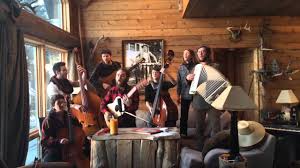
I know very little about these bands, but I assume that this folkie collective uses this kind of instrumentation all the time, although I have to suggest that two upright basses and a viola seems excessive. The beginning of this video shows an early aborted attempt with different instruments (accordion, banjo, flute, drum and ukulele), so that sounds promising–and honestly the overload of large strings doesn’t sound bad at all in the final product.
It’s interesting that bands with lots of members are a kind of trend–it’s so impractical. And yet when done well, it’s quite lovely. And when these seven folks starts singing along near the end of the song it’s really pretty.
The story of this video is also interesting. They had planned to film their video outside. But on the day of their video shoot it was 33 degrees below zero (in Minnesota). They have some brief footage at the beginning and then the video switches to them inside a quite cozy cabin.
It’s hard to tell from just this one song what kind of folk collective Spirits of the Red City is, but I enjoyed this song quite a bit.
[READ: February 20, 2015] Axe Cop Volume 3
Axe Cop Volume 3 returns to the format of Volume 1 (the one I liked better) with a mix of shorter comics and the return of Ask Axe Cop!
The first comic we see features the return of Bat Warthog Man and features the practical science of Chemist M (whom Axe Cop buys for ten dollars). It also has a chihuahua who was a soldier that was turned into a chihuahua when the soldier’s dog bit him (Malachai’s understanding of how transformations work makes me hope he never gets bitten by anything). The dog can turn back into a man “only when I am not ready to fight…which is almost never.” There’ also a hilarious scene where Axe Cop is inside the imagination of a mouse which is in color and is “full of unicorns and cheese.”
The Ask Axe Cops are more intense in these later variations, like the one that asks if he ever got in trouble (he got in trouble with his mom when he chopped the head off a rabbit who was not following rabbit rules). We also see the introduction of head trash–a place where all the heads that axe cop has removed are disposed. There’s dating advice (very sound); a jumping competition and a hilarious bit about Halloween (where he gets 1,051 candies to share with his friends, but the bad guys have poisoned 1,040 pieces of it. There is also Axe Cop’s strangely violent generosity on Thanksgiving (yipes). (more…)
SOUNDTRACK: REINA DEL CID-“The Cooling” (Tiny Desk Contest Runner-Up 2015).
Last week, a Tiny Desk Contest winner was announced. This week, All Songs Considered posted ten runners up that they especially liked. And I want to draw extra attention to a couple of them.
I know very little about these bands, so I don’t know if this is Reina del Cid’s normal band or what. But I love the sound of this orchestral chamber pop. There are plenty of chamber pop bands, but there’s something about the melody of this song that works so perfectly with the strings.
There are seven people in the video (Reina is the singer). I love the way the song starts out with some pizzicato guitar and slowly building violin strings. I also love the starts and stops that the song has–very dramatic. And it all works so well with Reina’s voice which doesn’t soar or hit super high notes, rather it is just powerful and strong and very pretty (even when she does an occasional mmm mmm).
When the song builds to its climax, the violins switch to pizzicato and the drums grow louder. It’s quite lovely and I’d like to hear more from her (them). I gather that the new album is coming out in May!
[READ: February 19, 2015] Axe Cop Volume 2
I enjoyed Axe Cop Volume 1 so much I couldn’t wait to jump into Volume 2. But something was different.
This book was made for Dark Horse as a three issue arc. It’s in color and it’s all one long story. Ethan is super proud of it, and I think he should be, it’s pretty impressive that he and his brother (now aged 6) were able to come up with such a huge story.
But I found that like the longer stories in volume 1, I got a little bored by the end of this book. Indeed, I let Clark read the first book (it was placed in the YA book section, but I figured if it was written by a 5-year-old, my nine-year old could read it). He liked the first book but only gave this one a few pages before he gave up. He likes Ask Axe Cop best too. (more…)
 SOUNDTRACK: BUILT TO SPILL CAUSTIC RESIN (1995).
 This is one of those CDs that I used to see all the time back when I shopped at Tower Records in Boston. Either they had a lot of copies of it or it was always at the front, or something. But I never forgot the title of this EP, which I only purchased a few years ago.












 I Just Read About That...