Feeds:
Posts
Comments

Archive for the ‘Work’ Category

SOUNDTRACK: LADAMA-Tiny Desk Concert #853 (May 30, 2019).

There’s a lot to like in this Tiny Desk, but I am immediately drawn to Mafer Bandola’s  bandola llanera.  Is it see through?  Is it hollow?  I have so many questions.

Some of which are answered in the blurb.

But what might be even more interesting than the instruments is the international makeup of the band.

During the course of their performance behind the desk, the four core members of LADAMA — Lara Klaus, Daniela Serna, Mafer Bandola and Sara Lucas — had a chance to display their individual cultural and musical roots as part of an engaging and mesmerizing whole. Represented in glorious musical virtuosity are Brazil (Lara Klaus), Colombia (Daniela Serna) and Venezuela (Mafer Bandola), with a dash of New York City (Sara Lucas and bassist Pat Swoboda) thrown in just to make it interesting.

Not to mention all four of them sing lead.

“Sin Ataduras” opens with great sounds from the bandola llanera and some really great bass work Pat Swoboda.  Daniela Serna sings, almost raps, the lead vocals.  The song is catchy with a middle parts that’s all rim shots from Lara Klaus and clap alongs.  Then Sara Lucas adds a little guitar work, but it’s Mafer Bandola’s solo that’s really fantastic.

For the second song, “Elo” Lara Klaus plays the pandeiro and it’s amazing how much sound a little tambourine-looking drum can make.  She also sings lead–a very different vocal style.  Daniela Serna moved over to the congas and the tambor alegre.  Mafer Bandola switches to a more traditional-looking bandola llanera but still plays some amazing leads.

Throughout the songs, Sara Lucas plays quiet electric guitar that acts a foundation to lead bandola.  Incidentally, Mafer Bandola is a stage name (I assume Mafer is her first names put together).  Her real name is Maria Fernanda Gonzalez.

“Tierra Tiembla” is a much slower ballad.  Sarah Lucas sings lead (in Spanish).  Has a slow, smooth rhythm with nice echoing sounds form the bandola.  Sara Lucas sings lead on this one.  Lara Klaus is back on the kit, so with her and Daniela on congas, there’s a lot of percussion.   Mafer plays some nice lead lines and everyone sings delicate backing vocals.

The final song is “Inmigrante”  this song is for everybody–para todos inmigrantes–we are all immigrants.

It’s the fiery “Inmigrante” that finally raised the BPM meter and got hips swaying in our corner of NPR’s HQ, with its call-and-response back-and-forth and a very enthusiastic audience. T

Mafer Bandola sings this last song.  The bandola is a echoed and very cool sounding as she plays an excellent riff.  The drums are mostly hi-hat while the congas supply most of the percussion.  Sara Lucas puts down her guitar to play the raspa.

The song ends with a clap along and some fast and furious congas from Daniela.

This is yet another great Spanish-language band that enjoyed quite a lot.

[READ: July 1, 2019] “A Love Story”

The Summer 2019 issue of The West End Phoenix was a special all comics issue with illustrations by Simone Heath.  Each story either has one central illustration or is broken up with many pictures (or even done like a comic strip).

Each story is headed by the year that the story takes place–a story from that particular summer.

1992: This is the story of tree planting and romance.  Claudia and her friend drove to the planting location with dreams of getting rich.

I have heard about tree planters from many different sources (it seems a very Canadian thing to do–I’m not even sure if people do there).  All sources suggest it is very hard, physically exhausting and pays little.  No matter how romantic the idea sounds, it’s not a fun job.

Claudia adds to this idea and includes that they slept in tents and were sleeping in an area where bears traveled.  They could hear the bears every night but the experience planters assured them they were safe (how does anyone do this long enough to become experienced?). (more…)

Read Full Post »

SOUNDTRACK: BETTY WHO-Tiny Desk Concert #861 (June 26, 2019).

I had never heard of Betty Who before this show and my word did she win me over.  She is so much fun, so entertaining that it makes me want to explore her music (and maybe even see her live show).

However,  Betty Who is an Australian cellist who plays dance pop music.

Her third LP, Betty, falls squarely in the … sun’s-out, buns-out pop genre.

I suspect that as with most of the pop stars who play quietly at Tiny Desk, I will probably much prefer these version to the original–so maybe I should just leave it here.

Some background

She grew up in Sydney, Australia, and started playing [cello] at the age of four (just like Yo-Yo Ma). Maybe it had something to do with her mom being in the room, but emotions ran high for the charismatic and chatty singer. “I didn’t want to be the girl who played cello and sang,” she told the crowd gathered to watch. “‘Cause that girl feels really far away from ass-out, sparkle-covered pop-star me.”

I would not have guessed her pop star ambitions as the first song starts with just her voice and cello.

When all the studio production is stripped away, what’s left are intricate melodies that soar through Betty’s impressive vocal range and relatable lyrics. As the audio engineer for the Tiny Desk concert series [Josh Rogosin], I’m always curious how the vocals will translate without the aid of pitch correction and tons of effects you hear on the album. I’m a sucker for great melody and Betty Who’s raw vocal performance at her Tiny Desk had me in a state of aural ecstasy.

It sounds fantastic.

She plucks the cello for the beginning.  She has a terrific voice, although she sings a little too pop for my full appreciation.  After the first verse, Myla Bocage adds some keyboard notes to flesh out the song.  After another verse, Jemila Dunham adds some cool bass lines.  Her bass throughout the show is pretty excellent.

After a chorus or two, she throws in a bowed cello solo which works perfectly (and sounds great of course).

After the song she is so bouncy and bright and energetic.

She tells us that she always wanted to be a pop star–she likes sparkles and have her ass out.  She wanted to be the love child of Beyonce and Britney Spears.  But she studied classical music since she was little.  She says, “I told myself I would commit to pop star life and dance and do what I always wanted to do and make that vision come true.  And then one day I’d just whip out my cello and say oh P.S. By the way.…  And this is the first time I’ve been able to do this.”

One of my favorite things about Tiny Desk concerts is that artists are often inspired to experiment. Betty Who was in town recently for a three-night residency at D.C.’s famed 9:30 Club where her sound was larger than life. The subwoofers cranked out backing tracks you could feel in your gut and dancers flanked the pop star, punctuating every pulsating beat. But she began her Tiny Desk performance with only her cello and her voice — the first time she’s ever accompanied one of her original songs with the instrument.

Song two is “Friend Like Me,” which is one of her favorite songs she’s written.

She wanted to wrote a song that said, I love you but you make me fucking crazy and I want to punch you in the face or I love you so much but you’re your own worst enemy and you’re taking yourself down.

It’s just her on the acoustic guitar and her voice is really lovely (less loud and poppy)  After a couple of verses Bocage adds some keyboard twinkles.  Some bass fleshes out the song, but it remains a very pretty ballad.

Before the final song, “I Remember,” she introduces the band and says “Ian Barnett on the [drum] pad.  You should come see us, he does much more than this.”

Betty Who says she dreamed of having a Tiny Desk concert ever since she was a teenager. She chose to end hers by asking everyone to sing along to the track, “I Remember.”

Dancing under the stars
Kissing you in the dark
I remember your love, oh
Never giving you up, giving you up, oh.

I love that she gives hand motions and massive encouragement as she teaches everyone the words.  She says she has three plants in the audience.  They’re going to sing loud and you can all mumble along if you want.

She says this song is about real couples “not kind of Instagram we love each other so much.  People who don’t fight, ick, what is that.  The best couples know each other the best and can push each other’s buttons.  It’s an amazing feeling to love someone so much but also want to strangle the life out of them,  They make you the most crazy, but that’s what makes you love them so much.

Betty’s reaction to their singing is wonderful.

She’s great and I hope she starts selling bigger venues.

[READ: July 1, 2019] “Bad Dream Job”

The Summer 2019 issue of The West End Phoenix was a special all comics issue with illustrations by Simone Heath.  Each story either has one central illustration or is broken up with many pictures (or even done like a comic strip).

Each story is headed by the year that the story takes place–a story from that particular summer.

1978: Dave Bidini got his first job working in a record store at the Albion Mall (made famous (to me) in the Rheostatics’ song “Jesus Was Once a Teenager Too”).

It was a dream job–that’s where he bought his 45s and LPs.  It was right across from an Orange Julius! (more…)

Read Full Post »

SOUNDTRACK: CHRISTONE “KINGFISH” INGRAM-NonCOMM (May 16, 2019).

Generally speaking, I don’t like the blues.  I think it’s pretty boring music-wise, with most songs sounding vaguely the same, especially on record.  I would never go to a blues show on purpose.  However, if all blues shows were like this one from Kingfish, I’d go to a lot more.

Christone “Kingfish” Ingram a Mississippi guitar player has a lot of hype around him (XPN loves him) and while I haven’t enjoyed the songs they’ve played, this set was stunning.  And when you learn how old he is, it’s even more incredible.

Ingram’s otherworldly guitar playing and ridiculously rich voice make it hard to believe that he is only twenty years old. He is clearly aware of the absurdity of his talent given his age, as he sings “they say I got an old soul and I ain’t even 21.”

He opened with “Before I’m Old”, off his debut album Kingfish.  The song opens with a lengthy guitar solo and lyrics that are basically an autobiography.  When I was younger, I used to rate guitar players by their soloing skills.  I don;t do that anymore.  In fact I don;t really care if there are solos in songs these days.  But I do still enjoy a guitarist who can play a wicked solo live.

I don’t care much about the structure of “Before I’m Old” because it’s all about the jamming solo he plays.  The great part of the solo is the tone he gets.  It’s just him and a bassist (and a drummer), but it doesn’t sound like a bassist playing notes and a guitarist soloing independently.  His guitar is full enough that it sounds like a bigger band.

But his skills are really tremendous.  He seemingly casually busts out a minute and a half solo mid-song that is exciting and full of passion.  There’s basically two verse sin this five minute song which ends with a little nod to Jimi Hendrix.

Next came “Fresh Out”, which Ingram started solo. Eventually he was joined by his bassist and drummer, but his solo verse demonstrated that in a way, they’re just extras; he can carry this all on his own.

This is a slower, classic blues song about having no love.  But it’s all about the three and a half minute solo.  In the middle of it, he quiets everything down while playing a slow, moody passage while the band is almost silent, playing just enough to keep the song going while Kingfish jams.

The final song, “Out of This Town” is the one I’ve been hearing on the radio.  It’s catchy in a classic bluesy way, but I never thought much about it.  I do like the five note hook and pause just before he sings “out of this town” but otherwise it was just a blues song.

But this live version was a revelation.

Ingram stretched each of his tracks out, squeezing every last drop of possibility out of them. He stretched them so much that he was only able to fit three songs in his twenty minute slot. Like with the two before it, Ingram led “Out of This Town” into an explosive electric blues epic.

This song stretches out to 9 minutes, five of which are the guitar solo.  In the wrong hands, a five minute guitar solo can be an interminable wank-fest.  But Kingfish makes it interesting–you actually don’t want the song to star up again because the guitar is so good.  And yet, when his sings, his voice is deep and rich as well.

This show may even get me to enjoy the song more the next time I hear it on the radio.

[READ: June 1, 2019] “In the Hay”

This essay is a fascinating insight into manual labor, immigration and alcohol.  All in three columns of type.

In 1959, Wolff looked for summer work on the farms along the Skagit River near Seattle.  Wolff was fourteen and kind of small, so he worked at a farm for a bit and then moved on.  Then he met a farmer who paid him better and treated him well, so he settled in.

The more permanent field hands bucked hay, but Wolff was not strong enough to do that, so he hacked weeds or shoveled shit. He would pause from time to time, catching snippets of conversation on the wind.

The following summer he returned bigger and strong and he joined the hay crew.  The crew was four people: Wolff, Clemson, the farmer’s nephew and two Mexican brothers, Miguel and Eduardo. (more…)

Read Full Post »

SOUNDTRACK: THE TALLEST MAN ON EARTH-“I’m a Stranger Now” (2019).

I’ve enjoyed The Tallest Man on Earth and I’ve been looking forward to seeing him live for a while.  I’ve actually had really back luck with his tours.  One time something came up on the night I was supposed to see him.  Another time he had to cancel his tour.  But, with luck, I will get to see Kristian Matsson live.

The Tallest Man on Earth sings simple folk songs.  The greatness of his songs comes from his voice and delivery.  There’s something about his voice and his style that is steeped in American folk, but the fact that he’s from Sweden changes his outlook and his accent.

This song from his album I Love You, It’s a Fever Dream follows in the style he is known for–spare, simple melodies and his often wordy lyrics.

Starting with fast acoustic chords (played high on the neck), Kristian begins singing in his familiar but unique style.  The bridge ends with a fast vocal melody that is a pure hook that leads to the singalong titular chorus.

After three minutes, the song slows down to a quiet guitar melody and near-whispered vocals.

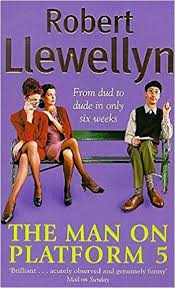
[READ: May 1, 2019] The Man on Platform 5

I know Robert Llewellyn from the show Red Dwarf, of which I am a huge fan.

In fact, I didn’t know anything about this story, but I figured if Kryten wrote it, it must be good.  I had read his memoir, the wonderfully titled Thin He Was and Filthy Haired, and I was sure I had read this at the time as well.  But evidently not, because when I started flipping through it I realized I didn’t know a thing about this story.  I also see that he has written quite a lot more in the last two decades.

It seems fairly obvious from the get go that this story is a gender reversing story of Pygmalion or My Fair Lady.  Instead of a man trying to improve a woman, in this story, a woman is trying to “improve” a man.  In some ways it’s very modern and progressive and in other ways it’s pretty stuck in gender stereotypes.  But hey it was the 90’s, before writers were enlightened.

The man who needs bettering is Ian Ringfold.  He is a trainspotter!  (I love that Llewellyn made that his hobby as I have heard of it but never knew exactly what it entailed).  He loves obscure facts, dry goods (he works in a supermarket) and being incredibly dorky.  He is deeply into what he likes and genuinely can’t understand why other people wouldn’t like those things.

Enter Gresham and Eupheme.  They are half-sisters and have spent pretty much their entire lives squabbling.  Their train breaks down on the same platform that Ian is currently trainspotting.  Eupheme, the more humane one of the two, bets Gresham that she can turn this sad “anorak” into a “useful member of society.”  Gresham says it cannot be done.  Eupheme (who is short on funds) says that if she can turn this loser into someone that Gresham would fancy that Gresham would pay her a tidy sum.  (more…)

Read Full Post »

SOUNDTRACK: A-Hi-Fi Serious (2002).

Many bands are hard to search for online.  A may have topped the roster of most unsearchable bands (they were named in 1993 way before Google was even a thought and when they would be at the front of record store racks).  A are also the alphabetically first CD I own.  So my collection literally goes from A to Z

A are a band from Suffolk England.   They formed in 1993, broke up in 2005 and have been sort of reuniting off and on every since.

Their second album A vs. Monkey Kong was well received and this, their third album had a solid single in “Nothing.”  I’m not sure how I heard of them (probably well reviewed in Q magazine back in 2002) so I grabbed this album.  This album comes with a Quicktime video!  When I learned about this band back in 2002, scads of information were not available about them.  So as I was looking them up I learned all kinds of things about them (like that they cite Rush as an influence).  And that this album name comes from the name of the hi-fi electronics store Alan Partridge buys a stereo from in the last episode of I’m Alan Partridge series 1.

This album is pretty punky/grungy.  Lead singer Jason Perry has a distinctive voice with some good power.

There are all kinds of hit-making elements in here.  Big crunching guitars coupled with soaring vocals dominate most of the songs, like “Nothing” and “Pacific Ocean.”   “The Distance” also revels in the grunge punk guitar sound with a totally metal guitar solo

Songs like “Something’s Going On” have a distinctly pop-punk bratty sound.  So does “Starbucks” with the line: “don’t wanna get a job at Starbucks”  The title track also works in this snarky, funny, catchy vein.

“Six O’Clock” mixes some cool electronics in the verses while the chorus is, once again, big and catchy.  “Going Down” has a much smoother sound with anything distinctive coming from his vocal delivery.

“Took It Away” does the quiet/loud verse thing very well.  Some deliberate glitching is a fun surprise too.  While “The Springs” introduces acoustic guitar and lots of oohs–a real flick-your-lighters kind of song.  “W.D.Y.C.A.I.” is also catchy with a sing along (woah oh) bridge and a super poppy chorus.

“Shut Yer Face” sounds like the quintessential grunge song–snarky lyrics, big grungy guitars, and a soaring chorus.  It even has vulgarish lyrics, record scratching and other samples!  And man is it catchy.  If this didn’t crack the States for them, nothing would.

[READ: April 15, 2019] “Djinn”

I was shocked to see that Esquire had published a story by Russell Banks in both March and June of 2000.  I was also shocked to see that a man gets shot in this one as well (that’s four of the first five stories in Esquire in 2000 in which someone is shot).

This is a story of a man who works in Hopewell, New Jersey.  They manufacture and sell women’s and children’s high end rubberized sandals.  The sandals were manufactured in Gbandeh, the second-largest city in the Democratic Republic of Katonga, a recently desocialized West African nation.

One of his jobs was to travel to Gbandeh and make the acquaintance of the local managers with hopes of facilitating communication.  And of course to make sure the Katongans could adapt the the fast paced technology in place. (more…)

Read Full Post »

(Field Recordings, January 12, 2012). 

This is a lengthy Field Recording [Mantra: Post-Minimalist Percussion In Aisle 12].  It has some interruptions by one of the guys.  Then he talks about how they have set up the board–suspending it on pegs.

There’s something primeval about guys banging on wood. But the New York percussion group Mantra takes such primitive pounding to a surprisingly refined level. For composer Michael Gordon’s mesmerizing new work — Timber, written for six two-by-fours — Mantra set up a public performance of the piece in the lumber department of a big-box hardware store in Alexandria, Va. Who knew 60 inches of processed pine could sound so good?

It’s unclear how long the piece is since there are constant interruptions.   Although it does run for about 2 and a half minutes uninterrupted.

For the most part the six players play a constant rhythm that creates overtones and resonances.  It’s a little monotonous until one of the starts to play a slightly different rhythm.  And by the end, there’s a couple of different rhythms that make it sound even better.

It’s a neat piece and would be fun to walk unto a hardware store and see that.

[READ: January 22, 2018] “Elf-Cio”

This is from a children’s book called Elves for Dignity.  It was published by a worker’s cooperative in Buenos Aires–one of 170 worker-run businesses in Argentina. The piece was translated by Burke Butler.

Once upon a time there was a greedy and merciless King.  One morning he awoke with the idea of converting one of his palaces into a hotel.  He hired a legion of elves whom he considered selfless and docile. They all abandoned their markets and farms to serve the King.

They worked night and day to ensure the splendor of the hotel. (more…)

Read Full Post »

SOUNDTRACK: BRANDEE YOUNGER-“Hortense” (Field Recordings, June 6, 2013).

I had never heard of anyone playing jazz harp before.  At first I thought that it was just going to be harp music with an upright bass giving it a jazzy feel, but no.  Younger is playing a beautiful lead melody on the harp while Dezron Douglas’ upright bass adds a real boho jazz element.  Basically, this is in no way new age harp music.

But this Field Recording [Brandee Younger: Taxidermy, Two-Headed Skeletons And Jazz Harp] seems to get more than a little distracted by its surroundings.  And who can blame the filmers?

Among the vestment racks, satchel purveyors and art galleries of New York’s SoHo neighborhood lies a small merchant unlike its neighbors. It’s called The Evolution Store, and it peddles, um, natural-history collectibles. You know, preserved insects, taxidermy, skulls and bones, remnants of marine creatures. It’s as if a museum ran out of space and started putting its sloths and tarantulas in the gift shop.

We’re not quite sure what any of this has to do with Brandee Younger [who doesn’t know a sloth when she sees one], though she is a rare breed in her world: a jazz harpist.

A bit more about Younger:

She’s classically trained, and plays her share of freelance and wedding gigs — in her C.V. are recordings for rappers Common and Drake — but like predecessors Alice Coltrane and Dorothy Ashby, she’s also developed a way to improvise and truly groove on the harp.

I really enjoy the minimalism of this piece.  I am quite fond of the harp. So I’m intrigued to read:

With a full band, the song heard here, “Hortense,” takes on a distinct Caribbean bounce, a one-drop reggae beat anchoring Dezron Douglas’ bass line. Stripped down to a duo, it wafts and glides, all arpeggios and plucked wires.

I’m not sure I would enjoy the full band version as much, so I’m glad I got this one–bizarre as the surroundings may be.

[READ: January 25, 2018] “Willows Village”

This is the story of Guillermo, call him Billy, who has moved to Santa Ana to live with his Aunt Maggy.  Billy has a wife and a child in El Paso, but he doesn’t have a job and he thought he could move to a more wealthy part of the country, get a job and send a lot of money home to his family.  His Aunt Maggy is his mother’s sister and while he has heard a lot of gossip about her, he will still ask for the favor of her hospitality.

He hasn’t seen her in years and he is surprised at how good she looks–she’s actually pretty hot, which he finds disturbing but true.  And she welcomes him with open arms.  She gives him a room and whatever food or drink he wants.

Maggy proves to be quite the character  She drinks.  A lot.  She has a ton of money–when she opens her purse to pay a delivery guy, money just falls out of it.  And she seems to eat one bite  of food and store the rest in the fridge, until it spoils.

She tells Billy that Lorena is also staying with her.  She is a good friend and has been having marital trouble, so Maggy put her up in the guest room.  She put Billy–Guillermo she will call him–in her “playroom,” a pink room with dolls and make up boxes and photos.  It was weird. (more…)

Read Full Post »

SOUNDTRACK: ANTHONY ROTH COSTANZO-Tiny Desk Concert #789 (September 21, 2018).

The first thing you see when you look at this Tiny Desk Concert is the amazing harpsichord–large and decorated like an old-fashioned leather-bound book.  It is stunning.

But you’re only likely to notice it if you haven’t first heard Costanzo’s voice and then had a look at him.

A word about Costanzo’s voice. He is a countertenor, a man who sings in the range of a female alto. The roots of the tradition date way back to the 1500s, when young male singers, called “castrati,” were castrated in order to preserve their high, flexible voices.

“I’ve managed to do it without castration,” Costanzo joked to the audience of NPR staffers. These days, countertenors sing in falsetto, and while as recently as 30 years ago it was considered something of an androgynous novelty, now countertenors are part and parcel of the opera world.

The music is exceptional and is wonderfully modern with that classical feel that opera naturally seems to add.

Costanzo performs songs from his new album, which pairs music by George Frideric Handel with Philip Glass. Strange bedfellows perhaps, and born more than 250 years apart, but somehow Glass’ repetitive, staccato beats and Handel’s long, flowing melodies manage to shake hands across the centuries.

The first piece is by Philip Glass.  And the music sounds like perfect chamber pop.  The flute plays the Glassian up and down melody while the bassoon plays the wonderful, peculiar bass notes.

One obvious common thread is the arrangements, by Nicholas DeMaison, that Costanzo commissioned expressly for this performance, featuring harpsichordist Bryan Wagorn (playing a beautiful double-manual French-styled instrument built by Thomas and Barbara Wolf), along with flutist Alice Teyssier and bassoonist Rebekah Heller.

Glass’ “Liquid Days,” begins with a recitative introduction, similar to a Handel aria. But the lyrics, by David Byrne, depict love, in all its quotidian splendor.

It is somewhat strange to hear a countertenor (or even if he were a female singing alto) singing lyrics in English.  His voice is truly amazing.

It is even more peculiar to hear the word “television.”  But Byrne’s lyrics are pretty awesome:

We are old friends
I offer love a beer
Love watches television

Love needs a bath
Love could use a shave
Love rolls out of the chair and wiggles on the floor
Jumps up
I’m laughing at love

And all the while Costanzo’s voice sounds operatic, serious, significant.

Costanzo’s agile voice, with its polished tone and patrician phrasing, is a singular reminder that we live in a golden age of countertenors – guys who sing high in music both ancient and modern.

Up next is Handel’s “Pena tiranna” (From ‘Amadigi di Gaula’) which means, I have a tyrannous pain in my heart and I can never hope to find peace.  It opens with harpsichord and bassoon, a wonderful combination.  The flute then enters to play a harmony with his voice.

“Pena tiranna,” from Handel’s undervalued Amadigi di Gaula, is a compelling example of how well the composer can spin a gorgeous melody to evoke the deepest anguish.

The final piece is from Glass: “In the Arc of Your Mallet” (from ‘Monsters of Grace’)” which has a text by the 13th-century Persian poet Rumi.  It speaks of longing in sexy undertones.  He says that in this translation brings out the strange, layered longing–sometimes dirty–meaning under the surface.

Anthony Roth Costanzo is a feisty performer who knows a thing or two about busting down barriers in classical music. After all, opera singers don’t normally belt out arias behind office desks, and they don’t insist on lugging harpsichords with them. They also don’t routinely sing in Bronx middle school classrooms and get students talking about emotions. But Costanzo is fearless. (And after seeing this amazing Tiny Desk performance, watch him melt the hearts of distracted sixth-graders.)

[READ: January 9, 2017] “The Driver”

I never anticipated where this story was going.  And the direction it took to get there was really interesting.

It begins with the story of Mrs Quantrill, a respectable woman who managed to get their house listed on the Nation Register of Historic Places.  She and her husband were philanthropists and they threw legendary parties.

There’s an aside that says when their son Spencer inherited the house, he demolished it and replaced it with storage units.

But at the time of this story Spencer is 9 years old.  And Mrs Quantrill has been called into the principal’s office because Spencer is struggling.  Spencer is nervous and doesn’t know what to do with his, feet, his eyes or his hands. (more…)

Read Full Post »

SOUNDTRACKAGES AND AGES-“Divisionary (Do the Right Thing)” (Field Recordings, August 28, 2014).

I really like this song.  I’ve heard several recordings of it.  The studio version, the Tiny Desk Concert, the one with the Northwest Children’s Choir and now this one.

Once again, done during the Newport Folk Festival, this Field Recording [Ages And Ages, Singing An Anthem For (And With) Everyone] corrals a band into a small, unused space. In this case, that space seems to be an unused room.  And in that small room, the band is joined by The Berklee Gospel and Roots Choir.

Bob Boilen says:

I’ve seen many magical collaborations at the Newport Folk Festival over the years, as artists band together and create in the Newport spirit. This particular venture was epic, featuring the strongest anthem of the year — by the Portland band Ages and Ages — and the voices of the Berklee Gospel and Roots Choir.

This song always sounds better with a big chorus of singers.  There’s not much to it, but the full body of voices can lift anyone;s spirits.  Especially when they start singing various different melodies on top of each other.  It’s quite lovely.

Ages and Ages played near me recently and I thought about seeing them and then I realized that this is the only song I know by them!

[READ: January 2, 2017] “How Can I Help?”

This is a story about a woman and her sister.  But the way the story is revealed is really wonderful.

It begins: “Consider Hayley, our hire of two months, a relative endurance run.”

The narrator bemoans Hayley’s decisions, like spending $4.25 (roughly 31 minutes of work at her salary) each day on a skim latte coffee from an unnamed retailer even though their office offers the same coffee in-house for free.

In the second paragraph, she says “I like and admire Hayley, she is a team player.  I don’t judge.  But I have of late been tempted to judge.”

And that’s when she reveals that perhaps her objectivity is clouded because Hayley is her sister. (more…)

Read Full Post »

SOUNDTRACK:  YO-YO-MA-Tiny Desk Concert #777 (August 17, 2018).

One needs to say very little to introduce Yo-Yo Ma, probably the most famous cellist in the world.  He is here because he has recorded Six Suites for Unaccompanied Cello by Johann Sebastian Bach.  Again.  For the third time.

Obsessed or awestruck, artists revisit great inspirations because they believe there is yet another story to tell – about life, about themselves.  Cellist Yo-Yo Ma brought his great inspiration, and in turn part of his own life story, to an enthusiastic audience packed around the Tiny Desk on a hot summer day. Ma is returning, yet again, to the Six Suites for Unaccompanied Cello by Johann Sebastian Bach, a Mount Everest for any cellist. He has just released Six Evolutions – Bach: Cello Suites, his third studio recording of the complete set and is taking the music on a two-year, six-continent tour. Ma’s first recording of the Suites, released in 1983, earned him his first Grammy.

Certainly one of the most brilliant cellists of modern times, he’s also a thoughtful, curious humanitarian, with an endless thirst to understand, celebrate, and connect disparate cultures of the world.

He plays three pieces from the Suites

J.S. Bach: “Prelude (from Suite No. 1 for Solo Cello)”  It is so beautiful and familiar, it sounds amazing on his cello.  he says “This was the very first piece of music I started on the cello… when I was 4 years old.  One measure a day.  It’s not painful to learn something incrementally.”  He describes how he recognized that the second measure was similar to the first and the third was just a variation.  He says, “I lived with this music for 58 years (plus 4, that’s my age).”

Ma has played the music for 58 years and along the way it’s become something of a practical guide to living, pulling him through hardships and celebrating times of joy. “It’s like forensic musicology,” Ma told the Tiny Desk audience. “Embedded in the way I play is actually, in many ways, everything I’ve experienced.”

J.S. Bach: “Sarabande (from Suite No. 6 for Solo Cello)”  The sarabande comes from many places.   All of these places have claimed it:  Guatemala, Mexico, Moorish Spain, via Portugal or Morocco.  He says the sarabande is the heart of the suites.

It has served dual purposes, Ma explained. “I’ve played this piece both at friends’ weddings, and unfortunately also at their memorial services.”

J.S. Bach: “Gigue (from Suite No. 3 for Solo Cello)”  He says for the last piece at the Tiny Desk, I’m going to play a tiny jig.  He says Bach goes from old dances to folk or popular dance.  Here is this German composer working a jog into the third suite.

The exuberant “Gigue,” from the Third Suite, with its toe-tapping beat, reminds us that Bach was far from a stuffed wig. Such is this sturdy, versatile and benevolent music, offering a full range of the human condition.

Ma is happy to teach the listeners what he is doing, to share the joy and love of music.  Sometimes literally

As soon as he arrived at our office to play, Ma unpacked his cello – a famed 1712 Stradivarius – and immediately handed it over, with his bow, and said, “Here play something.” It didn’t matter that I’d never held a cello. It was just another one of Yo-Yo Ma’s warm and welcoming gestures, another way to open up music to anyone and everyone.

It’s all beautiful!

[READ: August 27, 2018] “Ways and Means”

This story tackles sexual harassment at the workplace from an interesting angle (and is written in a great, fluid style that makes the story utterly compelling).

Hal (short for Haley-Ann, a name she always hated) is an engineer at a public radio station.  She was one of the first women to work in such a position and has been there for over a decade.  The story opens with her reading a public apology from an on-air personality, Oliver.  Oliver had worked at he station for over three decades and was a huge draw for both audience and pledges.

The apology went to everyone’s inbox and then went public.  She felt it was trite with words that he, Oliver, would never have said in real life like invalidated).

The accuser was unnamed but everyone in the building knew it was Molly, a 26-year-old podcast producer. (more…)

Read Full Post »

« Newer Posts - Older Posts »