Feeds:
Posts
Comments

Archive for the ‘Word usage’ Category

SOUNDTRACK: “Grim Grinning Ghosts (The Screaming Song) Disney’s Haunted Mansion ride (1963).

When producer/musicians John Congleton was a guest DJ on NPR, he played some expected and then some very unexpected songs. The most surprising (although it does make sense) was this song from the Disney Haunted Mansion.

Maybe this song is the reason why he likes the dark so much.

It’s a fun bouncy song, like most Disney stuff it’s hard to believe anyone was really afraid of it, and yet as a kid, that voice and those sounds could certainly be frightening.  The song has all kinds of sounds in it–keys, tubular bells, xylophone, hammered percussion marimba, and a lot of backing vocals.  And of course the amazing vocals (and laughs) Thurl Ravencroft and others.  There’s also great effects with analog tape.  He also points out that the chord progression is quite chromatic: A to B flat to B which is jagged and close together and not easy to listen to.

Congleton says (listen around 34:50):

The vocals are done by Thurl Ravenscroft, who was the voice of Tony the Tiger and the Grinch. I mean, This is Tom Waits before Tom Waits. When I was a kid, I was so attracted to this song, but I was scared of it. The record would sit with my other records and I would see it in there, and I would be like, ‘Do I have the bravery to listen to it right now?’ And sometimes I would, and I was mesmerized by it. But the then I grew up, and I went back and listened to it, and was like, ‘This is brilliant. This is really, really well done.’ I never in my entire life heard background vocals that sounded as tight as that. Never in my life. The harmonies are the tightest harmonies I have ever heard ever. And it’s like, this is for a silly kid’s record — but they were committed to making something special. Everything about that song is incredible to me.”

And yes, it is a silly song, but the recording is really impressive.

[READ: April 20, 2017] Why Is This Night Different from All Other Nights?

It has been almost two years since I read Book 3.  The fact that I’ve had book 4 all this time and simply not read it was not a good sign.  And, ultimately, I found this story ending to be strangely annoying, vaguely compelling and ultimately unsatisfying.

This book mostly follows young Snicket on his solo mission.  He awakes in the middle of the night to see his chaperone S. Theodora Markson sneak out of their room.  He follows her to a warehouse where she steals something and then to a train.  She boards but he is unable to.

The train used to make stops in town but it no longer does and Snicket jumps on board at the only place he can think of).  While he’s hanging on the outside of the train, Moxie drags him in through the window.  That’s about the first third of the book.  It was nice to have another character for him to talk to.

Then a murder happens (this is a pretty violent series for kids).  And the blame is laid at the wrong person’s feet. (more…)

Read Full Post »

SOUNDTRACK: RHEOSTATICSFall Nationals The Horseshoe Tavern Toronto, ON. Night 3 of 13 (November 12, 2003).

This was the 3rd night of the Rheostatics 13 night Fall Nationals run at the Horseshoe.  Rheostatics Live has recordings of nights 1, 3, 4, 5 and 7.

As the show starts, Tim says, “Thanks for coming out.”

So Dave replies, “Why, you’re welcome, Tim.  I was doing nothing else so I figured why not play a little drums, a little bass, a little guitar.”

“Here Comes The Image” opens the show (Dave is on drums for this).  It’s slow with lots of cool keys from M.P.W.  The sound quality fades dramatically about 3 minutes in.

Dave explains, “That was an epic song by Tim Vesely.  We’re gonna do another epic song now.  Epic means just long basically, and grand.”  It’s “Oneilly’s Strange Dream.”  Which Dave describes as a song that “was supposed to the be the equivalent of an Edgar Rice Burroughs book.  He’s the guy who wrote Tarzan.  Not to be confused with William S. Burroughs–an urban jungle thing still a lot of guys with no shirts on.”  Martin: “I hate those guys.”

Martin repeats the first verse.   There’s some great powerful drumming in the middle of the song.  The sound levels go back up during this song.

The final notes are a little cockeyed and you hear someone re-sing “pile of bones laying at my side” with that bad chord.

They play Woodstuck “with a drum fill.”  Dave says it’s an old song and someone asks him what it’s about.  Dave tells a story about touring in 1987 and he tells a strange story about a merch guy.  It’s pretty strange and ends with: that’s a song about Brett.  We left him in Calgary naked, quivering under the bed.  Tim says “we didn’t leave him, we gave him to another band: Pigfarm.

Mike notes that “that story was on the set list.  That was a tune.”

Next they play a new song (from 2067), “The Latest Attempt On Your Life.”  It seems they haven’t quite figured out the backing vocals live yet.  “CCYPA” rocks and then they settle things down with “Introducing Happiness” and “Power Ballad for Ozzy Osbourne” (with no ending howl from Martin).

Dave says this is our 3rd annual Fall Nationals.  Mike asks if there is a theme for this night.  No, but one might emerge.

Mike says, “A bolt of lightning struck exactly one block from my house this evening.”  (Dave makes an allusion to Frank Marino of Mahogany Rush (who “inherited the soul of Jimi Hendrix”).

They play a sweet version of “It’s Easy To Be With You,” about which Dave says, “Boy is this song ever about cocaine.”

Next Thursday is an all covers night, so they’re going to do some tonight to make sure they know what they’re doing.

They play Simon & Garfunkel’s “The Only Living Boy in New York,” which I don’t know at all. Martin sings and plays gentle guitar.

Then they start joking about “Old Garfunkel, eh?”

He walked across America with just a credit card…it’s true.  Talk about time on your hands.  I thought it was a knife and a rope.   I heard it was credit card shoes.  Shoes made out of old credit cards.  That was his last album Credit Card Shoes.

In Edinburgh we listened to Scissors Cut about 20 times.  Weirdest album ever made.  Scissors cut and yet the hair remains.

They finally get to a quiet “Palomar” with limited backing vocals.

Somebody in the audience says “I heard you guys have a synchronized soft shoe routine.”  Tim says,”we’re waiting for that to become an Olympic event before we unveil it.”  Dave says, “I couldn’t remember if it was black square white square or white square black square.”

Martin introduces “Self Serve Gas Station”: Take it away Dave.”  But Dave plays “Roll Another Number” bu Neil Young which segues in to “Self Serve.”  The quiet guitar section at the end segues beautifully into “California Dreamline.”

They play a cover of The Clash’s “London Calling,” which sounds great although Dave is a little not angry enough.

People shout out “Michael Jackson”  Martin: “pleased to announce that Michael Jackson is in the audience tonight.”

Then after lots of ums there’s discussion of what to play. Martin in HAL’s calm voice “Why not both, David.  Let’s do both.”  They play “One More Colour,” but then go to an encore break.

Thanks all.  “Frozen rock pose.”  Dave: “We are Frozen Rock Pose.”

We have a few more for you—Dave sings “My First Rock Show” and gets the wrong verse!  He also sings “I ‘sore’ [sic] everything.”  Tim calls him on that.  At “swan dived,” Mike plays a thunderous drum and Dave recites a spiel:

The drums of war were in the air yet they were peaceable times.
And you saw a band like Yello and found out that they sucked and it didn’t cost you $85 to find out.  No $21.50.  Trixter, Heart, The J Geils Band.    Meat Loaf, Blue Peter, The Spoons.  A Flock of Seagulls.  No A-ha did not play.  OMD  OMD, baby.  Oingo Boingo at the first Police picnic.  To Martin: Are those guitar sounds a flock of seagulls?  Dave: they were the best, not the best but they were good.

Where to?  A Flock of Seagulls.  No Tim will do a Warren Zevon song.  called “Reconsider Me.”  I don’t know it.  He sings very high and off a bit.  He groans but then by the middle he says its coming to me and he finished okay with a “Sorry, Warren, I tried.”

We’re here til next Saturday and tomorrow night is guest vocals night.  We have 26 guest vocalists.  We better get in the habit of thanking our guests.

Andrew Houghton played tonight.  And Serena Ryder the next two nights held over by popular acclaim.  They end the with a poppy “In This Town.”

[READ: January 25, 2017] The Ugly

I read a review of this book that made it sound really compelling and strange.  And the back of the book has some of that compelling strangeness in the blurb:

Muzhduk the Ugli the Fourth is a 300-pound boulder-throwing mountain man from Siberia whose tribal homeland is stolen by an American lawyer out to build a butterfly conservatory for wealthy tourists.  In order to restore his people’s land and honor, Muzhduk must travel to Harvard Law School to learn how to throw words instead of boulders.

And that is exactly what happens.  Along with a bunch of other strange things.

I enjoyed the way the story was told.  There are basically parallel narratives.  One is told in first person and is Muzhduk’s life after Harvard (perhaps the present), the other is told in third person and is all about his life at Harvard law school.

But the story begins with the Dull-Boulder Throw.  In his village a chief is determined by who can catch (and throw) a boulder hurled at your chest.  Muzhduk the Ugli the Fourth is the next in line for the throne–his ancestors have all been leaders–but he is the smallest of his lineage being only 300 pounds.

Nevertheless, he knows he must defeat Hulagu who was inbred huge and dumb.  If Hulagu won, the tribe would suffer.  And so for the good of the tribe, he win the Throw. But the second part of becoming chief was climbing the tallest mountain.  Each of his ancestors had climbed a taller mountain, and now his task was trying to find one taller than the tallest one around here. (more…)

Read Full Post »

SOUNDTRACK: RHEOSTATICS-The Cabana Room, Spadina Hotel, Toronto, ON (December 23 1983).

This is “Rheostatics and Trans Canada Soul Patrol 1983 at The Cabana Room – Spadina Hotel Christmas Party show. Amazing sounding recording considering it is from 1983.”

As far as I can see it is the only recording of the band with the Trans-Canada Soul Patrol.  And that basically means that it’s a lot of these early songs only with saxophone–lots of saxophone (it seems like only one member sof The TCSP is there).  According to a cassette recorded in 1984, the band was:

  • Drums – Dave Clark
  • Guitar – Dave Bidini
  • Tenor Saxophone – Charlie Huntley, Dave Rodenburg
  • Trumpet, Flugelhorn – Ray Podhornik
  • Voice, Bass – Tim Vesely

So it seems likely that it was a similar e lineup in Dec 1983.  I only hear guitar bass and drums, but I can only hear one sax.  And does that mean that Tim was the main singer back then?

This show is loose, dare I say sloppy.  There’s a total drunken party vibe going on, as befits a Christmas Party.  But the most notable thing is that sax–soloing all over the place.  Dave Clark gets a lot of shout outs during the set–trying to get him to do a solo or “lay the groove.”  Before “Thank You” (the Sly and the Family Stone song), Dave tunes his guitar with harmonics and someone “sings” Rush’s “Xanadu” briefly.  The band puts a massive echo on the first chorus–it’s pretty obnoxious.  And in the middle of the song Dace Clark starts chanting songs: “Fly Robin Fly,” “You Should Be Dancin'” and “Convoy.”

During “Chemical World” someone asks “What do you think Ronald, am I better off dead?” and then there’s a shout out: “show us your teeth, Paul.”  (None of these guys are in the band, right?).  Someone jokes that Clark is still playing drums even though his mom said that playing drums is not a career.

It’s unclear what’s happening or how serious the band is but they tell people “watch out, guys, you broke a fuckin’ beer bottle, okay.”  They introduce “The Midnight Hour” by saying it’s a song written by Wilson Pickett called, “Go Fuckin’ Nuts, no I don’t know what it’s called.”

This is the only recording I know of with “Big in Business,” which they describe as “something marketable.”  And after two shows where “Man of Action” gets cut off, we finally get to hear it to the end.

By the time they do “Louie Louie” the whole thing is a drunken mess.  There’s shouts of Merry Christmas, comments about it being the last  time they’ll play in 1983, calling people up on stage.  It sounds like Clark is looking for his girlfriend.  “Louie” is a massive party jam with all kinds of people singing along, including a woman with a very high singing voice, and someone going “shock” like Peter Gabriel’s “Shock the Monkey” after each “Louie Louie” line.

The set seems to be over but then some one encourages them to sing “Shake Yer Body Thang,” which they do with lots of screaming and shouting and letting it all hang out.

It’s nice seeing a relatively young band acting so cool and comfortable and fun on stage, even if I’m really glad they got rid of the horns (and their whole sound).

[READ: August 28, 2016] In Short

Manguso’s book review of four books of aphorisms is fun because she (an aphoristic writer herself) breaks it down into 36 paragraph-sized chunks.  Including that “Hippocrates coined the word aphorism to describe his brief medical teachings.”

A few interesting things: She says that she doesn’t so much read prose as “root through it for sentences in need of rescue.”

John Gross, in his introduction to the Oxford Book of Aphorisms, says the word aphorism took on a moral sand philosophical tone after the Renaissance.  By the 17th century the definition included witticisms.

James Geary wrote The World in a Phrase: A History of Aphorisms and offered a five part definition of aphorisms: it must be brief, it must be personal, it must be philosophical and it must have twist.  But the best thing that Geary has said is: (more…)

Read Full Post »

SOUNDTRACK: NONAME-Tiny Desk Concert #609 (April 3, 2017).

Noname (born Fatimah Warner) is a wrapper and crooner.  her voice is pretty and her demeanor is infectiously upbeat.  Although I don’t really love her songs, I find her attitude infectious.

The blurb says

It’s in the way she’s able to muster a smile while performing a heartbreaking tale of abortion. It’s those sometimes bleak, melancholy lyrics over brilliant, colorful production.

“Diddy Bop” is a strange mix of gentle music (delicate guitar lines from Brian Sanborn meld with synthesized flutes) and rather vulgar lines:  There’s a line “you about to get your ass beat” and lots of “my niggas” thrown around.  Phoelix (bass) sings a verse as well.  The song is only two minutes long.

After it she says she has watched many Tiny Desk Concerts and she “Just wants to be as good as T-Pain.”

The second song is actually a medley.  It begins with “Reality Check” and then segues into “Casket Pretty,” and “Bye Bye Baby.”

She says “Reality Check” is her most straightforward song, but “it would be shitty if you were like ‘damn that made no sense either.'”  I normally speak “in like, scramble-think, so hopefully you guys follow it.” “Scramble-think” refers to the clever metaphors she weaves in detailing the many ways she’s dodged destiny.

Akenya Seymour (keys, vox) takes a verse in this song and Phoelix gets some backing vocals.

“Casket Pretty” is quite an evocative expression but she repeats the lyric an awful lot during the song.  The drums by Connor Baker are interesting throughout the set, but especially in this song.

She says that “Yesterday” is her favorite song on the tape.  It’s the first song she made.  It’s vulnerable and honest and she was surprised how much people liked it so she decided she had more sadness and vulnerability for her album.

[READ: January 20, 2017] “Constructed Worlds”

I enjoyed this story very much.  It is the story of a girl who is off to Harvard.  The story is set in the early 1990s–in the time of Discman and the beginning of e-mail.  It even opens with the fascinating line:

I didn’t know what e-mail was until I got to college. I had heard of e-mail, and knew that in some sense I would “have” it. “You’ll be so fancy,” said my mother’s sister, who had married a computer scientist, “sending your e-mails.”

The girl, Selin, has been hearing all about the World Wide Web from her father. He described that he was in the Met and one second later he was in Anitkabir in Ankara. (more…)

Read Full Post »

booksSOUNDTRACK: YO LA TENGO-Tiny Desk Concert #271 (April 15, 2013).

y-o-la-tenI’ve enjoyed Yo La Tengo’s music for years and years.  I have many of their records, although I’d never consider them a favorite band. They’re just a reliable band I like.   This Tiny Desk Concert sees the venerable band in acoustic format (with no drums!).  Ira Kaplan sings and plays guitar, drummer Georgia Hubley sings backup and bassist James McNew plays an acoustic 12-string guitar.

Yo La Tengo has a lot of diversity in their records.  And even here, their songs sound quite different.  I had never before considered that on “Is That Enough” Kaplan sounds like someone out of A Mighty Wind (Harry Shearer perhaps?)  I also never considered how much they sound like The Velvet Underground (which I guess others have, but I especially noticed when Hurley sings her slow song).  McNew also adds some lovely high-pitched harmony vocals (compared to Georgia’s deeper harmonies).

After the first song, Kaplan says, “You in the back will never hear this one”  They start “Tears Are In Your Eyes” from their 2000 album (and I can’t help but hing that McNew’s 12 sting is out of tune).  Georgia sings and sounds incredibly like Nico on this song.

It’s strange how Ira keeps whispering to Georgia (you can kind of hear him) throughout the song–the microphone is really sensitive.

“Ohm” is one of my favorite songs from their album Fade. Its simple, but with some great harmonies and I love the way the song–which is fairly straightforward–goes up an octave during the “say goodnight “ part.  That little melody shift really makes this song wonderful.  And it sounds terrific here.   I also love how the end is a repeating of the same chord and chanting vocals while Ira plays a wild (but acoustic) guitar solo.

I’ve never really considered seeing Yo La Tengo live (they tour all the time), but maybe I should.

[READ: January 23, 2017] “Don’t Be Evil”

Before Simon Rich started writing longer pieces for the New Yorker, his Shouts & Murmurs pieces were usually pretty short–and he crammed a lot of funny into that short space.

This piece is all about Google.  It’s kind of one-note, but it’s still pretty funny.  And its brevity prevents it from wearing out its welcome.

So it begins with him saying how much he loves the Google Dictionary feature.  It’s really convenient, but sometimes the results can be strange.  Then he gives some examples: (more…)

Read Full Post »

pipSOUNDTRACK: DANIEL BACHMAN-Tiny Desk Concert #256 (December 9, 2012).

dan-bach Lars Gotrich, an NPR music dude, loves metal and weird music but also amazing Americana folk guitarists.  Daniel Bachman was an early-twentysomething when he recorded this Tiny Desk Concert.  And he is very impressive indeed.  Lars explains:

His approach to the American Primitive style of acoustic guitar — a sonically vivid fingerpicking technique developed by John Fahey and expanded by the likes of Robbie Basho and, later, Jack Rose and Glenn Jones — is conversational and uplifting, much like the man himself. After a rousing performance of “Honeysuckle Reel” from a forthcoming seven-inch single, however, Bachman turned beet-red in the NPR Music office and said, “I’m not going to lie. I’m pretty nervous.”

He only plays two songs, although each one is about 7 minutes long.  Lars says, “Strap on a pair of heavy boots and “Honeysuckle Reel” becomes an ecstatic dance tune or, at the very least, a foot-stomping good time.”  And he’s right.  It’s really amazing to watch him playing.  He uses a thumb pick and the low notes are constantly going–an incredibly fast rhythm, in contrast to the slower melody he’s playing on the higher strings while finger picking.  It’s a very pretty melody.

The second piece, “Seven Pines,” is slower and more reflective.  It comes from one of two albums he put out in 2012). The simple melody “dives in and out of low-string chord crashes and tumultuous swirls of dizzying fingerpicking.”

The sound he gets from his guitar is really fantastic and while I don’t tend to listen to guitar music like this, I really enjoyed this a lot and would like to hear more from him.

[READ: February 3, 2016] Ava and Pip

Since Tabby and I loved Ava and Tacoocat so much, we knew we had to read the prequel Ava and Pip as well.

This book is set up exactly as Tacocat is (I know that this book came first but since I read the other one first I’m comparing things backwards).

There are diary entries and it starts with Ava on her first day of school.  When she gets home she says that she is the only Ava in her class (which is frankly shocking as there are about 5 in my daughter’s grade).  Then we learn all about the Wren family and their love of palindromes.

Bob and Anna Wren had two daughters named Pip Hannah and Ava Elle.  And her diary entries wind up being chock full of spelled out palindromes (some obvious, others not). (more…)

Read Full Post »

tacocaoSOUNDTRACK: CANADIAN BRASS-Tiny Desk Concert #220 (May 26, 2012).

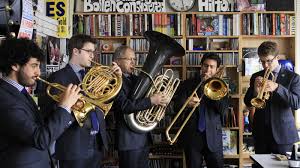
brass I hadn’t realized that Canadian Brass part of the institution of Canadian Brass.  They’re not only part of it, they are it.  Indeed Canadian Brass

led by its avuncular tuba master (and sole original member) Chuck Daellenbach, essentially put the idea of the brass quintet on the map.  Then there are the recordings — more than 100 of them, selling more than two million albums total.  Daellenbach and his fresh-faced players, each with red-striped sneakers and matching outfits, strolled into the NPR Music offices, took their places behind Bob Boilen’s desk and started blowing as if they’d played this peculiar gig a hundred times.

They began with a version of J.S. Bach’s intricately woven “Little Fugue in G minor,” an impressive staple that stretches back to the band’s first recording. In those days, precious little was available for brass quintet (two trumpets, horn, trombone and tuba), so the band relied on making arrangements of existing music. Since then, Canadian Brass has transcribed and commissioned more than 200 works, including “Tuba Tiger Rag,” Luther Henderson’s lighthearted tribute to Dixieland jazz. It’s a showpiece for Daellenbach, who twirls his tuba (while playing) and lands on a final note of such subterranean depth that you feel it more than hear it.

The players closed with another favorite, Rimsky-Korsakov’s dizzying “Flight of the Bumblebee,” in an arrangement by Canadian Brass trumpeter Brandon Ridenour. Although the music buzzes past in less than two minutes, players get plenty of opportunities to shine — as in the lightning-fast runs negotiated by trombonist Achilles Liarmakopoulos, the newest member of the group.

The band consists of   Christopher Coletti, trumpet; Brandon Ridenour, trumpet; Eric Reed, French horn; Achilles Liarmakopoulos, trombone and Chuck Daellenbach, tuba.

The band sounds amazing playing these familiar songs in a way that is–unexpected–but still right on.

J.S. Bach: “Little Fugue In G minor” is probably one of my favorite classical pieces.  I really enjoy Bach’s fugues a lot and this one is just perfect–and the arrangement here is great–everyone gets a chance to explore the phrasing.  It starts with the tuba and then the trombone and then the horn and finally the tuba.

Luther Henderson: “Tuba Tiger Rag”  Introducing this piece he says that in Bach everyone is equal, but he felt they needed a tuba song.  He says that while this song might be low art for other instruments it is high art for a tuba.  And yes he does spin it around while playing it. He uses that instrument to make roaring sounds and incredibly deep notes.  This is a medley, I think, because while the trombone and tuba play, the other three sing “hold that tiger / tuba tiger.”  How on earth does he reach that super low note?

Before the final song Bob says that his tuba doesn’t look brass.  And Chuck replies that there’s an old joke: “How old do you have to be to play the tuba and the answer is old enough to be able to carry it but young enough to still want to.”  He still wants to so he’s been  so he;s lightening the horn with carbon fiber.

For the final song Nikolai Rimsky-Korsakov: “Flight Of The Bumblebee” he tells us that the two trumpets play very fast–it must be easy for them. But the trombonist Achilles didn’t know what was coming when they had him play along.  Chuck says you’ll never see anyone play this song this fast on this instrument.

And it is amazing.  The song flies past–a blurry of fingers.  And I love that at the end, one of the trumpets sings the triumphant final high note.

You wouldn’t expect a band as old and legendary as Canadian Brass to be so funny and good-natured, but they sure are.  And that makes these familiar songs even more fun.

[READ: February 7, 2016] Ava and Tacocat

Sarah brought this book home, in part because Clark’s reading group called themselves tacocat which is a palindrome.  Turns out that Clark wasn’t interested in the book, so Tabby and I got to read it together, which was really fun.

The whole book is a language lovers’ dream, chock full of big spelling words and all kinds of palindromes littered throughout.

It was a few chapters into the book before we realized that this is actually the second book of a series (the first one is called Ava and Pip) and that this book references things that happened in book one without exactly explaining what happened.  That’s a little annoying for us, but it certainly made us want to read the first book.

The book is set up in diary form with Ava writing in it on most days.  I like that she loves palinromes so much (S-E-N-I-L-E-F-E-L-I-N-E-S) and every time she mentions one in the book, they spell it out like that. (more…)

Read Full Post »

2016-12-05-21-06-09SOUNDTRACK: YVA LAS VEGASS-Tiny Desk Concert #241 (September 24, 2012).

I’d published these posts without Soundtracks while I was reading the calendars.  But I decided to add Tiny Desk Concerts to them when I realized that I’d love to post about all of the remaining 100 or shows and this was a good way to knock out 25 of them.

yvaYva Las Vegass is a fascinating performer.  With just her voice and a small stringed instrument she sounds like no one else I’ve heard.

The blurb says:

she infuses Venezuelan folk traditions with a punk aesthetic. I heard songs as allegories, songs that told stories and songs that felt like deep primal screams, all accompanied by a traditional Venezuelan cuatro — a small stringed instrument similar to a ukulele.

She does not use a pick and her strumming varies from delicate and soft to aggressive and loud   And her voice is really powerful.

“Mariposas” starts off slowly with some delicate strumming and her singing.  When she gets to the fast chorus, her playing is so hard and percussive that the song changes tempo incredibly.

Introducing “Tonadas Y Cantos” she says that people in Venezuela sing this song to milk their cows.  It’s a traditional song but she plays it a little harder and a little punk “because that’s who I am.”  She sings fast and aggressive (some lyrics so fast it’s impossible to even know what the words are).   And while most of the song is in Spanish, there are some English lyrics too: “What do you do when you can’t pretend anymore. What do you when being dead sounds good.  Be brave be strong.”

This song ends very abruptly and the next one starts just as fast—there was clearly an edit–I wonder what they edited out.

“Polo Margaritenoio” is a traditional Venezuelan song “with no author because someone stole it.”  The writer “was a woman who was very vulgar like me.”

Yva is a fascinating performer and while she’s not very flashy, she commands attention with her voice and her playing.  I only wish I knew what she was singing.

The blurb continues:

You can’t quite see her cut-off jeans and Chuck Taylor high-top sneakers behind Bob Boilen’s desk, but in attitude and style, Yva Las Vegass is punk-rock through and through.

As the show ends, she says “I worked my ass off, you can tell by how much I sweated in my wool hat.”

[READ: December 22, 2016] “At Christmas Time”

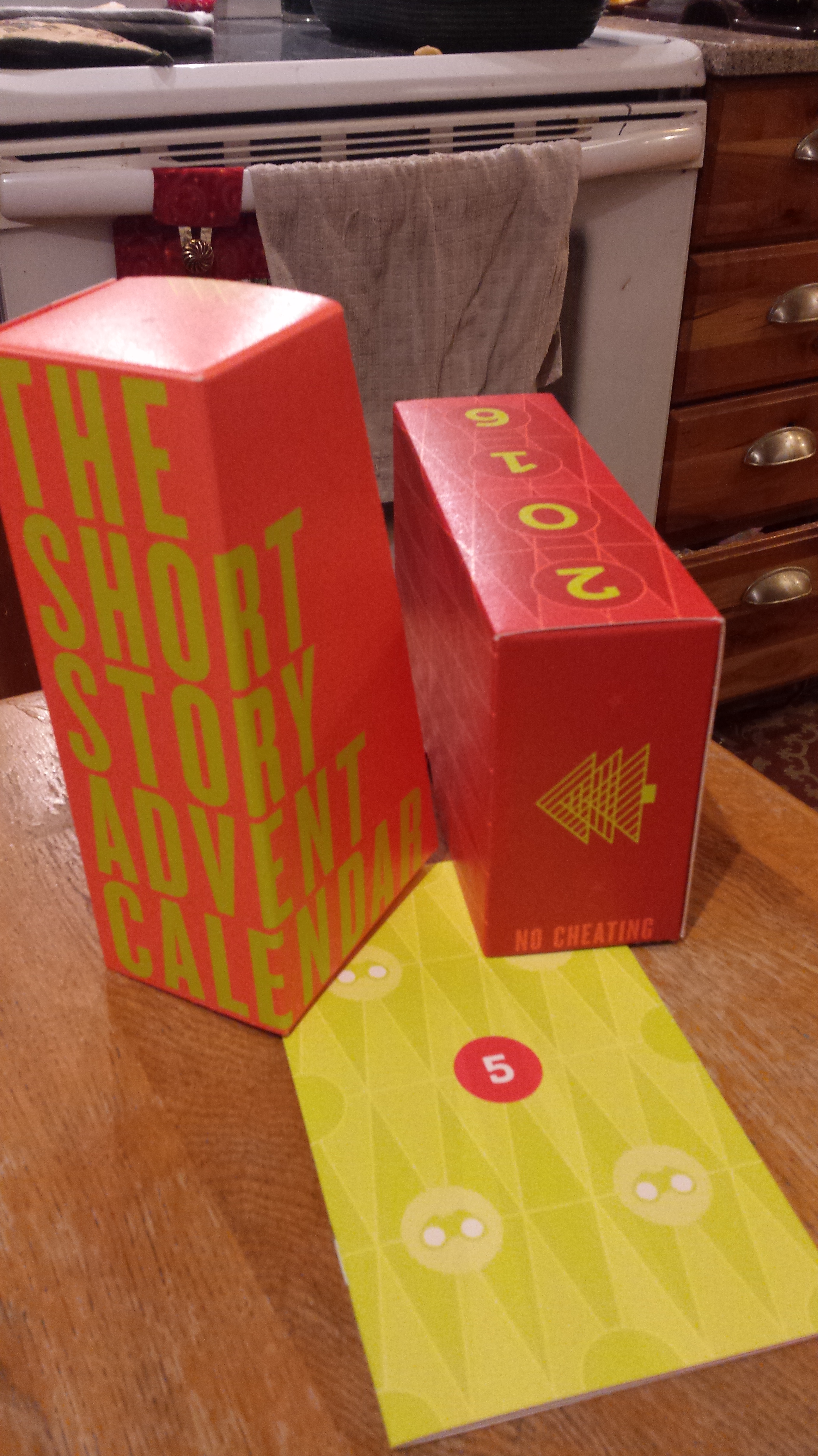
Near the end of November, I found out about The Short Story Advent Calendar.  Which is what exactly?  Well…

The Short Story Advent Calendar returns, not a moment too soon, to spice up your holidays with another collection of 24 stories that readers open one by one on the mornings leading up to Christmas.  This year’s stories once again come from some of your favourite writers across the continent—plus a couple of new crushes you haven’t met yet. Most of the stories have never appeared in a book before. Some have never been published, period.

I already had plans for what to post about in December, but since this arrived I’ve decided to post about every story on each day.

This is the first story on this collection that I have read before!  That’s not bad out of 22 stories.  (Or it’s very bad t hat I haven’t been reading enough stories).

I haven’t read that much Chekov, but I have read this one.  When I read it last time, I liked it but was more than a little confused by the ending.

I feel like I got a little bit more out of it this time, but the ending is still a puzzle.

This very short story is set up in two parts.

In the first part, an old couple from the country wish to send a letter to their daughter in the city whom they have not seen in four years.  She had gotten married and had sent two letters to them.  But they have not heard from her since that second letter several years ago.  Her mother, Vasilissa , wanted to send a letter sooner, but there was no one to write it for her.

At long last, and with so much to say, Vasilissa finally she asks Yegor, the innkeeper’s wife’s brother, “who had done nothing but sit idly at home in the tavern since he had come back from military service, but of whom people said that he wrote the most beautiful letters, if only one paid him enough.” She pays him 15 kopecks.

Vasilissa had spent so much time imagining what to say to her daughter.  But now that she is under pressure, she has drawn a blank.  Yegor asks what their son-in-law does.  He used to a be a soldier but now he is a door-keeper at a hospital.

Yegor begins writing some very formal sounding military instructions, “Fate has ordained you for the military profession.”  Of course the mother wants to tell her daughter about the famine and their poor crops.  And she wonders if she is a grandmother yet.

Vasilissa is revolted by this man (although I’m unclear if she knows what he is writing or not).  But she looks at him: “He was the very essence of coarse, arrogant, stiff-necked vulgarity, proud to have been born and bred in a pot-house, and Vasilissa well knew how vulgar he was, but could not find words to express it.”

The next morning, Vasilissa walked 11 miles to the post office and mailed the letter.

Part Two opens on New year’s Day, with the daughter’s husband working as a porter at a doctor’s office.  He receives the letter and delivers it to his wife.  The daughter is very excited to receive the letter. She reads the letter to her children.  And she is excited–laughing or crying, it’s hard to tell.  She reads of the snow and the warm fire and the doggie.  She huddles close with her children until he leaves the room.

The husband remembers back to three or four letters that she had asked him to send but which are still lying around somewhere.

And it’s super poignant.  And the more I think about it and reread it, the more powerful it is.

But then there’s a final line which I simply didn’t get.  I even translated the French “Charcot douche,” but it didn’t really help.  I can’t decide if those final words are meant to be significant or just suggesting that life goes on.

Incidentally, there are several different translations of this story available.  This one was by Constance Garnett.  Although I found the version online at Eldritch Press, translated by Marian Fell to be a bit easier to read–despite the fact that it was translated in 1915.

Read Full Post »

dfwreadSOUNDTRACK: CHRISTIAN SCOTT aTUNDE ADJUAH-Tiny Desk Concert #477 (October 9, 2015).

aacsChristian Scott aTunde Adjuah and his septet play what he calls stretch music: “the particular type of jazz fusion he’s up to: something more seamless than a simple collision of genre signifiers.”

They note that even his appearance stretches traditional jazz: “You may note that he showed up in a Joy Division sleeveless T-shirt and gold chain.” It’s sleek and clearly modern, awash in guitar riffs, but also bold and emotionally naked.

Christian Scott aTunde Adjuah (not sure how to abbreviate that) is a trumpeter and he can hit some loud powerful and long –held notes.   It’s funny that when he bends over the trumpet grows quieter—those ic really are direction-based.

For the first song “TWIN” he does some impressive soloing over a simple and cool beat—piano and delicate guitar riffs (there’s also an upright bass and drummer).   After his lengthy solo there’s a flute solo that also works perfectly (if less dramatically) with the background music.  (Christian plays tambourine during her solo).  He says that this song is about being a twin.  His brother, Kyle Scott is a film director and for whom Christians scores the music.  Christian also explains that he comes from an African-American and Native-American background and that this song has rhythms as a sort of history of his family that touches on Mali, Senegal Gambia and The Ivory Coast and makes its way to the Caribbean, Cuba and into New Orleans.

He’s pleased to play the Tiny Desk Concert for an audience that appreciates “Music that has nutritional value.”

For the second song, “West of the West” he brings on a young alto-saxophonist who plays with his drummer in a different band. The song opens with a rocking electric guitar solo and then the jazzy band kicks in behind it.  The instrumental features a couple of solos by the saxophonist, the pianist and the bassist.

“K.K.P.D.” is a dramatic song for which he gives a lengthy back story.  Many years ago in his home of New Orleans, he was stopped by New Orleans police late at night for no reason other than to harass and intimidate him.  he was coming back from a gig.  He resisted and was in a serious situation and was seriously threatened—the story is long and very affecting, especially given how articulate (I know, terrible word, but true) and calm he is about retelling this horrifying story.  His pride almost made him do something ill-advised, but instead he channeled that pent-up frustration into a piece of music whose long-form title is “Ku Klux Police Department.”

He adds that we see things on TV about inner cities or the ninth ward and we believe them to be true.  Like that the neighborhood is happy that the police are clearing out the youth there.  We begin to think that the narrative is true, although the people who live there can tell you otherwise.  Despite the title and the origin, the is song is designed to reach a consensus to move forward –not to build derision or hate.  He says that we have to start working on that now, because if it doesn’t start now then our children will continue to inherit this situation.

It opens with a noisy guitar wash and fast drums.  It’s quite noisy and chaotic although it resolves very nicely into an almost sweet piano-based song with slow horns.  The middle of the song ramps up with some intense soloing from Christian.  I love how that segues into a very different section with an electronic drum and delicate piano.  Chritsian’s next solo is much more optimistic.  The final section is just wonderfully catchy.

When he introduces the band, he points out just how young some of his newest members are: Drummer Corey Fonville (another new member) used a djembe as a bass drum, and also brought a MIDI pad so he could emulate the sound of a drum machine; Lawrence Fields, piano; Kris Funn, bass; Dominic Minix , guitar (21 years old); Braxton Cook, saxophone (24 years-old) and Elena Pinderhughes, flute: 20 years old!

I don’t listen to a ton of jazz, but I really liked this Tiny Desk Concert a lot.

[READ: July-October 2016] The David Foster Wallace Reader

I’ve had this book since Sarah bought it for me for Christmas in 2014.  I haven’t been in a huge hurry to read it because I have read almost everything in it already.  And some of that I have even read recently.  But this summer I decided to read some of my bigger books, so this was a good time as any.

One of the fascinating things about reading this book is the excerpting in the fiction section.  I have never really read excerpts from DFWs longer books before.  And once you decontextualize the parts, you can really appreciate them for themselves rather than as a means to the end of the story.  This is especially true of the excerpts from Broom of the System and Infinite Jest.  But also just reading some of these sections as a short story makes for an interesting experience.

It was also very interesting to read the non-fiction all together like that.  These pieces come from difference anthologies, but they have thematic similarities  So, placing them together like that allows for really comparing the stories.

And of course, the selling point for most DFW fans is the teaching materials in the center of the book–an opportunity to look into the man’s mind at work shaping younger minds.

I have written about virtually everything in this book already (title links refer back to previous posts), so mostly these are thoughts about the pieces themselves and not a part of a whole. (more…)

Read Full Post »

may16 SOUNDTRACK: SOFIA REI-Tiny Desk Concert #338 (February 22, 2014).

sofiaSofia Rei is an Argentinian singer.  For this Tiny Desk Concert she has two accompanists: drummer Franco Pinna incorporates a drum from the Argentine Pampas into a traditional drum set and guitarist/bassist JC Maillard plays a pretty guitar and a modified saz bass.

In profile Sofia looks a bit like Polly Jean Harvey but when she sings it’s very different.  Her voice is sultry and influenced by Argentinian jazz.

I love the way the first song, “La Gallera” starts with slow verses but the chorus are just wild and crazy and full of rhythms and some great chords.  And of course, that drum is an integral part of the solo that fills the middle so the song.

“La Llorona”  is a beautiful slow ballad with Rei’s voice floating above the percussion and gentle modified saz bass (more on that in a moment).  The song builds over five minutes with her voice getting louder and more impassioned.  And just as the song really builds and seems as if its going to rock out, it ends–leaving us wanting more.

“Todo Lo Perdido Reaparece” (“Everything That Has Been Lost Reappears”) brings her back home to Argentina.  The song starts quietly with Rei singing some syllables and noises before the song proper starts.  It is a slow ballad filled with percussion.  Midway through the song while Maillard is doing a wonderful guitar solo, Rei picks up a charango and plays lovely high notes.  The chord progression during this and the following section with vocals is fanatic–catchy but also unusual.

At the end of the show, Maillard talks about his modified saz bass.  He says it is based on the Turkish instrument but it was made for finger picking rather than plectrum.  His is the first ever made.  With eight strings, it has bass strings for thumb picking and high notes for the other fingers.  It also has a lot of “empty” spaces to make interesting percussion sounds. I love seeing new instruments and this little demonstration is very cool.

[READ: July 11, 2016] “Bad Character”

The May 16, 2016 issue of the New Yorker had a series called “Univent This” in which six authors imagine something that they could make go away. Since I knew many of them, I decided to write about them all.  I have to wonder how much these writers had to think about their answers, or if they’d imagined this all along.

Ted Chiang says he never learned anything in the Saturday morning Chinese school he was forced to attend as a child.  But that’s not why he wants to get rid of the Chinese character-driven alphabet system.

He says that he is a fan of literacy but that Chinese characters have been an obstacle to literacy for millennia. You have to learn three thousand characters and you can’t use pronunciation to help you–it’s all memorization.  Even highly educated Chinese speakers regularly forget how to write the characters that they use infrequently.

He also decries the technological obstacles that Chinese poses–computers and smart phones are impossible to use.  And even dumbed-down solutions like Pinyin just cause more work.

Interestingly, even though he wants to do away with the written characters the last couple of paragraphs of this essay talk about the virtues of this system.

Pronunciation changes over the centuries, so as language evolves, older works are harder to understand (take Beowulf).   This is why “Classical Chinese remains readable precisely because the characters are immune to the vagaries of sound.”

Chinese culture is notorious about tradition.  He says this is not because of the Chinese characters but there must be some influence.  He speculates that if the English language had not evolved since the days of Beowulf, that maybe English culture would be more Anglo-Saxon.

Conversely if China didn’t have the language it does, it too may have evolved over the years and might be less resistant to new ideas.  Perhaps the country would be better able to deal with modernity.

Regardless of whether that would be better or not, he’d love to live in a  world where he wouldn’t have to hear the misconceptions about Chinese characters “that they’re like little pictures, that they represent ideas directly, that the Chinese world for ‘crisis’ is ‘danger’ plus ‘opportunity.'”

That’s a bit anticlimactic of an ending, but the overall essay was interesting.

Read Full Post »

« Newer Posts - Older Posts »