Feeds:
Posts
Comments

Archive for the ‘Violence’ Category

woesSOUNDTRACK: ATERCIOPELADOS-Live at Bumbershoot, September 5, 2010 (2010).
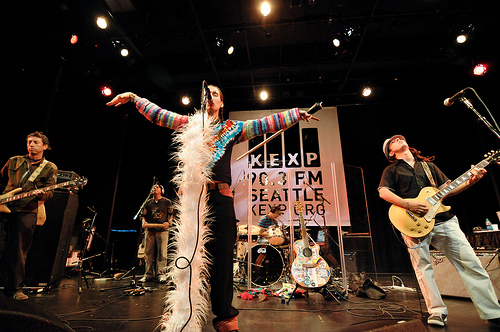
atercioA rock en Español band who have returned after a brief hiatus, Aterciopelados have changed a bit since their early more punk days.  Their last album Rio came out in 2008, I knew them back in the mid nineties.  This brief set (7 songs) at Bumbershoot showcases their more mellow tracks (there’s pan pipes) on “El Estuche.”  The Colombian band has always been political, but it seems like they are much more explicit about it on this record.  As singer Andrea Echeverri introduces a number of song, she talks about how they are “important” and are meant to bring attention to the troubles of Colombia.

“Ataque de Risa” has a wonderfully catchy melody (and I believe she says her daughter is singing with them on it).  The song “Bandera” (which means “Flag”) is pointedly directed at Arizona’s anti-immigrant law.  She introduces it as saying that all peoples are together under a rainbow flag.   It’s a more angry sound for Echeverri’s voice, but she does a great job.  Her voice is really impressive.  “Rompe Cabezas” has a rollicking chorus that’s a lot of fun and “Bolero Falaz” ends the set with a very cool and catchy song.

Here’s a video of El Estcuhe

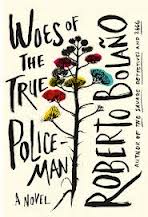
[READ: December 2, 2012] Woes of the True Policeman 

This is yet another unfinished novel from Roberto Bolaño.  Bolaño knew that he was dying and he created a lot of work in anticipation of his legacy.  The afterword of the novel says that they found all of the various parts of this novel in various locations among his work–hand written and computer drafted.  And they all mention this titles, so they are pretty certain about the order and that it is as finished as it could be.

Unlike some of his other posthumous releases, this one must be deemed pretty significant since it was published by Farrar, Straus and Giroux instead of New Directions (publisher of most of Roberto Bolaño’s other smaller works).

And really what it reads like is a kind of prelude to 2666.  For this is the same Amalfitano as in 2666.  But it is his story from before he moves to Sonora, Mexico–before all of the murders started.  Indeed, there are parts of 2666 which make Amalfitano’s past seem like it is unknown but this story fills in the gaps quite well.  One of the details in 2666 is that Amalfitano’s teaching contract had expired at the University of Barcelona, although this book gives the behind the scenes reason why it expired.

Bolaño has many many stories in which he explores the past of a character from a different story.  Typically, it is a novella in which a minor character from a bigger novel gets his or her own story told.  And that seems to be the case with this as well.

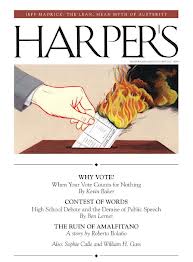
The story is set up in five sections (just like 2666).  Section I of this story (part of which was as excerpted in Harper’s recently) is called The Fall of the Berlin Wall and tells how Amalfitano, a professor, fell for a young poet named Padilla.  He wound up having an affair with him, which ended his career (I’m unclear whether it is because he is a student or because the affair was homosexual that the University wanted him out).  Amalfitano had never had homosexual desires before, and he was a proud husband and father, but he found that Padilla really affected him.

And so Amalfitano and Rosa, his daughter, moved to Sonora and the only school that would have him. (more…)

Read Full Post »

SOUNDTRACK: THE ENGLISH BEAT Live at KEXP , March 8, 2007 (2007).

Afebkexpter enjoying the 2010 Bumbershoot concert I found this earlier in-studio show from The English Beat.  It’s amusing that it’s longer than the Bumbershoot concert (they play three of the same songs and eight in total).  This set introduces a few less “famous” tracks, like “Hands Off She’s Mine” and “Ranking Full Stop.”  They also play a “new” song called “Said We Would Never Die,” a sweet ballad in which he sounds a bit like Bob Mould singing.

When they play “Save It for Later,” they introduce the song with a verse from Pearl Jam’s “Better Man,” which must be a nod to Pearl Jam’s constant placement of “Save It for Later” in the jam session at the end of “Better Man” when they play it live.  The song ends with a lengthy sax solo.

Overall, this set is slightly less enjoyable for me than the Bumbershoot one.  The band adds a bit more jam into the set–the songs are longer and a bit more mellow feeling, which doesn’t work for ska.  But they all sound good and Dave Wakeling is very funny in his chats with the DJ.  He talks about his guitar being in the Rock n Roll Hall of Fame and the history of the ska movement.  How labels felt burnt that they missed the Sex Pistols and wanted to get whatever the next trend was.  This was interesting in that he talks about reggae and punk bands playing together on the same bill (before the skinheads went racist) and how the mellow reggae and the fast punk kept the dancefloor full if they alternated.  He also says that when they introduced the Beat Girl, it made the boys in the audience stop getting into  fights with each other and try to impress the girls.

As they head into their final song (“Tenderness”) Dave notes that “the first 27 years are the hardest.”  Hear if he’s right.

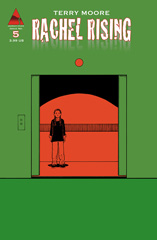
[READ: January 31, 2012] Rachel Rising 5-7

I have finally gotten around to reading some more Rachel Rising (it’s only been ten months), and I see that there are already several new issues out (I should get a subscription).

As I mentioned in the end of my review of the first four books, Terry Moore has gone to a really dark place with this series.  By the end of Book 7, my mouth was left agape, because I never thought that Terry would go quite so dark!

I like the way that Book 5 is more or less split in half with the first half being all about Rachel trying to fit back in with her friends (Jet reminds her of their pinkie swear to tell the truth about everything).  And yet there’s also Dr Siemen who states matter of factly (at the dinner table) that Rachel is the Angel of Death.

The second half of the book involves the little girl (she’s so cute with her pigtails).  A foster family is coming to take her for the night while the authorities try to figure out what happened to her house and family.  Moore goes dark right away with the man of the foster family showing his true colors, but the girl will have none of it.  And there’s a scene in an elevator which happens in movies, and yet in real life, I’ve never heard of an elevator door that doesn’t open when something gets stuck in it. (more…)

Read Full Post »

SOUNDTRACK: THE ENGLISH BEAT-Live at Bumbershoot, September 6, 2010 (2010).

I’ve always loved ska.  So to see that the (English) Beat were playing shows and playing them for download on KEXP was  a pretty grand thing.

I’m still trying to figure out if these short sets from Bumbershoot were KEXP-only shows (in which the band plays a brief set and then they play the actual show later), but I believe so. Anyhow, the band sounds great, singer Dave Wakeling is a great frontman, telling amusing stories about the songs and generally charming everyone (his singing voice still sounds great, too).

Wakeling has a nice little diatribe about Target.  It begins with him saying how he never was asked to be in a commercial before Target asked him for “Tenderness.”  And now it’s everywhere.  But he’s upset that Target supported the  anti-gay candidate in Minnesota.  He promises that if he ever gets the money from the ads, it will go to support the candidate’s opponent.  He also says that “Mirror in the Bathroom” was not about cocaine–they couldn’t afford it bcak then.

I’m not really sure who is in the band on this tour.  Ranking Roger is apparently running another English Beat band in the U.K.  Sigh.  But regardless, this was like a wonderful flashback to the long lost art of ska.  The set is a collection of highlights from their 80s career.  I mean look at all the great songs they wrote: “I’ll Take You There,” “I Confess,” “Save It for Later,” “Never You  Done That,” “Tenderness,” and “Mirror in the Bathroom.”

Listen for yourself here.

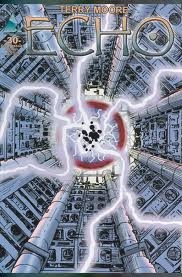
[READ: November 27, 2012] Echo #27-30

The problem with a comic book that comes out every six weeks (especially if you stopped going to the comic books store) is that it’s easily forgotten, no matter how much you like it (my rave of issues 25 and 26 leave me stunned that it has been almost two years since I last read the story).  But I recently went to my local shoppe and scored these last few issues (#30 even signed by Terry himself).  And I immediately got back into the story.

So as #27 picks up, we see that the climax is almost at hand.  Ivy, the hardened agent is growing younger and younger and is forgetting more.  Meanwhile, Julie is almost completely covered by the alloy and is now a giant.  And Annie is surfacing more and more in Julie (Annie is in the alloy’s DNA) which means Dillon is allowed a degree of closeness and closure.

#28 was awesome because it tied this universe back to the Strangers in Paradise world even more.  They are still using Tambi, the bodyguard, (from SiP) who worked for Darcy.  In this issue she interrogates another member of Darcy’s team (with the telltale tattoo).  By the end of the book Ivy is a mere child (the fact that Moore can draw this–keeping her Ivy and yet now looking like a little kid with such few lines is amazing). (more…)

Read Full Post »

SOUNDTRACK: ELFIN SADDLE-Wurld (2010).

Yesterday I mentioned the Wurld DVD.  Today I wanted to talk about the music.

There are three songs that come on the audio extras portion of he DVD: “Wurld Soundtrack (abridged),” “A River of Horses” and “A Tree in Dark Water/A Sinking Celebration.”  The “Wurld Soundtrack” is indeed the music from the film.  The abridged version is about 15 minutes long, while the movie is about 23.  I’m not sure what got cut or why it needed to get cut, but it’s a good reference to the movie–dark, a little creepy with moments of beautiful melody.

“A River of Horses” is dominated by a xylophone melody and a cool piano riff.  It has a loping quality that I really like.  It’s instrumental (and serves as one of the main themes of the DVD).  “A Tree in Dark Water” is a slower dirge-like piece which features Honda’s “Da Da Dee Da” vocals.  It more or less morphs into “A Sinking Celebration” which has a sound not unlike a carnival, but a very slow, almost sad carnival.  Both of these songs work as backing music for other aspects of the DVD–I’m not sure if they were songs first that they decided to use for the DVD or vice versa.

For the full Elfin Saddle experience, though, it’s worth watching the live show that comes on the DVD.  The show is a 7 song set that they performed before the opening of the Wurld exhibit in Montreal.  So yes, this show was performed Live at the Montreal Museum of Contemporary Art.  Nearly all of the songs come from their debut album Ringing for the Begin Again.

The band plays a kind of droney world music. And it has a very homemade feel–cobbled together, but brilliantly.  There’s an accordion, a bowed saw and a bunch of other percussive items–things that look like found metal.  There are two singers, Jordan McKenzie does most of the singing and he sings in a deep voice and sometimes in a higher voice that has a middle eastern feel.  Emi Honda is Japanese and that’s evident in her intonations, whether she is singing backing or lead vocals.  The band is also utterly multi-instrumental. McKenzie sings, plays accordion and xylophone at the same time (must be seen to be believed) while Honda switches from saw to ukulele to drums all in one song.  She also later bows cymbals for a very eerie sound.  Although they make most of the noise themselves, they are accompanied by a cellist and a double bass (which acts as a percussive time keeper).  Once they add a tuba, the song sounds much more klezmerish (although there are elements of klezmer throughout).

In the background of the show, on the projection screen, is the spinning wurld from their art exhibit.  The whole show is mesmerizing.  Songs include: “The Bringer,” “Sakura,” ” Muskeg Parade,” “Wind Songs,” “Garden,” ” The Procession,” ” The Ocean.”

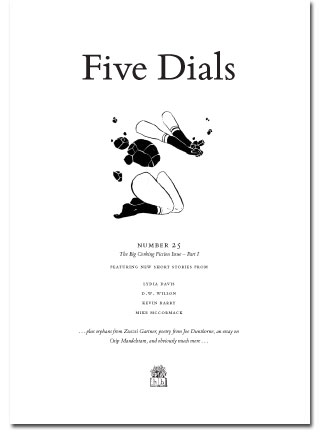
[READ: October 15, 2012] Five Dials #25B

The issue continues the theme of the short story and Frank O’Connor.  It features a hugely long story by Nathan Englander and a couple more unusual short stories as well.  I enjoyed Part 2 of the Cork Issue more than Part I.

CRAIG TAYLOR-A Letter from the Editor: On Englander and Lists
In addition to introducing us to Nathan Englander and wondering if we’ve all read his award-winning book What We Talk About When We Talk About Anne Frank, Taylor talks about lists.  The staff was pooled for their opinions with the intent to make it seem like the staff was an individual with specific tastes in Books, Music, Movies, Food, etc. (more…)

Read Full Post »

SOUNDTRACK: WOODEN SHJIPS-Live on KEXP, August 7, 2011 (2011).

while ago I reviewed an Earth concert and while I felt like I should have liked them, I didn’t like them as much as I anticipated.  Well, Wooden Shjips (no idea what’s up with that “j”) sounds like I would have liked Earth to sound–a bit faster and yet still ponderous   They play with really distorted guitars and heavy bass, but their songs aren’t terribly fast or anything.   The thing that sets them apart is the keyboard–loud droney keyboards that take a kind of lead role and add a weird sort of retro feel to the heavy proceedings.  Indeed, even the voice is fuzzed out and echoey, making the keyboard one of the few clean sounds in the show.

As befits droney metal bands, all of these songs are long.  The first two “Lazy Bones” and “Black Smoke Rise” are over four minutes while the final two “Home” and “Flight” are over 5 and nearly 7 minutes respectively.

Lazy Bones is dominated by a spacey keyboard riff and vocals that are echoed almost into oblivion, reminding me of a kind of mid 70s Black Sabbath (if Ozzy’s voice was deeper).  The riffs on “Home” and Flight” sounds like we’re in for some real classic rock, but again that droney keyboard (which also sounds retro but in a different way) mixes with the heavy distorted guitar in a new way.  I’m intrigued to hear more from them.

Rock out here.

[READ: November 15, 2012] “Batman and Robin Have an Altercation”

I’m always surprised to see a Stephen King story in say Harper’s or the New Yorker.  Not because he’s not good, but because he’s such a famous genre writer (and he certainly doesn’t need the exposure).   I don’t even think of him as a short story writer, really.  I wonder how he gets his stories in these magazines?  Does he get vetted?

Well, this story was really enjoyable and if I hadn’t known it was Stephen King, I never would have guessed.

The first 3/5 of the story are about Dougie Sanderson and his Pop.  Pop is in an old age home, suffering from Alzheimer’s. They have a routine, which is easy enough for Dougie  to do, even if to his father it’s new every time.  Dougie visits every week, they go Applebee’s, and they come home.  This depends, of course, on how good Pop is doing that day–as long as he’s fairly lucid and isn’t cursing out everyone in sight.

What I appreciated about this story was that Pop has moments of incredible lucidity that can be immediately followed by moments of utter confusion   Like when Pop calls him Reggie (Dougie’s brother who died forty-five years ago in a car accident .  But the moments of lucidity are nice for Dougie–although they’re not encouraging exactly, because most days he guiltily admits that he wishes things would end sooner rather than later.

The Batman and Robin of the title refer to a Halloween costume that Dougie ad Pop wore when Dougie was little.  Indeed, Pop remembers it very well, “Halloween, you dummy.  You were eight, so it was 1959.  You were born in ’51.”  Pop even adds a detail that Dougie didn’t remember: that Norma Forester looked at Dougie and said “trick or treat” and then looked at Pop and said “trick or drink” and offered him a bottle of Shiner’s.  Dougie is silent–amazed at the memory.  Then Pop says “she was the best lovin’ I ever had.”  Dougie doesn’t know whether to believe this or not thinking, “They hurt you….  They may not mean to, but they do….  There’s no governor on them, no way of separating the stuff that’s okay to talk about from the stuff that isn’t.” (more…)

Read Full Post »

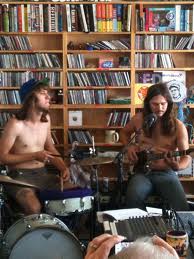
SOUNDTRACK: FOSTER THE PEOPLE-Tiny Desk Concert #155 (September 9, 2011).

This is a very brief Tiny Desk Concert.  The guys play three songs with just a little chatting which makes this a tidy morsel of a concert.

The set is very stripped down compared to their recorded version.  “Helena Beats” sounds great in this setting–there are effects and processing on the album but you can tell that the kernel is in the guitar and voice, which is pretty cool.  The first song feature solo tracks and gentle picking (he comments that you’ll be able to hear the other songs better).

The discussion features the bassist’s quote from Plato that he has inscribed on his bass.  And of course, they play “Pumped Up Kicks.”  There’s a funny comment from Bob Boilen asking is that the first time you said “This is pumped up kicks” and no one said anything.  He replies, “I think people are over that song.”  But it sounds very good in this stripped down version.

You can hear the whole set here

[READ: November 14, 2012] “Breatharians”

This story poses the question: after the protagonist has killed three cats with a wrench, will you continue reading?  For many the answer is no.  For those who persist, they have the mass poisoning of many other cats to look forward to.

I recall in the 70s or 80s that “dead cat” jokes were de rigueur, but I don’t think any were as brutal as this story.  And the strange thing is that the title has nothing to do with the cats.

Indeed, if I were to tell you that the Breatharians in the story are people who believe that they can subsist without eating–they simply inhale and gain all of the sustenance that they need, you might think that this was an interesting story about spirituality.  And if I mention that the main character’s mother has recently become a Breatharian, even though she continues to make him delicious sounding food (that pork chop…yum!), you might be very curious about this whole Breatharian thing. (more…)

Read Full Post »

SOUNDTRACK:  JEFF THE BROTHERHOOD-Tiny Desk Concert #165 (October 8, 2011).

This was my first exposure to JEFF the Brotherhood, a rollicking duo who blast out the walls of the NPR studios.  The guitarist and drummer play simple, power punk (quite well) and they sound like a whole band, not just two guys.

“Diamond Way” reminds me of the Meat Puppets–echoey lazy-sounding punk.  ANd the oh oh oh oh oh is very catchy.  And then, after describing an NPR host as sounding like Ira Glass–if he were an old woman (and then apologizing if he offended anyone), they play “Bummer”–shirtless—presumably a first for the NPR offices.

“Bummer” is a mellower song and their sound doesn’t sound less full for the mellowess–especially when he kicks on the distortion pedal.  “Bone Jam” is one of my favorites–more ooh’s and the simple but wonderful lyrics “Gonna grind your bones to make my bread.”  It’ s amazing that two guys can sound this good.

[READ: August 17, 2010] “The Ruin of Amalfitano”

Natasha Wimmer has translated yet another posthumous work from Roberto Bolaño, this one called Woes of the True Policeman, due out this month.

This may already exist, but I hope someone is compiling a family tree of all of the Bolaño characters who have appeared in different locations.  For instance, the Amalfitano in this story appeared in 2666, indeed he has a whole chapter about himself.  And we know it’s the same Amalfitano because they both have a daughter named Rosa.  This story is set before 2666 and these fascinating events would shed some light on the state of Amalfitano when we do meet him in the novel.  Of course, Bolaño’s writings don’t seem to follow a conventional strategy so who knows if he intended any of this to be part of the “missing” Part 6 of 2666.

Anyhow, this story is about Amalfitano, but it opens with Padilla who decided to become an artist at the age of 13.  After dabbling in theater and film, he settled on poetry.  By 17, he was a sarcastic angry kid who could be easily provoked to violence (he claims that when fighting Nazis, anything is permitted).

At 18, he published his first book of poetry and when he was 21 he showed the poems to Amalfitano.  Amalfitano was a teacher of Latin America writers at the University.  He liked Padilla’s poetry, although he didn’t much like Padilla who didn’t come to class very much.  But once Amalfitano gave him praise for the poems, Padilla never missed another class. He even invited Amalfitanoto his house for parties.  After many such parties, the two became lovers.

Once the University learned of this, Amalfitano was fired.  (more…)

Read Full Post »

SOUNDTRACK: BELLE AND SEBASTIAN-Live at KEXP, April 13, 2006 (2006).

This four song set samples a broad swath of Belle & Sebastian’s career.  It takes place after The Life Pursuit‘s release, but they only play one song from it “To Be Myself Completely” (with Stevie on vocals).

It’s amazing how quiet and shy the band seems i the interviews (or is that bored and petulant) especially after being through the mad swings of success.  Indeed, the interviews are almost embarrassing how unresponsive the band is (but not rude unresponsive, just unresponsive).  Like “where did the soul influence on this album come from?”  “Probably black America.”  “Did the new producer have any influence on the soulfulness?”  “Not really.”

But they do let the music speak for them.  And they don’t just do the horn songs or the strings songs.  They play “She’s Losing It” from Tigermilk (with lots of horns–it sounds great), they play “A Century of Fakers” with strings (although the female vocals seem a little too subdued on this track).  They also play a rollicking cover of Badfinger’s “No Matter What.”  It’s a delightfully poppy song which I didn’t know but which Sarah did (and I thought was the Beatles, and the DJ guessed Paul McCartney wrote it–he didn’t).  It’s when discussing this song that the band finally gets animated, perhaps they just don’t want to talk about themselves.

[READ: October 15, 2012] Five Dials #25

The issue is all about the short story.  Five stories from Lydia Davis, a short story contest from Zsuzsi Gardner, and a couple longer stories as well.   But there’s also some poetry and an essay.  And I fear I have to say I didn’t enjoy this issue as much as some of the other ones.  I love short stories, but I didn’t really love these very much.  And, the essay at the end was a lot of fury about very little.  I have to assume Part Two will simply kick ass.

CRAIG TAYLOR-A Letter from the Editors: On Orphans and Cork
Taylor name-checks the Cork International Short-Story Festival and mentions how this issue is a sort of tie in to the festival (and just how many writers wanted to be in this Cork issue).  Taylor says that many readers wanted more short stories in the Five Dials issues, and that Noel O’Regan, short story editor says that the short story is always alive–witness the great success of the Cork Festival.  Writers flock to it (and a hefty prize is given).  This issue is only Part I of the fiction issue because they simply had to break it into two parts. (more…)

Read Full Post »

SOUNDTRACK: MUDHONEY-Live on KEXP, March 14, 2006 (2006). 

I was never a huge fan of Mudhoney.  Of all the Seattle grungy bands, Mudhoney was always near  the bottom for me.  Some of their stuff was great (“Touch Me, I’m Sick” is undeniable) but I never really got into them.

Having said them, this set taken from the Under a Billion Suns album is really good.  It’s more political than their earlier stuff, but the band still sounds heavy and loud and right on.  “Where is the Future” (“Where is the future that was promised us?  I’m sick to death of this one”) really summarizes their sound–slightly off sounding vocals, slightly off sounding verses and a great chorus.  “It is Us” (“I’ve seen the enemy and it is us”) features some of the more extreme vocals moments in the band’s sound.  And then the chorus is surprisingly catchy.

“Empty Shells” sounds like a hardcore song from the 8os, slightly awkward verse and then a gang-shouted chorus.  “Hard On for War” is kind of funny (but yet really not) about how since all the men at war it’s important to have sex with him as much as possible.  (“These lovely lonesome ladies don’t ignore me anymore.  Now I know why dirty old men are always pushing for war.”

As with every other heavy, angry band, it’s always funny to hear them being chatty and friendly with  the DJs.  They’ve been around Seattle forever and are very nice and happy to talk about their upcoming shows.  Mark Arm, incidentally has been interviewed in Metal Evolution, the 11-part series of VH1 that I have been enjoying a lot lately.  And he seems like a funny guy in that documentary as well.  Maybe it’s time to reassess those early CDs.

Hear this set here.

[READ: November 1, 2012] “Ali-Baba”

Ludmilla Petrushevskaya’s last story in Harper’s was called “Medea,” and now she has “Ali-Baba.”  In this one, Ali-Baba is a woman who has a drug and alcohol addiction.  Her mother continually tries to get her help, but this inevitably fails, especially now that the mother is in the hospital and Ali-Baba has free access to the house.

Ali-Baba has sold a few large books from her mother’s library to get some cash and is now out on the prowl at a bar.

Strangely though, this story opens with Victor, a man who has more or less given up on women.  He sees Ali-Baba dancing seductively, but he ignores her, believing that women would have no interest in him.  Eventually they wind up next to each other and they begin talking.  Seeing how unused Victor is to attention, she feels a strange tenderness towards him and even buys the last round.

But she is  especially delighted to learn that he lives alone (and not with his mother).  So she goes home with him. (more…)
Read Full Post »

SOUNDTRACKQUASI Live at SXSW, March 8, 2010

I really enjoyed a few Quasi albums back around the turn of the century, and then I kind of forgot about them.  But this set is really great.  The always excellent Janet Weiss on drums and harmonies and the wonderful Sam Coombs on guitar and vocals. Around the time of this album, American Gong, they added Joanna Bolme on bass which really fills out their sound.  The first song, “Repulsion,” rocks harder than any of their older stuff (which was more keyboard based).  Indeed this album was apparently much rockinger than any of their earlier releases–I must check it out.

This set was recorded during SXSW  from the Gibson Showroom in Austin.  They play five songs in about 20 minutes.  “Never Coming Back Again” has a far more country feel (especially the backing vocals which have a real twang.  The lengthy instrumental section of “Black Dogs and Bubbles” is great–especially check out Weiss’ drumming.  “Little White Horse” is a shambolic rave of a song–fun and noisy.

The set ends with the inspiring Rise Up, a short stomper that encourages you to, yes rise up.  Weiss and Coombs both have other bands that they play in, so Quasi never seems like a full-time project.  But that seems to make their music all the better.  Listen here.

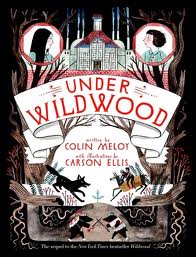
[READ: November 1, 2011] Under Wildwood

I enjoyed Wildwood, but I wasn’t blown away by it.  So I admit I wasn’t totally excited to read this one (especially since I had some other books lined up).  But Sarah managed to get it from the library (I guess it was not as a big a deal as I assumed it would be?) and I decided to give it a go.

I found it a little slow at first, but after about 40 pages, the book totally took off and I was fully engrossed.  Whether it was because there was less exposition since this was a sequel or because the story itself was more exciting, I couldn’t put the book down.  And, more importantly, the book did not feel like its 550 pages were excessive.  He really filled up every page with story.

But I was a little concerned because part of the story is set in an orphanage–a setting rife for cliché.  But Meloy has some great ideas and although he does use the orphanage as a scary setting (and employs some clichés from all orphanages) he transcends the conceit with some great characters and some evil owners who use demerits to completely move the story along outside of the orphanage–a great plot idea.

But let’s back up. (more…)

Read Full Post »

« Newer Posts - Older Posts »