Feeds:
Posts
Comments

Archive for the ‘Violence’ Category

withoutSOUNDTRACK: GOJIRA-L’Enfant Sauvage (2012).

gojiraGojira is a French heavy heavy metal band, and this album was highly recommended back in 2012 (I didn’t realize it wasn’t their debut–they have quite a few records out already).  This album is quite heavy, but it has a lot of diverse elements to keep it interesting.

At the same time, they do rely on a couple of guitar effects which make the album weirdly samey (no idea if they do it on other albums too).  The two biggest offenders in this “repeated” scenario are the seeming over-reliance on the open high e string to add contrast to the heavy chugging chords.  It’s a cool effect once or twice but they do it a lot (especially in the song “The Axe” where it happens way too much and which is then followed by “Liquid Fire” where they do it again).  The other thing they do is this weird scraping sound.  It happens in the first few notes as the disc opens (in “Explosia”).  It’s a really cool sound and quite distinctive.  When you do a weird sound like that a lot in one song, it feels like maybe too much, but then to do it in several other songs, it feels like a crutch.

Which is a shame because the rest of the album is really interesting–the vocals are growly but audible and there’s occasionally really cool backing harmony vocals (“Liquid Fire”) and some really unusual different parts to songs.

So “Explosia” opens really heavy with a crazy riff and pounding drums (and that weird scraping sound).  I love that at 2:30 it switches from bludgeoning to slower (but still heavy) and that as the song fades out with another heavy section there are slow guitar notes that remind me of a Western.  It’s really cool. “L’Enfant Sauvage” uses that open high E string in an interesting riff (by doing more than just letting the string ring out).  (The scraping sound appears here too, but in limited quantity). I like the way the song’s volume just drops for the last thirty seconds or so.

“The Axe” opens with a pummeling drum and guitar sound.  “Liquid Fire” alternates between heavy guitars and that open high E sound.  “The Wild Healer” is a simple, pretty instrumental.  It is 2 minutes long and the main riff is simple one (again all on one string).  There’s an interesting solo that plays along behind the main riff which is quite pretty–but it all ends very abruptly.

“Planned Obsolescence” jumps right in with some pummeling guitars (an a scrape sound).  It slows down a bit, but towards the end the pummeling double bass drums resume until the really slow sweet guitar section that comes in around 3:45.  “Mouth of Kala” has a heavy riff which is a cool change (even if the riff is fairly simple).  But there’s some nice melodies that alternate with the heavy stuff.  I also really like the way the song ends with a very different riff and sound than the beginning.  (And the backing vocals are really cool too).

“The Gift of Guilt” has an interesting open E string riff (which is similar to Iron Maiden’s “The Trooper,” although they do something very different with it.  This song is just littered with odd effects, like a big heavy “bowh” sound and some high-pitched guitar pyrotechnics.  But I love the way it alternates parts (the growly vocals work really well here, too) and then ends so melodically.

“Pain is a Master” opens with a slow guitar riff and whispered voices, it’s a great change of pace for the disc.  Once the slow part ends, the guitars and drums pound furiously and we get some more odd effects–a siren sound (from the guitar) alternating with the ubiquitous scrape.  But the middle parts are really quite different, slower, slightly more menacing.  “Born in Winter” opens and closes with a slow and atmospheric section (delicate vocals even).  In the middle it gets heavier (and has some really fast drumming).

“The Fall” has an Alice in Chains vibe in one section and then a more cookie monster type vocal on another.  The scraping sound returns for a final showing. I really like the way the album just sort of disintegrated into random sounds as it ends.

So overall I really enjoyed this album. It’s probably nitpicky to complain about the overuse of certain sounds, especially since they are cool.  But they have so much creativity on the disc, that to hear the same things a few times just seems redundant.  Nevertheless the album rocks and is a really enjoyable metal album.  I was supposed to see them open for Mastadon earlier in the month but something came up and I had to eat the tickets (who knew you couldn’t even give away Mastadon/Gojira tickets, come on!).

[READ: November 21, 2014] Without Blood

I’ve been enjoying Baricco so much that I decided to grab this book while I was in the library too. I had already read this book a couple of years ago, or actually, I had read the version that appeared in the New Yorker.  The Wikipedia entry says that the New Yorker version is a”revised form” of the novel.  I didn’t know what that meant exactly.  But basically I gather it means that Ann Goldstein (who translated the New Yorker version) has re-translated the story (or that they edited it for the magazine the first time).

The New Yorker version is really long for a New Yorker story (it is practically the whole novel), so it’s understandable why things were a little shorter for the magazine.  But she hasn’t changed very much for the book.  There’s a lot of little modifications–tenses of verbs (in flashback situations), word phrases are altered, additional details seems to have been added and there is at least one small section in this novel that was not in the New Yorker version.

This “new” section is about a woman who is sitting in the cafe with them.  She asks the waiter about the two main characters and we learn a little about her past as well (it’s not relevant to the story and I can see why it was omitted, but it does flesh out the scene).  I am not willing to do a page by page comparison of the two (even though that is something I tend to do). But suffice it to say that the stories are virtually identical, although I found it more satisfying reading the novel version.

Since my original recap is basically how I would summarize it this time as well, I am including it here almost verbatim.  But in the spirit of the updated version of the novel, I am modifying this post from the original in small details–see if you can spot the differences. (more…)

Read Full Post »

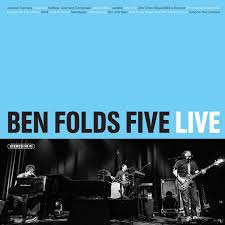
bungSOUNDTRACK: BEN FOLDS FIVE-Live (2013).

bfflThis is the first official live record from Ben Folds Five.  They reunited after a decade or so away and put out a great album and this documented their tour of that album.

It’s a fun collection of songs that spans their career and also includes a solo Ben Folds song.

To me, one of the best things about BFF was Robert Sledge’s bass (yes, I know BF is the man and his piano and songwriting are stellar, but the sound that Sledge gets on his bass just brings those songs to new heights of coolness).  And that bass does not disappoint here.

The setlist is taken from a number of different venues over the course of 2012 and 2013, with a lot of shows in San Francisco, but also some from across Europe.  And the songs really span their career, opening with a song from their debut (“Jackson Cannery”) and then following up with one of their most recent songs “Erase Me”).  They even play “Tom and Mary” from their Naked Baby Photos collection.

About midway through the disc, Ben plays an improvised One Chord Blues (which turns into “Rock This Bitch”) in which he makes up “some bullshit” and this segues into part of “Billie’s Bounce” by Charlie Parker.  This is followed by “Do It Anyway” into which he throws a verse from Jesus Christ Superstar.  On the liner notes of the disc he talks about how throwing these verses onto a live album will cost you “a lot.”

For the song “Draw A Crowd” they play a synth opening, but when Ben switches to piano, he messes up and sings “the piano player can’t play…but keep the party going.”  He is amusingly self-deprecating both in his banter and in his song lyrics.

The disc ends with the awesome “Song for the Dumped” which includes great audience participation.  Amusingly as the crowd cheers, he asks them “Would you like us to play one more?” And as they cheer for one more, the disc ends.

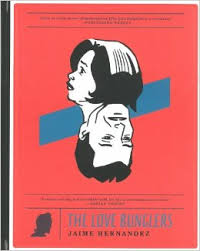
[READ: October 28 2014] The Love Bunglers

Jaime Hernandez is one half (with his brother) of the duo who create the cool graphic novel series Love and Rockets.  I have read (and own) some issues of the book, but I haven’t really kept up with it all that much.

But I really like his stuff, so I was delighted to see this book, which was originally printed in Love and Rockets: New Stories 3 and 4.

This is a complex story, written in a back and forth style which only makes the narrative that much more compelling.  As the story opens we see some men playing chess on a street corner.  A woman, Maggie, walks by.  She is older but still curvy and the men size her up.  One of the men, the “new guy” gets up and follows her then hides in the bushes watching her.  Next we see Maggie, naked, lying on a leaf.  But she is actually talking to Reno and relating this recurring dream.

Then we see that she is a landlady and is also friends with a man named Ray.  Ray is an artist who is showing at a local gallery.  Maggie agrees to go with him. By the end of the first section it’s not entirely clear what Maggie’s feelings are about either of these men, but they both seem to like her. (more…)

Read Full Post »

elmer SOUNDTRACK: R.E.M.-Collapse into Now (2011).

R.E.M._-_Collapse_into_Now“Discoverer” opens this disc with ringing guitars–not exact R.E.M. replicants, but familiar.  And then Stipe comes in and the refresher course in R.E.M. begins.  Collapse Into Now proved to be R.E.M.’s final album, and while some of their latter albums weren’t great, Collapse seems to revisit everything that was great about R.E.M. and tries to spread it all over this album.

The blueprints for classic R.E.M. songs form the structure of a lot of these songs, with chiming guitars, and Stipe’s recognizable vocals.  “All the Best” sounds like classic R.E.M. (although Stipe’s delivery is more current sounding).  It also fits in well with the faster songs from Accelerate and is only 2:46.  But it’s “Überlin” that really sounds like a classic R.E.M. song.  That notable guitar style with Stipe’s very specific delivery style.  And then come Peter Buck’s harmonies.  It sounds like a good outtake from, say, Automatic for the People.

Stipe tends to do a lot of his sing-speaking on this album (and i think the one thing I don’t like that much about the album is that early R.E.M. seemed to obscure Stipe’s vocals and lyrics a little bit, giving them an air of mystery.  Whereas the newer records are all pretty well laid bare).  So “Oh My Heart” has Stipe almost speaking his poetry.  It’s got mandolin and Buck’s mildly annoying backing vocals (I’ve never thought that about his backing vocals before).

An Eddie Vedder cameo is utterly wasted on “It Happened Today,” you can barely hear him as all he does is backing crooning near the end of the song (and frankly the “hip hip hooray” chorus is lame).  “Every Day is Yours to Win” is a pretty slow song.  It doesn’t amount to much but the melody is really beautiful.  “Mine Smell Like Honey” is a crazy bad title, but it’s a great rocking song, really hearkening back to classic R.E.M.–ringing guitars and Stipe’s vaguely disguised voice.  “Walk it Back” is another slow ballady type song and is really pretty.  While “Alliagtor_Aviator_Autopilot_Antimatter” is a rocker with Peaches singing and speaking backing vocals.  “That Someone is You” follows up with another speedy track.

I tend to dislike the really slow R.E.M. songs, so “Me, Marlon Brando, Marlon Brando and I” doesn’t do much for me.  The disc ender, “Blue” reminds me of Out of Time‘s “Country Feedback” (I keep waiting for him to say “I need this”).  And the Patti Smith backing vocals recall “E-Bow the Letter.”  “Blue” is meandering and unfocused but Buck’s atmospheric guitars are quite effective, even if the song itself is nothing special.  I don’t quite get the coda of tacking the opening chords of the album on to the end, but whatever.

So basically this album feels like some mostly great outtakes from earlier R.E.M. albums. And there’s really nothing wrong with that (well there would be if R.E.M. was still trying to release a lot of new music).  But since the band was ready to call it quits anyway, it’s a nice recap of their career.  True, I’d rather listen to their earlier records, but you could definitely throw most of these songs into a mix with the earlier ones and they would sound perfect.

[READ: October 25, 2014] Elmer

Elmer has a  chicken on the cover.  It also features this quote at the top of the book: “It’s the Great Filipino Novel, with chickens.”  What to expect from this book?  Well, chickens, obviously, but I never would have guessed what this book contained.  Indeed, this book is pretty mind-blowing (in a good way).

It has a simple premise, which seems comical but is actually taken very seriously: what if chickens became “aware” and learned to speak?  It sounds funny, right, but Alanguilan really explores this issue seriously–if a species of animal that we normally eat suddenly talked to us en masse, how quickly would we deal with this, and what would humanity’s reaction be?  It tackles issues of slavery and racism and pushes them further.  And while the “change” takes place in 1979, it addresses contemporary society with an inquisitive glare.

While there is some humor in it, this is a serious book.

Jake Gallo is a modern chicken (the book is set in 2003–two decades after chickens became “human”).  He has just been rejected for a job, and he pulls the race card (this would be the hilarious reveal that our main character is a chicken).  While he’s feeling sorry for himself, he gets word that his father, Elmer, is dying and he returns home to be with his mother and family.  On the way home he runs into Farmer Ben, the farmer who helped to raise Elmer’s family.  And he is genuinely glad to see Jake.  Jake seems somewhat put off by Farmer Ben and declines his offer of a ride. (more…)

Read Full Post »

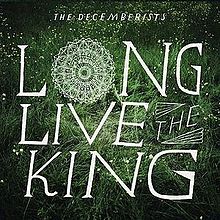
paintedSOUNDTRACK: THE DECEMBERISTS-Long Live the King EP (2011).

220px-The_Decemberists_-_Long_Live_the_KingLong Live the King is an EP that was made of outtakes from their previous (and so far final) LP The King is Dead.  In the style of that album–straightforward folk songs with country tinges, this EP makes a fine companion.  “E. Watson” is a classic storytelling Decemberists song.  It has a great chorus and really wonderful harmonies.  There’s a pedal steel guitar on “Foregone,” which adds a neat sound to this really catchy song.  In fact, the chorus is one of the catchiest things they’ve done, and it’s hard to believe they tucked it away on this EP instead of the album.

“Burying Davy” (which I had been mishearing as Burying Babies, such is the darkness of Colin Meloy that that was a real possibility) is a much creepier song.  The melody is dark and minor chord and yet it’s somehow still catchy and strangely fun to sing along to.  “I 4 U & U 4 Me” rumbles along with a great Smiths-esque bass line.  This version is a home demo (although there’s no non-demo version that I know of).  “Row Jimmy” is a cover of Grateful Dead song that I do not know.  It’s the slowest and most shambolic song on the EP.  I don’t especially like it, but I do like the way he sings “Get Down and” before some choruses.  “Sonnet” is a pretty straightforward folk song.  It’s done on acoustic guitar and features Meloy’s falsetto at certain times.  But just as the song seems to be a pretty standard acoustic guitar ballad, a whole bunch of horns blast in and play along.

Even though this is an EP of predominantly folk songs, there’s some cool headphone stuff going on in this album as well (especially the guitars on “Burying Davy”), so turn it up and tune out for 25 minutes or so.

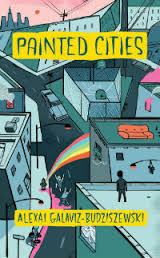
[READ: October 18, 2014] Painted Cities

Painted Cities is a collection of stories (I assume they are all short stories although the early ones read a bit more like essays) that are all set in the Pilsen district of Chicago.  Evidently AG-B grew up there and these stories are about the people and gangs in this largely Latino neighborhood (the fact that his name is Alexai Galaviz Bidziszewski, which conjures up so many different nationalities, although few of them Latino has certainly confused me, although I have no doubt that these are all based on reality).

There are fifteen stories in the book.  I enjoyed the first couple, then I got a  little tired of the gangland/macho tough guy aspect of the stories.  But just as I was a bout to give up on them, he threw in one with magical realism that I really loved, and the rest of the book was equally interesting.   I will say that this region of the country is completely unknown to me and while I don’t typically like gang related stories, these stories did not dwell in the heartache of gangs, but used them as a periphery around which to establish the stories. (more…)

Read Full Post »

2014-07SOUNDTRACK: SLOAN-Commonwealth [Spade Side–Andrew Scott] (2014).

commonFor Sloan’s 11th album, the four members of the band each wrote the songs of a side.  I originally thought that they recorded all of the music alone, but that seems to be wrong–and would hardly be a Sloan album).  In conjunction with the album, each guy was given a suit of cards (and an actual deck was made as well).  While this doesn’t necessarily mean the album is very different from their others (it still sounds very Sloan), it seems to have given the guys a bit more room to experiment.

The final side of Commonwealth is by drummer Andrew Scott.  Scott has written three singles for Sloan over the years: “500 Up”, “People of the Sky”, and “I’ve Gotta Try.”  But for this album, he has created a 17 minute and 49 second epic called “Forty-Eight Portraits.” This makes it seem like it could be 48 small songs which it isn’t.  But it also isn’t one long song exactly.  There are, by my count 15 sections–although there could be more or fewer depending on how you break it up.

So my demarcations:

  1. The song opens with a dog barking.  There’s complex percussion and a smattering of piano seemingly searching for a melody.
  2. At 3 minutes the first real song proper starts.  We’ll call it “You say you’re going with me.” There’s acoustic guitars and a bouncy melody.  It’s a great song with a neat guitar riff that overlays around 4 minutes in.  But
  3. At 4:23 the song changes dramatically.  It grinds to a slow pensive section, call it the “Don’t ask for a second chance.”  But it doesn’t last long,
  4. At 5:16, the next part jumps in, it’s a bit faster and feels like it could be an extension of the previous section.  Call it the “Do the things I do” section.  It speeds up
  5. At 5:41, to a similar style as the “first song.”  It has a sing along starting “How Does It Feel?”  It’s got one verse before a time signature change and instrumental break.
  6. At 6:40 the next section comes in.  Aggressive guitars and spoken word lyrics “There’s something happening here.”  It also has one of the few uses of the word “fucking” in a Sloan song.
  7. At 7:25 it shifts to a falsetto style and higher pitched guitars.  It’s vaguely Beach Boys-like for a verse “Do you think she loves you?” until
  8. At 7:48 it’s back to a reprise of the “How does it feel” section.
  9. At 8:15 it shifts to a new slow piano section.  This feels like the most fully realized song section of the epic.  “I can’t believe you never told me the truth.”   It leads into a big chorus sounding section (two lines) around 8:40 (“What it is us unsustainable”).  There’s even a repeat of this “verse” and  “chorus” as well.
  10. At 10:26 a new guitar section is introduced.  It works as a transition “You said you’re coming with me.” It morphs
  11. At 10:52 into a very cool slowed down section “I asked for a proper glass.”  And then
  12. At 11:22 the song again returns to the “How did it feel” section.
  13. At 12 minutes the song transitions with a “ba ba ba” and horns which move into the “Sometimes I feel like I’m slipping away” section.  The song feels like it might end at 13 minutes as the last notes seem to ring out.  But
  14. At 13:21, the song rebuilds again with the “inside a cloud” section.  This feels like the final section of the song is built around a similar construct. It’s a guitar riff that introduces a children’s chorus at around the 14 minute mark.  There’s a slow guitar solo and pizzicato strings that keep this section from being to easy, but that guitar riff and children’s section reunite the end which concludes with the spoken “W.W.L.R.D.?” (which I assume the L.R. refers to Lou Reed).
  15. At 16 minutes, the chaos of the beginning returns with a dog bark, but the concluding riff is strong and seems to really draw out the end.

I really haven’t listened to the lyrics that carefully to know exactly what’s going on, but I really enjoy the “choruses.”  While a 17 minute song is not everyone’s cup of tea, there are so many parts and so many interesting and catchy sections, that it feels like a whole collection of short songs rather than one long song.  It’s a cool experiment and one that I find myself singling out as I try to parse it a bit more.

[READ: October 11, 2014] “Part of the Main” and “Watching the Cop Show in Bed”

The Walrus’ summer reading issue presents three stories and two poems in which: “The Walrus presents fresh takes on old crimes.”  Each story is about a crime of some kind, but seemed from an unexpected way.  I rather enjoyed the way the writers played around with the crime genre to make them something very different.  These were two poems.

I’ve don’t normally review the poetry in The Walrus, but since I had four sides and only three stories it seemed worthwhile to throw the two poems in as well 9especially since the finally song was so unusual).

The first one “Part of the Main” is written with wonderfully evocative language as it talks about something so base.

The first stanza talks about the inevitability of the tide, of life.  With beautiful language like: “the contours of the and effaced by the saintly patience of the tide.”  But the second stanza shifts gears.  In it, the narrator says that you can show him dire things on the television: “bloated bellies…bomb blasts” and he will weep and clench his fists “but otherwise do nothing.”  It is sadly an uncomfortably relatable attitude. (more…)

Read Full Post »

2014-07SOUNDTRACK: SLOAN-Commonwealth [Shamrock Side–Patrick Pentland] (2014).

commonFor Sloan’s 11th album, the four members of the band each wrote the songs of a side.  I originally thought that they recorded all of the music alone, but that seems to be wrong–and would hardly be a Sloan album).  In conjunction with the album, each guy was given a suit of cards (and an actual deck was made as well).  While this doesn’t necessarily mean the album is very different from their others (it still sounds very Sloan), it seems to have given the guys a bit more room to experiment.

I’ve always had trouble telling whose songs are whose in Sloan, primarily because they all write such different songs all the time.  But also because their voices aren’t radically distinct.

According to the CBC website, Patrick Pentland is responsible for some of the band’s biggest hit songs, including “The Good in Everyone,” “Everything You’ve Done Wrong” and “Money City Maniacs.”

Pentland only wrote four songs for his side.  And none of them are especially long.  Overall his songs are heavier fuzzier and rockier.

“13 (Under a Bad Sign)” is a heavy rocker at only two minutes.  Even though it’s the same length as Murphy’s also heavy “Get Out” it just rocks a lot harder.  It also opens with a bass–one of the few songs on the album that does so.  It’s a big loud rocking riff.  “Take It Easy” is even noisier.  The guitars feedback as the bass propels along.  It’s a simple song, with a simple heavy chord structure, and it has a simple catchy chorus.  Good rocking Sloan.

“What’s Inside” slows things down a bit—it has a familiar bass line and swirling guitars.  There’s lots of echo on this song, especially in the chorus which seems almost shoegazey.  It’s probably my least favorite song on the album because of the way it kind of meanders–it rather slows the momentum of the disc.  But his final song, “Keep Swinging (Downtown)” totally redeems it, with a super catchy classic rock sound classic.  It has a great got sing along chorus.  This could easily be a huge single and a live concert favorite.  It’s 3 and a half minutes, but nearly the last minute is an extended outro with a great pretty acoustic guitar riff.

For only four songs, Pentland makes a huge statement.

[READ: October 11, 2014] “Brute”

The Walrus’ summer reading issue presents three stories and two poems in which: “The Walrus presents fresh takes on old crimes.”  Each story is about a crime of some kind, but seemed from an unexpected way.  I rather enjoyed the way the writers played around with the crime genre to make them something very different.  This story is about murder.

Of the three stories I liked this story the least.  Not because it from the point of view of a dog–that part I liked.  In fact I enjoyed a lot of details in the story–like that there was a character named Grassy Noel, that the narrator believes all golden labs have a Scottish accent and that the narrator speaks as if he is not a dog.

First we learn about Big Cy’s (the narrator) history.  He used to hang around the bus station grubbing for food.

Then he witnessed a Lab rescue a baby and saw that dog praised and held high.  He wants to know:

Who is better. The dog who is … naturally good or the one who struggles to be good. (more…)

Read Full Post »

2014-07SOUNDTRACK: SLOAN-Commonwealth [Diamond Side–Jay Ferguson] (2014).

 commonFor Sloan’s 11th album, the four members of the band each wrote the songs of a side.  I originally thought that they recorded all of the music alone, but that seems to be wrong–and would hardly be a Sloan album).  In conjunction with the album, each guy was given a suit of cards (and an actual deck was made as well).  While this doesn’t necessarily mean the album is very different from their others (it still sounds very Sloan), it seems to have given the guys a bit more room to experiment.

I’ve always had trouble telling whose songs are whose in Sloan, primarily because they all write such different songs all the time.  But also because their voices aren’t radically distinct.  According to Wikipedia, Ferguson’s more famous songs are: “I Hate My Generation” from the album Twice Removed, “The Lines You Amend” from One Chord to Another, “Who Taught You to Live Like That?” from the album Never Hear the End of It, and “Witch’s Wand” from Parallel Play.

Jay Ferguson has the more falsetto’s/delicate voice of the bunch.  He writes five songs that all works as kind of a suite.

“We’ve Come This Far,” opens the disc as a minute and a half piano intro.  It blends right into “You’ve Got a Lot on Your Mind” one of several super catchy songs on this record. The verses are gentle with an acoustic guitar playing along with Ferguson’s singing.  It’s a simple song with a great sing along chorus (and even a long Yeah- h- h ).   “Three Sisters” also starts with a piano (and reminds me of Twin Peaks theme in tone).  It is slower than the other songs, which suits Ferguson’s voice very well.  I enjoyed this lyrics which plays to the album art: “I Played a diamond where her heart should land. She recognized the tune but not the band.”  The mellow song has a cool buzzy guitar solo laid over the top.

And It jumps right into the much faster “Cleopatra” which is a simple (and again catchy) track with a boppy “talk to ya later” bridge. The piano and guitar solos are quiet affairs which play against the type of song and really showcase the Ferguson’s songwriting skills.  “Neither Here Not There” opens with, in sequence: a gentle organ, a quiet electric guitar riff and then a 12 string guitar  (not bad for 20 seconds). The song is barely 2 minutes long and is pretty ballad.

It’s a really pretty song cycle and shows of the kinds of songs that Sloan has been doing so well for so many years.

[READ: October 11, 2014] “Ultrasound”

The Walrus’ summer reading issue presents three stories and two poems in which: “The Walrus presents fresh takes on old crimes.”  Each story is about a crime of some kind, but seemed from an unexpected way.  I rather enjoyed the way the writers played around with the crime genre to make them something very different.  This story is about rape.

I’ve mentioned before that I feel kind of hit or miss about Stephen Marche’s short stories.  But I loved this one.

I was a little concerned at first because of the very cold and distant way it began: “On a scale of 1 to 10, with 1 representing “of no interest to me” and 10 representing “of maximum interest to me,” the rapes in my neighbourhood rated a 2.3.”

It’s a cold way to open a story.  But the narrator is not finished with his detached tone.  Indeed, he looks at everything in this detached way–on scales of 1-10 or in percentages.  He shares the same outlook as the protagonist of American Psycho, but this story is not about a psycho, just about a person who is exceedingly rational.

And it is a love story too (sort of).  We learn that he dated Catherine Anne Doran and he rates his time with her at 9.3 out of 10.  But by the end of the story something changed.  It wasn’t how he felt about her, it as something intangible.  Thus we learn the problem with the narrator: “Despite this high level of personal significance, the measurable changes our relationship produced were negligible. The numbers were the same, but everything changed. This is what I fail to understand.” (more…)

Read Full Post »

anoukSOUNDTRACK: THE DECEMBERISTS- We All Raise Our Voices to the Air (Live Songs 04.11–08.11) (2012).

220px-The_Decemberists_-_We_All_Raise_Our_Voices_to_the_Air I have been a Decemberists fan for a while, so I was bummed that they went on hiatus.  Although I understand they have a new album in the works for next year.  Yay!

This live album came after the tour of their then last record, The King is Dead.  I had heard a number of concerts (mostly on NPR) of their previous tour in which they played the entire epic playing live for The Hazards of Love album in sequence.  That was pretty awesome, both because of its complexity and because they had so many guests with them.

The King is Dead was a decidedly simpler record–one of the simplest they have made–and the live show proved to be an interesting mix of simple and complex rockers.  This collection of songs is not from one show–songs were cherry picked from throughout the tour.

While the show relies heavily on the King is Dead (7 songs out of 20), there’s a bunch from their other records as well.  There’s only one from Hazards of Love (a rollicking “Rakes Song”) but there’s all three parts of the titular “Crane Wife” trilogy.  And then there’s a few classics thrown in as well.  I love that they have an audience participation of the “Mariner’s Revenge Song” (but I do wish there was a visual as to what the signal that Chris Funk sends out is).

There are only 20 songs since three of them are over 10 minutes long,

This album is a really great summary of The Decemberists live music. The sound quality is different–rawer and less “perfect” sounding than the records.  There’s also nice changes of instrumentation in some of the tracks, with Jenny Conlee’s accordion taking center stage from time to time and lord only knows how many things Chris Funk is doing.

And Colin Meloy proves to be a chatty and funny host, as you might expect from his lyrics.

This is a great document that could have been the band’s last.  Although I’m glad they’ll be releasing more music next year.

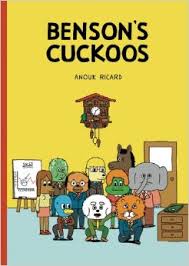
[READ: October 10, 2014] Benson’s Cuckoos

My oh my this is a strange book. I am unfamiliar with Ricard’s work.  Evidently she does mostly children books (a series called Anna and Froga) and this is her foray into more adult themed stories,.

In this graphic novel all of the characters are animals with human bodies.  And each character is a different species.  The drawing style is simple and child-like but very effective in conveying emotions and feeling. You can tell a lot from the cover image above.

The story opens with a blue headed duck (Richard) applying for a job at the titular Cuckoo factory.  He hands in his resume the boss (the big poodle looking guy on the cover) And the boss says, “What kind of lousy paper is this?”  Confused, Richard replies, “Uh… printer paper.” To which the boss responds, “Yes it is.  That’s one point for you.”  The boss is clearly cuckoo.  He draws a mustache on Richard’s picture and then tell him he look stupid.  Then he asks if he can touch his toes, and then basically hires him without even actually saying that he is hired.  Richard is pleased except that he has to bring his own computer to work.

The rest of the staff proves to be just as weird. The frog looking lady with the Annie wig gets mad that he doesn’t want to see her panties in the elevator and then offers curt responses to everything he says for the next few pages.  But it’s during the first conference meeting (in which Richard is expected to do a presentation even though he was given no materials to work with) that we learn that he was hired because George has gone missing.  (more…)

Read Full Post »

lauraSOUNDTRACK: FUN.-Some Nights (2012).

funI didn’t realize that this wasn’t Fun.’s debut album. I hadn’t heard of them until, well, until they got pretty big.  Sarah got this for me for Christmas in 2012 on the recommendation of an NPR list.  Of course, my biggest surprise was playing it Christmas morning and hearing the word fuck twice in the first song.  Merry Christmas, kids!

I read recently that the band really liked Kanye West’s My Beautiful Dark Twisted Fantasy so much that they hired the same producer to get that sound.  And that makes a ton of sense on the style and final product here–big grandiose sounds that are layered and layered and dense. The difference of course is that Fun. writes more catchy/poppy songs with a pop rock sheen.  And the Queen comparisons are unavoidable.  But with auto-tune.

“Some Nights (intro)” opens the disc with a quiet piano intro that builds to what you’re really going to get here–dramatic, theatrical, anthemic over the top pop rock.  Because after a minute when the backing vocals come in, it sounds pretty much like an updated modern day Queen.  While lead singer does bellow like Freddy Mercury the Queenisms come more from the backing vocals and the orchestrations.

The first song proper, “Some Nights” has a more polished, more poppy sheen to it.  And like the rest of the album, it has a huge sing along chorus with whoa hos and everything.  It’s nearly inevitable that they would become huge because of this album.

And yet, despite all the pop, I like this record a lot.  The artsy, theatricality is so over the top.  And really each song is like a mini showstopper.  “We Are Young” has the title of an anthem and thus the song is an anthem.  It starts with just drums but after some clever lyrics, it shifts to a slow building chorus that the world can sing along to.  The same is true for “Carry On,” a slow piano ballad that builds in a big anthemic chorus.  “It Gets Better” is a bit more electronic and fast paced from the start.  “Why Am I the One” slows things down again, this time with guitars.  But again each one has a big sing-along chorus.

“All Alone” is a bit more electronic (with harpsichords!) and a little more drum heavy, while “All Alright” stays anthemic throughout.

What’s surprising really is the lyrical content–he sings a lot about loving his parents (there’s a few shout outs to his mom).  I admit I don’t entirely know what’s happening on the album–I haven’t looked at the lyrics too carefully, but it seems far more introspective and personal than big anthemic pop hooks would suggest.

“One Foot” is the first song that diverges a bit from the formula–it’s still a big stomping song, but the way the main riff is played on orchestral hits rather than more conventional instruments points to the more Top 40 elements of the band.  And the final song, “Stars” really tips the balance. This is the one song that I don’t really care for.  It’s 7 minutes long and the melody is more pop than artsy.  The song builds in a less dramatic and more poppy way.  This song has the most mom intensive lyrics: “Most nights I stay straight and think about my mom–oh god I miss her so much.”  By 2 minutes it devolves into an auto-tuned ballad where the Kanye influence really rears its head.  For the last 3 minutes or so it is a string filled ballad with crazy auto-tuned vocals (especially when they harmonize!).  It’s a bit much even for me, although I think it works pretty great as an album ender.

The strange thing about that is that there is one song after it. It turns out that it’s a bonus track, which i didn’t realize until recently.  I couldn’t imagine why you’d put a song after that autotuned nonsense.  So it makes sense as a bonus track, although after “Stars,” I’m done with the album.  The song, “Out on the Town” brings back the guitars but the “oh oh oh oh” in the beginning is really boy band like.  And I fear the whole set up is more commercial than theater. So, no real bonus for me.

Basically, the album sounds quite the same throughout (in that it is big and theatrical, although there are some differences that distinguish the songs enough).  And if you don’t like one of the songs there’s not going to be much here for you.  But if you like your theatricality over the top, you could do worse than Fun.  Just get ready to sing along.

[READ: October 1, 2014] The Original of Laura

naboI have had Nabokov on my list of authors to read for a long time.  I have read and enjoyed a few of his books and planned to read his oeuvre at some point, just not quite yet.  And then, as serendipity would have it, I stumbled on a book of his novellas (the Penguin classic edition) and decided to read them.  Because they aren’t really meant to be taken as one item, I’m going to mention them individually.

The Original of Laura is a controversial release because of its history.  And it seems that more words have been written about the history of the book than the actual content of it.  So I will summarize the history by saying that Vladimir said that if he didn’t finish the book that it should be destroyed.  Vladimir’s wife did not destroy the book and some thirty years later his son Dmitri decided to publish it [cue cat fights and gnashing of teeth].

The interesting way the book was published was as a series of index cards.  Nabokov wrote all of his stories on index cards.  The book version is on heavy card stock in which all of the index cards were reproduced and the words were typed below (errors and cross outs and all).  And all the pages are perforated for, in theory, the reader’s ability to mix and match the pages as apparently Nabokov did.

This seems like a cool idea except that most of the index cards are numbered, so it’s not like there is any doubt as to what order they should go in.  The final cards are not numbered, but again, they are pretty much sequential–there’s not a lot of play at play here. (more…)

Read Full Post »

10SOUNDTRACK: FATHER JOHN MISTY-Fear Fun (2012).

fjmI can’t get over how much I’ve been enjoying this album for the last two years.  Father John Misty is J Tillman from Fleet Foxes.

This disc is a gentle folk album with vaguely country leanings.  The arrangements are spare and yet the verses and choruses are so great to sing along to. “Funtimes in Babylon” has this infectious chorus: “I would like to abuse my lungs, smoke everything in sight with every girl I’ve ever loved.  Ride around the wreckage on a horse knee deep in mud.  Look out, Hollywood, here I come.”  “Nancy from Now On” has a great propulsive chorus with oohs and tinkling bells and pianos and Misty’s engaging falsetto.

I was introduced to this album by “Hollywood Forever Cemetery Sings” which opens with the super catchy line, “Jeeeeesus Christ, girl.”  I love the big crashing drum sound he has here.  “I’m Writing a Novel” is a fun romp, with the great line “I’m writing a novel because it’s never been done before.”  “O I Long to Feel Your Arms Around Me” introduces a great organ sound.  It’s a full song at only 2 and a half minutes.

“Misty’s Nightmares 1 & 2” opens with a slide guitar and turns into a stomping song with more Ooohs and a great chorus.  “Only Son of the Ladiesman” has a great chorus with the fun couple: “I’m a steady hand, I’m a Dodgers fan.”  “This is Sally Hatchet” has cool guitar blasts and a great bridge.

“Well You Can Do It Without Me” is a countrified 2 minute stomper.  “Tee Pees 1-12” is a big stompin’ honkey tonk song with fiddles and slide guitar.  The disc ends with “Everyman Needs a Companion” a slow ballad with a great piano melody and a fun to sing along with verse and chorus.

I love the lyrics on this album, especially the song “Now I’m Learning to Love the War” a slow ballad with a great story:

Try not to think so much about
The truly staggering amount of oil that it takes to make a record
All the shipping, the vinyl, the cellophane lining, the high gloss
The tape and the gear

Try not to become too consumed
With what’s a criminal volume of oil that it takes to paint a portrait
The acrylic, the varnish, aluminum tubes filled with latex
The solvents and dye

Lets just call this what it is
The gentler side of mankind’s death wish
When it’s my time to go
Gonna leave behind things that won’t decompose

In addition to all of the great music on here, the CD packaging is fantastic with that great cover, done in a cardboard gatefold sleeve including two huge books full of words and drawings and lyrics and everything.  I’m really looking forward to his next release.

[READ: September 14, 2014] Grantland #10

Despite my being in the middle of reading several other things, I was looking for a short article to read the other night and grabbed my Grantland 10.  And, of course, once I started, I couldn’t stop. I put everything else on hold and blasted through this issue.

And so all of my loves and hates are the same with this issue.  I never know how anything they talk about nearly a year ago turned out, which stinks.  And yet I get so wrapped up in the writing that I don’t care.  I’m not sure what it is about the writing for Grantland that i enjoy so much.  It is casual but knowledgeable.  Often funny but not obnoxiously silly. And I suppose that now I feel like I’m in on all of the secret stuff they talk about so I’m part of the club.  I fear that if I were to ever go to the website I would get sucked into a black hole and never emerge.

I often wonder how they choose what goes into the book.  This issue has some new writers and the surprising absence of some regulars.  I wonder what went on there.  And as always, the book could use some editing and maybe actually listing the urls of the links that were once in the online version.  But I think I’m talking to deaf ears on that one.

This issue covers October-December 2013 (that’s ten-twelve months ago!  Some of this stuff feels ancient!)

(more…)

Read Full Post »

« Newer Posts - Older Posts »