Feeds:
Posts
Comments

Archive for the ‘Unreliable narrator’ Category

1.14.2008 SOUNDTRACK: IRON & WINE-Tiny Desk Concert #105 (January 21, 2011).
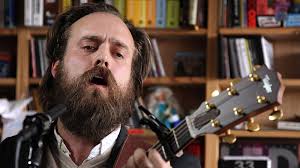
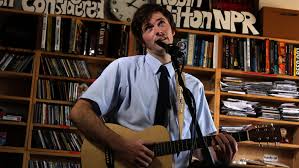
irionwineI have enjoyed Iron & Wine, but not extensively.  I knew that it was more or less a Sam Beam project (until recently, as the band has since grown in size).  And I knew that he sang beautiful folk songs. I did not know that he was such an amiable and sweet fellow.

For this Tiny Desk, Beam plays four songs.  Three are from his then new album, Kiss Each Other Clean, and they are great.  Beam’s voice sounds fantastic and his playing is excellent too.

After the first song, “Half Moon,” Bob Boilen asks him when he has time to write songs and Beam replies that he has less and less time.  He has to get up early to take the kids to school, so he works like a day job for song writing.

For the second song, “Big Burned Hand” he begins with the capo on fret five and then switches it to fret four apologizing that it’s early.  It’s another beautiful song.  At the end he apologizes for the word “fucking” in the final line (“the lion and the lamb are fucking in the back row”) but says that no other word would have had the same impact.  He doesn’t use words like that lightly in his songs.

He says that “Tree By The River” is a song he had been writing for ten years.  He was afraid it was always turning out saccharine, but thinks he finally got it.

Before playing the final song, Robin Hilton requests an old song (I can’t hear it) which Beam says he will butcher.  Robin says he will die happy if Beam plays it, but Beam says he’ll die unhappy if he plays it badly.  So instead, the final song is an older one, “Naked As We Came,” which has become a set-ender for the band.   Stephen Thompson says it’s great to hear this in this stripped down acoustic format instead of the full band version that has been common now.

And speaking of the full band, when Kiss Each Other Clean came out, the full band of Iron & Wine performed it live on WNYC (you can hear all four of these songs with the full band). And NPR has archived that performance, which you can download here.

[READ: January 7, 2015] “Wakefield”

I have always intended to read more from Doctorow, but he always seems to fall off my radar.  So I don’t know how this compares to his other works.  I really enjoyed it even if I felt like I had to suspend my disbelief a number of times in what was otherwise a somewhat realistic story.

Realistic or not, I really loved the conceit behind it.  The narrator and his wife of many years have had a fight about something stupid.  He went off to work as usual, but on the way home strange things happened.  First there is a problem with is train and he winds up arriving home much later than usual.  And then he finds there’s a power failure (it was interesting to read this right after Updike’s power failure story last week).

He gets out of his car and sees that there are raccoons behind the garage so he chases them away.  When he goes upstairs in the garage he sees that there are baby raccoons there too.  He chases them away and, since the power is still out and he is mentally taxed, he sits in a tattered rocking chair.

He only wakes up the next morning.  And he knows that his wife will never believe the truth. (more…)

Read Full Post »

july2015 SOUNDTRACK: THE HELIGOATS-Tiny Desk Concert #98 (December 15, 2010).

heligoat I thought that I would have written about all of 2010’s Tiny Desk shows last year, but it turns out that I missed two.  This was one and tomorrow’s will be the second.

According to the blurb, Stephen Thompson says that this was the 100th Tiny Desk Concert.  I have counted all the shows (twice) and using my counting method, I found this to be the 98th show.  So either this was aired out of order or they never aired two shows.  I have noticed that I’ve been off on all of their milestones, so something is up (and I’m pretty sure it’s not my counting).

Chris Otepka is the Heligoats. He has another band called Troubled Hubble, but Heligoats are his acoustic unplugged band.

In addition to singing unusual songs (he’s a songwriter for whom lyrics are very important (if not always comprehensible)), he tells some elaborate stories between songs.  His stories seem spontaneous, although I expect that they are not (especially the cremation story)

“Goodness Gracious” is a slower song (although he somehow makes a really full sound with just his (small) acoustic guitar).  There’s some great lyrics and twists of phrase in this song.  And his voice is quite nice, too.

“I’m Pretty Sure I Can See Molecules” is a song he says he started writing when he was 8 years old.  He says he liked pushing his fingers back into his eye sockets to see what kind of fractals appeared.  He gives a lengthy explanation about this phenomena which he says is the cause of floaters.  All of this is an introduction to this uptempo song.  I really like the somewhat “off” chord he plays between chorus and verse.

Before “A Guide to the Outdoors,” he talks about cremation and the metal parts in his body.  And about having his will explain about his robotic existence.  The song seems to be a letter written to the person who has found his dead body?  It’s surprisingly upbeat though.

The final song, “Fish Sticks,” is my favorite.  It is about a man named Carl Beakman who gets a grant to protect a wetland for migratory birds (I suspect all of this is nonsense, but whatever).  I like the way the song has super fast strumming and the bouncy chord progression in the verses.

The Heligoats require close listening, and the songs are worth it.

[READ: January 6, 2015] “A Little Bottle of Tears”

As part of last year’s push to read a lot of books, I blew off most of my magazines.  So this year I’m going to get back to all the issues I missed and I’m going to try to keep up with my subscriptions going forward.

I’m starting with the Harper’s that I hadn’t read in 2015 and then I’m going to move on to the errant New Yorkers.

I’m starting with this story.

I haven’t really liked any of Diane Williams’ stories.  I find them maddeningly elliptical.  She has some excellent sentences and turns of phrase but as for an entire story, I’m always left wondering what I just read.

This is a short piece about how people could have better friendships if they weren’t so old. (more…)

Read Full Post »

blueblue SOUNDTRACK: NICK BUZZ-A Quiet Evening at Home (2013).

quietIt seemed like Martin Tielli was done making music after his (so far) final solo album in 2009.  He has been focusing on (gorgeous) visual arts since then.  But then in 2013, Tielli along with Jonathan Goldsmith, Hugh Marsh and Rob Piltch recorded another Nick Buzz album (cover painting by Tielli)–possibly their last as well, but who knows.

This album is almost entirely mellow, with beautiful slow pieces and delicate singing and instrumentation–with some exceptions.  The biggest exception is the first song and single (with video) “The Hens Lay Everyday.”  It is unlike anything else on the album.  It is a weird, electronic fast song with pulsing beats and funny lyrics (and a crazy video).  It’s kind of a shame that it’s on this album because I want more music like that.  But the rest of the album is also wonderful in a very different way.  This song just doesn’t fit.

Beginning with the second song, the album is a beautiful album of wonderful ballads.

“This is Not My World” is a delicate guitar song with simple keyboard washes.  Martin’s voice even sounds different on the song–I almost didn’t recognize him until the last few verses.  “Milchig” opens with a buzzy violin (that sounds almost like a fly).  Tielli did this song with The Art of Time Ensemble (it was called “Moglich”).  It has a gentle guitar and Tielli’s keening voice and spoken word–“he had given me ‘the relax.'”  There’s several sections in this song, and I especially like the slowly lurching middle section.

“Sea Monkeys” opens with some delicate chimes and underwatery sounds.  And once again, Tielli’s voice sounds different.  I love this peculiar song about ordering and “growing” sea monkeys.  He says he only wanted plankton or krill but during that evening, the sea monkeys started building their city, and after 4 and a half minutes, the song turns somewhat more sinister with a section about the Crustacean Monkey Queen.  The delicate music grows harsher and more mechanical sounding.  It’s pretty intense.  And it coincidentally relates to the book below.

“If You Go Away” has a vaguely Spanish guitar feel to it.  It’s a very delicate, slow ballad (I should have realized it was an old song written by Jacques Brel) with strummed guitar and gentle percussion.  It has a lounge feel as well (the romantic lyrics aid in that style).  It was recorded live with audience clapping at the end.

The mood picks up a little with the next song, “The Happy Matador.”  It’s played on acoustic guitar with flamenco-esque runs.  It’s a delightful song even if lyrically it’s a little dark.  “Eliza” is a darkly comic song with a kind of circusy feel.  It opens with accordion, adds a violin and basically makes fun of a woman named Eliza, with the great last line: “The only incredible thing about Eliza is the terrible terrible music she inspires.”

“A Quiet Evening at Home” opens with some strange noises like Circo did, but this is an older, more mellow album and they quickly give way to some pretty, delicate guitar chords.  About two and a half minutes of gentle chords are disrupted by a noisy saxophone and some manipulated spoken words.  This process repeats itself for about six minutes of mellow, slightly weird, but really enjoyable music.

“Uncle Bumbo’s Christmas” continues in that delicate vein, but this time with actual words.  It has gentle echoed guitar and some occasional strings.  It’s not exactly a Christmas song although the lyric “I love everything about Christmas, except Christmas” is decidedly ambiguous.  There’s beautiful overlays of vocals and guitar for the middle two minutes of the song before it resumes with a slightly more uptempo and much more catchy end section.  This song gets better with each listen.

“The House with the Laughing Windows” opens with a tinkling piano melody.  It hovers between ominous and dreamy.  I like the way the song gently, almost imperceptibly, builds over the course of its 4 and a half minutes.  And I love the way the guitars start playing louder as if the song is going to build to something bigger but it never quite does.  John Tielli plays theremin on this track.

“Aluminum Flies” is a slightly louder song which is much more meandering and ends with what I believe is the sound of windshield wipers.  The final song is the lovely “Birds of Lanark County.”  It opens with chickadees chirping and a beautiful delicate acoustic guitar melody from Martin.  Michele Williams sings lovely backing vocals.

It’s amazing how different this album is from Circo–same band members but an entirely different style, and a simply gorgeous collection of songs.

[READ: November 25, 2015] Blue on Blue

I had never heard of Quentin S. Crisp before (he’s not to be confused with Quentin Crisp, the British raconteur who died in 1999).  Except that I knew he contributed lyrics to the most recent Kodagain album.  But I received an advance copy of this book with Brendan Connell’s latest book (its publication date is December 15 (from Snuggly Books)).

This story was fantastic (in both senses of the word).

The story is told in 5 parts.  And what I loved about it was that the central part of the story is a fairly conventional story about love and loss, and yet the other four parts frame the story with an other-worldliness that is almost familiar, but not quite.

The story begins with the statement “I am a citizen of the ASAF, the Alternative State of the American Fifties.”  There’s a footnote attached which explains that the ASAF “ia an artificial history zone ‘reclaimed’ from sunken parallel time.”  This is a potentially worrisome beginning to a book to be sure, and yet the book does not go through any rabbit- or worm- hole, this is simply the set up for the story. (more…)

Read Full Post »

secretevilSOUNDTRACK: ABAJI-Tiny Desk Concert #47 (February 15, 2010).

abajiThis is the only time I have heard of Abaji. He is an unimposing man with roots in Greece, Turkey, Armenia and France.  He sings gently (often in Arabic with some English) and he plays while he sings.

The impressive thing about Abaji is his skill and love of musical instruments.  The notes say “when recording his latest album, Origine Orients, he played 10 different instruments, many of them simultaneously, with no second takes or overdubs. It took him just two days.”

“Min Jouwwa” (which means “From Inside”) is played on  what looks like a normal guitar but which sounds so very different. The notes say it’s “a tricked-out Western-style guitar with extra strings, giving it the sound of an Egyptian oud.”

“Steppes”  is a brief haunting instrumental.  It’s played by bowing a soft-toned kamancheh (a three-stringed instrument that you hold upright on your lap for a scratch, middle eastern sound).  He often times rocks the instrument instead of the bow back and forth.

The final song is played on the Greek bouzouki (with whistling as accompaniment).  “Summertime” is the Gershwin song (which is only recognizable from the words–the first verse anyhow, which he sings in English–the second verse he sings in Arabic).  It sounds nothing like the original with the serpentine riffs and that unique bouzouki sound.

I only wish the cameras were still rolling after the set because “he demonstrated a large duduk (an Armenian cousin of the oboe), an Indonesian suling (flute) and a Colombian saxophone (of sorts) made from bamboo that looked more like a snake.”

This is what I love about the Tiny Desk–seeing very different instruments and unconventional performers up close.  Abaji is fun to watch.

[READ: May 7, 2015] The Secret of Evil

This has got to be the final posthumous collection of writings from Bolaño.  The Preliminary note from Ignacio Echevarria explains that this book is a collection of the final fragments that were found on Bolaño’s computer.  As such, the book consists primarily of works that are unfinished (some barely even started).

This isn’t as disappointing as it sounds because Bolaño seemed to write very thoroughly right form the beginning with his stories.  So even though they are incomplete, the section that is written feels fully fleshed out–and you can imagine that more will be coming. Echevarria says that “Bolaño rarely began to write a story without giving it a title and immediately establishing a definitive tone and atmosphere.”  This of course made it difficult for Echevarria to know what to compile here.

Not everything in this collection if unfinished.  And indeed, with Bolaño sometimes it’s unclear if the unfinished things were actually unfinished. (more…)

Read Full Post »

SOUNDTRACK: PRIMUS-“Mephisto & Kevin” (1998).

chef aid oct27On the South Park Chef Aid album, Primus played this song.  It’s not one of their best, but it’s a fun little number.  The bass is interesting and once the chorus comes along, there are some great guitar sections.

The lyrics are a childish thing about Michael Jackson’s semen–and I don’t think they have anything to do with these two characters directly.

It is of course fun that Isaac Hayes sings the chorus (which has to have been kind of cool).  And the music in the pre-chorus is heavy and interesting.

Apparently, that’s Trey Parker singing at the very end.

[READ: January 16, 2015] “Alan Bean Plus Four”

Yes, THAT Tom Hanks.

Who knows what to expect from an actor, especially one whom you’ve never heard of writing a story before.  And who knows even more what to think when the story is as strangely written as this one.  Well, not strangely written… it’s pretty normally written. But the content is quite unexpected.

The story is about a four people who build a rocket and fly it around the moon and back.

What is strange about the way it is written is that there is never any doubt from anyone that it will work or questions about how it will work.  Even though some of the things they discuss are preposterous, it will still work and does still work. So it seems like the narrator is crazy, and yet we are not given that information.

It begins with the premise that if you could throw a hammer with enough muscle, it would sail around the moon and return to earth like a boomerang.  Of course Anna points out that a hammer would melt upon reentry, so why not just make a shuttle and they could all fly round the moon.  They could succeed where the Russians failed.  And so they set out to build one and sail it on the anniversary of when Apollo 12 landed in the Ocean of Storms (forgotten by 99.999 per cent of the people on Earth). (more…)

Read Full Post »

922SOUNDTRACK: PRIMUS-Tales from the Punchbowl (1995).

punchbowlTales from the Punchbowl is the final album to feature Tim Alexander on drums (until he came back a decade or so later).  It was never a favorite although it has some really good songs on it.  I feel like their songs were getting a bit too long and kind of dull at this point–all of the songs weren’t fun.

“Professor Nuttbutter’s House of Treats” the opening song, is over 7 minutes long.  It starts off with cheering and what I think of as circus music.  Then the bass comes rumbling in.  After about a minute the proper bass riff begins and the heavy heavy guitar crunching follows.  It’s a surprisingly heavy opening song.  By around 3 minutes, Ler plays a crazy solo and then the song slows down into a jam band sounding song–a bass solo and a normal guitar solo. Around 5 minutes the song turns into something else–a fast bass line with Ler’s repeated solo and Les (I guess) talking over something although it’s kind of inaudible.  It’s a weird way to start the album.  “Mrs Blaileen” is a quietly sung song with a groovy bass and drums.

The two biggest hits on the album were “Wynona’s Big Brown beaver” and “Southbound Pachyderm,.”  I forgot just what a great song “Wynona” is. Anytime Primus does a fun bouncy song you know it’s going to be good.  And between the bass and the guitar this song is just instantly catchy (but because MTV thought it was vulgar they only played it after midnight, so it never became quite the hit it could have).  “Southbound” is a slower song with a smooth bass punctuated by a dissonant riff that is strangely compelling.  At 6 minutes it an unexpected hit, but Primus has been doing the unexpected for ages now.

“Space Farm” is a 2 minute piece of weirdness with a South Park type bass riff and the sounds of, yes, farm animals in space.  I find that I can’t get into “Year of the Parrot” that much.  Not sure why.  I think I don’t like the songs that feature Les’s slow vocals and rhythms, I like the faster more upbeat tracks.  “Hellbound 17 1/2” is called a “theme” and it could feel like a theme song, although the South Park theme is better.

I don’t mention Tim’s drums enough in these songs, but they are great starting point to “Glass Sandwich” which follows up the opening cool drum sequence with a bowed bass.  It’s a little slow as well.  But a song like “Del Davis Tree Farm” brings the excitement back with the weird and unexpectedly poppy chorus.  The next song is “De Anza Jig.”  I love Primus’ goofy song like this one, big wet bass and Ler’s banjo tells a funny story in Les’s cartoon voice.  “On the Tweek Again” is a dark song with a big bass sound and Ler’s effects filled guitars.  The disc ends with “Over the Electric Grapevine” is a great 6 minute song (sometimes when they are long they are really good).  It opens with Les’ bass sounding middle eastern again. The solo in the middle is full of interesting noises (I’m not sure who is making what sound).

There are some great songs on this disc, but I find I don’t listen to it all the way through like I do with their earlier discs.

[READ: January 7, 2015] “Jack, July”

I have enjoyed most of the stories that I’ve read in my recent run through of New Yorker stories.  But I really did not like this one.  I’d say the first reason is because Jack is a meth head and I could not get sympathy for him, especially with the chaotic way the story opened.

I will say that there were a lot of funny moments, in which Jack, while coming down from the meth seems genuinely confused by what’s going on around him.  The crazy mistakes he makes are quite amusing, but considering the whole first part of the story was just Jack trying to get to a house presumably to score more meth was very disappointing.

So Jack walks through the baking Arizona sun.  First he arrives at his “girlfriend” Rhonda’s house.  She tells him he can’t be there [“Jack, who was clearly there, only smiled”].  He walks on to his mother’s house.  But there’ a woman living there (whom he calls Yoga Tights because that is what she is wearing).  She immediately gives him a hard time and calls the cops on him (could be because he climbed in through her window and his pants got caught and were pulled off as he climbed through).  So he runs off with some supplies from her house (“she liked all stores that ended with Mart”). (more…)

Read Full Post »

hooeySOUNDTRACK: Songs for Stuffing: A Thanksgiving Mix (2011).

turkey_wide-5d9e8a59bec66b4815045e86e4267da98ecc9263-s1900-c85There are not too many Thanksgiving songs.  But our friends at NPR created this Thanksgiving mix back in 2011.  It seems to lie dormant for much of the year but they bring it back at a seasonally appropriate time.

I have to admit I have not actually listened to it (at least not yet).  But it includes this rather broad selection of artists (designed to please or alienate everyone on Thanksgiving).

A Band of Bees • Amadou & Mariam • The Andrews Sisters • Louis Armstrong • The B-52’s • The Beatles • Ludwig von Beethoven • William Billings • Willie Bobo • Bow Wow Wow • Greg Brown • Cab Calloway • Cyrus Chestnut • Guy Clark • Nat King Cole • Joe Craven • Joseph Curiale • Guy Davis • Champion Jack Dupree • Bob Dylan • The Flaming Lips • Dave Frishberg • William DeVaughn • Rick Gallagher • Dizzy Gillespie • Johnny Griffin • Patty Griffin • Golden Smog • Benny Goodman • Arlo Guthrie • Herb Alpert’s Tijuana Brass feat. Ozomatli • Herbie Hancock • Bill Heid • David Holt • The JB’s • Jay & The Techniques • Louis Jordan • Lambert, Hendricks & Bavan • Paul Lingle • Lyle Lovett • Eric “Two Scoops” Moore • New England Conservatory Wind Ensemble • Harry Nilsson • Tim O’Brien • Lee “Scratch” Perry • Michelle Shocked • Dmitri Shostakovich • Southern Culture on the Skids • Spearhead • Still on the Hill • Rufus Thomas • Traffic • Bobby Troup • Jay Ungar & Molly Mason • Warrant • Ethel Waters • The Wiyos • “Weird Al” Yankovic

You can hear the mix streaming on NPR.

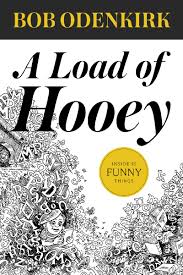
[READ: November 27, 2014] A Load of Hooey

Just in time for Thanksgiving, McSweeney’s has sent us A Load of Hooey.

Bob Odenkirk has been cropping up a lot lately (not as much as erstwhile partner and financially secure comedian, David Cross, mind you), and that’s a good thing.  There’s something about Odenkirk’s persona (crotchety, uptight, white guy) that is usually really funny.  He often elevates crappy sitcoms just by yelling at one of the characters.

This book is a collection of short pieces (most are 1-3 pages), including “unabridged quotations” and poems.  They cover a variety of subjects, but pretty much all upend expectations.  And, as one might expect from Odenkirk, there’s a lot of religious and political jokes as well.

The “unabridged quotations” allow Odenkirk to append something that removes the pomp from some famous quotations.  The poems are usually funny, twisted barbs at some subject or another.

But the main targets are religions and politicians. (more…)

Read Full Post »

harpjuneSOUNDTRACK: KING TUFF-“Black Moon Spell” and “Eyes of the Muse” (2014).

tuffI first heard King Tuff on WXPN.  A few weeks later I heard two of his songs on NPR Music.  I’m including both of these because they’re from the same album and yet they are so very different.

“Black Moon Spell” has a stupid, great, heavy riff–it’s all distortion and garage rock.  And when the first verse starts, Tuff’s voice sounds very 60’s–whispered and trippy.  It’s a great contrast to the rocking riff that repeats in the chorus.  The second verse and the chorus sound pretty much the same, but they are so catchy it’s hard not to rock out to it all.  There’s a cool guitar solo and, perhaps most unexpected, female backing vocals as the chorus repeats in the outro.

It has a real classic rock sensibility but with modern elements.

“Eyes of the Muse” is also full of classic rock sensibilities but in a very different way.  This song is anything but heavy–it has jangly chords, and a pretty guitar riff.  The vocals are also higher pitched with a very sixties folky style.  And when the Boston-style guitars burst forth about half way through, you’d swear you’d heard it all before, and yet it is still different enough to be really enjoyable.

Ty Segall plays drums of “Black Moon Spell” and I can compare this record to him or to Mikal Cronin–simple familiar elements done in a novel and exciting way.  I’d definitely like to hear more from this record.

[READ: November 17, 2014] “The Second Doctor Service”

I didn’t think I’d read anything by Mason before, but I had.  I didn’t really like his previous story in Harper’s,(which was sort of a parody of Herodotus).  This one was written in an old style as well (although not a parody this time–if indeed the first one was supposed to be one).

Anyhow, this one opens like an old story (with county names given in this format: K— and S—).  At first I thought we didn’t really need a story pretending to be old like this, but Mason really mastered the style.  Not to mention a story with this content works much better as an old one (before “modern” science).

Essentially, the author is writing a letter to the Journal, in response to Dr Slayer’s study “On the So-called Cumberland Were-wolf.”  He has not encountered a were-wolf but he hopes that anyone reading the Journal might be familiar with his own unusual plight.  (more…)

Read Full Post »

lostscrapSOUNDTRACK: THE XX-Coexist (2012).

coexGiven my proclivities towards noisy fast rock, there is no reason that I should like The XX, and yet I like Coexist quite a lot. It is such a spare album, but Romy’s voice is fantastic—so sensuous and breathy–that she can totally handle a song that is nearly a capella. So a song like “Angels” whose music consists pretty much entirely of a beautiful echoey guitar (and virtually nothing else except for some occasional soft percussion) is engrossingly intimate and not at all boring. In fact when that simple percussion eventually comes in, it’s like a revelation of sound accompanying her.

What also keeps the album interesting is that she is not the only singer (so there’s something for everyone). “Chained” has Oliver’s breathy, sexy voice as he more or less whisper/sings the lyrics. It has slightly more complex arrangements (meaning the drum is constant and there are quiet waves of synths). “Fiction” slowly builds with an ominous muted guitar motif and echoed chords. But when the chorus kicks in, that muted guitar grows loud and it’s almost overpowering (relatively, of course).   “Try” brings in a spooky kind of keyboards that is slightly unsettling under their mellow hushed duet of vocals.

The diversity of simple sounds that Jamie xx adds to each song are revelatory.  Even though each song is quiet and intimate, the sounds that he uses are so very different within that limited palate.  So “Reunion” sounds like a steel drums, before adding pulsing bass beats. “Sunset” has a slinky guitar and “Missing” introduces as drumbeat that is like a heart beat.  “Tides” has one of the loudest drum beats on the record, alternating with a delicate guitar line.

The simple bass line adds a really funky quality to “Swept Away.”  And when the claps and keyboard hits come in it feels almost like a dance song.

This is a great album for quiet nights and headphones.  Even if the songs seem to be mostly about lost love, it has a calming effect that is really enjoyable.  I’ll have to check out their debut as well.

[READ: September 30, 2014] The Lost Scrapbook

Some fans of David Foster Wallace speak well of Evan Dara (at least that’s how I’ve heard of  him).  I was unfamiliar with him and the fascinating story he has built around himself.  Evan Dara appears to be a pseudonym.  As one writer put it: “Hell, we don’t even now who Evan Dara is. Apparently, he is a male American in his 30s living in Paris.”  This, his debut novel, has attracted attention not only for being really weird, but for being really good.

What was fun about reading this was that I knew there were strange things afoot in the book, but I didn’t know what exactly (I really like to go into a book completely blind if I can).  So when the book started out with a conversation in which no character names were given (or even how many there were), I was prepared.  And while I didn’t really know what the subject they were talking about was, I figured that would be fine as well.  Then when four pages in the all caps word YIELD seemed to signal a change of narrator/perspective/something, I thought, okay this is what I’m in for.

Then I noticed that every paragraph which wasn’t conversation (with an em dash) was preceded by three ellipses (and ended with same).  A few pages later there’s an all caps TOW-AWAY ZONE which introduces another shift.

And somewhere around page 14 a sort of plot begins to form (although it’s unclear whether or not any of the earlier sections have anything to do with this one).  A man is shot…or not?  But then after the KEEP DOOR CLOSED section break, a new story develops.  A man with a Walkman (I was trying to decide if this was deliberately retro or intentionally set in the 80s, but that was unclear to me) is driving along to meet a man named Dave (at last a name!).  Dave is a filmographer who has been collecting fireflies for a video project.  And just as we near a kind of resolution of this section, it morphs, unannounced, mind you, into something else entirely–a discussion of music, specifically Beethoven and his decision to rework limited material into multiple variations.  It is fascinating and engaging and very well-considered, but it too ends before anything can be “resolved.” (more…)

Read Full Post »

chomuSOUNDTRACK: THE FAINT-“Help in the Head” (2014)

doom“Help in the Head” opens with an incredible amount of feedback and squalling noise–some of it natural and other parts sounding quite processed.  After ten seconds the song begins properly with a pounding drum and buzzing guitars.  The song is quite simple–a catchy melody that blossoms once the bridge kicks in (with some “oh ohs”).  The chorus is also simple and catchy, “I just meant you needed help in the head” with all kinds of fuzzy screaming swirling around.  A few minutes later, the song ends with more noise, just as it began.

The Faint has been around a long time and are on Saddle Creek records, home to Conor Oberst and his many bands (he was in an original incarnation of The Faint). The song has much in common with Oberst’s style of pop–simple melodies and very catchy structures, but it is so overlaid with noise and distortion that it takes it out of the realm of simple pop music into a pop music that is actually abrasive..

[READ: February 21, 2014] The Galaxy Club

Brendan Connell is back with his most daring book yet.  Daring, because it is so very different from what he usually writes.

I have really enjoyed Connell’s audacity in his previous books–whether it was the extensive research done into both cooking and history in Lives of Notorious Cooks (2012) or the brutality that religion can inspire in The Architect (2012) or his exploration into extremely transgressive behavior in Metrophilias (2010).  He has never been afraid to push the edge of the envelope into unexpected areas.  But what makes this book so daring is that it is, for the most part, pretty “normal.”  Book covers don’t typically indicate anything really, but this book cover, in sober black and white, really conveys the feeling of the book–gritty, small town, hardscrabble Southwest.

And yet despite the somewhat conventional nature of the story, there are also fantastical elements.  Each chapter is narrated by a different (sometimes recurring) character.  Some are narrated by “Those Underground,” and “Demon Taming Stick” and even “Prawn Dragon Colonel.”  But they are also narrated by normal folks.  Connell’s past work in creating manifold characters in his short stories really pays off for the number and divergent characters he has here.

The main characters are a man named Cleopatra–who claims to be the Queen of the Nile herself.  The Montoya family: Ibbie, Theodore and their son Blue Boy.  The Roybal family: Elmer and his aunt Ramona.  And a police officer named Alfonso Torcuato Southerland-Hevia y Miranda who claims to be switched at birth with Elmer–but he claims he bears no grudge. (more…)

Read Full Post »

« Newer Posts - Older Posts »