Feeds:
Posts
Comments

Archive for the ‘Travel’ Category

jetpackSOUNDTRACK: WE WERE PROMISED JETPACKS-“Quiet Little Voices” (2009).

jetpacksWhen you have a book with “Jetpack” in the title, the appropriate band is We Were Promised Jetpacks, no?  I’ve heard a lot of good things these guys.  But all I knew for certain was that they were Scottish.

I listened to their debut EP, The Last Place You’ll Look, which I liked a little.  But I didn’t care for the sound of the EP itself, it was rather flat.  A few listens got me enjoying the melodies and such but it never grabbed me.  Especially when I compared it to “Quiet Little Voices,” the lead single from their debut full length, These Four Walls.

The vocals are a bit stronger, the guitars and bass are both more clear.  The overall feeling is just brighter.  Now this may be a sign of selling out (is that something bands still do?), but really I think it’s just a better production for this song.  Which has a big chorus (and good backing vocals).

I listened to a few more tracks from These Four Walls and they are all good too.  I guess start with the albums and save the EP until after you’ve absorbed the band.

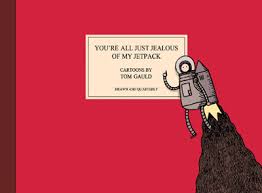
[READ: July 5, 2013] You’re All Just Jealous of My Jetpack

Gauld makes comics like no one else I know.  Most of his people are silhouetted or are the most rudimentary designs–simple triangle-shaped clothes, circle heads with dots for eyes and little else–maybe a nose if it’s profile. (Okay, there’s a bit of Chris Ware, but more like a much more relaxed Chris Ware).  And the wonderful thing is just how much he can convey with these painstakingly simple drawings.

The content of his comics is usually quite clever and often literary.  While I admit there were some I didn’t get (Like the Eric Gill cartoon–shame on me?–Aha: “[Gill’s] personal diaries describe his sexual activity in great detail including the fact that he sexually abused his own children, had an incestuous relationship with his sister and performed sexual acts on his dog.”  Geez, now the comic is very funny.).  There were some in which I liked the set up but would have preferred something funnier (like the Tom Waits comic–shame on him?)

But overall this collection was really enjoyable.  And I laughed a lot. (more…)

Read Full Post »

CV1_TNY_06_10_13Schossow.inddSOUNDTRACKDRUG CHURCH-“Deconstructing Snapcase” (2013).

drugchurchYesterday I commented about another Drug Church song by saying I liked this one better.  What’s interesting is that this one is thirty seconds longer but seems shorter.

The song opens with big loud aggressive guitars (kind of early Soundgarden), but the vocals, which are screamed, are brighter that their other song, providing a  nice contrast.  But the thing that made me like this song more than “YouTube” is the fast bright guitar bridge, in which the guitars ring out in contrast to the heavy opening chords–it gives the song a lot of dynamics.

There’s a guitar solo, which surprised me for some reason, but it breaks up the song and reintroduces some of the earlier riffs.  It’s a good heavy song.

[READ: June 18, 2013] “Brotherly Love”

Lahiri has the last and longest story in this New Yorker issue that’s chock full of stories.  This one is some fifteen pages and is part of a novel.

I was gripped instantly by the story.  But I am glad that it is part of a novel as I feel there were parts of the beginning that seemed extraneous without more story to follow.  Or should I say, if it was just a short story, it could have been shorter.  The story is about two brothers, Subhash and Udayan.  Subhash is older by fifteen months but Udayan is the far more daring one.  Subhash is cautious and does everything his parents say, while Udayan flouts the rules at every opportunity.

The first transgression we see is when they climb the wall into the country club, where locals are pretty much excluded.  They were told they could get golf balls, so they hopped the fence and took what they could.  They also marveled at the manicured lawns and the beauty around them.  They returned regularly until they were caught–but luckily for them they were not turned in. (more…)

Read Full Post »

CV1_TNY_06_03_13Hall.inddSOUNDTRACK: DEAFHEAVEN-“Dream House” (2013).

deafheavenNPR’s Lars Gotrich always picks songs that I like–even if I would never have found them any other way.

His favorite album of the year so far is by this band Deafheaven whom I have never heard of.  The song is 9 minutes long and it combines big loud guitars, super fast crashing drums, and cookie monster vocals (mixed so low in the mix that they almost sound just like noise–a neat trick).  The waves and layers of sound give it a kind of My Bloody Valentine feel.

For the first half of the song, the drums are absolutely speed metal fast–pounding and pounding with wild cymbals.  But they too are mixed low in the mix–setting a beat but not dominating the song.  For really this song seems to be all about the guitar–which is not exactly playing along with them.  Sure, there are fast  moments, and the guitar is largely distorted and noisy.  But the tone of the guitar is very bright–especially when he starts playing some simple but pretty riffs (amid the noise).

And then about half way through, the noise drops away and the music become quiet and pretty.  Two guitars interweave slow melodies.  Until the music crashes back in, but with a different tempo and a feeling like Explosions in the Sky or Mogwai.

I know many will be turned off by the vocals (I think I might even like it more if it were purely instrumental), but the way they are mixed, shows that the music is the dominant sound, and I can get behind that.

[READ: June 12, 2013] “Company Man”

I always enjoying reading a David Sedaris Personal History (interestingly I haven’t read all of his books—I seem to stick to the articles instead).  This one is about having a  guest room.  He considers it a true sign of aging gracefully that his new house has a guest room (with its own bathroom).

Their previous house in Normandy had nothing of the sort and he gives typically humorous anecdotes about being embarrassed for the guests who don’t have any privacy in the bathroom (“we’ll be going out for about twenty minutes if you need anything.”)  But now they have this new space.

Which means of course that they have guests.  I enjoyed the part when Hugh’s friends come to visit–based on his father’s behaviors, David is allowed to leave in the middle of a conversation because he is not the one entertaining the guests).  But the bulk of the second half concerns David’s family.  (more…)

Read Full Post »

5.20SOUNDTRACK: SAVAGES-Live at KEXP (May 16, 2013).

savagesI heard some songs from the Savages album, and I loved them–that combination of 80’s punk and goth all wrapped up in current technologies and attitude.  A couple of their songs are some of my favorite of the year so far.  I’d also heard that they were even better live.  So here are four songs played live in the studio from KEXP.  And while the audio is awesome, they are a lot of fun to watch.

In fact, the more I watch the less I know who I am most impressed by–the amazing guitarist?  the great unaffected bassist?  the wild drummer?  They’re all a pleasure to watch.

But it also sounds great.  There’s some great soaring guitar sounds on “City’s Full” which really has a Patti Smith meets Siouxsie vibe.  And there’s that whole goth feel–the bass up front and dominant but with really big guitar chords and cool riffs.  And the drums, man she rocks out in the whole first half of “City’s Full.”   Then listen to the fabulous bass line that runs through “Shut Up.”   I love the way the low bass plays off the high guitars  (and the vocals sound very Siouxsie there).    And the drummer is amazing at the end of the song.

A great 80s echoey riff opens “She Will.”  I love when the song almost stops and it’s all fast cymbals and faster guitar (which is really cool in and of itself) until it builds back up.  And just look at her drumming at 10:20.  Wow. 

And the closer, Husbands” just gets more and more intense.  Like the crazy noisy cymbals.  And the way her voice soars and soars until it just stops.  Wow.

[READ: May 23, 2013] “The Dark Arts”

Julian is sick. Very sick.  So sick, in fact, that American doctors can’t seem to help him, can’t even seem to effectively diagnose him.  So he and his girlfriend Hayley have traveled to Europe for new medicines that the AMA hasn’t approved yet.  They travel to a few places first as a kind of romantic vacation and their ultimate destination is Düsseldorf.  It’s there where Julian will have his bone marrow drawn out, then boiled and tinkered with and then injected back into him.

Ouch.

But there’s been a snag.  On their way to Düsseldorf, they had a fight and Hayley stayed behind.  So Julian went to Düsseldorf to a hostel.  Every day he goes to the train station hoping to see Hayley show up.  He imagines what he must look like to the locals–a skeletal American wearing what must look like a death shroud.  He barely eats, he barely does anything.  In fact, he has more or less given up.

But his father and Hayley, they believe in him, they believe that these cures can help.  Indeed, his father has been so great through all this offering him anything he needs–money they don’t really have and unwavering support.

And then the story gets even more interesting–we find out that American doctors not only couldn’t diagnose him, but actually believed that there as nothing wrong with him. (more…)

Read Full Post »

mystrugglSOUNDTRACK: TRICKY-“Christiansands” (1996).

christiansandsThis book is set in Kristiansands, and so naturally this song was ringing through my head the whole while I was reading it.  I’ve known this song for ages, but had no idea that Chirstiansands was an actual place in Norway.

This song is dark and tense.  Over a slinky beat, a spare guitar riff introduces Tricky’s voice as he rasps (his voice is slightly modified to give him a weird echo).  And while he’s reciting his verses, the gorgeous voice of Martina Topley-Bird, repeats what he’s saying in a whispered voice until she sings out the chorus “I met a Christian in Christiansands.”

The verses repeat with Tricky emphasizing, “master your language and in the meantime I create my own.  It means we’ll manage.”

I honestly don’t know what the song is about, and it feels like it never properly ends–that riff, at once menacing and gripping never seems to conclude.  It’s a masterful track and hard to forget once you’ve heard it.

[READ: May 11, 2013] My Struggle Book One

I read an excerpt of Book Two from this series in Harper’s.  And despite the fact that nothing really happened in it, I was drawn in by the writing style.  This first novel is very similar in that not a lot happens but the voice is very captivating.  The translation is by Don Bartlett and it is fantastic–I can only assume the original Norwegian is just as compelling.  So, despite the fact that this autobiographical series contain six books (six!) and totals over 4,000 pages (how could this be if Book one is a mere 400?  Books 4-6 are over 1,000 pages each), I decided to give it a try.  (Incidentally, Book Two has just been translated into English this month).

This series has caused some controversy because it is given the same title as Hitler’s Mein Kampf (Min Kamp in Norwegian), and also because he says some pretty means stuff about people who are still alive (like his ex-wife).  Although there isn’t much of that in Book One.

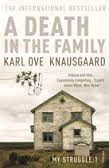
death in the familyIndeed, Book One basically talks about two things–a New Year’s Eve party when Karl Ove was youngish and, as the bracketed title indicates, the death of his father.  (The title A Death in the Family is the same book as My Struggle Book One–from a different publisher.  It has a totally different cover but is the same translation.  I don’t quite get that).  But indeed, these two events take 430 pages to write about.

How is this possible?  Because Karl Ove writes about every single detail.  (I assume this why the books are considered novels, because there is no way he could remember so much detail about every event).  I’m going to quote a lengthy section from a New Yorker review (by James Wood) because he really captures the feeling of reading the book:

There is a flatness and a prolixity to the prose; the long sentences have about them an almost careless avant-gardism, with their conversational additions and splayed run-ons. The writer seems not to be selecting or shaping anything, or even pausing to draw breath….  There is something ceaselessly compelling about Knausgaard’s book: even when I was bored, I was interested. This striking readability has something to do with the unconventionality of “My Struggle.” It looks, at first sight, familiar enough: one of those highly personal modern or postmodern works, narrated by a writer, usually having the form if not the veracity of memoir and thus plotted somewhat accidentally, concerned with the writing of a book that turns out to be the text we are reading.  But there is also a simplicity, an openness, and an innocence in his relation to life, and thus in his relation to the reader. Where many contemporary writers would reflexively turn to irony, Knausgaard is intense and utterly honest, unafraid to voice universal anxieties, unafraid to appear naïve or awkward. Although his sentences are long and loose, they are not cutely or aimlessly digressive: truth is repeatedly being struck at, not chatted up.

That idea of being bored but interested is really right on–and it may sound like a bad thing, but it’s not.  You can read along thinking that there’s no way he is going to give so much unimportant detail.  But you get this description of drinking a cup of tea: (more…)

Read Full Post »

wim SOUNDTRACK: GIRAFFES? GIRAFFES!-“Fucking Ants Man! Where They Coming From? (Let’s Hang The Carroll Footnoteitsists)” (2005).

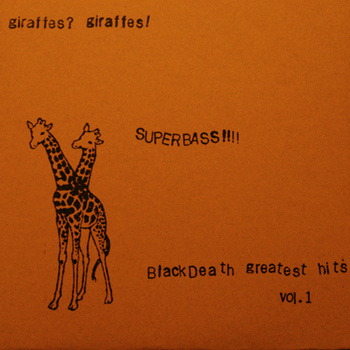
girafI just learned that there is a band named Giraffes? Giraffes!, which is the name of a silly book published by McSweeney’s.  I was so delighted to find out about this band, that I immediately went to their band camp site, where I was further delighted to find out that they are an instrumental post-rock kind of band with some great tunes.  And, of course, when your songs are instrumental, you get to make up the best titles.  Like this one.

There’s only two guys in the band which must mean overdubs (I hope so, otherwise they defy physics).  This song starts out with a riff in what I think is 5/4 time which discombobulates for a while until it becomes a wild guitar riff (and the drums come more to the fore).  While that speedy riff is going on, another more pleasant solo plays over the top.  Then the song plays some really fast drums with chords that sound like mid 70s Who, which is followed by another pretty guitar solo.  The end resorts back to some mild chaos and fun until it ends very prettily.

If you like post rock, give Giraffes? Giraffes! a try.

This song comes from their debut album, Superbass!!!! (Black Death Greatest Hits Vol. 1).  Which you can hear here.

[READ May 5, 2013] Places, Strange and Quiet

This is a book of photographs by Wim Wenders, filmmaker extraordinaire.  What I fouond very interesting about this book is that it is not a book of art (as far as I define it).  It is rather a book of documentation.  These pictures are not beautiful, they are not artistically arranged, they are not profound.  Rather, it is the combination of picture and text that really makes the story.  In some ways this becomes a book of stills from a never-to-be-made film.  And as such, it’s very cool.

The first one is a picture of a family in front of a dinosaur (which looks like it is from the 1970s—huh turns out to be 1983).  It is under-lit and not very impressive.  Until you read the sidebar: “A picture is defined twice.  When you see the whole at first glance: “A dinosaur!  A family!” And then when you find a detail that changes everything…Mom reading in the backseat.  He’s absolutely right.

I loved “Sun Bather” with a crazy scene of polka dotted sun benches in Palermo.  Wender’s text: “Nothing exists without its opposite…But what could the opposite of this be?”  To me the most profound pictures are the series Ferris Wheel from two different angles. His comment “Sometimes only the reverse angle tells the truth” is really powerful, because from one angle the Ferris Wheel shows one scene and yet from the other the background is entirely different.

I loved the wall with sink and the Armenian alphabet—although the Armenian cemetery was even more impressive.  And the gorgeous gorgeous (this one is art) pictures of the islands off of Japan is simply beautiful. (more…)

Read Full Post »

CV1_TNY_04_01_13Gutierez.inddSOUNDTRACK: THE KNIFE-“Old Dreams Waiting to be Realized” (2013).

theknife With the release of The Knife’s new album, the New Yorker review that I mentioned yesterday pointed out just how radically different this new disc is from the synth pop of yore.  Sasha Frere-Jones talked about the weird instrumentation that they use (and made themselves) and the processed vocals that often defy gender.  But he mostly focused on this, a 19 minute song.

What’s so radically different for The Knife is that the song isn’t really a song so much as a series of slow washes of keyboards which rise and fall.  There’s no melody at all and no singing either.  It’s basically an uneasy ambient song–quite a departure from the three-minute pop of “Heartbeats.”  There’s also a bunch of percussion, also seemingly random.  It sounds like a bleak landscape–the moon perhaps.

At around 10 minutes, the washes of sound (which have been pretty constant and low volume) are eclipsed by a processed steel drum sound which play a little melody and just as quickly goes away.  Helicopter-ish sounds come to the fore around 13 minutes.  And that louder noise stays with us for a couple of minutes until it is replaced by a very mechanical-sounding moaning.

After 19 minutes of this, it simply vanishes leaving a minute or so of silence at the end of the track.  You’re not going to get too many fans playing music like that.

 [READ: April 28, 2013] “Long Way Home”

In this piece, Sedaris revisits a moment that has got to be a major fear for a lot of people—the theft of a passport.  Sedaris has a British passport with an Indefinite Leave to Remain sticker on it.  This basically allows him (and partner Hugh) freedom to come and go as they please in the UK—a handy thing for a traveling author.  When the passport is stolen, it means that rather than waltzing back home, he has to go through the same old scrutiny (a writer, eh?) and very real threats that they could simply not allow him back in.

Evidently receiving this sticker is a laborious process not for the faint of heart (and not for those whose grasp of English is not perfect).  Which is why David let Hugh do all the prep work for it (although David did ace the test).  There’s a very funny sequence in which he wonders how non Westerners might deal with the question, “How might you stop young people playing tricks on you at Halloween?”  Needless to say, not having that sticker was a major hassle, but reapplying for it meant surrendering the new passport for several months while bureaucracy got its sticker together.  Which is what he eventually had to do. (more…)

Read Full Post »

mouldbookSOUNDTRACK: BOB MOULD-Silver Age (2012).

silverage

I was a huge fan of everything Bob Mould put out.  And then he more or less gave up on music.  So I just enjoyed his past and ignored what else he did.  But then I heard great reviews of his new album Silver Age.  So great in fact, that I couldn’t help but listen to it.  And it is amazing.  It’s a major return to his punkier roots.  The guitars are loud and fast but the melodies are still present.  And what’s more important, his voice sounds great and the album is mixed really well–previous Mould records have suffered in production quality.  But this is a great great record.

“Star Machine” opens the disc with loud guitars, a simple melody and lots of attitude.  I love the repeated “Said It” that appears throughout the song.  “Silver Age” is something of a manifesto for Mould.  The guitars are harsh and jagged with lots of distortion and the lyrics tell you everything: “Never too old to contain my rage  This is how I’m gonna spend my days gonna fight gonna fuck gonna feed gonna walk away.”

“The Descent” is classic Mould–big guitars, great catchy vocals and really nice harmonies/backing vocals.  “Briefest Moment” starts with a thudding drum and a sparse fast guitar (which somehow reminds me of Cheap Trick).  The bass comes in with a galloping line rather than playing the same notes and it adds a lot of depth to the album.  “Steam of Hercules” slows things down a bit but “Fugue State” comes crashing back in with more fast thumping drums and sparse but effective guitars.

“Round the City Square” picks up the noise level and includes a wild guitar solo.  “Angels Rearrange” again sounds like classic Mould.  While “Keep Believing” has a great bridge that reminds me a lot of Hüsker Dü (yes I mentioned the band that should not be named).  “First Time Joy” ends the disc on a gentle note.  It’s a ballad (where you can really hear Mould’s voice and how clean and strong it sounds).  There’s keyboards on this song that add some nice dimension.  By the end the song gets bigger and more powerful, ending on a really strong chord.  It’s an awesome return to the rock fold for Mould and I look forward to more from him.

[READ: March 5, 2013] See a Little Light

After getting The Silver Age, I remembered that Mould had written an autobiography and that I’d heard it was quite good.  I don’t really read a lot of autobiographies, but my history with Mould is pretty deep and I was curious to see what had happened in his life to make him abandon his rock roots.  So I tracked it down.  And I really enjoyed it.

The fascinating thing is what a reasonable man Mould presents himself as.  I’m not disputing this–I don’t know really anything else about the guy–but every time someone dumps on him, he accepts partial responsibility for the problem and moves on.  If he’s really like that, that’s very cool.  But he almost seems too nice sometimes.

As I’ve said, I didn’t know much about Mould.  My friend Al got me into Hüsker Dü and I’ve been a fan ever since.  I’ve bought some of his solo records and all of his band records, but I kind of lost interest in him the last decade or so (during his experimental phase).  But I didn’t even really know why Hüsker Dü broke up.

Some interesting things about Bob: he was born numerically gifted–I really enjoyed the section about his childhood and the genius-y stuff he did.  Although he had a pretty rough childhood–his older brother died when Bob was young and so Bob was seen as a golden child (especially after something that happened to him which he didn’t learn about until much later).  And he started drinking at a very young age.

When he got to college he formed Hüsker Dü with Grant Hart (Greg Norton came a little later).  I enjoyed hearing about the early days of Hüsker Dü because I only learned of them much later.  And man were they productive!  They’d release an album and have new material ready to record before they even toured for the album that came out already.  It’s cool reading about the punk scene back in the days before the internet when bands had to rely on each other for support.  There’s also a lot of people who Bob name checks and it’s fun to hear all of the punk names again, especially the names of people who are still active.  (There’s also some bad vibes against SST, but since this is Mould, the bad vibes are pretty mild). (more…)

Read Full Post »

14

SOUNDTRACK: DEFTONES-Diamond Eyes (2010).

diamondBefore releasing Diamond Eyes, Deftones had two band crises. The first was that they didn’t really seem to like each other anymore.  The previous album was fraught with tension and they barely toured.  After deciding that they wanted to remain as a band, they were invigorated and made an album called Eros.  But during the recording, bassist Chi Cheng was in a car accident and was in a coma.  As of yet he has not fully recovered.  So they shelved Eros, hired a temporary bass player Sergio Vega and set about recording Diamond Eyes.  And for whatever reason, it proved to be one of their best releases so far.

“Diamond Eyes” opens with a heavy down-tuned guitar–very abrasive–until the chorus come in and it’s their most beautiful ones yet–with soaring keyboards and  harmonies.  And then the heavy guitars come back–it’s what Deftones do so well–beauty and ugly together.  Stephen Carpenter really shines, as always.  “Royal” is a fast song with a great harmonizing chorus.  “Cmnd/Ctrl” has a shocking low riff that explodes into a  bright chorus.  “You’ve Seen the Butcher” has guitars that seem almost untuned as the song starts.  But it morphs into a kind of sexy butt-shaking chorus.  And Abe Cunningham’s drums are, of course, fantastic.

“Beauty School” is the first that doesn’t really start out heavy, it’s a got a gentle guitar intro and the first song where Vega’s bass is really prominent as a separate instrument and it creates a beautiful alternative song–great vocals throughout.  “Prince” brings in a lot of new textures to the album, including a clanging guitar sound and a great screamed chorus. “Rocket Skates” is one of my favorite songs on the record, it has a classic metal riff and the great screamed-beyond-comprehension chorus of Guns, Razors Knives and a weird little whoooo that ends the chorus.

“Sextape” is a surprisingly gentle song, opening with an echoed guitar riff and one of Chino’s most gentle choruses.  “976-Evil” has an echoey guitar and voices not unlike the Cocteau Twins.  “This Place is Death” has another great alt rock feel–a big song with bright guitars and dark lyrics.  I haven’t really mentioned Frank Delgado on keyboards and samples.  He’s been with the band since White Pony, and I feel like his presence was made notable on a few songs here and there.  But it seems like on this disc he really comes to the fore, adding new textures and sounds to the album which really fill it out.

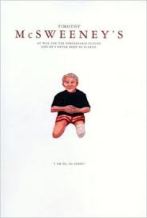
[READ: March 12, 2013] McSweeney’s #14

After the colorful extravaganza of the Comics Issue of McSweeney’s #13, this book settles down into something more somber  The book is softcover and all white.  The cover depicts a cartoon of George Bush with both legs blown off and the caption, “I Am So, So Sorry.”  On the spine in small print: “We’re praying as fast as we can.”  It is the most context-full cover they’ve done yet and, nearly a decade away it seems like a rather mean cover, but if I remember correctly at the time it seemed apt and delicious, especially in light of the upcoming election.

Yet despite the overtly political cover, the content inside is not political or even thematic (although it is pretty dark stuff).  Nevertheless, the table of contents gives us a small joke when it says “To help you know which stories to read first, we have indicated with either a * or a † those that deserve special consideration from you, the reader.  If you see either a * or a †, do not miss that story.”  Of course every story has either a * or a † but they cleverly did not put any kind of pattern to the symbols.

The colophon explains that when they were in Ireland, they met an actual Timothy McSweeney.  He had been given a copy of Issue #3 and then promptly forgot about the magazine.  But when McSweeney’s was in Galway to do a reading at the Galway Arts Festival, Timothy (Ted) McSweeney traveled from Dublin to check it out (not a short trip).  This also resulted in a letter from Mr McSweeney which is actually quite funny.

There are also illustrations in the book, although they are small illustrations and are placed on the title of each piece in the book.  All of the illustrations are old, mostly coming from the 1800s, although one dates back to 1670.  They illustrations are all technical scientific ones and don’t have anything to do with the stories. (more…)

Read Full Post »

expedSOUNDTRACK: JAPANDROIDS-Celebration Rock (2012).

japan2So, the cover looks the same and there’s still only two of them and there are also 8 songs and it’s also 35 minutes long.  I guess the Japandroids second album is going to be more of the same.  Well, yes and no.

Their debut was a surprise success (which actually prevented them from breaking up) and they seem to take the successes of that album–big choruses and sing along sections to even more glorious heights.  The songs are still poppy and super catchy and they’ve removed some of the noise that was on the first album.  Of course at the heart of the album is still two guys playing kinda sloppy, poppy punk with loudly yelled lyrics–not exactly a formula for pop success, but not too far away from it either.

The disc is pretty unmistakably from the Japandroids–the duo is still loud and fast with distorted guitars and vocals.  But there is a lot more melody here.  The guitar riff that opens the album on “The Nights of Wine and Rose” is simple, but it sounds like a new edge for the band.  “Fire’s Highway” has a guitar sound not unlike Tom Petty until again the propulsive drums (and guitar) follows along.  But there’s a lot more space to breathe on this song–it takes some of the punk edge off (although again the chorus is fast) and those backing Oh ohs bring it to a catchy conclusion).  And check out the “Oh Yeah, Alright” section of  “Evils’s Sway,” another Tom Pettyish nod to major catchiness.

“For the Love of Ivy” is a cover and it very distinctly does not sound like a Japandroids song (which sounds obvious, and yet it’s fascinating that it fits with the album but doesn’t sound like anything else they’ve done).  It’s followed by “Adrealine Nightshift” a song that adds a kind of classic rock anthemic feel–a very different kind of anthemic feel than the other songs–to the mix.  “Younger Us” is a powerful rocker that gets more and more chaotic as it goes along–but it starts from such a poppy place that it’s a great ride to take.  “The House That Heaven Built” has a kind of Arcade Fire feel to it (ironic given the disparity of band members), but it’s got that same big vibe and lots of oh oh oh ohs.  The guitars start fast and don’t let up.

The final track, “Continuous Thunder” sounds like a slightly different band–the vocals are cleaner and the drums are more martial and less frenetic–although the guitar is still continuous and by the end the pace is simply breakneck.

So yes, this is a poppier version of their debut (and a successful one at that).  If one still cared about bands selling out one might suggest that that’s what’s happening here, but it’s still a far cry from a pop album.

[READ: February 11, 2013] The Expeditioners and the Treasure of Drowned Man’s Canyon

This is the first book in the McSweeney’s McMullens collection that is written for young adults.  And while the writing isn’t perfect (there were a number of sentences that I found a little awkward), the story is wonderful and very captivating.

The book is set in a parallel universe or a distant dystopian future.  The protagonists live in a borderline-wilderness state.  There is little money for food, there is no electricity and no modern technology.  But the big difference in this book is that there are places that have yet to be explored.  New worlds, new territories that are not on the map.  So it must be a new world?  No, because the protagonists venture to Philadelphia and Arizona.  So, perhaps this is set way in the future after the deterioration, when maps proved to be unreliable?  It’s never exactly explained, and does it really matter?  No, not really.

The protagonists are three kids: Zander, the oldest , M.K., the youngest and only girl who is a whiz with tools and tinkering and Kit, the middle child and narrator.  Kit is the smart one, able to read his father’s maps and make smart decisions based on given information.  Their mother is long gone (mothers always fair so poorly in adventure stories) and their father has recently disappeared.  He was on an exploratory mission and has been reported killed.

However, government officials did not approve of their father’s recent actions and had him stripped of his ranking as an explorer (could they be fabricating his death as well?  Or at least the cause of his death?  With the government acting in a very dictatorial fashion, anything is possible, especially since they have eyes everywhere.

The story gets underway when Kit, who is out buying food at the market  is grabbed by a tattooed man.  The man knows who Kit is and presses a book on him, saying his father wanted him to have it.  He tells Kit to be careful and runs off.  Kit puts the book in his backpack and heads home, with his mind reeling.

When he gets home, government officials are at their house.  The kids are lucky–since they are technically orphans, they should be removed from their home, but for some reason, the government has not taken them away yet.  But they ask if Kit or any of them has been approached by a man with a tattoo.  Kit lies, and the men eventually leave.

This sets in motion a series of events that lead the kids to realize that their father has half of a map of Drowned Man’s Canyon in Arizona.  The kids believe that their father wants them to find the treasure there.  But how could they possibly find it?  They can’t travel unnoticed, they have practically no money and they’re not even really sure what they are looking for.  Well, that is the story, now isn’t it? (more…)

Read Full Post »
« Newer Posts - Older Posts »