SOUNDTRACK: THE HEAD AND THE HEART-Sasquatch Music Festival, May 28, 2011 (2011).
This is the fourth live recording from The Head and the Heart that NPR offers. Not bad for a band with only one album out. This set finds the band even more confident and relaxed (despite their genuine excitement at playing the festival). The band sounds fantastic and I’ve really grown to appreciate the female harmonies on most of the songs now (I’ve not always liked them on every song).
This set has two as yet unrecorded songs in it (one of them was listed as untitled). There’s some banter between the band and the fans (the band is nothing if not jovial) including a great story about how someone in the band went to Sasquatch the year before and swore he wouldn’t remove his backstage pass wrist band until The Head and The Heart band played Sasquatch. I like to imagine there was ceremonial wrist band cutting ceremony on stage, but that is lost in the audio version. Of course the story would be better if it was two or three years later, but it’s still a pretty good one. [See the Five Dials review below for a similar story!]
I found the sound quality of the show to be less than perfect. The sounds are a bit muddied. I don’t blame the band. The Sasquatch venue may be beautiful (so many performers comment on it, I’d love to see the view) but I suspect that maybe the audio was less than stellar.
Nonetheless, The Head and the Heart continue to amaze in a live setting.
[READ: July 3, 3011] Five Dials Number 14
If Five Dials 13, The Festival Issue, was a double live CD, jam-packed with photos and stories and all kinds of wonderment, Five Dials Number 14is an EP. Even though it contains only one item, it’s more than a single, because the item is long and a lot is packed into it. And that ends my metaphor.
One of the fun things about Five Dials is that it can be whatever length it wants to be. Many magazines offer double issues, but they never offer tiny issues afterwards. And sometimes it’s nice to have a short issue that you can enjoy leisurely, without having to sift through filler.
So this issue consists of exactly two items: Craig Taylor’s introduction and the nobel prize acceptance speech by Orhan Pamuk. (more…)
SOUNDTRACK: BLACK MOUNTAIN-Live at Sasquatch, May 30, 2011 (2011).
The previous Black Mountain live show I downloaded from NPR was a real disappointment. For me the major problem was Amanda Webber’s voice–she applied a really harsh vibrato to the end of every single line. It was so pronounced it sounded almost like a stutter. I found it very distracting.
She doesn’t do that here, which automatically makes this set 100 times better (she has a minor vibrato on a few places, which is totally fine). This Sasquatch concert covers songs from all three of their albums, which really showcases the diversity they explore within their trippy, space-rock, metal sound. It works like a (brief) greatest hits for the band.
And the band sounds comfortable and fresh in this live setting (the guitars are fantastic and the keyboards add a wonderful spacey feel to the mix). The two tracks of “Wucan” and “Tyrants” is particularly amazing; it’s interesting that they play four songs from their middle album and only three from their most recent.
Regardless, this release has won back my faith in Black Mountain live.
[READ: July 13, 2011] “The Gourmet Club”
I’d never heard of Tanizaki before and I haven’t really read that much Japanese fiction. This translation by Paul McCarthy was really fantastic, and I never felt like I was reading a translation.
When I started this story (the first fiction from Lucky Peach), I was concerned that it was going to be the same kind of story as Neil Gaiman’s “Sunbird” (I realize “Sunbird” was published much later than “The Gourmet Club” originally written in 1919), but I’m glad it didn’t.
Essentially, this story focuses on five Japanese men who live to eat. They are Epicurean to the highest degree, eating only the best at least once a day and often to bursting. They go through all of the restaurants in Japan, traveling across the island to find new foods. But they soon reach the end of their new food options. (more…)
This is a fascinating release. I assumed it was a quick cash in of unreleased tracks. And yet it doesn’t sound like a bunch of tracks from different eras thrown together. A little digging reveals that it is sort of a collection of unreleased tracks. The ten songs here were written over the band’s career but were either never finished or were finished but never released. According to various places online, Rivers edited and manipulated the songs (and maybe re-recorded some?) to make them all sound current (and like they’re from the same time). Thus he considers this to be the follow-up to Hurley.
The album is full of poppy songs (“Turning Up the Radio” has FIFTEEN people listed as composer on Allmusic–the true sign of a pop juggernaut). There’s a couple of slightly heavier songs, “Blowin My Stack” has a big shouty chorus and “Autopilot” has a very electronic kind of sound. But perhaps the most notable track is the cover of “Unbreak My Heart.” That song came out in 1996, so one assumes that this version must be at least ten years old, because why would someone make a cover of an old pop hit from fourteen years ago? It’s quite good, though, as Weezer covers tend to be.
If you like Weezer, this isn’t a throw away. The songs are just as good as their other recent records (which means they’re not as good as their early ones, but are still poppy). If you don’t like Weezer this will do nothing to change your mind.
Although I am amused by the album cover design that they chose for this title (which is a tribute to the band Manowar, obviously), I think a better cover would have been Weezer in loincloths. Can you imagine Rivers Cuomo brandishing a giant sword?
[READ: May 21, 2011] “Medea”
Ludmilla Petrushevskaya had a story in The New Yorker recently. The fact that she has one here as well can only mean she has a book coming out (although a quick look at Amazon does not indicate that she does).
The opening line says, “This is an awful story…” And it’s true (not in the sense of being bad, but in the badness that it contains). Petrushevskaya tends to write very dark stories (dark fairy tales is how they’re mostly categorized), and while this is not a fairy tale, it is certainly dark (and as with most of her stories, it’s quite short).
It’s a fairly simple story: the narrator hops in a cab and complains about how her seventy-three year old grandmother called for a cab to pick her up at a certain time but it never came–and never even called to say it wasn’t coming. This meant she missed her plane, and the people waiting for her missed her and basically the whole day (and a lot of money) was lost because of a cab.
The cabbie didn’t have anything to do with that, but he tells her that it could be worse, and proceeds to launch into a story trying to outdo her story. They jockey for position in terms of terrible stories (a woman whose baby dies on vacation–and that’s only the beginning of her problems) until finally he talks about himself. (more…)
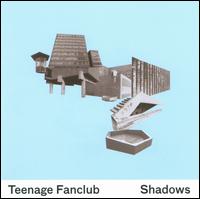
Back in the 90s, Teenage Fanclub released a few noisy, feedbacky records that were quintessential 90s alt rock.
Since then they have mellowed considerably, and this album is one of their most mellow to date. Usually for me this kind of mellowing is a sign that I’m done with a band; however, Teenage Fanclub’s songwriting gets better with every disc. And these folky tracks are all fantastic.
What’s neat about the arrangement of the album is that each of the three members of the band writes four songs. They are collated so that you cycle through each singer before repeating. You get maximum diversity–and it’s easy to tell which songwriter is your favorite.
The opening two songs, “Sometimes I Don’t Need to Believe in Anything” and “Baby Lee” are two wonderful upbeat pop confections. They sound very different and yet both are infused with wonderful pop chops.
It seems that Blake is my favorite songwriter on this disc. He did “Baby Lee”, “Dark Clouds” (a pretty piano based number) and by far the prettiest song on the disc “When I Still Have Thee.” It’s an amazingly catchy folk song that sounds timeless (and even has the great couplet: “The Rolling Stones wrote a song for me/It’s a minor song in a major key.”
That’s not to dismiss the other songwriters at all. In fact, hearing their different takes on pop music is really pretty amazing. It’s a shame that it takes them so long to put albums out (about 5 years these days).
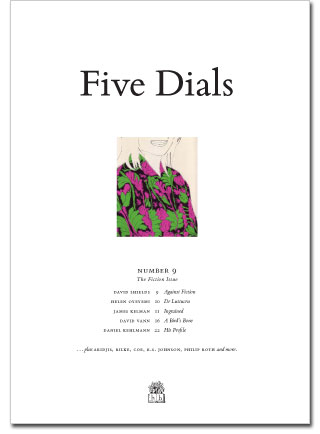
[READ: June 10, 2011] Five Dials Number 9
Five Dials Number 8, The Paris Issue, was pretty big (45 pages), but it had a lot of pictures. Five Dials Number 9 is also pretty big (41 pages) and it’s (almost) all text. For this is the Fiction Issue, and there are a lot of short stories in here.
CRAIG TAYLOR-A Letter from the Editor: On ‘Summer Reading’ and Fiction Issues.
Since most of what I talk about in the introduction to these posts is covered in Taylor’s Letter from the Editor, I figured I’d switch formats and start talking about his letter right away. In this letter, Taylor talks about the serious pitfalls of ‘Summer Reading’: We pledge to read mammoth books over the summer, but really we never finish War and Peace over the summer, do we? (except those of us who finished Infinite Summer, am I right?). And so, this Fiction Issue was released in December (finally, a date is given to a Five Dials!). Taylor briefly talks about all of the authors who contributed (including a pat on the back to Five Dials for securing the rights to a Philip Roth contribution in its first year of publication). He also talks about the essay from David Shields that is decidedly anti-fiction. And the final note is that Taylor’s own father has a piece in this issue (nepotism is alive and well!) (more…)
I’ve enjoyed every Dungen release that I’ve bought and this one is no exception. Although I will admit that the other ones grabbed me a bit more (there are some amazing songs on earlier discs). This one is a bit more sedate in general; perhaps this is Dungen’s ballad album.
It opens with “Vara Snabb,” an instrumental with lots of flute (!). While “Mid Edna Vän” is a gentle ballad (Gustav Ejstes’ voice is very nice: soft and delicate”). “Brallor” is a duet with Anna Järvinen–her voice is haunting and beautiful.
“Soda” is another delicate ballad. It opens with some loud drumming but quickly settles into a very gently sung song. “Hogdalstoopen” opens with a quiet piano and slowly morphs into a noisy instrumental with an expansive, wailing guitar solo–the kind of which attracted me to Dungen in the first place. It devolves into some chaotic noise, which is fun and works as a cathartic moment on this mstly quiet disc.
“Skit I Allt” is a pretty standard rock song (very 70s sounding). And “Blandband” is a catchy piano number with a tone that reminds me of Peanuts, but which concludes with another trippy flute solo. The last two songs return to the mellow quality of the earlier tracks and “Marken låg stilla” ends the disc with a super catchy chorus.
As I said, compared to their earlier discs which highlighted Ejstes’ firework-like guitar playing, this one shows the bands’ softer side. It works as a nice companion piece (and still shows off the band’s instrumental chops).
Here’s your quick Swedish translation guide: Dungen (“the grove”), “Vara snabb” (“Being quick”) “Min enda vän” (“My only friend”) “Brallor” (“Pants”) “Skit i allt” (“Fuck it all”) “Barnen undrar” (“The children are wondering”) “Blandband” (“Mixtape”) Nästa sommar” (“Next summer”) “Marken låg stilla” (“The ground lay still”)
[READ: May 23, 2011] “What Animal Are You?”
Etgar Keret was recently in McSweeney’s 37(I really liked his story). This short piece is from his forthcoming book, and if they are all unusual like this I would be very excited to read it.
This story seems so much like non-fiction, that I can’t really decide what, if anything, has really happened to him already. As the story opens, the narrator explains that he is writing for German Public Television. Literally. A reporter from GPT is in the room with him right now. They are filming him for a show and need him to be “writing.”
He tries to fake it, but she says that it will look bad on TV. So she insists that he write something for real, perhaps about her being there and how it makes him feel to be under pressure like this. And so he begins writing. Then his son comes home and gives him a big hug (he’s used to performing for cameras) but his wife (when she arrives) seems far more unnatural on camera–and will probably be cut.
The title comes from a phrase that his son (who is 4) says. He sits on the stairs and asks everyone who walks by, “What kind of animal are you?” The narrator reflects on how people respond to him: his wife, some random people who the boy encounters and, ultimately, the reporter.
The whole piece feels like several different snippets, and yet Keret ties them all together very nicely. And it’s funny too.
There’s a fascinating release history behind this EP (which mostly means fans wind up with three copies of “Stanley Kubrick.” First it came out as EP with 4 tracks (which I ordered on import). Then it was released in the US as EP+2 with two songs from the Fuck the Curfew EP (which was not released in the US) and finally in 2000 it was reissued again as EP+6 with ten songs in total (compiling 1997’s 4 Satin, 1998’s No Education = No Future (Fuck the Curfew), and 1999’s EP–I didn’t buy this version because by then I had the original imports).
“Stanley Kubrick” is a slow burner with a great repeated mournful guitar. It’s one of their best songs. “Christmas Song” is a slow, upbeat track with a very pretty melody. “Burn Girl Prom Queen” opens with some really quiet guitar. After about 90 seconds, a brass band kicks in adding amazing horns over the simple guitar melody. It’s my favorite track on the disc. “Rage: Man” is the first song on the album where Mogawai’s noise tendencies really come to the fore. Once again, it’s a simple slow melody (with piano). About two minutes in, the song is bombarded with noise guitars that take over the song but don’t obscure the melody. There’s also a noisy guitar solo played over the noise. Soon enough all the noise ends, and the simple, harmonic’d guitar comes back and the song ends peacefully. It’s a great example of Mogwai dynamics.
The other two tracks, “Rollerball” and “Small Children in the Background” come from the other EP as I mentioned. It’s odd to squeeze in songs from a different release, but Mogwai don’t sound terribly different on these early EPs, so these songs work well together.
Despite their length, Mogwai EPs are pretty uniformly wonderful.
[READ: June 1, 2011] Five Dials Number 8 bis
After publishing Five Dials Number 8, they quickly rushed out this addendum to the issue, which they’ve called Five Dials 8 bis. According to the introduction: “The definition of ‘bis’ is a passage to be repeated, so here is a small bis for our eighth issue.”
It’s only 9 pages long and really only contains one long piece. Primarily, this is a memento of their Paris-issue release party, which they held in Paris (duh). The opening pages includes scans of postcards (“One of our volunteers waded into conversations and asked attendees to write down their own thoughts on Paris. We’ve reprinted five of our favourites.”) The editor’s letter, which explains all about the party and this issue, is not credited to anyone, so I can’t so who is responsible. [This lack of proper crediting is the one major flaw with this publication–just saying illustrations by, and then not saying which is whose, or not including the date of publication is maddening].
The big article is by Guy de Maupassant (translated by Siân Miles). (more…)
SOUNDTRACK: LES CLAYPOOL-5 Gallons of Diesel (DVD) (2005).
I’ve loved Primus for years. And if you love Primus, chances are you love Les Claypool. And Les Claypool has created and released music with all manner of bands since Primus broke up (they have since gotten back together and have planned a new release for July). I don’t love all of his solo releases, but they all have something to commend them, and he’s made some great, unheralded music during those years.
This DVD covers the years from Sausage through to 2005. At first I was pretty excited by the DVD. The set opens with the off the wall video for Sausage’s “Riddles Are Abound Tonight” which is followed by a mercifully short “making of” video.
Then things started to go downhill somewhat. The rest of the DVD is live, which is fine (Les live is a thing of beauty). It’s just that for many of the videos the quality is terrible. The audio is also not ideal all the way through (that may have been my setup, but there were certainly songs that were much quieter than others). Now I accept that there weren’t professional film crews out for Les Claypool’s Holy Mackerel tour, and that these videos are basically bootleg, but it seems like they may have spruced them up a bit for the DVD.
Things change with the switch to Oysterhead. I could have watched several songs from Oysterhead and I wonder why they chose only one. This is a professional quality mix (although it is a little dark) and I have to say that the whole song is stolen by Trey Anastasio’s guitar thing. It’s a guitar (called the MatterHorn) but during the verses of the song it appears to be a kind of theremin on the reverse side (with a full-sized antler sticking out of the bottom) . He holds the thing upside down and waves at it to generate noise. It was bewitching.
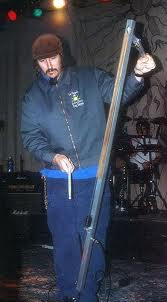
But Trey wasn’t the only one with a weird instrument. For the Frog Brigade set(s) on one of the songs, Les plays a “bass” which is just one string (called the Whamola). He hits it with a stick and changes the notes with a movable handle that he raises and lowers. I’ve never seen anything like that, either. Most of the Frog Brigade set is outside at a festival. The lighting is good but the sound is awful. In one song, the poor guy on percussion is banging away at various things and you simply cannot hear them. Les also uses a secondary microphone (the Sandman–which has a great story behind it) but its volume is also quite low, which is a shame as you can’t hear him for quite a bit.
When Colonel Claypool’s Bucket of Bernie Brains the setting is an odd one (they appear to be on a cruise(?)). It’s basically two lengthy jams, which is fine. Buckethead amazes with his skills. But the Bernie on keyboards, I can’t tell if he was screwing up or messing around during his solos.
There’s two more songs attributed to just Les Claypool, and this version of “Riddles Are Abound Tonight” is especially neat because there is a sitar playing the majority of the riff.
The DVD extras are fun. There’s a weird set from a band called 3 Guys Name Schmo which is 2 bassists and a drummer. The other bassist is miked very loud and it’s hard to hear Les (imagine outbassing Les Claypool!). Then there’s the second official video on the disc for “Buzzards of Green Hill” (very low budget). This comes with a making of the video video and a making of the audio video. Both are interesting and brief, giving tidbits of info without overwhelming us.
The final two items come from an actual TV show called Fly Fishing the World. I don’t fish, so I never knew this show existed. But sure enough, there’s our Les going to two separate locations and fishing on. The best part is that they play lots of Primus music between fishing (probably the most Primus music ever played on non-music TV), and they interview him as well (I didn’t know he had such cute kids). Despite my not knowing the show or caring about fishing, I found the whole program enjoyable and fascinating (and they catch and release as well). It’s well worth the time.
So overall, this is a mixed bag. There’s not a lot of video of Les’ non-Primus music out there, so in that respect this is great. I just wish the quality was better.
[READ: March 25, 2011] “Life in Three Houses”
This is an excerpt from Suicide. The introduction states that days after delivering the manuscript of Suicide, Levé killed himself. I suspect that that is the main reason that this story was published here.
It opens promisingly and very interestingly in the second person. The story tells us that you set off to play tennis with your wife, but you backtrack and go into the basement where you shoot yourself. Your wife finds you moments later but misses the clue you set out for her (that was handled very well).
The rest of the story (and there’s quite a lot) gets confusing. First off because it stays in the second person (even after death) but it also goes into apparent flashbacks. Even more confusing is the addition of an I as the narrator. An I who knows “you” but who was not present for the suicide so how could he have all these details?
The book is being published by Dalkey Archive Press. It’s possible that the excerpts do an injustice to the full book, but I fear that I will not be reading any more by this author.
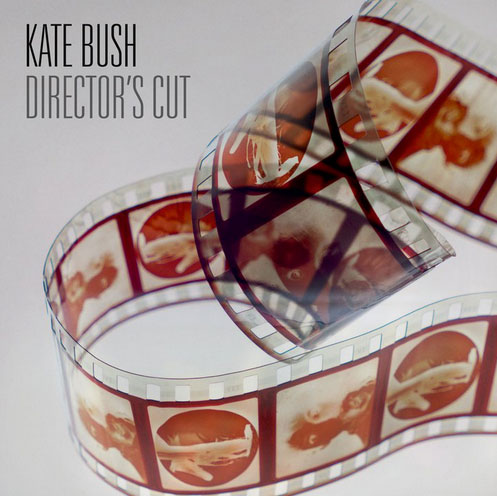
Kate Bush has re-recorded eleven songs from her two least-loved discs, The Sensual World and The Red Shoes. According to the story at NPR, this seems to have been inspired by the Joyce estate’s granting Kate the right to use part of Ulysses as the lyrics for the song “The Sensual World” (in the original version she paraphrased the book). So, she decided to re-record a bunch of other songs from those two albums as well.
I admit that neither one of those discs is high on my repeat play list, with The Red Shoes being a particular disappointment. (Although there are some great songs on each). When I read that these songs from those two albums I wasn’t terribly excited to hear them. But I must say that these new versions have really reinvigorated these tracks.
I’m surprised by some of the choices (redoing “This Woman’s Work” is something of a shock, as is redoing her only real hit from The Red Shoes, “Rubberband Girl”), but whether it’s that she chose the best songs, or the new version have more life to them, this is a wonderful collection of songs.
Actually, rechecking the track listing, it does appear to be the best tracks from both discs, but I’m pleasantly surprised to seen how many good songs were actually on The Red Shoes to begin with,
from The Sensual World
Sensual World (retitled “Flower of the MOuntain”)
Deeper Understanding
This Woman’s Work
Never Be Mine
from The Red Shoes
The Song of Solomon
Lily
The Red Shoes
Moments of Pleasure
Top of the City
And So is Love
Rubberband Girl
For the most part, the music seems to be the same (although there are some glaring exceptions). I admit to not remembering the originals for all of them all that well). But she has mostly rerecorded her voice (and possibly other lyrics, if NPR is accurate). Her voice is unmistakably Kate, but in some places she sounds noticeably older (which she is, so duh). She doesn’t seem to be able to hit quite the highs of before, but her voice has a throaty excellence to it now that brings something new to the songs. It’s not noticeable on every song, although it is most notable on “This Woman’s Work,” which began with high sopranos, and now begins with lower alto notes. But she can still hit some of the cool screechy notes on “Top of the City”
There are some tracks that are very different, “A Deeper Understanding” (a song about love via modems) replaces the earlier style of singing with a heavily autotuned computer voice. It’s unsettling but very cool sounding.
The biggest changes come in “This Woman’s Work” and “Rubberband Girl.”
“This Woman’s Work” is a far more sedate track now. It doesn’t have any of the soaring moments of the original. It seems to have more depth in this version, but I miss the “Oh darling make it go away” moment. Nevertheless, it sounds really pretty in this more mature version. It’s simply a very different song now.
As for “Rubberband Girl,” I’ve always had a real fondness for the original, so I don’t know how I feel about the rerecorded version (which is so very different). The original is very elastic with cool music and weird vocals and is kind of trippy (and may not even be all that good), but I have grown quiet attached to it. The new version is a simple guitar sound (it reminds me of a sort of unplugged Rolling Stones song now).
Overall, this is an exciting revitalization of Kate’s back catalog, and I hope it inspires her to make another new album in the next few years or so.
[READ: May 14, 2011] Austerlitz
I read about Sebald in Five Dials. And the glowing talk about him made me want to read one of his books (specifically, this one).
Austerlitz is a strange novel which I enjoyed but which I never really got into. I feel like rather than absorbing me into its words, the book kind of held me aloft on the surface. As such, I have a general sense of what happened, but I’d be very hard pressed to discuss it at length.
The basic plot summary is that an unnamed narrator runs into a man named Jacques Austerlitz. Austerlitz talks to him at length about his life. They run into each other at various points over the years, and Austerlitz’ story is continued. And literally, that is the book. Now, of course, Austerlitz’ story is multifaceted and complex. But we will never forget that this is a story within a story (it’s impossible to forget because the phrase “said Austerlitz” appears about 500 times in the book. (more…)
SOUNDTRACK: PJ HARVEY-Live at the Warfield Theater, San Francisco, April 14, 2011 (2011).
NPR was given permission to share this PJ Harvey concert. However, they were only allowed to share about half of it. The show is fairly short to begin with (about 75 minutes) but the downloadable portion is barely 40 minutes. It turns out that NPR was given the rights to all of the songs from the new album, Let England Shake.
Now, I have no idea how things like this work, why they are only given access to these songs as opposed to the other ones, or why an artist (or management) would not let her fans hear the ten or so other songs she played that night. Legal restrictions are weird and usually stupid. But as I’ve mentioned before, you shouldn’t complain about free stuff.
So, what we get here is a spliced together concert (it sounds seamless, although they have removed all of the banter (if there was any)). The album is played in its entirety (although we were not given “Written on the Forehead” which happens to be the song they are playing the most on the radio here), but it’s not played in order. It was also interspersed with older songs “The Devil” and “Silence” from White Chalk, “The Sky Lit Up” and Angeline” from Is This Desire, “Pocket Knife” from Uh Huh Her, “Down by the Water” and “C’mon Billy” from To Bring Her My Love, (I’d like to hear how she handles the older songs, now that’s she’s singing primarily in the higher register). And, “Big Exit” from Stories from the City.
It’s pretty clear that Harvey is no longer the young woman who made those first couple albums. And she sounds strong and confident here. It’s a great set; the autoharp never sounded better.
[READ: April 20, 2011] Five Dials Number 5
I have been enjoying all of the Five Dials, but this issue is easily my favorite so far. The “theme” of this issue is translation. Translators are the unheralded workers in literature, and while I have been trying to give them credit in my posts, I don’t always pay them enough attention (except when a translation is awkward or clunky).
But in addition to the theme (and the really cool interviews with some translators, I thought the fiction was outstanding and I loved Alain de Botton’s Advice column. The whole issue was great. (more…)
SOUNDTRACK: THE HEAD AND THE HEART-KEXP in Studio, September 14, 2010 (2010).
My saga of The Head and the Heart continues. Sarah had ordered me the disc for Christmas, but the self-released CD had gone out of print. This is because Sub Pop was going to re-release the record sometime in the new year.
Well, NPR loved the album, so why wouldn’t they have more recordings by them? (This is one of the great things about enjoying new bands…they are far less likely to restrict listening and downloading abilities online). So, this session (September) was recorded shortly after they released their album (July). I have still yet to hear the actual album, but I have fallen in love with these songs.
This set (which has some very brief interview portions) is five songs. The band sounds great, with wonderful harmonies. The first two songs “Cats and Dogs” and “Coeur d’Alene” meld together seamlessly, and it works wonders. “Lost in My Mind” is an amazingly catchy single: the “whoo whoos” (which sound not unlike a train) are wonderfully catchy (in a Mumford and Sons kind of way).
They also play “Ghosts” (another catchy catchy song) and the non-LP song “Down in the Valley” (which has the slightly uncomfortable opening lyrics: “I wish I was a slave to an age-old trade”).
This neo-folkie revival has generated some great bands, and The Head and the Heart are yet another one.
[READ: April 14, 2011] “A Withered Branch”
This is a very brief short story (a page and a half) translated by Anna Summers.
A young woman hitchhikes into Vilinus. She is picked up by a trucker and is unbothered until they get to a rest stop. While they are having dinner, one of the drivers wonders who she will sleep with that night.
But that is the prelude to the story. When she arrives in the city, she meets a woman of about fifty who, when the narrator asks if there is any place to stay, offers her own house to the (dirty and sweaty) stranger/narrator. (more…)
 This is the fourth live recording from The Head and the Heart that NPR offers. Not bad for a band with only one album out. This set finds the band even more confident and relaxed (despite their genuine excitement at playing the festival). The band sounds fantastic and I’ve really grown to appreciate the female harmonies on most of the songs now (I’ve not always liked them on every song).

















 I Just Read About That...