Feeds:
Posts
Comments

Archive for the ‘Translators’ Category

SOUNDTRACK: YOU SAY PARTY! WE SAY DIE!-“Monster (RAC Remix)” and “Like I Give a Care (Octopus Project Remix)” from Viva Piñata! (2008).

Viva Piñata is a free CD compilation that I received I think when I ordered a Tokyo Police Cub CD.  It celebrates “5 years of ass-whippin’ at Paper Bag Records.”  It came out in 2008, so presumably, Paper Bag Records has now been whippin’ ass for 9 years.

You Say Party! We Day Die! (that’s a name that seems to be trying too hard) is from British Columbia, Canada and they seem to be a noisy keyboard band.  “Monster” is a keyboard-heavy poppy song.  Of course, since this is a remix I have no idea what the original sounds like.  The lead singer has a cool deep voice (a more poppy Kim Gordon, perhaps?).  But this song is dominated by the propulsive synths.

“Like I Give a Care” has a remix that is even more intense, overeffected, noisy and chaotic with a great propulsive bass.  It also seems like most of the song has been stripped, leaving just a chorus repeated.  As a remix it works fine.

I’ve often complained about remixes–if I like a song, why would I want to hear a remix of it?  This is the opposite.  I’ve never heard the song before and the remix is kind of fun. I’m intrigued to hear what they actually sound like.

[READ: March 22, 2012] “I Can’t Read”

Another month, another excerpt from a new posthumous Bolaño release.  This latest book is called The Secret of Evil which Harper’s says will be out this month (we’ll see about that).  The Secret of Evil is evidently a collection of unfinished pieces that Bolaño was working on when he died.

This particular story certainly seems finished, so who knows what the rest of the book will be like.

I am particularly fond of this kind of story from Bolaño–it reads like nonfiction (and maybe it is).  It seems to be a true account from his life (written in first person and about his family)–it’s a personal, relaxed style in which he muses about things and events.  It is also set during his first trip back to Chile since leaving in 1974 (a subject he mines quite well).

This one starts with the line: “This is a story about four people.”  The first two people he talks about are his son Lautaro and a new friend that his son made named Pascual.  Lautaro was eight and Pascual was four, but since Lautaro was desperate for someone to play with, he overlooked the age difference and made a holiday friend. (more…)

Read Full Post »

SOUNDTRACKKHÔRA’s-Silent Your Body Is Endless [CST071] (2011).

This is the third and final disc from Constellation’s MUSIQUE FRAGILE 01 collection.  Khôra is Matthew Ramolo doing solo work on the guitar.  But unlike any other guitar album you may have heard, this one is processed and manipulated so that much of the album sounds nothing like a guitar.

Most of the sounds on the disc are washes and waves of guitars that grow and fade.  Although the opening track “Natura Naturans” has a recognizable acoustic guitar melody, the washes are all processed guitar sounds.  This sound also has an echoing church bell, the kind of sound that would bot be out of place on a black metal album although this is as far from black metal as you can get.

The church bell, by the way is a field recording, and in addition to the guitars there are plenty of field recordings on the disc.

He generates a wonderfully expansive amount of moods as well.  There are haunting melodies like on “Body Aperbut also beautifully upbeat ones like on “Hushed Pulse of the Universe”

I find the artwork that accompanies the Khora album to be the most satisfying of all three.

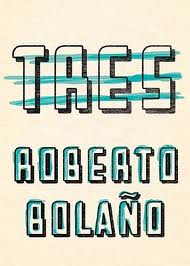
[READ: February 15, 2012] Tres

Another month, another posthumous Roberto Bolaño release.  Tres is so-called because there are three pieces in it.  They are described as poems, although I have a hard time seeing them as such.  It has the Spanish title because it was originally published as Tres and the English version is actually a bilingual version with facing Spanish and English pages (translated by Laura Healy–I guess if Laura Healy translated it, it must be poetry as she is Bolaño’s poetry translator).

Tres is also amusing to me because it is so clearly a way to make a very small book seem bigger.  In addition to the facing pages of the text, most pages have a paragraph or two at most (short ones at that).  So it’s total 173 pages is really half that and then, given how much white space there is, it’s easily half that as well.  None of this is a complaint, it’s just an observation.

The reason I’m confused about calling it poetry is because of the three pieces only one “looks” like poetry (with line breaks and what not).  Indeed, the first piece, “Prosa del otoño en Gerona” literally translates as “Prose from Autumn in Gerona.”  The second piece (the one that looks like poetry) is called “Los neochilenos” or “The Neochileans” and the final one is a series of numbered paragraphs (again, with no poetry conventions) called “Un paseo por la literatura” or “A Stroll through Literature.”  I read each of these pieces three times primarily because I found them hard to follow and wondered what I was missing.  Multiple readings did help, although I find with Bolaño’s longer short pieces, the details are exquisite while the overall picture is a bit confused. (more…)

Read Full Post »

SOUNDTRACK: MY MORNING JACKET-Circuital (2011).

I have really gotten into My Morning Jacket with their last couple of albums.  I know that they are quite different from their earlier releases, so I’m not quite as surprised by the diversity that’s on them.  With each release, they keep exploring new territory, although it’s all held together nicely by Jim James’ (or Yim Yames’) amazing voice.

The first half of the disc is much more wild than the second half, with longer songs, and more unusual textures.  The second half slows things down and feels almost, but not quite, acoustic.

“Victory Dance” is a slinky song and a cool intro to the disc.  It’s quickly followed by “Circuital,” a 7 minute long epic with two distinct parts.  The first is a kind of quiet echoey introduction, but when the guitars roar in at around 2:30, it turns into a big anthemy song…very ctahcy

“The Day is Coming” opens like a 70s AM radio song, with lots of da da das.  It’s a mellow song, the kind of song the MMJ flesh out with wonderful vocals so it never gets dull.

“Wonderful” is a simply beautiful song.  A gentle ballad about feeling wonderful.  I just found out that this song was originally intended for The Muppet Movie.  It would have been perfect.  Of course, the band are on the soundtrack doing a cover, so I guess that’s kinda close.

“Outta My System” is another catchy little number, also reminiscent of 70s AM radio, although it’s all about doing bad things as a youth and getting them out of your system.  Musically it would also work very well for the Muppets, but I suspect lyrically it might be a bit outré for the movie (granted I haven’t actually seen it so I can’t say for sure).

All the recent MMJ albums have one crazy track and on this one it’s “Holdin’ on to Black Metal.”  So the title is pretty unexpected but it’s nowhere near as unexpected as the content of the song.  It is complete with a children’s chorus and what sounds like horns, although I suspect they are keyboards.  It’s full of blasts of sound and woah woah ohs.  It’s crazy.  I love it.  Much like I love the crazy song, “Highly Suspicious”  from the previous album.  And I just found out that this song is more or less a cover (although with different words of “E-Saew Tam Punha Huajai” by Kwan Jai & Kwan Jit Sriprajan from the album Siamese Soul: Thai Spectacular 1960s-80s Volume 2.  More on that tomorrow.

  After that bizarre track, the album really settles down into an easy groove.  “First Light is a pretty traditional, simple song.  It also has lots of horns.  “You Wanna Freak Out” is also unexpected for the title, as it’s a pretty straightforward rocker. “Slow Slow Tune” doesn not belie its title.  It has a kind of 70s Pink Floyd feel and continues the more mellow second half od the disc.  The disc ends with “Movin’ Away” a slow, piano ballad.

  Although the album has a very comfortable, familiar feel, MMJ have little tricks (great soaring guitars and, again, James’ voice) to make it rise above the ordinary.  It’s great disc that warrants multiple listens.

[READ: January 28, 2012] How I Became a Nun

I didn’t love Aira’s Ghosts because it was too ephemeral for me (as befitting a book called Ghosts, right?).  How I Became a Nun is the exact opposite: a terrifically visceral story that is straightforward and easy to follow, except for perhaps two things.

The first thing is something that’s mentioned on the back of the book (so I’m not threatening a spoiler here).  The main character is named César.  Whenever someone talks to him, they address him as César or boy or him.  And yet, the whole book is written from the point of view of young César, and César describes himself as a girl.  In the fourth paragraph, the narrator states, “I was a devoted daughter.”  And yet, shortly thereafter, another character says about the narrator, “Is it my fault if the boy didn’t like it?”

This goes on throughout the story–not a lot–but enough to keep it in your mind.

The second thing is the ending.  Which I don’t want to spoil.

So what is this wonderfully titled story about?  Well, six-year old César begins, “My story, the story of ‘how I became a nun’ began very early in my life.”  The opening chapter tells the story of César’s first experience with ice-cream.

It is a wonderful chapter, with César’s father promising the wondrous delights of ice cream and taking them both out for a cone.  César’s father enjoys his cone very much, but César, although instantly in love with the pink strawberry color is instantly disgusted by the taste. He even retches a little bit. (more…)

Read Full Post »

SOUNDTRACK: LE BUTCHERETTES-Sin Sin Sin (2011).

I learned about Le Butcherettes from their Tiny Desk Concert.  So I thought I’d check out their album.  I’ve listened to it a few times now and it’s really quite good.

While the Tiny Desk Concert showed a subtle side of Teri Gender Bender, this album rocks really hard.  All three songs from the Tiny Desk Concert rock much harder here, and are actually better in this full band context (especially “Henry Don’t Got Love”).

It has a punk feel and reminds me of a more commercial sounding Bikini Kill or other Kill Rock Stars punk.  “Dress Off” is all Teri’s voice shouting over drums: “You take my dress off. Yeah, you take my dress off.
Yeah, You take my pretty dress off.”

In the Tiny Desk concert, Teri Gender Bender channeled PJ Harvey completely.  On the album, she has a bunch of different vocal styles that all work well for the songs.  Although “New York” is totally PJ, “The Actress That Ate Rousseau” reminds me of punkier No Doubt and”Tainted in Sin” has a simple stark keyboard melody with Teri singing a more aggressive guttural style.

Unsurprisingly for someone named Teri Gender Bender, there are some political songs as well.  “Bang!” has the lyric, “George Bush and McCain taking over Mexico.  Next thing you’ll see is their army banning seranata

Although there’s a lot of short songs (7 are 2 and a half minutes or under), there’s a few long ones too.  “The Leibniz Language is over 5 minutes and “I’m Getting Sick of You” and “Empty Dimes” are both over 4.  There’s also an instrumental, “Rikos’ Smooth Talking Mothers” which is a simple song spurred on mostly by scratchy guitars.

The final song, “Mr. Tolstoi” is the anomaly on the album.  Teri “sings” with a fake Russian accent  over a very Soviet-style keyboard march.  The chorus:

I want Raskolnikov To be inside of me.  I want Sonya’s eyes.  I want Sonya’s eyes.

Weird.  But not outrageously crazy for this record.  It’s good noisy fun.

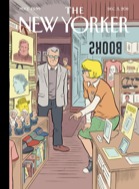
[READ: January 23, 2012] “Labyrinth”

It’s no secret that I love Roberto Bolaño.  And I’ve said before that one thing I love about him is the astonishing variety of subjects and styles that he comes up with.

So this short story is forthcoming from his newly translated collection of unpublished short stories called The Secret of Evil.  What I love and find so unique about this story is that the entire story is based upon a photograph.  The New Yorker includes the photograph (I wonder if the The Secret of Evil will include it also).  In the photograph, eight writers/thinkers sit around a table.  Thy are: J. Henric, J.-J. Goux, Ph. Sollers, J. Kristeva, M-Th Réveillé, P. Guyotat, C. Devade, and M. Devade.  The only person I know of this list is J. Kristeva, whose work on semiotics I have read.  [I just looked her up on Wikipedia and learned that she has also written novels, including: Murder in Byzantium, which deals with themes from orthodox Christianity and politics and has been described by Kristeva as “a kind of anti-Da Vinci Code.”  Gotta put that on my list].  But the others are (evidently) prominent in their fields as well (editor of Tel Quel, author of several novels and non-fiction, etc).

The beginning of the short story is an extensive detailing of the photograph.  Bolaño looks at each man and woman in the photo and describes them with exquisite accuracy.  Beyond that he imparts a bit of speculation about what they are wearing, where they are looking, their attractiveness and even, about the length (or lack) of necks. (more…)

Read Full Post »

SOUNDTRACK: WILD FLAG-SXSW April 1, 2011 (2011).

Wild Flag has released one of the best albums of 2011.  I can’t stop listening to it.  So, it’s funny that this show has been sitting on NPR’s download page for months without me checking it out because I didn’t know who the band was until the album came out.  Wild Flag is Carrie Brownstein, Mary Timony and Janet Weiss (and a keyboardist who I will never remember because I never heard of the band she was originally in). 

This show at SXSW is one of their earlier shows.  It’s so early that one of the songs in the setlist appears on the album with a different title.  And the band is full of raw energy and passion. 

Although research shows that they’d been touring since November, Mary Timony seems somewhat hesitant in a few songs.  But Carrie Brownstein seems fired up to be playing again, and she rages and jumps around the stage, her voice as aggressive and fun as it was in Sleater-Kinney.  Janet Weiss, as ever, kicks massive ass on the drum kit.  man can she wail–she is a vastly underrated drummer. 

The band has great cohesion and they seem like they’re really enjoying themselves. 

 In many respects this band sounds like Sleater-Kinney (2/3 of the band are here).  But the addition of Timony’s lyrics and more gentle voice bring a cool change.  And the keyboards flesh out the songs in wonderful ways as well–for a band with no bassist, it’s funny that the most pronounced keyboards riffs are at the high end of the register.

There’s a few flubs during the set, in one of the more pronounced keyboard riffs, there’s a pretty major gaffe.  And sometimes it seems like they don’t know exactly how they should be harmonizing with each other (not true on the record at all).  And during the extended soloing of “Glass Tambourine” (6 minutes), I’m not really sure what Mary is up to.  But that’s okay.  The band is all about rawness, so that can be forgiven. 

While the album is better, this live show is a good introduction to the band. 

Since Carrie Brownstein worked for NPR I almost expect all of their shows to be available here.  But for now, watch the whole show here.

[READ: January 17, 2012] “Old Mrs. J”

Stephen Snyder translated this story that was originally written in Japanese.  It’s interesting to me when a work is translated from another culture.  Does the translator intend to keep the other culture obvious or does the translator try to make the story, in this case, more European or American.  There’s some inevitability in that, since the language is changed, and yet the sensibility of the original often remains.

I bring this up because I tend to think of Japanese writing as being very distinctive.  And yet this story didn’t really “read” very Japanese to me (Kiwi fruit aside).  It did read a little bizarre, but that was the fun part.

The story starts out simply enough: a young writer (who is a woman, although you don’t find that out until very late in the story unless, unlike me, you assume the main character is a woman because the author’s name is Yoko).  The author works late and sleeps in til noon or so.  It’s a quiet, peaceful place.  The landlady is older and somewhat feeble.  Until, that is, she gets into her garden and then she seems possessed by a fire. 

The landlady hasn’t really talked to the writer.  Then one day the writer hears the landlady in the garden cursing at a stray cat.  The landlady hates cats and curses them up and down.  Finally the writer tells her to put pine needles down, that cats hate prickly things on their feet.  This I did not know.

And they strike up a friendship.  The landlady reveals that her husband was no good and that he left her.  She also reveals that she gives massages.  And she begins leaving the writer vegetables from her garden.  Then one day, the landlady brings her a strange carrot with 5 “fingers” coming off of the central stalk.  The carrots are quite special.  And she keeps them a secret until sure enough, she begins growing lots and lots of them.  Even the newspaper comes to take a picture.

This idyllic story is interrupted in the last few paragraphs.  First by what seems like metaphorical scariness and then, ultimately, with reality.  It is a wonderfully realized story, wonderfully told and with enough hints of magical realism throughout that the ending isn’t totally unbelievable–even if it is quite unexpected.

Read Full Post »

SOUNDTRACK: tUnE-yArDs-WHOKILL (2011).

I bought this album because NPR was raving about it back in the summer.  When I first played it I was really disappointed.  rather than the interesting experimental music, it sounded like a kind of unpleasant R&B.  So I put it aside for a while.  And when I listened to it again, I was really blown away by it.

For those of you unfamiliar with tUnE-yArDs, there are three or four different singers in the band.  There’s the raspy voiced R&B singer that opens the album.  There’s the whispering vocalist and the spoken word backing vocalists of “Es-So.”  And there’s the rasta singer of “Gangsta.”  There’s the soulful male who sings “Powa” and the woman who can hit the amazing high notes at the end of “Powa.”  And all of those singers are named Merrill Garbus.  For she is more or less the one woman operation behind the band.  (I’m a little unclear if the rest of the musicians are part of her band or just session folks).

I have deliberately been avoiding reading about Merrill Garbus before writing this because I didn’t want to be influenced by reality.  I honestly had no idea who she was or what she looked like when I started listening to the disc.  I assumed, by her voice, that she was a black woman.  But then the liner notes talk about Jewish grandparents and the disc itself includes samples of them, and they are clearly white.  And then yes I saw a photo of her, and she’s quite white.  None of that is of any consequence except to really highlight the chameleonic nature of the music and how it really transcends genres.  That’s pretty awesome.

 The trick that you will read about ad nauseam about tUnE-yArDs is that Garbus loops her own stuff live.  It’s not screamingly apparent on the disc but you can certainly hear stuffed looped as the disc goes along.

This album made almost every best of year-end list.  And that surprises me somewhat because it’s not always easy listening.  “My Country” has all kinds of screamed parts, a staccato horn solo and a cacophonous ending.   The second song, “Es-So” opens with a some clunking drums and what seems like a slightly out of tune guitar playing a simple, aggressive riff.  The rhythm and tune of the song is infectious and yet so…odd.  “Gangsta” is one of my favorite songs of the year.  It opens with a great bassline and then several “sirens” which I suspect are Merril’s own voice.  It seems to end after 2 minutes but there’s more…a bizarre interlude in which the song seems to have a hard time starting up again.  (“bang bang bang oy, never move to my hood coz danger is crawling out the wood”).

“Powa” is probably my least favorite song on the album although I still like it.  It’s slow and kind of ballady but the vocals are just so wild it keeps it from being dull.  “Riotriot” is strange meandering song full of peculiar percussion.  It’s a bit too long, but there’s some really interesting parts, especially at about 3 minutes when the song suddenly turns into a psychedelic freak out.  “Bizness” opens with Garbus’ crazy distorted voice over some pretty descending notes (which I assume are from Garbus’ pretty singing voice).

“Doorstep” has a bunch of fast sha la las that I normally dislike but which work so well within the song and with Garbus’ amazing, angsty singing near the middle of the song.  “You Yes You” has some great guitar work in the beginning and a very fun segment that ends with a big “Ha!”  “Wooly Wooly Gong” is a cool slow song, minor key with delicate vocals.  The disc ends with “Killa” another great song featuring Garbus’ rough voice and scratchy guitars.

The whole album keeps you on your toes.  There’s something for everyone, but it’s all mashed together so it’s not always clear than anyone will like it.  It’s a really fun release and although it took me several listens to really appreciate it, I simply can’t stop playing it now.

[READ: January 9, 2012] Ghosts

I had planned to read this book a little earlier than I did, but then three holds came in from the library which pushed everything back (those were all new and this book, well, to be fair, I’m not sure it was ever checked out, so I was allowed to renew it).  The only bummer thing about it is that this entire story is set on New Year’s Eve, so it would have been nice to post it then.  Oh well, what’s two weeks?

So, this is the first novel by Aira that I have read.  I really enjoyed his short story recently and, since Roberto Bolaño is a big fan, I wanted to see what he had written.  As I’ve mentioned elsewhere, Aira has written approximately forty-five novels (!) (since 1981 (!!)) He had five in 2005.  Most of them are fairly short (Ghosts is less than 140 pages), so it’s not quite as daunting as it could be.  And for English readers, there are only seven books translated into English.  So now is the time to jump on his bandwagon!

This novel was translated by Chris Andrews, who has translated many of Bolaño’s shorter works as well.  I did notice one or two British/Australian spellings in there (Andrews is Australian).  But I am very impressed with the translation, especially the occasional fifty-cent words that were wonderful choices (I wish I had written them down).

The story itself is fairly simple, although there are waves of complex ideas that come throughout.  As I mentioned, the entire story is set on New Year’s Eve in Argentina (which, North Americans please note, is really really hot–like super crazy hot, which is a little disconcerting to read during a cold January].  It’s also almost entirely set in one building (there’s a quick trip to the market).  And the bulk of the story centers around one (extended) family.

But as it starts, we see something altogether different. The building in question is a condominium.  It was supposed to be finished on January 31, but, of course, it isn’t.  All of the families who have bought into the condo have shown up to see the proceedings.  They are pretty much all there at the same time although some are coming and others are going.  We learn a lot about the building itself, the pool on the roof, the rooms and cabinets, the elevators.  It’s a pretty nice place.  We meet most of the families who will be living there when it is finally finished. The kids love running around in the unfinished house, watching the workmen carting things away and being a mild nuisance.  But it’s basically a holiday so no one cares all that much.

Oh, and there are ghosts all over the building.  (more…)

Read Full Post »

SOUNDTRACK: DANKO JONES-Below the Belt (2010).

I love Danko Jones.  He’s bad, he’s cruel, he’s crass and he rocks.  He’s everything a 15 year-old boy loves in rock.  And yet there’s something about him that even I (far older than 15) think is wonderful (perhaps he’s the thinking man’s Andrew W.K.?). 

I’m sure it’s because his early stuff was short, fast blasts of over the top machismo.  He hasn’t started too far from that template (his songs are now three minutes, but that’s okay).  And I still love him even if every song is a cliché (and that he still thinks a Cadillac is the height of coolness).

“I Think Bad Thoughts” is a stupid balls-out rocker about how bad Danko is.  Best line, “That’s how it is as a knight in Satan’s service.”  A nice nod to Kiss.  And this song is followed by the very early-Kiss sounding “Active Volcanoes.”  “Tonight is Fine” is a heavy rocker (okay they all are, that’s redundant), but “Magic Snake” is surprising because it seems to be addressing impotence (“It’s friday night but your magic snake don’t slither no more”.)–not doing anything about it, just addressing it.  “Had Enough” has a great sing-along chorus (when Danko is not yelling at you, he croons with the best of ’em).

Of course a song title like “I Can’t Handle Moderation” should tell you all you need to know about Danko (he must have his tongue in cheek, at least I hope he does.  I’ve never seen him in anything other than album covers, so I have no idea what his off-stage life is like).  It’s always a surprise when Danko reveals a softer side.  And even though “Full of Regrets” seems like it would show that softer side, it’s actually about how he’s full of regrets about any lonely nights he spent.  Heh.  “The Sore Loser” is a not very nice song about a woman.  But it’s funny.  “Like Dynamite” is all about sex, of course.

I love the aggressive riff of “Apology Accepted,” it’s faster and more furious (even if it is about accepting an apology).  And the final song “I Wanna Break Up with You” cracks me up.  It’s a song about wanting to break up with someone.  Did he imagine it as a breakup anthem?  Something you play in the background when you dump your significant other?  I particularly like the chanting “break up break up everybody break up” at the end.

There are two bonus songs on the disc (an idea as antiquated as his lyrics, but which is strangely charming).  Neither sounds like it shouldn’t be on the record–they continue what he does so well.  They’re both about guest lists, but I particularly enjoy “Rock n Roll Proletariat.” It sounds a lot like AC/DC but who fits the lyric “I pledge allegiance to the Rock n Roll Proletariat” into a chorus?  Genius!

Yup, his album covers are as sexist as his lyrics.  But there is something just cartoonish enough that I can’t help but think hes a really nice guy under it all (maybe it’s because he’s Canadian).

[READ: December 28, 2011] “Creative Writing”

Sometimes a very short, very well written story can really make your day.  I read this story this morning (because it was so short–a page and a quarter) and I was immediately hooked. 

It opens with a woman, Maya, taking a creative writing course (at the suggestion of her mother).  Maya just had a miscarriage and has been just sitting in the house not doing anything, and her mother thought that an activity wold be beneficial.  Maya’s first story was quite interesting.  [In fact, I LOVE the conceits behind each of her stories and while I immediately thought I’d like to read them, I’m not sure how will they would work beyond the simple concept presented here.  But the ideas are so clever that I wanted to read the full things right then!–maybe make this story longer and include Maya’s full works?]

All of her stories have to do with love or marriage or birth, but in wonderfully metaphorical ways.  The first story, about people who split in half to generate offspring has an ending that her teacher calls wonderful but which her husband finds quite dull.  [Incidentally, I’m all for reading stories from other cultures.  It’s fun and interesting.  But man, sometimes it’s so hard to tell the  gender of a person by his or her name is you don’t know the culture.  This story was written in Hebrew (translated by Sondra Silverston) and the secondary character’s name is Avaid.  In addition to not really knowing how to say the name, I had no idea if it was a male or female name.  I suppose it is not really up to the writer to compensate for ignorant audiences, but perhaps sometime earlier in the story an author can subtly hint at the gender of the person?  (We get the “he” in paragraph three).  Shy of a dramatis personae, there’s little that you can do organically for the story, I suppose. ] (more…)

Read Full Post »

SOUNDTRACK: THE SWELL SEASON-Strict Joy (2009).

I bought this disc for Sarah after it came out.  I didn’t think that I would enjoy it that much because while I loved the movie Once, I wasn’t sure if I needed more from Glen and Marketa.  But then I found a whole slew of free concerts from NPR and I became hooked on the band.

The disc opens with “Low Rising” (what I think of as the “Van Morrison” song).  It gets better with each listen.  It’s a slow ballad which is followed by “Feeling the Pull,” a more up-tempo song that really highlights Marketa’s beautiful harmonies.  “In These Arms” is a gorgeous song.  The verses are downbeat and somber “if you stay…with that asshole…it will only lead to harm” but again the harmonies are gorgeous.  “The Rain” is a more rocking tune (within reason, of course).  It has an interesting middle section that quiets down, but it’s a solid folk rocking song.

“Fantasy Man” is Marketa’s first lead vocal song on the disc.  I like her voice but sometimes I find her lead songs to be a bit too wispy, too quiet.  I like this song, but it feels long (and at 5 minutes, it is).  “Paper Cup” is one of Glen’s quiet ballads.  It’s a pretty song.  “High Horses” is one that I didn’t know from the live sets, I guess it’s not too popular with the band, but I think it’s strong.  It runs a little long but that’s because it has a cool middle section that keeps building and building with more instruments and voices.  “The Verb” is another song that I didn’t know.  It has a cool intensity to it and while it doesn’t stand out as a hit, it’s certainly an enjoyable song.

“I Have Loved You Wrong” is another pretty Marketa song, but again it’s very slow and very long.  I don’t think I could buy her solo album because although her voice is lovely and her melodies are nice, they’re just so ephemeral I can’t really get into them.  “Love That Conquers” is an interesting song.  It sounds nothing like The Swell Season (must be the banjo).  It’s a nice addition to the album and should maybe have been placed a little earlier to break up the sound style a bit more.  “Back Broke” ends the disc very strongly.  Although I think the song works better live (with audience participation), the melody and tone of the song are somberly beautiful.

There are moments of this disc when it turns out to be what I feared the whole disc would be–bland folkiness. But overall this is an enjoyable album for a rainy day.  And Hansard really has an amazing voice.  However, I really like them better live.

[READ: December 26, 2011] Third Reich

I was pretty excited when I heard about this book, although I must admit I was a little concerned by the title.  Bolaño has a kind of weird Nazi fascination.  There is Nazi Literature in America and then a whole section of 2666 is given over to Nazi Germany.  He doesn’t like Nazis or anything but he writes about them a lot and it can be a little exhausting.  So it was with some relief that I learned that Third Reich is the name of a game that the main character plays.  It is a kind of historical reimagining kind of game (I guess like Risk but more specific and with more at stake).  It is set during the time of the Third Reich and the players represent various countries (or perhaps even powers).

I am giving up on explaining the game from here on because a) there’s a lot about the game in the book and b) I’m not sure if it wasn’t explained very thoroughly or if I just missed out on exactly what was happening.  During the book he talks about Hexes 65 through 68 and so on.  So I assume the map of the world is a hex grid.  But he never gives any context (or even a picture!–and this makes sense as it’s written as the diary of a well-regarded player who is not trying to teach us the game).  So while I understand the general tenets and play of the game (there’s a die (or dice) and tokens that reside on the board), the specifics are completely nebulous.  But that’s okay.  Because the game specifics don’t impact the book, but the game overall is at the heart of the book.  I think it’s neat that Bolaño invented a game (and several others games are named, but no details are given).  He is clearly very gifted at inventing people, games, things.

But as I said, the game is only a part of the book and in fact, the game details don’t enter into the book until about half way through. (more…)

Read Full Post »

SOUNDTRACK: TRENCHMOUTH-Inside the Future (1993).

This album came before the other Trenchmouth CD I reviewed.  And it’s safe to say that all of the ideas were still in place for this CD as well. 

What I love about Trenchmouth is that all 4 members seem to be playing different songs and yet they all work so well together.  True, it sounds chaotic and at times unpleasant (such is the nature of punk) and yet when you listen a few times you hear how it all works.

“Telescopic” opens with a crazy punk bass line, the guitars are just screams of noise and the drums are rhythmic yet chaotic (that’s Fred Armisen on drums and he is a wild man).  Then lay over the top the disaffected vocals (which are in a different ke)y and you get one hell of  a punk song.  The feedback squalls at the end let you know that they have no intention of being on the radio.

“Power to the Amplifier” condenses all of that noise into 2 minutes of fury. 

“The Dawning of a New Sound System” starts with some crazy guitar chords (showing you just how weird the guitars are) but this song has a pretty catchy chorus (with backing vocal shouts of “Hail Hail”).  “Yes, This is the Place” offers slightly less abrasive guitars and a very smooth middle section.

“Capsule” actually opens with a sound similar to Prodigy’s “Smack My Bitch Up” and it has a different vocalist (although I don’t know who).    The percussion on “Confectionery” is amazing, while “In the Event of a Struggle” is another 2 minute cycle of styles.  “The Future Vs. Centrifugal Force” sounds the most like that mid 80s SST style that I like so much–kind of a jam feel, but short and punky.

“Sea of Serenity” is listed as “Swing Version”, although I don’t know if there’s another version.  This one has intense guitars (don’t they all) and frantic drumming.   It also has a wonderful third part with a great off-kilter guitar riff.   The final proper song is “Hit Men Will Suffocate the City” and it is more of the same noisy wonderment.  It ends with a great bass line.

The final track is “Now I Have Tasted Life” and it is absolute filler.  A weird addition, it’s 7 minutes of slow melodica noodling and occasional reggae sounding guitars with random percussion  There’s also some feedback squalls.  It sounds like one of their real songs stretched out and slowed down.  It would be okay if it weren’t so long.  But it’s hard to blame anyone for experimentation when the rest of their experimentation is so good.

It’s obvious why Trenchmouth weren’t popular (although you can hear proto-Primus all over this record–I wonder if Les and Ler knew Trenchmouth at all?), but it’s a shame their music is so hard to find.

[READ: November 30, 2011] “The Musical Brain”

I have been meaning to read César Aira for a little while now.  He’s on my list of new authors to check out.  So I was pretty delighted to see this story (translated by Chris Andrews) in the New Yorker.

There are so many wonderful and unexpected aspects to this story that I was constantly kept on my toes.  This also made it somewhat challenging to write about.

The story appears to be autobiographical (we learn late in the story that the narrator is named César), about an incident that happened when he was 4 or 5.   It is set in the Argentinian city of Coronel Pringles and it talks a lot about his family and the town that he lived in.

I loved the strange little details he threw in about his family.  Like his mother’s “invincible suspicion of any food she hadn’t prepared herself” or the provenance and outrageousness of his father’s wallet.

 As the story opens, César remembers a night when the family went out to dinner.  And on that occasion, he recalls the high school headmistress Sarita Subercaseaux holding forth in the corner of the restaurant while people brought her boxes of books.  He concludes (in the present, but had no idea at the time) that they are donations for the new library that is to be built (and of which Subercaseaux will be the head librarian).

He remembers Subercaseaux very fondly both from the library and from school, and when he asks his mother about her, we get the first of many erasures of the past.  His mother informs him that Subercaseaux died long before he was born.  Which of course he knows is impossible.  But his mother’s memory is better than his! (more…)

Read Full Post »

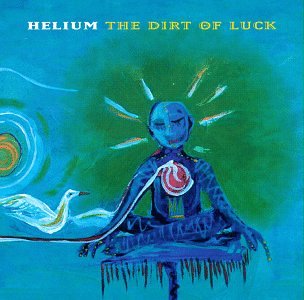
SOUNDTRACK: HELIUM-The Dirt of Luck (1995).

Mary Timony fronted Helium for a few years.  In that time she was recognized as something of a guitar wizard–not in her speed and flash, but in the weird sounds she conjured from the instrument.

She also had very peculiar musical sensibilities (these songs are quite odd) and a cool feminist attitude.  This album features the amazing song “Superball” (one of the best songs of the mid 90s–check out the video and watch the guitarist playing the strings with a screwdriver!  Man I miss the 90s) as well as a number of unpolished gems like “Medusa” and “Pat’s Trick” (the dual vocals are very cool and the dispassionate “oh oh oh” is very interesting, plus I love the lyric about “long-ass curly hair”).

Her singing style is often quite slacker-y, like in the opening of “Medusa”–she’s not always audible, and she often seems like a kind of buzzy sound more than a voice.   She sounds like she’s singing from very far away–seemingly powerful and yet quiet at the same time.

But combine that with the cool scratchy/noisy guitar sounds she gets and she’s pulling off a very cool combination (think Dino Jr without the hooks and killer solos).

Like “Baby’s Going Underground” features some crazy shoegazer guitar washes for most of its 6 minutes which really changes the pacing of the record.  There’s also the great “Skeleton,” a riff so cool that Sonic Youth used it for “Sunday.”

She also has a way with haunting melodies as on the piano  instrumental “Comet #9” and on “All the X’s Have Wings” which sounds very medieval. I think of Timony as a guitarist and yet there is there are lots of keyboards on the album too–mystical keyboards that are fascinating and seem out of character with the guitars, but actually work quite well.   But the prettiest song is “Honeycomb.’  It’s a sweet song with a wonderful melody.  It is followed by the ender “Flower of the Apocalypse” a guitar-based instrumental that is mostly feedback but is also surprisingly melodic.

Helium had mild accolades back in the 90s.  They released a couple of albums and then Mary Timony went solo.  It’s nice to have her playing now with Wild Flag.

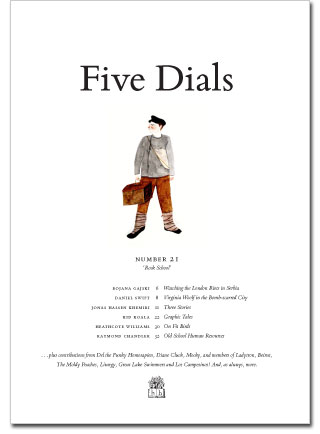
[READ: November 11, 2011] Five Dials Number 21

This is the first issue of Five Dials that I was ready to read when it was sent to me (I’ve been all caught up for a while now).  So that’s pretty exciting!

I was tempted to say that i enjoyed this issue more than other issues, but I have enjoyed most Five Dials issues equally.  But this one is definitely a favorite.

CRAIG TAYLOR–A Letter from the Editor: On Turning 21 and Thinking About Rock Stars and Greece.
The magazine introduction jokes about them now being legal to drink in the U.S. and also about now being old enough to run for M.P. in England.  He also tells us about their “new” section Our Town, which has vastly expanded in this issue.  He also explains that there are many rock stars on hand to give the magazine tutelage (authors that the rock stars enjoy) and three short stories.  He ends with a notice that they have gone to Greece where they are gathering material for Issue 22. (more…)

Read Full Post »

« Newer Posts - Older Posts »