Feeds:
Posts
Comments

Archive for the ‘Translators’ Category

alansSOUNDTRACK: DO MAKE SAY THINK-Do Make Say Think [CST005] (1999).
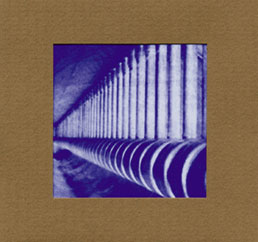
cst005web This album was self-released in 1997, but then the guys at Constellation took it and released it in a beautiful package in 1999.  And Constellation did it right: CD gatefold jacket made from 100lb. textured uncoated cardstock with foil-embossed text and window cut.  Three different two-sided duotone insert cards can be interchanged to show through the front cover window cut. Snazzy!

So this album was recorded in two different locations and it feels a bit more like  compilation of their songs than an album proper.  This doesn’t detract from the music at all, it’s just not as cohesive as their later releases.

“1978” has a raw sound.  It builds slowly, with waves of sorta static getting slowly louder for the first minute. And then the drums kick in. They sound very “live” and crisp. There’s a jazzy pattern accompanied by an unusual bass line.  At 3 minutes a big guitar riff breaks up the droning feeling as it rocks out and then disappears just as quickly.  There’s some saxophone and trippy headphone panning going on, too. This sets in motion a more funky bass line that runs like a lead instrument through the proceedings. There’s some noise bashing around at 8 minutes and a even wah wahed guitar solo at 9.  These occasional disruptions give an interesting melodic sense to this otherwise droney (in a good way) 10-minute song.

“Le’espalace”  feels a little warmer.  It opens with some analog synth trippy sounds and a pretty guitar riff. This is a lovely song that meanders around. The song gets more dense with a synth taking over the guitar line and another synth playing a contrasting melody, too.

“If I Only…”  is 7 minutes long.  It also has a rawer feel.  It’s more staccato with keyboard notes propelling the song forward. There’s a trippy middle section with a nice drum breakdown. It stops at about 5 & a half minutes and resumes with a fuller sound as it rides to the end.  “Highway 420” continues with that more raw sound.  It opens with washes of synths like Tangerine Dream or something.  There’s also a slick guitar line that begins about 3 minutes in.  It’s all rather atmospheric.

Do Make Say Think have always had a bit of jazz at their roots.  That’s evident in “Dr. Hooch” which has jazzy cymbals and slow atmospheric guitars.  About half way through, a wild synth riff comes in and takes over the song for a minute or so before returning to the atmospheric sound.

“Disco & Haze” is a warmer song that slowly builds with a spacey keyboard section.  Around 3 minutes in (of 9) a wah-wah’d guitar takes over—seemingly unrelated.   At 5 and a half minutes the song crashes into a big noisy “chorus,” probably the loudest thing on the record. There’s a noisy skronking sax solo to accompany this as well and it ends with washes of keyboards.   It really sounds like nothing else on the record.

“Onions” is only 90 seconds long.   It’s a simple keyboard riff with echo and little variation.  It’s an odd inclusion but maybe serves as a palette cleanser before the nearly 20 minute final song.  “The Fare to Get There” is warm with spacey keyboard washes and occasional woodwinds–there’s even flute at the end.  It’s 20 minutes long so just sit back and let it unfold over you.  Around 5 minutes in, eerie and spooky drums begin.  Then there’s some reverbed guitar chords and echoed notes which keep the song going.  About three-quarters of the way through, they add a simple guitar riff that continues for several minutes. With a couple of minutes left the song introduces some flutes as it mellows it way to close.

This is a pretty impressive debut.  The band knows the sound they are going for and they definitely achieve it.  Later records are more consistent (and consistently better), but this (especially the opening track) is a great place to start with this band.

[READ: February 7, 2016] Alan’s War

One of the things that First Second hoped for in their ten-year anniversary was that people might read books that they wouldn’t normally.  And boy was this ever one.  The title didn’t sound very appealing to me–I don’t really like war stories all that much.  And frankly I didn’t even know what to expect from the story, really.  Certainly not what I got!

This is the story of a man named Alan Cope.  And the origin of the story is as fascinating as the story itself (almost).  Turns out that Emmanuel Guibert met Alan Cope in the street in France.  Guibert asked the older for directions in June of 1994. Cope was 69, Gilbert was 30. They struck up a conversation.  And soon after, Cope began telling of his experiences in World War II.  What happened to him during and after the war and why this American solider now living in France.

Guibert asked if he could draw the stories that Cope was telling him and Cope said yes.  So this is a story of World War II but it is unlike any story I have ever read.  There is very little in the way of “familiar” WWII stuff in it.  Cope wasn’t in any of the major battles, he never came under heavy fire.  Rather, Cope had a fairly easy war, but he had a ton of stories that were interesting, funny, sometime unbelievable. And the number of famous people he encountered is pretty surprising.

I enjoyed this story so much.  On a side note, My father was in WWII and he also had a fairly easy war, although he was in the Pacific, he was on a small island that saw no action..  I wouldn’t say he enjoyed the war, but he came out with good experience and good friends, which is what Cope did, too.  My fathers stories were far less amazing than Cope’s, but it goes to show that everyone has interesting stories and that no amount of film or history channel commemoration will ever cover everyone’s story. (more…)

Read Full Post »

june2015 SOUNDTRACK: WOLF ALICE-Tiny Desk Concert #503 (January 22, 2016).

wolfaliceI have been really enjoying Wolf Alice’s album My Love is Cool. It has many familiar elements of shoegaze and grunge but it’s played in different and unexpected combinations.  The album is moody and at times abrasive. But there are some lovely melodies underneath these songs.  (They were originally a folkie band before going electric).

So this Tiny Desk Concert plays to their origins (all of five years ago).  And they really change their songs for this set.

“Fluffy” on the original has noisy guitars and some great stop starts and big screams.  They really, really slow it down for the set.  They remove the abrasiveness, sing delicately (with the drummer providing backing vocals), and for the chorus of “sixteen, so sweet” they actually whisper it.

On record, “Turn to Dust” is pretty and soaring and very moody.  This version is quite folky.  I prefer the original but I really like this version especially the way you can really hear the interesting lyrics. Also, Ellie’s voice is quite lovely with no effects on it.  They even hit Bob’s gong at the end.

The recorded version of “Bros” is upbeat and somewhat poppy.  This acoustic version takes on a similarly upbeat feel but in a very different style.  It feels like a real folk song and works surprisingly well in this context.  I love the ending that they take onto it which make it even prettier.

I enjoyed this set a lot, even if it took me two listens to recognize two of the songs.  But I didn’t really enjoy the band members all that much.  I’m going to assume they were nervous rather than disaffected.

After the first song the bassist casually asks, “How’s everyone doin?  Good?” and when everyone chuckles, he says, “That’s the end of that banter,” which is pretty funny (and makes Bob laugh out loud), but it proves to be true.  And it takes Bob to break the silence (while the guitarist tunes).  Bob tried to barter with the drummer for his shirt, which gets them to admire the strange things around the office.  Also singer Ellie Roswell seems really strangely uncomfortable looking at he ceiling quite often, which seems very unlike the cocky persona she puts on in her videos.  But the music is great, so that’s okay.

[READ: January 10, 2016] “Lip Service”

“Lip Service” is an excerpt from Hilbig’s book I which was translated from the German by Isabel Fargo Cole.

This was a strange story which is all about perception.

It starts “Most of W’s perceptions were acquired by looking from outside into the interior of lighted dwellings.”

He would watch people talking but he could barely hear them.  And so he learned how to perceive what was going on and how unimportant the actual words that people said could be.

And he really enjoyed the non-gratification this afforded–the idea of being a voyeur who never completes his quest. (more…)

Read Full Post »

1182016SOUNDTRACK: DAMIEN JURADO–Tiny Desk Concert #114 (February 28, 2011).

damienI had always assumed that Damien Jurado was someone else entirely.  I had no idea that he was (as the blurb describes him) “a big dude playing sad songs.”

And he is.

For this Tiny Desk it’s just him and his guitar.  He keeps his eyes closed tightly as he sings these sad songs.  His guitar playing is simple–just strummed chords and his voice is simple as well–there’s no tricks.  It’s all about his songwriting.

I liked all four of these songs: “Cloudy Shoes,” “Newspaper Gown” (that was my favorite), “Arkansas,” and “Beacon Hill.”

The strangest thing about him was how uncommunicative he seemed to be–almost nervous.  He barely spoke and when he did it was hard to hear.  And as soon as the set was done he immediately stood up to leave.

Although he does say it’s “nice.”

His songs were lovely although I don’t think I’ll be seeking him out anytime soon.

[READ: January 12, 2016] “The Story of a A Painter”

This story was translated by Anna Summers and, as the title suggests, it is about a painter.

But this story delves into surreal territory pretty quickly.  It may even be a fairy tale as the opening line is “There once lived a painter….”

This painter has had some bad fortune as of late.  His landlord promised to get him a lot of money if he would sell his large apartment.  But the landlord sold the place and kept the money (a lawsuit is pending).  Then the landlord offered him a place under the stairs–no running water–which the painter accepted.  But he can’t pay the landlord, so the landlord gives him grief every day.

On another day a man asked if he would rent him his “apartment.”  The painter said yes for money up front.  The man gave him the money then moved his entire family into the tiny, below-the-stairs place and planned to never leave.  Now the painter was destitute and homeless. (more…)

Read Full Post »

dq25SOUNDTRACK: ARCHER PREWITT-“O, KY” (2005).

wikldernessArcher Prewitt formed The Coctails (a kitschy lounge act) in the early 90s, several years before the lounge revival.  Then he joined The Sea and Cake and has been making amazing music with them.  And he has also released several solo albums.

He has also published some comics (Sof’ Boy) with Drawn & Quarterly.

This song comes from his album Wilderness.  The title of the song is clever, too.

It’s upbeat and folky with a little psychedlia and rock thrown in.  I like Prewitt’s voice quite a bit–it’s simple but really strong.  But the selling point on this song (and others from this album that I have listened to) is the composition and arrangement of these songs.

I like the way this one goes from simple guitar to orchestration (although presumably not a real orchestra) for the chorus.  And how post chorus there are flutes and other instruments to pick up the momentum which adds a vaguely psychedelic feel to it.

At four minutes (the song is five) it changes direction entirely and turns into a nearly new song with big guitars and drums. And it rather rocks.

And just to make Archer the all around dude that he is.  He also drew the cover art.  Jeez.  He’s probably super nice and friendly, too.

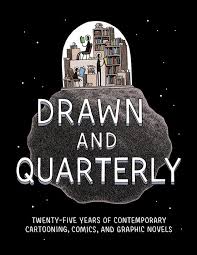
[READ: January 3, 2016] Drawn and Quarterly: Twenty Five Years 

I have liked a lot of D+Q books for a long time, although I never really considered a comprehensive look at their publishing house.  This book–about 775 pages long–is about as comprehensive as it gets.

This book contains a few previously published cartoons and excerpts as well as a whole slew of previously unpublished pieces.  There are essays and histories and reminiscences and love love love for the little Montreal graphic novel publisher.

I didn’t know much about the history of D+Q–that Chris Oliveros started the publisher in 1989 out of his house.  That he was the only employee for years.  And that he was essential in getting the term “graphic novel” used by everyone–including the library of congress!

He weathered distribution problems, he weathered the rise and fall of indie comics in the late 90s and he has come through with some of the most beautiful books published.  D+Q has also brought attention to foreign artists as well as out of print artists.

Really, if you have any respect for graphic novels (that aren’t superhero-based) you owe thanks to D+Q. (more…)

Read Full Post »

rhineSOUNDTRACK: HMSTR-Tiny Desk Concert #413 (December 24, 2014).

hmstrThe only thing I could think of to pair with a complete telling of Wagner’s Ring Cycle (aside from the entire thing itself, which… forget about it), was the smallest, most inconsequential music I could find.

Enter HMSTR.

HMSTR played the Tiny Desk Christmas show in 2014.  And really, they must be seen to be believed.  Not because they are spectacular, but because the joke isn’t really very funny if you just listen to the music.

Starting with some bizarre synth sounds, after 20 seconds the songs bursts into a lo-fi punk anthem.  It’s all buzzing guitars and a simple synth over some majorly lo fi drums.  There’s even a somewhat catchy “chorus” section.  After a minute, the guitars fade and sleigh bells signal the end of the song.

So whats the joke?  See for yourself

All in a tiny Tiny Desk setting.

[READ: May 20, 2015] Richard Wagner’s The Ring of the Nibelung

Yes, this is a massive graphic novel depicting Wagner’s “Music Dramas.”  The text was translated by Patrick Mason and then Russell adapted the whole thing to fit his story.

Everyone loves “Flight of the Valkyries,” but hardly anyone has listened to the entire Ring (it’s 4 operas and 15 hours long).  Except for the Bugs Bunny version, of course.  I have been interested in the Ring for a long time, but I wasn’t willing to devote that much time to it either.  So this book is perfect. (more…)

Read Full Post »

zambraSOUNDTRACK: NICK BUZZ-Arnold Schoenberg and the Berlin Cabaret (2003).

schoenIn 1901, Arnold Schoenberg wrote eight Brettl-Lieder (Cabaret Songs).  The songs were short and fun with naughty (cabaret influenced) lyrics.  Some 100 years later, inspired by the Art of Time Ensemble who commissioned Nick Buzz to play pieces for their Schoenberg show.

So the guys from Nick Buzz got together and recorded four of the eight pieces.  Then Martin Tielli released this disc as number 2 of his Subscription Series.  Some of us were a little disappointed when this came out since it was only 15 minutes of music, but the art is wonderful and I have recently rediscovered this disc and have enjoyed it immensely.

Basically the Buzz guys have interpreted the songs in their own style, but they have remained faithful to the original melodies and lyrics (which were in German but are now in English).

“Gigerlette” explores electronic manipulations (presumably by Hugh Marsh) and offers lots of fun samples (what I assume is some earlier recordings of the song in German).  It opens with sampled female singing and staccato piano as well as other unusual effects. Then Martin’s vocals come in and the effects clear out and the song becomes simple piano ballad for a brief moment.  Then the noises come back in again, playing around with this amusing song.  It’s a song of romance and love with the sweet punchline being that cupid is driving their coach and four.  At over 5 minutes this is the longest song by far, even if the basic song is just over two minutes.

“Der genugsame Liebhaber” (The Modest Lover) opens with what sounds like a distorted harp (presumably the piano) and scratchy records (from Marsh).  This song is about a man going to see his lover, but his over’s pussy loves his bald head so much that she continually climbs atop it.  It is charmingly naughty. There’s some wonderful violin from Hugh Marsh on this song

“Galathea” is the most conventional of the three songs.  A lovely piano ballad to Galatea.

“Arie aus dem Spiegel von Arcadien” (Aria from the Arcadian Mirror) is super fun. The music is weird and goofy with a very drunken feel.  And the chorus is just wonderful “my heart begins to thump and dance just like a hammer’s blow it goes boom boom boom boom boom boom boom boom boom (getting faster and faster).  I’ve listened to the original and it is very much the same, although Nick Buzz’s version is much better.

You can find some of these songs on line from a recording at Lula’s Lounge (Dec 9, 2010)

It’s cool to see how they recreate the album so faithfully in a live setting. It’s only a shame that the video isn’t a little closer so you could see just what they are doing.

Nick Buzz-December 9 2010 Lula’s Lounge

[READ: September 1, 2015] My Documents

I have enjoyed some of Zambra’s stories in other locations, so I was pretty excited that McSweeney’s released this collection (translated by Megan McDowell).  The book is pretty much all short stories, although the first items feels a bit less fictional and more memoirish.

“My Documents”
This is a brief historical account of Alejandro as a child and as a writer.  He talks about when he started working on computers and what happens when the computer dies with the information inside.  He explains that this file is in his My Documents folder and he’s going to publish it “even though it’s not finished.  Even though it’s impossible to finish it.”

“Camilo”
I read this story in the New Yorker.  It concerns the relation of a man and his godfather, whom he has not seen since his father and godfather had a falling out years ago.  See my link for a more complete synopsis.  I enjoyed it just as much the second time.

“Long Distance”
The narrator worked as a phone operator in 1998.  He liked the job–his boss was cool and would let him do anything he wanted so long as he answered the phones quickly. The job was in a travel insurance office and one day he received a call from a man named Juan Emilio. After speaking for a time about various things, the narrator realized it had been 40 minutes since they first started talking.  They were expected to call clients back 14 days later as a follow-up and this time Juan Emilio talked with him foe a while and, upon learning that the narrator studied literature, asked if they could meet and discuss books.   The narrator was already teaching classes at night, and these two situations overlapped somewhat.  I loved the way all of this information is used as backdrop to a romance he has with a student known as Pamela.  And the final line is great.

“True or False”
The titular phrase is uttered by a boy, Lucas,  who declared, based on an inscrutable internal feeling, that things were True or False.  An armchair might be true, while a lamp might be false.  Hid father Daniel had a cat, Pedra, even though pets were forbidden in his building.  Lucas loved the cat.  Then the cat had kittens.  There is a metaphor at work about the fatherless kittens and Daniel’s own behavior toward his son. I really enjoyed this story and the strangeness of the true or false brought a fascinating childlike quality to the story

“Memories of a Personal Computer”
The conceit of this story is great.  A PC remembers what it was like to observe a relationship as it begins and then ebbs–and how the PC was moved around into different rooms as things changed in the relationship.

“National Institute”
At the school where the narrator went, they were called by number.  He was 45.  The main subject of his story was 34, although he doesn’t know the boy’s real name.  34 had failed the grade and was made to repeat it, but rather than being sullen about it, he was popular and fun.  All of the students were worried about failing–the final test was very hard.  But one day 34 approached 45 and told him he had nothing to worry about.  The other students didn’t know what to make of it, but he slowly assessed everyone and told them whether they had anything to worry about.  By the end of the story, when 45 is brought to the inspector of schools, he is told a lesson he will should never forget.

“I Smoked Very Well”
A look back on smoking and how quitting smoking made him a different (though not necessarily better) person.

“Thank You”
She is Argentine, he is Chilean and they are not together (even though they sleep together).  They were in Mexico City when they were kidnapped together.  The incident has unexpected moments. It’s a weird story (with some really unexpected moments) but a really good one.

“The Most Chilean Man in the World”
A Chilean couple has decided to separate once she was accepted to school in Belgium.  After several months he is convinced that she wants him to visit, so he spends a ton of money and heads out to Belgium.  Without telling her.  And it goes very badly.  But he can’t just leave Belgium, now can he?  So he goes to a pub where he meets some new friends who call him the chilliest man in the world.  The story hinges on a joke, but the story itself is not a punchline.

“Family Life”
I read this story in Harper’s.  I thought it was fantastic–it was one of the stories that made me want to read more of his works.  This is story of a man house sitting and the false life that he constructs around him.  It was surprisingly moving.

“Artist’s Rendition”
I loved the way this story began.  It tells us that Yasna has killed her father.  But we slowly learn that Yasna is character in a detective story that an author is trying to write.  We learn how the author constructs details about this character and the things that she has experienced which make her who she is.  As this story unfolds we see how those first lines proved to be true after all.

This was a great collection fo short works and I really hope to see more from him translated into English.

Read Full Post »

dispossesSOUNDTRACK: YOLANDA KONDONASSIS-Tiny Desk Concert #96 (December 8, 2010).

yolandaI have mentioned a much more recent Tiny Desk concert from Yolanda Kondonassis in which she duetted with Jason Vieaux (from 2015).  This show is just Kondonassis and her harp.

And it is absolutely gorgeous.

Kondonassis plays three distinct styles of music to show the variety of music a harp can make.  It is amazing to watch her play as well.  She closes her eyes and simply knows where everything is, absorbed in the music.

Her first piece is by Domenico Scarlatti: “Sonata in A Major, K. 208,” which is considered a rather “traditional” harp piece (I love hearing her do the “fast notes” a the end of each section.

She introduces the second piece by saying that she wanted to compose a piece and through meeting a Chinese composer wound up arranging this traditional Chinese piece called “Small River Flowing.”  And it is amazing to hear the Chinese melodies immediately from the high notes.  But perhaps my favorite part of this song is that she hits the low bass notes to make them ring out almost like a gong.  I have never seen anyone do this before with a harp.

She says the final piece is by Carlos Salzedo: “Chanson dans la nuit” which crosses over into almost world music.  And in a short time, it really shows off all of the different sounds and colors that the harp is capable of.  She’s absolutely right.  While the song begins with some very traditional sounding harp music, she seems to also play some harmonics (who even knew you could do that on a harp) as well as some sounds of just her nails running across the strings–bringing a fascinating texture–as well as some very fast, loud chords and indeed, actual percussive sounds as she taps on the body of her (truly beautiful looking) harp.  The song is not as pretty as the others since there is so much going on, but it’s a wonderful song and it’s great to watch her play it.

I never knew I wanted a CD of harp music before, and now I do.

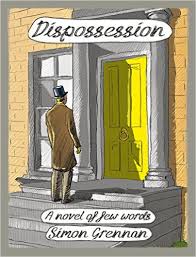
[READ: November 12, 2015] Dispossession

This graphic novel has a fascinating origin.  It is based on the novel John Caldigate by Anthony Trollope.  And in fact, it follows that story pretty faithfully.  However, it eschews massive amounts of the book (the original is quite long) and also adds a subplot of Wiradjuri peoples (which includes dialogue in Wiradjuri translated into English by Cheryl Riley).  There’s also a Postface (which is very helpful for explaining the origin of the story and how Grennan modified the original) by Jan Baetens and Ortwin de Graef.

The subtitle, A Novel of Few Words, proves to be accurate.  For the most part, each page has six panels, and the only words are sparse dialogue.  Grennan really has the story move quickly through these images, which tend to jump ahead pretty quickly.

We first meet John Caldigate.  Caldigate is a wealthy man, soon to be heir to his father’s fortune.  But he is unsatisfied in England.  And he decides to sell off his inheritance and to set off for New South Wales with his friend Ned.  There they will seek their fortune in the gold mines.

There is a woman he has left behind, Hester, the daughter of a local family.  She is certainly desirable, but it’s unclear how Caldigate feels about her because he wishes to find his fortune elsewhere.

Then the men set sail for Australia, two bachelors on a lengthy sea voyage.  Aboard the ship is Mrs Smith, a divorced actress who is also heading to Australia.  Mrs Smith is considered somewhat disreputable aboard the ship–and several people warn him against her.  But he cannot be denied. (more…)

Read Full Post »

sing no evilSOUNDTRACK: STILE ANTICO-Tiny Desk Concert #86 (October 25, 2010).

stile I’ve said before that one of the great things about the Tiny Desk Concerts is being introduced to bands that I never would have heard of anywhere else.  And that is certainly true of Stile Antico.  I really enjoy this kind of a capella music, although I never listen to it.  And I wouldn’t even know where to start looking for it.

So, lucky for me, I now know a band that performs gorgeous 16th-century choral music.  There are twelve singers.  And it is comforting in this day of pop singers who are more hot than musical that Stile Antico is all about the voice.  They don’t dress flashy or sexy, they don’t really do anything…except sing to the heavens.

They perform four pieces in about 20 minutes.  I don’t know any of them and I honestly couldn’t really tell them apart, but I loved the whole show.

The lead speaker (unnamed in this show) says that William Byrd is the best songwriter of the era, which is why they do two of his songs.  After the first one, he says that they want to transform this office into some kind of Tudor Chapel.

The second piece, “The Lord’s Prayer” is not done in any melody that I have ever heard it (and I assume it is in Latin).

But it’s the final piece that is really the showstopper, and the one that is fun to watch (even though, as I say they’re not actually doing anything–okay not true, they are nodding to each other instead of using a conductor).  Praetorious’s piece weaves 3 choirs together with 12 independent voices.  And the speaker jokes that each of the three choirs wind up flirting outrageously with each other.  It’s breathtaking.

Their voices are simply beautiful, and it’s amazing to see them working together silently as they sing.

The only problem is that now that I know who they are, which of their 11 records do I start with?

The songs:

  • William Byrd: “Vigilate”
  • John Sheppard: “Lord’s Prayer”
  • William Byrd: “Ecce Virgo Concipiet”
  • Hieronymus Praetorious: “Tota Pulchra Es”

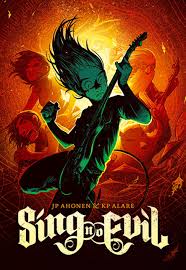
[READ: July 10, 2015] Sing No Evil

I saw this book at the library and loved the title.  As soon as I flipped through it I knew I had to read it.  This book was originally written in Finnish (cool!) and was translated by JP Ahonen into English.  It is all about Fininish death metal bands and the devil.  And it is cool and very funny.  It was originally called Perkeros (which is what the protagonist’ band is called) and which I can’t quite define, but that’s okay.

The book opens on Aksel rocking out (in his imagination).  He and his band are getting ready to go on stage and he is nervous.  Aksel is a perfectionist and his riffs and progressions are second to none (Perkeros is a progressive death metal band which I’d rather like to hear).  The problem for the band is that Aksel’s singing is poor.  But the band likes what they do.  So they keep playing.

Here’s the fun part.  The band consists of Aksel and Lily on keys (and here I have to comment that Lily and Aksel don’t look all that different in drawing style but somehow Alarea has made these simple lines create two very different looking characters, and with those simple lines you can see just how pretty Lily is).  There’s also Kervinen, a really old guy with a chest-length beard (he used to be a monk), and, well, a bear, yes, a bear, on drums (the bear’s story is never given).

The band is opening for Nelum Lucifera, a grease-painted death metal band (with names like Belphegor and Samael).  A fight ensures and the bands are banned from every playing that gig again. (more…)

Read Full Post »

borgesSOUNDTRACK: SEU JORGE-Tiny Desk Concert #79 (September 13, 2010).

seuSeu Jorge was the melancholy singer in Wes Anderson’s movie The Life Aquatic With Steve Zissou. He sang the David Bowie songs and was amazingly soulful and brought a completely unexpected quality to the Bowie songs.

He plays these five songs with his band Almaz.  For reasons unclear to me only one of the songs is on the video, but the other four are available in audio format.

He sings three songs in Portuguese, and his voice is husky and passionate, so even if you don’t know what he’s singing about, you can feel the emotion.

The first song in English “Everybody Loves the Sunshine” has a cool trippy 70s vibe, with some cool keyboards.  Although I don’t love his version of “Rock with You” which I imagine was super fun to sing, but it’s so different from the Michael Jackson version that it’s hard to reconcile the tow.

  • Cirandar” (Audio Only)
  • “Saudosa Bahia” (Audio Only)
  • “Everybody Loves The Sunshine” (Audio Only)
  • “Pai Joao”
  • “Rock With You” (Audio Only)

[READ: October 19, 2015] The Last Interview and Other Conversations

I have never really read any Borges (a piece here and there sure, but I have his Collected Fictions waiting for me and just haven’t gotten to it. However, when I saw this book at work I decided to give it a read. I have very much enjoyed the other books in The Last Interview series (there are ten and I have read four) so I thought I’d like this too, and I did.

Borges is a fascinating individual. He was legally blind from a youngish age and was completely blind by the time of the last interview. He was humble (but not exactly humble—he genuinely didn’t think he was that great of an author). He was a pacifist (remaining neutral even in WWII) and basically spent his whole life immersed in books.

This book contains three interviews

“Original Mythology” by Richard Burgin (from Conversations with Jorge Luis Borges, 1968)

“Borges and I” by Daniel Bourne, Stephen Cape, Charles Silver (Artful Dodger 1980)

“The Last Interview” by Gloria Lopez Lecube (La Isla FM Radio, Argentina, 1985) [translated by Kit Maude] (more…)

Read Full Post »

tsugeSOUNDTRACK: MOPS-“White Rabbit” (1968).

mopsAfter totally grooving on The Mops’ songs in yesterday’s post I decided I had to check out their cover of Jefferson Airplane’s “White Rabbit.”

And, boy do I love it.  It came from their debut album Psychedelic Sound in Japan which was released in 1968 (“White Rabbit” came out in 1967).   The album also includes covers of “Somebody to Love” by Jefferson Airplane, “Light My Fire” by The Doors and two songs by The Animals.  They received much press for being the “first psychedelic band” in Japan, and performed with elaborate light shows.

Lead singer Hiromitsu Suzuki really nails all the notes (even if he doesn’t quite nail all the words), but I especially enjoy the instrumentation they employ–the violin is an interesting addition.  And the way the instruments are separated in headphones (all drums in the right ear?) is really psychedelic.

It is really a trippy version (“Somebody to Love” is pretty fine too, especially when the really buzzy guitar kicks in about half way through).

Trash Market

Tadao Tsuge is a Japanese cartoonist considered “one of alternative manga’s cult stars.”  He has been making cartoons since 1959 and has contributed to all manner of Japanese publications.

What seems to set him apart from other cartoonists (according to the interviews and such that fill out the book) is that Tadao grew up in the slums of Tokyo and is willing to write about them.  He also worked for many many years at a blood bank (one that paid people for their blood).  It was there, amid the terrible conditions, that he believes he contracted hepatitis.

The amazing thing to me while reading these six cartoons (which I assume are only a tiny fraction Tadao’s total output, but I’m not sure) is that I had no idea when they were written–they have a timelessness that is really amazing.  So when I finally flipped back to the front and saw that the first story was written in 1968, I was blown away. (more…)

Read Full Post »

« Newer Posts - Older Posts »