Feeds:
Posts
Comments

Archive for the ‘Translation’ Category

pettySOUNDTRACK: “WEIRD AL” YANKOVIC-“Now That’s What I Call Polka” (2014).

npwpolkI knew that Al wouldn’t make a video for his polka medley (always a highlight of his albums).

I was surprised that I knew so many of these songs (on the last album I knew hardly any of the apparently huge songs that made up the medley).  So either I listen to more mainstream music now (or, perhaps I have kids who know more mainstream music) or the music was just much huger this time around.

This batch includes: “Wrecking Ball” by Miley Cyrus “Pumped Up Kicks” by Foster the People “Best Song Ever” by One Direction (I didn’t know this one, and I crack up at the childish way he makes the “best song” sound like gagging) “Gangnam Style” by Psy “Call Me Maybe” by Carly Rae Jepsen “Scream & Shout” by will.i.am featuring Britney Spears (I didn’t know this one) “Somebody That I Used to Know” by Gotye featuring Kimbra (I can’t believe how different this one sounds) “Timber” by Pitbull featuring Ke$ha (I didn’t know this one) “Sexy and I Know It” by LMFAO (or this one) “Thrift Shop” by Macklemore and Ryan Lewis featuring Wanz (or this one, amazingly) “Get Lucky” by Daft Punk featuring Pharrell Williams.

It’s in these medley’s that Al’s lyrics are the most graphic, because he’s actually singing other pop lyrics, not his own.

It’s always fun when he sings this live because he matches up the original videos to his new sped-up tempo.  Looking forward to Mandatory Fun Live in 2014 (or 15).

[READ: August 3, 2014] Petty Theft

I was intrigued by this story because of the strange cover art–two people in a book store–a hunched over guy and a pretty girl–both reading books.

The story is about Pascal.  He and his long time girlfriend have broken up and he is in a hellish limbo. He’s staying in a friend’s spare room and he is not drawing anymore.  In fact, he’s looking for a major change in his life–the whole cartooning thing isn’t working out for him.  The only comfort he has left is running, but on his last run he hurt his back and has been laid up practically immobile for weeks.

He goes to the chiropractor who helps him out some (although it hurts him as much as his back already hurts).  But she tells him that he cannot run for a couple of months.  He is despondent.  So he decides to go to the bookstore, his favorite local indie shop of course, and look around.  While he’s looking around he sees a girl pick up his own book (Bigfoot)…and steal it.  He is offended and intrigued at the same time.  He tries to follow her but loses her in a crowd.  And now he has to decide what to do.  Especially since he hears the clerks talking about how many books have gone missing lately.  And because he thinks the girl is really cute (and she likes his book!) (more…)

Read Full Post »

karl2SOUNDTRACK: BRASS BED-Tiny Desk Concert #339 (February 24, 2014).

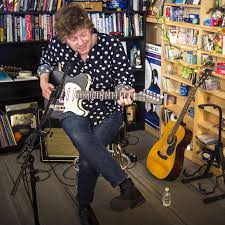
brass bedI expected Brass Bed to be a goofy band because of the snapshot image of them singing into toy microphones.  I was initially disappointed by how normal they were, but I was soon won over by their interesting floating sound. They have this overall trippy underwater vibe (which seems to be accomplished by a bowed slide guitar). This is especially notable on “Yellow Bursts of Age” their best song in the set.  Later the guitar solo is echoey and also underwatery. It’s a very wild sound for a fairly simple song.

They tell a funny story about being from Louisiana and encountering Washington DC snow and (of course) not having an ice scraper (although they did have bag of sand).

“Cold Chicory” is an upbeat sounding song musically although it is kind of a bummer lyrically, but again there’s the great sound of the bow on the slide guitar and the echoey lead guitar. “Please Don’t Go” is a slow song—with more interesting effects from singing into that slide guitar.

The plastic mikes do come out in the last song “Have to be Fine” in which they sing into the echoey mikes for the intro (with very nice harmonies).  They sing the intro for about a minute, and then the slide guitar player takes lead vocals on this simple but pretty song (I don’t know any of their names).

At the end, the NPR folks gave them an honorary NPR ice scraper.

[READ: June 24, 2014] My Struggle Book Three

boyhoodI read an excerpt of Book Three just a few weeks ago.  And in the post about it I said I wouldn’t be reading this book for quite some time.  But then the book unexpectedly came across my desk and I couldn’t resist grabbing it while it was here.  So it appears that I will now have to wait well over a year before Book 4 (which is, I think about 1,000 pages–yipes).  I also see that Book Three is fully called “Boyhood Island” in Britain.

At the end of Book Two, Karl Ove was more or less caught up to the present–writing about what he was then up to (with a few years gap, of course).  So it makes sense that this book is about his childhood–showing us how he came to be the man he is.

The book, amusingly enough, starts off with memories that he cannot possibly remember, and he even says as much.  He is using memories of his parents and piecing together pictures from when he was an infant.  In 1970, (Karl Ove was born in 1968) his family moved to the island of Tromøy tromo(and check out the idyllic picture that Wikipedia had).  This is where Karl Ove spent his (rather traumatic) formative years.  Their island is small, so he knows everyone in his school, but there are some amenities around like the Fina station and the B-Max, and there’s lots of soccer to be played and bikes to be ridden.

Things seem normal at first–he runs and plays with his friends, there is ample green space to run around in, and they have boats to sail on.  And we meet two of Karl Ove’s earliest friends: Geir and Trond (so many people are named in the book, I’m very curious to know if any of them remember him).  In an early scene they chase the end of a rainbow looking for a pot of gold (and have a discussion about what happens to it when the rainbow vanishes (the boys even play a prank on Karl Ove that they actually found the pot,a dn while he doesn’t initially fall for it, he is compelled to go back and they tease him).

But the looming figure here and throughout the book is Karl Ove’s father, who, at least according to Karl Ove’s memory, is pretty much a monstrous dick.  He is demanding and exacting, unforgiving and seemingly uncaring.  He is either bipolar or a drunk, jumping from goofy to outright rage in a mater of seconds.  Karl Ove and his brother Yngve fear him unconditionally and, by the end of the book they both seem to hate him.  The scene where their dad tries and fails to teach Karl Ove to swim is heartbreaking, especially when the dad goes home and tells their mom right in front of him “He’s frightened of water.”  There are dozens of instances of fear and intimidation (often accompanied by a wrenching of Karl Ove’s ear).  Like when Karl Ove turns on the TV for his grandparents (he wasn’t allowed to touch the TV but he wanted to do something nice for them).  After a few minutes, the TV fizzed out and, naturally, he was blamed for it and sent to bed without supper (after some minor physical abuse). (more…)

Read Full Post »

CV1_TNY_02_17_14Columbo_spine.inddSOUNDTRACK: THE ALLER VÆRSTE!-Materialtretthet (1980).

matThe Aller Værste! were a Norwegian new waves/punk band with elements of ska thrown in.  I only know of them because of this story, but I decided to check out some of their stuff since it is so relevant to the story.

This was their debut album, which has been ranked as the number 6 best Norwegian album of all time (by Morgenbladet, a Norwegian weekly newspaper).  The album opens with lounge piano and trombone before breaking into a ska-inflected “Du sklei meg så nær innpå livet.”  Lead singer Chris Erichsen sings in some unusually deep voices (some of which seem comical) in “Dødelige drifter.”  “Døgnflue” is a two-minute punk blast with a loud Farfisa organ running throughout.

“Bare du som passer på” has a distinctly Clash feel in the vocals.  “For dem betyr det lite” is powered by that organ sound, while “Bare en vanlig fyr” is very guitar heavy (and may have a different singer).  This is probably my favorite song on the album, there’s some great sections in it.

This sound of punk sensibility with a prominent organ (an vocals in Norwegian) really make The Aller Værste! stand out in 80s rock.  “Må ha deg” has some interesting backing vocals and sounds like a Clash inspired ska song (with more crazy vocals).  It has a slow instrumental section with a twangy guitar solo.

“Igjen” is 90 seconds of punk (but not very harsh punk).  The next few songs are all about 3 and a half minutes long.  “Bare ikke nok” has call and response vocals and an unexpected beat.  “Hong Kong” slows the sound down, with a prominent bass riff.  “De invalide” is an upbeat song with horns.  “Hekt” has some dissonant guitar over almost funky bass and a serious breakdown at the end.  “Discodrøv” has very fast drums as it opens, but it turns into a rollicking song with disco bass and big horns.

“Oppvekst” follows those horns with some fast (ska-like) guitars.  “Materialtretthet” opens with some great, wild bass and continues wit a very fast-paced song.  This is another favorite (it’s interesting that the title track is also one of the shorter songs on the record).  “Menneskelig svikt” sounds quite raw, with echoey distant guitars and vocals.  “Blank” is the final song on the album (reissues have added more tracks).  It has a distant echoey harmonica acting as a melancholy sound behind the vocals.

I hope that Karl Ove’s book somehow gets this disc in print, I’d like to listen to it on more than YouTube.

There’s a live version of the song mentioned at the end of the story here:

[READ: June 11, 2014] “Come Together”

I know that this is an excerpt form the third part of My Struggle which I plan to read in say six or eight months.  But I decided to read it anyway in part because I was intrigued by the cover picture, which is of a record sleeve with a man on a bicycle and the wheel is the inner label of an album.  That, coupled with the title “Come Together” made it pretty apparent that this would be about music.   And so it was.

As I said, this is excerpted from Karl Ove’s third book in the My Struggle series, which is called Boyhood.  I’m intrigued that this book is set in his teenage years since the first two were set much later–it actually felt like Book 2 caught us up to the present).  At any rate, this is one small section (chock full of details) about being young and being in love with music and with girls. (more…)

Read Full Post »

flies2SOUNDTRACK: CIAN NUGENT-Tiny Desk Concert #353 (May 3, 2014).

cianCian Nugent is from Dublin.  In this Tiny Desk Concert, he plays two guitars, including a crappy no name electric guitar with a great raw sound.  For the first song, he plays a pretty acoustic guitar instrumental called “Grass Above My Head.”   It has a slow melody that turns into a ragtime jaunt over the course of 6 and half minutes.

The next two songs are on that electric guitar and are both rather different (he says the songs comes from “incoherent range of the mess that is my musical career”).  Before playing “Hire Purchase” he tells a very funny story about getting a pencil from a garage (and that he uses it to keep his string from detuning–does that work?).  This is an electric guitar instrumental, bluesy and mellow with some great riffs.

The final song, “Nightlife” has words.  It’s a simple blues song. Nugent has a nice delicate voice.  I’m not a big fan of bluesy songs, but he does a great job with this and the other two styles.

He also wrote a song called “My War Blues” which is variations on a Black Flag song (I don’t recognize the original in his version, myself).  But you can hear that here.

[READ: June 4, 2014] King of the Flies 2. The Origin of the World

This book picks up right where Book 1 left off.  This edition was also translated only by Helge Dascher although it says she had help from Dag Dascher and Kim Thomspon (I didn’t notice any change in quality).

As this book starts, Eric’s mother is making serious advances with Francis–the man whom she just met but who she is already calling her fiance.  Eric fantasizes about killing him (his dream sequence mother says this is the 13th time he has killed Francis).  Marie and Eric are still together and, through a strange series of events, Ringo is asking Eric to hold on to a cool looking elephant bowling bag.

By the end of this first story, Eric has saved Becker from drowning.  And yet neither Becker nor Karine bothers to thank him.  Indeed, Karine seems even more angry at him.  But this blow off makes Eric want Karine even more.

In a later story we finally meet Karine’s family who are just as freaked out about her “dating” this old guy.  And, by the end of the story Becker has a heart attack and dies.  When she returns home after the funeral she sees Eric and she confides in him that she is pregnant.

The newest development in the book comes in the next story in which we learn that Damien is a ghost and that he visits everyone that he knew.  Some people who are receptive to seeing him can actually talk with him.  He’s obviously pissed about Eric and Sal, but he has come to terms with a lot of things.  He even forgives the man who killed him (by accident).  He also winds up meeting ghost Becker at some point. (more…)

Read Full Post »

flies1SOUNDTRACK: PUBLIC SERVICE BROADCASTING-Tiny Desk Concert #354 (May 5, 2014).

indexI heard about Public Service Broadcasting via NPR and I loved their song “Spitfire,” a rocking instrumental with interesting samples scattered throughout.  Well, it turns out that live, the rock just as hard.  Even though there’s only two of them.  There’s J. Willgoose, Esq. on guitar, banjo and electronics and Wrigglesworth on drums. The samples come from British public-service films from roughly the 1940s through the 1960s.

Watching this video, I was stunned at just how much Willgoose is doing, and just how much noise these two guys can make.  There’s even a video going on behind them.   The only problem here was that the samples were not loud enough.

 “Signal 30” opens with samples and samples and then a rocking guitar and solid drums. It amazing watching Willgoose do some many different things while playing the guitar. The change of tone at the middle of the song is great and I love watching him just bang the guitar to keep the notes going (while he is playing the keyboard).

 After the song, there is a sample of “Thank you very much” in an arch British voice (the duo don’t speak during the show).   “Spitfire” also sounds great hear–the song is surprisingly complex for an instrumental, and for what seems like it might be a novelty band, the song is really solid.  After this song, Willgoose had to fetch something and the talking sample said “talk amongst yourselves!” The final track “Everest” has a very catchy riff and some really great drumming.  But I love most watching Willgoose play the guitar with one hand and play a solo on the keyboard with the other.

This is definitely a band to check out live.

[READ: June 4, 2014] King of the Flies 1. Hallorave

Hallorave is a dark, violent, sexual comic series written by Pirus and drawn by Mezzo.  Both artists are French and have worked together before.  This book was translated by Helge Dascher and John Kadlecek (and it was translated very well–I didn’t realize it wasn’t American until they started talking about Euros sometime in the middle of the book.

So this is actually a series of short stories narrated by different people.  They seem unrelated, but after a couple of stories, you see the connections.  And there proves to be a core collection of characters all living in this suburb (the location is really irrelevant).

The first story starts with Eric (who proves to be the main protagonist) drinking, reading magazines and sitting on a couch on the (dried up and dead) lawn of his mother’s house.  He is also jealous of his best friend Damien because he is very hot for Damien’s girlfriend Sal.

That first story introduces us to a visual that will run through the book: Eric sitting with a giant fly head on.  The three are going to a Hallorave for Halloween.  Eric is King of the Flies, Sal has a giant cat’s head on and Damien is a skeleton.  By the end of the party, they are all high (you can seem them feeding each other drugs in the picture below).  Eric pledged his love to Sal in front of Damien, and Damien is in a foul mood.  He gets in a fight with some other party goers. By the end of the short story, Eric and Sal are having sex (with their costume heads on) and Damien has been hit by a car and killed.  That’s the kind of stories we’re getting here. (more…)

Read Full Post »

CV1_TNY_05_12_14Chast.inddSOUNDTRACK: TIMBER TIMBRE-Tiny Desk Concert #355 (May 10, 2014).

timberI wanted to like this band because I think their name is very clever. But I just don’t enjoy this kind of slow song.  Ten years ago I wouldn’t have even given this a chance, but since I have embraced the Tindertsicks, I have a lot more patience from this kind of music, but I just can’t get into this—it’s way too slow and meandering for me.  They play three songs, “Hot Dreams,” “Run From Me,” and “Grand Canyon.”  The second song “Run For Your Life” has a mellow Elvis vibe (I don’t like Elvis either), and when they break into the staccato guitar chords it sounds like Roy Orbison’s “Running Scared” (Nope, don’t like Orbison either).  I do like the way it builds but it’s not enough to sell the song for me.  And when you get to the lyrics, I’ll just say that the world did not need another song in which the singer calmly says “Run from me, darlin’, you better run for your life.”

[READ: June 4, 2014] “The Fugitive”

I really loved this story by Ulitskaya (which was translated from the Russian by Bela Shayevich).  What I liked about it was that there wasn’t a lot of plot exactly, because it centered on the mind of the “fugitive” who is an artist in Communist Russia and is persecuted for his drawings.

As the story opens, the police have come to his house and question his wife.  They are there for Boris Ivanovich (yes, there is a problem for me with compound Russian names, but I found this was pretty easy to get through after a few pages) because he has made some drawings that put Communism in a bad light (letters made of bologna that spelled out “Glory to the Communist Party” with a price tag of 2 rub. 20 kop.

Once the police leave (he presents a document that gives him temporary safety), he flees Moscow to the distant village of Danilovy Gorki–a tiny settlement of five houses.  He stays with his friend and fellow artist Nikolai.  The country life is a novelty as he does all of the things that country folk do.  And he feels largely safe because he is far enough away from prying eyes.  He doesn’t even write to his wife for fear of giving himself away.  This also means that he can have wild sex with a woman who is visiting for the holidays–Anastasia (“She’s so educated.  But such a slut!”).  Eventually he tells his friend that he loves this life because it is so anti-Soviet, but the friend replies that it is not anti-Soviet, simply a-Soviet.  (more…)

Read Full Post »

CV1_TNY_03_17_14Liniers.inddSOUNDTRACK: YASMINE HAMDAN-Tiny Desk Concert #359 (May 24, 2014).

Yysamineasmine Hamdan is a Lebanese singer-songwriter.  The three songs she plays here are sung in Lebanese (I assume).  Sung with just the accompaniment of one guitar, Yasmine sings and sways her way through these beautiful songs.  It’s actually fun to just see her move while she sings, she’s so loose and relaxed and yes, sensuous.

The most interesting thing is that Hamdan had only just met guitarist Gabriel Gordon when they traveled down together from New York that morning. They’d never rehearsed together, so the interesting guitar lines he’s playing sound great even though they might not be what she intended.  (I wish there was a little more information about this partnership in the blurb).

“Beirut” is a song form the 1940s and she does some interesting vocal things by using her hands around her mouth.  “Deny” and “Shouei” are beautiful songs that Hamdan has written and the two of them sound just great together.

[READ: May 27, 2014] “Long Story Short”

I have been one of those readers who doesn’t really know what to make of Lydia Davis, so I found this article very interesting and helpful.  It allowed me to appreciate her super short stories a lot more.  For yes I have mused about why “she doesn’t call them poems or fragments.”  The answer: “She prefers the deeper associations of the word ‘story’.”

I was interested that she is considered “one of the most original minds in American fiction today,” and I tend to agree that she is because no one else really writes like her.  Her Collected Stories has “some two hundred pieces” in just over 700 pages.  This is thirty years worth of work.

But I also liked seeing the succinct comment “like many things that Davis writes, [a letter] had started out sincere and then turned weird.”  In this case the letter she wrote to a frozen peas manufacturer was published as the story “Letter to a Frozen Peas Manufacturer.”

I didn’t know much if anything about Davis, so this article acted as a biography as well.  She dated writer Paul Auster and while he write his traditional stories, Davis struggled to do the same.  Her stories never came together or seemed to be about normal things, as her mother commented: “Why don’t you write about your travels or something more cheerful?”  But it was when she started reading very short stories by the poet Russell Edson (of whom I’ve never heard), that she hit upon the idea of writing very short stories and “The Thirteenth Woman” was her first successful attempt. (more…)

Read Full Post »

CV1_TNY_05_26_14Steinberg.inddSOUNDTRACK: LIGHTNING DUST-Tiny Desk Concert #38 (December 7, 2009).

lightingLightning Dust is a side project of heavy psychedelic band Black Mountain.  Lightning Dust is a kind of folk version of the band (with Amber Webber on vocals instead of Joshua Wells).  Her voice is full of vibrato (she almost sounds nervous at times).  The songs are simple, as folk songs tend to be, performed mainly on the acoustic guitar with organ backing tones.

“Antonia Jane” is very pretty, especially the tone of the organ that accompanies the acoustic guitar.  “History” has a nice unexpected chord change when the chorus rolls around.  For the final song, “I Knew”, Wells switches to 12 string guitar instead of keyboard–something he says he never does.  The song is faster and more upbeat, not necessarily because of the extra guitar, but it really broadens the sound a lot and makes it even catchier (even if it does give it a more countryish feeling).  And the backing vocals are quite wonderful.

I prefer Black Mountain to Lightning Dust but the songwriting is quite good.

[READ: May 27, 2014] “Camilo”

I don’t know Zambra’s work. This one was translated from the Spanish by Megan McDowell and I thought it was terrific.

The story is fairly simple, although it is revealed via a lot of layers which is very interesting.  It opens with a young man yelling “I’m Camilo…your daddy’s godson” and the narrator being suspicious of this statement.  But it turns out to be true.   This boy is his father’s godson.

The narrator’s father had been good friends with Camilo’s father Big Camilo.  They were best friends until they had a huge fight and never spoke again.  That was (obviously) after Camilo was born.  But in addition to this fight and lack of talking, Big Camilo later left the country all together and moved to Paris where he started a new family, leaving Camilo and Camilo’s mother back in Chile.

Soon the narrator and Camilo became almost inseparable.  Camilo was a few years older and was something of a protective presence for him.  Even the narrator’s older sister was infatuated with him.  In fact, even the narrator’s father liked him, although he did remind him a bit too much of Big Camilo.  The one difference was that Big Camilo (and the narrator’s family) loved soccer, but Camilo didn’t know a thing about it. (more…)

Read Full Post »

[ATTENDED: May 2, 2014] The Figaro Plays: The Marriage of Figaro

marriageAfter last night’s unexpectedly hilarious Barber of Seville, my expectations were much higher for The Marriage of Figaro.

For a brief explanation of these plays, see yesterday’s post.

The Marriage of Figaro is set three years after The Barber of Seville.  [It must be said that the promotional material said they could be seen in any order, but a lot from Barber is referenced in Marriage and since it is set three years later, it really does behoove you to see Barber first].  The situation is interesting: Count Almaviva and Rosine are still married, although the Count is sleeping around and the Countess is despondent (so much for that rush of first love).  But the main plot concerns Figaro.

Figaro is living with them (as Almaviva’s right hand man) and is set to marry the Countess’ Lady in Waiting, Suzanne.  Figaro is gloriously happy, as is Suzanne.  And they cannot wait to get married.  So, unlike the previous play, there are no shenanigans trying to get them together behind the back of someone else.  The shenanigans are of a slightly different sort.

For Suzanne reveals to Figaro that the reason the Count has given them this glorious space in the chateau–which is but mere feet away from the Count’s private room–is that he plans to deflower Suzanne on the night of her wedding to Figaro.  This was, apparently, the Count’s privilege at the time.  Although Count Almaviva ended that policy when he married Rosine.  But he seems ready to reinstate it now.

Figaro doesn’t believe it at first, but is soon convinced.  The Count wants to meet Rosine in the garden on her wedding night.  And so she and Figaro (with the help of Rosine) decide to hatch a plot.  And that’s just one of many plots in this sequel which is much more complicated, has a much bigger cast and pushes three hours in length. (more…)

Read Full Post »

[ATTENDED: May 1, 2014] The Figaro Plays: The Barber of Seville

barber2I won tickets to see The Figaro Plays at McCarter Theater.  And yes, there are two different plays going on at the same time. I have to say, I’m super impressed that they put on two Figaro plays on alternating days starring many of the same actors—how complicated must that be?

The Figaro Plays are, well, I’ll let the McCarter site, explain:

Stephen Wadsworth makes his triumphant return to McCarter Theatre with The Figaro Plays, two thrilling new translations of the great farces that inspired Mozart and Rossini’s operas: The Marriage of Figaro and The Barber of Seville…. Wadsworth brings his genius to these two delightfully scathing social satires. Figaro, the famous barber, has his hands full with schemes, plots, and a master who chases all the wrong women. Lush, lively, and a little bit naughty, these plays are chock-full of hilarious misunderstandings, passion, disguises, and sumptuous period costumes.

The plays were written by Pierre-Augustin Caron de Beaumarchais, um …who? He wrote three plays about Figaro and Count Almaviva: Le Barbier de Séville, Le Mariage de Figaro, and La Mère coupable.  And so Wadsworth translated, arranged and directed two (I don’t know if the third one was too much to do or not very good or what–according to Wikipedia, it is rarely performed, and the synopsis doesn’t sound great)

So you have certainly heard of these two The Barber of Seville or the Useless Precaution (written in 1773) was turned into Gioachino Rossini’s opera, The Barber of Seville (1816).  The Marriage of Figaro (written in 1778) was turned into the opera Le nozze di Figaro, ossia la folle giornata (The Marriage of Figaro, or The Day of Madness), K. 492, composed in 1786 by Wolfgang Amadeus Mozart,

So that’s a lot of background information, and I knew none of it before seeing this first play.  I wasn’t even sure if there would be music or not.  So no, they were not the operas, indeed, Barber has no music (well, one love song strummed on a guitar).

And it was hilarious. (more…)

Read Full Post »

« Newer Posts - Older Posts »