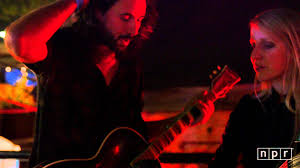
SOUNDTRACK: THE LOW ANTHEM-Tiny Desk Concert #43 (January 20, 2010).
The Low Anthem grow more charming as the Tiny Desk goes on. The first cool thing is the story that accompanies them. They played at the Newport Folk Festival and when Bob talked to the organizer about them, the organizer said that “Last year, they were volunteers at the festival, picking up trash.”
Then things get more interesting as each of the three songs introduces new instrumentation and ways of making music. They brought a lot of gear to this Tiny Desk.
The first song, “Ghost Woman Blues” opens with strummed acoustic guitar and upright bass. The first surprise comes with the clarinet solo (by harmony vocalist Jocie Adams). Lead singer Ben Knox Miller has a voice not unlike Vic Chesnutt’s and these songs follow along his rather simple and spare style.
The biggest surprises come in the second song, “This God Damn House.” Miller starts the song by playing a small bras horn (not sure what it is). Adams plays more clarinet (in a very cool echoing style) and upright bassist Mat Davidson switches to an old-sounding organ. But the coolest thing is when Miller takes out his cell phone (what!). He has dialed another phone in the room which he then answers. With both phones flipped open (it is 2010 after all), he begins whistling into them, playing with the feedback and echoes and creating a very cool sound to end the song.
It’s a shame there’s a cut to the next song, because I’m sure Bob asked him about that. For the final song, “To the Ghosts Who Write History Books,” Miller switches to the organ (and harmonica, man that guy is talented). Davidson is back on bass and Adams plays a bunch of cymbals with a violin bow (I wish that was a little louder).
I generally don’t like super mellow music like this, but there’s something really captivating about The Low Anthem–the instrumentation, the voices–something, really elevates them.
There is a drum kit set up although no one uses it. I can’t imagine it would have made a lot of difference. Check them out here.
[READ: April 11, 2015] “Kino”
This longer story was a typically enigmatic one from Murakami. In it, he does a great job of melding the real with the psychological, so that things that seem very surface level are actually much deeper.
Kino is a pretty simple man. He was a runner until he pulled his Achilles tendon and could no longer run. So he started working for a shoe company. He sold the premium shoes to good runners. The brand was not super popular, but it had a devoted following. And Kino made decent money for him and his wife.
He was a salesman and often went on business trips. As happens, he came home early one day to find his wife in bed with a fellow coworker. He walked out and never went back. (more…)
Karl Ove mentions many bands in this book, but the deLillos are the only Norwegian band that he plays. They sing in Norwegian and play sprightly, jangly guitar pop–they would fit in very well with some of the lighter alt bands from the late 80s and early 90s.
I have no idea what they’re singing about (well, the title translates to “love” so I guess I know what they are singing about.
The singer has a high, delicate voice and there’s some interesting harmonies. I really like the way the song transitions from verse to chorus with the picked guitar notes–very catchy.
It comes from their second album, Før var det morsomt med sne (Beforeit was funin the snow), which along with their first was quite popular and was reissued with a bonus disc in the 90s. Having said that I see that Amazon has one copy of the disc and no album cover listed. Worse yet, I can’t find many other songs online (Spotify lists the album, but I can’t get it to play).
Sorry, deLillos (even searching for you gives us more Don DeLillo than you guys).
[READ: June 24, 2014] My Struggle Book Four
I started including the British edition page numbers because at my work we received both editions of the book, and I received the British one first so I grabbed it and started reading. I noticed the page numbers were quite different (the British book is taller and the print is quite bigger, although this doesn’t explain why the previous books have fewer pages).
I had been interested in the differences between editions from the get go. I had enjoyed the American editions, but I enjoyed reading this British edition more (bigger print?). But when I noticed on one of the pages that the word “realise” was spelled as I typed it, it made me wonder if the American edition changed that to the American spelling. [Actually, I see that Don Bartlett lives in Virginia, so perhaps he translates it into American first]. While I wasn’t about to go into a deep inspection of the topic, when I saw the American edition on a shelf at work, I had to do a little comparison.
And what I found out was that even though Don Bartlett is the (amazing) translator for both editions, someone (perhaps Bartlett himself?) is translating the American into British (or vice versa). I looked at a couple of pages and noticed these changes from British to American:
BRITISH EDITION = AMERICAN EDITION
Pack it in, now = Give it up, now
roll-up = rollie [about hand rolled cigarettes]
looked daggers at = gave her a dirty look
a complete prat = completely useless
is that possible? = really?
to cook and wash up = cooking and doing the dishes
I had got = I’d gotten
had penned = had written
and yes, realised = realized.
Other than select phrases, every word is exactly the same. So somebody goes through the books and changes them to British english idioms and spellings. That’s fascinating.
I also see that this is the first book I had not read an excerpt from first. Not that it would have made any difference as to whether I read the fourth one. I couldn’t wait to get my hands on it.
So book four is set in Håfjord, a town in Northern Norway near Finnsnes (a five hour flight away–okay I had no idea Norway was so big!). Karl Ove is 18 and has decided to become a grade school teacher there for one year. The tax breaks are great if you teach, and he plans to teach and write his masterpieces and then get out. He has no interest in teaching, but the town is small (most grades are 3-7 students), so he figures it can’t be too hard.
As in most of Karl Ove’s books, the stories jump around and flash back and do not stay all in this one time, but it is largely set in this locale.
My first thought was that I have never read a story with as much semen (both nocturnal emission and premature ejaculation) in my life. It is a strange take away from the book, but there it is. Karl Ove is 18 and really wants to have sex for the first time. About 3/4 of the way through the book he reveals that he never masturbated (it just never occurred to him, apparently, and at 18 he’s too old to start–what!?). As such, he seems to have wet dreams every night. And every time he gets near a woman, he has an orgasm too soon. He is horny all the time–it’s a bit disconcerting.
And since I mentioned that, I don’t know if Karl Ove’s life is typical of Norway, but I am shocked by the number of women who take their clothes off around him (he may have never had sex, but he was about to on at least a half-dozen occasions). And he says that all through school (from around age 13 and up) it was common place for the boys to lift up the girls’ shirts and kiss and or fondle their breasts. It is mind-boggling to me. And the 16 year olds all seem to be having sex all the time–this may be skewed from Karl Ove’s perspective, but that’s what I now believe happens in Norway.
But while sex is the main theme of the book–sex, sex sex, there is more to it.
Karl Ove’s parents have split up and his father has started drinking in earnest. The dad has remarried and has just had a baby. Incidentally, I was also shocked to read that Karl Ove’s father, who is an abusive stodgy old man who is cranky and mean and abusive and all the stuff that we read about in the other volumes was only 43 at the time that Karl Ove was 18. So the old man who I pictured as a gray-haired curmudgeon in this book is actually younger than me. Great.
In Håfjord, Karl Ove is teaching kids who range from age 13 to 16. It’s disconcerting to read about him thinking lustful thoughts about his students, until he reminds us that for most of the students, he is only 2 years older than them. I am pleased to say that he behaves himself (except in his mind) with all of the students. There’s even a really interesting flash forward to eleven years later when he runs into two of them again.
He proves to be a pretty decent teacher it seems. The kids mostly like him (the girls all think he is hot) and he is young and tries to make it fun (he himself hated school and everything about it). He even seems to help out an awkward boy (although that is never resolved). We see him teaching, trying to interact with the kids and generally being a pretty good guy.
Until the booze comes out.
For in addition to semen, this book is chock full of alcohol. Before graduating from gymnas (high school), Karl Ove basically stopped caring about anything. He spent most of his time drunk. It is astonishing the amount of drinking he does–it’s practically like an Amish Rumspringa how crazy he goes. But even in this retrospective look, he talks about how much he likes it, how it loosens him up and makes him less nervous.
But really he just spends most of his time drunk, hungover or sick. He even got into the hash scene for a while. He was living with his mom at the time and she was appalled at the way he acted–especially when he threw a party which trashed their house. She even kicked him out for a time.
He seemed to be over the drink in Håfjord, but it turns out that there’s precious little else to do except drink up there, especially when it grows dark for most of the day. So there is much drinking–he only misses class once or twice because of it but he comes very close a lot.
The irony that he is appalled at his father’s drinking, while drinking so much himself, is apparently lost on him.
The other main preoccupation with Karl Ove is music. He talks a lot about his great taste in music (he reminds me of me–a little insufferable). Back when he was in gymnas, he spent a lot of time discussing his favorite bands and favorite songs. He got a job (at 16) writing reviews for a local paper (holy crap, jealous!) and then later gets a job writing a column for another paper. For the previous book I listed a lot of the bands he mentioned, and I wish I had written them down for this one. U2 features prominently (this is 1987, so I’m guessing Joshua Tree), but also Talking Heads, a Scottish post-punk/new wave band The Associates and their album Sulk which he describes as “an utterly insane LP.” he and his brother really like The Church and Simple Minds (before they got so commercial). He also has a whole thread in which he makes connections with albums:
Briano Eno, for example, started in Roxy Music, released solo records, produced U2 and worked with Jon Hassell, David Byrne, David Bowie, and Robert Fripp; Robert Fripp played on Bowie’s Scary Monsters; Bowie produced Lou Reed, who came from Velvet Underground, and Iggy Pop, who came from the Stooges, while David Byrne was in Talking Heads, who on their best record, Remain in Light, used the guitarist Adrian Belew, who in turn played on several of Bowie’s records and was his favorite live guitarist for years. (64).
He also specifically raves about “The Great Curve” from the Talking Heads album, and of course, he raves about the first Led Zeppelin album as well.
Music is a huge part of his life (and he dresses accordingly too). It’s unclear whether the kids think this is awesome or not, but he may be a bit too much for some of the locals. The locals are mostly fishermen (which makes sense), and Karl Ove is a bit intimidated that he is so wimpy compared to them–one of the women even teases him about his tiny arms.
But his main focus is writing. He writes a few shorts stories (to my knowledge he has never published any of them). We see some excerpts and they seem fine–he fancies himself Hemingway. But he also mentions a bunch of Norwegian authors (I love when he does that). Sadly again, not too many of them have been translated into English. [I really hope that some mega fan creates a database of all of the bands and authors he mentions]. He also talks briefly about his first novel which alludes to his time teaching here. I happened to read a small summary of said novel (Out of the World) and feared that it spoiled what was going to happen. But, in fact there does appear to be a difference between his fiction and non-fiction.
The book moves very quickly–from party to party, from failed sexual attempt to the next, even from his staying up all night long trying to write. And most of the time he comes off as kind of a dick–he is also very self-critical, which somehow tempers that dickishness.
As with the other books I cannot figure out exactly why I am so addicted to his writing. I brought the book home on Thursday night and finished it (all 548 pages of it) Monday night. This really completes the picture of himself as he moved from childhood to adulthood and really lays the foundation for whatever is to come next. Early in the book he talks about the books that he loved at that age, books that talk about the move from childhood to adulthood. And thus, this book becomes something of a bildungsroman as well. Although whether or not Karl Ove actually grew up at the end of this book will have to wait until volume 5 (which I have to assume is still another year away as there is no information about it online at all!).
For ease of searching, I include: Hafjord, For var det morsomt med sne.
Recorded outside of Stubbs while the groundscrew was cleaning up the huge mess, Luluc play a beautiful quiet ballad.
Steve Hassett plays lead acoustic guitar and sings harmonies while Zoë Randell plays rhythm guitar and sings lead. Interestingly, his voice often goes in higher registers than hers.
I really like the solo that he plays that adds a bit of uptempo feel to this otherwise quiet song.
This issue of Harper’s featured five essays (well, four essays and one short story) about “Growing Up: five coming of age stories.” Since I knew a few of these authors already, it seemed like a good time to devote an entire week to growing up. There are two introductions, one by Christine Smallwood (who talks about Bob Seger) and one by Joshua Cohen who talks about the coming of age narrative.
Here’s yet another piece by Karl Ove (like the recent essay in the New York Times Magazine) translated by Ingvild Burkey
It’s hard for me to imagine that Karl Ove (who has written literally thousands of pages about his life) could have anything more to say–any incident that he hasn’t gone over with a microscope. And yet, here he is with a new incident.
As with most things from Karl Ove, it explains a minute detail which proves to be a big event. He was 12 and in school and told to spit out his gum. As he walked up to the wastebasket the attention made him blush. The first time he can recall the burning shame making him more self-conscious which then kept repeating itself. And then some one said “Karl Ove’s face is all red!” (more…)
This is the final EP available from the We Arrive Alive bandcamp site. In fact 2013 is the last I can find any information about this band at all. This site, their Facebook page, there’s nothing after mid 2013. I wonder what happened.
For this EP, the band has also grown to a 7 piece Andrew McGurk, Ben Healy, Adam Faulkner, Sean Dexter, Iain Faulkner, Michael Naude, Neil Dexter (still no idea who plays what).
“3 years” opens with some noise and fat propulsive bass and guitar. The song feels more complex, although I’m not sure what the new musicians add to the song. There’s more noise (scraping guitar and whatnot ) that bring new dissonant textures to the song. There may even be horns at the end (it’s a little hard to tell in the din). “Slow Fall” opens with a slow piano and an intricate drum pattern. A slow guitar line plays over the bass before some really noisy guitars are laid over the top. At around 4 minutes the song shifts gear becoming faster and more broody.
The final song start with some ringing chords and a staccato guitar line. I like the way the new guitar introduces a melody to the proceedings. The song really starts to build at around 2 minutes, with some crashing cymbals shortly after. There’s also a pretty middle section (which seems like a ticking clock). The song end with a ringing guitar-and unexpected mellow ending to what I assumed would be a loud buildup to a song.
I’m intrigued by the direction the band went with this EP, although I like the sound of their previous one a bit more. I am also concerned that they’ve broken up. But if they have, they have three great EPs to their name.
[READ: March 24, 2015] Robert Moses
I can’t tell how ignorant I am that I’ve never heard of Robert Moses. I mean his name sounded vaguely familiar, but I would never have known who he was (the master builder of New York City). And I have to wonder if I am not alone. For this book was originally written in French (and was printed in Poland and released in England).
This turns out to be a graphic novel biography of Robert Moses. It’s hard to summarize how incredibly influential Moses was. The back of the book says “From the streets to the skyscrapers, from Wall Street to the Long Island suburbs, every inch of New York City tells the story of one man’s mind.”
If you have seen the (excellent) book Wonderstruck, the mini model of New York City mentioned in the book was created for Moses. New York Bound books describes the model thusly: “The Panorama, a miniature scale model of New York City that was commissioned by Robert Moses for the 1964 World’s Fair, is a 9,335 square foot architectural model that includes every single building constructed before 1992 in all five boroughs, or a total of 895,000 individual structures.” (more…)
I discovered We Arrive Alive from the Girl Band bandcamp site (it says the bands are friends). They are from County Wicklow and play very cool post rock instrumentals. They have three EPs, all of which are available for free on their bandcamp site.
Their first is called Walls. The opening song “Walls” has fast guitar with a slinky Sleater-Kinney kind of guitar progression. Unlike S-K, there is bass and no vocals. The middle section feels like any number of post-rock instrumentalists like Explosions in the Sky. But it’s not derivative–it’s expansive and beautiful. “Save Me from the Morning” is a much faster song with a more intricate bassline underneath the guitar riffs. The structure of the song makes it seem more like a conventional song (ie one with words). But there are no words, and the guitars fill in very nicely for where vocals might appear. But 90 seconds in, the songs switches gears and becomes a bit more jazzy. Then around 3 minutes the bass takes over with big loud notes—it’s a great transition. There’s yet another part, a quiet section, that ends the song. That’s a lot of music packed into 6 and a half minutes.
“This is a City” is the final song. A seven minute slow building instrumental. It starts quietly and the intertwining guitars get louder as they echo more. I love the way at around 5 minutes the song shifts gears entirely to a sort of electronic feel with pinging notes. It ends with a fantastic closing riff.
I’m glad to have discovered these guys, I love a good collection of instrumentals.
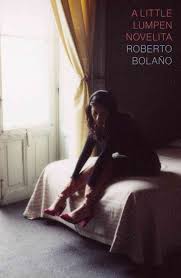
[READ: March 17, 2015] A Little Lumpen Novelita
This may be the final extant untranslated book by Roberto Bolaño. Although I have yet to read The Secret of Evil (that fell right off my radar), as far as I can tell, the only things left untranslated are:
Diorama (this book is unpublished at all, so it’s unlikely to be translated anytime soon) AND
Consejos de un discípulo de Morrisona un fanático de Joyce, 1984 [Advice from a Morrison Disciple to a Joyce Fanatic] which has yet to be translated and I don’t know why, so I assume it never will be.
I don’t fully understand the use of the word “Lumpen” in the title, but don’t let that odd word (which is in the Spanish title, so we can’t blame excellent translator Natasha Wimmer) keep you from reading this breezy and entertaining (if not a bit dark) book.
As with many books by Bolaño, there’s not a lot of plot, per se. In this book, a young woman (Bianca) and her brother have been orphaned at a young age. Their parents died in a car crash in Italy (which is where they live). They try to cope as best they can, but they ultimately decide to drop out of school and do nothing except watch a movie a day. Bianca tells her brother that they can’t afford that lifestyle (especially since he just seems to get X-Rated films), but he continues to do so anyway.
They realize that they will need money of course, so Bianca gets a job as a hair washer at a salon. Her brother gets a job cleaning floors at a gym. It seems to be enough for the time being. (more…)
SOUNDTRACK: GIRL BAND-Live at Kex Hostel in Reykjavik (November 8, 2014)
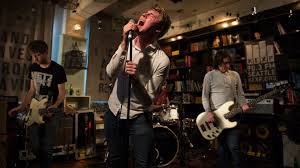
This brief concert finally allows us to see just how Girl Band make their unholy noise. And yes, it is just four guys–guitar (and a whole lot of pedals) bass drums and a vocalist.
“Sexy Wife” has staccato guitars until the real noise kicks in for the chorus (oh, so that’s how he does it). It’s also fun watching the bassist remain largely calm while still playing some unsuaul high notes on his instrument. The drummer doesn’t have any fancy gizmos, but he keeps a steady loud beat. And I love that the singer is quite a pretty fellow in his Oxford shirt and parted hair (but he can scream like the best of them).
“De Bom Bom (their newest single) is just full of noise and more noise (how can you have chords if it’s just staicky noise?) as the bass rumbles along. This song is intense.
“Heckle The Frames” is a noisy chaotic pile of hardcore (and is about 90 seconds long). It’s followed by “I Love You” a cover of the Beat Happening song. For this one, it’s pretty much all bass and drums while the guitarist fiddles with his pedals making a larger wall of noise until he begins playing a ringing open note. I don’t know the original, but I imagine it’s nothing like this.
“Lawman” shows off just how noisy the bassist can be in the opening moments. And his riff, coupled with the noisy riff of the guitar, make for such an enjoyable combination. I love how the song which you assume is over–at about the length of their other songs–suddenly turns into something else altogether–a sort of guitar solo, if you will.
The final song is “The Cha Cha Cha” which is all of 25 seconds. It’s a pretty great set if you like your music noisy.
[READ: March 19, 2015] Blacksad
This book collects the first three Blacksad volumes: Somewhere within the Shadows (2000), Arctic Nation (2002) and Red Soul (2005). I’m only bummed that it took me so long between books to read them. They were translated by Anthya Flores and Patricia Rivera
It’s amazing to see that it takes two or three years between books, but when you look at the visuals, it is completely understandable. The drawings/paintings in these volumes are simply incredibly. They are incredibly realistic with exquisite attention paid to detail. The fact that he can make people with animal heads seem sexy is really a testament to his drawing skills.
Okay so Blacksad is a noirish detective series with a slight twist. John Blacksad is a cat. Well, he is a human shaped person with a cat head. But otherwise he is very much a detective–he is hunky, has smoldering eyes and is a really hard dude. And that first story opens with his former lover dead in her bead. She is so pretty (and colored in pale fleshtones), that one might be hard pressed to see her as a car (except for the ears).
This mystery is personal and John sets out to find out who wanted his former lover dead. (more…)
I enjoyed “Why They Hide They Bodies Under My Garage?” so much that I immediately went to Girl Band’s bandcamp site to check out their other releases.
They have a bunch of EPs and singles out. This was their first one. It’s hard to believe that the band who is so experimental with noise and feedback sounds so different just two short years ago.
I like this single (which is only two songs and which you can get for free from their site), even though it has none of the more noisy elements that would come on later songs). Having said that it’s not like these are sweet ballads. They are plenty noisy, just in a more conventional indie rock vein.
They actually sound a bit like a Steve Albini project–sharp guitars and feedback (and both songs total 5 minutes)–and an aggressive feel like Therapy? perhaps.
“In My Head” has a pretty conventional rhythm section (which unusual guitars) and a rocking chorus that is pretty catchy. By the time the singer starts screaming the chorus the second time around, a lot has been packed into 2 minutes. “Conductor” has a thumping bass line that propels the song while the guitars alternate between ringing dissonant chords and a squealy guitar line. The vocals are almost spoken and sound like someone but i can’t quite place it). And once again, the chorus is strangely catchy under the noise.
But make no mistake this is still an abrasive bunch.
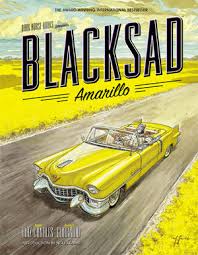
[READ: December 29, 2014] Blacksad: Amarillo
So I see now that this is actually the fifth book in the series, not the third. I’m glad I found the fourth volume before reading this one. I hope to get the first 3 volume set soon. There’s a wonderful introduction by Neal Adams who puts some context and admiration for these guys’ work.
I enjoyed this story a bit more than A Silent Hell (which was really, really dark). The fact that this one is so bright on the cover (and while I thought amarillo meant yellow (which it does) it is also set in Amarillo, Texas.
It opens with two lions–both writers–sitting by a pool. The one writer (who is bigger in general) throws his poetry into the pool out of artistic honesty, while the other sits, aghast. The poet then tries to throw the other writer’s scroll of a novel into the pool as well, but when the novelist talks about his work he did the poet scoffs and says he should think of it not as work but as poetry. They depart with hard feelings between them. (more…)
SOUNDTRACK: GIRL BAND-“Why They Hide Their Bodies Under My Garage?” (2014).
I first heard about Girl Band from the NPR Austin 100 list. This song blew me away. It is a noisy and unrelenting 8 minutes. It builds and builds into a chaotic tumult. And, amazingly, it is a cover of a dance song.
Girl Band is from Dublin and they make some of the noisiest rock I’ve heard in a long time. Not heavy rumbling death metal noise, but ear-piercing feedback and squalls and sqwaks of sound that are heard to imagine originating with a guitar or bass.
It open with controlled chaos, and clearly some kind of pedal manipulation from the sounds generated by… a guitar?
The lyrics are minimal–a simple repeat of “Why they hide they bodies under my garage?” These lyrics are repeated, more frenetically with the “music” just squeals of feedback and noise. The song doesn’t seem to change much, but there are subtle (if that’s the right word) changes in noise and intensity for four minutes until the song sorta stops and then resumes with even more intensity. It drops out again, but by 6 minutes the song has built to epic intensity, with interesting sounds in between “chants.”
There is pretty much nothing to this song and yet it is amazingly intense. And not for the faint of heart.
This song is from an earlier compilation release but is getting reissued on their soon to be released EP. (You can get a lot of their early stuff from their bandcamp site).
The video is creepy as anything too:
You can also hear the original by Blawan, which is similar without the building intensity, I tend to think that Girl Band has done this song a real service.
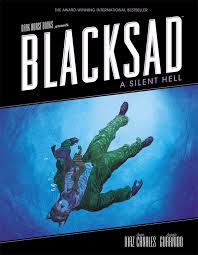
[READ: December 20, 2014] Blacksad: A Silent Hell
I had gotten the latest Blacksad book at work, so I looked to see if I could find the earlier editions. I couldn’t find the first book right away so I decided to dive in with this book. It is the second collection, but is apparently the fourth book. The first collection, simply titled Blacksad collects the first three books together. The books were originally written in French and were translated by Katie LaBarbera.
I don’t know how much if any introduction there is in that first book, so there’s no context for why these animals are people or people are animals. And I rather hope there isn’t one. It’s just a great world where everyone looks human except that their heads are a (very realistic) animal shape. In fact speaking of realistic, the artwork by Guarnido is amazing–perfectly noir with incredible realism and gorgeous colors (all done with watercolors, I believe).
This book opens with Blacksad, a private investigator, and Weekly, a reporter, at a strip club. (It is disconcerting that the stripper is a leopard woman and that she is really hot (thankfully, it’s only shown from the back because that would get weird). Weekly is super psyched but Blacksad has other things on his mind. They are supposed to be meeting Junior Harper but he ain’t showing.
The pull back shows that we are in New Orleans. (more…)
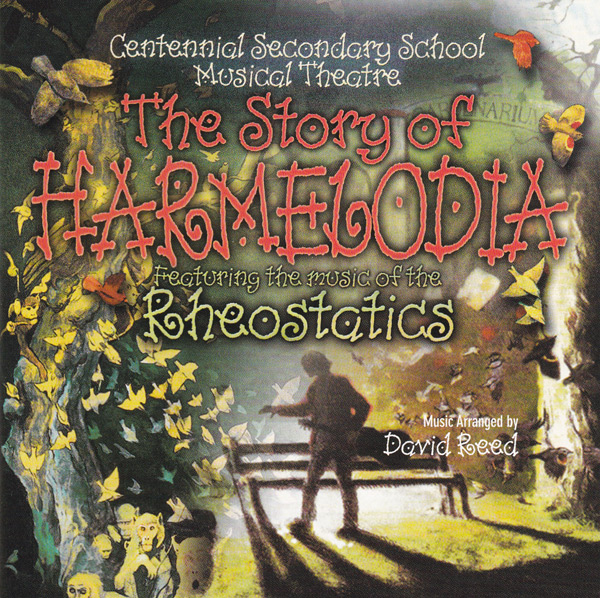
SOUNDTRACK: CENTENNIAL SECONDARY SCHOOL MUSICAL THEATRE-The Story of Harmelodia (2000).
As mentioned in yesterday’s post. The Centennial Secondary School and Choir released their version of The Story of Harmelodia. This CD (which to the best of my knowledge is no longer available for purchase anywhere) is newly available from the Rheostaticslive website. While the (very cool) cover is there, there’s no information about the musicians.
The disc is about 35 minutes long and it recreates most of the music from the original CD. For reasons which I’m sure have to do with rights, they do not include “Monkeybird” (everyone’s favorite song) and the songs about the Wingophone. Those songs were all written by Kevin Hearn. I’d be very surprised if Hearn didn’t give them the rights to the songs, so there must be something else at play.
They also do not include the narration. This of course makes the story a lot less clear–although at this point I feel like the songs are just fun and sweet, even if they story is lost.
The school’s version is quite good. The band sounds great (with a whole host of instruments). While the opening music on the first track sounds a bit high school bandish (perhaps because it so spare) as soon as the choir kicks in it really ratchets up the quality of the music. And it stays high throughout.
The choir is outstanding, and the variety of instruments (I can hear all the brass, an autoharp, synths (there’s some fun spacey keyboard sounds on “I am Drummstein”) and some electric guitars) makes for a really compelling collection of songs.
One of the biggest difference is that many of the songs have horns playing the main melodies. “Invisible Stairs” has a flute as the lead instrument. It’s very pretty and I like that it plays the “twinkle twinkle” melody as a counterpoint to the proper melody. It’s a very pretty version. I also love the way “The Music Room” came out. And the mostly instrumental “The Sky Dreamed” sounds really lovely.
I don’t know how many lead singers there are (or what their names are, although judging by the concert, I assume it is the same kids). The female lead as featured on “Home Again” is great. I like the male lead a little less. He sounds a but too stiff to me. Although I do like that on many songs he gives his own reading of the material.
The final song, “Song of the Garden,” sounds terrific. I love the way the two singers harmonize and the way they place a cool horns section (which reminds me of The Beatles) as the song trails out.
I am of course curious why the couldn’t release those missing songs. But I’m more impressed that the school (presumably with different people) performed a stage version of the show in 2004 which was played live in several places.
[READ: December 5, 2014] Sardine in Outer Space 2
Sardine is a children’s book published by First Second. It was originally published in France (and in French) and was translated by Sasha Watson. There are six Sardine books out.
This time the inner flap says “No Grownups Allowed (Unless they’re pirates or space adventurers),” and I found that I enjoyed book 2 quite a bit more than book 1. Perhaps the jokes just appealed to me a bit more–there were a number that I thought were very funny.
I enjoyed the double cross (well they pretty much all have a double cross) in The Brainwashing Machine. But I really got a kick out of The Cha-Cha Fly. When the fly bites you, you get stupid dance songs stuck in your head. Nice premise–even funnier that the flies are named Britney, Christina, Justin and Clay. (more…)
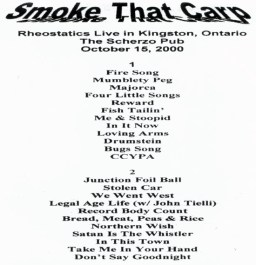
SOUNDTRACK: RHEOSTATICS-Scherzo Pub, Kingston, ON (October 15, 2000).
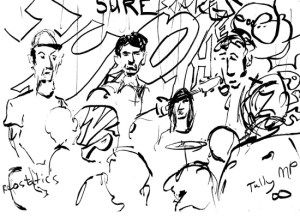
This show has some fun art work to go with it. The notes say:
“Rare original drawing by local artist “tully” drawn during the october 15 2000 rheos gig at the now defunct scherzo pub, kingston, ontario. the story goes that “tully” goes to shows, does a drawing of the band, and just leaves it on a random table for someone (like me!) to find it. i actually found it on the floor!”
The other joke on the set list over here is the Smoke that carp joke which is from Martin talking about something before the set even starts.
They play a lot of songs from the then unreleased NotSS. The version of “Four Little Songs” is crazy fun–lots of wildness, and a superfast ending.
In addition to playing “Majorca” they play two songs from Introducing Happiness and then talk about Martin’s guitar with the maple leaf on it. They challenged Gordie Johnson from the band Big Sugar to put a leaf on his guitar. Dave says that not only did he put the leaf on his guitar (on the back) but he plays O Canada at every show now.
In the middle of “Junction Foil Ball” Dave talks about how much he struggled to get the riff (earlier Martin said Dave was very proud of the riff). It’s a very lengthy talk with demonstration about the riff–quite amusing.
The end of the show has what sounds like an acoustic unplugged set. Not quite acapella, but Don is only playing the tambourine. It sounds like perhaps they are in the crowd or near the crowd or something.
So for “Record Body Count,” the crowd sings along beautifully and “Bead, Meat, Peas and Rice” is also done in this format. For “Northern Wish” Martin say he’s going to start it acoustic while the rest of the band goes back to their instruments. It’s a great version of the song. In fact all three are wonderful, and it’s cool to hear them sounding so different.
There’s another long chat from Martin about Burton Cummings and how they saw him playing a casino. It’s very funny. Then he insists on a “golden drag” on his cigarette before starting the next song.
The disc ends oddly with “Take Me in Your Hand” also done in that acoustic format as the earlier songs–which makes me think it should have been earlier and was placed at the end by mistake. It sounds great either way.
This is definitely a great show and one for any Rheos fan to enjoy.
[READ: March 5, 2015] “Family Life”
I had recently read something about Zambra that made me want to read him, and then, here he was in Harper’s. I like serendipity.
This story was translated by Megan McDowell, and I gather is part of a collection of stories called My Documents which will be out soon from McSweeney’s.
This story is a simple one, although it has an unusual beginning.
Martín is headed to a house for a job. He is to house-sit for a family while they are away for four months. I enjoyed the way the family members were laid out for us to meet: in alphabetical order: Bruno, the husband, Consuelo the wife (well, actually not the wife, because they never married although they act like a married couple) and Sofía their daughter.
We learn that Bruno sand Martín ‘s fathers were cousins. Martin’s father has just died. They barely know each other, although they did know each other when they were kids. But Bruno tries to strengthen this familial connection, because it builds trust. Otherwise they have a stranger in their house for four months.
When Martín arrives Sofi runs past him (“These days kids don’t say hi”) chasing the cat Mississippi. Consuelo is friendly and gives him instructions, which largely entail looking after the cat (who has a swinging door which is open all the time). When Martín looks at a large hour glass, Sofi runs up and says it last 12 minutes.
To pass the time Martín plays Sofi in chess. And when they get bored, he changes the rules so that the object is to get beaten, which Sofi enjoys more.
While Sofi is going to bed, Martín and Bruno talk. Bruno suggest that he “use the time to have ago with one of the neighbors.” Martín thinks (but thankfully doesn’t say out loud) that he’s like to have a go with Bruno’s wife.
After they leave, Martín discovers a photo of Consuelo and puts it up on the wall.
Martin plans to try a different route every day (different stores, different roads) so as not to make an impression on anyone in the town. But one day Mississippi doesn’t return from his nightly stalking. Two days go by and Martín grows concerned. So he puts posters up around town. But when he emails Bruno he doesn’t say anything.
A few days later he sees that someone has posted lost dog posters up over each one of his lost cat posters. He calls the number (while drunk) and talks to Paz, the woman who put up the posters. He complains about what she has done. The next day she does around moving her posters off of his. He gets some courage and goes to talk to her about their lost animals.
A week later he sees a dog that looks like hers and he calls her. They go looking for the dog but don’t find it. Then, after a month, Mississippi returns. He is beaten up , bloody and gross. Martín takes him to the vet and gets medicine that he must apply to Mississippi every night. When Paz calls him, he tells her about the cat and she comes over.
Paz scrutinizes his house–the photo of Consuelo–and he creates and elaborate fiction about his former life with Consuela and their daughter. How they are broken up and he is reluctant to date. Later, they have sex and start seeing each other every day.
Things are going quite well, although of course, it is all based on a lie. And the time of Martín’s departure (and Bruno’s family’s return) is coming up. But the sex is great and he really like her. She even invites him to go to a wedding with her.
What will happen when it’s time for Bruno and Consuela to return?
This is an unusual story (I guess) to start with because I’m not sure if Zambra’s other fiction is anything like this. This story was erotic and a bit salacious and was predicated on a lie. I enjoyed the idea of the main character being someone else and then realizing that he could be that person forever. (Even if that’s not an original concept). But Zambra’s handling of the story was really good and I’m interested to read more from him.
 SOUNDTRACK: THE LOW ANTHEM-Tiny Desk Concert #43 (January 20, 2010).
 The Low Anthem grow more charming as the Tiny Desk goes on. The first cool thing is the story that accompanies them. They played at the Newport Folk Festival and when Bob talked to the organizer about them, the organizer said that “Last year, they were volunteers at the festival, picking up trash.”





 This is the final EP available from the We Arrive Alive











 This show
 o for “Record Body Count,” the crowd sings along beautifully and “Bead, Meat, Peas and Rice” is also done in this format. For “Northern Wish” Martin say he’s going to start it acoustic while the rest of the band goes back to their instruments. It’s a great version of the song. In fact all three are wonderful, and it’s cool to hear them sounding so different.
 I Just Read About That...