Feeds:
Posts
Comments

Archive for the ‘Threats’ Category

SOUNDTRACK: PINK FLOYD-the final cut: a requiem for the post war dream (1983).

My college experience seems very unlike many people’s (especially the stories I hear from you young kids today).  And I’m just talking musically.  I went to college in the late 80 and early 90s.  And my freshman year, the most popular albums on campus  were Steve Miller’s Greatest Hits, Squeeze’s 45s and Under and Pink Floyd’s The Wall.  My friend John also loved this album.  And I think we listened to it hundreds of times, blasting out of dorm room windows.

It’s kind of strange that college freshmen would embrace an album about (more or less) Roger Waters’ father dying in WWII, especially since none of our fathers had died at all, much less in WWII.  But angst finds its home I suppose.

This album is not a sequel to The Wall, but it has echoes (see what I did there) from that album.  There were touches of WWII in The Wall.  And sonically a lot of this album sounds similar.  The big difference is that Roger Waters wrote pretty much the whole thing, long time keyboardist Richard Wright left the band and David Gilmour, sings on only one song.  So, it’s practically a solo project (and it fees a lot like Waters’ solo album The Pros and Cons of Hitch Hiking).

This album seems to have alienated fans of Floyd. But I happen to like it quite a lot.  And, I it a lot while reading Gravity’s Rainbow.

“The Post War Dream” opens with military sounding horns and funereal organs, as befits an album about the war.  It also has an intriguing assortment of sound effects (I wonder where he gets most of this stuff).  It sounds very Pink Floyd–Roger Waters’ voice is pretty unmistakable).  But “Your Possible Pasts” sounds even more Pink Floyd.  Evidently this album has a number of songs that were cast offs from The Wall.  If that’s true, this is probably one of them, as it sounds like it could easily fit on that album–especially when the keyboards kick in during the second chorus (even if Richard Wright wasn’t on the album).  And the guitar solo is so David Gilmour–that’s what you call a signature sound.

“One of the Few” has something I love from Floyd–whispered vocals (“teach”) and creepy laughing; it works as a nice transition to the louder “The Hero’s Return.”  This track is very complex–all kinds of tonal shifts, echoed vocals and bitter lyrics.  It explodes into “The Gunner’s Dream,” a gentle piano ballad about a soldier being shot down.   It’s a surprisingly tender song (although not really given the topic of the album) and lyrically it is really impressive.  I don’t really care for the saxophone solo–it’s not my thing, but I think it actually works well for the song.  And, again the end sounds like it came from The Wall (Waters is amazing at angsty screams).

“Paranoid Eyes” is a delicate song that works, for me, as lead in to the wonderful “Get Your Filthy Hands Off My Desert” a short, string-filled somewhat goofy song that is very bitter under its seeming jocularity.  It’s followed by “The Fletcher Memorial Home,” a really dark track about old age with a lot of current political commentary thrown in (although the “group of anonymous Latin American meat-packing glitterati” always confused (and amused) me.  So even though it is “about” WWII, there’s plenty of anger at current political climate, right Maggie?.  Boom boom, bang bang, lie down, you’re dead–take it away David…

“Southampton Dock” is another gentle song, more of a story with musical accompaniment.  It segues into “The Final Cut” a fitting piano end to a sad album about death and loss, that also happens to reprise song elements from The Wall.

But that’s actually not the last song.  We get the incongruous “Not Now John.”  It really doesn’t fit with the album at all (I happen to love it, even if it doesn’t).  It’s way over the top, including the how-in-the-hell-did-they-think-this-would-be-a-single? opening lyrics: “fuck all that we gotta get on with this. (fuck all that).”  And yet, single it was, reaching #7 in the US.  Man it rocks.  Oi, where’s the fucking bar, John?

The album ends properly with “two suns in the sunset” a mostly acoustic track that returns the mood to more sombre feelings (except for the rocking section where you drive into an oncoming truck).  Never has futility felt so upbeat.  For an album as personal as this is, it really draws the listener in.  Of course, if you don’t want to be drawn in, it’s easy to resist, as many have.

The reissue (which I don’t have), includes the cool song from The Wall movie, “When the Tigers Broke Free.”  Which I imagine would work quite well contextually.

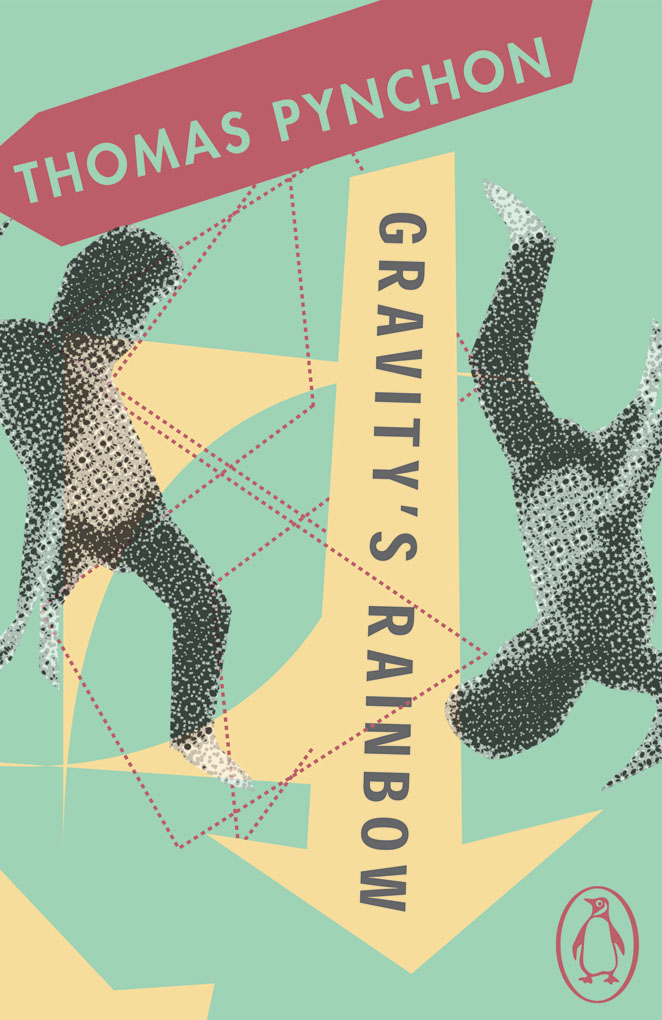
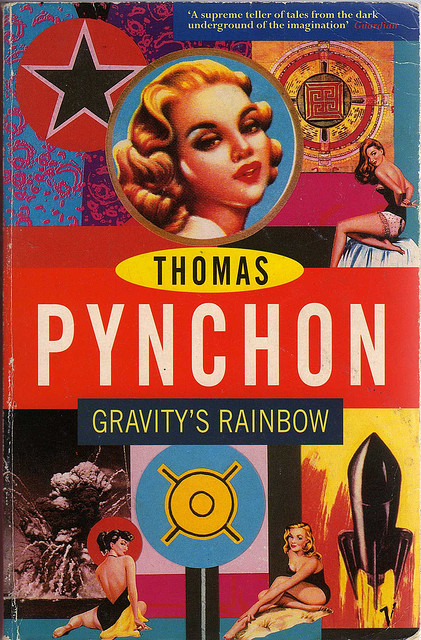
[READ: Week of April 30] Gravity’s Rainbow 4.7-end

And the book ends with a bang and a lot of leftover questions.  My first reaction is that I can’t get over Pynchon spent so much time in the last 60 pages talking about things that had nothing to do with the “plot” per se.  I never really felt like the story was all that hard to follow until the end, when Pynchon let loose the dogs of war on his writing.  There are several pages of stream of consciousness reverie where I was completely at a loss.  Of course, this has been true for much of the book–Pynchon would talk about something and then cycle back into it, filling in the gaps that he left open.  The whole book seemed to have this kind of coiled effect (perhaps a slinky). He would set up a scene as if you had been there all along.  And while you were puzzling over just who the hell he was talking about, he would flashback to whatever you needed to fill in the missing pieces.  And he is still doing that as the story comes to a close.

And although it starts out with a familiar figure, he quickly takes something and has a massive hallucination.  Is this even true? (more…)

Read Full Post »

SOUNDTRACK: PHOEBUS CARTEL-“Difficult,” “Asylum Energy,” “November”

If I had any idea how many bands were named after things in Gravity’s Rainbow, or were perhaps tangentially related to it, like this one, I would have never bothered mentioning bands that I actually know.

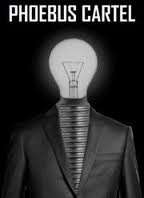
Phoebus Cartel is a heavy metal band based out of Denmark.  And…  well, that’s really all I know about them.  I found this image for them online which linked me to their site on bandbase (if you must, you can also get it in English–although there’s no extra information).

There are three songs here on the site.  They are all sung in English and all have heavy guitars.  The band is clearly heavy metal inspired, but they also classify themselves as “alternativ.”

“difficult” has elements of Marilyn Manson in the singing (and even the melody). It’s a very catchy interesting song and very heavy.  “asylum enemy” has some great heavy chugging guitars. I like the part in the middle where we just get two heavy notes and a pause.  It reminded me a lot of Tool.  “November” has the most normal sounding singing in the bunch–it’s also the least metal sounding–more like heavy alt rock.  Although the break in the middle with slow guitars is nicely atmospheric.

I really enjoyed all three songs.  I’d like to learn more about these guys but I literally can find nothing else about them anywhere.

[READ: Week of April 23] Gravity’s Rainbow 4.1-4.6

Section 4, the final section is here at last.  We are out of The Zone and into The Counterforce.  The epigram here is by Richard M. Nixon.  Hilariously it is simply, “What?”  Unfortunately, I found it to be way too apt for my own feelings while reading this pretty confusing section.  While some sections advanced the “plot,” there were a ton of new characters added and, even more confusingly, a bunch of scenes that were either hallucinations or fantasies  or both.  And none of these do much for you sense of what the hell is going on. (more…)

Read Full Post »

SOUNDTRACK: MERCURY REV-Deserter’s Songs (1998).

Mercury Rev has changed a lot as a band over the years.  They began as a noisy punk outfit who was getting kicked off of airplanes, and by this album (seven years after their debut), they’ve turned into a kind of sweet orchestral pop band (a transformation not unlike The Flaming Lips).  I got into them with their album before this See You on the Other Side with the seriously rocking song “Young Man’s Stride.”  This album came as something of a shock, it is often so delicate.

I used to really love this album a lot and then one day I thought that it was a little irritating sounding, and that has stuck with me ever since.  The irritation comes from a combination of the really high-pitched vocals and the musical saw that seems to accompany most songs.  However, I hadn’t listened to it in quite some time and hearing it now, I found it enjoyable once again.

It opens with “Holes” a five-minute song that layers many different instruments (musical saw, of course, and horns) over Jonathan Donohue’s timid and wavery voice and gentle keyboard washes.   “Tonite It Shows” continues in the pretty vein–a beautiful song that name checks Cole Porter.  “Endlessly” features more unearthly soprano singing (there’s a lot of high-pitched music on this disc).  It has a lovely melody and references “Silent Night” on the flute.

The first highlight has to be “Opus 40” which tempers all of the potential irritants but maximizes the beauty and wondrous songwriting.  It soars to the heavens but stays grounded with a cool retro organ solo.  The other major highlight is “Goddess on a Hiway.”  “Hiway” is even better than opus 40 at blending the wonderful elements of this album.

“Hudson Line” is an anomaly on the disc–raw saxophone solo and low vocals change the pace of the album quite a bit.  “The Funny Bird” actually sounds like a Flaming Lips song circa 2008.  The Flaming Lips comparisons aren’t all that surprising since Donahue played with the Lips back in the early 90s.  And “Delta Sun Bottleneck Stomp” is a pretty raucous song (“stomp” is correct).  It has a traditional feel and ends the disc on an upbeat note.

So, yes, although some of the effects on the disc veer into annoying, it’s still a great disc overall.

[READ: Week of April 16] Gravity’s Rainbow 3.25-3.32

We have finally exited The Zone this week.  The lengthy Section 3 has come to a close with an unceremonious send off to Slothrop, who I assume we’ll see in Section 4, with the reintroduction of old characters and with a chance meeting that made me go wow!

I’m really amazed at the interconnectedness of the book.  While I didn’t think that things would be unrelated, the number of unexpected connections is really tremendous.  And while I missed many of the other characters, seeing the occasional one pop up is pretty exciting.

I’m happy to leave the Zone, not because I didn’t like it (although I admit I Slothrop’s slog from one place to another was getting a little tiring), but because I really want to see how he wraps all this stuff up.  Connections are popping up everywhere, and I feel like he’s doing a whole lot more than I initially thought. (more…)

Read Full Post »

SOUNDTRACK: TEGAN AND SARA-“Alligator” on CDC Kids’ Mamma Yamma (2010).

Tegan and Sara take a slightly different approach than the other artists on Mamma Yamma.  Rather than creating a new song, they took their hit “Alligator” and made new words for it (much like many artists have done on Sesame Street).

The melody is exactly the same (which is good, as it’s a really catchy song). But rather than being about a failed relationship, it’s about alligators.

Old lyrics: Run around on me, I’d sooner die without

New lyrics: Run around a tree, skip and jump about

It’s a cute version and the band sounds very good.

I really enjoy these introductions to interesting musicians on kids shows.  I wonder if kids actually like seeing grown up musicians like this.

You can watch it here:

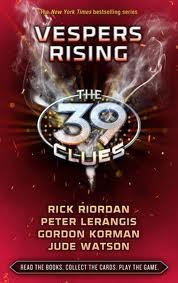
[READ: April 20, 2012] Vespers Rising

I finished The 39 Clues series last year. Or so I thought!  After completing books 1-10, I found out that they were planning a whole new series.  And they began with this transitional book, which they called #11 and which was co-written by four of the prominent authors.

Vespers Rising is actually four short stories that trace the history of the Cahill family and their feud with the Vesper family.  The Vespers were not a part of the first series at all.  In the first series, the 39 Clues were a kind of Amazing Race for Cahill family members.  (I’ll get to some details about the family in a moment).  It was a kind of private race for the prize–which was a life-enhancing serum.  But this book introduces a new villain to the story and explains that the villain has been there all along, just lurking.

Rick Riordan wrote the first story in this book takes us back to the beginning.  In 1507, off the coast of Ireland, Gideon Cahill invented this serum.  He was and alchemist, seeking an antidote for the Black Death which was ravaging Europe.  He was working for Lord Damien Vesper, a man bent on power.  Vesper wasn’t interested in helping people with the Black Death–he had no real value for life–however, he was interested in the results that Gideon might discover. (more…)

Read Full Post »

SOUNDTRACK: KATHLEEN EDWARDS-“Eat the Alphabet” on CBC Kids’ Mamma Yamma (2012).

I love Kathleen Edwards.  I think she has a wonderful voice (there’s something just slightly off that I think is really great).  I love all of her songs, because lyrically she’s clever and at times a little dark.

This is the only children’s song that she has sung that I know of. I don’t think it’s based on any of her proper songs.  It’s a simple strummed electric guitar ditty with a catchy chorus (as befits a children’s song).  Lyrically the song is all about different kinds of foods that start with the different letters of the alphabet.

Of course, she gets off to a strange start because after doing A (apples and apricots) and B (broccoli and banana) she gets to C which is “for Cat and mine’s called Mr T”).  She gets back on track (feta cheese!).  Although she skips J&K (which aren’t that hard, frankly).  She also skips Q and then  T, U, and V (in a way that seems like it’s improvised, although surely it isn’t).

It’s fun that she ends with Y as Mamma Yamma, our favorite talking potato.  It’s not the greatest kids song, but it is certainly fun.

You can see it here:

[READ: January-February, 2012] The Secrets of Droon: Books 17-21 & SE#2

I established with my previous Droon post that I would write posts for the books in between the Special Editions.  The arcs may not be completed, but the Special Editions seem like a natural recapping point.

I’ve been reading this series to my son and he is totally hooked.  And I have to say by the next sequence of books I was really blown away by the twist that Abbott put into the series.  At this stage, each book is getting more intense, although they are all kind of formulaic.  By the end of Book 21, though, things start to change, and the series has just gotten better and better.

Book 17 is called Dream Thief.  It has the kids waking up with dreams of Jabbo.  And Eric wakes up with a silver stone in his hand–a stone that he brought from the dream world!  The action of this book is set in the Bangeldorn Forest, where the monkeys live.  They befriend Tweet and Woot and go to the Dark Lands. (more…)

Read Full Post »

SOUNDTRACKMOLOTOV-¿Dónde Jugarán las Niñas? (1998).

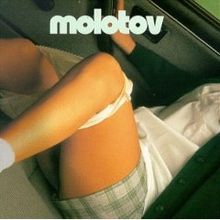
Molotov was the last Rock en Español band that I really bothered to check out.  They were probably most notorious for the cover of the album.  Interestingly, the cover is actually a four sided cover which you can flip to three other far less sexist scenes, so yes, that was pretty much a sales gimmick.  And it certainly attracted attention (and a law suit!).  So they reissued the title with the far less offensive, but very different cover below.

My Spanish is poor at best, but this album is a mix of Spanish and English.  And, of course, I know some bad Spanish words, so I get a sense of what this album is about. But here’s the thing–it rocks really hard and has some really great elements of the metal/rap/funk hybrid genre, regardless of whether you know what they’re talking about (although don’t go singing “Chinga Tu Madre” around the office, capiche?).

The opening song  “Que no te haga bobo Jacobo” has a very Rage Against the Machine vibe–heavy guitars and sound effects with militant rapped lyrics.  The riff is great and the vocals are smoother than Rage’s Zach–“Tito” Fuentes has great flow.  There’s also some good funky bass in the middle section.  “Molotov Cocktail Party” is a mix of English and Spanish, a pretty straightforward rap, not unlike Kid Rock.

“Voto Latino” has a more alt rock vibe in the guitars, although the vocals are pretty straightforward rap style.  The song title means Latino Vote, so perhaps there’s a politics context to it.  And “Gimme Tha Power” is a political song, too.  A rap (in Spanish) over some nice acoustic guitars.

There definitely isn’t in “Chinga Tu Madre” which has more of those cool guitar effects and group chanting, although it’ probably not worth investigating the lyrics much more.  But the chorus is catchy as anything.  “Matata Tete” and “Mas Vale Cholo” return to that Rage Against the Machine style, with vocals that are a bit more cookie monster-y (I’m not sure who sings lead on which songs, actually) although “Mas Vale Cholo” has some fun with the vocal delivery.  And there’s a spirit of early Red Hot Chili Peppers at work, too.

“Use It or Lose It” is rapped in mostly English.  It has a very cool acoutsic-feeling chorus (and a quote of the line, “what cha gonna do rap is not afraid of you.”).  “Puto” is presumably an anti-gay song (I suppose I should find that out before I say so).  “Porque No Te Haces Para Alla?…Al Mas Alla!” has a fun chorus and cool guitar effects once again.  “Cerdo” has a cool 70s vibe, with funky bass and scratchy guitars–it’s got a sexy feel, although the title means “pig,” so who knows.

The final track also rocks very well.  According to Wikipedia, the translated title of “Quitate Que Ma’sturbas (Perro Arrabalera)” is “Stay Away Because You Masturbate (Suburban Bitch)” which seems weird .  But maybe they had nothing better to write about.  Sometimes ignorance of a subject is not a bad thing.

¿Dónde Jugarán las Niñas? is not the classiest album around, but it’s got some really interesting sonics.  And I’m led to believe their later albums are even better.

[READ: Week of April 9] Gravity’s Rainbow 3.16-3.24

Last week ended with sex and this week opens with the way I felt–like a voyeur who can’t look away.  The exhausting orgy was exhausting to read about as well.  And I’m starting to wonder if Pynchon is making a point about sex rather than just enjoying writing about it.

This week’s read also brings back two characters from way way ago.  Well, one from not too long ago, but another from what seems like an eternity.  I assumed we’d see Pirate Prentice again, but I assumed that it wouldn’t be until Section 4. So that was a nice treat, even if it’s a less than happy return for him. (more…)

Read Full Post »

SOUNDTRACK: ROCKET 00000-What Women Want (2010).

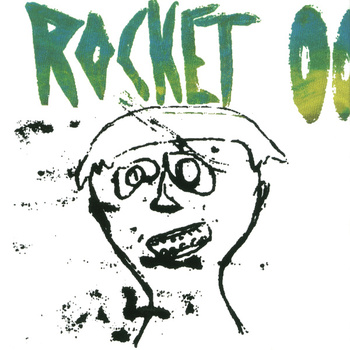
This is the second band that I have discovered because of this novel.  I was looking for images to paste in last week’s post for Rocket 00000, and I came across this EP.

Rocket 00000 are a trio from Cincinnati and this is their first (and only) release.   It’s got a kind of 80s punk vibe–I can’t really make out the words, but I like the feel.

There’s something very raw and almost amateurish about the record–but that seems deliberate, because the album sounds very professional–it’s recorded well and the band is very tight.  And since I like the bandcamp site quite alot, I’m going to provide the link with extras here so you can listen to the album, too.

There’s four songs–two are 5 minutes and two are around 3 minutes.  The two longer ones have intros and outros that extend the music to those long (for punk songs) times.  And I really like these instrumental sections. In fact, when I first listened, I thought maybe the whole first track was an instrumental.  Since  I liked the tone of the album I was okay with that.

The “Summer City” part of “Summer City/Conspiracy Theory” has a simple but effective guitar solo as an instrumental.  After about a minute and a half “Conspiracy Theory” kicks in, the vocals bring a new texture and a punk element into the song.  “Lethal Weapon 2 & 4” has a great title, but it doesn’t sound all that different from the other songs (although the lyrics, “We’re not perfect…but neither are you” are pretty clear).

“Signs” has some cool drum breaks and fills, and the end of the song is musically interesting.    “Braveheart: Forever Young” probably combines the music and vocals  best–I like the  upbeat music with the dark words.  The song ends with about 2 and a half minutes of instrumental (with interesting feedback) that works really well together.

It’s not the best punk EP, but it’s got some good qualities and the band has a good name.  I wonder how they “say” it?

[READ: Week of April 2] Gravity’s Rainbow 3.11-3.15

After last week’s breezy read, I figured that this week’s would be a bit rougher.  But for the most part, it wasn’t–aside from the very end which was a little hard to stomach.  There was a lot of technical discussion in this section–which was a  bit hard to comprehend.  There was a also a return of Franz Pökler–where we learned his story and what happened to him.  We assumed that he was killed by a police truncheon, but that turns out to be untrue.  His story is pretty dark and sad.  Sorry, as Marco points out below, it was Peter Sachsa who was killed by truncheon.  My conspiracy has been called out!

Section 3.11 opens uncomfortably with Franz Pökler… copulating with Leni in an aggressive and rough manner.  He has just come back from showing of Alpdrücken and imagines that it’s Margherita underneath him.  He assumes that men all over the country are doing the same thing because of the movie.  He calculates that it was that night that Ilse was conceived–they’d barely had sex around that time.  This flashback brings us forward to the scene of Franz waiting for Ilse to return to Zwölfkinder—a kind of children’s fantasy playground which would prove to be a very significant location for them. (more…)

Read Full Post »

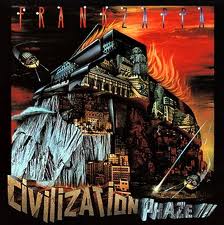
SOUNDTRACK: FRANK ZAPPA-Civilization Phaze III (1994).

There were a number of choices for soundtracks for this week’s read.  I could have chosen the Andrew Sisters (and their wonderful “Don’t Sit Under the Apple Tree”) who get a mention in the book.  And, of course, I could have chosen Elton John’s “Rocket Man.”  But, when I read Trudi tell Magda about her boyfriend Gustav who wants to live inside a piano, well, it was hard not to think of this, Frank Zappa’s final work.

Civilization Phaze III is an opera-pantomime.  According to the libretto, “The speaking characters all wear oversized masks, gloves and shoes.  They live in an abstracted grand piano….”  And musically opens with this introductory spoken passage:

FZ: The audience sits inside of a big piano and they listen to it grow.
Spider: People are going to sit inside of a piano. They’re going to listen to this piano grow.
John: They’re going to listen to the piano grow?

Civilization Phaze III was released posthumously in 1994.  But here’s the weird thing.  Most of the sessions of “piano people” dialogue were recorded in 1967.  Zappa had a bunch of people come into the studio, sit under a piano that was miked and improvise dialogue (sounds like the 60s to me).  He released some of this dialogue on his  late 60s albums, but as far as I can tell, the parts about the piano were never included (in Lumpy Gravy someone talks about wanting to live in a drum).  I’m also not sure how well-known the “piano sessions” were at the time.

So, here’s the question…did Zappa influence Pynchon or did these two people come up with the same idea at roughly  the same time.  The reason Zappa put off using the material recorded in 1966 was because technologies were simply not advanced enough to let him manipulate the dialogue so it would sound decent, much less coherent.  So Civilization Phaze III became his exploration of the past with contemporary technology.

He also recorded new spoken dialogue in 1991 and merged the two.  It’s an interesting idea, but I fear that the new dialogue absolutely misses the vibe of the earlier dialogue.  In the early dialogue, they all sounds like they’re stoned and are talking crazy nonsense about horses, smoke and music.  The later dialogue is much more abrasive (especially Michael Rappaport, the only person who has since gone on to renown).  At the time, Rappaport had been on one TV show as a guest, but by now he is too famous for this.  I find him a distraction (not Zappa’s fault obviously), even more so because he talks as if he is black (he says “Nobody said nothin’ when y’all bought my people, right?”) while he is demonstrably not.  And then ruins it contextually by mentioning Yo MTV Raps, the only thing that places the story in time.  It’s weird that Frank wouldn’t have a black person say these lines, especially since he has so many other races and nationalities represented in his music.  But maybe that’s me intellectualizing that I just don’t like Rappaport.

So, what’s this monstrosity about?  I have no idea.  Improvised stoner dialogue from the 60s is pieced together into a kind of story.  Occasionally Frank’s voice chimes in and prompts them to talk about certain things (which is quite  disorienting).  And the whole “plot” well, I’m not even sure if it can be called a plot, but Frank tries to cobble something together–again, the 1991 dialogue seems to be more pointed, more about conflict, possibly something about overcrowding and racism, and there’s certainly some social criticism at work, but as for a story, well, not so much.

The music, on the other hand, is the culmination of Zappa’s more experimental, atonal “classical” music.  Most of the first disc is performed on the synclavier while most of the second disc contains more actual musicians.  The music is difficult and not to everyone’s tastes, for sure.

Atonal music is far more intellectual than visceral, so it’s hard to “enjoy” this music.   Zappa obviously knew how to write catchy poppy friendly music, so this is a deliberate attempt to write something more challenging.  I like Zappa’s crazy music in small dozes, so listening to this entire thing (over 2 hours) can be a tough in one sitting.  But each piece (especially the two really long pieces “N-Lite” (18 minutes) and “Beat the Reaper” (15 minutes) ) showcases something interesting or satisfying.

The libretto that Zappa includes with the discs explains the story in far more detail and shape than one would ever get from listening to the music.  Without the book, you would know that this is a dark and moody piece, but with the book, you can actually see what the music is showing.  That may be a flaw, or that may be the way of a staged performance.  I have no idea if it was ever staged.

There are certainly easier introductions to Zappa’s music.

[READ: Week of March 26] Gravity’s Rainbow 3.6-3.10

Last week was a bear of a read for me, but this week was so fast (and short) that I just kept going because I was so into the Slothrop story (I won’t go past the spoiler line, I promise).  And yes, it’s (almost) all Slothrop this week.

Section 3.6 begins with Slothrop violently ill.  [I admit I don’t think of novel characters as getting ill very much–unless it’s a plot point–but surely characters get colds and tummy aches just like everyone else, right?].  He drank out of an ornamental pond in the Tiergarten–but, duh, everyone knows to boil water before drinking these days.  This also introduces Slothrop as Rocketman, something we won’t get more details on until later. (more…)

Read Full Post »

SOUNDTRACK: FRANK ZAPPA AND THE MOTHERS OF INVENTION-Over-nite Sensation (1973).

When I saw Marvy’s Mothers, it was hard not to pass up the connection to Zappa and his band.  But oh, what album to pick?  (He released like 40). I chose the one released in the same year as Gravity’s Rainbow.

It also happens to be full of all kinds of sex (imagine that).

It opens with “Camarillo Brillo” the kind of simple, catchy song that Zappa seems to whip out very easily.  I assumed that the title was some kind of sexual slang (not a bad assumption), but Wikipedia suggests it has something to do with an insane asylum (Camarillo) and the crazy hair they often had, which makes sense given the crazy lyrics.  It starts kind of trippy with inscrutable lyrics.  And then the bridge, “she was breeding a dwarf” is pretty insane.  It also features a very funny sequence that was oft-quoted in MST3K–“Is that a real poncho or a Sears poncho.”

“I Am the Slime” is a funky (a great Zappa riff) diatribe against TV (because it makes you buy crap you don’t need and makes you listen to the government).  “Dirty Love” is a perverse song with lots of guitar solos.  There’s some kind of bestiality in this song (which also ties in with parts of this section).

“Fifty-Fifty” features the vocals of Ricky Lancelotti (in a screaming style that would later be used a lot by Terry Bozzio).  It’s about an ugly guy who is crazy enough to sing to us.  The songs seem to be more about solos though, as there’s a keyboard solo an electric violin solo (from Jean-Luc Ponty) and some crazy guitar solos.

I don’t know what “Zomby Woof” is about, but it has some wicked guitar soloing and horns playing Zappa’s staccato riffs up and down the scale.

“Dinah-Moe Humm” is a song perfectly suited to this book–it’s a song in which a woman bets the narrator that he can’t make her have an orgasm.  The melody is twinkly and silly.  It’s shockingly explicit. But it’s even funnier to know that the backing vocals are supplied by The Ikettes (Ike and Tina were recording in the next room).  They got paid almost nothing and when Ike heard the song he called it “shit” and asked that their name be removed from the credits.

It also plays around with hippy slang.  “Kiss my aura Dora/It’s real angora/Would you all like some more-a/right here on the floor-a/and how about you fauna/You wanna?”

He also starts talking about Zircon encrusted tweezers, which come back in “Montana.”  “Montana” is about moving to Montana to raise dental floss (really).  It features some wonderful fast pizzicato notes that are more or less Zappa’s signature.  The middle section is  hugely difficult and very impressive for the backing vocalists (Tina apparently was really impressed that one of her girls could do it).

Zappa packs a lot of music into 35 minutes, and this album seems to be a turning point in his desire to cram sex and craziness into his commercial music.  Just about every song on this disc was played a lot live and this album has become something of a classic.

[READ: Week of March 19] Gravity’s Rainbow [3.1-3.5]

This week’s read has been the most challenging for me so far.  I enjoyed Section 2 very much.  The Slothrop scenes were funny and wild and even advanced the plot.  I never expected that Section 3 would introduce a ton of new characters, more or less ignore the old charterers and stay with these new characters so that by not paying close attention to them in the beginning I was just confused by the end.

I do admit that while skimming again for this post, I was able to focus on the new characters more and found it far less confusing.  It’s just that on a first read, suddenly there’s this whole new sequence of people and their histories to deal with!  Wow.

It was especially surprising because Section 3 begins with Slothrop (so it’s not like in 2666 where a new section means a new cast).  But he meets new characters and then we flash all the way back through each person’s life.  And yes, it was quite interesting once I actually paid attention, and the connections were pretty awesome.  But it was still pretty surprising on the first read through.

Section 3 is called In the Zone.  And the Zone is mentioned quite a lot, although I never figured out where it is meant to be exactly. (more…)

Read Full Post »

SOUNDTRACKDALLAS GREEN-“The Gift” on CBC Kids’ Mamma Yamma (2012).

I have no idea what Mamma Yamma is (well, obviously it’s a kids’ show on CBC–Wikipedia tells me, “Mamma Yamma, who is played by puppeteer Ali Eisner, is a yam who represents Ontario as the owner of a fruit and vegetable stand in Toronto’s Kensington Market” so now we know).  It’s pretty low budget and quaint and actually rather funny.  Also, (given the few links I’ve seen on YouTube) it must host some pretty hip Canadians.

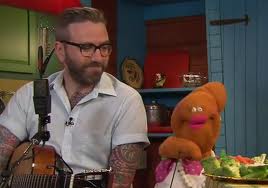
On this episode Dallas Green (who is City and Colour) sings a little tribute to Mamma.  here’s a brief intro and then he starts singing.  As one of the comments says, “Dallas Green: Phenomenal musician, terrible actor.”  And that’s pretty accurate.  If you can get through the awkward introduction (although I have to say Mamma Yamma is pretty funny…check out the clip with Jian Ghomeshi!), the song is really nice.

Dallas has a great voice.  Usually his songs are kind of angsty, but this one is really nice.  Not too many Dallas Green songs have the lyrics, “with jelly beans and sprinkles from front to back.”  I just hope that the kids aren’t running out to buy his proper album based on this.  It’s a rare treat for City and Colour fans.

[READ: November and December 2011 and January 2012] The Secrets of Droon, Books 13-SE#1

Even though I waited 12 books to talk about Droon the first time, this next section of books seems to have a definitive “arc” with SE #1 serving as a kind of transition. Book 13 introduces a new bad guy.  And although he doesn’t last all the way through to Book 16, Sparr is noticeably absent for this arc.  But just because Sparr is still missing, that doesn’t mean there’s a lack of trouble in Droon.

With this book, the series grows more magic based.  One of the first reviews I’d read of the series negatively compared it to Harry Potter.  I didn’t quite understand that since (in Books 1-12) the only magic came from the people who lived in Droon; the Upper World heroes didn’t have any.  Well, since book 12, Eric has gained magic and there is a bit more of a Harry Potter element now (remember HP was published in 1997, and really hit its stride around 2000).  I have no idea if Tony Abbott intended to give his main character magical powers from the beginning.  It’s possible, as there was magic in Droon, but Eric’s magic does add a new element to things.  He doesn’t use it often, it just seems to supplement things.  And remember, it’s not like wizardry is the point of Droon, the point has always been that the kids can work together to solve their problems (notice just how often Galen has to go away and can’t help any of them).  And, of course, this series is aimed at a younger group of kids.  Consider it a gateway book. (more…)

Read Full Post »

« Newer Posts - Older Posts »