Feeds:
Posts
Comments

Archive for the ‘Supernatural’ Category

SOUNDTRACK: TED LEO-Tiny Desk Concert #680 (December 4, 2017).

Up until now, I have more or less missed Ted Leo and all of his phases.  The blurb notes:

How you listen to Leo depends on when his work came into your life. If you’re a back-in-the-day type you might rep for Chisel, his ’90s punk outfit born on the Notre Dame campus and bred in Washington, D.C. If you’re just tuning in, you may have witnessed his understated comedy chops in arenas like The Best Show on WFMU and a highly enjoyable Twitter feed. At the center of this bell curve are those who found Leo at the dawn of the 2000s — when, at the helm of what’s most commonly called Ted Leo and the Pharmacists (shout-out to the typographical variants still mucking up iTunes libraries), he kicked off a run of five stellar albums in just under 10 years, each one urgently attuned to its political context and yet defiant in its ideas of what punk could sound like and whose stories it could aim to tell. Fans will tell you the songs about eating disorders and missing old ska bands felt just as vital to their moment as those that explicitly took on Sept. 11 and the Iraq War.

I know Ted Leo from when he played with Aimee Mann as The Both (they did a Tiny Desk show) and I am aware of Ted Leo + Pharmacists (the above mentioned typographical variant), but I somehow never really heard him/them.  I didn’t even know he was a Jersey guy.  (My friend Al is a big fan, I recently learned).

Recently, WXPN has been playing his new song “Can’t Go Back” which is wonderfully poppy and catchy and which I sing along to each morning.  Leaning more about him (and how funny he is in the Tiny Desk show) makes me want to see what I’ve been missing.

I obviously had no idea about his punk past, so I was pretty surprised to hear the feedback and heavy guitar of the first song here “Moon Out of Phase.”  Leo sings pretty hard on this song, too.  It’s fairly simple musically, but there’s a bunch going on lyrically that’s fun to pick out.

[After] the bone-rattling slow burn “Moon Out of Phase,” he smiled and explained the song was perhaps “a little heavy for noon — but, practically speaking, it helps me get the cobwebs out.”

“Can’t Go Back” couldn’t be more different. It’s catchy and not at all heavy.  It has backing vocals (provided by Leo himself) and just swings along.

 It’s a bit faster than on record, and as the blurb notes:

By the time he hit the first chorus of “Can’t Go Back,” a danceable bop about accepting that the life you have isn’t quite the one you planned for, any remaining cobwebs had been scattered to the wind.

Interestingly for being such a guitar based guy, there;s no solos on the songs (and yet they’re not short either, the first and third songs are about 4 minutes long).  Rather than a solo on “Can’t Get Back,” there’s a cool guitar chord progression.

He seems unsure of the quality of that song (not sure why–because he doesn’t hit those high notes perfectly?)  But then says he’ll finish off with a request.  “I’m a Ghost” is an old song that he doesn’t usually play solo, but figured he would because of the time of year (guess this was recorded around Halloween).

He tells an amusing story about someone asking about the first line: “I’m ghost and I wanted you to know its taking all of my strength to make this toast.”  The person asked if the toast was “a toast” or a ghost pressing the lever down on a toaster and “the hand of the frosty apparition is just going through the thing.”  He says it was originally “a toast” but now it is absolutely about the toaster, that’s the greatest metaphor for so many things.”

It’s really about “alienation from the political process.” It’s more rocking, like the first song, but with a catchy chorus like the second song.  This is a fun set and a good, long-overdue introduction to Ted Leo.

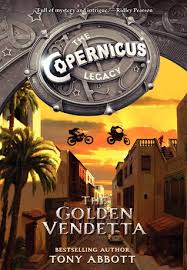
[READ: April 6, 2017] The Golden Vendetta

This is the third full-sized book in the Copernicus series.  It follows the mini-book about Becca.

I enjoyed this book more than the second one.  I enjoy the sections where they have some downtime and aren’t just running around.  And there was more downtime in this book.  I was also really intrigued by the way it began.

The families had been reunited and them separated.  So Darrell and Wade and the adults Kaplans were living in a hotel under an assumed name.  And Lily and Becca were also together under assumed names–but they were not allowed to contact the boys.  This went on for two months.

In that time Galina Krause had been inactive.  We learn that she had been in a coma, but the good guys never find that out, they’re just in the dark for months.

Until Galina wakes up and is on the move again.  And then everyone is on the move.

The families travel under assumed names but are still followed relentlessly by the bad guys. (more…)

Read Full Post »

SOUNDTRACK: WALTER MARTIN-Tiny Desk Concert #679 (December 1, 2017).

Walter Martin’s name didn’t sound familiar.  So this blurb helped:

Best known as a singer and multi-instrumentalist with the band The Walkmen, Martin has spent his solo career making unabashedly joyful, sweetly innocent and playful music perfectly suited for quirky four-part harmonies.

I sort of know The Walkmen; I know them more as an outlet for Hamilton Leithauser.  But after watching this, I find Martin to be a more satisfying performer.

I really enjoy his easy singing style and the every loose way he has with his guitar and with the songs in general.

Only Walter Martin would bring a barbershop quartet to the Tiny Desk.   The barbershop quartet is known as The Glen Echoes, a group of singers he found online and met for rehearsals the day before coming to NPR. It works particularly well on the song with which he opens this performance, “I Went Alone On A Solo Australian Tour,” a brilliant and comical call-and-response story-song about, well, going alone on a solo Australian tour.

“I Went Alone On A Solo Australian Tour,” is indeed really enjoyable.  Martin is casual and I love how the quartet starts out singing with him, then questioning him and then just acting like casual acquaintances–he asks them questions, too and they sing the responses.  All without losing the pacing.

It’s funny but also thoughtful.

The second song, the equally charming if slightly more wistful “Me And McAlevey,” is about a dear friend who lives in Maine.  It’s about friendship and loyalty and life as a middle-aged father.

The song is relatively simple and straightforward, but the guitar picking is delightfully complex and pretty.  I really like his vocal delivery and the way he ends his verses.

Martin closes with “Sing To Me,” his best-known song, thanks in no small part to its appearance in an Apple ad.

He describes it as the romantic centerpiece of his children’s album.  It is a pretty song once again, with lovely sentiments.  The pianist switches to electric guitar for a rather different sound.

The whole Tiny Desk Concert is delightful and makes me want to check out more of his stuff.  There’s no mention of who play what, but the mudsicians were:  Josh Kaufman; Jamie Krents; Brian Kantor; Richard Cook; Ken Sleeman; Mike Holmes and  Al Blount.

[READ: March 28, 2017] Becca and the Prisoner’s Cross

This is the second (and final) novella in the series.  It comes between books 2 and 3.  And, as the title suggests it is all about Becca.

The end of book 2 had Becca “materialize” on a boat in the past–right next to Nicolaus Copernicus.  It was a weird ending for a book that while sometimes magical, seemed to follow some kind of reality.  But this was different.  What could it mean?

Well, this novella explains it all (sort of).  We suspect that Becca’s proximity to the Kronos device when it went off triggered something.  (I keep wondering if it has something to do with her hurt arm which, frankly, shouldn’t hurt anymore, it has been two weeks, right?).

Anyhow, what we determine is that Becca is sort of passing out at home and her mind is travelling to Copernicus.  No time passes at home, but she is able to spend time with the scientist.  The best reveal comes early in the book when Copernicus senses that someone is there as well. (more…)

Read Full Post »

SOUNDTRACKPHISH-Live Phish Downloads 7.6.98 Lucerna Theatre, Prague, Czech (2007).

After finishing recording “The Story of the Ghost” in Vermont and Bearsville in upstate New York, Phish embarked on June 27th for a short European tour.

What’s interesting is that the official comments about this show talk about hoe legendary it was, and my takeaway was just how often someone (usually Trey) messes up.

“Buried Alive” is a surprising opening track.  It rocks and segues into a choppy “AC/DC Bag.”  The song ends with a funky section that segues into a 15 minute “Ghost.”  “Ghost has a fast and scorching middle jam section.”  I’m going to include some of the online notes here:

They deconstructed Bag’s concise jam into a perfect segue to the centerpiece of the show – a fast, funky and furious “Ghost.”  You can clearly hear the sonic flourishes layered over a driving groove with confident vocals that seethed energy. The dynamic feel of “Ghost” lent deep drama to the lyrics, highlighted the loops and effects and provided an ideal platform for some hairy soloing. Page migrated from piano to synthesizer, Clavinet to Rhodes in a floating conversation with the band. Eventually “Ghost” took on an electronic tinge that hinted at the deepest post-hiatus improvisation. This was fueled by Trey’s Hendrix-esque leads with bent tone and pitch into a series of shifting polyrhythmic counterpoints. Expanding until it seemed the room would explode, the music evolved into a funky groove with starts and stops punctuated by the now-roaring crowd.

“Ghost” segues into Talking Heads’ “Cities” which has a really sharp (weird) drum sound.  There a lengthy intro before the song starts properly.  The choruses are really slow (and someone plays a wrong chord).  But the song end with a really groovy solo that encourages people to clap along.

“Cities” started in double-time and shifted effortlessly into normal rhythm for the first chorus and the rest of the song. With the lyrics “a lot of ghosts in a lot of houses”, “Cities” continued the eerie theme of this already-historic performance, blending a smooth, creative vibe with an aggressive, rocking attack. Seemingly on cue, the band dropped out of “Cities” and left Trey to end the song alone with the clapping crowd. The momentary pause after Cities was the first time the band stopped at all, having linked Buried > Bag > Ghost > Cities into a powerful opening sequence for the ages.

“Limb By Limb” is mellow with Trey on guitars.

 “Limb By Limb” followed. Written by Trey on a sequencer with a drum part intended to stump Fish, Limb is always a feat of execution. This performance exhibited an added sense of dynamics no doubt spurred on by the intimate setting, highlighting restrained melodic dialogue among the whole band. While sometimes this jam breathed fire, this groovy interlude danced intricate circles around the glowing embers, leaving space for Fish to lay down some outrageous fills and cymbal work. Trey’s final solo culminated in repeated guitar fanning, which brought the song to a cathartic close.

Then comes “Train Song” and “Roggae” which gets more mellow by the end.

“Train Song” provided a moment of tranquil reflection in the middle of the set. The second-ever live “Roggae” followed, giving a chance to show off more new material in a new country as the band fashioned a coda with so much inherent space that the notes hung slightly suspended between phrases.

The 12 minute “Maze” perks everyone up.  There’s a lengthy keyboard solo followed by a nice solo from Trey.  During Maze the band stopped on a dime to thank the audience (and appreciate the architecture) , then finished the song.  It’s amazing how tight that was.

“Maze” blossomed into an electric improvisation starting with Page’s lively organ solo followed by a cacophonous solo from Trey who shredded unabashedly until the whole band telepathically stopped on a dime for him to say “We hope you’re all having a good time tonight…we just want to say that we really appreciate your support and how much we enjoy playing in Prague here.” Page interjected “We love the architecture” while Trey continued “I don’t think we got a chance to thank you last night so we just thought we’d take this moment to thank you very much.” After a quick countdown, the band re-entered the song in the exact shred-space they’d occupied before the acrobatic stop. After Maze, they closed the first set with Golgi Apparatus that had a rave-up ending with Trey shouting, in an apparent nod to the World Cup Soccer quarterfinals, “Jon Fishman, Jon Fishman, Hey, Ho, Hey, Ho”.

I noticed that “Golgi Apparatus” has a whole series of mess ups—someone is in the wrong key and can’t get free.

Set Two opens with the fast verses of “Julius” and then the slow staccato “Meat.”

Set two began with a swinging “Julius” that got everyone moving and Fishman passionately testifying at the highest peaks. “Julius” led into “Meat,” a new song. “Meat” returned the show to its initial ghoulish theme, confounding the audience with its multiple stops and starts. Immediately after Meat came a soaring, adventurous “Piper.”

“Piper” is 19 minutes long with a scorching solo in the middle.

“Piper” stretched nearly twenty minutes and bumped up against the boundaries already shattered by “Ghost.” Piper sped into a ferocious jam characterized by intense guitar runs … before it settled into hard rock with plenty of room for the whole band to explore. Like the experimental “Ghost” in set one, “Piper” was fearless, building to massive peaks before floating off into a slower, more minimal section accented by loops from Trey and Mike atop Page’s piano and Fish’s cymbal rolls. This part of “Piper” hinted at “Fikus,” part three of the “Ghost” trilogy, becoming slow and funky before locking neatly into the rowdy reggae of “Makisupa Policeman.”

“Makisupa Policeman” is a little goofy and fun. “Petrov” (Page) sings lead vocals. During this song there’s a drum solo and Trey tells the audience that if the solo is long and boring they should just whistle to make him stop.

As he scatted around the lyrics of “Makisupa Policeman,” Trey uttered the key phrase, “stink-kind”, adding a touch of home with “policeman came to Vermont!” He handed things off to Page for a piano solo (calling him “Petrof” after the logo visible on the rented piano) during which Page developed a ska feel. Trey announced a drum solo next, saying if Fish soloed too long the crowd should start whistling, as the band did when he talked too much. Fish played along, rendering a minimal solo of high hat, kick drum and rim shots, returning to the song in the nick of time. After some dancehall-style dub effects, the band finished Makisupa and dove into David Bowie.

The 13 minute “David Bowie” has lengthy washes of guitars and some noisy parts.

A thematic jam hinted subtly at Santana before riding a dissonant wave into the ending changes of the second and final Bowie of the European tour. With scarcely a pause, Page hammered out the opening notes of Loving Cup, cementing the status of this magical night.  it segues into Loving cup a loose jam

“Loving Cup” is a loose, fun version running almost 10 minutes.  There is much cheering at the “I know I play a bad guitar” line.

The encore is “Possum.”  It’s kind of slow and loping but fun.

The band returned for an encore and repaid the rowdy crowd’s enthusiasm with Possum. The audience clapped along for a bit eventually leaving the band to a textbook performance that was at once conscious and passionate, restrained yet explosive. Trey dropped a quick tease of “Stash” as he propelled “Possum” through machine-gun fans entwined with soft, dynamic sections that made this a perfect encore for such an intimate show. As the crowd filtered into the streets of Prague it was clear that this had been an unforgettable night that could only have happened when and where it did.

So there’s two takes on the show.  You can read all of Kevin’s essay here. and I’m going to re-listen to this show to hear the magic foe myself.

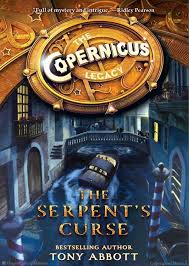
[READ: March 6, 2017] The Serpent’s Curse

This is the second full-sized book in the Copernicus series.  After reading the Copernicus Archives book I noted that the event of that book are not referenced in this book, but I was wrong.  There are several mentions to San Francisco.  It’s not a huge gap and you wouldn’t be lost without reading it, but it is odd that he would reference a book that apparently some people don’t read.

This book is pretty large–480 pages.  And I feel like it was kind of slow.  Or perhaps they just spent way too much time in Russia.  Or, and this is most likely the case–they spent the whole book looking for one relic.  And 500 pages is a lot of traveling for one item.

I’m bummed that I felt this way at the end because in the beginning I thought it was really exciting.  And Abbott filled in some things that a nitpicky reader might nitpick about with some interesting new developments.  One of the things that one has to wonder about is how this normal family will be able to jet set around the world.  Well, that comes with the assistance of a best-selling author with millions of dollars at his disposal.  Convenient? Sure.  But it’s a nice development.  The author, Terence Akroyd writes exciting thrillers (so of course he is interested in the plot) and he has a personal vendetta against the bad guys, so he’s happy to help out with money and resources, like his jets and technology. [That author is presumably not based on reality].

Terence also has a son, Julian, who is apparently pretty hot.  But he’s a few years older than our protagonists so presumably nothing will come from that.  Despite all of the potential romance between Wade and Becca in the first book and parts of this one, nothing is progressing on that front. (more…)

Read Full Post »

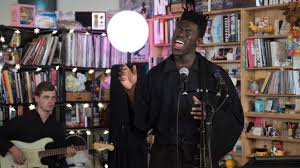
SOUNDTRACK: MOSES SUMNEY-Tiny Desk Concert #678 (November 29, 2017).

I had never heard of Moses Sumney before this show.  And the blurb seems to anticipate this:

If you don’t know this Los-Angeles-based force of nature, and haven’t heard him on tour with James Blake or Sufjan Stevens or perhaps on albums by Beck or Solange, then this is your chance to watch one of the most thoughtful talents of today as he makes music that is outside the box but easy to relate and connect to.

I’m very curious to know what he did with Beck.

I found Moses’ voice to be mesmerizing–a gorgeous soaring falsetto that he seemed to effortless get to rise higher and higher.  But beyond that, the blurb talks about his lyrics:

Moses Sumney puts a great deal of thought into the heartfelt music he creates. On his debut album, Aromanticism, he was inspired by everything from the works of Plato and Aristophanes’ account of the origin of humanity to the Bible, particularly Genesis and the story of creation. It’s all in an attempt to understand human relationships and the sorts of couplings we tend to be drawn to.

He plays 3 songs in the 20 minute time frame.  I wanted to describe the first song, but Bob’s description is too good:

The concert opens up with Moses not behind my desk, but at the piano we keep in our office. As his team of sax, harp and guitar players set up, Moses sat at the piano and began to play “Doomed.” He had instructed the band, which had already perched behind my desk 40 or so feet away, to create a transition for him to walk from piano to desk, continuing one of the most inspired 8-minute stretches I’ve witnessed here at the Tiny Desk.

So he plays the pretty piano melody and sings with those gorgeous falsetto vocals for about a minute and a half.  Then he strolls (in his cape) to the desk.  He activates some looping pedals.  He plays a beat on the microphone and then Sam Gendel plays a cool modified sax solo.  After 2 minutes of set up, he sings again.  The beats are in full and Brandee Younger is playing some simple gorgeous harp and Mike Haldeman has some echoed guitar on top.  Meanwhile, Sam has switched to a synth and Moses is also playing some kind of synth.  The song builds beautifully and he sings in a  higher and higher register.  It starts to sound otherworldly with the harp and his voice and the loops going faster and faster.  And then the wall of noise abruptly ends and the final minute is delicate and lovely.

He introduces the band and then says “we’re going to keep making noise.”  And then “hopefully no one’s printer goes off” (wonder if that happened).

“Quarrel” opens with him looping his own voice and then playing it faster and faster so it sound like a skipping CD.  Sam has picked up a guitar to pluck out notes (the head of his guitar is fascinating and I want to see it better).  Throughout the song Moses hits that looped vocal section for one or two seconds to add texture–it’s pretty cool.  The mix of that harsh(ish) electronic sound and the angelic harp is wonderful.

For the final song, “Plastic,” he removes his cape.  Everybody else leaves and he says “I want to make more room… for me!”  He picks up a guitar and says, “This is the end.  The bitter end.  Although for some of you, it will be sweet because it’s ending.”  It’s interesting how self-deprecating he is when his voice is so gorgeous.

This final song is much more jazzy with him playing interesting chords and singing to the guitar.  Overall it’s a bit less exciting than the other songs possibly because the last minute or so is just him repeating the line “my wings are made of plastic.”

But overall, Moses Sumney really impressed me with this set.  Right up to the end where he sinks slowly below the desk, to much laughter.

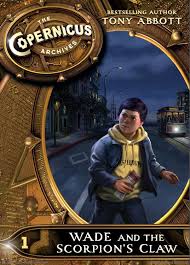
[READ: March 6, 2017] Wade and the Scorpion’s Claw

The Copernicus Legacy is a four book series.  But, in an interesting diversion, there are also two “extra” books inserted between the first two.  They are smaller and do not exactly affect the continuity of the main story, but they seem to delve into one character a little further (and there is some plot advancement).

Interestingly, Book One of the main series ends with Kaplans and their friends leaving Guam for New York.  The second book of the series opens with them in New York.  But this book, the first of the The Copernicus Archives, takes place between Guam and New York.  The big difference is that unlike the main books, this is told entirely from Wade’s Point of view.

En route to New York, the family has to stop in Hawaii.  They are in the airport for a while and they trust no one.  They are waiting for the flight to San Francisco when there are two notable people in the airport around them.  There’s a German man (you can tell by his shoes, Lily whispers) in a leather coat.  The kids don’t trust him and call him Leathercoat.  And then there’s a Chinese man doing acrobatics and other tricks to amuse some children while they wait. (more…)

Read Full Post »

SOUNDTRACKPHISH-Live Phish Downloads 12.7.97 Nutter Center, Dayton, OH (2007).

This concert included five covers out of a total of nineteen songs.

The show opens with a fairly slow “AC/DC Bag,” but there’s a seamless segue into an excellent cover of Talking Heads’ Psycho Killer” (only the second time they’d played it).  There’s some spacey sounds in the jam which then segues nicely into ZZ Top’s “Jesus Just Left Chicago,” a groovy blues.  The whole thing ends in a jaunty bluegrass “My Minds Got a Mind of Its Own.”

I have to admit at this point I’m pretty bummed by the setlist.  The songs are all good and the jams are fun, but if I were at this show I’d want to some actual Phish songs, you know?  I know a lot of people love the covers, but that’s not what I’m here for.

They rectify this with a fun “It’s Ice.”  There’s a lengthy piano solo and then the song segues into two deep cuts from Billy Breathes–a one minute “Swept Away” and then a one minute “Steep”–before closing “It’s Ice.”

Up next is a 10 minute “Theme from the Bottom” with a long solo and great harmonies at the end.  Then the band plays a great funky “Tube,” a non-album track with some great 70s sounding keyboards from Page.  After a pause (apparently the lights went out).  You can hear them chatting a bit and then they pick up a 6 minute instrumental called “Dayton Jam” that plays with the themes from “Tube.”

The set closes with a 12 minute “Slave to the Traffic Light.” There’s a great solo from Trey followed by a mellow section before coming to a good solid end.

Usually there’s a few really lengthy jams in the second set, but this upcoming set is full of mid-length songs.

It opens with a jam-filled 9 minute “Timber” and then a 7 minute “Wolfman’s Brother.”  This segues into yet another cover of Stevie Wonder’s “Boogie on Reggae Woman” before settling into a fast-paced 14 minute “Reba,” the longest song of the night.  The solos in the song remind me a bit of Frank Zappa.  It’s really amazing how tight they are during these jams.

Before they begin the next song, you can hear Trey ask, “Guyute?” and they play a 10 minute jam with a really fun middle section.  The show ends with a 12 minute “Possum.”  So while there are no really super long jams, there are a number of pretty long jams.

The Encore is a great loose version of The Beatles’ “A Day in the Life.”  I love how they handle the end.  The classic chord progression that ends the song is done sort of like that but more just fun noisy chaos.

[READ: March 6, 2017] The Forbidden Stone

I really like Tony Abbott books. He has tackled many different stories and I’ve found that I haven’t been disappointed by anything he’s written.  This series, The Copernicus Legacy is in the vein of The 39 Clues, although there are plenty of differences.  But as an outline, the premise is the same–some kids (and an adult) are trying to save the world from bad guys by collecting a bunch of things that cannot fall into the wrong hands.

Whereas The 39 Clues divides the family into 4 warring clans, this series seems to be basically good guys and bad guys.  The good guys are inspired by Copernicus.  This works out well because the main family loves astronomy.

So the main family is Wade Kaplan and his father Roald Kaplan.  Wade follows in his father’s footsteps and loves the stars and science. Roald is re-married to Sara (who is on a business trip as the book opens).  Sara has a son named Darrell.  Darrell is hip and cool and plays guitar.  He is also always hungry (a trait that Abbott loves to have in at least one character, although I haven’t seen it as being very important yet–and it seems to fade as the book goes on). I assume that Roald is not Darrell’s father as well, but I got a little lost in the family tree.  The crux is that Wade and Darrell are stepbrothers–and they get along really well.  The rest of the crew includes Wade’s cousin Lily and her friend Becca.  Lily is a techie girl who is able to wield a smart phone like a librarian.  And then there’s Becca  who is, interesting. Wade has had a crush on Becca (who is super smart and can speak several languages because her parents traveled so much) for a long time.

Okay, so there’s five people.  How does the excitement start? (more…)

Read Full Post »

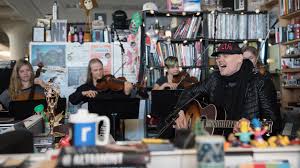
SOUNDTRACK: BILLY CORGAN-Tiny Desk Concert #674 (November 20, 2017).

Back in the day, I thought Smashing Pumpkins were pretty awesome.  I even enjoyed the bloated Mellon Collie.  Billy Corgan is a terrific songwriter with a flair for the drama.

Then I got really turned off by him.  Whether his ego exploded or if it just really became public (and the fact that he always wore a shirt that said zero), I;d had enough of him.  I didn’t even listen to any of the Pumpkins’ later albums (band fighting didn’t help that).

recently, NPR played the new song by William Patrick Corgan, a sweet piano ballad.  And I realized that I really don’t like Corgan’s voice  And the more I thought about it the more I didn’t like his voice in the old songs either–but the intensity if the music and his delivery overshadowed the parts that annoyed me (which is more noticeable when the songs are slow and mellow).

So what had Corgan been up to

Billy Corgan is a complicated guy. In the years since that iconic and much-beloved rock band broke up in 2000, Corgan has continued to put out music under various names and projects – including several releases as Smashing Pumpkins, with different lineups – while often stumbling through a bumpy minefield of his own making. To the head-scratching surprise of some longtime fans, he’s gotten heavily involved in pro wrestling, talked conspiracy theories during several appearances on The Alex Jones Show (warning of weaponized zombies in one interview), and, over the years, lobbed innumerable grievances about former bandmates, while trashing other musicians and publicly feuding with a revolving cast of celebrities and public figures.

More recently, Corgan seems to have mellowed. He opted to release his new solo album Ogilala, under his (very grownup-sounding) full name, William Patrick Corgan (though he very recently changed it back to Billy Corgan on streaming services and YouTube), and filled the record with beautifully rendered acoustic songs built on piano and strings.

Corgan plays three songs in the Tiny Desk Concert.  Impressively, he plays “with a string quartet he’d just met hours before”: Kristin Bakkegard (violin), Livy Amoruso (violin), Paul Bagley (viola), Carol Anne Bosco (cello).

He opened with a stirring rendition of the 1995 Smashing Pumpkins song “Tonight, Tonight.”  It sounds great with the simple acoustic guitar (it’s really a lovely melody) and the strings.  I did realize that I don;t really love his vocal delivery, but I’m so caught up on the strings that it’s hard to care.

It’s also odd that he kept on the heavy scarf, hoodie, down jacket and cap, but it didn’t seem to hinder him ob guitar or the final two songs which he played on piano: “Aeornaut” and “Mandarynne.”  I don’t understand the titles or what they have to do with the words I can pick out, but the melodies are again, lovely.  The blurb say they are about “staying strong and true to yourself and soldiering on in the face of a troubled world.”

He doesn’t say anything, and he seems pretty businesslike, but he acts graciously at the end.  And it’s nice to read that

Corgan was nothing but a good-natured delight. After years of selling millions of records and playing packed arenas, he showed up in a cab with just his tour manager and, during setup and rehearsals, joked about being all DIY now.

I haven’t listened to Smashing Pumpkins in a long time.  Maybe its’ time to bust out Gish again and enjoy Billy when he had long hair.


[READ: April 30, 3017] Captain Marvel: Rise of Alpha Flight

After two lighthearted series with Captain Marvel, new writers have come along and changed the tone of her story line quite a bit.  Indeed, everything is different from the DeConnick stories, right down to the incredibly different appearance of Carol Danvers on the cover and even the logo of Captain Marvel herself.  The art in these books is by Kris Anka and Felipe Smith)

When I looked this book up to see where it fit in to the series (it’s very confusing when there seems to be a recurring Volume 1 (this covers issues 1-5)), I read that a lot of people didn’t really like this story line.  So I wasn’t expecting to like it either.

But I found that I really enjoyed it a lot.  It’s very different from the whimsical stories from DeConnick (this arc was written by Tara Butters and Michele Fazekis) and in fact, since it is all set in space, I felt that it took on a kind of Star Trek quality which I enjoyed quite a lot. (more…)

Read Full Post »

SOUNDTRACK: NOW, NOW-Tiny Desk Concert #672 (November 15, 2017).

I really enjoyed the Now, Now album Threads.  It had a synthpop feel but with some cool slightly darker elements that kept the listener guessing.  The blurb describes it like this: “Its songs carried in them a weary recognition of how desire and nostalgia linger in the body and mind.”

I had no idea that it was released five years ago.

So I was pleased to see them on the Tiny Desk Concert.

But in the intervening years, their sound has become more poppy with (at least in this recording) many of the darker elements smoothed over somewhat.

Now, Now took the Tiny Desk stage with a minimal setup (dig the sampler as drum kit) that laid the vocals bare, but still lent the songs a room-filling pulse. Among those songs were “SGL” and “Yours,” the two singles that heralded the band’s return this summer (a full five years after Threads, with a pared-down lineup and no album yet announced, though the rumors say next year).

I hadn’t heard those singles.  But they are poppy and KC Dalager’s voice has become much more breathy.  Bradley Hale’s synths are very bouncy and sort of 1970s-sci-fi documentary sounding.

Jeffrey Sundquist and Daniel O’Brien join them, but I’m not sure who does what.  The guitar is quiet and echoed, adding textures to the songs.

Before the final song, they thanks NPR for their support and then KC says, “This [Tiny Desk] is the one thing we’re doing that my mom was really excited about.”  The final song, “Separate Rooms” is from Threads.  It retains some of the feelings of the original, but the synths still have the newer bounciness which is a little disconcerting.  The original also has a lot more guitar in it.  I almost don’t recognize the song.

It’s hard to know how different these songs would sound with a big drum sound (it’s funny to see the drummer standing there with his hand behind his back the whole time).  But I definitely don’t enjoy them as much as the original.

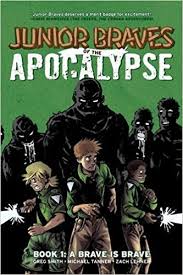
[READ: May 2, 2017] Junior Braves of the Apocalypse: Book 1

I saw this book at the library and I was intrigued by the title.  And, seeing it was from Oni Presss, I knew it would be a good read.   And, boy was it ever.

Without trying to reduce the story too much, call it a male version of Lumberjanes but with a whole end-of-the-world, zombie vibe thrown on top.

The book begins on Day 1 as we see a gruff and, frankly, angry-looking dude waiting for someone.  Turns out he is Padre Ron,the adult leader of the Junior Braves.  And over the next few panels we meet the braves.  There’s Travis (a bossy, jerky kid) and his (dorky)brother Marvin.  There’s Lucas, who is mad that they don’t say prayers. There’s Johnny who is Native American living with a foster family.  He is sullen and quiet.  And then there’s Raj (whose mom is overly cautious and thus, so is he) and Amir, a rough kid who knows Krav Maga.   And then there’s Dylan.  Their other adult leader is a recent graduate named Buddy.

Padre Ron is, as I said, kind of jerk, telling the parents that their boys will go out as children and come back an men and blah blah blah.  Exactly the thing that would make me hate the Scouts if we did that now.

Then Padre lets Buddy know they are not going to the promised camp.  The are going to a very secluded spot that proves to be very cool indeed.  Everyone has a pretty good time (except maybe Johnny) for 7 days.  But as they head back home, something… everything is wrong. (more…)

Read Full Post »

SOUNDTRACK: RHEOSTATICS-Fall Nationals, Night 7 of 10, The Horseshoe Tavern, Toronto (November 17, 2004).
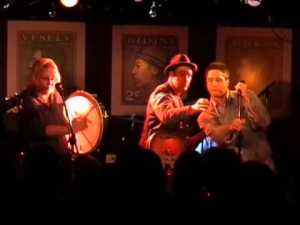
The Rheostatics, live at the Legendary Horseshoe Tavern in Toronto, November 14, 2004. This was the 7th night of their 10 night Fall Nationals run at the Horseshoe.

I compared all of the setlists from the nine shows and was somewhat surprised to see just how much repeating they did. Most of the rep

 Two versions are available – Mark Sloggett’s soundboard recording and 8 track files provided by Steve Clarkson.  The Sloggett download has 8 minutes of pre show intro music, which I assume is on the PA.  It starts out kind of synthy and cool then turns into piano music then a big horn-filled jazzy song then back to piano as mike starts playing some drums and that’s the official start of “Who Is This Man, And Why Is He Laughing?” even with the PA music still playing.   Despite this being guest vocalist night, this song is instrumental with accordion and clearly spoken Polish.

Martin says they’re not supposed to sing tonight so they’ll do an instrumental version of “Four Little songs.”  No one sings their verse, but Chris String on keyboards plays a lengthy sample: you gave this to, me but you cannot escape, not this time.”  They play the song really well without the vocals and for the end someone is ringing bells in tune.

Dave welcomes everyone to the 4th annual Fall Nationals and introduces their first guest vocalist Robin Lowe from Pittsburgh, PA.  She sounds great singing “Introducing Happiness.”  She’s followed by Melissa McClelland who asks, “Can I do something on this?” and someone jokes, “no don’t touch the keyboard.”  “Can I do some beat boxing on the mic?”  “Absolutely.”  She doesn’t beatbox but she sings a beautiful version of “Aliens (Christmas 1988).”  It’s a bit of a different vocal melody than martin sings and is quite wonderful.

Mike Bell comes out to sing “Beerbash” guessing that they haven’t done this in a while.  It’s rocking and fun/sloppy.   Then Paul Linklater and Donna Orchard
come out to sing “King Of The Past.”  Dave notes that “you guys sang separately last year.”  Which they did.  They do a kind of dramatic singing of the song which I think I like, but not as much as the original.

Dave says, “The beer is here and so is my adorable wife.”  Janet Morassutti who has co-written many songs sings “It’s Easy To Be With You.”  She has a good, deep voice and I love when she gets into the 1,2,3,4.

Kurt Swinghammer comes out and introduces the Trands-Canada Soul Patrol back in the house.  But Dave says they’re supposed to be backing Brenda Lee.  Kurt continues, “It’s time for a Tim Vesely song.  He’s sort of the George Harrison in the band.”  This brings forth three jokes at once including Dave saying he;s more of the George Foreman of the band.   They do “Loving Arms” and Dave says, “you’re lucky we did this last night.”  He sings in a deep and ponderous voice not sure it’s quiet right for this sweet song, but he does a great job with it.  The song ends but the give Kurt an extra solo.

Michelle Rumball comes out and says, “Dave do you know that the last time that I was supposed to sing this song, I showed up and only knew the backing vocals.”  Dave says, “I’ve never forgiven you for that.”  “It was like ten years ago.”  Then Dave notes “No one ever sings “Saskatchewan Part 2”  Michelle says, “next year?”  It’s slow and moody and she kind of messes up a bit but holds it together.  Chris Brown gets a keyboard solo.

Greg Smith of the Weakerthans recently.  He’s going to sing “The Tarleks” and they start asking him “what are you doing now that KRP shut down?”  He says he gets a lot of questions about Bailey Quarters–everybody liked her more than Loni Anderson.   There’s lots of wild synth stuff in the middle.

Chris Brown comes out for “Bad Time To Be Poor” and there’s some seriously off guitar to start the song, but they settle down and play along nicely.

Then they need to take a five-minute break to work on equipment.  Martins Steinberger guitar died.  It led a rich life and needs to go to the hospital.  Sorry about that.

Royal Wood sings a pretty version of “It” and then Steve Stanley puts the power back in “Power Ballad For Ozzy Osbourne” including the intro.  They say that he is currently in a band called Midi-Ogres.  At the end of the song, there’s sustaining feedback note–“make it stop make the bad man stop, stop the fucking note, Mike.”  While they’re fixing that, Chris plays a sample:, “I’ve been practicing every day for a year.  I can’t even learn a piece in a week.  When will I learn to play real good?  How long does it take?”

Jen Foster sings “Take Me In Your Hand” (no accordion) and they do the penny whistle ending.  Justin Rutledge comes up for “Marginalized.”  Dave notes that he played with the last night and slayed the house. There’s some raw guitar sounds, but not as interesting as Martin’s.

Amer Diab comes up to play “Lying’s Wrong.”  Mike says, “Shit, I don’t think I’ve ever played this one.”  Dave: “me either.  How does it start?”  “Thanks for pulling that out of the closet.”

Howard Druckman and Beverly Kreller come out to sing “Chansons Les Ruelles.”  Bev plays the bodhran, which is evidently too loud in the monitors, which makes Dave says, “You’re the John Bonham if bodhran players, aren’t you, Bev?”  Mike: “John Bodhran.”   Howard says, “I remember the People’s Republic of Dave.”  Dave says, “You know Broken Social Scene stole everything from PROD.”

Kate Fenner sings “Northern Wish.”  her raspy voice is nice with this although she misses the “built my rocket” section.  Reid Jameson sings “In This Town” and dedicates it to all the Pisces in the room.  “Posses of Pisces.”  Martin says that he hasn’t listen to it since they recorded it.  They typically play a different version.

Dennis Ellsworth sings “Palomar” but the teleprompter seems to give out for a few seconds.

Simon Wilcox sings “Dead is the Drunkest You Can Get.”  But it causes nothing but trouble.  “Anyone remember how to play my song?”  Tim: “I thought this song only ever appeared on a t-shirt.”  She has a sultry, almost sexy delivery.

Matthew Cowley sings “My First Rock Show” although ta the end he says “He was there, I’ve never seen any of those bands.”  During the Joe Jackson saved my life part, Dave chimes in: “hes always doing that.”

Chris plays the “we are the music makers” sample from Willy Wonka.

Simon Head sings “Shaved Head.”  He says “It’s fun to be part of Rheostatioke.”  Martin says, we were thinking rheo-oke.  It sounds good.  The heavy part is really heavy.  At the end everyone comments: “Nice Vegas walk off, Simon.”  Martin: “next time we do that I’m going to do a walk off like that.  The walk off is underrated.”

David Celia does a nice version of “Claire” and Yawd Sylvester sings “Record Body Count.”  They have fun with Yawd (who mentions Tim’s album that he played on).  They call him the one-armed bandit and then say that “Yawd gives this the one thumb up.”  I wonder what happened to him.  There’s some fun jamming guitars (and accordion?) and other sounds.  And he says “Thanks you guys for putting smiles on 28 faces.”

Ford Pier comes out and Tim says, “Thanks, Ford, for not making us learn ‘Motorino.'” He retorts, “I didn’t not make you learn ‘Motorino,’ you refused to learn ‘Motorino.’  Who wants to hear ‘Motorino?’  Yea, well it’s not going to happen because of the lassitutde of these bastards.”  Tim: “That song is fucked.”  Ford: “It’s a damn good song and next year you’re not getting off the hook so easily.”  [He doesn’t sing it next year]. Tim: “It’s like five or six songs.”  Mike: “The only reason it didn’t happen is because you just got off a plane yesterday.”  Ford: “Perhaps we should be doing “Connecting Flights.”  But instead they play “Junction Foil Ball” and everyone messes it up at one point or another.  Guitars, vocals, timing.  It’s a mess, but fun.  And then right away starts the clapping for the next song, “Rain, Rain, Rain.”  Selina Martin sings it kind of crazy and growly and the final verse is pretty silly.

And then they’ve made it to the end.  John Crossingham comes out and they comment that making it to the end is an achievement in itself.

Mike wonders, “Is there going to be an encore?  Or are we going to be more theatrical about this?”
Tim: “The encore is tomorrow morning.”
Dave: “The encore is Selina Martin jumping around a bit more.”

The next song takes a bit of extra special tuning preparation, bear with us.  So John takes the time to thank the band for such a wonderful idea.  It means a lot to all of us who have graced the stage this evening.

Then Dave asks, “John where’d you get your toque?”  John: “On the floor at a Green Day concert at the Rico Coliseum.  I stepped on something and that was it.  I did wash it before I put it on my head.”  Dave: “You’d have to be pretty drunk to leave toque like that at a Green Day show.  How was the tour?”  John: “It was good.  Had its ups and downs.  His book On a Cold Road got us through.  If you haven’t read it already pick it up.  They’re even selling it over there, smartly.  Or perhaps you’d like to read about Italian baseball or hockey in the Republic of China?”

And then they’re ready to end the night with a great version of “A Midwinter Night’s Dream” (which is not available on the Slogett MP3 download).  John does an amazing job with this really difficult song.  He even hits the super high note in the middle.  It’s a solid version, and while I love Martin’ more of course, it’s really enjoyable.

There’s no encore since the show was already 3 hours long (!).  Although there is a crazy noise at the end of the song for a couple of minute–with synths and Martin messing around.

What a fun night.

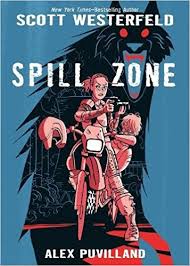
[READ: July 7 , 2017] Spill Zone

Sarah loves Scott Westerfeld, although I hadn’t read him before. I had to wonder if this graphic novel was also a traditional novel, because I’d love to see how he described the visuals.  But I believe it is only a graphic novel, so I just get to marvel in the visual imagination of Alex Puvilland.

This book starts out weird, no doubt.  Addison is a teen with a camera.  She has been taking pictures of her hometown in upstate New York.  Which isn’t so strange except that her town is a Spill Zone.

What’s that? Well, actually I don’t know yet.  Suffice it to say that it’s not good.  There are dead people, weird sightings and a roadblock with military personnel.  Addison speculates it could be a nanotech accident colliding with the nuclear power plant, an alien visitation, something from another world?  Some people escaped, like her sister Lexa, but most didn’t, like her parents.  Addison was not there when it happened, and since the accident Lexa hasn’t spoken a word.

She is part of group if what she calls crazy tourists who like to take pictures of the disaster. (more…)

Read Full Post »
olymmpSOUNDTRACK: RHEOSTATICS-Fall Nationals, Night 1 of 10, The Horseshoe Tavern, Toronto (November 11, 2004).

The Rheostatics, live at the Legendary Horseshoe Tavern in Toronto, November 11, 2004. This was the 1st night of their 10 night Fall Nationals run at the Horseshoe.  This show was exactly 13 years ago!

I compared all of the setlists from the nine shows and was somewhat surprised to see just how much repeating they did. Most of the repeated songs are new ones–they played a lot from 2067, which makes sense.  But for a Fall Nationals, there’s really not a lot of “popular” or “rare” stuff.  But the band is in terrific form for all nine shows and the recordings are consistently great.

PIN is kind of sweet sounding, Martins guitar “sounds” even “smaller” than usual.  As with many versions of this era, he’s changed the line to, “you’ve got the key to my bosom.”   Then you hear Mike say, What are we playing, I don’t have a setlist.

They are playing “Soul Glue” which is delightfully chaotic with all kinds of backing vocals (MPW is great with the b voc).  Tim is having a bit of fun with this song, calling the “poliziei” and adding the line: “execrate, take a big dump on.”  It jumps right into “Polar Bears and Trees.” Martin is making some really cool scratching sounds before he brings in the big riff.   The “can’t do it” part feels like a fun improvised section with lots of different vocal parts overlapping.

Martins guitar sounds great on “Marginalized.”  I love the little fills and of course the crunchy guitar.  This song does loud and quite together very well.

Introducing “The Tarleks,” Martin says we made a new friend the other day.  His name is Frank Bonner and he played a brilliant character Herb Tarlek in the WKRP TV show.  He knew what was going on.  You never know when you meet somebody what their situation is, but his was good.”  The song is really great with lot of keyboard accents from Christopher…  Lots of banter from the band:

We got a new guy, Chris Stringer.  He’s shy but he’s new.  He’s just checking us out.  He got the elite week pass–sit on stage and play synthesizer with the group.  Did you win that off the radio station or something?  He didn’t go far enough to get the vocal mic.  Oh he got it, he went for the super deluxe gold.  He helped us make our last record and he’s up here to help us remember how to play it all.

This is the first song on our new album “Shack In The Cornfields,” it’s about growing up as a kid in Kitchener and wandering around cornfields.  Next comes “Pornography.” The intro sounds like “Bread Meat Peas and Rice.”  When the song ends Mike shouts: Four. More. Beers!

The keyboard solo on “Here Comes The Image” is pretty similar to what Mike plays but with a few more frills.  “Try To Praise This Mutilated World” starts out quietly with some picked acoustic guitar.  Then Martin throws in some gentle solos and Tim adds some bass.  I love this song as it gets bigger and bigger–the guitar lines and the harmonies are just wonderful.  Its unclear who does the spoken word–recording or live?  I assume recording.

“The Royal Albert (Joey Part 2)” starts almost comically with a really strange pacing before Martin starts singing about Joey.  Midway through the song they start the riff to “Satisfaction.”  As it ends, Mikes says, “that was corpulent.”

Dave introduces a “couple of songs that kind of go together thematically.”  They play a quick two-minute romp of “Torque Torque” which segues right into “Claire.”  Martin gets a great solo which is followed by a rather strange keyboard solo.

Torque, Torque is a quite 2 minute romp that segues right into Claire  after a great martin solo there’s kind of an odd.

Send those two out to Paul Quarrington our friend nominated for the Giller Prize tonight–didn’t win but it looks good on him.  A friend of his daughter will be opening for us on Sunday: Hebrew School Drop Outs.  All ages, late afternoon matinee.

Dave: I got my beer back.  Touch and go for a minute there.  It’s called “Trailhead,” I’ve never seen of it before either.  Is that a kind of fish, Martin?  Nope. “A mythical beer fish?  Canada’s national animal is a mythical beer fish.”

“It”starts out slow and then has a roaring guitar solo in the middle.

Our new back drop for 2004 (up at the top).  Designed by Martin.  We’re auctioning them of at the end of the run and all profits will go to ….charity?  Mike: “yeah, that’s right, charity.”

“Making Progress” has a cool creepy synth opening and a very pretty acoustic guitar ending.  The more I hear “It’s Easy To Be With You” the more I’m surprised it wasn’t a hit.  There’s certainly some weird lyrical content what with it being from a kids’ album, but it’s so catchy.

“Stolen Car” starts out slow with a lengthy intro.  Martin sounds great and there’s a terrific solo from Martin.  He ends it in the middle of a line though, I think he should have stopped but kept going.

“Little Bird, Little Bird” is slow but nice.  There’s some lovely, quiet work from Martin throughout the song.  When it ends, Dave says, Happy remembrance day.  Do you say happy Remembrance Day?”  We’ll do two more for you.  It’s getting late.  Don’t want to overstate our case.

They play “Aliens” which sounds great.  There’s a cool spacey solo and some fun bass work from Tim in the middle of the song.  It gets extended with Tim playing a faster bass line and Martin saying “jamming!”  Martin gets into it with some crazy guitar sounds muttering “gabba gabba hey” and then the group singing all kinds of classic rock lines: “Mother…” “Voodoo Chile.”

Dave thanks everybody but Martin starts playing the opening to “I Dig Music.”

Tim: he said two more.

They have a lot of silliness with this song, appropriately.  Mike: there’s only so many more times I’m going to come out here and do this.  This is one of them. During the end part “some say I’m an animal,” Tim sings “too bad,” “too fucking bad” in falsetto.  The full song is called “I Dig Music (The Jazz Animal)” but by the end they are singing “Jazz enema.”

During the encore break, Dave says “Chris will be with us every day but tomorrow.  It’s his brother’s wedding tomorrow (Mike says: “he’s got to spend the night in jail).

Tim: thanks to By Divine Right for starting this whole thing off in the rockingest way possible.  We have a weeklong pass that’s available for sale.

When they mention the all ages show, Mike points out: “there will be a little bowl of earplugs for the young ones.  Dave says: “You can eat em too.”  And cigarettes for the youngsters.  Dave: they don’t call them candy cigarettes anymore they call them candy stix.

They play the mellow instrumental “Who Is That Man, And Why Is He Laughing?” which I would find a disappointing encore, except it’s followed by a rocking intense “Fan Letter To Michael Jackson.”

This is a terrific show and runs almost 2 hours and 15 minutes.

[READ: Summer 2017] Olympians 9

I’m still not sure how many books O’Connor has planned for this series, although in his introduction he talks about saving his favorite books for the end, so I assume there are at least two more (although 12 seems reasonable).

Here’s the summary of the man himself:

George O’Connor is a massive geek and Greek scholar.  He has done lots of research for these books, including going to Greece and visiting sites and antiquities as well as comparing all manner of ancient stories to compile the most interesting pieces. He explains that since these stories were orally passed down, they were modified over the years.  He doesn’t change the myths, he merely picks the story lines that are most interesting to him.  And then he adds a lot of humorous modern touches (and dialogue) which keep it from being at all stuffy.

O Connor’s drawing style is also inspired by superhero comics, so his stories are presented in a way that seems much more like a super hero than a classical hero, which is also kind of fun.

Each book ends with an author’s note which is hugely informative and gives plenty of context.  It also has a bibliography, but more importantly, it has a list of notes about certain panels.  Do not skip these notes!  In addition to providing a lot of insight into the myths of the characters themselves, there are a lot of funny comments like “Greeks raced in the nude (point and laugh)” which really bring new depths to the stories. (more…)

Read Full Post »

SOUNDTRACK: THE ROOTS-Tiny Desk Concert #665 (October 30, 2017).

This Tiny Desk starts out with The Roots walking into the area, sousaphone playing a fun riff and everyone clapping.  Questlove takes his seat behind the drums.

He introduces: This is Jeff Bradshaw and Brass Heaven.  Let’s get into it.”  They play a great big dancing brass melody singing “Just give me some more.”   There’s a fun trombone solo which starts with him playing a really long note and bending it and then just going to town.  It’s very James Brownish and utterly belies the intensity of the next song.

After 3 minutes they switch tempo completely and Bilal and Black Thought come out.  They play “It Ain’t Fair,” a thoughtful, powerful piece that I absolutely love.  I was unfamiliar with Bilal before this and his delivery is just fantastic.

He sings with a classic 70s style of raspy intensity.  There’s a great chorus: “the well is running dry / racial tensions running high / under 21 is far too young to die.”

The song builds up somewhat and then Black Thought raps a harsh counterpoint.

Justice is never color blind, never gun shy
For one crime, you may never see the sun shine
We know of one times, giving you the finger
’round hearing me, fuck you, it’s not the number one sign

then its back to Bilal

Some people say, “Let Jesus take the wheel”
Others say, “Thou shall not kill”
But that old time religion ain’t gon’ pay my bills

At the four-minute mark the whole band just goes nuts playing a cacophony of sound and then stopping silent at Questlove’s direction.

When they start Bilal absolutely wails the final verse.  It is utterly fantastic (and I think better than the performance on Fallon with the full orchestra).

Armed with the incredible vocalist Bilal, The Roots performed the signature track from Detroit, a film about the race riots in 1967. “It Ain’t Fair” glares unflinchingly, takes a knee and raises a fist against the societal construct that has systematically denied equality of experience to those “presumed inferior,” to quote one of Bilal’s verses. And it achieves all this while covering its heart with its right hand. This reflective hymn tenderly yanks your heart strings and offers a window into the ethos of those who would like to stand for the flag but cannot in good principle, lest these same evils continue to exist.

Those lucky enough to be in the Tiny Desk audience witnessed masters at work. Black Thought is truly one of the most intelligent emcees ever, and his razor-sharp lyricism was on full display. Questlove, a musical and cultural historian nonpareil, was both a metronomical and moral anchor. It felt like the culmination of decades of academic rigor and boom-bap sessions, fittingly backed by a seven-piece horn section. Bilal’s falsetto-laced vocals and warm resonance evoked powerful messaging reminiscent of Curtis Mayfield’s “Don’t Worry,” delivered with the eccentricity of Prince.

The band: Curtis L. Jones Jr (Trombone), Arnetta Johnson (Trumpet), Hiruy E. Tirfe (Sax), Richard L. Tate II (Sax), Joseph Streater (Trumpet), Norman J. Bradshaw (Trombone), Damon Bryson (Sousaphone), Ahmir (Questlove) Thompson (Drums), Tarik (Black Thought) Trotter (Emcee), Bilal Oliver (Vocals)

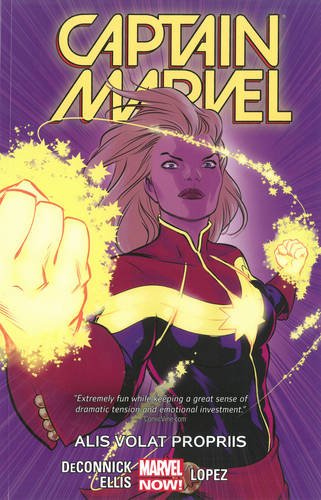
[READ: April 19, 2017] Captain Marvel: Alis Volat Propriis

The previous book in the series was pretty goofy.  So I was pleased that this final book was a bit more intense.  The title is the motto of the state of Oregon (probably not why it was used).  It translates as “She flies with her own wings” (which probably is why it was chosen).

As the book opens, Lila and Carl transport to her ship.  But once again something is amiss.  Harrison is offline totally and there are aliens closing in.  It is only through some quick thinking they are able to escape them until they can flee.

When full power is restored, Carol and Harrison decide to find out where Tic and Chewie are.  The baddies have a head start, but they take a shortcut through “The Endless Envelope.”  Once they get in this pocket they realize that it is bigger on the inside than the outside and their shortcut will take five times as long to traverse.  They encounter enemy ships and a phenomenon called a Warp Bear.  There’s some good humor in this section in which Carol tries to communicate with Harrison the ship. (more…)

Read Full Post »

« Newer Posts - Older Posts »