Feeds:
Posts
Comments

Archive for the ‘Skateboarding’ Category

1971 SOUNDTRACK: DAVÍD GARZA-Tiny Desk Concert #405 (November 15, 2014).

garzaI first heard of Garza back in 1998 with his minor hit “Discoball World.”  I really liked it.  And then I assumed he just went away.  But apparently he didn’t.

The first song, “Texas is My Hometown” is a slow jazzy song about how much he loves Texas.  He sounds like an old-timey crooner, except that he references all kinds of contemporary musicians.

And then he plays “Discoball World.”  It sounds quite different because it’s all acoustic guitar (although his strumming is pretty intense).  I prefer the original, but he’s really intense while singing this version.

He says he was walking around DC and he ran into his favorite singer in the whole world.  Then he invites Gaby Moreno to sing the final song, an old Spanish song their grandparents used to sing.  And indeed, with wonderful flair, he plays a beautiful Spanish guitar.  Gaby sings lead (in Spanish) on the whole song and her voice is really amazing.  She can hold a note for a really long time and then really powers through a loud note.  He does backing ooohss when needed, but Gaby is the star of this song.  Until, that is, he plays some great guitar at the end, very percussive, very powerful.

It’s a good set.

[READ: June 1, 2016] The Complete Peanuts 1971-1972

I took some time off from my Peanuts reading–I needed a break after fifteen years.  And it was fun to come back to the strip really looking forward to the 1970s.

There seem to be three big consistent ideas in these two years.  Woodstock becomes very prominent, Sally gets to complain about school a lot and Peppermint Patty comes into her own, with strips about her and Chuck, her and Franklin and her and Marcie (who is finally named!).

1971 starts off auspiciously with Charlie saying that this is going to be his year of decision–he’s going to start making changes.  But Lucy interrupts saying that she is going to spend the whole year regretting the past-“Forget the future!” (more…)

Read Full Post »

cute girlSOUNDTRACK: DO MAKE SAY THINK-Other Truths [CST062] (2009).

DMST-OtherTruthsCST062Other Truths is (so far) Do Make Say Think’s final album (they have been on hiatus since).  I’ve mentioned this album before, but here it has context with the others.

There are only four songs on this disc and it really feels like a culmination of what they have been exploring with their more recent output.  There is still experimentation (the shortest song is 8 minutes after all), but there aren’t the really strange sections like on the previous album (no weird drop outs or deconstructions).  And, in fact, they have embraced more of the catchiness that the last album hinted at.  The first song, “Do” (each song is named after one of the words in the band’s name) is one of the catchiest things they’ve done.  It’s easily my favorite song from them

I love the guitar lick that runs through “Do” a series of two note patterns that are surprisingly catchy.  The drums are wild throughout as the rest of the song chugs along nicely.  It’s 10 minute long though, and the whole thing is not that pattern.  About 2 minutes in the bass takes over, playing a similarly interesting riff before some dissonant guitars ring out and the band resumes with a new section of the song.  Some voices (from Akron/Family and Lullabye Arkestra) enter the song singing gentle ah’s as the song progresses.  The introductory riff resumes with some great additions.  Then the horns blow over the top–making the song soar higher and higher while the rest of the band plays in the background.  Around 7:30 the music all drops away except for some washes of keyboards.  The song continues like that with some quieter washes until the end.

“Make” is a 12 minute song which has tribal drums and simple guitar lines to start with.  The singing comes in around 2:30.  There’s some great moments in this song where the guitars play simple riffs that grow and build and then the horns come in again.  It’s a wonderful song with moments where the whole sounds of the song sounds so big and jubilant yet slightly menacing at the same time.  By about 9 minutes tape manipulation glitches it to a halt with the drums getting slower and slower and deeper and the guitars expanding out as slow as can be.  The last two minutes resurrect some ringing guitars and horns which grow and grow seem to be playing an elegiac coda for this song, It’s really beautiful, and it’s recorded so well it’s like you can hear the air being blown into them).

“Say” is also 12 minutes long.  It opens with what sounds like foghorns, or tubas getting distorted almost by a Doppler effect.  Then comes the rim shot drums and interesting effects sprinkled over the top.  At about 2 minutes another great, simple guitar riff comes in–DMST  has a way with making the simplest riffs sound great.  The whole band kicks in and plays along with the riff.   The song builds and ebbs, with the horns making the song feel huge.  For a brief middle section the song get quiet with a fast-picked guitar section and strings.  The end of this song (the last 2 minutes) also has a coda with horns but this one is mournful and quiet.  The chorus joins in again.  First with ohs and then with words.

“Think” ends the disc at a scant 8 minutes. It’s the quietest and most mellow song on the disc opening with jazzy drums and simple chords.  The slow guitar riff is lovely and there are dark voices humming along behind them.  Then you hear people talking in the distance, (I can’t make anything out) while a series of bass notes move the song forward.  By 4 and a half minutes a new guitar line comes in and the song gets a little bigger but it’s still slow.  The song never builds like the others; it stays quiet and slow, regretful and thoughtful, until it rings to a close.

This is a wonderful album full of all the great sounds of post-rock.

[READ: January 20, 2016] The Cute Girl Network

Imagine if you were a girl who moved to a new town and learned that there was a network of girls, cute girls, who kept tabs on all of the boys in town.  And the network was in place to keep you informed of what a doofus jackass your new boyfriend was.

It’s not a bad idea.  In fact a lot of good could come from it.  But sometimes informed choices have to have some personal experience as well.

And that’s where Jane and Jack come in.

Jane is new to Brookdale  Jane is pretty bad ass–she rides a skateboard and does amazing tricks.  She also works in a skate shop  She meets Jack when she wipes out in front of his soup kiosk.  He helps her out with a bottle of iced tea for her ailing coccyx and then just hopes that he’ll see her again.

Jack lives with Gil and Ruth.  Gil is a lunkhead who has been on a lot of first dates but few second ones.  Ruth hasn’t been on too many dates herself.  They both know that Jack is lazy (his previous wrote a song about him called “Layabout”) and a little dopey but he’s nice and kind-hearted and that’s what matters. (more…)

Read Full Post »

1969  SOUNDTRACK: ABIGAIL WASHBURN-Tiny Desk Concert #101 (January 3, 2011).

abigailAbigail Washburn had plans to study law at Beijing University in China.   Before she left, she bought a banjo—she wanted to take something to China that was American.  Then Washburn went on a road trip to study the banjo and to learn some tunes. She found her way to the Augusta Heritage Center in West Virginia, then to North Carolina and then Kentucky to the International Bluegrass Association. It was there that she sat down with a few women to play music, and right then and there was offered a record deal. She blew off China ans has made a career as a banjo player–typical story.

In the ten years since then, she has been to China (with her banjo) where she learned Chinese folk music.  She now mixes American bluegrass and folk with Chinese folk music.  For this Tiny Desk, she plays three songs with her band Rob Hecht on fiddle, Jared Engel on bass, Jamie Dick on drums and Kai Welch on keyboards and trumpet.  She uses two different banjos, a normal sized one and, om the final track, a great big-bottomed one.

The first song “City of Refuge” she says is done in hop high tuning (in case you were interested).  It’s fun seeing how fast her right hand is moving while her left hand is fairly still and her vocals are fairly slow.

“Taiyang Chulai” is a traditional Chinese song meaning “The Sun Has Come Out and We Are So Happy.”  She sings in Chinese (and plays no banjo).  Her Chinese sounds amazing (and it’s really funny to see her speaking/singing it).  She says that taught American folk music in China and learned that she needed to do arm gestures since all Chinese folk songs have accompanying arm movements.  She also wore armbands which her grandma made for her.

“Bring Me My Queen” is the final song.  I found it interesting that her songs are rather slower than the Chinese song, at least in tempo.  This song is even slow for a banjo song.  But it’s quite beautiful.  In addition to being a great banjo player, Washburn has a lovely voice, too.

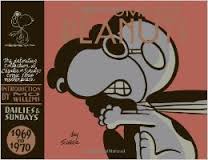
[READ: December 8, 2015] The Complete Peanuts 1969-1970

I was excited to get to this book to see which strip was published on my birthday (it’s sort of like seeing the headlines from the New York Times on your birthday).

Well, sadly, my strip was kind of boring–part of an annual be kind to animals or national dog week or something like that.  Nothing life-changing or earth-shattering.   Good grief.

I also decided that I’m taking a break from Peanuts for a time.  I have really enjoyed what I’ve read, but I need a breather.  I have read twenty some years of the strips over the last few months and, even if Schulz never rested, he didn’t condense twenty years into a few months either.  So sometime later in 2016 I’ll resume the books.

This book is notable for revealing Woodstock’s name!  I feel like that was the last big revelation that we’ll see for a while.  I am curious to see if the 70s added any new characters. (Well, there is Marcie.  I wonder when she comes along).

1969 starts out with Lucy saying that this is her year, “it’s all mine.”  Although a few days later she asks for a refund.  Lucy finally gets fed up with Schroeder and not only kicks his piano but throws it into the kite eating tree.  In March of 1970, Lucy says “I’m a new feminist.”

There’s a lot of Lucy/Snoopy rivalries.  In May 1969 we see the first an only reference so far to tether ball–Lucy is great at it (until Snoopy beats her).  There has been a somewhat recurring joke about Lucy beeping Snoopy on the nose (which he hates).  She does it in April and says it has been 384 days since she did it last (I wonder if anyone confirmed that).  In June, Charlie and his family go on vacation and Lucy is in charge of Snoopy (and she is particularly harsh).

Los of things happen to Snoopy this year.  As is per usual, Snoopy is skating in the winter time.  He is planning to win trophies (skating with Peppermint Patty–although she has to break the news that she is not interested).  He is also in preparation (in March 1969) to be the first beagle on the moon (wearing an astronaut helmet).  Surprisingly, there is no acknowledgement when the first man does land on the moon.

In April 1969, Snoopy goes on a two-week journey looking for his mom (but doesn’t find her).  In July of 1969 Snoopy takes up roller derby (for a very brief time).  In September of 1969 Snoopy finishes his first novel and submits it for publication. But he is rejected!  In Sept 1969 there are a lot of football jokes involving Snoopy and the little bird (the bird being too small to move a football of course).  March 1970 shows the return of the Easter beagle.

1969 sees a lot of talk of “Head Beagle.”  First Frieda reports Snoopy to the Head Beagle for not chasing rabbits.  Later Snoopy is appointed Head Beagle but can’t handle the workload.

In the summer of 1970, Snoopy goes to give a speech at the Daisy Hill puppy farm and a riot breaks out with tear gas!  And in September 1970 Snoopy wears a cooper bracelet to cure his arthritis.

In July 1970 Snoopy reveals a good truism “If you think about something at three o clock in the morning and then again at noon the next day you get different answers.”  Also in July is the first mention of “The Six Bunny-wunnies” fictional series of books.

For a few weeks in August of 1970 Snoopy pretends to be a grocery clerk (butter 28¢, bread 39¢, eggs 59¢, tea 79¢).

Lots of things seem to happen on the baseball field this year.

And in April 1969 Charlie Brown’s team wins two games in a row–neither team could make it so they both forfeit (Franklin is on one of those teams).  Later in June of 1969 Snoopy wins the Rookie of the year award for the baseball team.

In March of 1969 Linus make a sports drink which “replaces the body stores and prevents and diminution of vitally needed electrolytes and nutrients.”  (Gatorade was invented in 1965 and became popular with athletes in 1967).

Some great moments in this book:

In May of 1969 (on the baseball mound, of course) the team is talking about the costs of college “it can cost almost sixteen thousand dollars to go to college.”  The joke comes that Charlie is hoping for a baseball scholarship and every one busts out laughing.

In May of 1969 the school nurse is going to weigh them and Linus says he’s going to as about his hurting shoulder, “never pass up a chance to get a little free medical advice.”

In August, Linus’ gramma says she’ll donate $10 to his favorite charity, “ten dollars is a lot of money.”  (He ultimately decides not to accept).

In July of 1969 the little red-haired girl moves from Charlie’s street!  And Charlie never says anything to her.  Later in December 1969 Linus Charlie and Snoopy go skiing (on a school ski trip).   Charlie sees the little red-haired girl and falls off the ski lift.

Charlie makes a funny joke when he offers to shovel Lucy’s snow.  He asks for a quarter and she says “What if it snows tomorrow and covers up our walk again.  Do we get our quarter back?”  He replies, “No by then I will have spent it on riotous living.”

Peppermint Patty gets a lot of strips in these two years.  In Nov 1969 she talks about school: “I signed up for Folk Guitar, computer programming, stained glass art, shoemaking and a natural foods workshop.  I got spelling, history, arithmetic and two study periods.  I learned that what you sign up for and what you get are two different things.”  (I would TOTALLY sign up for those classes too).

She returns a lot in 1970–she’s a great character allowing Schulz to explore all different kinds of kids and ideas.  In the beginning of 1970 she is called to the principals’ office because she’s not allowed to wear sandals to school any more.  She cries and calls Charlie Brown for advice.  It takes Snoopy to kiss away her tear to snap her out of it.  The strip series ends with Franklin saying, “All I know is any rule that makes a little girl cry has to be a bad rule.”

Patty also says that she got an F on a test because she has a big nose–if a teacher doesn’t like your looks there’s nothing you can do.  Franklin looks at the paper and says “you turned in a blank test paper.”  She sighs, “there’s nothing you can do.”

In December 1970 Peppermint Patty invites Snoopy to a “turn about dance” (where the girls ask the boys).  They have a good time until a boy asks who her weird-looking friend is.  She punches him out and feels guilty about it until Snoopy says he had a great time and he’s the one who bit the chaperone.  Their friendship is great.

In Sept 1970 Patty has a crisis–thinking she’s not beautiful  (then Snoopy gives her a kiss).  The following week her dad gives her a dozen roses and says that the boys will be calling on her when she grows up and he wants to be the fist one in her life to give her a dozen roses.  It brought tears to my eyes.

In June of 1970, Peppermint Patty asks to borrow Charlie Brown’s glove for a kid on her team named “Thibault.”  Which leads to Charlie asking “Thibault?” at least twice.  Then Thibault (who has sideburns), refuses to give the glove back.  But Charlie Brown is happy by this because Thibault accuses him of “thinking you’re better than us.” And Charlie gleefully says “Me?  Better than someone else?”

1969 ends for Charlie when he buys a ticket to a sports awards dinner.  He gets a seat right next to Joe Shlabotnik…who never shows up.

This strip really sums up why Charlie Brown is so likable.  On October 26 in which Linus describes an amazing football game in which a team makes an amazing come from behind victory with seconds left in the game .  He describes the great plays and then Charlie’s response is “How did the other team feel?”

Sally is starting to become a more fully developed character–opinionated but often horribly wrong.  In May of 1970 she buys a fish tank saying “This is the age of aquariums.”  And she has no tolerance for school.  In Sept 1970 she asks why they have to learn all of these things in school.  Why does she have to learn the names of rivers?  “I’ve never even seen a river!  They could at least take me to see a river.”  Later she writes a theme for school, “If I had a pony:”  “If I had a pony I’d saddle up and ride so far from this school it would make your head swim.”  Then she crumples it up and says “That’ a good way to get a D-minus.”  In Nov she shows the class a document that is written by “an actual caveman.”  The punch line: “Show and Lie is my best subject.”

The best Great pumpkin joke comes in Oct 1970 when Lucy says “Santa Claus has elves to help him…what does the great pumpkin have, oranges?”

There are a couple of topical jokes.  In July 1970, when it rains during a game Lucy starts singing “Raindrops Keep Falling on My Head” (which was a hit in early 1970).  And in December 1970, the kids use a Ouija board which had been released as a game earlier that year.

And then on June 22, 1970 the little bird reveals his name to be Woodstock!  (strangely it was a year after the concert).  With a name he acts no differently.  In Nov 1970 Woodstock tries to fly south but gets lost.  So Snoopy walks with him.  After a week they get grabbed by a girl who say “Ma, I found a stray dog!”  Then Snoopy is tied up for a few days while Woodstock tries to rescue him.

The year ends with Sally doubting whether you really have to be good for Santa to bring you presents “the old rascal is bluffing…I know that [he] will bring me presents whether I am good or not.”  Then on Christmas Day, ”I was right!”

This was a great book, with some excellent strips and character developments.

Mo Willems, beloved children’s author, wrote the foreword.  Mo says he started his career by selling black market drawings of Snoopy and Charlie Brown in second grade.  He learned that even bullies liked Charlie Brown.  He says he could utterly relate to Charlie’s world, “For me, an immigrants kid, recently plopped into the middle of a small school in the insular world of uptown New Orleans, Charlie Brown was the only one who understood how confused and unhappy I felt.”

He says he aspired to Linus-ness: to be wise and kind and highly skilled at making gigantic structures of playing cards.  But he knew he was always a Charlie brown.  “Sometimes when I am in a deep funk and feel like my life if is an uphill battle…I try to stop and imagine someone reading the comic strip of my frustrated life and laughing.”

All of his characters are an homage to Schulz in some way.  And the greatest lesson her learned from Schulz, is “never let the characters know they are funny.”

He concludes by saying that Peanuts isn’t Art… it’s better.  He toured the Charles M. Schulz Museum and Research Center and held an original comic but he found it anti-climatic.  They were too precious to be enjoyed…they became Art.  The magic that you get from having them in a book or newspaper was missing.

Read Full Post »

1967 SOUNDTRACK: JULIAN LAGE TRIO-Tiny Desk Concert #140 (July 7, 2011).

lageJulian Lage is a jazz guitar prodigy.  he normally plays with a quintet but for this set he brought only a trio which includes bassist Jorge Roeder and percussionist Tupac Mantilla.

This was my first exposure to Lage and he does some really impressive lines and riffs.  He plays a hollow-bodied electric guitar that sounds an awful lot like an acoustic guitar. He does some phrasings that are really pretty or really interesting

But I was more impressed with Mantilla on percussion.  He uses thick brushes, he uses his hands on bongos and cymbals.  He uses his hands on his body–playing his lap and chest).  He even uses little dusts brooms (which must be unwieldy).  He’s also got some kind of drum (perhaps a loose snare?) with a great sound and even a bell.

They play three songs.  “Welcoming Committee” is a new song not recorded as of then.  At the end of the song, they all laugh as an office phone rings the end.  Julian is a sweet funny guy with some interesting stories about his songs.

“However” is an upbeat bouncy song (with some less noodling).  Interestingly, it was written by their saxophonist who is not playing in the trio today.

Before introducing the final song “Untitled (No. 24)” he says he started a blog for inspiration–to get people to bounce ideas off each other–healthy peer pressure with incentives for song writers.  The most recent one was a song a day for 30 days.  This was number 24.  (Hhe jokes that the first 23 sucked).  It’s a really fun piece that doesn’t feel incomplete at all.

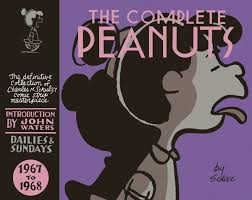
[READ: December 8, 2015] The Complete Peanuts 1967-1968

It’s 1967 and Schulz has had huge success with Snoopy’s Red Baron plots.  In December 1966 The Royal Guardsmen made a song called “Snoopy Vs the Red Baron” which made it to number 2 on the charts.  So The Red Baron plot takes over a lot of this year.  And while I enjoy seeing him like that and I get how it’s funny, I don’t really like it all that much–the jokes are too samey for me.  But despite all of the Red Baron excitement there are other things going on this year too.  Like the introduction of the Easter Beagle.  And of Franklin!

The kids get involved in many different sports this year.  In Feb 1967 Lucy begins arm wrestling (and beating) everyone.  She even takes on the Masked Marvel (Snoopy).  In Oct 1967 Snoopy plays hockey for the first time (I think).  He references Bobby Hull).  Later in Jan 1968 all the kids play hockey together.  Lucy beats everyone up and say how much she likes the game.  And at one point Snoopy smiles and is missing teeth.  In Oct 1968 Snoopy shoots and scores (on his doghouse) and says “they’re not sleeping well in Montreal tonight.”

In December 1967 Snoopy considers going to the Olympics in France for his ice skating.  He says he misses skating with Sonja Henie).  In April 1968 Snoopy is going to the Masters in Augusta.  When that doesn’t work out (we never see him there), later in April Snoopy is a wrist wrestler who is going to go to Petaluma for the world competition.  (There are many jokes about Petaluma).  Snoopy is disqualified because he has no thumbs.

In August 1968 Snoopy says “jogging is my thing.”  And in Nov 1968 we learn that Snoopy has a pool table but that Minnesota Fats won’t play him.

And of course there is baseball.

Peppermint Patty comes back in March 1967 to play against Charlie’s team.  She has a new player, Jose Peterson, who doesn’t really hang out in the strip for very long, but who is an awesome slugger.  In November of 1967, there’s a reference to the lousy New York Mets.  I didn’t realize it but at the time of this strip, the New York Mets were a recent expansion club with a terrible record.

In summer of 1967 Charlie and snoopy return to camp and they see Peppermint Patty is there.  Patty strikes out Charlie a whole bunch and says she considered letting him hit one but he wouldn’t want that, right?

In march of 1968 snoopy takes over as manager and is really mean.

And of course, Snoopy has a lot going on too.  We learn that August 10 is Snoopy’s birthday.  He also says a lot of things are gauche.

In a very funny skit, in May 1968 Snoopy watches a bird chomp a worm and then says “I’m going to be very very very very very very very very sick.”

June 1968 introduces Lila again, and how Snoopy pines for her.  Then in August she writes to Snoopy again.  And finally on Aug 24 we meet Lila for the first time.  Lila is a girl in the hospital.  But it’s not until the end of the month that we learn that Lila was Snoopy’s previous owner who lived in an apartment and had to get rid of him.  AND THAT’S ALL THAT’S SAID ABOUT IT!

On a lighter note, in March Snoopy pretends to be a piranha for a few strips.  In April 1967 there’s some Cheshire cat jokes from snoopy (who is only a smile)  April 1968 sees the first mention of the Easter Beagle (Lucy doesn’t believe Linus who is the only one to see him).

Linus and Lucy pop up a lot of course.  They revisit a lot of the same ideas with variations.  In August Linus’ grandma agrees to give up smoking to get Linus to give up his blanket.  He thinks she’ll never do it, but he goes through the real withdrawal.

In Dec 1967 Lucy ups her psychiatrist booth’s price to 7 cents (winter rates).  And then as the book ends in Dec 1968, Linus is taking shorthand notes for her.

Father’s Day this year had Peppermint Patty writing a card.  She says that her dad calls her a “rare gem,”  This phrase is used as a joke in the strip and then a few more times.

It seems like summer is a good time for new things as well.  There are two weeks of strips starring Peppermint Patty at camp!  She is a counselor of littler kids.  There is a little girl who looks like Marcie but isn’t (her name is Clara).  And then later that week another little girl, Sophie, calls her “Sir.”

And then July 31, 1968 introduces Franklin!  He and Charlie play at the beach for a few days.

Religion pops up from time in the strips, especially with quotes from the Bible.  But in March 1967, Violet asks Charlie if they go to church.  He says yes, but she says her family “used to…now they belong to a coffee house.”  And in April Schulz revisits the “here’s the church gag.”

[From the Peanuts wikia] On February 8, 1963, Sally watches while her big brother uses his hands to illustrate that old rhyme: “Here’s the church…here’s the steeple…open the door…and see all the people!” After carefully examining his closed fingers, she announces, “It looks like a rather small congregation!” Four years later, on April 8, 1967, Sally watches as Linus delivers the same rhyme…and then she provides an almost exact response: “Sort of a small congregation.”

Most of the strips are totally timeless, with me even thinking that I read some of them when I was much older than I did.  I can’t say as I remember a lot of specific strips, but I always remember the one from Dec 5, 1968 (which is from before I was born, so I obviously read it in a collection).  Peppermint Patty says that it snowed last night Her dad says that “when it snows you should always take a slice of bread out for the birds.”  She places a whole slice on the bird’s head.

I think the timelessness of the strips are what make reading these volumes so much fun.

In May 1967, Charlie asks Linus if he wants to be the first man on the moon.

In July 1967, the bird (unnamed yet) has “long hair” and Snoopy calls him a bird hippie.

Charlie writes to his pencil pal in Nov 1967 and says, “According to what I read, your country hates my country and my country hates your country.  I don’t hate you, and I don’t think you hate me.  I think about this a lot.  It makes sleeping at nigh very difficult.”

In Jan 1968, the girls are going to have a “crab-in.”

Dec 18 1968 Snoopy has a sled and Charlie looks at it and says “Rosebud?”

In June 1968, Snoopy says he thinks he is in love with Twiggy.

In August, Snoopy says that you never hear anyone sing “Chloe” anymore (although which song that is, I’m not sure.  Perhaps the Al Jolson one).

In Nov, Snoopy says he is feeling groovy (the Simon and Garfunkel song came out in 1966).

There are references to the election year with the birds holding ups signs that say ? and !!  Snoopy say he’ll vote for the one with the paw print on it.

My two favorite jokes in the book have to do with math.

Sally is trying to learn her times table and guesses answers like “Four-thousand six? elventy-twelve? fifty quillion? overly-eight?  twiddelty-two?”  Then she  asks “Am I getting close?” And Charlie responds, “Actually it’s kind of hard to say.”

In Dec 1968, Peppermint Patty says she loves numbers.  “Twos are sort of gentle, threes and fives are mean, a four is always pleasant.  I like sevens and eights too, too but nines always scare me.  Tens are great.”  When a classmate asks if she has prepared her division homework, she says “Nothing spoils number faster than a lot of arithmetic.”

~~~~

In my edition the May 1 strip is repeated instead of the May 3rd strip! (The missing strip will apparently be printed at the end of the next book).

John Waters give the best foreword yet.  He actually references strips in this book!

He says he became obsessed with peanuts when he had mono in 6th grade.  He loves the depression paranoia and delusions.   But John was all about Lucy.  He loves her politics, her manners “Get out of my way!” her narcissism and her rants.   He says he has a niece named Lucy and Schulz got the expression perfect when she yells “No” on page 61.

He also says that for the most part the strips don’ age at all (with a few exceptions).  He talks about Lucy shouting “police brutality” at Charlie as a crossing guard!  He also says that Schulz was criticized for including the minority characters (which is shocking).  Waters is also fascinated by characters like Roy who are rarely if ever heard.

Pig-Pen was an inspiration for Dingy Dave in A Dirty Shame; Divine cutting up her daughter’s jump rope in Female Trouble is inspired from a Peanuts strip.

He sums up with the attitude that Peanuts presents:

You are dealt a hand.  Deal with it.  But most importantly he teaches all ages that if you can learn to laugh at the things that cause you the most pain, you will be the strongest of all.

Read Full Post »

1965 SOUNDTRACK: TIME FOR THREE-Tiny Desk Concert #291 (July 27, 2013).

time for 3Time for Three are a string trio who play many types of music.  There are two violinists Zachary De Pue and Nick Kendall with a double bassist Ranaan Meyerand.  And over the course of their three songs (all original) they play classical, jazz, bluegrass and just about everything in between.

“Banjo Love,” features two contrary violin solos which get support from Meyer’s expressively propulsive bass.  It opens with the two guys strumming the violins before breaking into some lovely bowed playing.  Both violinists switch off solos (the blond player is a bit faster and more “showoffy” (but great)).  There’s even a bit of a bass solo after which the three guys all make a big grunt before continuing to the end of the song.

They say they are honored to be on the Tiny Desk series and compliment them on their new offices.

“Sundays” is a slow piece that features lots interesting bass parts behind the slow violin melodies.

They have funny stories about the origins of their songs.  “Don Don” is so named because the baseline goes don… don.  This has more of a bluegrass fiddle feel than a classical feel.  It’s super fast and fun with perfect slides and solos to really keep the song moving.

The notes say that they wished the guys played more, and I do too.  Interestingly I see that they have covered Daft Punk and Kanye West, so I guess they’re up for just about anything.

[READ: December 8, 2015] The Complete Peanuts 1965-1966

A whole bunch of ideas that I think of as BIG PEANUTS ideas come along in this book.  May of 1965 introduced the Daisy Hill Puppy Farm and Snoopy’s desire to meet his siblings.   In July of 1965 we get the first instance of snoopy at the typewriter writing “it was a dark and stormy night.”  We see Charlie Brown refer to the tree as a “kite eating tree” for the first time.  In July 1965 it’s the first time I can recall seeing the phrase “jelly bread.”  It’s the first appearance of Snoopy as Beau, the World War 1 flying ace (Oct 1965).  And in September 1966 we get the first appearance of Peppermint Patty!

The pop culture references seem to have dimmed somewhat too, although in January 1965, Linus cries “Annette Funicello has grown up!”

The “Happiness is” quotes are fewer, although Lucy squeezes Snoopy and says “Felicitas est parvus canis calidus,” which is Latin for “Happiness is a Warm Puppy.”   Of course later when he kisses her she freaks out “get some disinfectant, get some iodine” and he says “next time I’ll bite her on the leg.”

Linus’ blanket also takes on a mind of its own in March 1965 actually hissing at and attacking Lucy. (more…)

Read Full Post »

SOUNDTRACK: MC PAUL BARMAN-It’s Very Stimulating (EP) (2001).

So is this guy a joke? Well, he’s very funny.  Very funny, in fact.  But to my ear, not in a novelty sort of way.  He’s got the kind of rhymes that make you laugh but still work upon multiple hearings.  And, yes, Paul Barman is a squeaky, Jewish boy from Ridgewood, New Jersey (again!) and he really can’t rap on the beat and he really doesn’t have much in the way of rhythm, but got awesome skills in the lyrics department and he has production from Prince Paul (that’s the kind of credentials that anyone would like).

The theme of this EP is Paul’s utter failure to get with women (even in his fantasies).  He’s crass and vulgar and yet he’s also quite smart and rather witty (“I think about all the pube I got while reading the Rubaiyat“) .  The music is more or less inconsequential.  As Prince Paul noted, the craziness comes from the lyrics, so you don’t want to overkill the song.  But there’s some great samples and some solid beat work as well.  Nevertheless, we’re here for the words.  So, sample a few of these rhymes:

“The Joy of Your World”

It was time to copulate but we didn’t want to populate
So my bold groin reached for my gold coin proooophylactic
I unwrapped it, you can’t know how I felt
It wasn’t a gold coin condom, it was chocolate Chanukah gelt
The white part crumbled on her tummy and the rest began to melt
Foiled again…..

“School Anthem” or “Senioritis” (this song was renamed for the reissue of the disc it seems)

Homework is tell major lies or plagiarise encyclopedias, so boring
Fresh-faced teachers want to tickle ’em
but a test-based curriculum excludes exploring

I’ll let a mystery gas out of my blistery ass
Just to disrupt the misery of history class

“Salvation Barmy”

She said, “Go get a haircut”
So I showed her my bare butt
Pulled down my Carhartts put my moon in her star-charts

“I’m Frickin’ Awesome” ( I love this especially for the Lila Acheson bit)

It’s nice to be hypnotized by a man you don’t despise yet
He had a type of flow and I can’t quite label it
All I know it made me want to take off my cableknit
Sweater, Oh he better be hetero
I hope they don’t catch us in the Lila Acheson
Wallace Wing when Paulus brings the mattress in–rudely
He backlashed my booty
like I was Susan Faludi over the Grace Rainey Rogers Room rostrum

“MTV Get Off The Air, Pt 2”  (the first two lines are fantastic, but the whole thing is genius).

Smirkin’ jocks with hackysacks
in Birkenstocks and khaki slacks
I’m the hypest lyricist
while they’re like, “What type of beer is this?”

Just wait until the full length for the utter genius that is “Cock Mobster” (how can be s o smart and so stupid at the same time?)

[READ: October 10, 2011] E Pluribus Venom

Like most people, I learned the name Shepard Fairey because of his iconic prints for Barack Obama.   In addition to supporting Obama, I really liked the design of the prints–simple, bold, an easy iconic style (which has since been lifted, morphed and used everywhere).  I know that many of Fairey’s prints actually come from other people’s original photos.  He has a print of Muhammed Ali in this book, and he clearly didn’t take the original photo (I don’t know where it came from).  But since all art is theft, I’m okay with Fairey taking someone else’s work and making something new from it.  I’ve always felt that attribution should be enough if you modify the original enough to call it different (which I feel this print does).  [The fact that he didn’t acknowledge the source does bug me, of course].  But that’s neither here nor there because this book predates all of that.

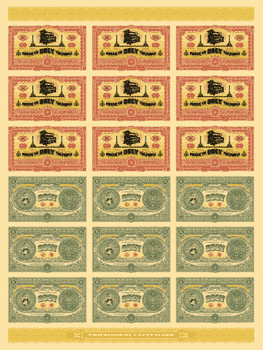
This book documents events that occurred in 2007.  The E Pluribus Venom show was based largely around two images that Fairey designed to reflect the two sides of capitalism.  The image to the right really doesn’t do any justice to the work itself, but you can kind of see that he created two-sided faux dollar bills.  The front showed all the good things that capitalism can do.  The back showed all of the evils that capitalism causes.  The images resemble dollars, but the text is straightforward in its message.  As with a lot of what Fairey does, it’s blunt and obvious but pretty cool.

As far as I’m concerned, though, this is the least interesting image in the book.  Although I love that they made dollar bill sized prints of these faux dollars and left them scattered around in cities to promote the show.  They way they were folded made them look at a glance like actual currency.  Very cool. (more…)

Read Full Post »

SOUNDTRACK: SHAD & DALLAS-“Live Forever” (2010).

Shad and Dallas Green (from Alexisonfire) recorded an EP called Two Songs and the profits go to Skate4Cancer.  The A Side is the new song “Live Forever.”  Shad is a great rapper, and make no mistake, this is a Shad song.  Green sings the hook-filled chorus (and an intro line).

Shad’s rapping is great and his rhymes are clever and interesting (he even does a fast double-time section which I’d never heard him do before). But the music itself is kind of bland.  I listened to it three times and I never really got into the flow of it.

I rather hope that sales are good (for the charity’s sake) but I’m afraid I’m not that excited by the track.

[READ: January 23, 2011] “Choynski”

I recently noticed that I had reviewed a whole bunch of stories from The Walrus.  So I wondered just how many stories there were in previous issues of the maagzine that I hadn’t posted about.  The magazine only started in 2003, and I still have all the issues (yes, that’s right…  I bought Issue 1 on the newsstand), so it wasn’t that hard to figure out.  In the early days, not every issue had fiction in it.  I started calculating and discovered that there were only about 25 stories to go.  So I thought, why not go back and read them all, eh?

This story was in Issue #2, and I have to say, good for them for picking David Bezmozgis to be their first author.  His issue bio reads that his first short story collection Natasha will be published in June.  And if you check now, you’ll see that Natasha won a Commonwealth Writers’ Prize and was a New York Times Notable Book.  Not bad.

There are essentially two stories in this piece and they tie together quite nicely.  The first arc concerns the narrator’s dying grandmother.  She is an old Russian Jew whose English isn’t great so she tries to speak in Yiddish to make up for it.  Her family understands but few others (like her doctor) know what she’s talking about.  As the story progresses, her family tries to keep the truth of her condition from her, but she is no dummy.

The second story concerns the narrator’s attempt to learn more information about Joe Choynski.  Choynski was being inducted into the International Boxing Hall of Fame (Old Timers division) and the narrator was going to the ceremony.  In trying to learn more about Choynski (considered America’s frst great fighting Jew), he enlists the help of Charley Davis, an old man who knows more than just about anyone else about the Choynski.  (more…)

Read Full Post »

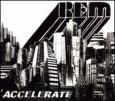
SOUNDTRACK: REM-Accelerate (2008).

I was thinking about the parallel careers of R.E.M. and U2 the other day.  The both started at around the same time: R.E.M. on an indie label and U2 on a major.  R.E.M. was a college band loved by critics but not really a big seller.  U2 had some huge hits in their early days and slowly grew to be college darlings too.  Then in 1987, they both hit it big time: R.E.M.’s Document had “It’s the End of the World As We Know It (And I Feel Fine)” and “One I Love” and of course, U2’s The Joshua Tree was the hugest album in the world.

R.E.M. and U2 became the hugest bands of the 1990s, selling millions of copies of records, becoming the biggest most famous people in the world (well, the singers did anyhow).  And then in the 2000’s, something happened.  U2 became even bigger and R.E.M. sort of drifted.  And their records got critically panned.  Even if they had a hit or two, overall the records received very bad reviews.

I didn’t even bother picking up R.E.M.’s previous record (and I guess no one else did either…its their ONLY record not to go at least gold (and that includes their early IRS label stuff).  So, who held out any hope for a new R.E.M. album?

Well, the good news came when I put on Accelerate.  After the initial guitar lick, the bass kicked in and Sarah said “Is that R.E.M.?” Now THAT’s a good sign.  And it is.  This album is the closest they’ve come to classic R.E.M. in a long time.  I’ve concluded that the defining characteristic of R.E.M. is not Michael Stipe, it is Mike Mills.  It’s his basslines and his glorious backing vocals that make a song stand up and say R.E.M.  And, they’re usually the most interesting parts of the songs.  (His “It’s time I had some time alone” is such a great counterpoint to “It’s the End of the World…” that the song wouldn’t be half as good without it.)  This is not to say that Mike Mills should be the lead singer or be placed more prominently, (he shouldn’t, he’s like a great supporting actor who would be too much if he was the lead), but his contributions make them even better.

And Accelerate is full of Mills, in ways that I feel have been absent in recent years.  His high bass notes, his great backing vocals, it’s like the R.E.M. of old.  Except that it isn’t.  The difference here is that Peter Buck has not returned to the reverby, picked-guitar of old.  He’s got more of the aggressive style of playing that he’s used on Monster and New Adventures… so what you get is a classic R.E.M. updated for the 21st century.

Another thing that is great about this record is its length.  At just over 30 minutes, it’s one of R.E.M.’s shortest releases.  And, after some of the bloated discs they put out lately, it’s a great change of pace–because really nothing overstays its welcome like too much R.E.M.  I mean Reveal has some good songs on it, but after six or seven tracks you can’t believe there are still six more to go.  But on Accelerate, none of the songs overstay its welcome; many of them could go on even longer (always the sign of a good song)–5 of them are under three minutes long!

But enough bashing R.E.M.  Accelerate is a short blast of rocking pop.  In fact, the first 3 songs are the best songs I’ve heard from R.E.M. in years. (more…)

Read Full Post »