Feeds:
Posts
Comments

Archive for the ‘Short Books’ Category

robotSOUNDTRACK: PAOLO ANGELI-Tiny Desk Concert #480 (October 20, 2015).

paoloPaolo Angeli is kind of a one-man band.  But not in a novelty sense.  Rather, he is an accomplished guitarist who decided to modify his guitar.  First a little and then a lot.

Angeli plays a Sardinian guitar which is several steps lower (and bigger) than a traditional guitar (and is bigger accordingly).  And he has added a whole bunch of strange gadgets and toys to alter and enhance the sound.

Notable additions: a set of electronic foot pedals that allow him to play little piano pads which hit the bass strings–he can play lead guitar notes and play complex bass patterns with his feet on the same strings.  He is somehow able to make the guitar sound like an electric and an acoustic at the same time.  There are propellers in the body which make a continuous buzzing sound on the strings.  There’ even a mobile phone for a drone.  I don’t think he uses it in this show, but he jokes that in concert he takes away peoples’ phones when they don’t turn them off and he uses them in his guitar.  He also plays the strings with a bow.

Anything else?  Yes.  Crossing the center of the guitar perpendicularly are another set of “strings.”  He seems to bang on these a few times for more dissonance, and maybe they are what the propeller is playing?  There’s also a set of strings that extend from the guitar head to the base about three inches above where one normally plucks the strings.  These extra strings are primary there for bowing, but they are quite loose and make some interesting scratching sounds on the final song.  There’s also a big spring attached to the bottom for percussion.

Not all of the effects are necessarily pleasant. The buzzing of the propellers is kind of harsh and the giant spring makes some crazy noises.  But his guitar playing is rally very pretty.

Oh and he sings too.

Well, not on the first song, the 12 minute “Mascaratu.”  Although he does whistle (it’s unclear if the deep breaths that he takes are meant to be a part of the song or not).  It opens with beautiful acoustic (fairly traditional) soloing, including some nice harmonics.  And then he flicks a switch and suddenly it sounds electronic.  And you can see and hear the foot pedals at work.  And then he turns on the propeller and starts using the bow.  About 4 minutes in he starts playing chords and the song comes fully alive.  By 7 minutes, he is playing the foot pedals and a lovely acoustic melody which he then trades off for a fast bowing solo.  The song proceeds in different directions and then ends with a lovely bowed solo.

He jokes that “Corsicana” is “Tom Waits vacationing in Sardinia, singing a traditional song in his own way.”  He places a damper/washer type thing under the strings which makes all of the notes sound flat and dead and metallic–yes like Tom Waits.  The bass line is even a bit like Les Claypool.  After an interesting certainly Waitsian solo, he sings what I assume are traditional lyrics (in a traditionally high tenor).  It’s about 7 minutes long.

He asks if there is time for a short song, which proves to be the 8 minute “Brida.”  For this song he uses many items to create a “prepared guitar.” He says that a “prepared guitar comes from the prepared piano which comes from John Cage.”  He wedges all kinds of little things (like binder clips) into the strings.  The song begins as a kind of noisy, chaotic solo.  In the middle of the song he plays some really fast acoustic chords.  Then it’s back to the bow–it’s cool to watch him bowing while the bass pedals are tapping away.  Then he added the buzzing propeller sound and starts hitting the piece of wood at the bottom for percussion.  This includes hitting the big spring for that weird sound and slowly slowly bowing those top strings making a creepy sound.

Angeli is a pretty ingenious player and he is a lot of fun to watch up close–he flips switches, and turns pedals and plays barefoot.  But not everything he does sounds pretty.  And some of the sections seemed to go on a bit long.   I thought I would be fascinated by everything he did but there were times when I couldn’t tell if he was playing something or just showing off the things his guitar could do.

But he is personable and funny and certainly a likable guy.

[READ: March 11, 2016] Little Robot

I love Ben Hatke.  His drawing style is wonderfully cartoonish and cute but with the ability to go a little dark and mildly scary on a dime. He also loves to draw strange-looking aliens and creatures.  Or in this case, robots.

One thing that I thought was especially cool about this book was that there are hardly any words in it.  And there doesn’t need to be.  I kind of wish it was all done without words, but that might turn it into a different kind of story, so I think it was  good choice to include dialogue, but to keep it minimal.

The story opens on a dark night as a truck drives across a bridge.  It hits a bump and a box falls out.  The box bounces over the bridge and lands in the river.

The next morning a little girls wakes up in a trailer park.  She climbs out the window and runs off.  There’s a moment when she seems to be afraid of the kids by the school bus (and the neighbor–there’s clearly a back story here that I wonder what it’s all about–I love that about his stories–there’s stories behind them).  And then she runs down to the water. (more…)

Read Full Post »

sweater SOUNDTRACK: ÁSGEIR-Tiny Desk Concert #397 (October 18, 2014).

asgeirÁsgeir Trausti Einarsson is an Icelandic singer songwriter.  He has a beautiful soft soaring voice.  He released his debut album Dýrð í dauðaþögn in Icelandic (it became the biggest-selling debit in Icelandic music history).  A year later he reissued it in English (with translation help from John Grant who was living in Iceland) as In the Silence and finally (the version I have, as a 3 disc set with the Icelandic and English discs as well as a selection of bonus songs.

“On That Day” is a pretty, guitar based song (Ásgeir plays the main melody line and has guitar accompaniment (and backing vocals) from his childhood friend Julius Róbertsson.

For the final two songs, Ásgeir switches to piano.  “Torrent” has gorgeous vocal harmonies. It’s interesting how much more deliberate this song feels–not quite staccato, but the piano chords don’t really ring out, letting each note stand on its own.

For this Tiny Desk, he stripped down the songs, getting to their core.  They’re not flashy, they’re just lovely.

The final song he plays, “Higher” is the first song on the record (interestingly “On that Day” is the final song on the record).  It has a very slow, delicate piano melody and is also soothing and beautiful.

And in a cool synchronicity at the end of the show Bob tells Ásgeir  that he’s playing at the same piano that John Grant played on a few months earlier.

[READ: July 2, 2016] Sweaterweather

Back in 2003, Sara Varon published her first book called Sweaterweather.  This collection includes all of the original 8 stories as well as a few more.  Each story gets a brief introduction from Varon which makes me like her even more (she’s quite funny).

Most of the stories are short(2-3 p[ages) and most don’t seem to have a title.  The contents page is actually thumbnails from each story.

When I first saw Varon’s style, I wasn’t sure what to make of it.  It is so innocent and childlike.  And I have really grown to love it–especially when these sweet animals characters (they’re pretty much all animals) tackle some intense feelings. (more…)

Read Full Post »

succourSOUNDTRACK: MARIA VOLONTE-Tiny Desk Concert #183 (December 27, 2011).

volonteOne of my plans for this calendar year was to write about all of the Tiny Desk concerts from 2016 and from 2011 (to play some catch up).  This is the final tiny Desk from 2011!  Huzzah.

Maria Volonte is an Argentine singer who interprets tango music in her own way.  She also plays folk, Latin blues as well as more traditional music.  She plays three songs here and is accompanied by the fantastic harmonica player, Kevin Carrel Footer.

“El Beso Azul” (The Blue Kiss) is a pop-folk ballad expressing menacing sadness.  Volonte’s voice is beautiful–full of longing and desire, heartache and sorrow.  She plays a very rich and full sounding acoustic guitar and is accompanied by a wonderful bluesy harmonica which plays some amazing lines and riffs.

“Oh Viejo Tren” (Oh, Old Train) is based on a long train ride from the outskirts into the city proper of Buenos Aires.  She says, “This is about people chasing their dreams in the city and then falling into reality.”  This song is slower and sadder and her voice changes appropriately, even if there is still an air of sultriness about it.  The harmonica in addition to playing great “train” sounds, keeps a perfect bluesy accompaniment.

“SF Tango” is an ode to San Francisco and to tango.  The song is in English.  I like the way she picks her guitar at the beginning and the cool strumming rhythm that the rest of the song has.

Typically, when there’s an interesting quote from the blurb, I post it here, but Jasmine Garsd’s write up is quite lengthy, and it tells an interesting history of the tango as well as some details about Volonte.  It also says she can barely listen to “SF Tango” as she finds it so moving. I didn’t find it so, but I did enjoy what she wrote.  Read it here.

[READ: January 2, 2016] Our Ladies of Perpetual Succour

I also wanted to make sure I finished all of the posts I started in 2015.  This is the last one (although maybe I finished the book in 2016?).  So it’s nice to have that burden lifted as well!

I read Warner’s The Sopranos in 1998.  I loved it.  It was very funny, very raunchy and a delightful way to see girls having wild fun.

Of course, it’s nearly 20 years later and I have a daughter of my own and I can’t help but think that the girls’ behavior is so unsafe, so unwise, so irresponsible!

This play also seems (if memory is any guide) to take the wildness of the girls and condense it.  Since there is no narrator to slow things down they are just wild from the get go.

So this play is about six girls.  The girls are the only ones in the play–they wind up doing different characters (including men) which sounds like it would be very funny to see).  All of the girls are in the choir of Our Ladies of Perpetual Succour Catholic school.  And they are all heading to a competition in Edinburgh

The six girls are:

Fionnula (lives in a council house bought with the money from her grandad)
Manda (Mum fucked off, lives with her da, never shuts up about her sister)
Chell (lives up the complex, has had a lot of tragedy in her family)
Orla (diagnosed with cancer but recently returned from Lourdes)
Kylah (parents own their house and she sings in a band)
Kay (stuck-up goody-two shoes, off to university)

The girls are hardened and cynical–they say there have been several pregnancies this year already in their class and they call their headmistress Sister Condom.  They are excited to go  to the city for this competition not to sing but to get shitfaced and hook up with guys.

Their language is fairly shocking from the starts.  It’s one of the girls who says  Manda’s mum “fucked off.”  And this being Scotland, the word “cunt” is thrown around all over the place.

The girls plan to separate when the get to the city.  But first they get started by going to the bar (the girls are afraid to bend over to pick up their cigarettes for fear of flashing the entire bar).  They drink.  A lot.  Even though they are underage.  And they get hit on by all sorts of men.  One even has the pick up line “Do you know you have 206 bones in your body?  Would you like another one in ya?”

And then the girls separate.

Two go home with a guy who is divorced and very sad about it (which leads to a very wild scene–including a moment in which one of the girls portrays a man with an erection–wonder how they did that).

By the end of the night at least one girls has thrown up, at least one girl has hooked up and it sure looks like they have no chance of winning their competition.

Unlike a Hollywood production though, this story is not destined to end with them winning everything (this is no Pitch Perfect).  The girls are going back to their hum drum lives after this and they will also have to deal with the realities that a night of debauchery can reveal.

So despite the fact that this play is laugh out loud funny, by the end, it’s not really a comedy.  Thanks, Scotland.

For a preview of the play, check out the video

Read Full Post »

trickSOUNDTRACK: I WAYNE-Tiny Desk Concert #180 (December 12, 2011).

Tiwaynehis Tiny Desk Concert is just 7 minutes long.  I Wayne is a reggae singer and he’s accompanied by an acoustic guitar.

“Real and Clean” is a simple song with the appropriate reggae rhythms used as background to Wayne’s lyrics, part of which go like this:

“let nature take its course / no need to rush no need to force / no need to worry about child support / abandon abused in family court”

“Can’t Satisfy Her” seems to be about a prostitute.  The song is from 2004 and the blurb says “he’s largely credited with bringing the roots and rock back to mainstream reggae.”  I’m not sure if the NPR office knew the song, but by the end they are singing along.  With a comment at the end: “thanks to the NPR chorus.”

It’s certainly catchy and a bit more interesting than the standard reggae fare.

[READ: December 10, 2015] Every Last Trick

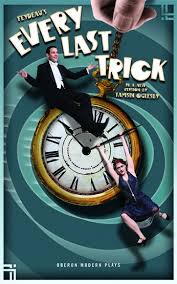
I found this book at work.  The cover was silly and the full title was “Feydeau’s Every Las Trick in a new version by Tasmin Oglesby.”  I saw that it was part of the Oberon  Modern Plays collection, which is a collection of short plays and I have read several of them (okay I just looked them up online and there are approximately 960 Oberon plays, I think I’ve read about 6).

Anyhow, this play is based on Le Système Ribadier by Georges Feydeau.  I’ve never heard of it or him.  But this version is a delightfully over the top farce.

There are four main players: Juan, Gus, Tom and Angela and a fifth one, Knowles.

As the play opens Gus, the servant of Juan and Angela is sneaking in through a window.  He steals some of the family’s booze.  Then Juan and Angela come in, arguing.  Angela is mad at Juan and accuses him of cheating on her. (more…)

Read Full Post »

resist3SOUNDTRACK: CHARLIE SIEM-Tiny Desk Concert #134 (June 15, 2011).

siemWhen he was 3 years old, Charlie Siem heard violinist Yehudi Menuhin play Beethoven’s Violin Concerto. That was all it took to inspire him to pursue the violin. Siem studied at Eton and the Royal College of Music, and now he plays one of Menuhin’s old violins—a stunning 1735 Guarneri del Gesu.  Upon describing this centuries old instrument he says “it helps me a lot when I’m doing my… little thing.”  He is also greatly amused when NPR’s Stephen Thompson asks if he can borrow it.

Siem recently discovered that he’s related to the 19th-century Norwegian violin virtuoso and composer Ole Bull. So he started off his Tiny Desk show with Bull’s bucolic Cantabile.  His introduction is great.  He says that Bull was a precursor to Paganini, who emigrated to the States and set up a colony on Pennsylvania.  He calls him a “really crazy guy.”  It’s a beautiful piece with occasional really high notes.  This violin seems to have an unreal sound to it, bringing it what sounds like harmonic notes or something.

Paganini’s Introduction and Variations on Paisiello’s “Nel Cor Piu”  (an aria from a now-forgotten Paisiello opera), contains a grab bag full of violin special effects.  This is just incredible.  His fingers move faster than can be believed.  There are trills all up and down the neck, there’s pizzicato plucking with his left hand (how?).  In a section of “harmonics” he even whistles the final note.  It’s amazing to watch.

Leopold Godowsky: Alt Wien (“Old Vienna”) (arr. Heifetz)  This is a lovely piece with lots of high keening notes in an arrangement by the incomparable Jascha Heifetz.

It’s amazing that Siem can be so good and yet somehow I’d never heard of him.  His kind of virtuosity is amazing.  And, as it turns out he’s a total hunk with a deep resonating actor’s voice as the pages of Italian Men’s Vogue magazine.  He’s also the 2011 spokesman for Dunhill, the men’s fashion house.  The write up says that for his Tiny Desk Concert appearance, you could say Siem dressed “casual, but with an understated elegance,” right down to his left-hand pinky, with its pink-painted fingernail.

I definitely need to hear more from him.

[READ: December 8, 2015] Victory

This final book in the trilogy sees the culmination of French Resistance against the Nazis.

We learn in the introduction that it has been four years since the occupation began and although victory seems within sight, things have been getting worse.  There’s hardly any food or resources and the Nazis are growing even more angry and vicious.  On June 6, 1944 the Allies landed in Normandy.  But they had a lot of fighting to do before they could liberate Vichy.

As this book opens we see Paul called into the prison because of his drawings.  He looks older now (a great detail on the drawing) and he finds it much easier to lie to the guards.  After an interrogation, Lucie’s father–the policeman we saw in the previous book who seemed to turn a blind eye to Paul’s activity–accuses him of sneaking around to see Lucie.  Paul catches on quickly that the man is helping him and when they are free together, Paul learns that there are people on his side who he never suspected. (more…)

Read Full Post »

resist2SOUNDTRACK: SIERRA LEONE’S REFUGEE ALL STARS-Tiny Desk Concert #118 (April 6, 2011).

sierraSierra Leone’s Refugee All Stars are famous for their story.  Its members met in refugee camps during Sierra Leone’s civil war and formed a band to spread joy during an otherwise difficult time.  But the band’s music is what has stood the test of time.  Ten years, two albums and an award-winning documentary later, these eight men are still riding that upbeat reggae groove.

The band consists of three drummers (all with hand-held drums) and one percussionist.  There’s 2 guitars (one electric and one acoustic) a bass and everybody sings.  Their music has a reggae feel, although it’s not exactly reggae, I don’t think.

“Jah Come Down” opens the show. The acoustic guitar keeps the melody while the electric guitar plays a riff throughout.  Occasionally the bass comes in with a cool line or two adding a nice low end.

“Living Stone” has a different singer (the percussionist).  His vocals are a bit more mellow, as this song is.  It’s amazing to see the age range of the players.

“Tamagbondorsu (The Rich Mock The Poor)” is the final song.  It opens with a guitar lick that reminded me of Paul Simon’s Graceland until i re-thought and realized that Graceland sounded like this.

The songs are fun and lively, perfect for dancing (as the singer does during the long instrumental outro).  Most reggae sounds the same to me, and these three songs do tend to blend together quite a lot.  But the music is fun and the players’ skill is undeniable.

Here;s to ten more years.

[READ: December 4, 2015] Defiance

This book is set three years into the Nazi occupation of France.  Things are sort of the same but worse for the residents of Vichy.  Neighbors inform on neighbors, and some residents collaborate with the Germans (and are more successful because of it).  And then in 1943, a new French-based Nazi police force called the Milice begin keeping watch over their own people

This aggressiveness causes more resistance, of course. And Paul has been drawing detailed and insulting pictures and posting them all over town (which is making the Milice quite upset).

Of course the kids are taking more aggressive stances now, too.  Some say that the posters are causing more harm because it makes the police mad.  But other kids’ parents have joined the police–some of whom are nice to the kids.  Even Paul’s sister, Marie, believes what her teachers say about Marshall Philippe Pétain (there’s a lesson about Pétain at the end of the book) and his governance.  And no one is going to say anything about the Resistance.   (more…)

Read Full Post »

resistSOUNDTRACK: LUISA MAITA-Tiny Desk Concert #100 (December 26, 2010).

maitaI’ve not heard of Maita.  The NPR write up speaks about the electronic flourishes and deep grooves of her songs.  Felix Contreras worried that their stripped down ensemble (only guitar, bass and fascinating bongos) would have a hard time creating that sound.

And in one way they do.  Except that it’s clear they didn’t even try.  Rather, they play a simple, but engaging kind of mellow Brazilian dance music.  In the first song, “Ai Vem Ele,” the guitar and bass play the same grooves except when they each take some meandering moments.  The percussion keeps a quiet but steady rhythm and Maita sings vocals and accent notes all over the place to keep the song interesting.  I really enjoyed at the end of the song when the bassist played exactly the vamping solo that she was singing.

“Alento” is a much faster song, with quickly sung lyrics.  It allows for rapid guitar playing and more uptempo feel.

They only play two songs (about 8 minutes long), but it really shows the kind of range she is capable of.

[READ: December 1, 2015] Resistance

This First Second graphic novel is about the Nazi occupation of France.  It’s not exactly light reading and yet Jablonski has taken this incredibly dark story and found an excellent and compelling narrative about one family who works as part of the resistance to fight back against their oppressors.

This is the first book in a trilogy and I am curious to see what the next two books bring as this story was nicely wrapped up but there are so many more stories which could be told.

Jablonski also helpfully sets up the situation in the introduction.  She explains how France was split in two as a result of the armistice agreement.  She gives a very brief but powerful explanation for why they would agree to splitting their country in half.  Paris and the upper portion of France became Occupied while Vichy and the southern part of France were “Free” (but still with a large Nazi presence).

This story is about an average family.  Paul Tessier and his parents and little sister live in the free part of France. Paul is an artist, and I love the way Purvis juxtaposes Paul’s art with what is actually happening (placing Paul’s “drawing” in the middle of the action so we know he is observing everything. (more…)

Read Full Post »

[LISTENED TO: December 18, 2015] A Christmas Carol

gaimanchristmasJust like two years ago when we saw A Christmas Carol, a few days later I listened to the audio book.  This year, I found a different reading of it by Neil Gaiman.  This one comes from the New York Public Library podcast, and is available on Soundcloud and iTunes.

What makes this reading unique (and now different from Patrick Stewart’s awesome reading and from the McCarter production (which is different from the book as well) is that the version Gaiman read was hand-edited by Dickens for his own performances.  What?

Yes, evidently Dickens performed this story live a few times.  As the NYPL site explians:

Charles Dickens could not only write a crackling good story, he could perform it. And so in 1853, he took his Christmas Carol show on the road, first in Britain and then in the United States. Audiences loved it. Dickens didn’t simply read from his book. He transformed it into a stageworthy script—cutting, pasting together pages of excised passages, adding stage cues for himself, rewriting, then cutting some more…. Indeed, there is only one such copy of A Christmas Carol, created by Dickens himself, and The New York Public Library has it.

Gaiman read the “as the great author intended, following edits and prompts Dickens wrote in his own hand for his unique readings 150 years ago.” (more…)

Read Full Post »

 puckettSOUNDTRACK: MARIACHI EL BRONX-Tiny Desk Concert #226 (June 21 2012).

bronx Mariachi El Bronx is an L.A. based band which plays Mariachi music.  They wear the full mariachi outfit (suits with great designs on them) and have traditional instruments.

According to Felix Contreras, NPR’s Alt Latino dude, their mariachi is quite authentic.  The biggest surprise to me is that the band started as a punk band.  So the lead singer is a bald Caucasian fellow and the accordionist has red hair!  That obviously doesn’t matter, it’s just surprising, especially since their music feels like the genuine article.

They play three songs,

  • “Revolution Girls”
  • “Everything Dies”
  • Norteño Lights”

And they have trumpets playing, a great violin solo on the first track and the big fat bass instrument on all the songs.  Mariachi is pretty much always fun, and this is no exception.

[READ: December 5, 2015] Desmond Pucket and the Mountain Full of Monsters

This sequel to the first Desmond Pucket book pushes Desmond’s love for scaring people (and making monsters) to a logical extreme.  But it also adds a romantic interest and a back story for his nemesis, Mr Needles.

I said that the first book surprised me with its ending, but there weren’t too many surprises in this one.

The book begins with Desmond showing us his Top Secret Master Plan, which involves giving Tina Schimsky a note asking if she’ll go on the Mountain Full of Monsters Ride during the school trip.

But before he can get her the note, class bully Scot Seltzer steals it.  We get a brief story about how Desmond and Scott used to be good friends and how they became enemies (which is pretty funny).   He gets the note back, but when he gets to Crab Shell Pier and is ready to put his plan into action, he is grabbed my Mr Needles, the school disciplinarian. (more…)

Read Full Post »

pipbartrSOUNDTRACK: TURTLE ISLAND QUARTET-Tiny Desk Concert #111 (February 26, 2011).

turtleTurtle Island Quartet (there’s no explanation for their name) are a quartet who play an interesting hybrid/jazz crossover. This is most evident in cellist Mark Summer’s playing.  Half the time he bows the strings but the other half he plays like an upright bass (including a percussive elements when he slaps the strings).

“Model Trane,” the opening tune is a John Coltrane-inspired piece, propelled by Summer’s running bass lines Despite the more classical set up (and three violins) it feels very jazzy.  It runs about 4 and a half minutes.

The band leader is David Balakrishnan who has written most of the songs.  He describes the second song, “Monkey Business,” as “loosely based on a sardonic view of Darwin’s theory of evolution.”  I don’t quite know what that means (it’s an instrumental after all), but it’s neat the way the music is all over the place stylistically.  The most notable moment comes when they quote (and fugue) “Strangers in the Night.”  Although other parts of the song remind me of the music in Bugs Bunny cartoons.

The final song has the funny title “Groove in the Louvre.” He says it was inspired by Django Reinhardt.  I don’t know enough Django to know if that is evident here, but there is plenty of soloing going on.  There’s jazzy fiddles (Balakrishnan plays a baritone violin on this song).  There is very jazzy bass (and even a bass solo on the cello) as well as classical elements.  The song is 8 minutes long.

They are definitely an unexpected quartet.

[READ: June 1, 2015] Pip Bartlett’s Guide to Magical Creatures

Pip Bartlett is a young girl (yes I was surprised that Pip was a girl, especially since it didn’t say so until nearly the end of the Prologue).  She can speak to magical creatures–unicorns, silky griffins, fuzzles–but no one believes her (because no one else can).  This is a drag because she loves magical creatures and her Aunt Emma is a veterinarian of magical creatures (people know magical creatures exits, they just don’t think people can talk to them).

The Prologue sets up that Pip loves unicorns but she never really encounters them.  Pip is an authority on magical creatures because she has read (and carries with her) Jeffrey Higgleston’s Guide to Magical Creatures.  She has actually been annotating it as she learns more stuff than is in the guide.  (The guide is good it’s just incomplete).  Then on field day, a classmate brings in four of her show unicorns.  Pip talks to them and discovers that they are incredibly vain and show-offy.  One of them demands that she ride her so that she can show off as much as the other unicorns.  So Pip does (against her better judgment) and all chaos reigns.  Pip is then sent to live with her Aunt for the summer.

As mentioned, Aunt Emma is a vet for magical creatures, and Pip is pretty excited to see them all.  Emma’s daughter Callie is less than thrilled.  She works in the vet’s office for long thankless hours.  And she is crabby when Pip sees her.  Within a few minutes, a couple of exciting things happy, though. (more…)

Read Full Post »

« Newer Posts - Older Posts »