Feeds:
Posts
Comments

Archive for the ‘Short Books’ Category

SOUNDTRACK: AGNES OBEL-Tiny Desk Concert #599  (February 15, 2017).

Agnes Obel recently played a show near me, but it wasn’t until after I watched this show that I realized I should have gone to see her.

Agnes Obel, a Danish singer and writer of deeply alluring music, brought her work into what you could call its opposite — an office in the daylight. While the setting is a bit contrary to her carefully plotted, vocally dense songs, she mapped out a strategy which included her own reverb and monitor mix in the (successful, I think) hope of giving the Tiny Desk an aesthetic more suitable to these focused and powerful songs.

Obel plays three songs from Citizen of Glass alongside her band, keeping it sonically spare.  “It’s Happening Again” opens with fairly standard-sounding piano chords.  Then Obel’s voice kicks in and it’s unique–not weird, but with a cool almost detached delivery.  Accompanying her is a cellist and keyboardist.  They each sing backing vocals (along with a third backing vocalist).  When they all sing together, it is magical–sometimes creepy, sometimes beautiful.  The song builds to the end with all of the strings growing louder as the cello plays some wild, sliding sounds.  It is quite striking.

For “Golden Green,” the cellist switches to percussion (which is a kind of clacky ball that she throws in the air).  The main melody comes from the mellotron.  Once again when the backing vocalists kick, in everything is magical, especially the way the final note ends with a dramatic rise in pitch from all of the singers.

On “Stone,” the mellotron player switches to (electric) ukulele.  The melody comes from the uke and it is quite quiet until the chord when the cello and keyboard adds some deep bass notes that seem to overwhelm the room–quite dramatic and quite lovely.

[READ: December 1, 2016] Bandette Volume Three

Bandette Volume Three is just as much fun as books one and two.  It opens with Bandette getting shot at as she gives her little dog Pimento an important note for Daniel.  Daniel calls her and she proceeds to tell him about an upcoming heist (while she is still being shot at).  She says that there is a fabulous emerald on display.  An emerald that was once owned by Madame Presto: fabulist, mesmerist, woman of impudent morals.

And later that night (after she easily dispatches the bad guys) she goes to that special event and steals… a film about Madame Presto.

The next night several people (and a dog) are hit with sleeping darts from a new villain–Dart Petite. (more…)

Read Full Post »

  SOUNDTRACK: DANA FALCONBERRY-Tiny Desk Concert #292 (July 29, 2013).

This Tiny Desk Concert introduced me to Dana Falconberry:

Dana Falconberry’s songs are gentle, almost invariably delicate, sometimes mysterious and frequently feather-light. But her music’s sweet, intricate softness never stands in for strength: This is a confident songwriter, whether she’s ambling through six- and seven-minute epics (“Leelanau,” “Dolomite”) or chirping sweetly in the bouncy “Crooked River.”

The compositions on Falconberry’s most recent album, last year’s Leelanau, are sturdy enough to be stripped down for a space like Bob Boilen’s desk at the NPR Music offices. But each benefits immeasurably from the broad assortment of lovely flourishes she re-creates here with the help of five instrument-swapping backing players. What makes Falconberry stand out in a crowded field of singer-songwriters is her music’s unfailing impeccability, and this Tiny Desk Concert finds her and her crack band hitting every immaculately crafted mark.

I tend to agree with the blurbs, but this one really is spot on: delicate, impeccable, sturdy.  These are words I would absolutely use to describe these songs.  I would also use fantastical–not suggesting that there might be fairies floating around during these songs, but it wouldn’t surprise me if one made an appearance.

“Dolomite” is a beautiful 7 minute song with many different sections.  Falconberry’s delicate (but not wimpy, it must be said) voice works perfectly with the capoed guitar she’s playing.  After the first verse, she’s joined by a cello, banjo and backing vocals, and the song builds.  Then after almost 2 minutes the bass and drums jump in and the song, while staying basically the same, gets a whole new feel (the bassline is staccato and unexpected while everything else is so smooth).  At around 3 and a half minutes the keyboards start adding these pretty little runs that make the song seem even more magical.  The middle of the song has the three female singers rotating through a  series of oohs and ahs as they make a cool-sounding fugue.

For “Crooked River,” the bassist switches to melodica.  Once again there’s a great sequence where each of the female singers sings one note in a very complex melody–it’s quite enchanting.  The cello is plucked giving the whole song a very different feel from the first.

Before the final song Bob asks if she has had any desk jobs.  She says she has had her fair share.  “I currently have a desk job…I hope. We’ll see when I get home.”

For Leelanau, the keyboardist switches to accordion, and there is prominent banjo and delicate melodica.  The verse is really quite catchy, and after the verse there is a gently rocking section where everyone joins together–it bursts forth in contrast to the rest.  It is repeated a few times throughout the song, and each one is more fun than the previous.  The middle has a kind of slow break down with the cello scratching and the melodica and accordion sounding like they are running out of breath.  Dana even hit’s Bob’s gong.  The accordion is even “breathing” without making a musical note.  The song returns to that super catchy verse and jam section and just as you think its going to fade to an end, there’s very cool chime that echoes and then a huge buildup to the conclusion.

I was so entranced by Falconberry’s music that I need to hear more of it.

[READ: September 19, 2016] Bandette 2

Two years ago I wrote about Bandette Volume 1: “The book was very exciting and sweetly charming as well.  I’m looking forward to Volume 2.”  And I waited and waited for it to come out.  I even saw Vol 1 the other day and wondered when we’d get volume 2.  Well, apparently this has been out since 2015, but the library just acquired it.  So I’m happy to say it’s not my fault it took two years for me to get around to reading it.

Even though I didn’t exactly remember how book 1 had ended, Tobin & Coover added a helpful “Previously” section to get us caught up.

The wit and charm of the first book is back in spades. Bandette continues to be seemingly immune to the world around her–she says what she wants and does what she wants and no resistance will get in her way–whether it is verbal sparring or her uncanny gravity-defying stunts.  Her love of chocolate remains as well, of course.  And the tone retains that agelessness.  It feels like this book could have been written in the 1950s but for the cell phones and scooters.

Chapter One reminds us that Bandette is a civilizan as well  She has dark hair and a love of pastries–she even gives the bakery owner priceless urn (from where) as payment for the delicious sweets. (more…)

Read Full Post »

SOUNDTRACK: BOMBINO-Tiny Desk Concert #301 (September 7, 2013).

So who or what is Bombino you, like me, are probably asking.  Well:

Omara “Bombino” Moctar is a Tuareg guitarist, born in Niger.  There’s something alluring and charming about Bombino, whose childlike face belies his fierce, hypnotic guitar playing. The familiarity in his music stems from the blues, a common thread between American music and Africa for obvious reasons. Bombino grew up on the music of Jimi Hendrix, whose sound keeps getting sent back and forth from America to Africa and back again.

Bombino plays three songs.  They’re all pretty lengthy with a lot of guitar playing.  But none are instrumental.  However, I certainly have no idea what he’s singing.  In addition to Bombino, there; a rhythm guitarist, a bassist and two drummers–one playing a djembe I believe and one playing that drum that you thump with your fist–I can’t find the name of it.

  • “Tamiditine” has a Western sounding melody
  • “Her Tenere” opens with a lengthy guitar solo–and o course his guitar has that distinctive tinny guitar sound  This one is really catchy.  I assume he is singing real words, but it just sounds like “deh deh deh.”
  • “Imuhar” feels a bit more Nigerian, than Western–it’s interesting to hear the distinction in scales there.  Overall this has a long jamming quality to it.

Before listening to the Tiny Desk Concerts, I’d never listened to music like this and I’m grateful for the exposure to it.

[READ: January 24, 2017 ] Snow White

Matt Phelan continues to make great graphic novels.  This one is an adaptation of Snow White.  I assumed it would be a fairly straightforward telling of the fairy tale, but Phelan changes the setting of the story and makes the whole thing far more “real,” which is a neat trick.

Phelan has moved the setting of the story from the forest to the glamour of 1920s Manhattan.  It is just before the Depression and the city is hopping!  Bright lights, (for a black and white book anyway), dancing and money everywhere.

And amid this, a young girl is born.  Samantha White is a few years old in 1918.  As she runs through central park her mother calls to her: Samantha…Snow!  The girl responds to this name, but as she turns around, her mother cough up blood into a handkerchief (virtually the only color in the book). (more…)

Read Full Post »

SOUNDTRACK: STEVE GUNN-Tiny Desk Concert #299 (August 31, 2013).

Steve Gunn is a fascinating guitar player:

his work mostly stems from a bushy, overgrown definition of what we often call “Americana,” with a healthy understanding of the La Monte Young drone.

Grateful Dead and J.J. Cale certainly reside in the rubber-band bounce of “Old Strange,” a song that keeps the groove mellow, but will suddenly pop with water-drop elasticity. “The Lurker” comes from a much longer solo guitar version that originally sounded like one of Roy Harper’s acoustic epics, but with Gunn’s trio, it becomes a back-porch barn-burner.

For this concert, Gunn and his band play two 9-minutes songs.  They center around his guitar work which yes, has a drone, but the main focus are the Americana riffs that he plays with precision.

“Old Strange” opens with a lengthy guitar passage that shifts after 2 and a half minutes to a slow folky kind of style.  The song seems like it will be an instrumental but 3 and a half minutes in he begins singing. His voice is deep and he sings a kind of narrative story.  It’s quite mesmerizing.   “The Lurker” is a slower, more mellow jam.

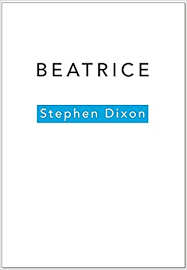
[READ: September 3, 2016]: Beatrice

I have read a couple of books from Dixon through McSweeney’s.  I didn’t know much about him then and I still don’t, but I recalled liking his stuff pretty well.  And this book was short so I thought I’d give it a look.

This book is told in a fascinating style–a kind of stream of consciousness in the mind of the main character, but through really close third person.

The book details the encounter of the main character Professor Philip Seidel (there’s a joke about this name, as Seidel means mug) and a woman named Beatrice.  Beatrice was a student of his some 25 years earlier.  She has stopped at his house to deliver some food in condolence for the recent passing of his wife.  She knows about this because she is now a professor where he taught her, although he had retired a few years back.

She brought some food and also wanted to tell him that he was her favorite teacher back then.  She had studied German and wasn’t allowed to take fiction courses until she completed her requirements.  She loved his teaching method and loved how encouraging he had always been.  She has clearly been keeping tabs on him–she has read some interviews he gave–and she definitely knows a lot about his life.

When she leaves he briefly wonders if maybe she’s interested in him now that the are older.  But he puts that out of his mind. (more…)

Read Full Post »

 SOUNDTRACK: MIRAMAR-Tiny Desk Concert #594 (January 27, 2017).

Miramar is from Richmond Virginia, but they play beautiful bolero music.

When the members of Richmond, Virginia’s Miramar first heard the music of Puerto Rican composer Sylvia Rexach, they were intrigued that she wasn’t as well-known as other popular bolero writers. So they came up with an album’s worth of her songs to cover, and have been wowing audiences across the country with their exquisite renditions of her songs.

When they pulled into NPR to play behind Bob Boilen’s desk, Miramar’s members made time stop with a performance that swept us off our feet, ably backed by friends of theirs from Richmond who played gorgeous string arrangements behind the band. So turn the lights down low, clear out the living-room carpet and find your dance partner for this one.

What is it about bolero music?

Some say you have to have loved and lost to appreciate the beauty of the bolero. Since its inception in Cuba in the early 20th century, the music has been designed for thoughtful and emotional consideration of the joys and pains that come with loving someone so intensely, it becomes like a religion to adore that special someone (an actual bolero lyric).

They play four songs: “Sin Ti” (without You) opens with some great Spanish guitar and shakers (which sound like water).  The song slowly builds and then the two singers come in.  Rei Alvaresz and Laura Ann Singh sing beautifully together.

The rest of the band includes: Marlysse Simmons Argandoña (piano, organ); Hector Barez (percussion); James Farmer (bass) and Sebastian Cruz (guitar).

“Estatua” (Statue) is faster and more upbeat.  The large string section is put to full use here. (With strings provided by Ellen Riccio (violin); Treesa Gild (violin); Kimberly Ryan (viola) and Schuyler Slack (cello)).  I love when she is singing “te creo” and he is singing low vocals underneath her.  The strings add wonderful drama to this mournful yet beautiful song.

“Urgancia” (Urgency) has some very cool organ sounds—very retro 60s swinging (almost soap opera)–sound.  But in addition there’s beautiful guitar and their great vocals as well.   The first three songs were all originals

“Tus Pasos”  (Your Footsteps) is by Sylvia Rexach–the inspiration for everything they’ve done.  It is a sweet, romantic, old-fashioned sounding love song.

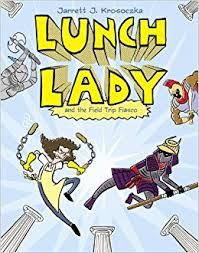
[READ: July 6, 2016] Lunch Lady and the Field Trip Fiasco

I’ve been really enjoying the way the events of the previous books lead to the follow-up.  So you actually should read these in order, which is more fun anyway.

Our opener shows masked men robbing a grocery store–Lunch Lady is able to stop them with fizzy soda.

But the plot of this book is the field trip that was foreshadowed in the previous one.  The Breakfast Bunch is excited to go, except that Hector forgot to get his permission slip signed.  So Dee (who is increasingly more sarcastic as the books go on) forges the signature–who will know?

Lunch Lady and Betty are bored because everyone is going to the field trip–there’s no lunch today.  But when Mrs Palonski learns that her chaperone can’t come she reluctantly agrees to let Lunch Lady come along.  (Betty tells her to go and have fun even though she sighs when she’s left all alone).  Of course Mrs Paloski is worried that Lunch Lady never stops talking (which proves to be an ironic worry). (more…)

Read Full Post »

SOUNDTRACK: BADBADNOTGOOD-Tiny Desk Concert #593 (January 23, 2017).

I’m amused at how kinda dorky all of these guys look–except for the drummer who looks “cool.”  Why is that amusing?  Because of this blurb:

BADBADNOTGOOD made a name for itself by reworking songs from the likes of Nas and Ol’ Dirty Bastard, eventually catching the attention of Odd Future leader Tyler, the Creator. The masses took notice in 2015 when the group produced an entire LP for Ghostface Killah, Sour Soul. BADBADNOTGOOD has been called a hip-hop ensemble, but its foundation is clearly jazz, which provides a gateway to countless genres. On IV, the group allows that gateway to widen, adding soul and funk to the repertoire.

And they are all only in their 20s!

They play three songs from IV.  This first “And That, Too.” is a very jazzy song.  I love the complex piano melody that’s getting thrown around–syncopation and almost chaos, but always staying true to the great rhythm laid down by the bass and gentle drums.  I also happen to love the flute solo that rides over the top of everything–it provides a great 19070s jazz vibe.  The flute switch es to alt sax, and instrument that I think is kinda cheesy–I’d have rather it stayed with flute.  But his solo is pretty great–meandering and intense.

Introducing “In Your Eyes” the drummer says that he was fortunate enough to go to high school with a sax player who he didn’t know would have a voice that would blow him away … “later in my life” (ha).  Charlotte Day Wilson’s voice is deep and sultry although I don’t particularly like it–it feels too forced or something?  But she does sound much older than she looks.  Which is shame because I think the music of the song is pretty great.  The flutist has switched to guitar for this song (that’s a talented dude).

Before introducing the final song the drummer says “My 2017 is feeling pretty good so let’s keep it going.”  The fact that this was recorded sometime around the inauguration trump feels incredibly tone deaf.  But whatever.  “Cashmere” (“which only slightly veered from the studio version”) is a ten-minute song that opens with a very cool high bass note section and lots of piano.  The guitarist switches to yet another sax (four instruments in three songs).   The middle of the song is just the bass notes and a  lengthy piano solo.  i also like how the song seems to be over but that bass line picks up one more time.

I was surprisingly delighted with this Tony Desk Concert.

[READ: July 4, 2016] Lunch Lady and the Bake Sale Bandit

As Book 5 opens, Lunch Lady foils some safe robbers (in a very funny way).  I really enjoy how every book starts out with an intro comic showing off Lunch Lady’s mad skills.

Then it switches over to a school bus.  The Breakfast Bunch is trying to get on board–they don’t usually ride the bus–but the driver, Brenda, is pretty awful. To them and to everyone.  She drives like a maniac and yells at everyone.  She’s nice to the principal bit once he tells her his news, she can’t even pretend to be nice to him.

The news is that there is going to be a bake sale.  And if it goes well, the students will get a field trip and… Brenda will be the bus driver!

Gah! “How she despises children.” (more…)

Read Full Post »

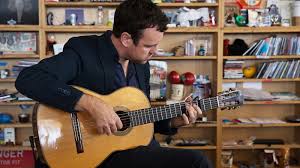
SOUNDTRACK: DEREK GRIPPER-Tiny Desk Concert #587 (December 16, 2016).

There are so many amazing musicians in the world that it’s impossible to have heard of all of them.  So it’s no surprise I haven’t heard of Derek Gripper, but at the same time, he is so mesmerizing I’m surprised that I haven’t heard of him before.

The 38-year-old started on violin at age 6, then wound up with one of the few classical-guitar professors in his native South Africa. But touring the world playing the music of the great dead white men was not all that appealing (though Gripper still loves to play Bach). Then he heard a record by the Malian kora player Toumani Diabate. He decided that that’s what he wanted to do: not play the kora itself, but play kora music on the guitar.

Of course, the kora has 21 strings, each tuned to a fixed note. The nylon-stringed guitar Gripper plays has six. But by using unusual tunings and fretting the strings up and down the neck with his left hand, he can pretty much hit all of the kora’s notes.

The remarkable thing is, he figured all of this out — and recorded two acclaimed albums — just by listening to CDs and checking out music online. Gripper painstakingly transcribed what he heard onto a kind of notation called tablature — similar to the music written for the Renaissance vihuela, which was also an inspiration. Earlier this year, Gripper finally made it to Mali, where his efforts received the blessing of Toumani Diabate himself; the two even jammed together.

That’s an amazing story but it’s nothing compared to the quality of his music.  It really does sound like he’s playing, if not the kora exactly, then certainly an instrument with more than 6 strings.

He plays four songs, three are traditional pieces which he has arranged for guitar and the fourth is an original piece.

Hearing the opening notes of “Tuth Jara” (Trad. Arr. Derek Gripper) and you know that you’re not listening to a typical guitar–the trills and runs sound so West African.   And once you get past the mesmerizing nature of his fingers. The melody is really pretty too.

“Joni” is an original piece about a love affair with a singer–the way he tells the story is delightful.  I love that part of the song is him actually down tuning one of the strings for a bit and then tuning it back up (all while playing everything else).  I also really like that he makes relatively quiet humming/singing noises while he’s playing.

He says he was inspired by Diabate who turned the kora into a solo instrument–which is much easier than traveling with a  band.  And then he illustrates how he plays kora music on his guitar–a bassline, the accompaniment and the melody–all on the guitar all by himself.  That’s his introduction to “Jarabi” (Trad. Arr. Derek Gripper).  And during the incredible playing out comes a beautiful, catchy and fun melody line.  All too soon, it’s over.

But since he has some time, they encourage him to play one more–“they’d be happier!” if he did.  So he ends with “Duga” (Trad. Arr. Derek Gripper) which he describes as a conversation between ngoni and kora.  The kora wins because he knows more about kora.   And like so many of his pieces, it is over way too soon.

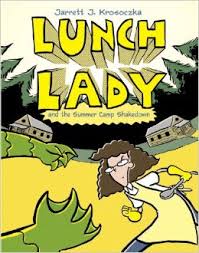
[READ: June 13, 2016] Lunch Lady and the Summer Camp Shakedown

As Book 4 opens, Lunch Lady is seen in a two-page spread wielding her fish-stick-nunchucks.

Then we see that everyone is heading off to summer camp.   The kids have been looking forward to summer camp since they were little and they are finally old enough. Sadly Milmoe the bully will be there too.

And, unbeknownst to Lunch Lady and Betty, they are working at the same camps as the kids.  Lunch Lady has worked there before and she knows everyone, she gives us the lowdown on the counselors like Scotty who has always been the most popular and Ben, the new guy, who is pretty foxy himself.

The counselors are super excited when the kids show up, although Dee is a little blasé about it.  And then they run into Lunch Lady. (more…)

Read Full Post »

SOUNDTRACK: ALSARAH & THE NUBATONES-Tiny Desk Concert #585 (December 9, 2016).

The Tiny Desk Concerts have introduced me to a ton of bands I’ve never heard of before.  They’ve also introduced me to styles of music I’ve never heard before.  Alsarah and the Nubatones play music inspired by her home country of Sudan.  But I believe she (they) include pop elements to make the music more accessible (and danceable).

And this Concert was great–I listened to it over and over.

The instrumentation is all fairly simple: Rami El Aasser plays all kinds of percussion.  I love the sound that he gets out of that hand drum.  Brandon Terzic plays an amazing oud and  Mawuena Kodjovi’s bass holds the whole thing together in an incredible way–something that I think this traditional music lacks.

But most important are the singers’ voices.  Alsarah sounds great by herself but when she and Nahid harmonize, it is enchanting.  Especially in the chorus of the first song, “Ya Watan” when their voices work together so perfectly

But what’s Alsarah’s deal?  The blurb is really helpful:

When singer Alsarah left her native Sudan, she was just a child who’d shown an interest in music. She’s said it served as her coping mechanism during a subsequent transition to life here in the U.S. That passion led her to a university degree in ethnomusicology.

It also drew her to musicians who were passionate about the intersection of culture, music and migration. Together, their one-of-a-kind expression has been called “East African retro pop.” But that tag only scratches the surface: In their hands, the music pulses, breathes and comes alive with a mix of tradition and contemporary influences.

I don’t know what the song names mean, but I love “Ya Watan.”  The song is really catchy, but when the bass did a big slide at the end of the middle slow section to announce the final part, I was hooked.

I have no idea why there’s a 3 in this titular word, but that makes me even more intrigued by “3roos Elneel.”  Before the song she says (in perfectly unaccented English), “I’m going to tell a story because I think I can do whatever I want.”

She says that the song is inspired by “girls music” performed at wedding ceremonies in Sudan.  But she tries to merge it with an old myth.  The Nile River would flood every season because the gods were angry and lonely.  So the Sudanese people would sacrifice the most beautiful maiden in the village.  But she wonders what happens after she goes in the river.  And what happens next season when there’s a new girl–that’s a lotta wives.  So, she likes to think there’s trade off.  You go in to the river and do 3 months as a Nile god bride and then you swim off.  Maybe the bottom of the Nile is full of ex-Nile-god-divorcees giving birth to mermaids.  Yes, she claims mermaids as a Nubian invention.

The song begins with a call and response. It sounds rather traditional.  But after a few lines, the song stops with a four-beat clap-along section.  And then everything shifts.  First the bass plays a cool riff then the oud joins in with some fast playing and then the percussion makes it utterly danceable.  There’s even a cool oud solo.

The first section of “Fulani” is the chorus repeating the word Fulani over and over (in call and response style), but it’s done in wonderfully melodious fashion, including a catchy stop start section with more clapping.

The song is really great and I love the way all the instruments are able to make the song fade out.

This music was totally captivating.

[READ:January 27,2017] Beautiful Blue World

Sarah brought this book home and read us a little bit of it and I decided I had to read it, too.

The part she told us about was about a girl taking a test to see if she would be useful for the army.  But it was no ordinary test, it was more like Bletchley Circle–puzzles and observations more than facts.  That sounded great.

What she didn’t tell us was the general set up of the story.

So, this story feels like a World War II story, with a country like England being attacked by a country like Germany.  But what makes this book special is that these are not the countries. The countries are called Sofarende (the attackees) and Tyssia (the attackers). But despite these countries having fantastical names, the story feels very real.

(more…)

Read Full Post »

SOUNDTRACK: JOSHUA BELL & JEREMY DENK-Tiny Desk Concert #568 (September 30, 2016).

After hearing a pianist and then a violinist, it was fun to hear a duet of the two.

Joshua Bell and Jeremy Denk are masters of their crafts.  Although I did not know that:

Bell and Denk have been chamber-music partners for 10 years, and they’re a bit wound up on Brahms these days. They’ve released a new album, For the Love of Brahms, and they’re performing the music, along with that of Brahms’ friend Robert Schumann, in concerts.

They play three pieces, two Brahms, and one Schumann.  And they all sound spectacular.

Brahms: Violin Sonata No. 3, IV. Presto agitato
“You gotta love Brahms,” Joshua Bell says, a little short of breath. He’s wiping sweat from his brow after the big rock ‘n’ roll conclusion to the composer’s D minor Violin Sonata. Bell and the astute pianist Jeremy Denk play it with all the turbulence and tenderness Brahms demands, and it’s an invigorating way to open this Tiny Desk concert. [I love that the focus jumps back and forth from violin to piano, with interesting riffs and trills from one then the other.  I also love the way the melodies seem to creep around and sneak up on us].

Schumann: Romance, Op. 94, No. 2
Contrasting with the fiery Brahms, Schumann’s Romance, Op. 94, No. 2 unfolds like a song without words. Bell makes his 1713 Stradivarius sing, capturing the bittersweet tone of the music. When the theme comes around for the second time, he lightens bow pressure for a more intimate, almost whispered disclosure.

Brahms (arr. Joachim): Hungarian Dance No. 1
Another of Brahms’ close friends figures prominently in Bell and Denk’s final offering. Violinist Joseph Joachim was something like the Joshua Bell of Brahms’ day, as well as the man for whom the composer wrote his Violin Concerto. Joachim’s gift to Brahms was creating piano and violin arrangements of the composer’s Hungarian Dances.  Brahms’ Hungarian Dance No. 1, powered by a sweeping theme and chugging piano topped with pearly descending runs, whisks you to a smoky café where gypsy fiddlers battle for supremacy. Starting off on the low G string, Bell’s tone is as rich as dark chocolate, the feeling a touch wistful.  [I really love Hungarian dances.  It seems like every composer’s take on Hungarian music is excellent.  I love how the violin plays a very simple yet dark melody and the piano sprinkles in all of these descending notes in a fairly dramatic scale.  And then of course as all the dances do, it speeds up, careening around in wild abandon and fun.  Wonder what made Hungary such a lively place].

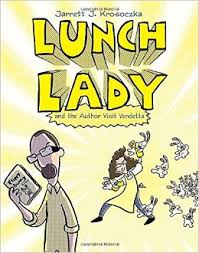
[READ: June 13, 2016] Lunch Lady and the Author Visit Vendetta

I rather like that the Lunch Lady books are sequential and mildly dependent on each other. Of course you can read them in any order you like, but reading them in the proper order allows you to see some continuity between books.

In the previous book, Dee mentioned that the author of the Flippy Bunny series was coming to the school. And in this book he does.

The kids are super excited that Mr Scribson is going to be there to read and sign books.  He is something of a primadonna though as he is upset that the reading will be taking place in the gym.  After his presentation, he signs books, but when Hector brings him a very old copy of the book Scribson says “I don’t sign opened books.”  Hector who has always love the Flippy Bunny books is devastated). (more…)

Read Full Post »

SOUNDTRACK: RACHEL BARTON PINE-Tiny Desk Concert #555 (August 5, 2016).

I’ll let the blurb do the introduction:

Violinist Rachel Barton Pine began playing Bach in church at age 4. Ever since, she’s been mastering and re-mastering Bach’s set of six Sonatas and Partitas—more than two hours of solo violin music that looms like a proverbial Mount Everest for any serious fiddler. The trick is getting the details down. Bach left us with the notes but not much else. Pine recently analyzed every measure of these works, and prepared a new edition of the music with her own dynamic markings, phrasing indications, bowings and fingerings.

For this performance, Pine chose three contrasting movements from the set and plays them on her Guarneri del Gesu violin, which was built in 1742 — eight years before Bach died. She highlights the spirit of the dance in the “Tempo di Borea” (a Bourée from the First Partita). She unfolds a serene melody, just lightly accompanied, in the “Largo” (from the Third Sonata), and she closes with the intertwining “Fuga” (from the First Sonata), which sounds like three violinists in deep discussion.

And the music is gorgeous (Bach is truly sublime) and Pine’s violin playing is stunning.

She plays three pieces:

  • J.S. Bach: “Tempo di Borea” (from Partita No. 1)
  • J.S. Bach: “Largo” (from Sonata No. 3)
  • J.S. Bach: “Fuga” (from Sonata No. 1)

The first she describes as dance music.  She says that even though this was not created for the dance, you can sense the implicit choreography.

She describes the second piece as the sorbet course in between the exciting stuff.  It is in the key of F major, which historically is an intimate key.  This piece is calm and peaceful with the sparest of accompaniments.

For the final piece she says she will finish by playing the most complex of violin pieces.  Bach wrote it as a fugue for solo instrument.  She describes a fugue as a musical pattern that the voices toss around in conversation with each other.  So this little four string violin sounds like a full string ensemble.  And it absolutely does.  The opening melody is followed by the same melody on a lower string (while the first string is playing something else at the same time).  And then that riff is continued on the next string while the other two continue.  It is amazing.  And then near the end, she plays some incredibly fast dervishes of flying fingers and that crescendo is not even the end.

You might say that Bach was cruel, except it sounds so amazing, it’s worth it.

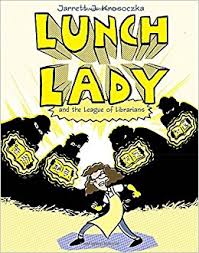
[READ: June 13, 2016] Lunch Lady and the League of Librarians

Librarians don’t really like when librarians are portrayed as villainous–unless they are done well.  And these librarians are pretty evil.

I enjoyed how this book also started out with a short clip of Lunch Lady stopping some bad guys before we even get to the story proper.

This book sees the Breakfast Bunch split between wanting to play video games (Hector is excited about the new X-Station 5000) while Dee is excited for the Read-a-thon contest.  Of course when they go to check out the Book Fair, the librarians insist that it starts tomorrow, not today.

Things seems calm and quiet for Lunch Lady.  In the meantime, Betty has come up with a new gadget: taco-vision night goggles. (more…)

Read Full Post »

« Newer Posts - Older Posts »