Feeds:
Posts
Comments

Archive for the ‘Short Books’ Category

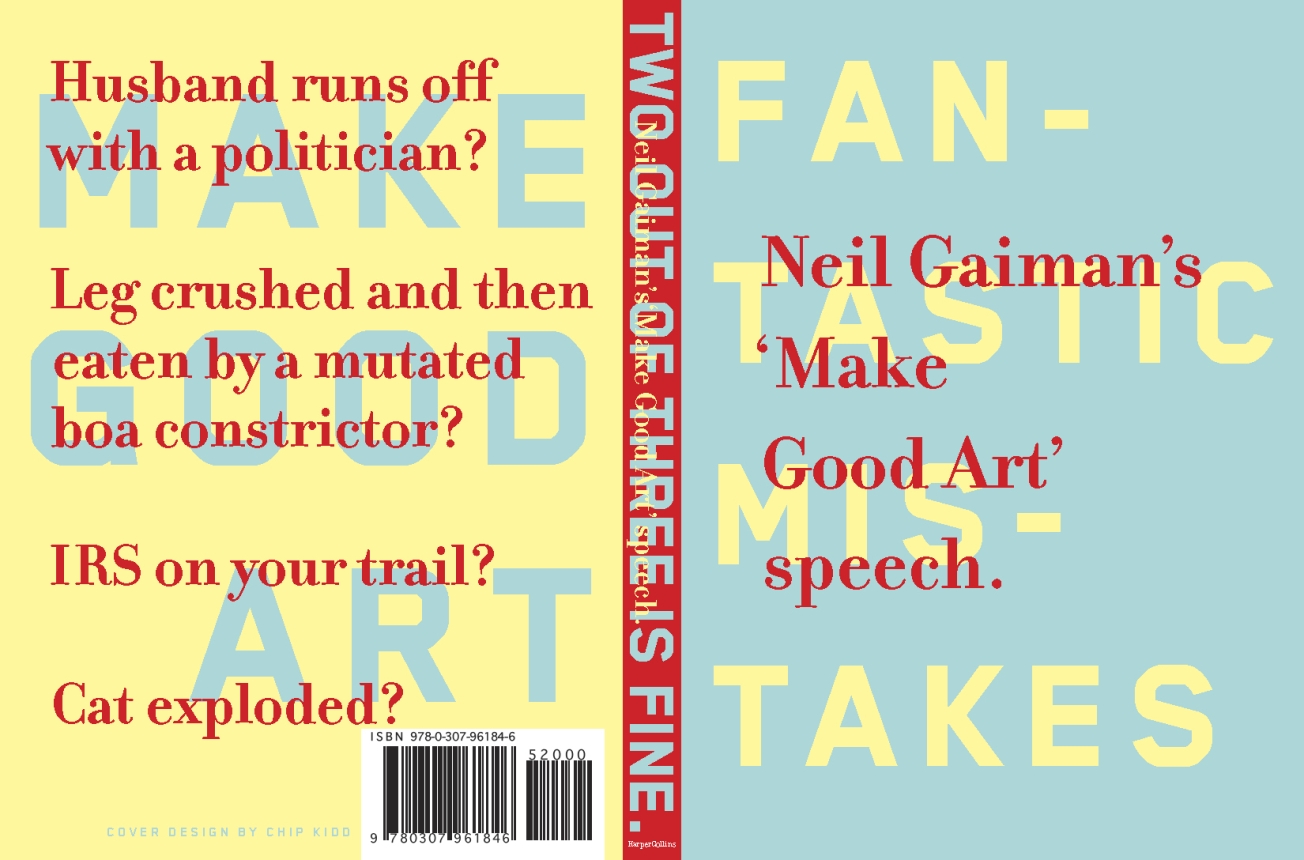
makegoodartSOUNDTRACK: AMANDA PALMER: The Art of Asking (TED Talk, February 2013).
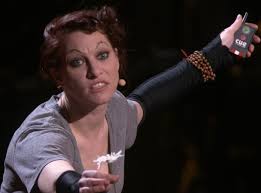
palmerAmanda Palmer is Neil Gaiman’s wife.  She was the singer in The Dresden Dolls and has a solo career.  I actually don’t know that much about her music.

But I linked to this TED speech after reading Gaiman’s book.

In this talk, Palmer talks about asking for things and how it’s hard to ask, to beg., but how it makes for a real connection, especially between musicians and fans.

And she talks about crowdfunding–she’s going to give away all of her music but she’s asking for help from fans along the way.

It’s a pretty inspirational talk–how asking for things helps you connect with people.  It also made me feel a lot better about Palmer, who I’d heard negative things about.

Check it out here.

[READ: June 5, 2013] Make Good Art

As with David Foster Wallace’s This is Water, this book is a short speech padded out to 80 some pages. The difference is that while This is Water is a rather boring-looking book, this title was designed by Chip Kidd, fabulous designer extraordinaire.  So every page looks interesting.  It’s not so much illustration as design—with shapes and text twirling and twisting upside down and what have you.

As with most inspirational works, this book is indeed inspirational.  But it is especially so if you are an artist or an aspiring artist.  Because this speech was given to the graduating class of Philadelphia’s University of the Arts in May 2012.  You can watch the whole speech here as well.  http://vimeo.com/42372767

Gaiman explains how he never went to college and never even really had a career, he just had a list of  things that he wanted to do: write an adult novel, a children’s novel, a comic, a movie record an audiobook, write an episode of Doctor Who.  And how he set about achieving these things is pretty great.

So some advice from Gaiman:

1. It’s better not to know the rules so that you’re not afraid to go beyond them.  If you don’t know something is impossible, it’s easier to do. (more…)

Read Full Post »

htthinkSOUNDTRACK: DEPECHE MODE-“Fly on the Windscreen” (1986).

flyonEvery time I use the phrase ‘death is everywhere” (which I don’t do often, but which I do do below) I think of this song.

I forgot how synthy this song sounds when it opens–two different very synthy sounds.  After the vocals (which feature Dave Gahan’s voice at its strongest) the guitars come in and the song sounds a bit more complex.

It’s funny how the song which starts with the dark verses and  “death is everywhere” can have the cool and rather sweet bridge of “Come here, touch me, kiss me, touch me, now.”  (Gahan’s o’s are so wide when he sings, it’s great).

This song really marks the transition of Depeche Mode from synth pop to darker more angsty music.  Indeed, all of Black Celebration, with its noisy percussions and unusual instrumentation and of course, Martin Gore’s dark lyrics, shows a band transitioning to new levels of greatness.

[READ: May 30, 2013] How to Think the Unthinkable

This play was created and produced for the Fringe Festival.  I tend to think of the Fringe Festival as, you know, stuff on the Fringe, so I imagined that this play that was “After Sophocle’s Antigone” would be a modern and possibly weird update of the story.  And it starts off that way with a guard coming back with three clothespins.  He explains that he always draws the short straw and he was the one sent off to get clothespins to block the noses of the other guards.  You see, they have been sitting watch over this body for a few days and he is starting to smell pretty bad.

But when the guard, Tom, arrives, he discovers that the other two guards (Roy and Bo) have fallen asleep and the body is gone.  Tom freaks out, he tells them (and us) that the body (of Polynices) cannot possibly be given a proper burial.  Polynices was a traitor to King Creon and his punishment is to be left to rot outside of the city walls.  How could they have let someone take and bury his body?  They were tired.  See, it’s funny.

Indeed, the other guards have no answer and are more or less comic relief.  Until Haemon shows up.  Haemon is Creon’s son.  He is super annoyed because he was the one who vouched for Tom and the others.  Now he looks bad and Creon will be pissed.

Cut to Creon ensuring the City Elder that he plays no favorites and if even his son is found guilty of a crime—like burying Polynices–well, the full force of punishment will come onto him as well.  Like any Greek tragedy, you can see the set up. (more…)

Read Full Post »

arborSOUNDTRACK: DAVID BYRNE-uh oh (1992).

uhohI received this CD free when it came out (radio station perk), and I listened to it a few times, but not really all that much.  I never really thought that much about it because I didn’t really like the cover–it looked too babyish.  It’s been a while since I listened to it and I am delighted at what a good, solid, Talking Heads-ish album this is (with David Byrne, you never know exactly what you’ll get from a record, but this is poppy).

“Now I’m Your Mom” opens with an early 90s funky electronic bass and some crazy guitar sounds.  But as soon as the bridge kicks in, the song is pure Byrne/Talking Heads.  And that world music style chorus means that this song could have been huge (even if it is about a transvestite or transgendered person–I didn’t listen that carefully).  However, the extended section at the end makes the song feel a little long.  “Girls on My Mind” is a strange (but good) song from start to finish—a weird cheesy synth sound pervades the song, and yet once again, it’s very Byrne—especially the crazy singing of the chorus.

“Something Ain’t Right” opens with an odd chant but then turns very conventional—with choral voices giving big oohs.  “She’s Mad” opens as a kind of sinister song.  And yet, after some verses about her being mad, the chorus is as bright as anything else on the record—a very schizophrenic song.  “Hanging Upside Down” has a very commercial Talking Heads Feel, like “Stay Up Late.”

“Twistin’ in the Wind” has more of those big choruses of voices to “well well well” up the song.  “The Cowboy Mambo” has another weird sound that circulates through the song, but it’s got a good beat and a great chorus and it would be fun to dance to.  “Monkey man” is a horn-heavy track that opens in a sinister vein once again.  “A Million Miles Away” just gets stuck with you and makes you want to sing along.  “Somebody” ends the disc with more Latin horns and rhythms.  It’s a fun song, and a good ending.

Overall, this is a surprisingly good record.  All of the songs are a little long–Byrne songs should really max out around 4 minutes.  For that extra time, he either tends to repeat himself or add superfluous codas that drag out the end.  But aside from that, this is a real treat, especially for Talking Heads fans.

[READ: May 20 2013] Arboretum

The back of the book describes this as a collection of enigmatic, enchanting mental maps.

And that is kind of what the book is.  It is a collection of drawings–tree and branch-style drawings mostly–that endeavor to map relationships.  But the subject matter is crazily diverse–oftentimes nonsensical or at the very least unparseable.  The good news is that many of the drawings have an explanatory text in the back of the book.  I acknowledge that ideally the drawings should make sense without needing an explanation, but the explanations were really useful–they really give you the frame of mind that Byrne was trying to explain through the pictures. (more…)

Read Full Post »

bikesSOUNDTRACK: ARCHIE PELAGO-“Avocado Roller” (2013).

archie-563227e1389d31573229dc9d8c7651d5cda681a0-s1I’d never heard of Archie Pelago (get it?).  This is an instrumental that begins with lots of electronic percussion, creating  complex rhythms and beats. It’s funky, but mildly funky.  Then after about a minute or so, there’s some music thrown on top–layers of sounds that are interesting. Then comes a weird sax solo–is this suddenly smooth jazz?  Then we gets some voices and spoken word, all working to create an instrumental soundscape.

I can see this in a movie, although I wouldn’t choose to listen to it myself.

[READ: May 19, 2013] Bicycles Locked to Poles

I recall when this book came out from McSweeney’s and I remember thinking what a weird idea–a book of pictures of bicycles locked to poles.  I thought it sounded … I don’t know… weird.  So, when I saw it used for a penny I decided to check it out.  And indeed, nearly ten years later it’s still weird.

It is an incredibly audacious book as it is literally just pictures of bicycles locked to poles (and an occasional tree).  The book is broken down into four parts, although there is no difference between the parts–it’s just more pictures.  And there is no text at all.  Except for a chart on the front and back inside cover which shows what pats of the bike were left in the picture (an unusual index which could be useful if you were doing some kind of study of the state of bicycles left to poles, but something which is not terribly useful in this book).  Categories include: Frame, fork, front wheel–spokes, steering–grips, comfort–saddle, options–front basket. (more…)

Read Full Post »

sign4SOUNDTRACK: GOAT-“Run to Your Mama” (2012).

goatI was intrigued to hear this song by Goat (whom I don’t know) because of the picture below.  Now that is a band photo!

Goat are a Swedish band and, like a bunch of Swedish bands recently, their guitar sound is very retro–a big open clean guitar sound.  But the riffs that they play are also very retro, this song sounds incredibly 70s–classic rock/heavy metal 70s.

The lead singer is the female of the trio, and she has a great raspy voice (and I assume she does the backing vocals as well).

The song feels like it could be an epic workout (especially when the solo kicks in and it is lengthy and, apparently, on a xylophone).  But right after the solo (at just under 2 and a half minutes), the song just ends.  It’s fantastic and I’m looking forward to hearing more from the album.

Goat

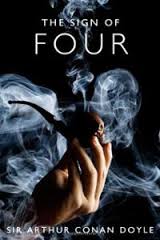
[READ: May 12, 2013] The Sign of (the) Four

I recently found out that the Sherlock Holmes book that I was supposed to have read in high school (from a reading list that I know I read at least some of) was actually not by Sir Arthur Conan Doyle.  Rather The Seven Per Cent Solution was a relatively recent (1974) book by Nicholas Meyer.  The only thing I remember from the book was learning that Holmes was an addict (and passing that news along to my mother with a tone of “see people have always been bad”).

Anyhow, in The Sign of (the) Four, the book opens with Holmes shooting up a seven per cent solution of cocaine.  The reason being that the cocaine kept his brain active when he had nothing else to do.  Holmes is bored, just waiting for something new to come along.  But Doyle doesn’t keep us waiting long.  A young woman, Mary Morstan, calls on Holmes for help with a case.  Or actually more like a series of interesting puzzles.  The first is the disappearance of her father, Captain Arthur Morstan in December 1878.  He came home from the war and then disappeared.  Holmes asks if he could be hiding, but she says no, he was very excited to come home and see her.  Since he has been gone, she has been employed as a governess and the family she assists have more or less taken her in as a member of the family.

The second puzzle is that she has received in the mail one very expensive pearl a year since 1872.  It always comes on the same date and the sender has remained anonymous.  This all started when she answered an anonymous newspaper ad that asked about her.  With the last pearl she received a letter that said she has been wronged and the sender asks to meet her.  He also says that she shouldn’t come alone.  So she asks Holmes and, by extension, Watson to accompany her.

Through a series of vehicles, they meet Thaddeus Sholto, a friend of Captain Morstan, who confirms that the Captain died in 1882.  Sholto’s father and Captain Morgan were in the war together.  Six years ago they had a fight over a treasure.  During their argument, the Captain suffered a heart attack and died.  Sholto’s father totally freaked out and hid both the body and the treasure.  Some time later, in declining health, his father confessed his sins, but on the night he died, he saw a man out the window who later broke into the house and left a note that said The Sign of Four (incidentally, the title of the book is variously The Sign of The Four and The Sign of Four; Doyle himself had written it both ways).  Thaddeus and his brother Bartholomew take over the treasure.  Well, Bartholomew takes it over and allows Thaddeus to send Mary the annual pearl as a payment for what happened to her father.

On the night that the story takes place, they travel to Bartholomew’s because he is in declining health.  But when they arrive, they find him dead–from a poisoned dart.  And the treasure is missing. (more…)

Read Full Post »

Burn-This-House-175x250SOUNDTRACK: THE KNIFE-“Heartbeats” (2002).

knifeheart

I learned of this song from the José González cover that was featured in the (very cool) Sony video with the bouncing balls.  The song turned me on to González, but not necessarily the song itself.  I knew The Knife did the original  and I remember when I first heard it, I didn’t like it nearly as much as the González version.

It’s been a few years and there’s a new The Knife album out and in the New Yorker review of it Sasha Frere-Jones mentioned this song again.  So I wanted to listen to it without the cover so prominent.  And indeed, the González cover is quite straightforward (acoustic guitar rather than mega synth, but otherwise pretty spot on). The Knife’s version is very retro synth-sounding .  It reminds me of a wacky 80s song.  Or perhaps a 2000’s Europop song.

The vocals are high-pitched and a wee bit over the top, but all in all it’s very catchy.  Frere-Jones said that The Knife version was very popular but evidently I didn’t travel in those circles because I don’t recognize it as being huge.

And I still like José’s version better.

I know it’s not really cool to show the video of the cover version when I’m talking about the original, and it’s really not that cool to use a commercial as a video, but it is still very fun to watch.

[READ: April 30, 2013] Burn This House

For the last day of April, the last day of poetry month, I read a new book of poetry that came across my desk today.  This is Kelly Davio’s first collection.  She is an MFA and quite an accomplished poet (managing editor and Pushcart nominee).  I also thought that I would see if she was a “modern, weird” poet or a more traditional one (I secretly hoped for more traditional as I’d burnt out on wacky ones).  For the most part she is more traditional and I liked most of her poems quite a lot.

The book was divided into five sections.  And I have to admit that the final few sections contained poems which seems a little forced to me (more on that later).  For it was in the early pages that I thought the poetry was most magnificent.

Although when I first started reading I was afraid that the poetry was going to be ponderous without enough concrete detail.  Like in “auguries” which showed a series of potential omens (Davio seems to have a thing with birds crashing into windows) which were effective, but I didn’t like the ending: “To what /significance such eroded things?” It seemed too vague to be powerful.

But the poems that came right after were just wonderful with detail like in “The First Lines” which had this description of a scarecrow: (more…)

Read Full Post »

between heaven SOUNDTRACK: ALTAR OF PLAGUES-“Scald Scar of Water” (2013).

aopI never think of death metal coming from Ireland.  I think of punk and metal and obviously the Pogues, but noise metal?  Unlikely.   And yet here is some.  And why shouldn’t Ireland produce music like this?  There are fans everywhere.

I heard this from good old Lars at NPR.  I’ve come to expect the unexpected from Lars’ picks.  And this is no exception.  The song is six minutes long.  It has some traditional death metal stuff–growling vocals, incessant drumming and lots of noise.  But there’s a lot more going on here.  It opens with electronic noise and thudding drums.  The drums are punctuated by alternating abrasive guitar riffs.  The song meanders along until it settles down to some heavy heavy verses (I have no idea what the man is screaming about).  After returning to the buzzsaw riffs, and repeating the verse, the song suddenly stops.

At 4 minutes the whole thing stops.  There’s some scratchy noises and then some slow pulsing bass and suddenly the whole song turns into  kind of alternative metal song, complete with chanting.  It’s pretty unexpected.  I can’t imagine what the rest of the album is like.

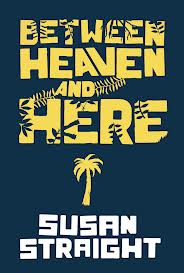
[READ: April 17, 2013] Between Heaven and Here

This was another book that I did not like in the beginning. Well, that’s not exactly true, I enjoyed the beginning but I really didn’t like the middle and really wanted it to end soon.  Not a good way to feel about a book. The reason I didn’t stop is because it was so short.  It turns out that an excerpt from this book was in a McSweeney’s issue that I recently read (and which I haven’t posted yet).  I didn’t “get” the excerpt then, and while it makes more sense in context I still felt the section was really hard to follow.

And so was much of the book.

This is the story of Rio Seco, an area of California, and the citizens who live there.  As the story opens we learn that Glorette Picard is dead.  Glorette was a crack whore, the kind of girl who would get killed and no one would miss her.  Except that people would miss her.  She had a lot of friends and relatives who cared about her.  She even had a son, Victor, who is 17 and studying his ass off to be able to go to college.  When a boy in town finds Glorette’s body dumped in a shopping cart, he feels compelled to move her, to bring her to her Uncle Enrique because he knows that the police won’t care if some crack whore was killed.  So he moves the body and that sets in place the rest of the story.

What was confusing to me was that the novel was constructed like a series of short episodes–different people and how they knew Glorette and how Glorette affected them.  That’s not a problem, except that there’s very little indication that that’s what was happening.  It felt increasingly difficult to know who was the main character was in each section, especially since so many characters overlapped.  Which again wouldn’t have been a problem except that I really couldn’t tell which person was the narrator or at least focus of each section.  Sometimes they were never identified, other times only after several pages.  The chapter that was excerpted in McSweeney’s has virtually no names in it, it is just dialogue.  And sure the dialogue was interesting and with the novel’s context made some sense, but I’m still not sure who was in the conversation. (more…)

Read Full Post »

highlySOUNDTRACK: FAMILY GUY-“Everything is Better with a Bag of Weed” (2009).

familyguyI recently posted about the song “Me Ol’ Bamboo” from Chitty Chitty Bang Bang.  When I was looking it up, I discovered that Family Guy had created a song called “Everything is Better with a Bag of Weed” that is sung to the tune of “Me Ol’ Bamboo.”  And holy crap I nearly busted a gut laughing when I watched it.

Of all the weird songs to parody, this was a brilliant choice.  The song is catchy and fast paced and absurd and just adding these new lyrics has made it funnier and more absurd.  There’s even the same odd instrumental break which they animate as playing glass bottle with drumsticks and as far as I can tell that’s really what it is.

My o my, this is very funny indeed.

I can’t seem to embed the video here which is a shame, but by all means check it out here.

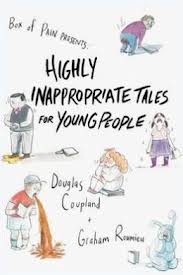
[READ: April 9, 2013] Highly Inappropriate Tales for Young People

I have read most of Douglas Coupland’s work and I like him quite a bit.  But I have discovered from re-reading his books recently that he’s not exactly the author I thought he was.  And one thing is that he’s really not very funny.  Existential? Yes. Comically absurd?  Yes.  Funny?  Not so much.  So I was surprised to see that he made this book with the rather funny title.

I assume this book is supposed to be funny since the inside flap says “Seven pants-peeingly funny stories featuring seven evil characters you can’t help but love.”  And indeed, the premise is funny, the title is funny.  But the stories are really not funny at all.  Here’s the list of the seven stories: Donald the Incredibly Hostile Juice Box; Sandra, the Truly Dreadful Babysitter; Hans, the Weird Exchange Student; Brandon, the Action Figure with Issues; Cindy, the Terrible Role Model; Kevin, the Hobo Minivan with Extremely Low Morals; Mr. Fraser, the Undead Substitute Teacher.  Judging from the titles of the tales you may think there’s humor in them…a juice box as a main character?  But there’s something about them that falls flat. (more…)

Read Full Post »

xxSOUNDTRACKQUEENS OF THE STONE AGE-“My God is the Sun” (2013)

qotsaAfter a six-year hiatus, QotSA is back with this slinky song.  It has the sleazy feel that Homme does so well (how does he do that?).  This song feels a little more guitar based (meaning it is a bit more trebly–with interesting echoes on the guitars).  It’s not as immediately catchy as their bigger hits, but it’s got all the elements you look for from QotSA.

It opens with some slashing sounds and then the riff kicks in.  The song is propulsive but somehow doesn’t feel as fast as some of their earlier tracks.  Which is not to say it’s mellow at all.  And once Homme starts singing, well, it’s like they never went away.  There’s a lengthy middle instrumental section which is quite interesting and otherworldly, but it never gives up the propulsion, especially as the end gets faster and faster.

[READ: April 8, 2013] The Mays XX

This is another book that I saw at work and wanted to read (this job is wrecking my already long list of books to read).  I had some difficulty cataloging it (for various reasons), which meant I had to pour over contents.  And the more I looked it over the more I realized that I wanted to read it.

So The Mays Anthology publishes the best new student writing and art from Cambridge and Oxford Universities.  Read more about it at their website.  I’d never heard of The Mays before, but when I saw that John Darnielle of the Mountain Goats was a guest editor, I thought it might be a fun collection tread through.

Issue 20 features poetry, a graphic novel, photography and prose.  The other editors are Andrew Griffin (general), Sebastiano Barassi (Visual Arts), Tao Lin and Toby Litt (Prose) and of course, Darnielle (Poetry).

I was really delighted with the prose in this issue.  None of the stories are more than 1,000 words, which I decided is a wonderful length for a story.  I’m going to talk about the stories, but not so much about the poetry or art.

Darnielle’s introduction to the poetry section was excellent and really resonated with me because of my ideas and fears about poetry (how we feel stupid if we don’t get poetry).  He then explained the things that he looked for in this poetry and I imagined that i would love every piece here.  I didn’t, but on the whole I really liked the poetry. (more…)

Read Full Post »

seminarbookSOUNDTRACK: BOBTOWN-“Don’t Fear the Reaper” (2012).

bobtownI heard this song on the radio today.  When it started I didn’t think much of it–a nice acoustic guitar which… suddenly sounded familiar.  And then, no doubt, it was “Don’t Fear the Reaper.”  With banjo!  A good song can be played in any genre, and while I never would have guessed that this song would work in this genre, man, Bobtown knock it out of the park.

Bobtown has five members–two men, on bass and banjo, and three women who sing in gorgeous harmony.  And if you know “Don’t Fear the Reaper” you know that there are various vocal parts, which these woman tackle beautifully.  Their version gave me chills.

Now, befitting a bluegrass band, they did not play the super fast part (in fact they ignored that entire section of the song–the didn’t use cowbell either).  I was initially a little disappointed because I wanted to hear what they would do with it.  But it was truer to their version to leave it out and by removing it, they made the song a little different–more sombre, less wild.  And it was really good.

This version below is not the studio version, it was recorded in a stairwell.  But the band sounds great in this unlikely location.

[READ:April 7, 2013] Seminar

I grabbed this book at work (just like Cousin K).  This book was also short, which was a plus since I knew nothing about it.  It was also a play and it listed the cast from the opening on Broadway.  And I was rather surprised.  Hamish Linklater (the brother on New Adventures of Old Christine), Jerry O’Connell and..Alan Rickman!  I hadn’t heard of either of the women (Lily Rave–she’s been in nothing I’ve seen and Hetienne Park–her first role).

The story is a one act play about four college-aged writing students taking a seminar with a former great writer and current old man.

The four students are Douglas, a cocky writer who has connections and talent and who has been published in Tin House and is soon to be published in The New Yorker.  Martin, a shy writer who is rather insecure, although he proves to be very talented.  Kate is a girl who Martin knew from high school.  She has been writing the same story for six years and is outraged at the way her fellow students and their teacher behave.  And Izzy (who I thought was a man for a few pages) is a sexually adventurous woman who seems to be willing to do anything to succeed. (more…)

Read Full Post »

« Newer Posts - Older Posts »