Feeds:
Posts
Comments

Archive for the ‘Sex’ Category

azyoumeSOUNDTRACK: VoirVoir-There are No Good Goodbyes (2015).
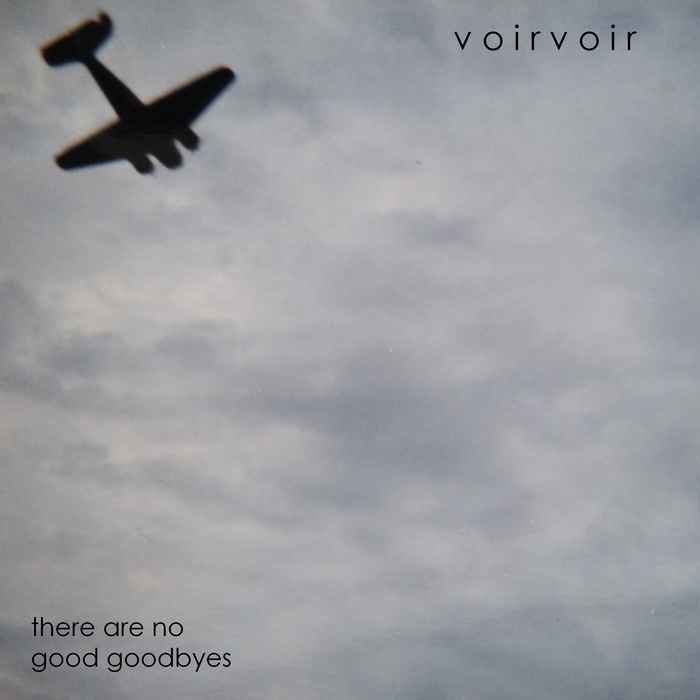
voiroivrVoirVoir eluded me at Musikfest this year.  I was supposed to see them open for the Flaming Lips but my shuttle arrived late.  And they played THREE TIMES on the following Saturday, but we couldn’t coordinate getting to a stage where they were playing.  Which is  shame because after missing their set the first night, I bought their CD and really liked it a lot.

My copy of the CD looks like the one at the right except that someone in the band hand cut out two irregular shapes in the cover so you can see through to the back, which is a cool touch.

The album itself is mostly punky and fast with vocals not unlike Superchunk or more accurately Built to Spill. Not that they copy either band, but you get that comfortable rocking feeling from these songs.

“I Wanna” is such a great opening statement. After the fast punky verse there’s a slower chorus which is just as catchy as the verses.  I could listen to this song all day.  “Make Your Bed” also has a wonderfully catchy chorus—the way it shifts into such an upbeat song after the buzzy and feedback filled verse is wonderful. “Stupid for Now” reminds me a lot of Built to Spill—there’s no guitar solos or anything, but in the catchiness and slow build of the verses and the much slower but still catchy chorus. It’s a great song.  And I love that there is a  glockenspiel as well as the guitars in the mix. “His Last Sound” continues in this vein with another great chorus.

Track five opens with a surprise when a new vocalist enters the mix.  My copy of the CD has precious little information about the band–just a list of names.  But I’ve pieced together some details to determine that the main vocalist is Matt Malchany and the female vocalist is (I assume) April Smith.  So “Be Your Machine” opens with Smith singing and her voice is great–hushed and deep–a stark contrast to Malchany’s voice, which takes over after the first verse.  She (or perhaps both women, guitarist Emily Meixell is also in the band) provide backing vocals to the more delicate chorus.

“Let’s Not” plays with the loud/quiet, male/female dynamic more as the verse is brash and loud and sung by Matt and the bridge is quiet and sung by April.  Then they mix it up further with a later quieter section sung by Matt.

“There are No Good Goodbyes” is a gentle song sung by April.  It has really interesting swirling guitar noises that are almost ominous.   I love the way she sings the chorus slowly as the music builds and builds faster and faster.  “If Miles Were Years” has some interesting dissonance as well, especially the closing ringing notes.  And once again, there’s a catchy chorus. I also really enjoy how much attention is paid to the percussion at the end of this song and many others (nice job Josh Maskornick).  And lest I forget bassist Matt Juknevic who keeps the rhythm steady throughout the variations of tone.

“Down Together” slows things down with a martial beat and a duet of vocals. It has couple of moments of loudness that build and drop off only to return to the delicate sound of the beginning.  The final song, “This is a Drag” is indeed a bit of a drag. It’s slow and repeats that chorus in a kind of monotonous voice.  It doesn’t really play well with the rest of the album, even if the end does build (and yes maybe by the you’re enjoying singing “this is a drag” along with them).  I can imagine it might be fun live if they can let it build and build and jam on it for a while, but the rest of the album is so up and fun that this closer is kind of a drag (especially since it’s the longest track on the record).

But despite that, I absolutely love this album.  And I love the way I discovered it, and I love that are from Bethlehem, PA, which means I’ll be able to see them live one of these days, surely.

Check out VoirVoir at their bandcamp site and order their album!  We need to hear more from them.

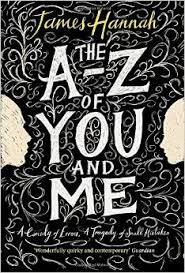
[READ: July 27, 2015] The A to Z of You and Me

I admit that I am a sucker for stories that work along a kind of theme (or gimmick).  But only if the book is done well.  And when this book had the subtitle of A comedy of Errors, a Tragedy of Small Mistakes, it seemed interesting enough to dive in.

When I say that this book is narrated by a man in hospice, you can be sure that that information would normally be enough for me to stop reading.  The last thing I need to do is read a book by someone who is dying–especially if he is only 43.

But the way the story is told is really intriguing and it unfolds the plot in such a great way.  The A to Z part is something that the hospice nurse has told the narrator, Ivo, to do to keep his mind active.  Think of a body part for each letter of the alphabet and then think of the most interesting thing that has happened to that body part.  And so page one starts with Adam’s Apple.  And while he doesn’t exactly think back to his own, he does remember a teacher’s Adam’s apple from grade school and how it left quite an impression on his young life.

The book is written in first person but is mostly directed towards “you.”  And “you” is the woman that he was dating whom he is no longer dating. (more…)

Read Full Post »

ny15SOUNDTRACK: RHEOSTATICS-Halifax, NS (August 27, 2004).

haliRheostatics are reuniting for 3 shows at the Art Gallery of Ontario in a few weeks.  And I am going to see them!

So it’s time to listen to a few shows from eleven years ago.  This show doesn’t even mention a club, but that’s ok.  It’s a fun gig in Nova Scotia.  The quality of the recording is not great–it was recorded in the audience and you can hear a lot of audience chatter (and consequently the band is not as clear as could be).

Their final album 2067 is out in just a few months from this show, and they play a few songs from it: “Marginalized” and “The Tarleks.”  Later, Martin describes “Aliens” as “The Tarleks Part 1.” They also play “I Dig Music” a fun jazzy number.  There’s a drum break in the middle and drummer MPW says that he was trying to play the intro from Rush’s “Lakeside Park.”

There’s a wild middle section in “Satan is the Whistler.”

This show has lots of banter, and there’s a discussion about an audience member mocking The Headpins.  And later when a fan says his friend was kicked out, Dave gets mad at the bouncers and seems genuinely concerned for the friend and offers to go get him.

After they play “My First Rock Show” they ask MPW about his first rock show.  The discussion devolves into a discussion of John Cage’s smell (Old man vegan smell).

For “Take Me in Your hand” a fellow named Reid does guest vocals.

During the encore they play a version of happy birthday to someone whose birthday it is which is followed by a scorching version of “Rock Death America.”

As the encore winds down Dave says “dim the lights, chill the ham,” which I assume is a nod to fellow Canadians Shadowy Men on a Shadowy Planet and their 1991 album. Martin (I assume) also starts playing around with a voice modulator as the song ends.

If the audio was better this would be an amazing show.

[READ: July 20, 2015] “So You’re Just What, Gone?”

I’ve enjoyed most of Taylor’s stories, even though his protagonists tend to be unpleasant.  But this story felt entirely too insubstantial for me to get beyond the grossness of it.

Charity is a high school student.  She is flying with her mother to visit her grandmother.  She doesn’t want to go and doesn’t want to be with her mom.  She’s pleased when she and her mom are separated on the plane (five plus hours of freedom!).

She winds up sitting next to a guy who tries to be chatty with her.  She wants none of it, but when she wakes up mid-flight to find that she has been sleeping on the guy’s shoulder, she feels a little bad and actually talks to him.  When Mark asks her if she gets bored and then says she is pretty, you know things are creepy.

When Mark he grabs her inner thigh and squeezes it and then gives her his business card, well, you just know the guy is a shit. (more…)

Read Full Post »

zinkSOUNDTRACK: PAUL WELLER-Tiny Desk Concert #457 (July 28, 2015).

wellerPaul Weller is a highly regarded and well respected elder statesman of rock.  Some of his songs with The Jam are my favorite songs from the 80s.  Weller hops from genre to genre quite a lot, and I did not care for The Style Council at all.  So even though he’s been making music forever, I haven’t really paid him much attention.  In this tiny Desk, he brings a fairly large band (6 people (4 guitars!)) to sing an acoustic collection of songs. There’s a drums (just a snare) and a percussionist too. And everyone sings.

His voice sounds fantastic—older but still really strong.

They play four songs. Three are from his new album Saturns Pattern.  Like “Dusk Til Dawn” which is a delightful folk song.  The band sounds really loud, or not loud but big, like there are really 6 people out there.   This is especially true on “I’m Where I Should Be” which also has some great harmony vocals and percussive guitar techniques.  I love how much the harmonies contribute to the song and the general song structure is great.

“Out of the Sinking” goes back to Weller’s most popular album Stanley Road (which I don’t know). It’s a wonderful song.  It showcases Weller’s gruffer vocals and nice finger picking. There’s some more great harmonies from the bongo player.  And the song has a real nice campfire song feel (it reminds me a bit of Van Morrison’s folkier songs).

For “Going My Way” Weller switches to piano. It’s a simple song with some great backing vocals and harmonies, (and hand claps), although I prefer the middle two songs.

I hadn’t really given much thought to Weller in the last few decades, but this set was really enjoyable.

[READ: August 7, 2015] The Wallcreeper

This is Nell Zink’s first published novel (she has another novel, 1998’s Sailing Towards the Sunset by Avner Shats) which I read about that I would love to find, but I don’t think it has ever been published).

I really enjoyed Zink’s Mislaid and wanted to see what her earlier work was about.  There was an article in the New Yorker which gave an interesting background to this story which involved a long correspondence with Jonathan Franzen and resulted in a book that I would suggest is not completely unlike something he might create–expect that it is way shorter and slightly more erratic.

Zink does not follow conventional story structure exactly.  This is not to say that the story is weird or avant garde, not at all.  She just doesn’t like to set things up conventionally.  For instance, the first sentence of the story is: “I was looking at the map when Stephen swerved, hit the rock, and occasioned the miscarriage.” (more…)

Read Full Post »

mislaidSOUNDTRACK: AROUND THE WORLD IN 80 DAYS-Euphoria (2014).

euphoriaI found out about Around the World in 80 Days when they started following me on Instagram.  I’m not sure which photo it was that interested them, or if they just follow lots of people, but I was intrigued that they are a post-rock band from Yekaterinburg, Russia.  They formed in 2009 and have a few releases out (EPs, mostly).  You can hear all of them on their soundcloud page (and other places).  This was their first full length album.

Their bio says

Around the World in 80 Days is a three-piece band formed in 2009. It’s impossible to compare their music with anything. The guys just play whatever they want and don’t care about genres, styles and cliches.

I appreciate the sentiment, but it’s not impossible to compare them.  They have elements of Mogwai and Explosions in the Sky in their swirling post-rock instrumentals.  But they definitely add elements that those bands don’t.  There’s some heavy metal riffs in “Racing the Light” and some more poppy elements in “Inside Me.”

 I typically try to listen to an album a few more times before I post about it, but I was so interested in this band that i wanted to get the word out right away.  I’ll certainly be listening more intently to their output over the next few days.

[READ: May 24, 2015] “Mislaid”

I read an excerpt from this book in Harper’s a few months ago.  And then I found the full book at work.  Huzzah!

I had said that I didn’t know how long this novel could be because the excerpt seemed so complete.  And in a sense I was right.  Except that the book went so much further than the excerpt led me to imagine.

The excerpt was about Peggy Vaillancourt.  She was born in 1948 in Virginia.  A transformative event leads her to believe she must be a lesbian (something unspoken of at the time).

She winds up going to Stillwater College, a female-only school in the middle of nowhere Virginia.  She loves poetry and wants to be a writer.  She meets the poet-in-residence Lee Fleming.  Fleming was a local boy with wealthy parents.  His father believed himself to be as “queer as a three dollar bill.”  It was his father who put him in a cottage on the family’s property across the lake from Stillwater College.  Everyone in town also assumed he was gay, and there was much talk and consternation about it, although everyone assumed he was fine while he was by himself in that cottage.

The college asked Fleming to be a teacher (he canoed to work every day).  Instead of a salary he asked them to create a literary magazine called Stillwater Review, which became a success.  Many other famous New York poets came to Stillwater to be charmed by the idyllic Stillwater (and all the young girls). (more…)

Read Full Post »

raslSOUNDTRACK: METHOD OF THE W.O.R.M.-Cicatrix (2015).

motwormMETHOD OF THE W.O.R.M. is the project of one guy–known as Grimm.  Cicatrix is a collection of songs that spans decades (“begun long before the present digital day”) and recently remastered and released.

The blurb on CdBaby (where you can download the disc–it’s also on iTunes) notes that Method of the W.O.R.M. is “an industrial hard rock with a trip hop edge, intelligent grown up lyrics delving into the microcosm and macrocosm of our world. Influences run the gamut of NIN, Massive Attack, Cop Shoot Cop, Swans, Coil, Tricky, Skinny Puppy, Tom Waits and many others.”

There’s quite a diversity in that list even if the bands are similar, and you can hear the melding of influences.  And you can hear most of them in the songs. But what sets MotWORM apart from these bands is a keen sense of melody in the vocals.  Most industrial music tends to bury the vocals with distortion or just under the music.  But Grimm’s got a good (even pleasant) singing voice which elevates the songs above the din of lesser industrial bands.

While it’s not like pre-digital technology was all tape manipulation, it also wasn’t as easy as it is now.  And the complexity in these songs shows a lot of skill and attention to detail.

“No Flesh” opens the collection.  After some interesting noisy samples (steel drums?), a slow bassline enters (which also sounds sampled—it’s got a very 70’s sound).  The song slowly builds with more and more layers of sound until the vocals come in–a gentle singing that also builds.  There’s a Skinny Puppy feel in the music, but the vocals are very different from Puppy’s style.  “Purge” is the first of many songs with sampled dialogue, but it’s the sounds around the dialogue that are so interesting–squeaks and buzzes, radio tuners? who knows where they come from.  Once the verses start, the main music in this track is more synthy–a compelling riff that wends through the mix.  When the distorted guitars kick in, it takes the song to an entirely new level.

“Burned” showcases the vocals up front in the mix over a simple layered melody.  But there are actually a lot of vocals in this song, including a fascinating sample that opens and closes the track.  Grimm adds layers of vocals–harmonies (or not exactly)–distorted vocals and clean vocals.  I particularly like when the higher voice sings a new (very cool) melody in the middle of the song (the sampled voice melds nicely if creepily with this too).  This song is a real highlight.

“Tragic Rabbit” has some more interesting samples and a pulsing synth line with cool swirling sounds over the top of the vocals.  “As If a Dream” is a slow trippy number with an excellent processed sample.

“A Viral Method” introduces live drums (which sound great and were provided by Swans’ Phil Puleo).  It also has a great live guitar sound playing a fast riff and harmonics.  There’s more great harmony vocals. And a wild riff for the bridge (do I dare say a bit prog rock?).  Although I love the cool samples and layers in the earlier songs, this live instrumentation adds an excellent urgency to the music.  The only problem with this song is that it’s so short.

“Absolution” starts off quietly but after the distorted guitars, the chorus is super catchy–the way it seems like it’s going to end but rebuilds itself.  It’s really well crafted.  “A Moment of Silence” opens with a retro-sounding synth bass.  It’s a fairly minimal song with the vocals really taking over as that synth line drifts to the background and new sounds bubble up.  “Wasted” opens with distorted guitars kind of like a Ministry song, but the vocals are much cleaner, which brings an unexpected quality to what could have been a typical heavy song.  Especially the chorus which is musically bright (even if it’s lyrically dark).

“Freak-O” (what a great title) opens with some loud jackhammer type drums.  The song creeps along menacingly (with a great sample of someone shouting “You are one ugly son of a bitch!”).  I like the simple melody that simmers up from the noise by the end of the song.  “Miscreant” opens with quieter acoustic guitars before the drums kicks in and a menacing synth line takes over.  The vocals are quietly sung with an interesting effect placed on them.  The middle of the song has some wild sounds–I’m not entirely sure what’s happening with them, but it makes for an unsettling ambiance.

“I Love You Goodbye” is my favorite song on the disc.  It starts out simply with big guitars but quickly retreats into a much quieter verse.   There’s a great riff that throws in a slightly dissonant harmonic note that is just great.  But as the song builds into a unexpected bridge with horns, the song adds an dark carnivalesque atmosphere (and that harmonic note returns in a more prominent role).  It’s such an unusual riff and really bodes well for the interesting direction MotWORM might be heading (if they ever release anything else).

This is a real fun disc full of interesting sounds and samples.  If you like industrial music this is a disc totally worth checking out.

[READ: July 31, 2015] RASL

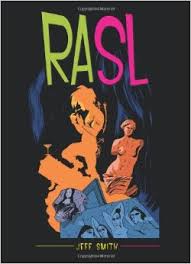
Jeff Smith is creator of Bone, one of my favorite comics ever.  As far as I can tell he hasn’t done a lot since Bone, but he sure did his research for this book.

The title is unfortunate (and is explained satisfactorily in the last few pages, but it’s still awkward and hard to manage).  But the work inside is extraordinary.  The story concerns dimension jumping, art theft and a whole lot of information about Nikolai Tesla.  It’s also more mature than Bone, in that there are a couple of (non-explicit) sex scenes.

In a nutshell, RASL (real name Dr. Robert Johnson) and his partner Miles are scientists.  They grew up together and studied the works of Tesla.  Miles married Maya, a beautiful scientist who has assisted them with their work over the years.  They delved deeply into the research that Tesla undertook (Resonant frequency, remote control, the earthquake machine, wireless communication) and used his ideas to create a machine that is something like a transporter/dimension hopper. They are working for the military but hope to be able to use the device to end wars (idealist scientists as they are).  Their small tests has been successful, but RASL believes that they need more testing to see if there are any effects when you use it on bigger subjects.

So he takes the machine and hops.  It turns out that each hop between dimensions takes its toll on his body and also tends to confuse matters.  (In one dimension, he checks his iPod and sees that Blonde on Blonde was recorded by Robert Zimmerman (I love that detail)).

We learn that RASL (who as the story opens has shaggy hair and cuts and bruises, unlike the composed scientist we see in flashbacks) has been jumping from dimension to dimension to steal precious works of art as a way to make some money.  There is also a really creepy-looking man whose face looks almost amphibian (Smith has some really disturbing characters in this book) chasing after him.  This man kills everyone that RASL knows in different dimensions because he is after something 9and he believes that the people in other dimensions are not real).  It is slowly revealed why RASL has been reduced to this state. (more…)

Read Full Post »

essexSOUNDTRACK: SONGHOY BLUES-Tiny Desk Concert #455 (July 17, 2015).

songhoySonghoy Blues are from Mali.  They play an interesting style of rock/blues that follows rock conventions but subverts it as well.

“Sekou Oumarou” is a pretty straightforward bluesy number.  Until the vocals come in and you realize that they are not singing in English.  I think they are singing in French, but I’m not exactly sure.

It feels like the main instrument on “Al HassidiTerei” is the drums which, while keeping  pretty steady beat, don’t keep a simple 4/4.  This is not to say that the guitar and bass do nothing, because they play a cool riff and rhythm.  But they tend to keep the music pretty steady while the song plays on.  That is, except for the massively cool fuzzed out guitar solo at the end.

“Soubour” has a great classic rock style riff and when the guitarist stars going it sounds like it could be coming from the late 60s.  It’s a stellar track with a groovy psychedelic sound and wailing solo.

It’s tempting to want to like Songhoy Blues because of the politics and story behind the band (which is pretty intense), but they are so good that you don’t need to know anything about them to really get down to their great songs.

[READ: May 17, 2015] Essex County

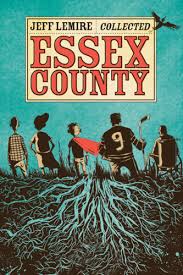
I saw this book in the library.  I was intrigue by the hockey player on the cover (okay and that it was 500 pages).  When I saw that it was a 2011 selection in Canada Reads, I knew it had to be at least worth a look.

This graphic novel looks at several generations of people living in Essex County, Ontario, Canada.  It collects the three books Tales from the Farm, Ghost Stories and The Country Nurse as well as some other odds and ends.

The introduction by Darwyn Cooke is really great for contextualizing this piece, although i wish he hadn’t spoiled the scene with the hockey players (so maybe for maximum impact, don’t read this before reading the book itself–actually, read the whole thing except that 8th paragraph). (more…)

Read Full Post »

dotaSOUNDTRACK: ASIA-Asia (1982).

asiaI’ll finish off this run through Yes with one final offshoot project–Asia.  Geoff Downes (who had only been on Drama) and Steve Howe joined forces for this pop outfit with a hint of prog.  Indeed, this is an album that is just chock full of poppiness–despite all of the trappings of prog rock–synths, connections to Yes, a cover by Roger Dean and Carl Palmer from Emerson Lake & Palmer on the drums.

This album was huge in 1982 & 1983.  They had so many hits from it (okay well, only 3 singles, but surely everyone knows this entire album, right?).

“Heat of the Moment” opens with nice big ringing guitars.  And while the drums aren’t fancy, they are quite distinctive.  The synth isn’t too dated sounding, and the middle part with the guitar slide still sounds cool.  And of course, the chorus is practically irresistible.  “Only Time Will Tell” has a totally recognizable keyboard riff.  While the riff itself hasn’t been copied, the sound has and yet at the time, Asia made it seem fresh.  This song is so simple as it starts with just keys and drums and John Wetton’s voice.  There’s great harmonies in the chorus and dramatic keyboard splashes.  And once again, Carl Palmer’s drums are big and loud yet understated.

“Sole Survivor” opens with some darker chords nut some interesting noodling going on, too. (I always thought t was interesting that Blue Oyster Cult released a song called “Sole Survivor” the year before).  Despite the darkness of the lyrics and the music the chorus is also very catchy (I also like how nearly every verse ends with a different keyboard sound or riff).  This song also has an interesting break where things get quiet and feel very wasteland like.

“One Step Closer” has a some interesting riffs and another catchy chorus.  This is probably my least favorite track on the disc even if it’s got a good chorus.  “Time Again” has a cool dramatic opening and then a nice speedy bassline to start off with.  I like the way the chorus leads to some quieter moments of unusual guitar and keyboard sounds.

Side two has some slightly longer, sightly less poppy songs. And yet to me all the songs on this side are really good as well.  “Wildest Dreams” is a song that is a bit over the top (as all prog should be).  I remember loving the dramatic “We fight” section.  It seems a but silly but it was still fun to sing along to.

“Without You” is a slower darker song but with another big chorus.  It also has the most prog rock sounding keyboard solos of the 1980s.  There’s some time changes and even a big bell!  “Cutting It Fine” opens with some mellow guitar and then a really interesting guitar sequence.   It moves along quickly and dramatically and then stops for a quiet piano solo section (with a build up of strings, martial drums and horns–the drama seems like it is leading to something big but it just kind of fades out, which is a bummer.

“Here Comes the Feeling” ends the disc in more dramatic fashion.   I love the way the bridge builds and builds (with the “now i can…” section that leads to the long held sung notes.).   The solo section has some very yes-like moments from Howe and over all ends the disc with some wonderful prog moments.

As with apparently every progressive rock band of the era, this one was full of lineup changes too (don’t even get me started on King Crimson).  The four stayed together for the next album, Alpha, but Steve Howe left after that and then various other incarnations have toured in one form or another to this day (in fact they’ve released about 20 albums over the years.  Who knew?).

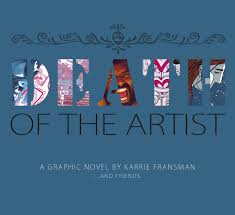
[READ: May 29, 2015] Death of the Artist

I grabbed this book from work because it looked interesting.  And it was.  I was more than a little confused as to how much is true.  And that was clearly the point.  Fransman totally pulled the wool over my eyes and I love her for that.

The premise of this book is that five artists are getting together for a weekend of debauchery.  They were friends in art school in Leeds when they were in their 20s.  Now, ten years later, they are reuniting in hopes of sparking creativity again.  Of the five only one is still doing anything “creative,” and they are all looking to reignite that spark.

And this book is the result of their week.

All five artists draw (or something) a story inspired by that weekend.  And in what turns out to be a pretty cool twist, Fransman has shaped the stories into a narrative. (more…)

Read Full Post »

nymarc22SOUNDTRACK: YES-Tormato (1978).

TormatoTormato might be Yes’ most hated album (I think people grudgingly respect Topographic, but they hate Tormato).  I mean the cover is weird and, well, weird.  The songs are not bad but they sound so far from Yes of old, that it could possibly not be the same band.  And then there’s those lyrics.  I find myself blaming Jon Anderson for this middling period style of Yes music.  It seems like he was the impetus behind topographic and he has a number of songs that he wrote on the last two albums.  If Anderson is the flighty stratosphere, Squire and White are the ground.  And the ground is sorely lacking on the last two albums.

There’s no Roger Dean on this album either (more Hipgnosis with a giant tomato spill (get it, Tormato?  No I don’t really either.)  Wikipedia sheds some light, kind of:

Howe pitched the album’s original title of Yes Tor, referring to the highest point on Dartmoor, an area of moorland in Devon, England. Wakeman claimed to have thrown a tomato at the pictures taken for the album as he was disappointed with its design. The album’s title and cover was changed accordingly. Howe said it was someone at Hipgnosis who threw the tomato on purpose, something that he felt insulted about.  According to White, the band “couldn’t decide on the cover. I think Po … put a picture of a guy with divining sticks on the front.  He took it home one night and decided it wasn’t working. So he threw a tomato at it”. 

I always thought it was drumsticks not divining sticks.  Oh well.  So there that in no way clears up the tomato business.

So what about the music?Even though Squire shows up a bit more here, the overall sound of the album is really tinny—a problem that to me plagued Yes throughout this period—there’s just no low end to speak of, even when Squire does some rumbling lines.

“Future Times/Rejoice” opens with an interesting riff and some cool bass lines from Squire.  The song itself is bouncy and jaunty, moving along briskly with some wild riffs from Howe.  It’s kind of refreshing.  At 3 minutes the song slows down with some counting and replies from Anderson. The next section has a pretty classic Yes build up and then a return to the beginning of the song. There’s a very 70s sounding keyboard solo from Wakeman as the song reaches the end—which is a coda called Rejoice (starting at 5:44), which is mostly harmony voices until the repeat of musical themes from earlier.

Next comes the divisive “Don’t Kill the Whale” This is one of those major heart-on-your-sleeve songs.  Musically it’s pretty interesting with some wild soloing from Howe, but those lyrics: “don’t kill the whale, dig it.” It’s hard not to agree with the sentiment but it’s hard to sing along to at the same time. The synth solo is also astonishingly dated and kind of nauseating at the end.

“Madrigal” is a ballad played on a harpsichord with vocals from Anderson. By the end some classical guitar is played with it. It’s a pretty piece.

“Release/Release” is probably the most interesting track on the disc. It’s got a great riff from Howe and although (some of) the synths feel dated it rocks along like a good mid 70s rocker should. I like the audacity of having a “live” drum solo tacked into the middle of the song. It reminds me in style of a King Crimson track with the staccato voices, although it is not produced anywhere as well.

“Arriving UFO” is, indeed, about seeing UFOs.  The narrator is incredulous about them at the beginning of the song (which comes with very “eerier” keyboard notes) but I believe is a believer by the end. I do like the way the music builds for the bridge, although the chorus is bit much (as is the dreadful synth middle section). The solo section has some really bizarre sounds that I take to be “alien” conversation. Whether its made by guitar synth or voice I cannot say.

“Circus of Heaven” might just be the worst Yes song ever. It is all high notes (even the bass is high notes). Around 2 and a half minutes in the song shifts from its whimsical circus feel to a slightly more serious tone that hearkens back to better Yes moments, but it does not remain there.  Rather, the narrator asks his son what he thought of the circus of heaven and then Anderson’s actual son tells him that he’s not impressed. It’s hard to listen to I have to say.

There’s more high notes in “Onward” which is more orchestral washes and Anderson’s vocals over the top. It’s not really much of a song, frankly, even with the string arrangement.

“On the Silent Wings of Freedom” is nearly 8 minutes long.  It tries to hearken back to longer classic Yes songs but it never quite makes it.  It opens with some loud basslines, some fiddly Howe guitar bits and a lot of synths. But none of it sounds as interesting as previous long song intros. Even the wah wah bass sound isn’t as interesting as the early 70s bass sound. Anderson comes in almost 3 minutes in and around 3:30 the song picks up speed and the elements gel in a really good way. Around 4:45 the song slows down to an interesting instrumental section with bass and percussion.   After a return to vocals the fast part picks up again, although with a synth solo that is less than stellar.  There’s a lot of “la la las” in the song and a mention of “celestial seasons” which I hope came out before the tea brand.  The song isn’t bad, and if Yes didn’t have such a great catalog behind them I might actually say it ‘s quite good, but like the rest of the album it pales with their peak.

And that’s probably why Wakeman left again and, shocking, Jon Anderson split from the band too (which i find surprising since I feel like the past two albums were all about him).

Since almost every Yes album had different personnel, I’m going to keep a running tally here.   With the middling success of Going for the One, this line up stayed in place for a second album!

Chris Squire-bass
Jon Anderson-vocals
Alan White (#2)-drums
Rick Wakeman (#2)-keybaords
Steve Howe (#2)-guitar

[READ: March 22, 2015] “Sleep”

This story was written in direct address, from an “I” narrator to a “you” subject.  It really personalized the story and was interesting to watch as the story that started as one thing was able to travel to another thing entirely.

It begins with the narrator, an older man, talking in his mind to his young lover.  The younger man’s parents are concerned that the narrator is older, but they do like him.  I loved the way it was constructed with him reminiscing about how they met and about how the world allowed them to be together: “Germany, Ireland, the Internet, gay rights, Judaism, Catholicism, they have all brought us here.”  The beginning of the story really stresses their differences, which he finds charming:

“Like a good American you wear a T-shirt and boxers in bed.  I am wearing pajamas like a good Irishman.”

They have been sharing living space for a while, but the younger man is concerned that the older man’s dreams are plagued by nightmares.  The nightmares are so strong that the older man often screams out loud –but does not wake up. (more…)

Read Full Post »

houseSOUNDTRACK: LAURA VEIRS-Tiny Desk Concert #49 (March 1, 2010).

lauraI have decided to contradict myself.  I simply cannot keep up with the regular release of Tiny Desk Concerts (sometimes 3 a week), so I’m going to focus on these older recordings for a while and occasionally devote a week or two to new ones.  we’ll see how that works out.

I only know Laura Veirs’ name, but not really anything she’s done.  So I wasn’t really sure what her “solo” work would sound like.  Well, she has a delightful voice and she writes really pretty songs.

She also offers one of the most dramatic screw ups I’ve seen in a live performance. She opens her song “Carol Kaye” with this lovely melody–just her and her guitar.  And then after about a minute, her band comes in with a beautiful harmony–in the wrong key!  The introduction of their voices is so dramatic (to go from her gentle voice to this huge chorus) was really amazing.  So much so that I didn’t quite realize they were in the wrong key at first.  Turns out that Laura put her capo on the wrong fret and it wasn’t until the keyboardist played the right note that they all sounded off.  And his mouth drops opens as he stares at Laura.  She laughs and says “you looked like this terrified Muppet.”

They play the song again, this time perfectly–and the harmonies are truly lovely.  As is the violin that swirls throughout the song.

“When You Give Your Heart” is another lovely song in which Viers’ voice and the violin play the same lilting melody.

“Sun is King” has some more lovely (that’s the word to describe her, clearly) harmonies–she has picked a tremendous backing band.  And they sound great in this small setting.

It’s hard to believe that the whole set (miscue and all) is only ten minutes long.

[READ: May 1, 2015] House of Leaves

I read this book when it came out in 2000.  I had the “2 Color” edition which the t.p,. verso explains has as features: “either house appears in blue or struck passages and the word minotaur appear in red (I had the blue version).  No Braille.  Color or black & white plates.”

The Full Color edition (which is the same price, amazingly) differs in this way:

  • The word house in blue, minotaur and all struck passages in red
  • The only struck line in Chapter XXI appears in purple
  • XXXXXX and color plates

So basically the full color edition isn’t really that big a deal although the three or four full color plates are much nicer.

Why do I have both?  Well, I bought the two color when it came out and then I won a free book at the library and there was this full color edition, so I brought it home.  I was amused to find that the previous owner had deciphered a clue in the back of the book (the first letters of sentences spell out a secret message).  She (it looks like woman’s handwriting) wrote out the secret message, which I appreciated as I didn’t feel like figuring it out.

ANYWAY.

This book had a huge impact on me when I read it.  Although I forgot a lot of the details, the overwhelming effect of the book has stayed with me an I never forgot the central conceit of a house that opened secret passages and expanded or contracted at will.  For, make no mistake about all of the accolades, this is a horror story.  One accolade, from Bret Easton Ellis: “One can imagine Thomas Pynchon, J.G. Ballard. Stephen King and David Foster Wallace bowing at Danielewski’s feet, choking with astonishment, surprise, laughter awe.” [Ellis will not be bowing apparently, and actually I can’t imagine Pynchon bowing before anyone].  It’s a very cool horror story with all kind of textual experimentation and twists and turns, but it’s still a pretty damned scary story.

The experiments are many and varied and they begin right from the start, as the title page lists Mark Z. Danielewski’s House of Leaves by Zampanò with an introduction and notes by Johnny Truant. The forward from the editors notes: “The first edition of House of Leaves was privately distributed and did not contain Chapter 21, Appendix II, Appendix III or the index.

This is all nonsense of course. (more…)

Read Full Post »

nyrbSOUNDTRACK: ALEC OUNSWORTH-Tiny Desk Concert #48 (February 22, 2010).

alecI didn’t recognize the name Alec Ounsworth.  But I see that he is the singer from Clap Your Hands Say Yeah, a band I don’t know at all.  He has created some other music outside of Clap Your Hands, like the band Flashy Python, which features members of Dr. Dog, The Walkmen and Man Man.  And in the fall of 2009, he released a solo record called Mo’ Beauty.

In this Tiny Desk it is just him and guitarist Matt Sutton.  They play three songs from Mo’ Beauty (on guitar and harmonica): “Modern Girl (…With Scissors),” “Holy, Holy, Holy Moses (Song for New Orleans)” and “When You’ve No Eyes.”

Since I don’t really know CYHSY, I can’t compare this to that band.  The songs are pleasant and a little catchy.  I feel like perhaps the wordplay is what draws you in (he refrains “all this useless beauty” in the first song).  His voice is distinctive and takes a little getting used to, but I warmed up to it by the end of the set.

After the set he says that the other three guys from the touring band were waiting in the van.  As the show fades you hear Bob Boilen mutter, “it was okay to invite them up.”

[READ: May 11, 2015] “Argentina: The Brothels Behind the Graveyard” 

Roberto Bolaño talked about this article in The Secret of Evil.  I was curious to read it and was happy to find it quite easily and for free online from The New York Review of Books.

I don’t really know Naipaul at all, although Bolaño spoke very highly of him.

This article looks at Argentina.  I don’t know how much time he spent there, but it sounds like NYRoB sent him there to write and essay or two..

He begins by talking about the death of Perón (in July of 1974).  Perón was in the ninth month of his third presidency and his legend had lasted for thirty years.  He was overthrown in 1955 and was exiled for seventeen years.  He had a triumphant return the previous year and a resounding failure shortly after. (more…)

Read Full Post »

« Newer Posts - Older Posts »