Feeds:
Posts
Comments

Archive for the ‘Sex’ Category

SOUNDTRACK: LUCKY DAYE-Tiny Desk Concert #852 (May 28, 2019).

I watched the Raphael Saadiq Tiny Desk Concert where he brought out Lucky Daye before watching this one.

I might have appreciated Lucky Daye’s guest spot more had I seen this first.  I wound up liking him quite a bit in this Concert.

In the blurb Sidney Madden writes:

NPR Music’s Bobby Carter and I have been checking for Lucky Daye since last year when we dubbed him one of the “Kings of R&B.” Then, after seeing Lucky perform live in Washington D.C., we knew his charisma and control would translate well to the Tiny Desk.

This set is fun for all of the horns that are included (which we’ll chalk up to his hailing from New Orleans).  I feel like the horns give the songs more excitement than if they hadn’t been there.

Hailing from New Orleans and inheriting a love of sticky, bass-bumping funk early on, Lucky wanted to bring the full flavor of his debut album, Painted to NPR. So he brought along a 10-person band, including a quartet of horns.

“Roll Some Mo” opens with a quiet guitar from Kenji Chan and twinkling keys from Quintin “Q” Gulledge.  There’s a soft cymbal escalation from Kendall Lewis when a cool bass line comes in from Daye’s go-to producer Dernst “D’Mile” Emile II.

The horns are quiet as the song starts.  The camera seems to really like trumpeter Crystal “RØVÉL” Torres as it zooms in on her a bunch.  Brandyn Phillips on trumpet and flugel gets some screen time too.  There’s not a ton of differentiation between the horns–no solos or anything.  But once in awhile you can pick out Chris Johnson on trombone and Corbin Jones on baritone sax.

Nikki Flores does the first backing vocal part but then Chelsea “Peaches” West adds a lot to the call and response.

“Misunderstood” is a quiet song with keys and Crystal “RØVÉL” Torres playing a muted trumpet.  This is my least favorite song because of the way he sings it–all of that moaning and ohhing is not my thing.  I don’t care for an R&B ballad, obviously.  But he won me over after the song.

“I’ve never performed that song in front of anyone with a band,” he said, trying to laugh off mid-set jitters and bask in the moment. “This is amazing, y’all. I’m really grateful.”

The final song, “Late Night” is a lot of fun.  It starts with some great wah wah guitar with horns and vocal hits.  I like the way his sings this song much better—deeper vocals and some fun backing vocals.

The end of this song with the horns swinging and singers singing is really fun.

[READ: July 1, 2019] “First Time”

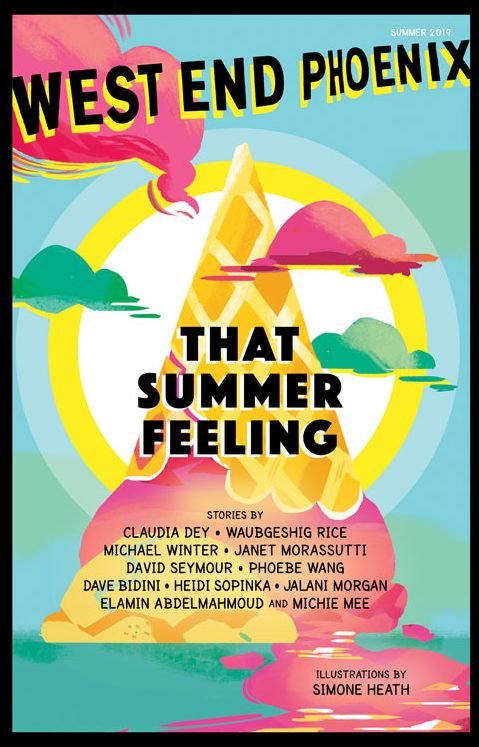
The Summer 2019 issue of The West End Phoenix was a special all comics issue with illustrations by Simone Heath.  Each story either has one central illustration or is broken up with many pictures (or even done like a comic strip).

Each story is headed by the year that the story takes place–a story from that particular summer.

1998

This story is mostly visual.  Because there’s not a lot of text.

Grade 11.  A daily bus ride.  A beautiful girl.

He wore a school uniform (grey pants, green cardigan).

She had long straight hair, amazing eyes and was always alone.  She was out of his league. (more…)

Read Full Post »

SOUNDTRACK: IMOGEN HEAP-Tiny Desk Concert #859 (June 20, 2019).

I know of Imogen Heap from a song called “Come Here Boy” that she released way back in 1998.  It was stark and dramatic and somewhat sexual. In short, a quintessential 90s track.

Then she disappeared.

Well, she actually made an album with Guy Sigsworth as Frou Frou.  And then she disappeared a again.

Actually she didn’t disappear at all. She released a song, “Hide and Seek” which was mostly just her singing into a vocoder (and was quite transfixing.  It became a huge hit (which I didn’t know about because I didn’t watch The O.C.).

But in 2011, she started experimenting with these high tech gloves that allowed her to do all kinds of audio manipulation just by moving her hands.

She even says, some people know me because I am interested in block chain technology and some people know me for these gloves.  They don’t even know I make music they just know about the gloves.

But in this Concert, the gloves come last.

Up first is the first song that she and Guy Sigsworth have written together in 17 years.  “Guitar Song” (she tends to leave placeholder names, so that will likely change) is a quiet pretty song with a lot of, yes, guitar from Steve Jones.  It’s a simple melody fleshed out with keys from Sigsworth.  It’s really pretty and very catchy.

Up next is “Speeding Cars” which she says was a B-side that was never released as a single but which her fans really love.  Zoë Keating plays cello and Imogen says she has a terrific album of her own called Snowmelt and she hopes Keating gets her own Tiny Desk someday.  Tim Keiper is on drums and vast array of percussion.  Imogen is on the piano she has an excellent falsetto for this very pretty song.

Then she puts on the Mi.Mu gloves.

Imogen Heap not only has an enchanting voice but also the talents of a world-class audio engineer. She’s completely engrossed in a technology she’s helped to develop, one that makes it possible to alter sounds, create loops and compose tunes all with the wave of her glove-wearing hands. The high-tech gloves, now called Mi.Mu Gloves, were first shown at a TEDGlobal conference eight years ago. Her performances, with her sound-altering arm and hand gestures, resemble a summoning of spirits, a far more compelling live experience than what Imogen said used to look like she was standing behind her laptop checking email.

She gives a lengthy explanation and brief demonstration of these very cool loves.  Then it’s on to “Hide and Seek,” which she had re-imagined for the Broadway play, Harry Potter and the Cursed Child and which she says that if she doesn’t play people throw tomatoes at her.

It really sounds nothing like the original but it is amazing to watch her make the song with her hands waving around.

[READ: June 1, 2019] “The Maid’s Story”

This story introduces us to the Gersons, a family on vacation in a hotel. The husband is small and insignificant. But the wife is larger than life.  Both physically and in personality.

Hannah Kohl, the maid, was taken with Mr Gerson’s red brooch and when she went to clean the room later, she pocketed it.  As she did so, she promised herself it would be the last thing she ever took from a patron.

But Mrs Gershon walked in before the maid had time to close the jewelry box.  She told her it was costume and worth nothing but how could the maid have thought Mrs Gerson wouldn’t notice?

The maid is very apologetic.  She begs not to be ratted out and pleads with the woman.  She says her eight-year-old son has polio (“So did our president, but Eleanor doesn’t go around stealing jewelry).

Mrs Gerson asks where Hannah is from–Wroclaw Poland.  In the camp? No, her father moved them before.  And the hotel owner’s second cousin helped them.  Then Hannah did something unexpected–she opened up to Mrs Gerson about her travels and her life.

Mrs Gerson diagnosed her as a kleptomaniac (she compulsively stile things she didn’t need).  But she was mostly concerned about the boy, Isaac.  She insisted that he receive proper care for his polio  The doctor Hannah’d been going to was an elder in the old country synagogue who showed no evidence that he knew anything about medicine  He said the polio would clear up and go away on its own.

The new doctor was in Manhattan, a lengthy trip for Hannah and Isaac.  Mrs Gerson said they could stay with her family when they traveled in.

The doctor gave many recommendations and said that Mrs Gerson was paying for it all.

The Gerson children were uninterested in Isaac until he told them a story about people dying at the hotel.  They found his story (which was partly made up) to be engrossing.

After dinner Mr Gerson excused himself and left the two women to talk.  Mrs Gerson pulled Hannah on to her lap  She soothed her and stroked her head but soon the stroking became sexual.  This made Hannah very uncomfortable and she froze, enduring the touches which gave her revulsed pleasure.

Hannah and Issac went to Manhattan twice a month.  Each time, the same thing happened.  Mrs Gerson never said anything about it, but it happened nonetheless. It was especially upsetting because Hannah very much liked Mrs Gerson otherwise. She was funny and bold and seemed genuinely interested in their health and prosperity.  And Hannah would put p with anything for Isaac;s welfare.

Soon, Issac was deemed just about normal;–one more visit would do it.

One night, Mrs Gerson revealed that all of their money was her husband’s–her family is as poor as Hannah’s. Nobody least of all Mrs Gerson really understood why Bert chose her.  Plus, he always knew that Mrs Gerson liked girls better.

Bert wants things to be easy.  So Mrs Gerson does everything—raises the kids, takes care of family affairs.

The thing with wives is they can leave. Mothers can’t.

Finally Mrs Gerson declared that she loved Hannah.

Hannah grabbed her things and Isaac and left.

When Hannah returned to the hotel, she was called to the office and informed that a guest said that Hannah had stolen from them.  They had to let her go.

What could Hannah possibly do?


Read Full Post »

SOUNDTRACK: ENSEMBLE SIGNAL PLAYS JONNY GREENWOOD-Tiny Desk Concert #850 (May 20, 2019).

The blurb for this piece is actually by Jonny Greenwood (instead of an NPR staffer), so I’ll keep the whole thing.

I’ve watched a lot of Tiny Desk concerts over the years. It’s good to see musicians in the raw, away from stage lighting and backing tracks — as if they’ve just stopped by an office to play over a lunch break, with desk-bound employees watching on. The performances should expose flaws, but instead they tend to expose musicians being casually brilliant, like the members of Ensemble Signal, who certainly play these pieces beautifully.

Unfortunately, I was nowhere near Washington, D.C. for this recording. And I still find it bizarre that you can put a musical idea on paper and have it reproduced at such a distance — and with such added life. We’re used to sounds and images being shared as exact clones of one another, but the pleasure in using ink and paper is that the music is interpreted rather than just reproduced. All those years of practice, in all those players, distilled into 15 minutes of music. It’s a big privilege — and a continuing motivation to write the best I can.

The first piece, Three Miniatures from Water, was originally a sketch for an Australian Chamber Orchestra commission in 2014. I thought it’d be easier to approach writing for full orchestra by starting with a piano miniature and scaling it up. In fact, only some of the material made it to the final commission, and I always felt the original three miniatures hung together well enough as its own piece of music.

I’m a big admirer of composer Olivier Messiaen, and one of the musical scales he favored was the octatonic mode. It’s a lot like an Indian rag in that it’s a rigid set of notes, yet isn’t necessarily in a major or minor key. There are hundreds of rags in Indian music, but I was surprised to find that Messiaen’s octatonic scale isn’t one of them. Despite this, it sits nicely over a drone — and that was the starting point for this music. That and the glorious sound of the tanpura, the drone instrument that underpins everything in classical Indian music.

The piece is called Water, after the Philip Larkin poem with the same title, and was especially inspired by the final stanza:

And I should raise in the east
A glass of water
Where any-angled light
Would congregate endlessly.

The second piece, called 88 (No. 1), is also in one of Messiaen’s modes in the first half, before becoming a celebration of the mechanical nature of the piano. The performer has to put fingerless gloves on halfway through, partly in tribute to the immortal Glenn Gould, and partly because the technique requires some painful hammering. But don’t let that fool you into thinking the music is dark or angry: It is — or is meant to be — joyful.

“Three Miniatures from Water” features lots of drones from the strings ( Lauren Radnofsky on cello and Greg Chudzik on bowed upright bass).  There’s also the excellent tanpura drones from Paul Coleman and Elena Moon Park. The violin from Olivia De Prato plays a slow melody that seems to appear and disappear while the piano plays a somewhat spooky pizzicato melody.

“88 (No. 1)” is a solo piano piece by Lisa Moore (who played piano on the other piece as well).  It does seem to use all 88 keys in various fashion.  Indeed, she does put on fingerless gloves a little more than half way through the piece where she does play quite possibly every note (I can’t imagine what that looks like on paper).  For the last 45 seconds, she seems to be banging relentlessly (but tunefully–are there chords?) all over the keys.

Neither one of these pieces seem particularly joyful to me–they both seem kind of scary, but I am fascinated at the kind of compositions the guy from Radiohead makes.

[READ: June 1, 2019] “Then Again”

This is an excerpt from The Other Half, a manuscript that Ciment is writing to rebut her own 1996 memoir, Half a Life.

In that original memoir, she wrote about meeting her husband.  At the time she was seventeen and he was forty-seven (and her art teacher).

She asks what should she call him now.  “My husband”?  Yes, if it is the story is about the man she married and lived with for forty-five years.  But what if it is about an older man preying on a teenager.  Should she call him “The artist” or “the art teacher.”

She says he didn’t know what to expect when he kissed her for the first time–she could have screamed or slapped him.  But she had fantasized about him for the last six months, so that was not going to happen. (more…)

Read Full Post »

SOUNDTRACK: SELFISH CUNT-“Britain Is Shit” / “Fuck the Poor” (2003).

I had not heard of this band until reading about them in yesterday’s Nick Hornby essay.  He didn’t name them, but he mentioned a review in which the band were described as combining ‘the hammering drum machine and guitar of controversial 80’s trio Big Black and the murky noise of early Throbbing Gristle.”

The band was formed in early 2003 by Martin Tomlinson and Patrick Constable, and was noted for provocative lyrics, aggressive stage shows, and electronic-influenced rock.  In 2004, The Guardian placed Selfish Cunt at #40 on its list of “top 40 bands in Britain today.”  They broke up in 2008.

This was their first single.  It surprises me that both of these songs are over three minutes long as they seems like they would be about 45 seconds.

“Britain is Shit” opens with a fast electronic drum beat with jagged guitar stabs and shouted vocals.  Big Black is an excellent touchstone.  After a few verses, all the music drops out except for the drum machine–it’s quite a bold musical statement (not to mention the lyrics).  A ringing guitar chord keeps the semblance of melody going.  The lyrics resume:

Are you having fun / when war is on
put your kettle on / cause the war is on.
Britain is shit / it’s full of lies
white men start their shit / in their shirts and ties.

“Fuck the Poor” is quite similar.  A simple drum machine beat with loud distorted guitars as the only musical element.  The lryics:

Fuck the poor / make war

sung in a heavy British accent,  After the first verse a second guitar chimes in with a guitar riff on top. and more distorted guitar.  The melody doesn’t change.  The song ends in a cacophony of noise.

These songs aren’t original (although combining the sharp electric drum with punk guitars is pretty novel) but they are provocative.  Evidently their live show was quite something.

A 2004 thread on Drowned in Sound describes the live show

I saw them last night, not sure if they could live up to the hype. I went with an open mind but thinking they might not pull it off.

But fuck me. They pulled it off. They fucking rocked. The singer was incredible, hypnotic, acrobatic, snarling, wearing a ripped up catsuit and eye makeup, prowling round the crowd and singing in people’s faces, coming on to all the straight boys, singing in the girls’ ears… like some kind of crossover between iggy, rotten and … grace jones or something. he threw himself around, doing these balletic poses, completely confident and… fucking ace.

Songs? yeah, there were some, they were loud and good. Britain Is Shit is the best anti war song I’ve heard. Fuck The Poor is an anthem. And, one more time, for the record, when he says those vile things like “bang bang another nigger dead” it’s not his own opinion, it’s the voice of someone else – soldier, politician, whoever. It’s a PROTEST not an advocation. come on, haters, get with the fuckin programme.

I think racist types are not really going to latch onto Selfish Cunt because Tompkinson is one of the most obviously gay frontmen i’ve ever seen, and i doubt many racist bigots are particularly accepting of gay people… and i honestly think that the disdain with which he spits out the lyrics make it pretty obvious that there’s something more going on than just the straight lyric.

Of course, you’ll never get a song on the radio with a name like that.

[READ: June 3, 2019] “The Male Gaze”

I enjoyed the tone of this story although the main character was a bit of a puzzle.  She is sophisticated and aware of the male gaze, but seems willing to succumb to it anyway.

Phoebe is a young, sexually active New Yorker: “sometimes she felt like hot shit, sometimes just like shit.”

The first section of the story is called The Most Important Artist of the Post-Second World War Period.

At a party, Phoebe meets Pablo Miles who approached her and says “you’re very fuckable.”

Of all the affronts!  But Phoebe knew the game and made big eyes at him and said “Do you really mean it?” (more…)

Read Full Post »

SOUNDTRACK: ORVILLE PECK-NonCOMM (May 16, 2019).

I have been intrigued by Orville Peck what with his masked face and all.  But then I heard this set and was disappointed.

What was even more disappointing was this blurb

Yeehaw is having a moment … country’s future has never seemed brighter.

My only hope is that the moment is brief and goes away soon.

Toronto-based Country crooner, Orville Peck, treated NonCOMM attendees to a taste of that future.

It’s interesting when you read a review of something and you wonder if you are listening to the same thing.

With his bulletproof voice, punk-inspired playing, and masked face, Peck put on a rousing and fringe-filled set.

His “bulletproof” voice sounds like a preposterous Elvis impersonation for most of “Dead of Night.”  I’d heard this song on the radio, but his voice is even more insane here. I mean, if someone came out and started singing like that I’d be on the floor laughing, assuming we were both in on the joke.

Although reading this, I’m inclined to like him more:

His backing vocalist joined only for the line “see the boys as they walk on by,” perhaps to highlight the novelty of a country song being about a gay relationship.

And, yes, I do like that part of the torch song because his falsetto is much better than his Elvis.

Punk-inspired? Well, “Turn to Hate” has some fast guitars for sure, although it slows down in a way I don’t like by the end.

“Big Sky” just sounds so absurd to me, like he is trying so hard to hit those notes that it is comic.  Again I feel like I listened to a different song that the blurb:

The somber “Big Sky” started slow, and dripping with melancholy. By the time Peck reached the second verse, it exploded.

In this case, exploded means it got slightly louder.  Weird.

I do agree with the “thunderous stampede of ‘Buffalo Run’” which would have been great aside from the “head on by” croon.

The final song, “‘Take You Back’ was played like a straight-up country jam, complete with a whistled intro and outro.”

I obviosuly don’t like country music, but I do enjoy a good stomping track like this.  Once again, it would be so much better if he didn’t try to croon like Elvis.

I guess people like him for this voice, but I don’t and, even worse, I found his voice mixed too loud throughout the show–it always seemed to be louder than the music.

His masks are cool, though.

[READ: June 1, 2019] “European Wedding”

I’ve enjoyed most of what I’ve read by Klam, but I found this story to be a little offputting.

It’s the story of, yes, a wedding in Europe.  I enjoyed many of the details of it, but the characters all sucked.

Nobody wants to get married in France except for the bride’s mother who has family there.  Gynnie the bride doesn’t want to get married there.  No one in the groom’s family wants to even go to France.

The groom, Rich, is terrible. (It’s also odd that I recently read his 2017 novel Who is Rich about a man named Rich.  It’s not the same Rich, but it is weird to have recycled the name).

Anyhow, as the story opens Rich is having sex with Nora, a client of his.  He wanted to have a little makeout session as a kind of last fling before his wedding.  But as soon as he kissed her, Nora took it really far. As she stripped, he found himself revolted by her.  And as she was sitting on his face and he was gasping for breath, he was revolted by himself. (more…)

Read Full Post »

 SOUNDTRACK: STRAND OF OAKS-NonCOMM (May 15, 2019).

I’ve seen Strand of Oaks three times, although only once as a full band. Usually I see Tim Showalter’s Winter Spectacles–intimate shows with just him and a partner.  I forget how big the can sound with a full band.

“Weird Ways” opens the set.  I love the moment about two minutes in when the second guitar kicks in.  It seems like the song is going to be one thing but that second guitar changes the texture of the song up until the end.  The end is a catchy coda–synth waves, a big crescendo drums and a sing along “That’s a weird way to say goodbye.”
As Showalter introduced the band’s biggest hit, “Goshen ’97,” he recalled one of his favorite moments from the last decade. “I guess this is the first song of mine I ever heard on the radio, and it was one of the best experiences of my life. I’ll never forget it. So if you know it, help us sing it.” The song describes Showalter’s memories of beginning to make music as a teenager in his hometown of Goshen, Indiana. “I was lonely but I was having fun!” he cried out during every pre-chorus.
I like mid-song when he says “gimme some shred!” and whoever is on guitar totally rocks out.
Up next is the new single “Ruby.”  I love the way he exaggeratedly slows down the chorus–it’s very effective.
Strand of Oaks stretched out many of their selections to make room for jamming and imagining, even though they were only scheduled to play a thirty-minute set. As usual, they made sure to enjoy every moment on stage to the fullest — they never rush. “If you know anything about this band, a half an hour is pretty tough for us to do,” Showalter admitted after fading out the end of “Ruby.” “That’s usually about one song,” he chuckled.
He dedicated “Keys,” to his wife, Sue.  “It’s easy to let your life slip away,” he sang.  The song featured slide guitar at its most melancholy and Showalter’s voice at its most wistful.
He dedicated “Radio Kids” to everyone who stayed up late listening for that song on the radio…pressing record and hoping to hear the name of the band.
They geared up for a set-ending “Hyperspace Blues” which I thought would be a lot longer.  But he was expecting his time to be over, so he kept it brief.  Then there was a surprise.
My favorite moment came after midnight, after Strand of Oaks were already supposed have finished their set. “So, the good folks at NonCOMM said that we can play a little bit longer,” Showalter announced with a grin. “We did this one a few days ago and dedicated this to a very dear friend of mine. Someone who’s changed my life for the better and I’m so happy and I’m so proud of him, and it’s just so good to see him …” He trailed off but then continued, almost broken up, “We’re gonna do this one for my dear friend Bruce Warren — let’s give Bruce Warren a big round of applause. The world’s a better place ’cause you’re here, Bruce, and we love you, so we’re gonna do this one for you. And we’ll burn it a little extra long for NonCOMM.”
“Forever Chords,” burns for twelve minutes.  It starts out slow, with a great tone and Showalter’s aching vocals.  There’s lengthy guitar solos, and pianos solos.  “The problem with living…. is one day you won’t” is not the happiest not to leave on, but the repeated chorus of “you hope it never ends” leaves us with an optimistic jamming moment.
[READ: May 30, 2019] “Revival Road”

Louise Erdrich writes unusual stories that I find very gripping.

This one is about a couple of families who live on Revival Road in rural new Hampshire.

The narrator is a middle aged woman who lives at home with her mother.  There is this wonderful passage:

It is difficult for a woman to admit that she gets along wit her own mother.  Somehow, it seem a form of betrayal.

The narrator is the lover of Kurt Heissman, a local artist.  His wife had died in a car accident many years earlier and he only had his daughter left.  She went to Sarah Lawrence.  She did not like the narrator.

Heissman’s work involved massive pieces of native slate or granite.  Pieces he couldn’t possibly move by himself so he always had a young man living in the guest house as his employee.  He had him stay nearby to be ready the moment that inspiration struck. (more…)

Read Full Post »

SOUNDTRACK: LULA WILES-NonCOMM (May 16, 2019).

I thought Lula Wiles was a person, but they are a trio.

Contemporary roots trio Lula Wiles shined brilliantly on Thursday night. The young band, consisting of Eleanor Buckland, Isa Burke and Mali Obomsawin — joined by Eli Cohen on drums — [played] a passionate mix of bluegrass, country rock and folk music.

All four members of the group grew up in Maine, and they met while taking lessons at Maine Fiddle Camp, “which I know is, like, disgustingly adorable,” Buckland remarked during the show.  All three singers are also songwriters and instrumentalists, and they displayed impressive group chemistry in several different instrumentations throughout their performance. The trio has always sounded stellar in a traditional bluegrass format — like fiddle, guitar and upright bass — but they added new dimensions to their set when they chose to break out of that format and explore other sounds.

They opened with a traditional country-sounding song, “Hometown”

Lula Wiles’ opener, the poignant “Hometown,” found Burke playing an electric guitar with plenty of added fuzz, which propelled the song forward on top of Cohen’s steady backbeat. Buckland sang three verses from the perspective of an adult returning to her beloved hometown to find her friends and family struggling to make ends meet; the song’s lens gradually moved from personal to historical. “Flip a coin and call it pride or shame / Red and white and the working blues / Welfare, warfare, laying the blame / No matter who wins, someone’s gonna lose,” she proclaimed in her third verse.

“Nashville Man” is even more country, but a more stompin’ country with lots of fiddle from Burke and old-fashioned harmonies.

The album, What Will We Do, which follows their self-titled 2016 debut, fits within the stylistic paradigms for American roots music, but the songwriters also bring personal specificity and a modern edge — they pose questions about identity, history, and the principles of justice. In a statement on Lula Wiles’ website, Obomsawin explains, “We wanted to make an album that reflected, in a current way, what we are all staying up late thinking about and talking about over drinks at the dinner table […] What is everyone worried about, confiding in their friends about, losing sleep about?”

The first two songs seemed kind of fun (musically at least), but things get more serious when Burke introduced “Shaking as It Turns,”

She explained that she had written the song following the violent neo-Nazi rallies that took place in Charlottesville, Virginia in 2017.

She says it’s about how she felt that summer and how I feel about what it’s like to be a person in America today.  Do you all have feeling about that.  We only have a 20-minute set or we’d expound on that longer–you’ll have to pay attention to the lyrics.

“Is this land yours? Is this land mine?” Burke solemnly wondered between plucks on her banjo. “Baby, do you know just who your enemies are?”

Musically, this was the most interesting with its percussion heavy banjo and loping beat.

Up next is the most powerful and affecting song of the night, “Good Old American Values.”

It is a country waltz on which Obomsawin sang and played a touching upright bass solo. Obomsawin, who is Native American and belongs to the Abenaki Nation, wrote the song “about growing up in a country that was built on the genocide of your people,” she explained.  She was inspired to write the song when protests against the construction of the Dakota Access Pipeline occurred on the Standing Rock Reservation in North Dakota in 2016.

She doesn’t hold back on the lyrics, and the slow melody allows the words to stand clearly.

“Indians and cowboys and saloons / It’s all history by now, and we hold the pen anyhow / drawing good old American cartoons.” Then, after a verse about “American tycoons kicking their feet up in Cancún,” the chord changes took a dark turn, leading into a steely fiddle solo by Burke. “On those good old American values / There’s a fortune to be made,” Obomsawin concluded at the end of the song.

Obomsawin also told the crowd that she has been working on an essay for the Smithsonian Center’s Folklife Magazine about her experiences growing up as a Native person in Maine — I spoke with her for a few minutes after the show about her writing. Obomsawin explained that Native people are the “most invisible” of any ethnic group in the United States, and that she wanted to write about the many ways in which she sees Native peoples’ history and culture being made invisible in the twenty-first century.

When she was growing up, she and her family were the only Native people in their community, which was predominantly white. Although she did not remember experiencing explicit discrimination, she remembered times when she felt alienated by other people in some ways that were “fetishizing” and other ways that were “just ignorant.” As she became involved in the folk music community as a young person, she realized that the culture of American folk music bears a legacy of using Native tropes in songs and performances — especially Native clothing and images of Native people. These forms of cultural appropriation by white musicians are sometimes so ubiquitous, she noted, that many people don’t even notice they are happening. Obomsawin concluded by saying that when Smithsonian Folklife publishes her piece later this year, she hopes people will “read it with an open mind,” because sometimes Native peoples’ critiques of American culture are “so fundamental,” and they lead so deep down to the core of our country’s history, that they challenge our deepest notions of American identity.

The final song of the night is “Love Gone Wrong” the first track on the new record.  It’s a more rocking song with a nice guitar sound a great harmonies that reminds me of I’m With Her.  This song is a

vulnerable reconciliation about an imperfect romance. “What you got left when the flicker dies out? / Tell me what we’re gonna do now?” Burke and Buckland asked together. After the second chorus, the song suddenly turned slow and brooding as Cohen’s drums began to thunder. “There’s never gonna be a right time,” all three singers cried out together, their close three-part harmonies at their boldest and brightest.

That shift in tempo makes the song so much more dramatic.  It is a great set-ender.

[READ: May 22, 2019] “Enough”

This is a short story of a woman’s life.

The story begins with her as a young girl, the youngest of six, whose job it was to clean the plates after Sunday meals.  Each Sunday was a feast topped off by dessert. Every fourth Sunday was ice cream, the day she loved best.

She would bring in two dishes at a time (it was the good china) and proceed to lick the bowls clean from rim to rim.  She also delighted in the ice cream in her own bowl, but was always told not to be so unladlylike in her enjoyment.

When she got older, she developed “the problem with the couch.”  The problem was that she kept getting caught with a boy on it.  First when she was fourteen, both children blushing brightly. (more…)

Read Full Post »

SOUNDTRACK: CHERRY GLAZERR-NonCOMM (May 15, 2019).

A couple of years ago I had a pass to NonComm, but ultimately I decided not to go.  I had never been to World Cafe Live and, while it sounded like a fun time, it was just so many mid-week nights and lots of leaving early, that it sounded more exhausting than fun.

I have now been to World Cafe Live and I can imagine that the (less divaish) bands are hanging around talking to people (and radio personalities) which is probably pretty cool.

I loved the idea of these sorta personal concerts, too.  But I have since come to see that they are 20-45 minutes tops.  Hardly worth driving 90 minutes for.

But now that the sets are available to stream after the show, there’s no need to go.

The year I was going to go there were a bunch of artists I was excited to see.  This year there weren’t as many.

Although Cherry Glazerr is a band I’d like to check out.

Cherry Glazerr is a Los Angeles trio who formed in high school.  The blurb notes:

They’ve been known to keep a social and political message at the forefront of their songs, confronting the misogyny that’s too prevalent in their scene — and in our culture.   At one point, frontwoman Clementine Creevy turned her back to the microphone, leaned back limbo-style, jumped up and down — and didn’t miss a beat. That’s what frustrated feminist punk looks like in 2019 according to Cherry Glazerr.

They totally rock as well, cramming six songs into 20 minutes.

They open with feedback and drums that settles into “Ohio” –a distorted lumbering catchy song with Creevy’s vocals riding along the top.  I love the unusual riff that accompanies the song after the verses.  The solo is simple but very cool.

“Self-Explained” is slower with a cool vocal line in the verses.  It has a tempo that demands a big build up.  And the guitar solo fills that in really well.   “Wasted Nun” has some more great buzzing guitars and thumping drums over a simple but satisfying punk riff.

“Daddi” changes the dynamic of things with whispered creepy-sounding lyrics and a quiet guitar melody for the verses.  The big pounding chorus changes things up dramatically.

Those three songs come from their new album, while the final two come from their previous album, Apocalipstick.  “Apocalipstick” has a big powerful riff and turns out to be a rocking instrumental–it’s as good as the title of the song.

They end with “Told You I’d Be With The Boys,” a song with a cool riff and some nifty guitar licks as well.  I also like the vocal tricks that Creevy uses on this track.  And the way it ends is a total blast.

It’s a great set and makes me want to see them next time they’re playing more than 20 minutes!

[READ: May 27, 2019] “Ross Perot and China”

The title of this story was just so evocative.  I couldn’t imagine where Lerner would go with this.

And so as I started reading it, I had to wonder, is the main character Ross Perot?  Is that a young Ross Perot on a boat, drinking Southern Comfort in a man-made lake?  It sure could be.  Or maybe the young lady he’s with is Ross Perot’s daughter?

So that when the young lady slips off the boat unnoticed and he can’t find her, I wondered–where is this going?

Well, soon enough it is revealed that Ross Perot is not a character in the story, he is more of an abstract idea. (more…)

Read Full Post »

SOUNDTRACK: BAILEN-NonCOMM 2019 (May 14, 2019).

A couple of years ago I had a pass to NonComm, but ultimately I decided not to go.  I had never been to World Cafe Live and, while it sounded like a fun time, it was just so many mid-week nights and lots of leaving early, that it sounded more exhausting than fun.

I have now been to World Cafe Live and I can imagine that the (less divaish) bands are hanging around talking to people (and radio personalities) which is probably pretty cool.

I love the idea of these sorta personal concerts, too.  But I have since come to see that they are 20-45 minutes tops.  Hardly worth driving 90 minutes (one-way) for.

But since the shows are streaming you can watch them live.  Or you can listen here.

Bailen is a trio made up of siblings Julia, Daniel and David Bailen.  The have an interesting mix of rock and country with folk leanings all serving as a backdrop for their stunning harmony vocals. 

They opened with “Rose Leaves,” which features lead vocals fro Julia and lovely harmonies from David.  Those harmonies continued on “Something Tells Me” in which both of them sang the whole song in perfect synchronicity.

“Going on a Feeling” is a much faster song with, again, dual vocals for the verses and then some cool Fleetwood Mac-esque vocals for the chorus.  There’s some really gorgeous wordless-harmonizing during the middle of the song and the a fairly rocking guitar solo from Julia.  That’s Julia on guitar for all of the songs as well as Daniel on bass and his twin David on drums.  So they’re sort of like the mixed-doubles version of Joseph.  Daniel says they couldn’t find any friends to be in their band, so it’s just family members.

After a jokey “thank you for choosing NonComm over ComicCon,” they play “I Was Wrong.”  The song has been getting a lot of justified airplay on WXPN and I really like it.  I really like the riff and the way it counterpoints with the smooth chorus.  It’s also catchy as anything (and their voices are stunning–even live).

It’s fun to hear a young band play a festival like this and talk about meeting some of the other bands.  I think it’s David who says, “we’re technically opening for Morrissey… with some stairs involved.”

“Your Love is All I Know”  sounds even more Fleetwood Mac the way the guitar and drums open the song.  There’s some country leaning in the sound,  but then another ripping buzzing rock guitar sound rocks the ending.

Their set ended with “Not Gonna Take Me.”  One of the guys sings the main lead vocal.  But when Julia adds harmonies after a few verses, it’;s magical once again.

I can see Bailen getting huge and yet, I can also see them being too hard to market.  Which is a shame because their music is superb.

[READ: May 3, 2019] “The Second Coming of the Plants”

The July/August issue of The Walrus is the Summer Reading issue.  This year’s issue had three short stories and three poems as special features.

I have enjoyed Gartner’s stories in the past. I liked the premise of this story but felt that, even at its short length, it was too long.  I get that the over the top language is done for effect, but plants can be boring too.

The premise of the story is that plants have taken enough from people and animals and are ready to dominate the earth.

There are three parts to the story, with the first being “Twilight of the Insects.”  This section is very long compared to the other two.  In this one, we hear about the plants kingdom’s rage.  Rage at letting “the insects carry on our fornication for us.”  Especially since “some of us virtually all vulva and vagina, penis and gland.”  They are the true hermaphrodites. The Mighty Hermaphrodites! (more…)

Read Full Post »

SOUNDTRACK: THE TALLEST MAN ON EARTH-“I’m a Stranger Now” (2019).

I’ve enjoyed The Tallest Man on Earth and I’ve been looking forward to seeing him live for a while.  I’ve actually had really back luck with his tours.  One time something came up on the night I was supposed to see him.  Another time he had to cancel his tour.  But, with luck, I will get to see Kristian Matsson live.

The Tallest Man on Earth sings simple folk songs.  The greatness of his songs comes from his voice and delivery.  There’s something about his voice and his style that is steeped in American folk, but the fact that he’s from Sweden changes his outlook and his accent.

This song from his album I Love You, It’s a Fever Dream follows in the style he is known for–spare, simple melodies and his often wordy lyrics.

Starting with fast acoustic chords (played high on the neck), Kristian begins singing in his familiar but unique style.  The bridge ends with a fast vocal melody that is a pure hook that leads to the singalong titular chorus.

After three minutes, the song slows down to a quiet guitar melody and near-whispered vocals.

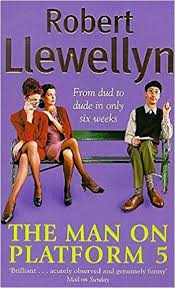
[READ: May 1, 2019] The Man on Platform 5

I know Robert Llewellyn from the show Red Dwarf, of which I am a huge fan.

In fact, I didn’t know anything about this story, but I figured if Kryten wrote it, it must be good.  I had read his memoir, the wonderfully titled Thin He Was and Filthy Haired, and I was sure I had read this at the time as well.  But evidently not, because when I started flipping through it I realized I didn’t know a thing about this story.  I also see that he has written quite a lot more in the last two decades.

It seems fairly obvious from the get go that this story is a gender reversing story of Pygmalion or My Fair Lady.  Instead of a man trying to improve a woman, in this story, a woman is trying to “improve” a man.  In some ways it’s very modern and progressive and in other ways it’s pretty stuck in gender stereotypes.  But hey it was the 90’s, before writers were enlightened.

The man who needs bettering is Ian Ringfold.  He is a trainspotter!  (I love that Llewellyn made that his hobby as I have heard of it but never knew exactly what it entailed).  He loves obscure facts, dry goods (he works in a supermarket) and being incredibly dorky.  He is deeply into what he likes and genuinely can’t understand why other people wouldn’t like those things.

Enter Gresham and Eupheme.  They are half-sisters and have spent pretty much their entire lives squabbling.  Their train breaks down on the same platform that Ian is currently trainspotting.  Eupheme, the more humane one of the two, bets Gresham that she can turn this sad “anorak” into a “useful member of society.”  Gresham says it cannot be done.  Eupheme (who is short on funds) says that if she can turn this loser into someone that Gresham would fancy that Gresham would pay her a tidy sum.  (more…)

Read Full Post »

« Newer Posts - Older Posts »