Feeds:
Posts
Comments

Archive for the ‘Scientists’ Category

[ATTENDED: March 11, 2016] Doktor Kaboom!

drkAnyone named Doktor Kaboom sounds like a performer I want to see. Especially if his thing is that he mixes science and comedy.

I knew nothing about the man when we bought tickets at RVCC Friday night, but boy was I excited.  And so were the kids, who both love science and things that go Kaboom!

So Doktor Kaboom came out on stage and…lo and behold…the K in Doktor wasn’t a zany spelling (thank goodness), it is because the good Doktor is German!  And when he asks you if you understand, you must shout Ja!, not yeah or yuh or okay, JA!

And he likes things to go Kaboom!  Ja?  JA! (more…)

Read Full Post »

primatesSOUNDTRACK: OTIS TAYLOR-Tiny Desk Concert #120 (April 13, 2011).

otisOtis Taylor is a big, burly, bearded man who plays the banjo. His band consists of fiddle, drums and electric guitar and bass.

The songs are bluesy without being like the blues, and they are folky without really being like folk music.  And the way he plays the banjo is unlike any typical banjo song I’d heard before.

The blurb explains what makes his songs sound so different:  He plays a style of music he calls trance blues.

Taylor’s music is trance-inducing, and he achieves that effect by playing songs that are modal: Sometimes, they sit on one chord for the entire song. Taylor says that by doing that, by eliminating chord changes, you also eliminate reference points, so songs can run as long as 10 or even 15 minutes in length.

And it’s true.  The basic melody of he first song, “Ten Million Slaves” (which is only 4 minutes) stays the same throughout the song.  It’s the fiddle (played by Anne Harris) that throws the new notes and riffs into the song that keep it so interesting,

He does throw in a simple but affecting solo at the end of “Ten Million Slaves” but it’s more fun to watch him rock out the end of the song.  That song also appeared in Public Enemies, the Michael Mann movie.

He calls his music trance blues music, came from Mali and Mississippi Hill Country.

The main riff of “Ran So Hard The Sun Went Down” is instantly familiar and a little dark.  I love the middle jam section where it just seems to gets bigger and bigger (I guess that’s the trance).

For the third song, “Talking About It Blues,” Taylor switches to acoustic guitar.  This is a fairly simple blues song, but I love the guitar riff that punctuates the verses.  The verse is simple enough “my daddy cut down a tree, make a guitar for me.”  This song features a lengthy solo by J.P. Johnson.

The drums (by Larry Thompson “Bryant Gumball of the drummers,”) and bass (by new bassist Todd Edmunds) are really simple but they sound great and really punctuate the song.

It’s a short song that segues into the final song, “Think I Won’t” which has a heavy five note riff to open with.  I love that it takes him forver to end this song.  Saying one more time even though they do more than one more time.

I don’t really like blues songs that much.  But this band is really tight and the addition of the fiddle really makes these songs stand out. Plus after those cool droning blues songs I was hooked.

[READ: December 15, 2015] Primates

I had been planning to post magazine stories this week.  Then I learned that it is First Second’s ten-year anniversary and they are trying to promote it with the cool hashtag #10yearsof01.   Since I’ve read a bunch of First Second books in the last couple of months, I’m going to give them a deserved shout out by posting a few in a row and including that hashtag.

This is a non-fiction graphic novel from First Second and it is outstanding.  In a wonderfully kid-friendly style, it talks about the incredible work done by Jane Goodall, Dian Fossey, and Biruté Galdikas.  And the man behind their success, Leonard Leakey.

The story opens on Jane Goodall.  After visiting a friend in Kenya, she spoke to Dr Leakey (who tells of his childhood growing up in Kenya).  Through their meeting, Leakey gained funding and sent Goodall to Gombe to study chimpanzees in 1957.  She soon discovered them using tools and eating meat.   Her work caused them to, as the book puts it, “redefine tools, redefine Man or accept chimpanzees as human.”

Then she went further and learned so much more about chimpanzees, using techniques that were not exactly scientifically approved (sifting through dung, setting up places for them to eat) but wound up being amazingly effective.

Jane married Hugo, her photographer and then they were visited by Dian Fossey. (more…)

Read Full Post »

  laikaSOUNDTRACK: RANA SANTACRUZ–Tiny Desk Concert #88 (November 2, 2010).

ranaThis is a fascinating Tiny Desk that was posted exactly five years ago as a way to celebrate the Day of the Dead.  Rana Santacruz plays ranchero music.  I did not know what to expect from ranchero music but to me there is a very bluegrass feel.  There is a banjo and a fiddle!  And then there’s trumpet and Santacruz’ accordion playing and Spanish lyrics.

The first song “Tacho El Gacho” begins with horns and has a kind of mariachi feel (Santacruz is dressed like a mariachi), but the song soon switches to that bluegrass feel and is very fun.

He introduces the next song by saying “The next song is called ‘Death.'”   And they play a ten second piece.  They laugh and joke that the real next song is “Dejala Entrar” about a sailor who leaves with death willingly  because of his happy life.  The chorus: “open the door let her in, death herself is here to pick me up.”  This one is like a sea shanty.

The third song is “El Funeral De Tacho” which has more trumpet and feels more mariachi in the opening.

He jokes about all their death songs but says that their songs that deal with death are happy ones.  And indeed, “El Ranchero Punk” feels like a real hootenanny.   The bass player even plays drums on the bass.

I enjoyed this set a lot, and even not really knowing what he was singing about, I totally got into the songs.

[READ: July 7, 2015] Laika

If you know who Laika is, you know that this is not going to be a happy story.  If you don’t know who Laika is, shame on you.  Laika was the first living creature shot into orbit.  She did not survive but she has become legend.

Abdzis has done a ton of research into Laika and the communist/American space race of the 1950s and 60s.  And he has created a wonderfully researched and nicely detailed account of the life of Laika and the people who handled her (and the women who loved her).

The story opens on a man walking through the snow. He has just been released from the gulag and is walking to the nearest town (in freezing weather).  It is Sergei Pavlovich, the future creator of Sputnik (he was falsely accused of treason).  And as the first chapter ends we see his success–Sputnik was the first satellite launched into orbit.  And we see that Nikita Khrushchev wants another satellite in one month. (more…)

Read Full Post »

armadaSOUNDTRACK: RAID THE ARCADE PLAYLIST (2015).

raidIt should come as no surprise that Cline’s media campaign would include a Spotify “Raid the Arcade” playlist.  A playlist of the mixtape that the protagonist’s father made when he was a teen.

And I can pretty much see how this would have been a very satisfying mixtape for killing aliens and generally rocking out.  Of course, I had to have a listen and add my thoughts.

Side A: Track:

  1. One Vision – Queen (I was never a big Queen fan, particularly their later poppier stuff)
  2. Crazy Train – Ozzy (A classic, of course)
  3. Chase the Ace – AC/DC (I find it odd that the two AC/DC songs are instrumentals from the Maximum Overdrive soundtrack.  It makes sense given the guy who made them, but there’s so many better AC/DC songs)
  4. Hair of the Dog – Nazareth (One of my favorite classic rockers)
  5. Get it On – Power Station (I really hate Power Station a lot, and this version of an already pretty stupid song song is pretty dreadful)
  6. Old Enough to Rock and Roll – Rainey Haynes (I didn’t know this song.  It comes from the Iron Eagle soundtrack.  This song is not on Spotify and I imagine that’s because it’s terrible)
  7. Danger Zone – Kenny Loggins (This song is such a punch line that even if I did like it I’m not sure I could take it seriously)
  8. Vital Signs – Rush (I was totally psyched that he chose this Rush song)
  9. Barracuda – Heart (I’ve mixed feelings about Heart, but I do like this song a lot)
  10. T.N.T. – AC/DC (Now this is more like it for AC/DC songs–not an overplayed one either)
  11. You Really Got Me – Van Halen (Not my favorite Van Halen song, but a good rocker)
  12. Another One Bites the Dust – Queen (I loved this song when it came out.  It holds up pretty well (there’s some interesting sound effects in the background, but it’s nowhere near as good as the songs below)
  13. One of These Days – Pink Floyd (I love this song but never would have considered it particularly rocking–in the way these other songs are.  But it does rather work)
  14. Top Gun Anthem – Harold Faltermeyer (seriously?  Well, I guess if you like piloting video games, this makes sense.)

Side B: Track:

  1. I Hate Myself for Loving You – Joan Jett (I don’t care for this song, although the guitars sound good for the mix)
  2. It Takes Two – Rob Base (I’m surprised and pleased that this song made it into what is basically a metal compilation.  I never would have had such diversity at that age.  Although I got really sick of this song in college.)
  3. Hammer to Fall – Queen (I don’t really like this era of Queen)
  4. Twilight Zone – Golden Earring (I don’t love this song, but it is cool to hear once in a while)
  5. We’re Not Going to Take It – Twisted Sister (I loved TS back in the day, although I wince at them now. If this song wasn’t overplayed I could probably really get into it.)
  6. Rock You Like A Hurricane – Scorpions (I loved the Scorpions back in the day too. I certainly tapped my foot along to this one.)
  7. Black Betty – Ram Jam (This song is in a Rayman video game that Clark plays and while I think the song is really dumb, it certainly rocks.)
  8. D.T. – AC/DC (see above for instrumental AC/DC)
  9. Delirious – ZZ Top (I never got into ZZ Top, and while I do like some late 70s ZZ, I really don’t like mid 80s ZZ)
  10. Iron Eagle – King Kobra (Wow, this was obscure even to me–more pop metal from Iron Eagle)
  11. Run’s House – Run-DMC (Whose house?  It’s funny how stripped bare Run-DMC songs sound compared to contemporary rap.)
  12. We Will Rock You/We Are the Champions –Queen (overplayed but classic)

Bonus Track: Snoopy versus the Red Baron – The Red Guardsmen (a goof y novelty song that I think overstays its welcome.)

So I guess my verdict is that I really don’t like the Raid the Arcade mix all that much.  That’s kind of a shocker, actually.

[READ: July 31, 2015] Armada

I loved Cline’s first book Ready Player One.  And Sarah and I were understandably excited about his latest book, Armada.  I was surprised about the content of the book which is of similar plot to the new movie Pixels (I say similar based on what little I know of Pixels–that video game characters attack the earth).  This is surprising to me because Cline has already sold the rights of this book to Spielberg–and I have a  hard time believing someone would try to cut Spielberg with an idea.

Of course, Armada is rather different from Pixels in that the characters that attack the earth are not classic 80s video game characters.  Indeed, there is a whole back story that shows how very different these two premises are.

In a recent interview, Cline talked about how you have to include all the pop culture sci-fi and video games in his book because there’s no way you should be able to make a sci-fi book or movie on earth and not reference all of the pop culture that the protagonist grew up with.  So this story is not set in a vacuum.  In fact, it the pop culture establishes the plot.

Zack Lightman is a senior in high school.  He’s had a pretty crappy life.  His father was killed in a sanitation explosion when Zack was just a month old.  The death set him and his mom up for life, but he has spent his whole life immersed in his father’s life (he is close to his father’s age when his father died).  Zack has a lot of his father’s effects.  His dad was a huge gamer, spending a lot of time at the arcade, and loving all things sci-fi and fantasy.  His father would have been born around 1970, making the pop culture references perfect for those of us around the same age.

One day, while looking out the window of school, Zack sees an alien ship.  But not just a generic cigar shaped UFO.  Rather this is a ship directly from his favorite videogame, Armada.  Zack plays this game pretty much every day. In fact, he is ranked sixth in the world as a pilot protecting the earth from alien invaders.  Naturally he assumes he has gone insane–especially since no one else has seen it. (more…)

Read Full Post »

raslSOUNDTRACK: METHOD OF THE W.O.R.M.-Cicatrix (2015).

motwormMETHOD OF THE W.O.R.M. is the project of one guy–known as Grimm.  Cicatrix is a collection of songs that spans decades (“begun long before the present digital day”) and recently remastered and released.

The blurb on CdBaby (where you can download the disc–it’s also on iTunes) notes that Method of the W.O.R.M. is “an industrial hard rock with a trip hop edge, intelligent grown up lyrics delving into the microcosm and macrocosm of our world. Influences run the gamut of NIN, Massive Attack, Cop Shoot Cop, Swans, Coil, Tricky, Skinny Puppy, Tom Waits and many others.”

There’s quite a diversity in that list even if the bands are similar, and you can hear the melding of influences.  And you can hear most of them in the songs. But what sets MotWORM apart from these bands is a keen sense of melody in the vocals.  Most industrial music tends to bury the vocals with distortion or just under the music.  But Grimm’s got a good (even pleasant) singing voice which elevates the songs above the din of lesser industrial bands.

While it’s not like pre-digital technology was all tape manipulation, it also wasn’t as easy as it is now.  And the complexity in these songs shows a lot of skill and attention to detail.

“No Flesh” opens the collection.  After some interesting noisy samples (steel drums?), a slow bassline enters (which also sounds sampled—it’s got a very 70’s sound).  The song slowly builds with more and more layers of sound until the vocals come in–a gentle singing that also builds.  There’s a Skinny Puppy feel in the music, but the vocals are very different from Puppy’s style.  “Purge” is the first of many songs with sampled dialogue, but it’s the sounds around the dialogue that are so interesting–squeaks and buzzes, radio tuners? who knows where they come from.  Once the verses start, the main music in this track is more synthy–a compelling riff that wends through the mix.  When the distorted guitars kick in, it takes the song to an entirely new level.

“Burned” showcases the vocals up front in the mix over a simple layered melody.  But there are actually a lot of vocals in this song, including a fascinating sample that opens and closes the track.  Grimm adds layers of vocals–harmonies (or not exactly)–distorted vocals and clean vocals.  I particularly like when the higher voice sings a new (very cool) melody in the middle of the song (the sampled voice melds nicely if creepily with this too).  This song is a real highlight.

“Tragic Rabbit” has some more interesting samples and a pulsing synth line with cool swirling sounds over the top of the vocals.  “As If a Dream” is a slow trippy number with an excellent processed sample.

“A Viral Method” introduces live drums (which sound great and were provided by Swans’ Phil Puleo).  It also has a great live guitar sound playing a fast riff and harmonics.  There’s more great harmony vocals. And a wild riff for the bridge (do I dare say a bit prog rock?).  Although I love the cool samples and layers in the earlier songs, this live instrumentation adds an excellent urgency to the music.  The only problem with this song is that it’s so short.

“Absolution” starts off quietly but after the distorted guitars, the chorus is super catchy–the way it seems like it’s going to end but rebuilds itself.  It’s really well crafted.  “A Moment of Silence” opens with a retro-sounding synth bass.  It’s a fairly minimal song with the vocals really taking over as that synth line drifts to the background and new sounds bubble up.  “Wasted” opens with distorted guitars kind of like a Ministry song, but the vocals are much cleaner, which brings an unexpected quality to what could have been a typical heavy song.  Especially the chorus which is musically bright (even if it’s lyrically dark).

“Freak-O” (what a great title) opens with some loud jackhammer type drums.  The song creeps along menacingly (with a great sample of someone shouting “You are one ugly son of a bitch!”).  I like the simple melody that simmers up from the noise by the end of the song.  “Miscreant” opens with quieter acoustic guitars before the drums kicks in and a menacing synth line takes over.  The vocals are quietly sung with an interesting effect placed on them.  The middle of the song has some wild sounds–I’m not entirely sure what’s happening with them, but it makes for an unsettling ambiance.

“I Love You Goodbye” is my favorite song on the disc.  It starts out simply with big guitars but quickly retreats into a much quieter verse.   There’s a great riff that throws in a slightly dissonant harmonic note that is just great.  But as the song builds into a unexpected bridge with horns, the song adds an dark carnivalesque atmosphere (and that harmonic note returns in a more prominent role).  It’s such an unusual riff and really bodes well for the interesting direction MotWORM might be heading (if they ever release anything else).

This is a real fun disc full of interesting sounds and samples.  If you like industrial music this is a disc totally worth checking out.

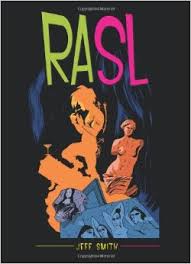
[READ: July 31, 2015] RASL

Jeff Smith is creator of Bone, one of my favorite comics ever.  As far as I can tell he hasn’t done a lot since Bone, but he sure did his research for this book.

The title is unfortunate (and is explained satisfactorily in the last few pages, but it’s still awkward and hard to manage).  But the work inside is extraordinary.  The story concerns dimension jumping, art theft and a whole lot of information about Nikolai Tesla.  It’s also more mature than Bone, in that there are a couple of (non-explicit) sex scenes.

In a nutshell, RASL (real name Dr. Robert Johnson) and his partner Miles are scientists.  They grew up together and studied the works of Tesla.  Miles married Maya, a beautiful scientist who has assisted them with their work over the years.  They delved deeply into the research that Tesla undertook (Resonant frequency, remote control, the earthquake machine, wireless communication) and used his ideas to create a machine that is something like a transporter/dimension hopper. They are working for the military but hope to be able to use the device to end wars (idealist scientists as they are).  Their small tests has been successful, but RASL believes that they need more testing to see if there are any effects when you use it on bigger subjects.

So he takes the machine and hops.  It turns out that each hop between dimensions takes its toll on his body and also tends to confuse matters.  (In one dimension, he checks his iPod and sees that Blonde on Blonde was recorded by Robert Zimmerman (I love that detail)).

We learn that RASL (who as the story opens has shaggy hair and cuts and bruises, unlike the composed scientist we see in flashbacks) has been jumping from dimension to dimension to steal precious works of art as a way to make some money.  There is also a really creepy-looking man whose face looks almost amphibian (Smith has some really disturbing characters in this book) chasing after him.  This man kills everyone that RASL knows in different dimensions because he is after something 9and he believes that the people in other dimensions are not real).  It is slowly revealed why RASL has been reduced to this state. (more…)

Read Full Post »

whatifSOUNDTRACK: SON LITTLE-“The River” (2014).

sonlittleI don’t like the blues.  I find it dull and repetitive.  I also don’t really like singers who are described as “soulful.”  And yet here is Son Little with a soulful blues stomper that I really like a lot.  WXPN has been playing this song pretty often, and I like it more with each play.

It’s a fairly simple set up with handclapping and a two note guitar riff.  Even Son Little’s voice doesn’t seem all that special at first.  But there’s some way that all of the elements combine that makes it so much more than the sum of its parts.

And with each verse, more elements are added, a synth sound, some guitar lines, even some bass riffs, building the song’s intensity.

But it’s that chorus–so catchy and ominous at the same time with interesting harmonies that just sound like he is echoing himself.  I really can’t get enough of it.

[READ: January 31, 2015] What if?

This book was just entirely too much fun.  Well, actually I thought it would be a bit more fun, but Munroe is so scientific that at times (when he got really factually scientific) I just felt dumb.  Which lessens the fun.  In fact, the first couple of pieces are really heavily sciencey, unlike some of the later ones which are really funny.

But what am I talking about?  This book is a collection of the “what if’ section of the website xkcd. There’s no real guidelines on the site for what kind of question you can ask, and many of them are quite strange (and often hilarious). They are hypothetical (what if?) questions and, depending on the arcane rules that Munroe follows he will answer them to the best of his scientific scrutiny.  And he will take the questions very very seriously–no matter how stupid your question may seem, he will try to answer it scientifically.  It’s fun!

But it’s also serious, and seriously scientific–Munroe is a former NASA roboticist.

So the first one “What would happen if the Earth and all terrestrial objects suddenly stopped spinning, but the atmosphere retained its velocity” almost seems to be put in the front to scare off those who might not want to be too scientific.  And the second question comes more down to Earth (but also destroys the Earth): “What would happen if you tried to hit a baseball pitched at 90 percent the speed of light?” (more…)

Read Full Post »

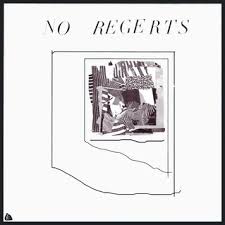
xkcdSOUNDTRACK: CHASTITY BELT-No Regerts (2013).

regertsChastity Belt’s debut full length returns to the lineup of the first EP: Julia Shapiro (guitar, vocals), Lydia Lund (guitar), Annie Truscott (bass), and Gretchen Grimm (drums).  But it retains some of the more full sound of the second EP.  It’s a really interesting album with a lot of diverse styles that are all held together by Shaprio’s voice.

I love the complexity of “Black Sail” which has some jangling guitar and an interesting lead riff at the same time–and which exudes a more psychedelic feel.  “Seattle Party” is up next and between the two songs, they clock in at 8 and a half minutes, which is funny since the next four songs total less than that.

“James Dean” (re-recorded from that first EP) sounds better here–you can make out the lyrics better and it’s less staticky.  It really highlights their great short song writing skills.  “Healthy Punk” has a quick sound, with an almost ska-like rhythm.  “Nip Slip” is a funny song about wanting some chips and dip (with appropriate sound effects–the whispered chorus is really quite funny too).  “Full” is a rather spare song that changes things up a bit.

“Happiness” is a slow song that I don’t love, but it’s followed by the awesome “Giant (Vagina)” which takes PJ Harvey’s “Sheela na Gig” to an even more unexpected place–it’s funny and funnier.  “Pussy Weed Beer” is about well, pussy weed and beer–a fun song for one and all.  “Evil” ends the disc with a bright happy guitar sound–belying the “evilness” of the narrator.

Not every song is great, but there’s plenty to like about this weird album.  And the new single from their soon to be released album sounds even better.

[READ: February 10, 2015] xkcd volume 0

After reading Monroe’s What If? [which, in a cool, utterly intentional time bending way will be posted two days from now], I saw that he had a previous book called xkcd.  This is also the name of his website. I had passing familiarity with xkcd, but didn’t know all that much about it.  I’ve mostly been sent links to it rather than actively going there.  And it turns out it’s not that friendly of a site anyhow.  But there is a lot of funny to be had there.

xkcd is primarily a bunch of stick figure characters getting involved in a few kinds of situations: romantic (or unromantic), mathematical and sci-fiction/sci-reality issues.  Or as he sums it up:

Warning: this comic occasionally contains strong language (which may be unsuitable for children), unusual humor (which may be unsuitable for adults), and advanced mathematics (which may be unsuitable for liberal-arts majors).

It helps to know that Munroe used to work for NASA (although not as like an astronaut or anything), and that he has a very scientific/mathematical brain.  So much so that a liberal arts major such as myself found many many of these comics to be waaaaay over my head.  Of course, he also has cartoons about Vanilla Ice and MC Hammer, so we can’t all be smug bastards, can we?

I laughed a lot at this book, and of course I scratched my head in confusion a lot too, but that’s okay, the ratio of humor to huh was high (there’s some basic math, right?). (more…)

Read Full Post »

elmer SOUNDTRACK: R.E.M.-Collapse into Now (2011).

R.E.M._-_Collapse_into_Now“Discoverer” opens this disc with ringing guitars–not exact R.E.M. replicants, but familiar.  And then Stipe comes in and the refresher course in R.E.M. begins.  Collapse Into Now proved to be R.E.M.’s final album, and while some of their latter albums weren’t great, Collapse seems to revisit everything that was great about R.E.M. and tries to spread it all over this album.

The blueprints for classic R.E.M. songs form the structure of a lot of these songs, with chiming guitars, and Stipe’s recognizable vocals.  “All the Best” sounds like classic R.E.M. (although Stipe’s delivery is more current sounding).  It also fits in well with the faster songs from Accelerate and is only 2:46.  But it’s “Überlin” that really sounds like a classic R.E.M. song.  That notable guitar style with Stipe’s very specific delivery style.  And then come Peter Buck’s harmonies.  It sounds like a good outtake from, say, Automatic for the People.

Stipe tends to do a lot of his sing-speaking on this album (and i think the one thing I don’t like that much about the album is that early R.E.M. seemed to obscure Stipe’s vocals and lyrics a little bit, giving them an air of mystery.  Whereas the newer records are all pretty well laid bare).  So “Oh My Heart” has Stipe almost speaking his poetry.  It’s got mandolin and Buck’s mildly annoying backing vocals (I’ve never thought that about his backing vocals before).

An Eddie Vedder cameo is utterly wasted on “It Happened Today,” you can barely hear him as all he does is backing crooning near the end of the song (and frankly the “hip hip hooray” chorus is lame).  “Every Day is Yours to Win” is a pretty slow song.  It doesn’t amount to much but the melody is really beautiful.  “Mine Smell Like Honey” is a crazy bad title, but it’s a great rocking song, really hearkening back to classic R.E.M.–ringing guitars and Stipe’s vaguely disguised voice.  “Walk it Back” is another slow ballady type song and is really pretty.  While “Alliagtor_Aviator_Autopilot_Antimatter” is a rocker with Peaches singing and speaking backing vocals.  “That Someone is You” follows up with another speedy track.

I tend to dislike the really slow R.E.M. songs, so “Me, Marlon Brando, Marlon Brando and I” doesn’t do much for me.  The disc ender, “Blue” reminds me of Out of Time‘s “Country Feedback” (I keep waiting for him to say “I need this”).  And the Patti Smith backing vocals recall “E-Bow the Letter.”  “Blue” is meandering and unfocused but Buck’s atmospheric guitars are quite effective, even if the song itself is nothing special.  I don’t quite get the coda of tacking the opening chords of the album on to the end, but whatever.

So basically this album feels like some mostly great outtakes from earlier R.E.M. albums. And there’s really nothing wrong with that (well there would be if R.E.M. was still trying to release a lot of new music).  But since the band was ready to call it quits anyway, it’s a nice recap of their career.  True, I’d rather listen to their earlier records, but you could definitely throw most of these songs into a mix with the earlier ones and they would sound perfect.

[READ: October 25, 2014] Elmer

Elmer has a  chicken on the cover.  It also features this quote at the top of the book: “It’s the Great Filipino Novel, with chickens.”  What to expect from this book?  Well, chickens, obviously, but I never would have guessed what this book contained.  Indeed, this book is pretty mind-blowing (in a good way).

It has a simple premise, which seems comical but is actually taken very seriously: what if chickens became “aware” and learned to speak?  It sounds funny, right, but Alanguilan really explores this issue seriously–if a species of animal that we normally eat suddenly talked to us en masse, how quickly would we deal with this, and what would humanity’s reaction be?  It tackles issues of slavery and racism and pushes them further.  And while the “change” takes place in 1979, it addresses contemporary society with an inquisitive glare.

While there is some humor in it, this is a serious book.

Jake Gallo is a modern chicken (the book is set in 2003–two decades after chickens became “human”).  He has just been rejected for a job, and he pulls the race card (this would be the hilarious reveal that our main character is a chicken).  While he’s feeling sorry for himself, he gets word that his father, Elmer, is dying and he returns home to be with his mother and family.  On the way home he runs into Farmer Ben, the farmer who helped to raise Elmer’s family.  And he is genuinely glad to see Jake.  Jake seems somewhat put off by Farmer Ben and declines his offer of a ride. (more…)

Read Full Post »

lostscrapSOUNDTRACK: THE XX-Coexist (2012).

coexGiven my proclivities towards noisy fast rock, there is no reason that I should like The XX, and yet I like Coexist quite a lot. It is such a spare album, but Romy’s voice is fantastic—so sensuous and breathy–that she can totally handle a song that is nearly a capella. So a song like “Angels” whose music consists pretty much entirely of a beautiful echoey guitar (and virtually nothing else except for some occasional soft percussion) is engrossingly intimate and not at all boring. In fact when that simple percussion eventually comes in, it’s like a revelation of sound accompanying her.

What also keeps the album interesting is that she is not the only singer (so there’s something for everyone). “Chained” has Oliver’s breathy, sexy voice as he more or less whisper/sings the lyrics. It has slightly more complex arrangements (meaning the drum is constant and there are quiet waves of synths). “Fiction” slowly builds with an ominous muted guitar motif and echoed chords. But when the chorus kicks in, that muted guitar grows loud and it’s almost overpowering (relatively, of course).   “Try” brings in a spooky kind of keyboards that is slightly unsettling under their mellow hushed duet of vocals.

The diversity of simple sounds that Jamie xx adds to each song are revelatory.  Even though each song is quiet and intimate, the sounds that he uses are so very different within that limited palate.  So “Reunion” sounds like a steel drums, before adding pulsing bass beats. “Sunset” has a slinky guitar and “Missing” introduces as drumbeat that is like a heart beat.  “Tides” has one of the loudest drum beats on the record, alternating with a delicate guitar line.

The simple bass line adds a really funky quality to “Swept Away.”  And when the claps and keyboard hits come in it feels almost like a dance song.

This is a great album for quiet nights and headphones.  Even if the songs seem to be mostly about lost love, it has a calming effect that is really enjoyable.  I’ll have to check out their debut as well.

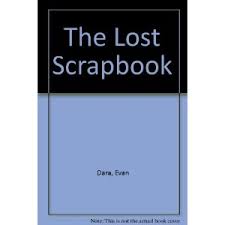
[READ: September 30, 2014] The Lost Scrapbook

Some fans of David Foster Wallace speak well of Evan Dara (at least that’s how I’ve heard of  him).  I was unfamiliar with him and the fascinating story he has built around himself.  Evan Dara appears to be a pseudonym.  As one writer put it: “Hell, we don’t even now who Evan Dara is. Apparently, he is a male American in his 30s living in Paris.”  This, his debut novel, has attracted attention not only for being really weird, but for being really good.

What was fun about reading this was that I knew there were strange things afoot in the book, but I didn’t know what exactly (I really like to go into a book completely blind if I can).  So when the book started out with a conversation in which no character names were given (or even how many there were), I was prepared.  And while I didn’t really know what the subject they were talking about was, I figured that would be fine as well.  Then when four pages in the all caps word YIELD seemed to signal a change of narrator/perspective/something, I thought, okay this is what I’m in for.

Then I noticed that every paragraph which wasn’t conversation (with an em dash) was preceded by three ellipses (and ended with same).  A few pages later there’s an all caps TOW-AWAY ZONE which introduces another shift.

And somewhere around page 14 a sort of plot begins to form (although it’s unclear whether or not any of the earlier sections have anything to do with this one).  A man is shot…or not?  But then after the KEEP DOOR CLOSED section break, a new story develops.  A man with a Walkman (I was trying to decide if this was deliberately retro or intentionally set in the 80s, but that was unclear to me) is driving along to meet a man named Dave (at last a name!).  Dave is a filmographer who has been collecting fireflies for a video project.  And just as we near a kind of resolution of this section, it morphs, unannounced, mind you, into something else entirely–a discussion of music, specifically Beethoven and his decision to rework limited material into multiple variations.  It is fascinating and engaging and very well-considered, but it too ends before anything can be “resolved.” (more…)

Read Full Post »

neuroSOUNDTRACK: CHVRCHES-Tiny Desk Concert #356 (May 12, 2014).

chvChvrches are just on this side of the kind of synth pop that I like.  I simply can’t deny the awesomely catchiness of “Recover” which must be due to Lauren Mayberry’s wonderful voice, or perhaps the bubbly synth sounds that the three of them generate.  In this Tiny Desk version, they brought all kinds of synths along with them.  I don’t know what they normally play live, but this is an amusing sight to see 4 keyboards (for three players)—all of the musicians with their arms hanging down as they play their instruments (synths that are about a foot long and boxes with lots and lots of dials).

“Gun” is a darker sounding song, but again Mayberry’s voice is so clear it cuts through the dark sounds.

I enjoyed that before they played “The Mother We Share” she asked if she could curse.  NPR says yes and she says good for them.  (There is a parental advisory for that one curse word too).  She also says this is the nicest but oddest gig that they have played.  She is charming and it just makes me like them even more.

[READ: June 3, 2014] Neurocomic

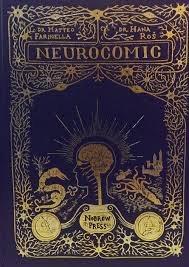
First I saw the name of the publisher–Nobrow Press–then I saw the name of the graphic novel–“Neurocomic” and I imagined some sort of sci-fi riff on Gibson’s Neuromancer.  Then I saw that both authors were doctors and I thought that it was going to be some kind of science book.  But the cover has a drawing of a brain and a squid and some other kind of creature and from there I just decided I had better see what this was.

So, this actually proves to be a very basic history of neuroscience.  With a plot.

As the story opens our hero, a rather generic looking fellow, is walking along a landscape when he sees a woman (presumably beautiful) with whom he seems to fall in love.  He is suddenly sucked into someone’s brain and then onto a forest floor.  He is confused and upset and has to find a way out.

Welcome to chapter 1: Morphology.  Our hero learns he is not in a forest, he is in a brain and those trees are neurons.  And he has run into Santiago Ramon y Cajal (1852-1934) and Camillo Golgi (1843-1926).  They explain to our guy about neurons and axons, but really he just wants out.  So they tell him to enter a neuron and on we go… (more…)

Read Full Post »

« Newer Posts - Older Posts »