Feeds:
Posts
Comments

Archive for the ‘Religion’ Category

SOUNDTRACK: AND THE KIDS-When This Life Is Over (2019).

I’ve seen And the Kids twice and they put on a fantastic live show.  I highly recommend seeing them when live shows start again. 

The core of the band is Hannah Mohan on guitar and vocals and Rebecca Lasaponaro on (fantastic) drums.  For this record they were a four piece (although no names are included on the disc).

“No Way Sit Back” starts the record with a slow swinging song that features the wonderful wordless hook of Mohan singing “oooh oh oh no.” Midway through, the song shifts gears to a kind of glockenspiel melody over the lyrics “the world is never made for us.”  Even though lyrically this album is dark, musically it is really lovely.

“Butterfingers” lopes along at an unusual pace before a really catchy guitar melody kicks in midway through.  There’s some more catchy melodies as the two vocals line intertwine with each other.  Then comes “Champagne Ladies” a remarkably catchy song right from the get go.  The quietly rumbling guitar and the great vocal melody is nicely mimicked by the bass.  It’s a really fantastic song and should have been a big hit, even with the uplifting chorus: “life is a bastard, it wants to kill you don’t let go.”  But if the lyrics are too dark, there’s another fun wordless “ah ah ah” melody near the end.    

“2003” opens with a penny whistle introduction (when I saw them live, Mohan played the whistle and then just tossed it aside before she started singing).  There’s some excellent unusual and complex drumming at the top of this song. 

“The Final Free” has grooving guitars and a cool part in the middle where the guitar follows the vocal line in a quiet but catchy melody.  “When This Life Is Over” has a kind of hawaiian feel to it with guitars and choral vocals.   “Special For Nothing” is a quieter song that builds into a gorgeous soaring chorus. When the song shifts to the middle part and the music all falls back except for the vocals, it’s really quite lovely.  I love when the backing vocals do counterpoint over the refrain

“Get To That Place” is a short song, less than two minutes and sounds like a bedroom recording (lots of hiss) but as the song gets bigger there’s some cool vocal tricks (so much soaring highs) and glockenspiel.  It’s followed by another short song.  The mellow “Somethings (Are) Good” is just over two minutes with more overlapping vocals and a dynamite melody. 

“White Comforters” sounds bigger and more full sized.  It’s much slower with a bouncy guitar melody and a lot of spare playing. It starts a little too quietly but it builds very nicely.  “Religion” brings back the rocking guitars with a loud opening and a simple but catchy guitar melody, the joyous vocals with two layers of oh ho ho s really makes this song soar to glorious heights.

The disc ends with “Basically We Are Dead” a longer song that opens with a quieter guitar melody and vocal.  Atmospheric keys fill in the backing moments along with a bouncy synth melody and some joyful bah bah bahdahs.  But before the song ends, some familiar chugging guitar chords enter the song and they sing the chorus to “Champagne Ladies” one last time before it’s all over.

And the Kids play wonderful indie pop with plenty of unexpected twists.  And they are terrific live, too.

[READ: November 5, 2020] The Divided Earth

This is the final book in the The Nameless City trilogy.

The book opens with the leaders of the city agreeing that their sacred fire, Napatha, must be destroyed, lest it be used by one of the splintering factions.  But one copy of the recipe spared–given to the monks to hide for as long as was necessary.

Then we flash forward.

Kaidu is sitting with Rat and the others, resting up for what’s to come.

We see Mura, the woman who was abandoned by the monks as a little girl, receiving that copy of the book from the monks (they are hesitant).  She has every intention of learning the formula and creating the Napatha again. She imagines giving the formula to all of the other Dao generals for maximum production against the Yisun.  But Ezri, who has forcibly put himself in charge of the Dao people, wants to keep it under wraps.  Being a treacherous person, he anticipates treachery from everyone else as well.

The Yisun army is marching on the city.  Ezri hopes to have the Napataha ready to use against them.  He has just enough to show how powerful it is.  And it has the desired effect.

When Rat and Kaidu see what happened, Kaidu announces that he is going to steal the book from Mura’s clutches.  How?  Well, that’s where most of this book’;s adventure comes in.  It’s clever and stealthy and very exciting with switches and crosses and trouble everywhere.  They even get help from their minstrek friends (it’s always nice to see minor characters come back). 

At the same time, Kaidu’s parents (Kata and Andren) are (unbeknownst to Kadi and Rat) planning to negotiate with the Yisun army to save the city  Kata explains that she is in charge of the Dao tribe Liuvedao and she is no friend to the Dao regime currently ruling.

The soldier in charge of the Yisun army scoffs at this idea.  Until Kata’s secret weapon (which she didn’t know she had) steps forward and explains why the Yisun leader might want to hear them out. Kata proposes an dambush on the city, using an equal amount of Kata’s forces and the Yisum army. 

None of the attacking plans go smoothly.  Rat and Kaidu face very difficult odds (and many soldiers) and the ambush team literally walks into a dead end and needs to be rerouted through a sewer tunnel (ew).

There is a terrific showdown between Rat and Mura, two women whose lives began in a similar way but who took very different paths. And there are many many pages of battle scenes.  Hicks does a great job of keeping the action exciting and clear, with lots of one one one combat as well as an army of warriors.

The story has an epilogue set three years later, which is fun. It’s neat to see Kadi and Rat grows up some, although I could have used a dozen more pages of epilogue to see what things are like now.  And to see them catch up (there’s no Facetime back then). 

But even so, this was a great series, full of excitement and very emotional moments,.

Read Full Post »

SOUNDTRACK: BORIS-präparat (2013).

präparat is Boris’ 18th album.  It contains a huge variety of styles in its 40 some minutes.  It also features a couple of guests.  Michio Kurihara plays guitar on track 3 and 5 and Gisèle Vienne offers spoken word on track 6.

So this album starts with one of the band’s most beautiful instrumentals.  “december” is slow with a cool bassline and gentle drums. The lead guitar perfectly matches the strummed bass.  It’s a lovely post-rock instrumental complete with a section that manipulates the volume knob to bring in extra soft notes.

The pretty guitars continue to ring in on “哀歌 -elegy-” for about 20 seconds before the ominous distortion means an oncoming crash of chords.  But this is a slow crash of chords with some gentle singing (from Takeshi?) in the melodic verses.  About three minutes in the song jumps into a fast rocking section with a great guitar riff and heavy drumming. It’s excellent.

It segues into the 57 second noise fest that is “evil stack 3.”  It’s just distortion and wild soloing, a noisy interlude that is abruptly ended by the gentle “砂時計 -monologue-”  This song is four minutes long complete with gentle drums, and pretty guitars.  About halfway in, it takes off in another postrock spectacle of pretty guitars and a gentle melody.

“method of error” features Michio Kurihara on guitar and starts with some slow heavy thumping chords.  Church bells come echoing in followed by soaring guitars.  The drums interject crashing sounds from time to time.  Two guitars provide an extra wailing solo as the rest of the band jams a heavy chunky riff.  This song runs over 7 minutes.

“bataille sucre” starts off quietly but then brings in a loud ringing guitar.  Then an old school heavy metal riff begins with some screaming lead guitars.  The guest vocals are whispered (presumably in French) and add texture (if you don’t know what she’s saying).

Then comes two songs in under a minute.  “perforated line” is 34 seconds of fast heavy guitar (and synth) that feels like the beginning of song, but it abruptly ends and jumps into the oddball, almost dance stylings of “コップの内側 -castel in the air-” all SEVEN SECONDS of it.  It’s followed by “mirano” which is a warped, carnivalesque waltz with keys and possibly vibes.

“カンヴァス -canvas-” has the tone of a Kim Gordon Sonic Youth song with fuzzy guitars and an almost whispered vocal, although the chorus is pure shoegaze with layers of soft vocals.  About half way through the band add a noisy wall that sounds like it’s going to explode, but it just drops away for some clear crooning from Takeshi.

The disc ends with the eight and a half minute “maeve.”  It opens with skittery percussion and faraway gongs.  Then comes a distorted slow riff.  It’s a slow drone-like song that lumbers along for about six minutes.  The last two are a wave of distortion that sounds like a slow heavy train echoing through your head. 

I love the diversity of this record and the tracks that are not experimental are just dynamite.  I’m really glad this album is no longer hidden away.

[READ: November 12, 2020] The Proof

The Little Buddhist Monk (written 2005) has been bundled with The Proof (written 1989) together in one book.  Both stories were translated by Nick Caistor.

The Proof is about as different from The Little Buddhist Monk as you could get.  It’s also the most visceral story I’ve read by Aira, whose stories tend to be very “of the mind.”

Indeed, you can tell this story is quite different just from the way it starts.

“Wannafuck?”

This question is asked to Marcia (a senior in high school?–she’s “fourth year”) as she is walking down the street.  There are groups of teenagers hanging around,and this question comes from one of the girls.  (more…)

Read Full Post »

SOUNDTRACK: BORIS-Vein (2006/2013).

Boris continues to reissue their back catalog in streaming format.  Which is pretty amazing since so much of their work is so hard to find.  Possibly not great for collectors, but great for those of us who actually want to hear the music.

Vein is Boris’ thirteenth album.  Because they are Boris, the released two different albums under the same title in 2006.  The packaging was identical on both records and the only way to tell them apart was to check out the surface of the vinyl itself.

The “Hardcore version” had punk, hardcore, and drone.with vocals that are screamed rather than sung.  The  “Noise version” had drone and noise music as well as punk. This version of the album does not include any vocals.

In 2013, the band announced that the album would be released as a 2-CD set not as a reissue, but rather a re-arrangement of both albums combined.

Given all of this, it’s not even entirely clear to me what has been released her on bandcamp.  But it seems like the first two tracks (here labeled “v” and “e” are the hardcore version.  The third and fourth tracks “i” and “n” are a little harder to place.

“v” is 14 minutes long, broken up into several small pieces:

It starts with a wall of noise–static and low feedback swirling and manipulated until 4.01 when it segues into segues into ringing bells and effects that sound like a jet taking off and broken glass swirling and zipping around.   Then some drums and chords are introduced.   At 6:15, there’s a samples from the 1979 film Stalker, by Russian director Andrei Tarkovsky. A man says “И пусть посмеются над своими страстями” (Russian for “Let them laugh at their own passions”) followed by a blistering hardcore song  until 7:52.  After an abrupt halt comes the next screaming hardcore song which is more fuzz than chords with screams and feedback which at 9:06 segues into another super fast song which is distinguished from the others because of a riff where the chords go up and up higher and higher and faster as if they are going to explode, although it rumbles unto feedback at around 10:24 when a new tone of fuzzy nose feedback and a much slower introductory opens before before the pummeling hardcore resumes until 12:03.  This first song ends with a moment of silence and then a woman saying “unpleasant dreams” before a Wata fast high note solo is balanced by slow pummeling chords and drums and cymbals. After a minute or so, the hardcore returns this time with a solo all over the top of the song.  The song ends with a humming and what sounds like car keys jingling

“e” is over 15 minutes long and is one third hardcore punk and two thirds slow lengthy drone.  It starts with an Atsuo scream and hardcore drums. There’s a blistering hardcore song–fast riffage and screamed lyrics (which I assume are in Japanese).  Although the hardcore songs sound similar (and are unnamed) the riffs are distinctive enough to tell them apart.  Some backwards masked sounds come in at 1:05 and a similar riff at 1:15.  I have never seen them play this kind of set–it must be exhausting.  At 2.01 a loud bass comes in with a lot of cymbals and the song is buried under a blanket of distortion.  two minute song starts with.  At 3:04 a buzzsaw sound and a cool riff is coupled with some intense screaming.  At 4:45 it morphs into feedback that contains another sample from an Andrei Tarkovsky film, this time the 1986 film, The Sacrifice.  A man say “I hela mitt liv har jag väntat på det här. Hela mitt liv har varit en enda väntan på det här.” (Swedish for “All my life I’ve been waiting for this. My whole life has been a long wait for this.”)  The rest of the song feels like it might stay a lengthy drone, but at 5:46 after some cracks of the snare, a slow powerful Boris riff emerges.  But the riff dies away for some slow Wata soloing over droning chords.

Track 3 is probably the “noise version” (which is 17 minutes long) or the 2013 re-release (which is 17:25) but this track is 18:04.  Of course, if the “noise” version has no vocals, it can’t be this because it does have vocals.

It opens with a similar kind of noise that opens “v” but more staticky and with distant riffing going on.  At 1:58 a riff comes in.  The songs are like “v.”  A shorter version of the jet sounds are followed by some slow heavy chords.   At 3.22 there’s some chirping feedback that introduces the first hardcore song in “v.”  At 5.22 [#4 above] segues into a scream-filled hardcore song followed at 6:14 by the riff that goes higher and higher.  At 7:36, there’s slow thumping with noise and feedback (this might be new and not on “v”) then a sudden drop off of sound and near silence before the screeching feedback that starts at 8:39 with a blistering hardcore song that sounds unlike anything before. There’s heavy fast riffing with a pause and a big scream before resuming.  At 11:50, warping sounds and a thundering drum compete with a really fast riff which sounds like the first part of “e.”  At 13:05 song 2 from “e” begins–short, fast and loud.  Then at 13:51 comes track 4 from “e” (there’s no track 3) with the buzzsaw opening. At 15.21 there’s some backwards recording which eventually becomes the guitar solo that ended “v,” although this time it’s just under 3 minutes long.

Track 4 is “n.”  Perhaps it’s the “noise version” as there are no words.    It’s 17:59 and is a noisy composition of drone and feedback.  There’s some heavy chords and some quieter moments.  The high soaring notes seem to fit in very nicely with the sludgy bottom parts.  About half way through it turns into a fast, heavy hardcoreish track with a lot of drums, but buried under a wall of feedback and distortion.

[READ: November 12, 2020] The Little Buddhist Monk

The Little Buddhist Monk (written 2005) has been bundled with The Proof (written 1989) into one book.  Both stories were translated by Nick Caistor.

The Little Buddhist Monk is an absolutely bizarre, borderline stream of consciousness story.  It jumps from topic to topic like a fever dream and resolves itself in an even more unexpected way.

The story opens with us meeting the little monk who would very much like to leave Korea (where he was born and where he studied). But he has no money and no reasonable expectation for ever emigrating.  

Then one day a French photographer, Napoleon Chirac, and his wife Jacqueline Bloodymary (!) happened in his path.  They were on vacation and spoke French to each other.  The monk knew French and joined in the conversation.  They were delighted to meet a fellow French speaker in such a foreign land.  He imagined that they could be his ticket out of Korea.  So he decided to help them throughout the day.

They talk a lot about art.  Napoleon photographs empty rooms with a 360 degree camera and then splices it together as one image.  He has traveled the world filming places and he is looking to do a Korean monastery.  What luck, the monk can take them to a good one. (more…)

Read Full Post »

SOUNDTRACK: BORIS-“warpath” (2015).

Back in 2015, Boris released three albums on the same day all under the “new noise literacy” banner: “urban dance” “warpath” and “asia” [according to their label numbers, this is the order they go in].

All three records are experiments in abrasive noise.  Despite the adorable child on the covers, these records will scare children.

This album has four songs, all of which are variations on drone.

“Midgard Schlange” is 11 minutes of heavy distorted chords played slowly, as they ring out and rumble.  Its a a sort of seven-note melody but stretched out impossibly long.  At around 5 and a half minutes the electronics start to fade in from far away.  The first time I listened to the song I thought an airplane was flying overhead as these sounds came in.  These sounds eventually resolve into chords that acts as a kind of counterpoint to the guitar drones. It’s relatively fast tempoed for a drone song, but it still long and stretched out.

“Behind the Owl” continues the drone, but in a different way. There aren’t pummeling guitar chords that ring out.  Rather, they are just quietly building distortion waves, pulsing in and out.  It’s rather understated, a low menace that seems to cycle slowly between two notes.

The wonderfully named “Dreamy Eyed Panjandrum”starts with a kind of staticky electronic pulsing with occasional glitchy percussion sounds.  It sounds like somebody doing light construction for about 8 minutes.

The guitars come back on “Voo-vah,” and ominous ten and a half minutes of dark rumbling.  This time, the guitars are low and ringing, with waves of pulsing bass and stretched out chords. Around 8 minutes some higher-pitched notes come in, almost sounding like ghosts in the night.  Closing credits to a nightmare.

The album is credited to: takeshi: guitar, bass / wata: guitar & echo / atsuo: electronics.

[READ: November 5, 2020] “Sitting with the Dead”

I really enjoyed the way this story revealed its details.

It begins with an old, sickly man asking to go out to his barn. It was winter and he wore only his pajamas and a winter coat.  A week later, the doctor assured his wife Emily that that’s not what killed him–it didn’t even hasten the inevitable.

At half past seven on the day he died, the Geraghty sisters knocked on her door.  They were two middle-aged women who sat with the dying.  They were known in the area although Emily didn’t know them personally.  They had heard that her husband was dying and they came to sit with him, but they were too late.

Emily laughed to herself at how much he would not have wanted these two there to sit wit him.  He was not religious and he would have said that their sitting with him had an ulterior motive. (more…)

Read Full Post »

SOUNDTRACK: BORIS-“asia” (2015).

Back in 2015, Boris released three albums on the same day all under the “new noise literacy” banner: “urban dance” “warpath” and “asia” [according to their label numbers, this is the order they go in, but I’m posting them out of sequence].

All three records are experiments in abrasive noise.  Despite the adorable child on the covers, these records will scare children.

This album has three songs.

“Terracotta Warrior” Runs for 20:38.  It opens with quiet, slow rumbling–almost inaudible for the first 30 seconds or so.  Then the pulsing sounds start bubbling up under a hissing, mechanical sound.  Around seven minutes the rumble stays pretty steady, but the higher noises–hissing, clanging, horror movie sounds, start to grow more intense.  At 8 minutes, some discernible guitar chords ring out (heavily distorted, but clearly guitars).  It turns into a lengthy drone with squeaky feedback noises throughout.  At 17 and a half minutes the feedback gets louder and louder until it abruptly cuts off and after moment of silence distance guitars start ringing out again.  There’s even the first sign of drums (a gentle hi-hat).

“Ant Hill” is half as long, but similar is tone.  It is primarily pulsing electronics and high pitched squealing electronic manipulation.  There’s also some digital glitching sounds. After 8 minutes the song fades to a pause only to resume a few seconds later with some more digital glitching and manipulation.  With 30 seconds to go, a drum beat comes in and the distortion takes on a more melodic sound including what sounds like someone sawing in the distance.

“Talkative Lord vs Silent Master” is also ten minutes long and it is the most unpleasant of the three songs.  It is full on static and noise with what sounds like a monstrous voice growling in the distance.  By the end of the song it sounds like being in the middle of a howling winter storm.  And as it closes up there is some serious digital glitching.  Not for the sensitive of hearing.

The album is credited to: takeshi: guitar & bass / wata: guitar & echo / atsuo: drums & electronics.

[READ: January 19, 2017] “The Very Rigid Search”

Jonathan Safran Foer has become something of a more serious writer over the last few years, so I’m alway happy to read one of his earlier funnier works (himm, that sounds familiar).

This story is written from the point of view of a Ukrainian tour guide named Alexander Perchov.  He is writing this tale in English, although his English is slightly off (as the title hints at).  He speaks very good English, but his word choices often eschew idioms for literal translation (and much hilarity ensues).

Alex’s family own a Ukrainian branch of an international travel agency and it is his job to pick up and translator for an American traveller.

Alex refers to the traveler as the “hero” of the story.  And the hero’s name is Jonathan Safran Foer.

Jonathan Safran Foer is not having shit between his brains  He is an ingenious Jew.

JSF was travelling from New York to Lutsk. (more…)

Read Full Post »

SOUNDTRACK: LITTLE BIG TOWN-Tiny Desk (Home) Concert #91 (October 6, 2020).

Little Big Town is a country band that has been around for a while.  I feel like I’ve heard of them, but I’m not sure.

Evidently the band is really the four main singers, but they have added more touring members for this Concert.

They open with “Nightfall.” It has nice folkie guitar and Karen Fairchild sings with a strong folksinger style. The snaps from Hubert Payne’s drums really ring out in a cool way.  Thee upright bass John Thomasson adds a nice anchor to the melody.

I thought maybe they weren’t all that country after all.  But as soon as the chorus jumps in and the accents start flying–especially the high notes from Kimberly Schlapman–the country has come into the house.  The song is catchy though.

Up next guitarist Phillip Sweet jokes is the “most profound thing” they’ve done.  “Wine, Beer, Whiskey” opens with a surprise trumpet intro from Jacob Bryant.  Although songs about drinking are about as cliché as they come, the stompin,’ dopey tone is quite fun and Jimi Westbrook’s lead delivery sells it well.

They apparently use some songwriters known as the Love Junkies who came up with “Girl Crush.”  There’s some nice harmonies on this track.  You really can’t hear keyboard player Akil Thompson on the other songs, but his chords ring through here.  Westbrook puts down his guitar while Sweet plays.

They end with “Boondocks” their first hit about where they come from.  I like the bowed bass and Evan Weatherford’s slide guitar lead, but the thought of thousands of people stompin’ along to these lyrics is a tad disturbing.

[READ: October 5, 2020] Parable of the Talents [an excerpt]

During the COVID Quarantine, venerable publisher Hingston & Olsen created, under the editorship of Rebecca Romney, a gorgeous box of 12 stories.  It has a die-cut opening to allow the top book’s central image to show through (each book’s center is different).  You can get a copy here. This is a collection of science fiction stories written from 1836 to 1998.  Each story imagines the future–some further into the future than others. As it says on the back of the box

Their future.  Our present.  From social reforms to climate change, video chat to the new face of fascism, Projections is a collection of 12 sci-fi stories that anticipated life in the present day.

About this story, Romney writes:

I’ve ended this collection with a meteor.  An African -America woman born with “hyperempathy” must navigate the 2020as and 2030s in a hellscape formed by climate change disasters…  The reader is introduced to a rising demagogue whose slogan in “make America great again.”  Did that send chills down your spine?

At the time she was writing, however, it’s more likely she was inspired by the past than by the future.  When Ronald Reagan accepted the presidential nomination from the 1980 Republican National Committee, he gave a speech in which he promised, “For those who’ve abandoned hope, we’ll restore hope and we’ll welcome them into a great national crusade to make America great again.  Butler perceived the problems behind that phrase and used science fiction to explore how such a mindset could lead to history repeating itself, resulting in story that is even more powerful today than when she first wrote it.

I first looked at the date of 1998 and thought it was so current, not exactly realizing it was 22 years (and a lifetime) ago.  Without even reading the story, just reading the above paragraph, it’s pretty easy to see exactly what Reagan wrought.  He really was the beginning of the end for the country.

And Butler could totally read the writing on the wall.

Not much happens in this excerpt.  A farm is burned and most people killed. the refugees take shelter with the narrator at their farm/commune.

It’s the details below that are so chilling. (more…)

Read Full Post »

SOUNDTRACK: JAPANESE BREAKFAST-Live at Philly Music Fest @Ardmore Music Hall, Philadelphia PA, September 25, 2020).

I saw Japanese Breakfast back in 2018 at Union Transfer.  It was a really fun show.  Since Michelle Zauner is from Philly she really made the show personal. 

During the introduction to her set for Philly Music Fest, the announcer said that he’d been trying to get Japanese Breakfast to play this festival since it began.  So one good thing about the pandemic was that the band was still in Philly and not world touring.

We got to watch the band come out from back stage, take up their instruments and start “Diving Woman.”  This song has a wonderful, memorable bass line and a jamming guitar solo from her lead guitarist.

For this show she had the addition of Molly on violin.  Molly added so much to the upbeat and poppy “In Heaven.”

Michelle put down the guitar for “The Woman That Loves You,” a shorter song that was followed by the funkier “Road Head.”  This song is really catchy and has a very interesting slide sound from the bass.

It was funny to see her not playing the guitar because usually when she just had the microphone, she would interact with the crowd some.  But she only had the video monitor to look at.  Nevertheless, after the song she said “it feels great to feel like you have a purpose again.”

They played a new song–the first time the band played it together–called  “Kokomo Indiana” which is from the perspective of a love-lorn 17 year-old boy whose girlfriend moved to Australia for a summer exchange program.  It was a slower song with a slide guitar melody.

Michelle returned to the guitar for “Boyish” the catchy song from her old band Little Big League, with the chorus

I can’t get you off my mind
I can’t get you off in general
so here we are we’re just two losers
I want you and you want something more beautiful

Up next was “The Body is a Blade” with some slinky guitar lines.  After the song, someone triggered a sample of a crowd cheering, which was fun to hear and made Michele laugh.

Michelle put the guitar down again for “Essentially,” with a dynamite bass line that runs through the song.

Then she sat at the keyboard for the next song.  A new one called “Tactic.”  This is the first time she’s sat at the keyboard, “I feel very professional.” Her guitarist also played keys for this slow song.

She commented that it was lovely to see The Districts play–they are rehearsal space buddies and she felt it was surreal hearing them practice for the same show that her band was.

Then it as time for an old classic, the bouncy “Heft,” with a really nifty guitar line after the chorus.

During the quarantine, Michelle made a quarantine music project with Ryan from Crying.  The band is called BUMPER, and they released an EP called Pop Songs 2020.  She did a countrified version of the song “Ballad O” which was a look at both perspectives from Kenny Roger’s “Don’t Take Your Love To Town.”  Peter plays the slide guitar and the drummer sings the male parts.

She announced that her bass player Devon was going to get married (cue the fake cheers from the sampler) and so she was going to play a sing about marriage, “Til Death.”  This is the first song I’d heard from Japanese Breakfast many years ago and it always sounds great live.  The opening verse feels even more poignant today:

all our celebrities keep dying
while the cruel men continue to win

Then came a surprise cover: Tears for Fears’ “Head Over Heels.”  Musically it sounded spot on and I enjoyed her vocal take on it–not unusual or weird, just very differed with her voice instead of Roland Orzabal’s.  Then for the “da da da da” part at the end, three of The Districts came out (with masks on) to sing into one of the microphones.  It was a wonderful moment of live spontaneity (or not, but still) that is what makes live shows so much fun.

They followed that with a ripping version of “Everybody Wants to Love You.”  The drummer sang the backing vocals on this part to good effect.

Michelle took a moment before the last song to use her platform and say that of course “Black Lives Matter.  Not just saying it, it means marching and fighting.  Please vote.  We must work to defund the police and invest in our communities.”

That’s another thing I’d missed about live shows–bonding over good causes.

They ended with a “goofy” cover of a “Taste of Ink” by The Used.   I don’t know the song or the band, but it was a jangly bouncing song and the most rocking song of the night.

And then it was over.   While it was nice not having to drive an hour to get home, I still would have preferred to be there (although maybe not right now).

Diving Woman [§]
In Heaven [¶]
The Woman That Loves You [¶]
Road Head [§]
Kokomo, Indiana [new]
Boyish [Little Big League song]
The Body is a Blade [§]
Essentially [newish]
Tactic [new]
Heft [¶]
Ballad 0 [BUMPER song]
Til Death [§]
Head Over Heels [Tears for Fears cover]
Everybody Wants to Love You [¶]
Taste of Ink [The Used cover]

[§] Soft Sounds from Another Planet (2017)
[¶] Psychopomp (2016)

[READ: September 24, 2020] “Sultana’s Dream”

During the COVID Quarantine, venerable publisher Hingston & Olsen created, under the editorship of Rebecca Romney, a gorgeous box of 12 stories.  It has a die-cut opening to allow the top book’s central image to show through (each book’s center is different).  You can get a copy here.

This is a collection of science fiction stories written from 1836 to 1998.  Each story imagines the future–some further into the future than others.

As it says on the back of the box

Their future.  Our present.  From social reforms to climate change, video chat to the new face of fascism, Projections is a collection of 12 sci-fi stories that anticipated life in the present day.

About this story, Romney writes

I first learned about Muslim Bengalese feminist and writer Begum Rokeya through a massive landmark anthology: Ann and Jeff VanderMeer’s The Big Book of Science Fiction published in 2016. …  The story was first published in The Indian Ladies Journal in 1905…. She simply switches the roles of men and women in her Muslim society.  This may seem like a simple trick, but … writers of science fiction have long known that sometimes a switch on perspective is all it takes to illuminate truths that are otherwise obscure.

This story is pretty simple and straightforward.  A woman, Sultana, falls asleep.  She dreams (or is it real?) that a woman named Sister Sara has come to walk her through the streets of Darjeeling. (more…)

Read Full Post »

SOUNDTRACK: clipping.-“Chapter 319″/”Knees on the Ground” (2020).

On June 19, clipping. released this excellent track, “Chapter 319.”

clipping. has often released music that is harsh and unpleasant (great, but not “pleasant”).  This song, removes a bit of the musical harshness to focus on the vocals.  It’s still abrasive and cacophonous, but it’s meant to be heard by a lot of people.

After a sample, Daveed Diggs raps over a rumbling bass line.

Left, right, left

How long can we holler when it ain’t no breath?
You keep killing fathers without no regrets
Then keep on countin’ dollars ’til it ain’t none left
So the streets gon’ keep on marching like
Left, right, left

The middle of the song adds some complicated drums and effects but the focus is the lyrics:

This march a foot in yo fucking throat to choke out
The whole assumption that you are here to protect … us
This government doesn’t respect … us
And somehow they seem to expect … us to accept
The power a piece of shit millionaire president wants to project

Diggs raps in a normal flow and then adds some remarkably fast verses.  But the spotlight comes with this section, repeated twice.  It is not the chorus, it is more of a hook, with the music pausing at the full stop.

donald trump is a white supremacist / full stop
if you vote for him again, you’re a white supremacist / full stop

Full stop.

The other song on this release is called “Knees on the Ground” which was originally released in 2014.

The fact that lyrically it could have been written in 2020 is a succinct testament to systemic racism in four minutes.

Six thumps that sound like someone pounding on a door are the only sound bedsides Diggs’ lyrics (and some sound effects).   The pounding is unnerving as you can imagine who is on the other side.

An intense middle section has this quickly rapped verse:

Brown boy sitting on his knees with his eyes shut
Hands behind his head fingers woven pinkies up
Saying he ain’t even doin’ nothing what you want T
hey threw him on the ground when he called them all punks
Retro blue and white Jordans tongues out
Over the black jeans cuffed just the right amount
To make them bunch by the calves how he like
Just ran out of boxer briefs so he wearing tighty-whities
With a white t-shirt and the breeze catch it just so
Pressing it tight against his chest so the red hole
Is getting wider and the blood is soaking in the fabric
And pooling on the ground he looks down automatic
And the dark pavement gets darker when it’s wet
He’s losing balance slow with his hands on his head
So his face hits first and his eyes go dead
And the air is sucked out of the world with his last breath

Then the pounding comes back for another verse.  The chorus has some eerily quiet echoing chords as he recites:

Keep your knees on the ground where they belong.

It ends with noise and static.

Proceeds from the sale of the song go to organizations for racial justice.

[READ: July 20, 2020] Stamped

This book has been on the top of everyone’s recommended lists for being proactive about understanding systemic racism.

I didn’t quite understand what the subtitle meant by a remix, but the acknowledgements explain that Kendi wrote his book Stamped from the Beginning as

a history book that could be devoured by as many people as possible–without shortchanging the serious complexities–because racist ideas and their history have affected us all. But Jason Reynolds took his remix of Stamped from the Beginning to another level of accessibility and luster…that will impact generations of young and not so young people.

Reynolds is a multi-award-winning author of books for children.  He is also a teacher.  He knows how to write a compelling story.

I haven’t read Stamped form the Beginning, but this remix is outstanding. (more…)

Read Full Post »

SOUNDTRACK: BENEVENTO/RUSSO DUO-Best Reason To Buy The Sun (2005).

I’ve become a huge fan of Marco Benevento over the last few years.  When I saw that he was releasing these earlier records with Joe Russo (of Joe Russo’s Almost Dead) I was intrigued.

This set up is indeed a duo.  It’s just Russo on drums and Benevento on all manner of keyboard sounds.  (There are a couple of guests later in the record).  The sound is really full–Marco’s low end is fat and heavy and never wavers no matter what melodies he plays.

This album is all instrumental and there’s quite a lot of diversity in the sounds.  Most of the songs are relatively short (around the 4 minute mark), but a few do stretch out.

The disc opens with “Becky” which has a great funky bass and drums.  There’s some typically weird sounds from Russo’s drums to start (showing that he’s not only going to be keeping time) and a nice distortion filter on the keys.  “Welcome Red” starts with accordion!  It morphs into a slow grooving song with a pretty melody that’s accompanied by bells.  “Sunny’s Song” is brighter and bouncier with a pretty main riff on the keys and the bells.  Half way through the song gets bigger and it rocks harder with lots of cymbals.  Smokey Hormel adds some guitar to this song.

“Vortex” is slower and trippier with a kind of ice-skating rink vibe.  Eventually the song kind of takes off into an outer space sound.  “9×9” pushes past the six minute mark with a slow melody that’s accented by sprinklings of trippy sounds.  There’s some really dynamite drumming in this song.  By the end, it takes off, really rocking as it segues into “Scratchitti.”

On “Scratchitti,” Skerik plays some horns and Mike Dillion adds percussion (it’s impossible to know what he is playing that Russo isn’t).  This is the first weird song on the record.  It’s off kilter with noisy funk (Skerik is all over the place).  Although it does have a really catchy melody and a great bass sound from Marco.  There’s a middle section where things stretch out nicely turning kind of spacey–a trait for this album.

All three guests appear on “Three Question Marks.”  It’s a piano-based song and is jazzy in a kind of free jazz, everybody soloing kind of way.  Midway through the song Marco plays the strings of his piano, making a kind of harp sound before Russo (and Dillon?) get a drum solo.  With about a minute left, the song turns into a manic freakout with Skerik’s wailing sax and Hormel’s wailing guitar both fighting for dominance.

MIke Dillon appears on “Bronko’s Blues” which is slow and jazzy with a 1970s style keyboard solo.

The disc ends with “My Pet Goat” which is a slow jamming song that runs about 15 minutes.  Skerik, Dillon and Hormel all appear.  The first 8 minutes are slow chords over a fast syncopated drum pattern.  About half way through, there’s a pause and the second half of the song picks up with a new slow section based around some big bass notes.

I enjoyed this album a lot and thought it was really fun.  It’s a solid record of catchy, but not poppy insturmentals with a jazzy feel despite not being a jazz album.

There’s a bonus track–a 9 minute version of “The Three Question Marks.”  This is a big jamming monstrosity of a song. I don’t really recognize the original in it, but then I don’t think the original is all that recognizable.  This song has lots and lots of drums in it.

[READ: September 1, 2020] “The God of Dark Laughter”

This story is quite dark and it is written in a style that makes it feel much older than it actually is.

It listen as a report from a district attorney who is investigating a grisly crime.  The introduction to the report says

I make the following report in no confidence that it, or I will be believed, and beg the reader to consider this, at least in part, my letter of resignation.

Two boys found a dead body.  They were not innocent children–they had been killing squirrels and were covered in blood–but even they were disturbed by what they found.  The body was dressed like a clown and was surgically mutilated.

Only two weeks earlier the Entwhistle-Ealing Bros. circus had left town, so the D.A. called the circus owner to see if they knew of a missing performer.  The owner would check, but he wanted the D.A. to know that clowns have unsuspected depth–who knew what hey might get up to..

Sometime later they found the clown’s effects.  He had been living in a cave near by.  The cave smelled terrible.  Among his effects, they found clown makeup and clothes as well as some intellectual books including one in German by Friedrich von Junzt.

The D.A. went to the library to research this von Junzt fellow.  There was nothing in the card catalog for Von Junzt–not surprising for a small town–and no reference materials mentioned him. But there was a word in von Junzt’s book that stood out.  When he saw it again in another book, he had to put them together.

With the help of a dictionary the D.A. started clumsily translating the book which was written around 1895.  He learned that in Northern Armenia there were two competing cults.  The first supported Ye-Heh, the god of Dark Laughter.  They viewed the world as a cosmic hoax–the world was terrible but you had to laugh about it.  The descendants of this cult grew paler and some believe that the idea of white face for clowns comes from this cult.  The other cult worshiped Ai the God of Unbearable and Ubiquitous Sorrow.  They also believed the world was terrible bit that you should cry about it.  They set about killing all of the Ye-Heh believers.

As a man of the law, he had always followed the principles of Occam’s Razor, but this made him question everything.

Read Full Post »

download (89)SOUNDTRACK: BORIS-Archive Volume Two “Drumless Shows” (2005/2020). 

a2895361933_2

In early August, Boris digitally released six archival releases.  Volume Two is called “Drumless Shows” and that’s what it contains.

I tend to think of drummer Atsuo as the leader of the band–he’s the mouthpiece after all. Plus, he’s the most larger than life of the three.  And, his drum sound is huge.

To have 46 minutes of drummless Boris music is quite a change.  It is, as the blurb says, the beginning of Drone Metal history.

Originally released in 2005 from the US label “aRCHIVE”, limited to 600 copies which sold out immediately. Includes 2 songs recorded live from Boris’s 1998 studio album “Amplifier Worship” and 1 song from “Early Demo”, all arranged for a drumless performance. The beginning of Drone Metal history in 1997.
(Reissued as part of Archive 1 on March 5, 2014. Limited to 1,000 copies)

The first of two songs from Amplifier Worship is “Huge” which was also on Archive 1 (this version was recorded at Nagoya Music Farm 9th Aug 1997).  It is 17 minutes long and is very different sounding without the drums.  It’s all drone with one of the instruments sounding almost like a didgeridoo.  After ten minutes echoing screamed vocals comes in but the drone remains.

The final two songs were recorded at Koenji 20000V 8th Aug 1997.  “Mosquito” was also on Archive 1.  It was three minutes there, but it is stretched out to 17 minutes of slow pummeling chords and guttural noises from Atsuo (I assume).  After ten minutes Atsuo starts chanting slowly with the thumping chords.  The final chords echo and feedback as they segue into

“Vomitself” also from Amplifier.  This track is only 12 minutes of drone.  About six minutes in the melody changes briefly before reverting back to the original sound.  For the final two or so minutes, squealing feedback brings this archive to a close.

Takeshi: Bass & Vocal ; Wata: Guitar & Echo ; Atsuo: Drums & Vocal.

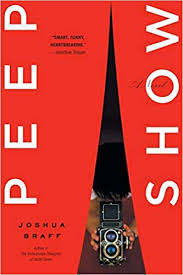
[READ: August 12, 2020] Peep Show

Thirteen years ago I read Braff’s The Unthinkable Thoughts of Jacob Green and really liked it.  Then I forgot all about him.

This book was nothing like his more whimsical first novel.

It is set in the mid 1970s.  The main character is David Arbus, a seventeen year old high school student in New Jersey.  His main interest is photography.  He has a younger sister, Debra, whom he loves very much.  But his parents are something else entirely.

David’s father owns “real estate” in New York City.  This means that he owns The Imperial, a burlesque theater where women strip for money.  But this is the 1970s and men don’t just want tame strip shows anymore–they want to see everything.  They want porn flicks.  They want peep show booths.  They want sex toys.

But David’s father doesn’t want any of that.  He wants his business to stay “classy,” even though all of his friends and partners think he’s crazy for passing up the opportunity to make a lot more money.

David is aware of his father’s business although Debra is not. (more…)

Read Full Post »

« Newer Posts - Older Posts »