Feeds:
Posts
Comments

Archive for the ‘Religion’ Category

1978SOUNDTRACK: LAND LINES-Tiny Desk Concert #494 (December 11, 2015).

landLand Lines are a trio from Denver.  They have a drummer, a synth player and a cellist/lead singer.  Although their music is pretty spare and simple, I find them really compelling.

On “Wreckage,” Martina Grbac plays the cello with her fingers, strumming chords on the neck of the instruments in a way I’ve not seen anyone play before.   Grbac sings quietly and her voice–echoing and effects-laden–reminds me of someone from the 1990s, although I can’t exactly pinpoint it (maybe a Cocteau Twins vibe?  but not quite). James Han plays really interesting chords and textures on the keyboard.  Sometimes he adds melody lines, and other times, like at the end of this song, growing washes of sounds.  Ross Harada’s percussion is also fun for the complex and different sounds he adds to the songs.

“Anniversary” has a similar vibe withe that cello chord playing.  The opening keys play simple echoing notes which add a nice atmosphere to the acoustic chords and percussion.

For the final song, “Fall or Fall,” Grbac plays a rapidly bowed cello (which has such a different sound than the other songs).  The bass is provided by the synth (a good sounding bass).   I love the way her voice contrasts the keyboard chords.  The chord progressions throughout the song are interesting and I really like the unexpected sounds that close out the song.

I’d never heard of Land Lines, but I liked this show enough to listen to it a bunch of times.  I’ll have to check out their other songs as well.

[READ: July 9, 2016] The Complete Peanuts 1977-1978

I feel like this era is when I would have read Peanuts the most, although I have no recollection of any of these strips.

The covers of the books don’t necessarily depict who will be prominent in the collection, but Peppermint Patty on the front does equal a lot of Patty inside.  While Peppermint Patty continues to do very poorly in school, she does get some witty remarks like “What was the author’s purpose in writing this story?  Maybe he needed the money.”

We see a return of Truffles in January which also introduces Sally calling Linus her Sweet Babboo for the first time.  “I’m not your Sweet Babboo!”  Truffles is very excited to see Linus and vice versa but it kind of ends with unanswered questions because, in one of the first times this surreal gag was introduced, Snoopy flies in as a helicopter–a joke used many more times in the future–to sort of interrupt the whole saga.

Snoopy also pretends to be the Cheshire Cat a few times.

It has been a while since Linus has built anything outstanding (something he used to do a lot as a precocious child).  Well, in Feb 1977 he builds a snowman of Washington crossing the Delaware (to show up Lucy’s George Washington snowman with a little sword). (more…)

Read Full Post »

jerusalemSOUNDTRACK: JERUSALEM IN MY HEART-If He Dies, If If If If If If [CST114] (2015).

ififif Since 2005, Jerusalem In My Heart has been Radwan Ghazi Moumneh (all music) and Charles-Andre Coderre (all visuals).  This is only their second album, however, because they were always more of a live band.

Obviously there’s no real visual component to the record.

Since I don’t know all that much about this band, I rely on the Constellation records website for my information.  Thus:

Moumneh expands his compositional palette on If He Dies, If If If If If If, exploring new deconstructions and juxtapositions of both traditional and popular Arab musical currents, with an album that oscillates between powerfully emotive vocal tunes and instrumental works that primarily make use of Radwan’s expressive acoustic playing on buzuk as a point of departure.

The album’s first song “Al Affaq, Lau Mat, Lau Lau Lau Lau Lau Lau (The Hypocrite, If He Dies, If If If If If If)” opens the disc with a short piece of processed vocals.  The Arabic traditional voice is mildly auto-tuned which sounds kind of cool.  [FROM CST: One of Moumneh’s finest melismatic a cappella vocal performances].

Track 2, “A Granular Buzuk” is a 7-minute instrumental piece of Moumneh on buzuk with pulsing electronic background music.  [CST: the buzuk is processed, re-sampled and otherwise disrupted through Radwan’s real-time custom signal patches]. As with a lot of this record, pretty instrumental passages are interrupted and taken over by noise—this time a kind of mechanical scratching.  It ends with some quietly ringing percussion as the electronics all slowly drift away.

“7ebr El 3oyoun (Ink From The Eyes)” is a vocal track with an electronic drone.  It sounds traditional and mournful, but about 3 minutes in, a drum and buzuk keeps time and the song grows a bit more upbeat.  [CST: languidly plaintive vocals set against a gradually accelerating riff underpinned by hand percussion].

“Qala Li Kafa Kafa Kafa Kafa Kafa Kafa (To Me He Said Enough Enough Enough Enough Enough Enough)” has incredibly loud static with a buzuk playing in the background.   After a minute and a half the static drops away and the background is filled with a quiet pulsing kind of static.  You can finally hear the instrument being played in all its glory.  [CST: a scabrous white noise intervention wherein the entire audio mix is fed through a contact mic placed in Radwan’s mouth].

“Lau Ridyou Bil Hijaz (What If The Hijaz Was Enough?)” is mostly synth–again an old sound with metronymic electronic percussion and quiet vocals. It’s all kind of muffled and very retro.  [CST: Moumneh continues to channel his love for Arabic pop and Casio/cassette culture with this silky lo-fi dance].

“Ta3mani; Ta3meitu (He Fed Me; I Fed Him)” is a faster piece.  Echoed vocals and drones rest behind a fast buzuk melody.  [CST: he pays homage to the until-recently-exiled Kurdish poet and singer Sivan Perwer on this traditional-minded, unadorned folk tune].

“Ah Ya Mal El Sham (Oh The Money of Syria)” opens with a loud vocal and a flute mirroring the voice.  It runs for seven-minutes and ends quietly.  [CST: a tour-de-force drone piece built from Bansuri flute (performed by guest player Dave Gossage)].

The disc ends with “2asmar Sa7ar (The Brown One Cast A Spell),” a fast buzuk solo played over the relaxing sounds of oceans waves.  It has a cool melody and runs quickly and then calmly for some five-minutes before the disc ends with more waves lapping against the shore.  [CST delicate acoustic number set against the sound of waves recorded on a beach in Lebanon].

As with the previous record, song titles employ the transliterative characters used in Arabic phone texting, which I think is pretty cool.

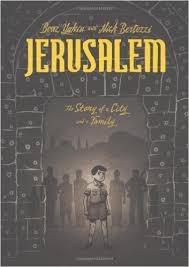
[READ: March 30, 2016] Jerusalem

With a title and subtitle like that you know this isn’t going to be a fun and lighthearted story.  And it is not.  The introduction explains how this is the story of a family, but it is more about the land and the strife that has been there for generations.

A lengthy history of Jerusalem is given, but for the purposes of this story the most recent action is the 1929 dispute over prayer rights which led to riots.  And then the British imposed the White Paper of 1939 which blocked Jewish immigration and was in place as the Nazis were riding to power. This led many Palestinian Jews to regard the British as hostile. And yet many Palestinian Jews joined the British army to fight the Nazis in Italy and the Middle East.  At the same time there were underground forces of Palestinian Jews who were attacking the British.

The action of this story takes place in 1945.

There is also a history of the Halaby family about whom this story is concerned.  Yakov Halaby was born after a series of girls were born in his family.  His father vowed that if they had another son they would move to Jerusalem.  After Izak was born they did so.  But Yakov was jealous from the start.  And he made Izak’s life miserable.  Eventually Izak left and married an Egyptian woman and they both moved back to Jerusalem. (more…)

Read Full Post »

harpjulySOUNDTRACK: JERUSALEM IN MY HEART-Mo7it Al-Mo7it [CST093] (2013)

mo7So just what is Jerusalem in My Heart?  According to the Constellation records website:

Jerusalem In My Heart (JIMH) has been a live audio-visual happening since 2005, with Montréal-based producer and musician Radwan Ghazi Moumneh at its core. Moumneh is a Lebanese national who has spent a large part of his adult life in Canada.  Moumneh is also active in the Beirut and Lebanese experimental music scenes, where he spends a few months every year.

but more specifically, what does it sound like?

Jerusalem In My Heart (JIMH) is a project of contemporary Arabic and electronic music interwoven with 16mm film projections and light-based (de)constructions of space, exploring a relationship between music, visuals, projections and audience.  …   [The album blends] melismatic singing in classic Arabic styles and electronic compositions with contemporary electronic production. …  Moumneh’s voice has become a powerfully authentic instrument, [along with Saturated synths and the overdriven signals of Moumneh’s acoustic buzuk and zurna].

And what’s up with the title of the record?

The numeral 7 is pronounced like an h; all titles on the album are rendered in contemporary colloquial “mobile” Arabic (the transliterative characters used in Arabic phone texting).

Alright, now that that’s out of the way, the album begins with “Koll lil-mali7ati fi al-khimar al-aswadi (Speak of the Woman in the Black Robe)” which opens with an echoed voice that reminds me of the way a dance track might start.  But it quickly becomes clear that the singer is sing in Arabic and in a somewhat traditional manner (but with an echoed effect on the voice).  I don’t really know how Arabic music might be sung, but this is what it sounds like to me.  By the end of the track, some keyboards are added, echoing to the end.

The second track, “3andalib al-furat (Nightingale of the Euphrates)” is a 9-minute instrumental.  It opened with acoustic stringed instruments Dina Cindric playing the Rast Virginal on the banks of Al-Furat.  It is a beautiful piece, recorded outdoors with the sounds of birds and other animals contributing.  It never grows louder than these instruments.

And then this acoustic and mellow piece jumps into the very electronic sounding third song, “Yudaghdegh al-ra3ey wala al-ghanam (He titillates the shepherd, but not the sheep…).”   The opening riff is very late 70s Tangerine Dream-sounding.  I expected a lengthy instrumental, so I was very surprised when the female vocalist (I assume Malena Szlam Salazar) began singing in tradition Arabic style.  It’s a great mix.  Especially at the end as her voice gets more processed.

Track four, “3anzah jarbanah (Sick, Diseased Goat)” is a mostly a capella vocal song with Moumneh singing in his mournful keening voice.  He sounds pained as his voice has a slight echo to it.  After about three minutes a distorted keyboard plays behind the voice.  It has a distinctly 1980s sci-fi vibe.

“Ya dam3et el-ein 3 (Oh Tear of the Eye 3)”  is 5 minute-instrumental which I believe is done mostly by Sarah Pagé playing the Bayat Harp on the banks of Dajla.  Again birds are heard throughout.  These instrumentals are just lovely.

“Ko7l el-ein, 3oumian el-ein (Eyeliner of the Eye, Blindness of the Eye)” has a kind of solo opening on what I assume is the buzuk.  It’s fast and a little wild by the end with an electronic sounding synth line running in the background that more or less takes over the song.  The final track is ” Amanem (Amanem)” which has Moumneh’s vocals and a keyboard drone behind it.  It’s a rather mournful and spooky  vocal style and sounds likes he as about to cry.

Since I don’t really know what the album is about, the ending seems like kind of a downer.  But since I am exposed to practically no contemporary Arabic music, I found this to be a really interesting listen, and I wonder if it is in any way representative of contemporary Arabic music.

[READ: August 22, 2016] “My Holy Land Vacation”

I read this more of Bissell, not because of the contents, as I like Bissell quite a bit.  But I found myself strangely engrossed by this story of traveling to Israel with a busload of Conservatives.

Bissell says that he enjoys listening to right-wing radio.  He names a few hosts who I don’t know and then ends with Dennis Prager.  I don’t know him either, but he is the impetus for this article so there ya go.  Bissell describes him as the “patriarch trying to keep the conversation moderately high-minded” which sounds pretty good.

Prager is Jewish and his audience is largely Christian.  And in the summer he organized a Stand with Israel tour.  For about $5,000 you could go on an all-inclusive guided tour across the world’ holiest and most contested land.

Bissell provides some context that the religious right hasn’t always been fans of Israel.  Indeed my recollection is that the Christian right was very antisemitic.  But by 2002 conservatives were vested in the cause because of some common beliefs like forbidding abortion and being suspicious of Muslims.

When Bissell first saw Prager in person he admits to the man’s charisma.  Bissell talks about what is known as the Israel Test which is summed up “if you ever find fault with Israel, you’re horrible.”  Prager believes that all American parents should send their children to Israel between high school and college to let their moral compass be righted again.

As for the trip itself–the food is plentiful everywhere–embarrassingly so.  He doesn’t like many of the people on the trip.  And he and his wife have to remember to not act like New York liberals.  But the one thing that Tom and his wife (and the people he has grown to like on the bus) can agree on is that their guide David is “the tour guide to have while Standing with Israel.”

Bissell is pleased to hear that the locals are pretty even-handed about a lot of things, always trying to explain up how most of the citizenry–both Israelis and Palestinians want peace.  But the travelers are appalled at this even handedness.  They want partisanship.  A woman yells that there no way that Israelis are teaching their children to hate.  A soldier–a man who lives here–responds to her that he knows Israeli families who do raise their children to hate Palestinians.  She responds, “Respectfully, no.  Respectfully, no.”

Later when they go to Nazareth, their tour guide explains that Nazareth has pretty much always been Arab territory–they didn’t take it from the Israelis, but no one appears satisfied with this answer.

Eventually they go to a settlement and meet self-described “Israeli rednecks.”  The man was born in Cleveland and moved to Israel in 1961.  He is a rabble-rouser and makes Bissell uncomfortable.  Bissell has to leave the room during the man’s excoriations.  When he steps outside, he meets Pastor Marty who is also appalled at the belligerence.  Marty blames talk radio in general and wonders when the last time “anyone was forced to have a civil discussion with someone who thought differently.”

But the real crisis is aboard Bus Five–Bissell’s bus–because their beloved tour guide has been fired because of complaints.  And a whole section talks about the bus’ reaction to this.  They even form factions who want to Stand Up for Dave, and the de facto leader begins trying to find out who is for or against Dave.  The section is pretty fun and strangely exciting.

But the final section grows much more serous.  They visit Yad Vashem, Jerusalem’s Holocaust Memorial.

Soon the rest of the bus and its occupants are forgotten and Bissell simply thinks about this memorial and the thousands of dead.  And then he thinks of his own family–he and his wife left their relatively new-born daughter home with grandparents.

I expected that this essay would be full of some crazy people spouting crazy things.  And to an extent it was, but what I like about Bissell’s writing is how empathetic he is and how he can really convey different perspectives while retaining his own individuality.  The essay also  contained a lot of interesting information and had a surprisingly emotional ending–one that is far removed from right-wing radio..

Read Full Post »

harpaugSOUNDTRACK: LAND OF KUSH-The Big Mango [CST097] (2013).

mangoOsama Shalibi is how Sam Shaibi is credited on this album.  He is the composer and creator of The Big Mango, although he does not appear on it.

Some background that may or may not be useful.  This comes from Popmatters:

“Big Mango” is the nickname for Cairo and The Big Mango is a love letter from composer Osama (Sam) Shalabi to his new home, Cairo, and all of its tumults and contradictions…. Reveling in free-jazz noise, rock rhythms, and the radical propulsion that Shalabi encountered on trips to Dakar, Senegal, the album weaves the divine spirit unleashed through fury and joy and dance into an utterly fascinating whole…  This pinging between controlled pandemonium and something beautiful, strident, transcendent, is not accidental. Shalabi is tackling the nature of change and the place of women in Arab culture on Big Mango, and by so clearly blurring the strange and the celebratory, he suggests that even sweeping, radical change need not be a revolution, but perhaps a way of life, movement as vital force in the universe.

With an introduction like that it’s hard not to want to love this record.  But a with everything Shalibi does, he is always trying to push boundaries and attitudes.  And so, this album has some songs that are really fun ad/or pretty and some songs that feel like (but apparently are not) wild improvisations that test the limit of your patience for experimentation.

As I mentioned, Shalibi doesn’t play on this –I would have loved to hear his oud, but instead we hear all kinds of interesting Western and Eastern instruments: setar (is a Persian version of the sitar), flutes, saxophones, piano, balafon (a wooden xylophone), hand drums: riqq (a type of tambourine), darbuka (goblet drum), and tablas (like bongos) and of course, guitars and bass.

“Faint Praise” opens the disc with 3 and a half minutes of Middle Eastern music quietly played with a rather free form vocal over the top.  The vocals are a series of wails and cries (and almost animalistic yips).  It sounds like an orchestra warming up, and indeed, the Constellation blurb says:

These opening six minutes are an inimitable destabilizing strategy of Shalabi’s – his lysergic take on an orchestra ‘warming up’ – that serves to introduce most of the instrumental voices and the montage of genres that will form the rest of the work

It comes abruptly to a halt with “Second Skin,”  a much more formal piano piece—structured notes that end after a few minutes only to be joined by a saxophone solo that turns noisy and skronking and nearly earsplitting.

After some dramatic keyboard sounds, “The Pit (Part 1)” becomes the first song with vocals (and the first song that is really catchy).  It begins with a jolly sax line which is accompanied by another sax and a flute before the whole band kicks in with a refreshingly catchy melody.  For all that Shalibi likes exploration, he has a real gift for melody as well.  The lovely lead vocals on this track are by Ariel Engle.  It’s very catchy, with a somewhat middle eastern setar riff and those voices.  When the song stops and it’s just voices, it’s really beautiful.  The song is 7 minutes long and I love the way the last 30 seconds shift gears entirely to a more dramatic, slower section.  This section is so great, I wish it lasted longer.

“The Pit (Part 2)” is only two minutes long.  It’s a quiet coda of piano and flute.  After about a minute, a low saxophone melody kicks in, it is slowly joined by other instruments and Engle’s voice.  Unfortunately I can’t really tell what she’s singing, but it sounds very nice.

“Sharm El Bango” is a jazzy song with hand drums and all kinds of space age samples spinning around the song.  I really like when the flute melody takes over and the song become quite trippy.

“Mobil Ni” is the second song with vocals.  It begins with some strings instruments and hand drums over a slow bass line.  Then Katie  Moore;s voice come s in with a gentle lovely vibrato.  Her voice is a little smoother than Engle’s.  The song ends with a mellow section.  And then there’s a trumpet blast that signals the beginning of “St. Stefano.”  The trumpet gives way to brief explorations off free-jazz type before turning giving way to a bowed section with resonating bass notes.

“Drift Beguine” returns to catchy territory with a full Middle Eastern musical phrase and Elizabeth Anka Vajagic’s lovely voice raging from high to scratchy and breathy.  Around 4 minutes when the pace picks up, it’s really quite fun.

The final track is the only one that really rocks.  “The Big Mango” has a big catchy guitar riff and hand drums filled in by Molly Sweeney’s rock vocals.  The song ends the disc as a kind of fun celebration.

As with most of Shalibi’s releases, it’s not for everyone.  But there’s a lot of great stuff hear, if you’re willing to experiment.

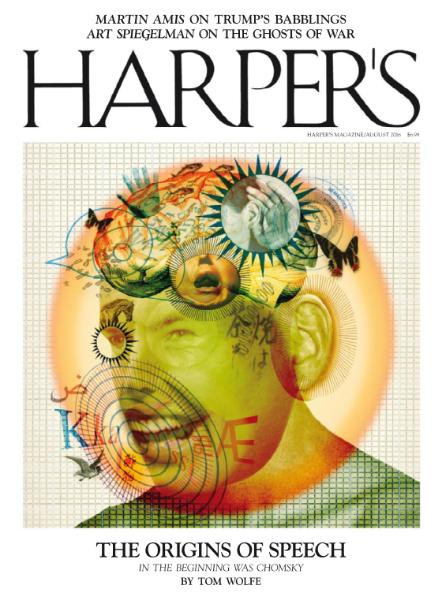
[READ: August 25, 2016] “Don the Realtor”

I hate to contribute anymore attention to Trump.  But it’s hard to pass up a chance to read Martin Amis, especially when he eviscerate his targets so eloquently.  Hopefully Trump’s voice will soon disappear from the airways and we can go back to forgetting about him.

Ostensibly this is a review of “two books by Donald Trump,” The Art of the Deal (1987) and Crippled America (2015).

Amis begins, as he usually does, by getting to the point: “Not many facets of the Trump apparition have so far gone unexamined, but I can think of a significant loose end.  I mean his sanity: What is the prognosis for his mental healthy given the challenges that lie ahead?”

Some basic questions come up about Trump: “Is his lying merely compulsive, or is he an outright mythomaniac, constitutionally unable to distinguish non-truth from truth.  Amis adds that “Politifact has ascertained that Donald’s mendacity rate is just over 90 percent, so the man who is forever saying he ‘tells it lie it is’ turns out to be nearly always telling it like it isn’t.”

But the Trump lying machine has grown from the rubble of the G.O.P. which “has more or less adopted the quasi slogan ‘there is no downside to lying.'” (more…)

Read Full Post »

town-boy SOUNDTRACK: DUBLIN GUITAR QUARTET-Tiny Desk Concert #409 (May 15, 2015).

dgqWhen I first listened to this brief concert for some reason I didn’t realize that the quartet were playing Philip Glass.  Of course, once he stated that that’s who they were playing, it became quite obvious–but having Glass played on acoustic guitars instead of synths or violins, is quite an unusual experience.

The music is still rigidly repetitive, but there is a great deal of warmth added with the guitars (and the human element as well).

The Dublin Guitar Quarter has been around since 2002 and they play pretty much only contemporary and new pieces (despite being dressed in suits and playing on “classical” guitars).

They play two pieces, with two and three movements of each piece respectively.  They were originally recorded for strings, so these guitar transcriptions change things quite a lot (especially in Mishima).

The first piece is called “Company.”  They play Movements 2 and 3. What’s most impressive about the first piece is that you can hear all of the musical lines.  Glass often interweaves line up line of music ad you can see each guitarist playing these lines on high guitar notes and low notes while the other play accompaniment–transcribing these must have been a real challenge.

The loud chords are practically heavy metal chords on the guitar as opposed to what the strings might sound like.  And for all of the repetition, these two movements of clock in at less than four-minutes total.

It’s interesting to listen to the original after this and hear how it’s clearly the same piece but it sounds so very different.  From tone to drama, everything is changed.

The final pieces are three movements from Mishima.  In Mvt 3 there is some fast picking while the other three play chords.  It’s also fun to watch them all doing similar but distinct things through the middle of the movement.  This doesn’t have the fast lines that Glass is known for but it has a lot of loud repetitive notes.

What’s so interesting is that original is full of drums–and parts of only drums.  Obviously these aren’t present here, but the music resonates in a similar (but again, distinct) way.

Mt 2 is a slow meditative piece, and is far shorter than the original (which is also full of drums).

The final piece opens with some chords and then grows very beautiful as the Glass riff takes on an almost prog rock feel because of the guitar and the way the bass notes contrast so wonderfully with it.  It is short in this and the original and is great excerpt to listen to.

  • Glass: String Quartet No. 2, “Company,” Mvts. II & III
  • Glass: String Quartet No. 3, “Mishima,” Mvt. III, “1934: Grandmother & Kimitake”
  • Glass: String Quartet No. 3, “Mishima,” Mvt. II, “November 25: Ichigaya”
  • Glass: String Quartet No. 3, “Mishima,” Mvt. XI, “1962: Body Building”

[READ: March 24, 2015] Town Boy

This book was written (and drawn) in 1980.  First Second books had it translated and published in 2007.

I found Lat’s first book, Kampung Boy to be quite charming.  It was about a boy growing up in a small village in Malaysia in the 1950s.  This is the sequel and it is about moving from the village into the town and being a teenager.

This book is a little less episodic than the first.  Most of the story is laid out as text on one page and a drawing on the next.  But the drawings also have speech bubbles, so there’s a lot of different things going on. (more…)

Read Full Post »

bourbonSOUNDTRACK: RAQUEL SOFIA-Tiny Desk Concert #395 (October 11, 2014).

raquelRaquel Sofia has been a backup singer for Juanes and Shakira and has no come out front to make really catchy songs about breaking up with people.

She sings in Spanish (although her English is excellent) about love and loss and the blurb correctly notes “it’s hard to believe that feeling bad can sound this good. ”  Her songs are all acoustic, but with a fiery punk flair (to match her partially shaved head).

Of the first song, “No Me Importas,” she says she wrote this song about a guy who didn’t call me.   It is a rollicking fun song which starts out with a big HEY! before rocking out.  Her voice is awesome–loud and powerful and for this blow off song, she’s got a great sense of bite in her voice.  And again, for a break up song it’s really fun and even has a with a clap along section

“Agridulce” (which means Bittersweet) is a more mellow ballad.  She says she was in a relationship and was about to get dumped.  Too much damage had been done to say she was sorry so she had to write a song.  She says it’s her next single.  It’s a pretty song and at he end, she says that the look on his face when she told him she wrote the song made the trouble worth it.

She says she wrote “Te Amo Idiota” which means “I love you, Idiot” in the darkest, darkest hour of her life.  It’s an impassioned song.  Not quite as fun as the others, but really good.  The end is really great.

She wasn’t expecting to do a fourth song, but they ask her to and she plays “Hombre Como Tú.”  She says she was mad at a guy and was sure she was never going to see him again.  So she wanted to make sure he knew exactly what she thought about him.  We never find out what he thought of that one.  She says it’s her next single (even though the other song was also her next single).  It’s incredibly catchy and even if you don’t know what she’s saying.

Hearing how great her songs are, it make me want to have a bad break up with her so she can write some more great songs (especially since I wouldn’t know what she’s saying).

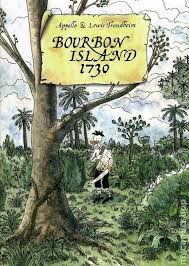
[READ: June 11, 2016] Bourbon Island 1730

I joked with Sarah about the disclaimer at the beginning oft his book which says that “Bourbon Island 1730 is not intended to be a historical account.  It is a fictional narrative, freely inspired by historical events.”  And I joked because one of the main characters is a bird and the other looks like a dog or something.  So clearly not historically accurate.

But I soon learned that this is a more or less accurate account of piracy  and slave trading around Bourbon Island in the 1730s.

Although as with a lot of Trondheim’s books I found this one to be lacking focus somewhat.

I wasn’t always sure exactly what was happening.  And one of the problems to me especially was that the book deals with racism and slavery, but it wasn’t always clear who was who because the characters were animals–how do you depict racism with animals if the animals don’t seem to conform to a race? (more…)

Read Full Post »

guibertSOUNDTRACK: JACKSON BROWNE-Tiny Desk Concert #394 (October 6, 2014).

jbI don’t really think much of Jackson Browne.  He’s always been a staple of classic rock radio, but I never especially sought him out. His voice is unique and recognizable although if pressed I can’t think of the names of any of his songs (but I’d know them immediately if I heard them).

Bob Boilen talked with Browne in his book and that’s where I learned that Browne dated Nico from The Velvet Underground fame and even wrote songs for her.  I also learned that he is quite the activist.  And that he plays a lot in California with various performers (the blurb says “he’s largely free of obligations”–that’s a nice phrasing).

He plays three songs here.  I assume they’re all new as I don’t recognize them.  And they all sound very much like Jackson Browne.  He voice is largely the same although it does crack and break a few times (could that be the setting or the time of day or does he just accept that he’s getting older?).

It’s also interesting that Browne plays the rhythm guitar for most of the songs–allowing Val McCallum to play the lead guitar and Greg Leisz to play “all manner of stringed things” (including the slide guitar solos).

The three songs are “Call It A Loan,” “The Barricades Of Heaven” and “Long Way Around.”  I’m surprised at just how long these three songs are (the whole set comes in around 20 minutes).

Before “Long Way Around” (which is quite political), he says that they’re “Lucky to play for such an informed group.”  Bob says they stopped the news–there’s no news being made–so that Browne could play.

Some of the lines in “Long Way Around” are: “It’s hard to say which did more ill, Citizen United or the gulf oil spill” and “It’s never been that hard to buy a gun, now they’ll sell a Glock 19 to just about anyone.”

The songs are nicely accentuated by the backing vocals of Jeff Young who also plays keyboards for them but which they couldn’t bring.

This is a delightful, mellow (and thoughtful) set of music (with a huge crowd watching).  And there’s a funny moment at the end where someone triggers a James Brown doll and Browne does a pretty good “hit me!”

[READ: March 2, 2016] How the World Was

I was intrigued to read this book by Emmanuel Guibert because I’ve really enjoyed his work lately.  But how was I to know that How the World Was is a prequel of sorts to Alan’s War?  It was also translated by Kathryn Pulver.

This book is a”loving, immersive portrait of Alan Cope.”  Cope was born in 1925 when California was still the frontier and life was simpler and harsher.  And Guibert felt that it was a gift for Cope “in the last moments of his life” (unlike in Alan’s War there’s no word on whether Cope saw this book).

So this book is indeed all about Cope’s childhood.  And while he did have some pretty interesting things happen to him, his childhood was in no way extraordinary.   This is just a simple portrait of growing up in Californians in the 1920 s and 1930s as seen from one man’s eyes. (more…)

Read Full Post »

solomonSOUNDTRACK: RYAN KEBERLE & CATHARSIS-Tiny Desk Concert #393 (October 4, 2014).

keberleWhen Trombone Shorty played the Tiny Desk I said that I was surprised to see that the leader of the band was a trombone player.  Well, perhaps it’s not that unusual as Ryan Keberle is a trombonist as well.  But unlike many recent jazz performers, Keberle & Catharsis aren’t showing off. As the blurb puts it, “he’s not after any high-concept framing. He’s just targeting the sweet spot where a nifty arrangement meets a solid groove.”

This band plays pretty traditional jazz (complete with upright bass solos and everything). Although, interestingly, their first song is a cover of  Sufjan Stevens song (turns out that Keberle toured with Stevens).  “Sister” is my favorite of their three songs.  I really enjoyed when the full band kicked in after the intro riff from Keberle.  The band has a vocalist, Camila Meza, who mainly does wordless vocal sounds.  As the song nears its end she does sing lead vocals, and it’s quite pleasant.

Her vocals work pretty well for this song, but I didn’t like it is much later.  That could be because “Sister” is a catchy pop song, where the other songs are jazzy.  And I find her singing style to be a little lite-Fm for my tastes.

“Gallop” is a bit faster than the first song.  It moves along at a nice clip and then stops for a bass and drum solo–very very jazzy.  There’s a trumpet solo in the middle of song too (no trombone solos which is interesting, I guess).  The other guys in the band are Michael Rodriguez on trumpet, Jorge Roeder on bass and Eric Doob on drums.

“Zone” opens with two contradicting three note riffs on both trombone and trumpet which is pretty cool.  Then the song settles down to just bass drums and voice and Keberle playing the melodica (beloved instrument of Tiny Desk Concerts) which works but sounds odd in the mix.  It seems like the song is going to end as the music fades to just bass, but it soon picks up again with anew trumpet solo.

I don’t love mellow jazz like this, but these players are excellent.

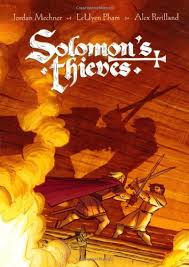
[READ: April 13, 2016] Solomon’s Thieves

I had this book on hold for quite some time.  When it finally came in, I thought, hey this art looks familiar.  And then hey, this book is about the Templar knights, what a strange thing that First Second would have two book about the Templar Knights.   And then as I flipped through it I realized the author and artists were the same.  And for a split second I though, they wrote two books about the Templar Knights?

And then it came to me that the first part of Templar was called “Solomon’s Thieves.”  And that this is indeed the First Part published long before Templar actually came out in full.

So even thought I had read the whole of Templar not too long ago, I decided to read this as well   As far as I can tell it is exactly the same as the first part of Templar.  Although it’s possible that there are some minor changes, I wasn’t sure if things that I didn’t remember were just because I can’t remember everything, you know?

Perhaps because I had read the full book not too long ago, I really enjoyed this run though again.  Since everything looked familiar, it was fun to pick up on things I missed the first time, and to see how things made a little more sense once I could tell who everyone was and what their roles were (there is something to be said for re-reading).

I’m including what I wrote about the first part of Templar here because it’s the same, but if you want more about the whole book or background about the Templar Knights check out the full post.

As the story opens we see Martin, a Knight, looking longingly at a woman, Isabelle.  We learn that he had been “dating” her (or whatever they called it back then) and then one day he found out that she left to be married to the brother of King Philip.  So he joined the Knights.  As they march through the city, we see that they are drunkards and carousers.  They get in all manner of trouble.  And one evening they were heading back to Paris when suddenly the above dictum was established–all Knights were to be arrested.  And Martin is one of them.

But through some excellent machinations (and good fighting) he escapes.  And he soon joins together with a very unlikely band of merry men, including Brother Dominic (a real priest with the tonsure and everything) and Brother Bernard, a loutish drunken man who is not above thieving from people.  Martin is offended at the thought of working with him, and they wind up at odds with each other from the start.  Before the end of the first book, we see that they have a letter revealing where all of the Templar gold and jewels are hidden.

There’s a great bit of accounting work done in which the bookkeeper shows on his ledger that rooms were empty when in fact it appears that the gold was taken out on hay carts.  The bookkeeper, even under torture, swears he knows nothing of the fortune’s whereabouts.

Mechner tells a really exciting story with humor and sadness.  The fact that it’s linked to history is just a bonus.  Another winner for First Second and their #1oyearsof01 anniversary.

Read Full Post »

colony3SOUNDTRACK: LULUC-Tiny Desk Concert #390 (September 15, 2014).

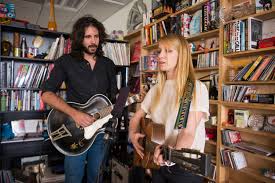
luklucBob Boilen has loved Luluc for a while.  I never really appreciated them as much as I do on this Tiny Desk Concert.  The duo is from Australia (and now Brooklyn), and I’d always felt that their songs were nice but nothing special.  But you can really hear what’s going on in them.  Zoë Randell’s voice sounds like a revitalized Nico and Steve Hassett’s accompaniments are really interesting.

“Small Window” starts with Zoë strumming a small acoustic guitar and singing.  Steve accompanies on electric guitar.  It’s a pretty song with a nice melody. And his solos accentuate the song.  But when the song shifts gears to the “crystal waters” section and an unexpected chord change it becomes much more than a simple folk song.

For the second song “Without A Face,” Steve switches to bass.  When Zoë talks, her speaking voice is gentle and somewhat high-pitched so when she begins singing she sounds even more shockingly like Nico.  And the bass is wonderful on this song.  He throws in a lot of little fills that really add a lot to the verses.  And the “oh oh” section in the middle is wonderful with some great harmonies from each of them.

Zoë says they used to play with just two guitars and mics and they have added a lot more gear lately, but that they’ve they’ve stripped down for this show.  For “Reverie On Norfolk Street” he plays electric guitar (cooly vibrato’d) and his gentle backing vocals on this song are a nice almost bass addition to the song.  There’s even a guitar solo which after the song he says is “the quietest guitar solo in existence.”

Luluc really surprised me with this session and I may have to give their studio tracks another listen.

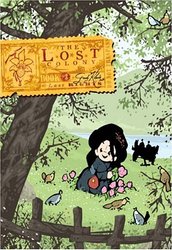
[READ: July 23, 2016] The Lost Colony 3

Book 3 ramps up the excitement quite a bit,  and also a had a lot of flashbacks that fill in some story lines.

Like the other two, it also begins with someone lost saying “Dear God where the %$!* am I?”  But this time he is a beautiful hunk of a man with gorgeous blond locks.  He is Buck Swagger and he is transported to the island on the ferry because of a letter from Olympia Snodgrass (the Mayor’s wife and Birdy’s mom).
(more…)

Read Full Post »

colony2SOUNDTRACK: JUSTIN TOWNES EARLE-Tiny Desk Concert #389 (September 8, 2014).

 jteI had an idea that Justin Townes Earle was a country singer.  Although I’m sure I’m conflating him with Steve Earle (his father) and Townes Van Zant (whom he’s named after).  But I realized I’d never heard him.  He’s more of a folk singer and he’s very charming.  He implies that he flew from Nashville just to play the show (“a quick trip just for y’all”) which gets an awww from the crowd) and like Trampled by Turtles and Jessica Lea Mayfield, he’s heading back home right after he’s done.  He also had his guitar maker send his guitar to him in DC so he didn’t have to travel with it.

He has an interesting percussive strumming style (he doesn’t use a pick) and he sings about love and loss.  The first song, “Burning Pictures” has a great line about how he doubts you even remember your love’s name since it’s another girl in the picture frame.

“When The One You Love Loses Faith In You” is a bit more bluesy sounding.  He picks some melodic notes between full-fingered strums.

Amazingly, he seems like he might quit after just two songs.  Bob asks him to do one more–doesn’t have to be new–it can be one he loves.  His favorite so that he ever wrote was “White Gardenias” (for Billie Holiday).  He says it feels like he’s about to miss the beat as he’s starts singing–which scares the shit out of a rhythm section.

Before beginning, while tuning, he says he has to learn a lot of his old songs for the upcoming tour.  Bob asks if he listens to the records, and he laughs and says he Googles the songs, which is just so ridiculous.  Bob asks if he illegally downloads them but he says no he just streams them.

“White Gardenias” is a lovely song with beautiful lyrics although I don’t really get that Billie Holiday vibe from it.

[READ: July 22, 2016] The Lost Colony 2

The inside cover of book 2 gives a little summary of book 1 (which is helpful). It also give s little recap of all of the main characters (which all series should do, frankly).

I loved that book 2 also starts with someone asking “where the %#!* are we,” it’s a man and a very large woman.  They also convinced Fud’na (the screeching violin playing guardian of the ferry) to ferry them to the island.  The large woman reveals that she is wearing a  stars and stripes dress which is very tacky.  But more importantly, she is a singer herself (almost as bad as Fud’na perhaps).

As the bok opens, Louis the slave boy is being set upon by the rocks bugs (although we dont know why).  He is recused by Jo’Pa an Indian who lives on the island (it is rumored that he used to be a real savage Injun).  And there’s Birdy, she is dressed as Squinto, compete with feather and bow and arrow.

Then we meet the Snodgrass family and Birdy’s heretofore unmentioned Gramdy, a cantankerous old man (who is her mother’s father). Turns out that Grandy hates the Injuns and is very mad that Birdy is dressed like one. “We’re at war with the Indian, dont you know they’re evil.” (more…)

Read Full Post »

« Newer Posts - Older Posts »