Feeds:
Posts
Comments

Archive for the ‘Racism’ Category

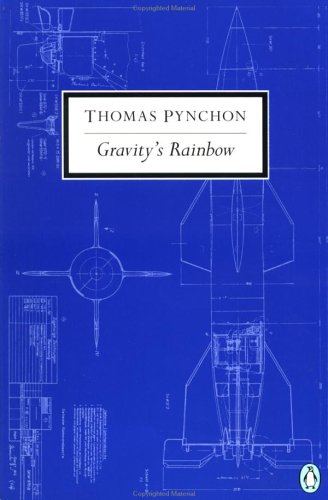
The edition I’m using.

SOUNDTRACK: KINCH-The Incandenza (2011).

I like this album more than I have any right to like an album that I bought purely for the name.  The album name is The Incandenza which is named after the main family in David Foster Wallace’s Infinite Jest.  The band name is Kinch which is named after what Buck Mulligan calls Stephen Dedalus in The Odyssey. That’s pretty high literary tributes.  So who cared if the music sucked.  But the thing is is that it doesn’t.  And I’ve been having a hard time writing about it because I like it so much and yet I don’t know what it is that grips me about the disc so intensely.  It’s not staggeringly original.  It’s more of an alt rock take on classic rock.  But even that doesn’t work because they use pianos prominently and the classic rock is more sound styles than sounds themselves.  Yet at the same time I hear a number of different band in the mix (and only a few of them use pianos).

“When I was Young” opens the disc with a great loud piano sound and a strong vocal line.  When the chorus comes in, the song picks up tempo and strings add intensity to what is already a catchy song.

“Evelyn” has a great stomping rock guitar sound.  At two and half minutes, it’s an amazing potential single with, again, a great chorus.  “45 Minutes” opens with screaming guitars and a great bass line that sounds like a classic song from The Jam.  “That’s Just the Mess That We’re In” features some horns that accentuate the chorus nicely.

“Once I was a Mainsail” starts like a pretty normal piano based rocker but the screaming chorus adds a great punk feel to the song.  “Tea Party Bomba” unravels its beginning into a great prog rock riff, with shades of Queen via Muse everywhere.  The same is true in “Bye Bye Bye Bye” which has a bombastic bridge (really showcasing the singer’s voice) until we get to the great shift to the quiet “I don’t think he ever knew.”  It’s a wonderful change of pace. It’s followed by the punky buzzy guitars and a simple melody of “Ocean”

“VHS” is another song that is just over 2 and a half minutes.  It begins quietly and (again) simply, this time with some gentle keyboard washes as the song build and builds adding drums and guitars.  It bleeds into “The Incandenza,” the longest song on the disc at just over 5 minutes.  It never feels like it’s 5 minutes long–another great bride with more sing along bits (and a great tempo change after the bridge) and a guitar and whistling solo make the song ever-interesting.  even if I don’t think it has anything to do with the Infinite Jest.

Kinch have a few other short albums out and I’m looking to get them as well, but in the meantime all of these great music can be streamed at their bandcamp site.

[READ: Week of February 20] Gravity’s Rainbow 1.1-1.12

This is my first time reading Gravity’s Rainbow.  And I know literally nothing about it.   I have always felt like I should read it (being a good modernist and a fan of Joyce and David Foster Wallace), but I never bothered to find out even a basic plot.  And it’s kind of fun going into this thing completely blind.  I had no idea even that it was set in England just Post WWII (1945).  So that was a surprise.  [Interestingly, having just read The Apothecary which was set in London right after WWII, it is cool to read another story set just around WWII and to hear similar things about the living conditions.]

But back to GR.  The only thing I have read before writing this post (aside from a few thoughts over at Infinite Zombies) was a comment (again, on IZ) that you will be confused while reading this book and that’s okay.  Phew.

Having said that I didn’t find it as confusing as I imagined.  (I’ve been intimidated by reading this book for fear of its difficulty).  I admit there are several scenes with pronouns that are somewhat elusive to me, and there’s a few other scenes where characters seem to be there without being fully introduced until later, but overall it’s not that bad.

The first section of the book seems like a lot of exposition–good, thorough exposition, which is also funny—but by section 1.12 we’re still meeting new characters.  It feels like serious plot things will happen later.   The book opens with a more or less famous line (Okay, I knew about that line before reading the book, but that doesn’t give any context).

And so, the screaming comes across the sky and the city is in the midst of an evacuation, but it is too late.  At least for some.  And the opening is a little confusing, as an evacuation might be.  It certainly seems like the end of everything, but then we also find out that some people are sleeping through it.  That this bomb is a localized attack.

Section 1.1 also introduces us to Lt. Capt. Geoffrey (“Pirate”) Prentice.  Pirate is just waking up when he notices that his flatmate Teddy Bloat is about to fall off of the minstrels’ gallery but Pirate manages to shove a cot in the way just as Teddy falls off the balcony.  Pirate is famous for his Banana Breakfasts (he’s the only person in England who has bananas).  And at this point the story settles down into a rather enjoyable domestic scene.  I mention in a post at Infinite Zombies that this opening scene of Pirate on the roof is reminiscent of the opening scene of Ulysses (I won’t go into that here).

The next scene is a raucous affair with a bunch of locals clamoring for their Breakfast plates.  The scene feels like a college dorm, although the participants are (I assume) older—Pirate himself is in his early 40s.

It’s time to mention Pynchon’s astonishing character names. I love them all, they are so weird and evocative without (always) being obvious.  So Teddy Bloat is a good name, but what about Coryson Throsp, the designer of their building.  And with the Breakfast comes names out of the woodwork:  Osbie Feel, Bartley Gobbitch, DeCoverley Fox, Maurice “Saxophone” Reed, Joaquin Stick.  I’m not going to go speculating about names in these posts, but I am sure going to highlight my favorites. (more…)

Read Full Post »

SOUNDTRACK: MATANA ROBERTS-COIN COIN Chapter One: Gens de couleur libres [CST079] (2011).

This is an abrasive album.  Not only does it has some massively skronking free-jazz, but it is also aggressively political, dealing with slavery and race.   So, if the heart-rendered screams of Roberts don’t make you uncomfortable, the description of a woman on the auction block will do it.

I listened to this album a number of times and kept thinking that it would probably work much better live than on record.  Lo and behold, if I’d read the liner notes more closely I would have known that it was performed live.   (The final song has an introduction and cheers at the end, but none of the rest of the album indicates that it’s live).

I like free improv jazz (when I’m in the mood of course) and I also like noise jazz (John Zorn mostly).  So I’m not averse to a lot of the genre.  But there was something odd about this recording to me.  And this is where that whole “live” recording comes into play.  This music felt like it was being performed for an audience.  I don’t know what the difference is, but it’s one I heard.  I can imagine images going along with the show.   And because of that, I feel like I was missing a crucial element.

The liner notes don’t explain anything about the show itself, nor how this person apparently named Coin Coin relates to her (it seems vaguely autobiographical, but I’d love to know more).

There are moments of rather conventional beauty on this recording.  The song that contains the “Bid ‘Em In” section is a great singalong (of course, when you realize what you’re singing about, you’re horrified).  And there are some other sections where Robert’s voice melds perfectly with her band and with Gitanjali Jain’s backing vocals.

The final song is a very moving song written for her mother.

The only thing I really don’t like about the album is Roberts’ poetry-slam-type singing.  I have complained before about this type of sing-song delivery, which just irks me.  I can see that there are times on the album where it works, but for the most part it feels arbitrary (as it always seems to me).  And when you have crazy improv jazz you need something to hold it down.  The poetry slam lyrics don’t do that.

This is not for everybody, but it is certainly a powerful album.

[READ: January 16, 2012] Vicky Swanky is a Beauty

McSweeney’s has gotten me to like a lot of things that I never thought I would–a cooking magazine, a sports magazine, long out of print unheard of titles.  But they simply cannot get me to like flash fiction.  Okay, that’s not entirely true.  Deb Olin Unfurth is quite a master of the genre.  But man, I just cannot get into Williams’ short short stories.

The majority of these stories are two pages long.  This means 12 lines on the first page and anywhere from a quarter to a full-page on the second.  But there are also some stories that end after one page (12 lines).  So here’s the little drinking game I invited.  Since Williams’ stories end so arbitrarily, try to guess which ones end after those first twelve lines and which ones continue on to the next page (it’s not really a fair game because some stories end in ten lines or so, but you get the idea).

Take “Cockeyed” (more…)

Read Full Post »

SOUNDTRACK: LONDON PHILHARMONIC ORCHESTRA-Angry Birds Theme (2011).

My son, Clark, loves Angry Birds.  I’ve played it a few times and found it enjoyable, but he is obsessed.  He is absolutely the target market for this song.  And who knows maybe it will get him to like classical music.

I wasn’t sure if I’d recognize the tune, but it is already ingrained in my head.

This version is wonderful.  It sounds like it might be from a Tim Burton movie. 

The full CD is a collection of video game themes.  We don’t have a console, so I don’t know any of the other songs on the disc. But I do rather like this one.  I can’t wait to see his face when he hears it.

Check it out on NPR!

[READ: December 15, 2011] “What We Talk About When We Talk About Anne Frank”

This story went from being a (rather) funny piece about Hasidic Jews to being a (rather) emotional story about marriage, religion and self-preservation.

As the story opens, Mark and Lauren are visiting the narrator and Deb.  Deb and Lauren grew up together.  But after school Lauren met Mark and they moved to Israel where they became Hasidic (and took the new names Shoshana and Yerucham).  As the story opens, the narrator (a non-observant Jew) is trying to hold his tongue while these religious folks are well, kind of judging  them.  It’s wonderfully summed up by this comment:

“Jewish to you?” I say.  “The hat, the beard, the blocky shoes.  A lot of pressures, I’d venture, to look jewish to you.  Like, say, maybe Ozzy Osbourne or the guys from Kiss, like them telling Paul Simon, ‘You do not look like a musician to me.'”  [Is there a joke in there since the guys from Kiss are indeed Jewish, or no?]

The narrator and Deb has a son, Trevor, who is sixteen.  The scene where he comes into the room to discover the Hasidic couple is hilariously subtle (very well written).  Then we learn that Shoshana and Yerucham (which Deb calls them) have ten children–all girls.  Yikes.  But the narrator continues to refer to them (at least in his story) as Mark and Lauren.  And the more questions he asks the more we find out that although they keep Holy the traditions, they are a bit lax about some of the rules (maybe?)  I actually don’t know the rules so I don’t know if what they’re doing is “wrong” or not.  And, amusingly there’s a bit in the story in which Yerucham complains about non-Jews giving them shit for what they do–“Can you eat in there?” kind of questions.

So, when the narrator asks if they can drink, Yerucham says he can make the whiskey kosher.  And that starts them on their way. (more…)

Read Full Post »

SOUNDTRACK: SUFJAN STEVENS-The Age of Adz (2010).

Sufjan Stevens has released a bunch of albums of beautiful orchestral rock.  It is multi-layered and complex with classical elements and all kinds of cool instruments.

And this album starts out with a beautiful acoustic guitar melody and Sufjan’s delicate vocals.  Although it is a far more stripped down song than usual, “Futile Devices” seems like it is heading in the standard direction.  But anyone who heard Sufjan’s Christmas album number VIII knows that he has been having some fun with electronics.  And they show up with a vengeance on track two, “Too Much.”

All of the multilayered noise that was once orchestral and (some might say) precious has been replaced by a cacophony of gorgeous electronic noises.  The beginning of the song reminds me of the sounds in Skinny Puppy’s “Stairs and Flowers” (how many Sufjan Stevens reviews mention Skinny Puppy?).  The song is nothing like Skinny Puppy once the vocals kick in–it’s catchy and delicate–but those electronics underpin the whole thing, bringing his pastoralia into the twenty-first century.  When I first reviewed this song I didn’t like it but once you get absorbed by Sufjan’s world, it’s an enticing place to be,

“Age of Adz” takes this electronic nonsense even further with an 8 minute brew of strange sounds and choral voices.  But he always manages to throw in some catchy parts, no matter how strange the song gets.

For me one of the highlights of the disc is “I Walked” it features one of my favorite Sufjan things–falsetto vocals in a beautiful but unexpected melody.  And this song has them in spades.  “Now That I’m Older” has a very disconcerting sound–his voice is slowly warbled and mournful.  It’s a beautiful melody that is alienating at the same time.

“Get Real Get Right” returns to his earlier style somewhat (there’s more layers of music, although the electronica is still in place).   “Vesuvius” is a beautiful song and “All for Myself” is another of those great falsetto tracks that I like so much.

“I Want to Be Well” eventually turns into a manic electronic workout in which he repeats the chorus “I’m not fucking around.”

But nothing compares  to “Impossible Soul” a twenty-five minute (!) multi-part suite of electronic chaos.  It’s a fantastic song complete with autotune (used to very cool effect), repeated swelling choruses (it’s like a Polyphonic Spree tribute), electronic freakouts, and acoustic comedowns.  All in a positive, happy message.  I can’t stop listening to it.  “It’s not so impossible!”

Sufjan continues to impress me.

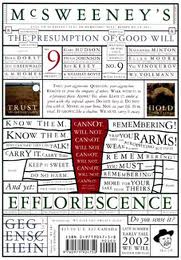
[READ: November 10, 2011] McSweeney’s #9

After the excesses of McSweeney’s #8, I was excited to get to the brevity (and urgency) of McSweeney’s #9.  This one is a paperback and looks like the first couple of issues.  The cover is mostly text with a hodgepodge of phrases and pleas.  You get things like: Thankful, Emboldened, The (Hot-Blooded/Life-Saving) Presumption of (Perpetual/Irrational (or More Likely, Irreducibly Rational) Good Will, Efflorescence, Our motto this time: We Give You Sweaty Hugs,” Alternative motto: ” We Are Out Looking,” GEGENSCHEIN (no more), and the promise: “We will Do Four This Year.”

This is the kind of issue that makes me love McSweeney’s.  There are some wonderful short stories, there are some nice essays and there are some dark moments all centered vaguely and tangentially around a theme.  There are some great authors here, too.

The back cover image is called Garden Variety by Scott Greene and it’s a fantastic painting.  You can see it here (navigate through the 2000-2004 paintings, but I have to say I really like the style of all of his work.

There are no letters and no nonsense in this issue.  So let’s get to it. (more…)

Read Full Post »

SOUNDTRACK: KISS-Unmasked (1980).

It was hard to like Unmasked, but, being an 11-year-old boy, who loved Kiss, I never doubted its awesomeness.  Despite kids in school telling me Kiss sucked and, peculiarly, even the cover of this album telling me they stink (whose idea was that?) I knew in my heart of hearts that Kiss was the best.

In a stroke of marketing genius, this album teased the audience with the idea of finally seeing who was under these “masks” (which is weird since everyone knew they weren’t wearing masks, but whatever).  There’s even a poster that came with my vinyl copy!  Yahoo.

I just recently found out that “Is That You?” is a cover.  I always liked the high-pitched part of the song (“you always get the boys you like”), although in retrospect it’s really not very good–simplistic in a way that Kiss songs weren’t but then became.   I always joke about Kiss doing a tour and playing “Shandi.”  It’s such a cheesy ballad and yet I think it’s really good (for a cheesy ballad–Paul sings this type of song so well).  I constantly have the “there’s another mess I’ve got myself in” line in my head all the time.

I liked “What makes the World Go ‘Round” but even I can acknowledge that the song is pretty poor.  “Tomorrow” sounds like another song off of Paul’s solo album and probably should have been a huge hit.  In fact, they could have re-released it in the 80s and it would have fit right in with their non-makeup success–Paul’s soaring choruses are always a hit.  “Easy as it Seems” is kind of the album encapsulated in one song–very sleek, very soft, lots of choruses vocals and really kind of bland.   There’s even a wimpy keyboard solo (gasp!).

Ace was the star of Dynasty, and he gets three more songs on Unmasked.  “Talk to Me” is one of his repetitive songs that drives me a bit nutty (never liked that “talk to me-e” part).  It’s interesting how much Ace moved into prominence on these albums, especially since he was headed for the door soon.  “Two Sides of the Coin,” is a decent rocker, but listen to those crazy synth drums during the instrumental break.  “Torpedo Girl” is the most interesting track on the disc.  It has the cool opening “man battle stations torpedo,” a really funky (!!) bass line from Gene (who knew he had that in him) and a cool weird riff at the opening.  It’s then got a very catchy chorus (although honestly, “c’mon get your feet wet”?).

Gene has a bit more prominence here.  “Naked City” has a pretty menacing riff to open with, but Gene turns in one of his more melodic turns (with some pretty high notes in the chorus)!  The solo, while not blistering, is pretty great (as with Dynasty, the solos are too short).  “She’s So European” aside from being a really stupid title and lyric is the song that really puts this album over the edge–the twinkly keyboards, the “you ought to see her” falsetto, and, basically the same chord structure as “Living in Sin” on the verses.  Gene ends the disc with “You’re All That I Want,” a rather uninspired song that reminds me of the songs on side 4 of Alive II.

You’ll notice that Peter doesn’t get a vocal turn on this album.  In fact, he didn’t play anything on it at all (Anton Fig on drums again), but he was contractually obligated to appear on the cover (perhaps that’s why they did a cartoon).

No matter how much I listened to it back then, I can still admit that this album isn’t really very good.  Although interestingly, some of the songs and sonmg styles foreshadow the kind of music they’d play on Lick It Up: simple songs without a lot of substance, and that album was huge!

[READ: November 2, 2011] “Wildwood”

After reading “The Brief Wondrous Life of Oscar Wao” in the New Yorker, I saw that they had also published Lola’s “Wildwood” adventure as an excerpt from Oscar Wao the novel.

As you can see, this excerpt came out around the same time as the novel.  And as far as I can tell, this excerpt is exactly the same as the novel except for one line that was in the excerpt but not in the novel (the part in italics):

Hija de Liborio she called you after you picked your tia’s winning numbers for her and when you guessed correctly how old to the day she’d been when she left home for the U.S. (a fact she’d never told anyone).  You assumed….

The only other noticeable difference is that the first section of this excerpt is not really separated from the rest of it.  The first section is told in the second person, while the rest is in the first person.  In the novel, the second person section is set off by itself, so it’s a little less jarring when you jump to first person, but I think any reader could cope with that pretty well. (more…)

Read Full Post »

SOUNDTRACK: COLIN STETSON-Live at All Tomorrow’s Parties, October 4, 2011 (2011).

In addition to playing SXSW, Colin Stetson also played All Tomorrow’s Parties, and NPR was there.  Unlike with SXSW, this set appears to be full length (about 50 minutes–which is a pretty amazing amount of time for him to blow that horn).  Like SXSW (and the album) Stetston starts with “Awake on Foreign Shores” and “Judges.”  What I love about this recording is that after Stetson finishes “Judges” a guy in the audience shouts (in a voice of total amazement) “That shit was off the hook!”  And he is right.  It’s not even worth me going into how amazing Steston is once again (check previous posts for  that), but man, just look at the size of that horn he’s playing (seriously, click on the link to see it bigger).

Stetson plays a few more songs from New History Warfare, Vol. 2: Judges like “The Righteous Wrath of an Honorable Man” (which is outstanding) and “A Dream of Water” (which works without Laurie Anderson, although he does say he’s sorry she’s not there).  He also introduces two news songs “Hunted 1” and “Hunted 2” which show new levels and new styles that Stetson employs.

This is a remarkable set, and Steston is clearly in his element (and the crowd is rapt).  The only problem I have is the recording level.  It must be very difficult to maintain recording levels for Stetson’s brand of noise–his louds are really loud–but you can’t hear him talk at all.  And most of the time, the introductions to his songs are worth hearing.  I’m sure if they tried to get the speaking level a little louder the music would have sacrificed though, so I think they made the right choice–I only wish there was a transcript available.

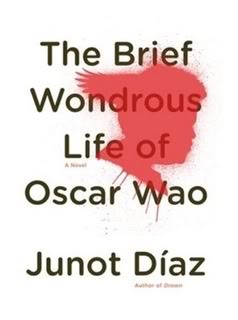
[READ: October 31, 2011] The Brief Wondrous Life of Oscar Wao

Apparently it’s pronounced, “Wow”, by the way.

Because of my new job, I don’t have a  full hour of lunch-time reading like I used to.  And so this book took considerably longer than I intended.  However, once I set aside some time to read it, I flew through the book.

I’m going to get this part out of the way because I was thinking about it throughout the book and I want to mention it without having it bog down the post.  This story reminded me a lot of Roberto Bolaño.  On the surface, sure this is because they are both writers from “Central America” (Diaz is originally from the Dominican Republic but moved to the US, while Bolaño is originally from Chile but moved to Mexico and then Spain).   But I’m not really talking about their origins so much as the style of storytelling.

Without going into a lot of Bolaño here, I’ll just say that Bolaño tends to write very detailed character studies–stories that follow one person throughout his whole life on something of a fruitless quest.  And the details of that person’s life include information about family members and distant relatives.  Further, Bolaño has written about the brutalities of both Chile and Mexico and how a person can survive in such a place.  Similarly, Díaz follows the life of Oscar and his extended family and he talks about the brutalities of the Dominican Republic.

This is in no way to suggest that there is any connection between the two writers. I mean, The Savage Detectives came out in the States in 2007 (same years as Oscar Wao) and while he certainly could have read it in Spanish, I have no evidence that he did (and as I recently found out, the first draft of the Oscar story was written in 2000).  Again, the parallels are only from my reading and have nothing to do with Díaz himself.

Okay, now that that’s out of my system…

This is the story of Oscar de Leon.  But more than that, this is the story of a fukú–a curse that befalls the de Leon family and follows them through several generations.  Oscar is the youngest member of the family and the person whom the narrator knows best.  So we see this fukú as it impacts Oscar.  And although the book is ostensibly about Oscar, it is about much more.

Oscar was born in Paterson, NJ (the town next to where I grew up!) and went to Don Bosco Tech High School (where many of my friends went).  Oscar is Dominican (his mother is from the DR, but he and his sister were born in NJ), but unlike every other Dominican male, Oscar is totally uncool, into geeky sci-fi and D&D and is clearly destined to be a virgin because he is fat with terrible hair and no social skills.

And, (no spoiler), as the title states, his life will be short. (more…)

Read Full Post »

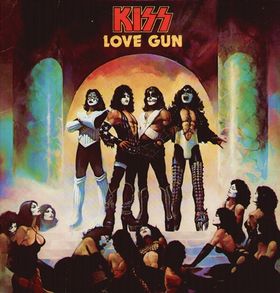
SOUNDTRACK: KISS-Love Gun (1977).

This was the first Kiss album I’d ever heard.  I’ll never forget my cousin bringing it to Long Beach Island in the summer of 1977.  I loved “Christine Sixteen” (of course, I was 8 and had no idea what it was about, I just loved singing it).  And the album has always held a magical mystique for me.

And even now I think the opening guitars of “I Stole you Love” are fantastic–fast and furious.  And the processing (or is that harmonizing) on Paul’s vocals make this song so urgent it’s really amazing.  I also got a kick out of the “guitar!” comment before the solo–certainly not the first band to do it, but surely the first I’d ever heard (they may be the first to say “Listen” at the end of a solo, though).  “Christine Sixteen” is a preposterously poppy song (listen to the bouncy, happy piano!), how could an 8-year-old not love it.  It is, of course, utterly creepy when Gene sings it now, (actually, my calculations show that he was 27 when he wrote the song–still pretty fricking creepy–and in some places, illegal).

The choppiness of “Got Love for Sale” makes the song different from many other Kiss songs, which were all about flow.  The guitars are choppy, the drums are choppy: t’s pretty cool. It’s all hard and heavy (except for the doo wopping “got love for sale” backing vocals).  Ace Frehley finally gets a lead vocal turn on the awesome “Shock Me.”  This has always been one of my favorite Kiss songs although listening to it now it sounds a little weak on this album (really uninspired backing vocals, eh?) but the solo is ripping–and the live versions are much more intense.

My first version of Love Gun had a skip at the beginning of “Tomorrow and Tonight” which made me not like the song very much.  Now I just think of it as a piece of filler–it sounds like it could come from Paul’s solo album (what’s up with the backing singers?).  I assume that they were trying to dip into the anthemic power pop well one too many times with this one.    But all is forgiven with the next song, “Love Gun.”  Yep, sex metaphors abound in Kiss, but this one is pretty awesome.  Beyond that, the sound of the guitars is great: the powerful power chords and the amazingly full chorus are also great.   And the staccato drums (and blistering solo) obviously make the song genius.

The rest of “Side two” is pretty interesting.  “Hooligan” is an odd little number.  It’s Peter’s song and it swings–Peter was always more into older rock than anything else, and this song, if it was stripped of its rougher edges (and cool solo) would fit pretty well on any of Peter’s (not very rocking) solo albums.  Although “dropped out of school when I was 22” is a pretty great line.  “Almost Human” is a weird song with some crazy guitars.  The solo is absolutely insane–I’d love to have seen the recording of it–just noises upon noises, very cool.  And the music itself has an odd eastern feel.  There’s great vocals and effects and all kinds of interesting things going on.  It’s an overlooked gem from this disc. 

Then there’s “Plaster Caster” the song about the woman who makes plaster casts from rock singer’s penises.  I still laugh at the euphemism of “if you want to see my love, just ask her”.   I’ve always loved this song even though listening to it now, it sounds kind of anemic (of course, the guitars were sampled in Tone Loc’s “Funky Cold Medina” so that’s got to mean something, right?) 

The album ends with a cover of “Then She Kissed Me.”  Even though Kiss likes that kind of music, I never did, so this song has always been my least favorite song of all of the first six Kiss albums.  But hey, the album runs 32 minutes in total–without those three minutes, you’re under half an hour.  That’s why I assume it was included.  The solo is nice though.

The album is pretty heavy overall and has some great guitar solos from Ace.  They’re not as anthemic and pretty as on Destroyer but they really show off his guitar skills.  And even though I tend to like Destroyer, Love Gun might be #1 for me on any given day.

[READ: October 4, 2011] “The House on Sand Creek”

This short story was on the surface very funny even though underneath there was exceptional sadness.  The events that set the story in motion are pretty unlikely–a couple rents out a property sight unseen (as if–especially since he is a realtor) and it turns out to hold so much karmic malfeasance that it quickly makes the wife, Monika, flee the god forsaken countryside and fly back to Bosnia. 

The narrator falls into a rhythm with his neighbor Bob (this part of the story reminded me of parts of Wells Towers’ stories–two men, out in the middle of nowhere, bonding despite obvious differences).  But the story quickly moves back out of Tower territory when the narrator gets a call from Monika (about two years after she left).

Her new marriage in Bosnia didn’t work out and she’s moving back in with him and bringing her new son as well.  (Again, it seems unlikely that this could just happen–that she would just call and say she was moving back in with him after two years, but whatever, it moves the plot).  And so, the narrator and his ex-wife move back in together with Monika’s son, Karel.  Karel is the son of an African man and Monika hopes he will grow into a Mandingo (this seems unlikely since the boy’s father is actually a short neurosurgeon from Yoruba–a West African village). (more…)

Read Full Post »

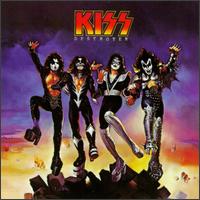
SOUNDTRACK: KISS-Destroyer (1976).

Although this is not the first Kiss album I heard (that would be Love Gun) it was probably the one I listened to most (it had “Beth” on it after all).  It is also full of some of the most over the top theatrical music of any heavy metal band at the time (is it any wonder that I also enjoy Meat Loaf and other over the top bands if I was raised on this?)  Kiss has always been about theater, and how much more theatrical do you need? (How about a cartoon of the band standing on a pile of ruins?).  But this album is such a classic, it’s hard to even think critically of it

“Detroit Rock City” is, well, it’s “Detroit Rock City.”  An amazing, iconic (albeit simple) guitar solo, great effects in the beginning (with Paul (I always assumed) singing along to other Kiss hits on the radio) and an awesome crash at the end.  Fill it out with an amazing riff and great work from the whole band.  What more need be said?  How about the way it leads perfectly into “King of the Night Time World.”  This song is overlooked despite its greatness.  It opens so loud and full then the verses get awesomely tinny until the galloping chorus kicks back in (Petter Criss plays drum rolls mid-song like no one else).  It also has great riffs and a memorable solo.  Oh and then a little song called “God of Thunder.”  Awesome bombast, creepy kids’ voices (I remember some kind of rumors about who the kids were and how they were held captive by the band or something).  It’s a wonderfully memorable song.

“Great Expectations” slows things down but adds the bombast.  I’ve always enjoyed this egocentric song, even as a kid singing along in a mirror.  Although the extra musical notes (keyboards and such) are kind of wimpy.  But it’s followed by the electrifying “Flaming Youth,” a hard-edged guitar song that is pretty simple, but pretty potent.  Again, the keyboard bits undermine the heaviness, but the repeated “higher and higher and higher” is pretty bad ass.

“Sweet Pain” is a great dark Gene-sung song (evidently about S&M, although I never knew that quite so specifically–I never understood the first two lines until I looked them up just now: “My leathers fit tight around me/My whip is always beside me”).  “Shout It Out Loud” is one of the great Kiss anthems.  I actually prefer it to “Rock and Roll All Nite” although that could be just because of the over exposure of “RaRAN.”  Of course, “Beth” is next and it is impossible for any Kiss fan to say anything about “Beth”.  This was the first song I ever memorized the lyrics to, and I sang it to my no doubt confused grandmother when I was 9 years old–my first and only live performance until college.

I always liked “Do You Love Me” (I think these Kiss fantasy songs were pretty big for me).  I was always confused by the tinny voice in the final verse of the song.  It was very strange to my young mind, but it really stands out in the song–as does Paul’s ending rant.  The overall sentiment of the song  is kind of funny coming from the guys who would soon be singing “Love Em Leave Em” but it is nice that they feel insecure once in a while too.

My LP of this album (or maybe it was an 8 track?) did not have the “bonus” track, which is just 90 seconds of a crazily processed version of “Great Expectations” with some lifted vocals of Paul in concert.  Apparently even though it is untitled, it is called “Rock and Roll Party” by most fans.  It appears to be a joke about all of the backwards masking that was supposedly on Kiss records.  Huh.

This is still one of my favorite albums of all time.

[READ: September 30, 2011] “The Russian professor

Nabokov did not secure the teaching position at Wellesley where he had been creative writing professor the year before (Lolita would not come out for a nother 13 years, so he was working via his Russian book reputation).  So instead, he went on a several-month speaking tour of Unites States colleges, many of them in the South.  These (excerpts from) letters to his wife detail some of the indignities that he suffered and reiterate his love for her and his son.

On his way to Coker University in South Carolina, his train car was double booked, his taxi didn’t show up and he wound up going to the wrong hotel.  When he finally was picked up: “Feeling that I wouldn’t have time to shave before the lecture…I went in search of a barber” [what kind of time management is that??].  Nabokov writes of the shave:

He shaved me horribly, leaving my Adam’s apple all bristly, and since in the next chair a wildly screaming five-year-old child was grappling with the barber who was trying to touch up the back of his head with the clippers, the old man shaving me was nervous, hushed the child, and finally cut me slightly under the nose.

(more…)

Read Full Post »

SOUNDTRACK: DINOSAUR JR.-Live at the 9:30 Club, Washington D.C. October 8, 2009 (2009).

This was one of the first shows I downloaded from NPR.  I’ve been a fan of Dinosaur Jr. since my friend Al turned me on to Green Mind back in college.

This is an amazing show created by the original Dino Jr. members.  This tour is in support of their second album since reuniting, Farm. This set-list is an outstanding mix of old songs, new songs, Barlow-sung songs and even some songs from when Barlow and Murph weren’t in the band.  (Green Mind is still my favorite album by them).

When the band reunited there was much joy, and I’ve said in reviews of the newer albums, I’m not entirely sure why.  I mean, Dino Jr has always been about Mascis, and it’s not like Barlow is such an unusual bassist (although Murph’s drumming is always solid).  I’ve nothing against Barlow (I love Sebadoh and Folk Implosion) or Murph, it just seems odd to get excited about having them back in the band aside from nostalgic reasons.

Having said that, the band sounds amazing (and yes, Barlow does get to sing on “Imagination Blind”).  What never really came across to me until hearing all of these great songs live was that Mascis has always been a great pop song writer.  These songs are catchy as hell. But Mascis buries them under loud squalling guitars and a voice that is almost whiny, almost off-key, a total slacker voice.  (But you’ll notice it is never actually off-key.  He must work very hard at that.)

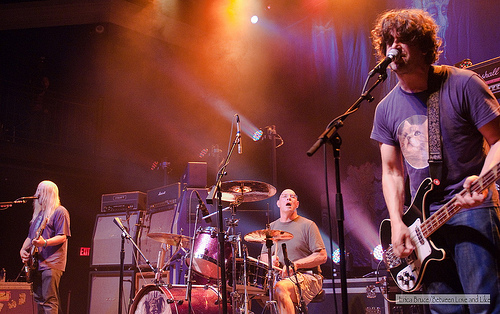
By the nd of the show Mascis chastises the audience for not moving (we obviously can’t see what they’re doing), saying he forgets that people don’t move in Washington, D.C.  But during the encore break, NPR host, Bob Boilen, points out that Mascis himself doesn’t move either–he just stands in front of that wall of Marshall stacks (Boilen wonders how he can hear anything anymore).  And looking at the pictures it’s comical the way he looks, surrounded by amps.  The picture above doesn’t fully do it justice, but check out the extra photos at the NPR page.  And while you’re there, listen to this show. It is amazing.  For a total slacker, Mascis can rock a guitar solo like nobody’s business.

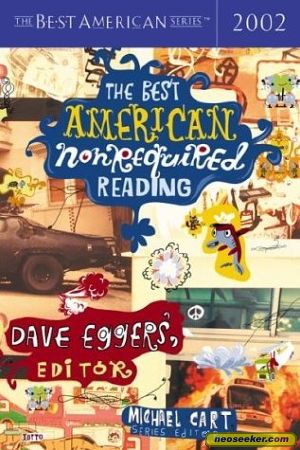
[READ: July 20, 2011] The Best American Non Required Reading

I’d been meaning to read this series for years (yup, Eggers fan), But I have a hard time starting “collections” because I feel like I’d rather be reading a novel.  Nevertheless, I have most of these Nonrequired books, so it seemed like I should dive into one and see what it was like (I don’t think the year really matters all that much–some of the articles are topical but most are not exactly).  Then Sarah said this would be a great book to read on vacation because it’s all short essays, and she was right.  It was perfect for late nights when I wanted something to read but didn’t feel like getting involved in the novel I was reading.

DAVE EGGERS-Introduction
Eggers’ introduction is actually a partial short story about kids who go swimming in pools around town. It reminded me of the opening of Life After God by Douglas Coupland, but of course, lots of kids did that so I’m not saying it was “lifted” from DC.  The story “ends” (it doesn’t really end so much as stop) with an interesting scene between two unlikely kids who get caught.

After this story Eggers includes these three notes about the collection: It’s not scientific, It’s alphabetical, and We had a lot of help with this.  Of the three, it’s the middle one that’s most useful because Eggers says that you shouldn’t necessarily read them in order just because they are printed this way: “In the first half of this collection, you get a good deal of hard journalism, primarily about war and refugees, from Afghanistan to the Sudan, followed immediately by a number of less serious pieces, about malls and Marilyn Manson.  We didn’t group anything by theme , and won’t be offended if you skip around.”  This was good to know (not that we needed the permission of course), but yes, the beginning of the book is pretty heavy. (more…)

Read Full Post »

SOUNDTRACKSUPER FURRY ANIMALS-“Let the Wolves Howl at the Moon” (From the Basement) (2007).

[DISCLAIMER: This post was published on September 6th see that post for details].

Continuing this exploration of the From the Basement series, I found this unlikely video from Super Furry Animals.  SFA have never been big here (well, that had a fluke hit but that doesn’t count).  I have no real idea how big they’ve been back home.  So maybe it’s not a surprise that they are playing here.

SFA were a bunch of crazy psychedelic indie rockers.  Their early albums are totally nuts (like the EP Llanfairpwllgwyngyllgogerychwyndrobwllantysiliogogogochynygofod (in space)).  But over the years, they have mellowed considerably. This song is the final track from Hey Venus!, an album that returned the Furries to their more rocking roots.  Despite the album’s overall rockingness, this song is the mellow ender to the album. 

This live version is very good, with Gruff Rhys sounding in fine form.  Visually, it’s more interesting than say Neil Hannon’s in that there are five of them, but they’re not exactly putting on a crazy show. What’s nice is the chance  to see just what the recording space looks like (there’s lots of wide shots) and to see just which hairy Welshmen are making which sounds. 

This is a wonderful song that could easily have been on anyone’s mellow folkie playlist.  The album version has a little bit more going on, but it’s not missed in this someowhat stripped down form. 

[READ: August 29, 2011] 3 Book Reviews

After last month’s tour de force about one title, this month returns to Zadie’s typical 3 books/month schedule.

The first book is Ian Thomson’s The Dead Yard: A Story of Modern Jamaica.  Zadie makes the amusing observation that this book, a very good and very well researched cultural study of Jamaica was written by a white Scotsman; she notes that a sense of remove from the culture was probably essential in order to create this book. 

Thomson offers historical context for the dangerous world that Jamaica occupies now (it’s not all “Jah, ganja mon” in the country.  In fact, five people are murdered every day (on this island of 3 million).  Fascinatingly, there is much racism in Jamaica—people seen as too black are often looked down upon in favor of lighter-skinned people.  Because of this, respect is very important.  Indeed, any kind of disrespect can cost you your life—just about everyone packs a gun (hence the stat above.  Of course this racism also may be why the Jewish, Indian and Chinese Jamaicans are thriving while the majority black are not.

Zadie says the only place where Thomson falls flat is in his utter dismissal of dancehall music (he likes reggae but can’t stand dancehall).  He dismisses Sean Paul and although Zadie’s not a huge fan of Sean Paul, she finds this dismissal a poor oversight possibly due more to his age (culture being a young person’s game) than anything else.  I especially enjoyed her dissection of one of Sean Paul’s videos. (more…)

Read Full Post »

« Newer Posts - Older Posts »