Feeds:
Posts
Comments

Archive for the ‘Racism’ Category

SOUNDTRACK: KATE BUSH-“Under Ice/Waking the Witch” (1982).

A lot of the music I listen to is weird and probably creepy to other people, but I don’t necessarily think of songs as appropriate for Halloween or not.  So for this year’s Ghost Box stories, I consulted an “expert”: The Esquire list of Halloween songs you’ll play all year long.  The list has 45 songs–most of which I do not like.  So I picked 11 of them to post about.

Esquire didn’t pick this song, but the inclusion of Kate Bush yesterday reminded me of this pairing of songs which I find incredibly creepy–especially late at night wit headphones.

This comes from side two of the Hounds of Love album.  Side Two is a suite or a story called The Ninth Wave.  Kate makes full use of sound effects and vocal panning so that you can hear the voices all around your head as they whisper, call or threaten.

The side begins with the gentle “And Dream of Sheep” which shows a young woman falling asleep (later we find it’s not as innocent as it seems).  This segues into “Under Ice” which begins with slow string notes that sound like someone skating.

Kate’s voice is deep, slow and echoey as she sings about skating on the ice.  You can hear a voices calling, but she doesn’t heed them:

I’m speeding past trees
Leaving little lines in the ice
Cutting out, little lines in the ice
Splitting, splitting sound
Silver heels spitting, spitting snow

and then in a more tremulous voice (with great watery sound effects) followed by a chorus of voices:

There’s something moving under
Under the ice moving
Under ice through water
Trying to
It’s me
Get out of the cold water
It’s me
Something
It’s me
Someone, help them

The two minute song segues into “Waking the Witch” which opens with a whispered “Wake up!” and an early morning wake up call while voices from all over the headphones try to get you to wake up–some more gently than others.

After a minute or so of this the song becomes an intensely scary four minutes.  A voice of someone, pleading, but garbled and cut up–perhaps under water? It is a nightmarish attempt at communication when a deep scary male voice states (with Kate singing the parenthetical)

You won’t burn (red, red roses)
You won’t bleed (pinks and posies)
Confess to me, girl (red, red roses, go down)

With a pretty melody, a voice whispers Spiritus Sanctus in nomine.  It cuts to another chopped up and manipulated voice praying “Bless me, father, bless me father, for I have sinned.”

The deep voice returns in accusation:

I question your innocence
She’s a witch
(Help this blackbird, there’s a stone around my leg)
Ha, damn you, woman
(Help this blackbird, there’s a stone around my leg)
What say you, good people
(Guilty, guilty, guilty)
Well, are you responsible for your actions?
(This blackbird)
Not guilty (help this blackbird)
Wake up the witch

As the four minutes fades off, we hear a helicopter flying through the air and a man shouting

Get out of the waves!
Get out of the water!

The story continues from there and gets a bit more positive, but man, the cinematic detail of this is staggering. Apparently she was finally able to stage this suite when in 2014, she performed her first concerts since 1979.  I would have loved to have seen that.

[READ: October 23, 2019] “The Distributor”

Just in time for Halloween, from the people who brought me The Short Story Advent Calendar and The Ghost Box. and Ghost Box II. comes Ghost Box III.

This is once again a nifty little box (with a magnetic opening and a ribbon) which contains 11 stories for Halloween.  It is lovingly described thusly:

Oh god, it’s right behind me, isn’t it? There’s no use trying to run from Ghost Box III, the terrifying conclusion to our series of limited-edition horror box sets edited and introduced by Patton Oswalt.

There is no explicit “order” to these books; however, I’m going to read in the order they were stacked.

This has been quite possibly my favorite story in any of the Ghost Boxes.

Richard Matheson wrote I am Legend and many episodes of The Twilight Zone and this story was the epitome of dark suburban paranoia come to life.  It is also scarily timeless and, aside from some of the words used in the story, could easily have been written today. (more…)

Read Full Post »

92000SOUNDTRACK: U.N.K.L.E.-“Ar.Mour” (2019).

armourHaving learned that U.N.K.L.E. had not only been making music all of these years but even put out a new album this year, I thought I’d listen to something new and see what it was like.

I chose “Ar.Mour” because James Lavelle described it as a sci-fi beat jam.  It features vocals from Elliott Power and Miink.

A pulsing beat opens this five minute song.  Some deep echoing drums come in and slowly add tension and then after about a minute the slow trip-hop drum beat begins. Then a simple guitar line comes in and around two minutes voices swirl up from underneath.  There is definite sci-fi feel to the song.

The song seems to fade out around 2 and half minutes before picking up again and just when you think the whole song is an instrumental the vocals come in.  There’s a deep voice followed by a repeating higher voice.  Then there’s a rap.  All of the voices are enveloped in a soft echo, making the words hard to hear.

The end of the song has a catchy vocal melody as the whole song builds with all of the parts melding together.

[READ: September 1, 2019] “Nelson and Annabelle” (Part 2)

I’m still not sure if this is a two-part, long short story or if it is an excerpt from a novel.

What was kind of strange was that this whole story was utterly chock full of details as if it were a novel, and yet the ending just sped through and finished up with a kind of epilogue tacked on.

This part starts at Thanksgiving dinner.  Nelson has invited Annabelle to his mother’s house for dinner with the family.  The family includes his mother’s new(ish) husband Ronnie and a bunch of Ronnie’s closest relations.

The conversation is cordial until they start talking politics.  Everybody hates Clinton and they are angry that Hillary might run for office in New York.  It was not enjoyable rehashing the political arguments from twenty years ago, but I was fascinated at how much the things they said about him could easily be applied to trump and I wondered if these fictional people were now pro- or anti- trump.

…he lied to us, the American people.  He said it right out on television….

…he’s a draft dodger.  If I were a soldier I’d tell him to stuff his orders….

He makes me ashamed of being an American he makes America look ridiculous.  Drowning us in sleaze and then flying around all over the world as if nothing whatsoever has happened. Its so brazen.

He makes Nixon look like a saint.  At least Nixon had the decency to get out of our faces.  He could feel shame.

Its the sleaze. What are children supposed to think.  What do you tell the Boy Scouts?

As people get drunker, Ronnie, who has been against Annabelle since she showed up tells her to her face that “You’re your mother’s daughter alright… She’d fuck anybody…  It must feel funny being the illegitimate daughter of hooer and a bum.”

Nelson takes Annabelle and leaves the house and swears he will never set foot in it again.

Next we met one of Nelson’s oldest friends, Billy.  Billy is now an oral surgeon and very rich.  He calls up Nelson and invites him out for dinner to catch up. They have a nice time so when New Year’s Eve comes around–the Y2K New Years–Nelson invites Billy out with him and Annabelle.

Also in town are Nelson’s ex-wife, Pru, and their son.  Their daughter, who is 20, decided to go somewhere else with her boyfriend.  Nelson is bummed about the visit.  He wanted to see his daughter and he imagined that they would all stay with him.

Pru is pleased that he finally moved out of his parents house (the two of them lived in his parents’ house when they were married), but she doesn’t want to stay in his new cramped place.

For New Years Eve, Nelson Pru and Billy plan to go out.  Nelson invites Annabelle to come with them–what else is she doing?

They go for dinner (Billy uses his pull as a n oral surgeon to get them a seat at a crowded restaurant) and a movie.  They see American Beauty and have lots to say about it–it’s fascinating how racist and homophobic these men are.

Annabelle and Billy hit it off.  Nelson didn’t intend for that to happen, but it did.  In fact, in the car, it sounds like maybe he can hear the zipper of her dress being undone a little.

They decide to spend the last minutes of 1999 at a club.  But as they head downtown, the streetlights go out.  Is it a terrorist attack (in central Pennsylvania?)

With the traffic lights out, Nelson thinks people will take turns through the intersection.  But when a jerk in an SUV tries to cut him off, Nelson guns it, making the SUV screech to a halt.

For the first time all night Pru is really nice to him, “Oh honey, that was great, the way you made that asshole chicken out.  I think I wet my pants.”  As they drive further Pru whispers that she might stay at his place tonight after all.

The epilogue is satisfying, if you care about these characters.  Which I kind of do.  I definitely wonder if there’s more to their story or if this was just Updike’s way of capping off the full Rabbit saga


Read Full Post »

yorkernSOUNDTRACK: SOUL COUGHING-“Is Chicago, Is Not Chicago” (1994).

soul cI really enjoyed Soul Coughing’s output, and Ruby Vroom stands out as a great debut.  They had a terrific blend of great music played behind a more or less spoken word.  The idea wasn’t unique, but they made it work as more than a gimmick.

The musicians of Soul Coughing were tremendous and Mike Doughty’s voice has a wonderful resonance for telling is offbeat/absurd stories/poems.

This track seems especially appropriate when talking about Saul Bellow.

Starting with rhythmic guitar chunks, an upright bass plays a very cool rising and falling bass run.  It sounds like modern noir.

Then Doughty tells us “a man drives a plane into the Chrysler building.”  It’s difficult to hear it now, but in 1994 it was simply a fantastical image.   The drums come in as the guitar starts making shapes and slashes of sounds.

The chorus is a rather boppy moment amid the noise as things slow down for the recited “Is Chicago is not Chicago.”

Then the bridge(s):

Saskatoon is in the room
Poulsbo is in the room
Bennetsville is in the room
Palmyra is in the roomKhartoum is in the room
Phnom Penh is in the room
Pyongyang is in the room
Cairo is in the room

The song ends with a wonderful cacophony of guitar scratches and drum beats that definitively ends the song without it having to end itself.

[READ: September 1, 2019] “Re-Reading Saul Bellow”

I decided to read this article because I like Philip Roth and because I have never read any Saul Bellow.  In fact, although Saul Bellow is a name I was familiar with, I wasn’t entirely sure what he had written. So I was pretty surprised to read that he wrote The Adventures of Augie March, which I had without a doubt heard of, but which I knew very little about.  I was also really surprised to find out that he was still alive when Roth wrote this esay (Bellow died in 2005).

Roth knew Bellow, of course, and Bellow had once told him that his Jewish heritage led him to doubt himself as a writer.  This was mainly because “our own WASP establishment, represented mainly by Harvard-trained professors considered a son of immigrant Jews unfit to write books in English.”

By the time he wrote Augie March, he was prepared to open not with a line like “I am a Jew, the son of immigrants,” but “I am an American, Chicago born.”

Roth summarizes a few of Bellow’s works and talks about how he progressed as a writer.  Of course, he writes this re-reading as if we ourselves have read the books (so, spoiler alerts).

He more or less dismisses the first two novels Dangling Man (1944) and The Victim (1947) and moves straight on to The Adventures of Augie March (1953) saying how the transformation from the earlier writer to the writer of Augie is remarkable.  It won the National Book Award.

He especially likes “the narcissistic enthusiasm for life in all its hybrid forms” that is propelling Augie.  He cries out to the world “Look at me!”

What appeals to me about the way Roth describes this book is the “engorged sentences” as “syntactical manifestations of Augie’s large, robust ego.”  That sounds like a fun 500 page book to me.

Up next was Seize the Day (1956) which is a short novel and the fictional antithesis of Augie March–a sorrow-filled book about the culmination of a boy who is disowned and disavowed by his father.  Whereas Augie’s ego soars, Tommy Wilheim’s is quashed beneath its burden.  Tommy cried out to the world “Help me!”

Bellow seemed to alternate between comedy and tragedy and I would much rather read the comedies myself.

Next came Henderson the Rain King (1959) which contain an exotic locale, a volcanic hero and the comic calamity that is his life.  Henderson is a boozer, a giant, a Gentile, a middle-aged multimillionaire in a state of continual emotional upheaval.  He leaves his home for a continent peopled by tribal blacks who turn out to be his very cure. Africa as medicine.

According to Wikipedia, Bellow became very conservative and somewhat (or very) racist as he got older.  I hesitate to read this book although it was written when he was younger.  On the other hand, I do enjoy that Roth calls it “a screwball book but not without great screwball authority.”  So that’s a tentative maybe on reading this.

Herzog (1964) also won the National Book Award.  Moses Herzog is a labyrinth of contradiction and self-division. He is Bellow’s grandest creation.  Herzog is American literature’s Leopold Bloom.  Although in Ulysses, “the encyclopedic mind of the author is transmuted into the linguistic flesh of the novel and Joyce never cedes to Bloom his own great erudition… whereas in Herzog, Bellow endows his hero with a mind that is a mind.”

Much of the plot is given away in the review, presumably because a 50 year-old award-winning book is pretty well known.

Roth says that Herzog is Bellow’s first excursion into sex in a novel. Adding sex allows Herzog to suffer in ways that Augie March never did.  He also says that “in all of literature  I know of no more emotionally susceptible male, of no man who brings a greater focus or intensity to his engagement with women than this Herzog.”

In Herzog, there is barely any action that takes place outside of Herzog’s brain.  Roth suggests, the best parts of the book are the letters that Herzog writes.

This book sounds rather appealing.  Unlike Mr. Sammler’s Planet (1970) which also won the National Book Award (dang this guy must be good).  Roth gives it a rather short write up, but it appears to be about a man dealing with the culture around him.  It is a darker story, that sounds like a critique of the sixties.

That leads to Humboldt’s Gift (1975) which won the Pulitzer Prize for Literature [that is an impressive amount of awards Mr Bellow].  Roth describes it as the “screwiest of the euphoric going-every-which-way-out-and-out comic novels.”  It is “loopier and more carnivalesque” than the others.  It’s like the tonic that helps him recover from the suffering in Sammler.

Interestingly. Roth doesn’t really talk about the rest of Bellow’s works: The Dean’s December (1982); What Kind of Day Did You Have? (1984); More Die of Heartbreak (1987); A Theft (1989); The Bellarosa Connection (1989); The Actual (1997); Ravelstein (2000).  Rather he continues with Humboldt and talks about Bellow’s relationship with Chicago.

Roth says that in Bellow’s early books Chicago was barely mentioned–a few streets here and there, but by Humboldt Chicago infuses the book.

Perhaps Below didn’t seize on Chicago at the start of his career because he didn’t want to be “a Chicago writer” any more than he wanted to be “a Jewish writer.”

Roth does in fact mention The Dean’s December, but only to say that the exploration of Chicago in this book is not comical but rancorous.  Chicago has become demoniacal.

It feels like Bellow is no longer a part of Chicago.

Read Full Post »

SOUNDTRACK: TOBE NWIGWE-Tiny Desk Concert #881 (August 19, 2019).

Tobe Nwigwe is the leader, but he shares the spotlight with his backing vocalists all of whom take lead vocal spots at some point.

The thing I like best about this set is that they are all wearing T shirts that say “My First Tiny Desk.”

There’s a wide array of sounds on this Tiny Desk too, from delicate R&B to some abrasive rapping.  I like the abrasive rapping a lot more–he has terrific delivery in that part.

Tobe’s performance was a five-song medley sandwiched effortlessly into a 15-minute block. Launching with “Houston Tribute,” he used clever and evocative wordplay to rap about coming of age in the South. Accented almost hypnotically by a trio of harmonies provided by background vocalists Luke Whitney, David Michael Wyatt and Madeline Edwards, Tobe’s mindful words are like a life hack for those seeking guidance.

The song has a gentle melody with delicate keys from Nic Humes.  The song is a rap, but a soft one.  He speaks quickly but the rhymes are positive and amusing.

My flow a monastery for them extra poor people
That don’t get commentary and get honored rarely
For the guava jelly they produce even though they get thrown fecal
Matter on a platter made by they oppressor
I shatter all the chatter that seem to make us lesser

After about two minutes Lucius Hoskins kicks in some guitar licks.  Then Devin Caldwell throws in some cool deep bass sounds making the song sound very full.

Tobe’s wife, Fat, known for her striking beauty and lead role in the magnificently directed music videos that have paved the way to Tobe’s rapid growth on Instagram. And through it all, young Baby Fat sat silently in her mom’s arms, absorbing the spiritual energy of her dad’s music.

After the song he says, “That’s how you do it June 24” (So it took two months for this to air).  Then he says “Lets teach ’em why the caged bird sings.  “Caged Bird” opens with Aldarian Mayes playing some simple drum thumping before Tobe starts rapping.

LaNell “NELL” Grant gets a lead rap mid song then after another chorus, Luke Whitney takes a high falsetto verse followed by an even higher falsetto from David Michael Wyatt.

Up next is “Against the Grain.”  Madeline Edwards takes the first lead vocal, but Ii love this song for the great raw sound of the bass and guitar and Tobe’s growling rapping delivery.

Aight, I feel like the masses on melatonin when it come to melanin
I grew up melancholy ’cause I ain’t realize that the hemoglobin in my skin
Was connected to a lineage that never ever had to penny pinch

That sound is unlike anything else in the set, although it does segue into “Shine” with more lead vocals from Madeleine.

Throughout the set he offered pleas for listeners to look past inherent hardships and evil and to keep their eyes on the prize, while he reflected on his own decision to go against his Nigerian roots and parental expectations to pursue his dreams of being a rapper.

He is very funny and says, “I’m Nigerian I know a lot of y’all though I was regular black”  For Nigerian parents, if their children haven’t done one of three things they’ve wasted their lives: become a doctor, a lawyer, or an engineer.  So you can imagine when I told my mom that I wanted to be a rapper. She said (in maternal Nigerian accent) Tobe, why are you such a parasite to my life?  Tobe, why do you love poverty so much? Tobe, why re you trying to kill me?

Legends like Dave Chapelle and Erykah Badu were telling me I was dope which is what  “I’m Dope” is about.  David Michael Wyatt sings an impressive falsetto and the song actually does mention that Chapelle and Badu said he was dope.

The credits also cite Igbo Masquerade: art.  I’m not sure what that’s a reference to.

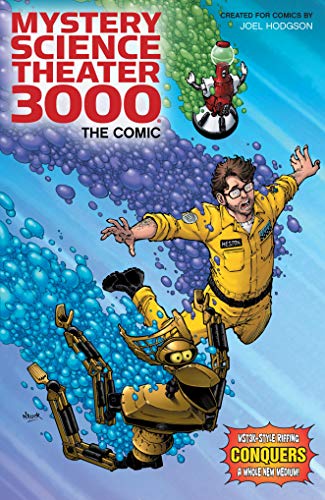
[READ: September 1, 2019] Mystery Science Theater 3000: The Comic

I couldn’t imagine how this comic book would work with the premise of Mystery Science Theater 3000’s movie riffing.  But Joel Hodgson had an idea and it works wonderfully.

The Mads up on the dark side of the moon are still tormenting a guy up on the Satellite of Love.

This book is Netflix-era, so the Mads are now represented by Kinga, Synthia, TV’s Son of TV’s Frank (Max) and the Boneheads.  And joining Crow, Tom Servo and Gypsy on the SOL are Jonah and two small robot creatures that I didn’t recognize (I haven’t watches the Netflix episodes).

I absolutely hate the way Todd Nauck draws the host segments. I can’t stand the mouth designs on anyone, especially Kinga.  They all look like the Joker (is that because this is from Dark Knight comics?) and are horrifying.

But once you get past the art design of the host segments, the premise is pretty great.  Synthia has designed a machine The Bubbulat-r which allows a person to enter a comic book.  They test it out on Max and his favorite book Funny Animals.  Max jumps in as a rabbit can talk to the other characters.

The book explains that there’s a little bubble at the bottom of the word balloon to indicate a line that has been added and is not a line from the actual book.

But when Max comes back he tells us that the cute little bunny is in fact four feet tall with powerful sinewy limbs and reeks of a bizarre musk.

But the key point is that that Kinga has invented a way to do movie riffing from inside the comic.  So Kinga sends them comics and our heroes are inserted into different books. (more…)

Read Full Post »

SOUNDTRACK: THE FLAMING LIPS AND HEADY FWENDS-“Tasered and Maced” (2012).

2012 saw the release of this very strange collaborative album.  Whether The  Flaming Lips had entered the mainstream or if people who’d always liked them were now big stars or maybe they all just liked doing acid.  Whatever the case, The Lips worked with a vast array of famous (and less famous) people for this bizarre album.  Here it is 8 years later. Time to check in.

The final song of the album features Chris Martin from Coldplay on the vinyl release.  But it’s something else entirely on digital releases.  This is the digital song.

This starts as a buzzy feedback wall of noise.  Then comes a simple synth riff over which Aaron Behrens tells a story about cops busting into a party and macing everyone.

He was drunk and decided to fight the cop.  The cop turned around and maced him in the face.  So he ran.

He says Friends will stop chasing you after a while, but copes don’t stop.  They caught him and tasered him.  Hence maced and tasered.

Musically thus piece is interesting to listen to, but the story doesn’t really hold up to repeated listens.

[READ: August 20, 2019] “No Life”

This story concerns parents looking to adopt.  But it is handled in a unique (to me) way.

As the story opens we meet Edward and Alison.  Once happily married (having sex everywhere) they were soon desperate to get pregnant (sex became a chore).  Now they have given up on getting pregnant. But neither one will ever refuse sex (even if they don’t want to have it) because it means they have given up.

So they are looking to adopt.

I’ve never heard of a setup like this, but maybe it happens all the time:

Prospective adoptive parents are invited to a picnic where all of the potential adopted children are playing.  The adults are told to act natural and speak to the children casually.  Never say things like would you like to come home with us and try to keep things as upbeat as possible. (more…)

Read Full Post »

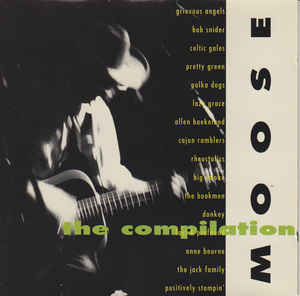
SOUNDTRACK: RHEOSTATICS-“Woodstuck” (Moose: The Compilation, 1991).

Back in the 1990s, it was common to buy a compilation or soundtrack or even a band’s album based on one song.  Only to then find that you didn’t really like anything else on it.

Maybe that single sounded like nothing else on the album.  Maybe the movie was almost entirely one genre, but they had that one song that you liked over the credits.  Or maybe the compilation was for something you didn’t know, but a song you really wanted was on it, too.

With streaming music that need not happen anymore.  Except in this case.

I bought this compilation, used, recently exclusively for one song, Rheostatics’ “Woodstuck.”  It’s a goofy song and this is the only place you can get the studio version.  The actual compilation was not well documented, so I didn’t know what the other bands on it might sound like.  It turns out to be a compilation for Ontario based Moose Records which specialized in Rock, Folk, World & Country.  They put out another compilation in 1992 and that’s all I can find out about them.

I’d heard this song on several live bootlegs, but I was very curious about the original recording.

It’s a stomping folk song with great backing vocals and a very funny chorus.

You can’t go back to Woodstock baby, you were just two years old You weren’t even born

And this wonderful verse

Before they were kissing the earth now they’re washing their cars
Before they were feeling stoned now they’re feeling bored
Sure you shed your clothes but you shed no blood
Poor hippie child don’t sit and wait for another summer of love

Was it worth getting this whole compilation for a two and a half minute joke song?  You bet.

[READ: July 20, 2019] “Just Keep Going North: At the border”

William T. Vollmann continues to amaze me with his dedication to writing about issues that matter.

This lengthy essay is Vollmann’s attempt to discover what is happening at the border after trump warned of migrant caravans coming up from Mexico in February of 2019.

He decided to go to the Arizona border, a place he knew little about, to save himself from prejudgment (he is from California and knows that border situation a little better).  He went to the internationally bifurcated town of Nogales.  Nogales said it would sue the federal government if it did not remove the new coil of razor wire.

He talks to an immigration lawyer from Tucson who says in the old days it was no big deal to cross the border–you could come and go. There were some small changes in the mid-eighties.  Then 9/11 caused big changes.  It had been bad before trump but trump’s policies at least opened peoples eyes to what was happening here. (more…)

Read Full Post »

SOUNDTRACK: TASHA COBBS LEONARD-Tiny Desk Concert #860 (June 24, 2019).

Tasha Cobbs Leonard tells the crowd we’re gonna do some worship songs–gonna go to church some.  Everyone is wearing blue except Tasha who is in a very colorful outfit.  She is “regarded as one of the best gospel singers performing today — she’s won numerous awards, including a Grammy.”

“Break Every Chain” has the opening lyrics: There is power in the name of Jesus.”  It opens with David Williams II playing keys and after a verse or two Wellington “Boo” Britt adds some simple drums.

Her backing vocalists Kennya Miller, Breona Lawrence, and Emoni Robinson sound fantastic–adding a wonderful chorus.

After the first chorus Archie “Snoop” Pearson adds some bass and the whole song feels full.

Her Tiny Desk set started out with one of her favorite songs and her most popular tune, “Break Every Chain,” an anthem that reminds many of us that “there is power in the name of Jesus.”

Tasha gives a little preach about God’s plan for everyone before the next song

“You Know My Name,” is one Cobbs Leonard wrote a few years ago with South African musician and friend, Brenton Brown.

This songs starts out as a ballad with just guitar from Benjamin Forehand and voices.

I like the way Tasha was brought to the Tiny Desk:

I first saw Tasha Cobbs Leonard sing live in my church’s 4,000-seat sanctuary. Her voice easily powered-over the PA system and I was amazed by how well I could hear its beautiful resonance and clarity.

The final song is “The River of the Lord,”

a country-influenced tune, written by her husband, musical director and producer, Kenneth Leonard, along with some of their friends. Originally from Jesup, Georgia, Cobbs Leonard explained that “where I’m from, this is called a hand-clapping, foot-stomping, church song. We’re going to clap a little bit, put a smile on our faces and celebrate the river and the joy of the Lord.”

I grew up listening to religious music that was pretty bland and people who didn’t seem to like singing it.  But I can see why people get into gospel music.  Music that’s this fun–even religious music–is really enjoyable..

[READ: July 1, 2019] “First Powwow”

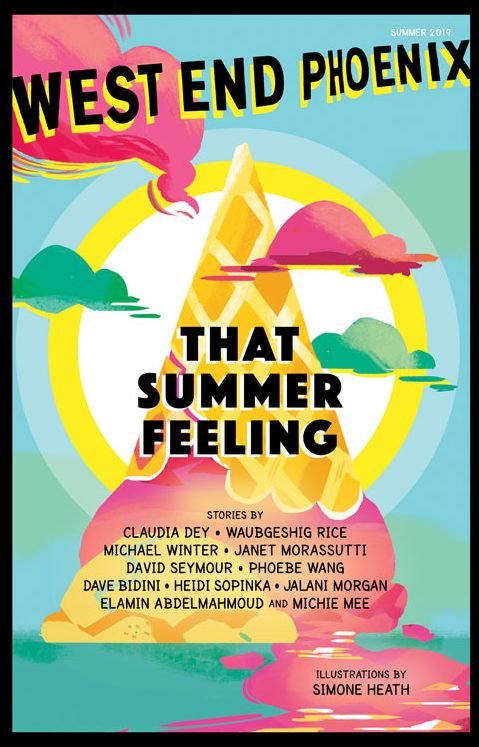
The Summer 2019 issue of The West End Phoenix was a special all comics issue with illustrations by Simone Heath.  Each story either has one central illustration or is broken up with many pictures (or even done like a comic strip).

Each story is headed by the year that the story takes place–a story from that particular summer.

1983: Waubgeshig and his family traveled more than 300 kilometers from Wasauksing to Mississaugas for his first powwow.

He doesn’t remember the journey or arriving.  He really only remembers the sound of the big drum.

The beat echoed in his chest and he was thrilled at the colors of the people dancing around the drum. (more…)

Read Full Post »

SOUNDTRACK: SELFISH CUNT-“Britain Is Shit” / “Fuck the Poor” (2003).

I had not heard of this band until reading about them in yesterday’s Nick Hornby essay.  He didn’t name them, but he mentioned a review in which the band were described as combining ‘the hammering drum machine and guitar of controversial 80’s trio Big Black and the murky noise of early Throbbing Gristle.”

The band was formed in early 2003 by Martin Tomlinson and Patrick Constable, and was noted for provocative lyrics, aggressive stage shows, and electronic-influenced rock.  In 2004, The Guardian placed Selfish Cunt at #40 on its list of “top 40 bands in Britain today.”  They broke up in 2008.

This was their first single.  It surprises me that both of these songs are over three minutes long as they seems like they would be about 45 seconds.

“Britain is Shit” opens with a fast electronic drum beat with jagged guitar stabs and shouted vocals.  Big Black is an excellent touchstone.  After a few verses, all the music drops out except for the drum machine–it’s quite a bold musical statement (not to mention the lyrics).  A ringing guitar chord keeps the semblance of melody going.  The lyrics resume:

Are you having fun / when war is on
put your kettle on / cause the war is on.
Britain is shit / it’s full of lies
white men start their shit / in their shirts and ties.

“Fuck the Poor” is quite similar.  A simple drum machine beat with loud distorted guitars as the only musical element.  The lryics:

Fuck the poor / make war

sung in a heavy British accent,  After the first verse a second guitar chimes in with a guitar riff on top. and more distorted guitar.  The melody doesn’t change.  The song ends in a cacophony of noise.

These songs aren’t original (although combining the sharp electric drum with punk guitars is pretty novel) but they are provocative.  Evidently their live show was quite something.

A 2004 thread on Drowned in Sound describes the live show

I saw them last night, not sure if they could live up to the hype. I went with an open mind but thinking they might not pull it off.

But fuck me. They pulled it off. They fucking rocked. The singer was incredible, hypnotic, acrobatic, snarling, wearing a ripped up catsuit and eye makeup, prowling round the crowd and singing in people’s faces, coming on to all the straight boys, singing in the girls’ ears… like some kind of crossover between iggy, rotten and … grace jones or something. he threw himself around, doing these balletic poses, completely confident and… fucking ace.

Songs? yeah, there were some, they were loud and good. Britain Is Shit is the best anti war song I’ve heard. Fuck The Poor is an anthem. And, one more time, for the record, when he says those vile things like “bang bang another nigger dead” it’s not his own opinion, it’s the voice of someone else – soldier, politician, whoever. It’s a PROTEST not an advocation. come on, haters, get with the fuckin programme.

I think racist types are not really going to latch onto Selfish Cunt because Tompkinson is one of the most obviously gay frontmen i’ve ever seen, and i doubt many racist bigots are particularly accepting of gay people… and i honestly think that the disdain with which he spits out the lyrics make it pretty obvious that there’s something more going on than just the straight lyric.

Of course, you’ll never get a song on the radio with a name like that.

[READ: June 3, 2019] “The Male Gaze”

I enjoyed the tone of this story although the main character was a bit of a puzzle.  She is sophisticated and aware of the male gaze, but seems willing to succumb to it anyway.

Phoebe is a young, sexually active New Yorker: “sometimes she felt like hot shit, sometimes just like shit.”

The first section of the story is called The Most Important Artist of the Post-Second World War Period.

At a party, Phoebe meets Pablo Miles who approached her and says “you’re very fuckable.”

Of all the affronts!  But Phoebe knew the game and made big eyes at him and said “Do you really mean it?” (more…)

Read Full Post »

  SOUNDTRACK: FOXING-Tiny Desk Concert #857 (June 12, 2019).

I saw Foxing live and they were quite different from their recorded output–louder, more intense, a very physical band.  I was curious if they would sound more like their records or more like their live selves.

They have chosen the album sound–quieter, more subtle with gorgeous orchestration.

But I wasn’t the only one to wonder this.

When we invited Foxing to NPR HQ, we wondered how the band’s big sound would translate to such a (forgive us) tiny space. Would Foxing bring a bagpiper to recreate the shrill accent it snuck onto its latest album, 2018’s Nearer My God, or try to replicate the cathartic energy of its live shows over the hum of computers and fluorescent lights?

I didn’t realize that Foxing was

at the forefront of what’s referred to as “emo revival,” a term for today’s crop of bands heavily influenced by late-’90s and early 2000s groups… But with each new LP, Foxing’s ambitions reach beyond the genre’s boundaries, incorporating broader inspiration.

When I saw them, the show was dominated by singer Conor Murphy and guitarist Eric Hudson.  Interestingly, Hudson is on keys for this set.  Caeleigh Featherstone was on keys for my show.  She is on keys here, but her backing vocals are far more prominent here.

For this performance, Foxing expanded its numbers, bringing a saxophonist (Jordan Pettay) and a couple of string players (Gabriel Valle: violin; Nathan Sander: viola) to accompany the band’s touring lineup — and somehow, we managed to fit everyone behind Bob Boilen’s desk.

The first song, “Slapstick” features Conor’s falsetto and Caeleigh’s backing vocals.  Hudson plays the single wobbly notes that float behind the vocals. The strings are quiet but fill in the silences really nicely.  I love the gentle repeating guitar solo that Ricky Sampson plays through the middle.  Sampson plays bass throughout the rest of the show and Brett Torrence plays it on this song.  That sax solo at the end adds a nice touch to the emotional ending.

For its Tiny Desk, Foxing spotlighted three standout tracks from Nearer My God. The quieter instrumentation pushed singer Conor Murphy’s starkly confessional lyrics and shattering delivery to the forefront, especially on the set’s opening song, “Slapstick.”

And even with minimal amplification, the swelling chorus of the title cut “Nearer My God” is just as impressive as performed during the band’s explosive concerts.

“Nearer My God” accentuates Murphy’s falsetto even further and the harmonies sound truly wonderful.  The opening is quiet but it builds really nicely to the middle section which features great drums from the almost never on camera Jon Hellwig.

The set ends with “Grand Paradise” the song that I think makes them sound most like TV on the Radio.  It’s terrific the way the music counterpoints the vocals. The end section of the song just overwhelms with impassioned vocals.  The ending sax solo is pretty cool too although there’ s a nice bass riff around 11 minutes and we don’t get to see Ricky do it.

This is a great set, although I have a little question over the filming–too much attention to the strings and not enough to the rest of the band.

[READ: June 5, 2019] “Conduction”

This is an incredibly powerful story of slavery and freedom.

The story opens with Hiram Walker departing Virginia.  He is a slave with fake papers and a route to freedom.  The writing is excellent.  You can feel the tension, the fear and the sense that anything could go wrong at any second.  Slave catchers, known as Ryland’s Hounds, were at every turn.

He saw the men who were supposed to help him but he couldn’t make eye contact.  The conductor looked at his false ticket which stated that he had recently purchased his freedom.  The conductor didn’t care and he was allowed on.

After two days, he met a contact whom he also did not know.  After one more silent ride, he was in a house in Philadelphia with members of the Underground.

He explains how he knew the white man who helped him as well as the black man named Raymond White who also helped him.  Raymond’s brother Otha was also there–he was more charming, more jovial than Raymond.

For the next few days he wandered the city of Philadelphia, a free man.  Unused to and somewhat unhappy with this new burden.  It was an unsettling feeling, one that carried great deal of responsibility. (more…)

Read Full Post »

SOUNDTRACK: CANADIAN GUITAR SUMMIT (RIK EMMET, ALEX LIFESON, LIONA BOYD, ED BICKERT)-“Beyond Borders” (Guitar Player Magazine, July 1987).

I was not familiar with this recording and just happened upon it this weekend while looking up Rik Emmet.  So it turns out that back in 1987, around the time of the release of the final Triumph album with Rik Emmet, Rik had created this instrumental composition.  It features four superb Canadian guitarists.  I didn’t know Liona Boyd (classical) or Ed Bickert (jazz), but if course I know Rik and Alex.

Evidently Rik wanted to do something which fused genres together (Rik plays all manner of guitar quite successfully).

Fusing different musical forms is hardly new in the guitar world: The marriage between jazz and rock has survived nearly two decades, while jazz and classical get together fairly often. Of course, the more styles you try to blend, the less probable success becomes and the greater the risk of producing something whose sum is smaller than each individual element.

Rik Emmett, leader of the rock power trio Triumph and the author of Guitar Player’s Back To Basics column, was fully aware of the artistic hazards involved when he proposed a Sound page recording to Editor Tom Wheeler in late 1986 that would fuse rock, jazz, and classical. While such a project promised to be the most complex one of its nature since the Sound page’s debut in the Oct. ’84 issue, after hearing Emmett’s concept and who he had in mind to fill out his guitar quartet-Alex Lifeson, Liona Boyd, and Ed Bickert-the go-ahead was given.

The resulting composition-Emmett’s masterful “Beyond Borders” -succeeds in melding its various elements on a number of levels. Although brilliant playing abounds, the piece is more than a vehicle for virtuosic displays as it integrates various styles and weaves in and out of different moods, textures, tones, rhythms, key centers, and time changes. The players receive ample solo space; however, the emphasis clearly is on interaction-a surprising outcome, considering the ever-present temptation to fall back on excessive blowing (Emmett discusses “Beyond Borders” on page 80; the Sound page and musical excerpts are on page 82).

It’s a really lovely piece with each musician playing to his or her strength but also doing some unexpected things.  I feel like Alex has the most fun with th epiece as he seems to create a lot more textural stuff that actual solo material.

This recording is available on line in many places, but I chose this one because the sound quality is quite good.

During this lengthy piece in Guitar Player, there’s an interview with all four guitarists as well as some background information about the piece itself.

There’s also this explanation from Rik about who plays what, so you can follow along:

“Beyond Borders” is basically 120 bars long, and it begins with an adagio section with a tempo of 72 beats per minute. I do the lead guitar off of the top, and Alex plays the atmospheric stuff in the background, which includes low weird things and floating sound effects. Ed comes in with a little melody that lasts from bar 4 into measure 5, and then Liona’s little melody enters at bar 6. The lead that comes in at measure 8 is Alex. In measure 15 Liona plays a little classical lick that Richard Fortin wrote. At bar 17 I play a long feedback melody that continues to measure 26.

Liona begins her classical tremolo solo at measure 22; in the background you’ll notice the feedback guitar part. Liona’s and Ed’s parts cross at bar 28, as Ed takes over with a rubato chord-melody solo. At measure 33 he kicks into an allegro tempo of 140 beats per minute. That’s where I back him up with a simulated bass guitar part that I play on my Yamaha arch-top. For the warm bass sound I rolled the treble back and played with the fleshy part of my thumb. Ed does a cadenza at measure 64, and Alex plays an atmospheric technique where he holds a chord and brushes the strings quickly with the fleshy pads of his right-hand fingers; Lenny Breau was the first person I saw use that.

Bar 65 has an adagio tempo of 70 beats per minute. I play the lead guitar, and Alex adds the arpeggiated electric guitar part behind it. That continues to bar 76, where Liona plays her Lenny Breau octave harmonic lick. That’s also where I begin using the Coral Electric Sitar, with echo repeats on it. Bar 77 is semi-country acoustic fingerpicking with an andante tempo of 90 beats per minute. I play the acoustic steel-string, and Liona plays nylon-string in unison, all the way to bar 102; sometimes I break into harmony, but it’s a unison part essentially. During that same section I also play the Dobro part and all of the electric fills that have a Pat Metheny-esque sound. Alex did the violin sounding swells in the background with a volume pedal.

Where measure 101 crosses over to 102, I did a little lap steel thing with a volume pedal and echo that goes up from a fifth to an octave; it’s kind of a Steve Howe cop. Measure 102 is the beginning of the end. Liona plays the little classical part, and then I break into the harmonies above it. During this section I did all of the wire choirs, which are triads with some of the voices doubled, and I also played the 6/ 8 melody lead guitar fills on the tag right near the end.

It’s really great.

[READ: June 4, 2019] “Javi”

This was a wonderful, slowly evolving story that was one thing on the surface, but had so much more roiling underneath.

As it opens, Javier has knocked on the house of a “lady” in the middle of nowhere, New Mexico.  The person who answers the door doesn’t like that word and to Javi’s mind he’s not sure if the person is even a woman.  He clarifies that he’s looking for the painter.  She concedes that she is the only painter in the area.  He says that his moms heard she needed help.  She asks how old he is.  He replies “I’m four– I’m sixteen.”  The painter says she is 82, how can a young boy help her?  He lists the various things he can do for her–cook, clean, drive etc.  She is concerned that people are talking about her but he assures her it was for his benefit, not hers.

He explains that he walked the twenty miles from Pueblo.  If she’s impressed by this it’s hard to tell.  She is rather inscrutable.  She is supposed to go to an old age home, but if Javi can help her, she can delay that for a year or so.

There’s plenty of wonderful details that unfold slowly, because that is how she is: ‘watching her work is calming, hypnotic.” (more…)

Read Full Post »

« Newer Posts - Older Posts »