Feeds:
Posts
Comments

Archive for the ‘Racism’ Category

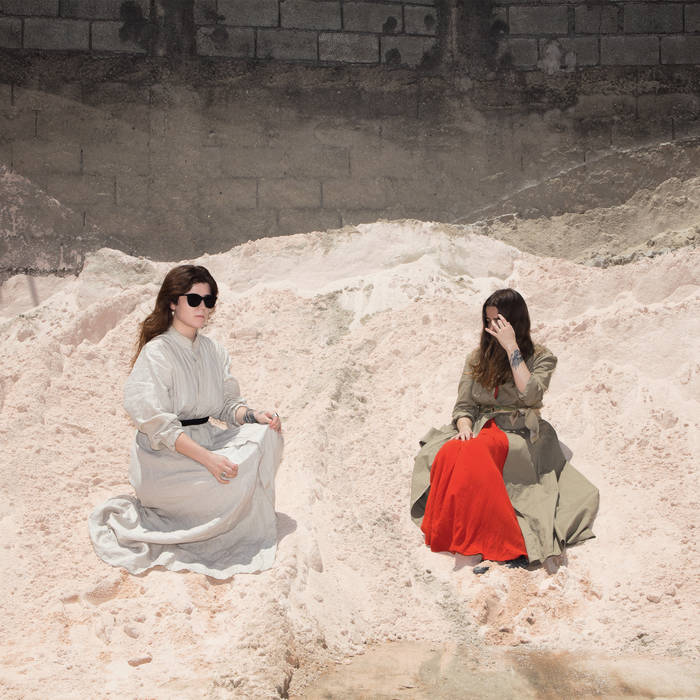
SOUNDTRACK: OHMME-“Kicking Television” (from WILCOvered, UNCUT Magazine November 2019).

The November 2019 issue of UNCUT magazine had a cover story about Wilco.  It included a 17 track CD of bands covering Wilco (called WILcovered or WILCOvered).  I really enjoyed this collection and knew most of the artists on it already, so I’m going through the songs one at a time.

I will always associate OHMME with Wilco because they opened for Jeff Tweedy when I saw him.

This song sounds immediately like OHMME–their guitars and voices up front and very distinctive.  There’s some intense backing vocals (ahhhhs that sound like The B-52’s) over a spare bass and drum.  They add some of their now patented hocketing for the middle of the chorus (which sounds fantastic) and then come together to harmonize or the “television” part.

The song is manic and wild with some great weird guitar sounds (that are very apt for latter-day Wilco).  But it’s also really catchy.

I love the original of this song.  This version is so different and it’s also fantastic.

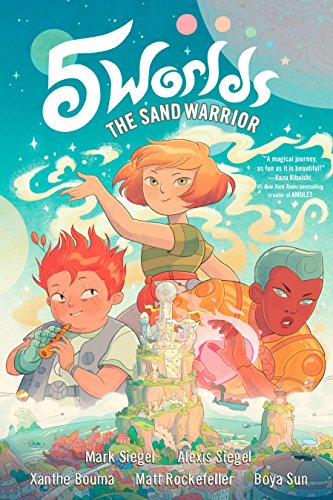
[READ: February 10, 2020] 5 Worlds Book 1

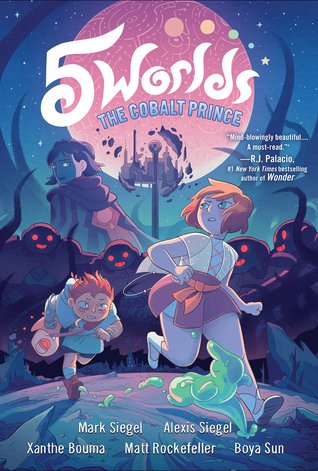
This is an ongoing series that is something of an indie supergroup of creators.  Mark and Alexis Siegel wrote the amazing Sailor Twain, Xanthe Bouma draws for The Amazing World of Gumball, Matt Rockefeller illustrated the children’s book Pop, and Boya Sun created the quirky Chasma Knights.  So this was very promising indeed.

The illustration style of this book is very trippy–soft and delicate with fine lines and gentle coloring. It looks very anime and yet it’s not.  It’s hard to know which artist’s style dominates.  I feel like Boya Sun, but they all have a similar aesthetic.  I really like the character design as well.  I found it very refreshing that none of the characters look like superheroes (well except for Jax the athlete).  Oona is a short girl who has wide hips and thighs and An Tzu is a chubby boy.  Even the other creatures are all interesting and uniquely designed.

The story is magical and fairly complicated with a lot of parts.

On the land of Mon Domani, we see a young girl, Oona, with a halo (which turns out to be sand, I think) sitting alone.  Elders pass and say she looks a lot like her sister, but they shall not speak of her.  Oona is in school learning how to do the summoning dance (which has to do with the sand), but she’s not very good at it because she can’t control the sand.  She and her friend practice but when it goes wrong the bratty boys in class call her Oona Oopsa.  When her sand dancer runs off she chases it and overhears something important. (more…)

Read Full Post »

SOUNDTRACK: TXT (투모로우바이투게더) ‘Cat & Dog’ (2019).

Because this book is about cats and dogs, I was going to put “Cats & Dogs” from The Head and The Heart as this song.  Bit when I searched for “Cats & Dogs” the first video was for this song.  And any band whose name is in a language I can’t read will certainly get posted here.

In fact, I didn’t even realize they were called “TXT” I thought it was something to do with text messaging.

Turns out TXT stands for Tomorrow X Together.  Of course.

The video starts with five cute boys running to the a window and looking out on a cartoon world.  It seemed like The Monkees.

So I was quite surprised when the song started with heavy bass and auto-tuned and I realized that duh, this must be a K-pop band.

I assumed I’d heard of all of the popular K-Pop bands by now (how many could there be?), but here’s one I’d not heard of.  Nevertheless. this song has over 47 million views.

I really don’t know how to talk about K-Pop.

The five of them are adorable and pretty much identical (hair color being the distinguishing factor).  They all seem to dance well (in the heavily edited sequences).  All of their voices are auto-tuned so who knows if they can sing.  They are also singing in at least two languages, so who knows what they are singing.

I assume the language I can’t understand is Korean, although it sounded to me like Spanish at one point (which seems very unlikely).

There’s a repeated refrain of someone gong “brrrp brrrp brrrp” which is a weird but catchy hook for all languages.  I assume that none of the boys’ voices can possibly go deep enough t make that sound.

Apparently, this song has something to do with cats and dogs because there are meows and barks in the song (and in the video they do lots of synchronized cat and dog ear movements).

I’m kind of curious what the chorus actually says–are they saying the word “Pet” or is a Korean word?

At the end he sings I just wanna be your dog, but not in any way like Iggy Pop.

Sometimes it’s fun to dive into music you don’t ever experience.

[READ: February 6, 2020] Kitten Construction Company: A Bridge Too Fur

I really enjoyed the first Kitten Construction Company book.  I loved the premise–not that the kittens were good at building things–but that no one took them seriously because they were so cute.  It allowed for a lot of funny frustrations from our feline friends.

Well, now the city of Mewberg has fully accepted the Kitten Construction Company. They have built a new stadium with updated energy efficiencies and plumbing.

There’s a nice joke that while accepting the adulation for this stadium, architect Marmalade can’t help but knock the microphone stand off the podium.  I only wish that Green had drawn it to look more deliberate–that would have been a lot funnier.  Instead it almost seems like an accident. (more…)

Read Full Post »

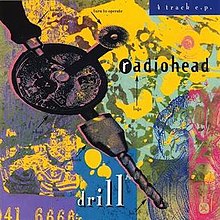
SOUNDTRACK: RADIOHEAD-Drill EP (1992).

Radiohead recently released a bunch of their stuff to streaming platforms.  One of those releases was Drill, their debut EP that came out a year or so before Pablo Honey.  Most of the tracks appear to be demos.  And yet, they are very well recorded demos.–they sound quite good.

Three of the four songs were rerecorded for Pablo Honey.  The only one not on the album is “Stupid Car” a quiet ballad.

“Prove Yourself” and “You” sound a lot like the album versions.  The biggest difference is the sound quality and the “Prove Yourself” guitar solo which is much louder and more piercing on Pablo Honey.  “You” sounds pretty identical, right down to Thom Yorke’s powerful scream mid song

The biggest difference comes with ‘Thinking About You”  On Pablo Honey it is a slow acoustic ballad.  But here it is a fast-paced almost punk rocker.  It’s got racing guitars and fast drums.  Honestly I prefer this to the album version.

The impressive thing is just how good these songs sound.  Not only because they were basically demos.  But because this was their first release and while Radiohead has changed drastically over the years, these original songs are still really good.

Fans tend to disregard Pablo Honey, but the compositions, while nothing like the newer work, are solid, well-crafted alt rock songs.  Don’t dismiss this EP, this band is going somewhere.

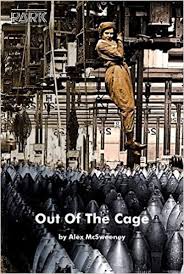
[READ December 29, 2019] Out of the Cage

Every now and then I get a short play at my desk.  This one looked pretty interesting.

Inspired by the munition women of Silvertown, London during the First World War, this tells the story of women’s courage, dignity and hope, fired in the crucible of war.

During the War, women worked in munition plants (munitionettes, they were called).  Despite their hard work in dangerous places, they were given far less credit and pay than their male counterparts.  (Sound familiar?). Could they possibly stand up for themselves or would they forever be seen as second class citizens.

There are eight major characters in the play

  • Jane Byass: 40’s 4 kids, hard but fair
  • Nancy LongdonL Late 20s upper-class, committed to the cause
  • Dee Jessop: 40s, sick and dying, vengeful
  • Nelly Jonson: 30s forceful and sharp, the only Irishwoman there
  • Annie Castledine: early 20a vibrant and funny
  • Carrie Sefton: Early 20s, tough and engaging
  • Ol’ Mim: 50’s nurturing, tough
  • Lil’ Ginny: early teens, naive

The play opens in Jane’s apartment.  The women are meeting there to discuss what to do about he unfair working conditions.  The first to arrive is Nancy.  The others are mistrustful of her because she is upper class, but she is dedicated to women’s rights.

Dee arrives next, she is bitter and sarcastic, she has been breathing in the toxic fumes in the furnace room.  Her breath is a short as her temper and she is not doing well at all.  Nelly arrives next.  She is the most cynical about Nancy because of the Irish vs. English class wars.  The women descend into bickering but Jane settles them down. (more…)

Read Full Post »

SOUNDTRACK: Bob Boilen’s Favorite Tiny Desk Concerts of 2019.

For 2020, I intend to put more albums in my Soundtrack section.  But it’s amazing how time consuming that can be.

Nevertheless, I’ll always be posting about Tiny Desk Concerts because I watch all of them.  So I’ll start 2020 with Bob Boilen’s favorite Tiny Desk Concerts of 2019.

It amuses me that Bob Boilen and I often share very similar tastes in music, but our favorite things are usually quite different.

When we first started filming musicians playing behind the Tiny Desk in April 2008, the beauty was in the intimacy and simplicity of these concerts. Now into our 11th year, after more than 900 Tiny Desks, the other treasure I find in these concerts is the variety. I remember having the cast of Sesame Street here in May, with NPR parents and their children seated on the floor watching the Muppets. The following Monday we had the blood red-faced raging of Idles, climbing all over the desk and singing “I’m Scum.” The scope of music is invigorating, especially considering a world of listening where we can not only get comfortable with what we love, but where the quantity of music from any particular genre could keep us happy all year. Tiny Desk concerts are here to shake up your tastes a little and help you stretch your ears and discover something you never knew existed or convert you to something you never thought you’d like. Here are 10 great examples of that magic from 2019.

I don’t have a list of favoirtes, but I will make some observations about Bob’s.

Bob seems to really like bands who put their names in all caps.  Also bands who have a number (specifically 47) attached to their letters.

Quinn was the Tiny Desk Contest winner.  Sesame Street is pretty iconic.  Taylor Swift is something of a surprise, but was clearly the biggest name they’ve ever had.  And yet, Lizzo’s Tiny Desk has twice as many views as Taylor Swift’s (5 million to 2.5 million!).

Looking forward to their 1,000th show later this year.  I wonder who it will be.

[READ: January 6, 2020] “Playing Metal Gear Solid V: The Phantom Pain”

This was a great short story about playing a video game.

For decades, the video game industry has been releasing video games in which a protagonist kills people from other countries.  Since I don’t play these games, I never really thought about what it would be like to be from that country and to play those games.

Surely people from all around the world like to play video games, and they probably want to play the popular ones as well.

In this story an an Afghani-American kid, Zoya, who works at Taco Bell has saved up all of his money (the money that he doesn’t give to his out of work father) to buy the final game in the Metal Gear series.  He has been playing this series which has becomes “so fundamentally a part of your childhood that often, when you hear the Irish Gaelic chorus from “The Best is Yet to Come” you cannot help weeping softly into your keyboard.” (more…)

Read Full Post »

SOUNDTRACK: FALHA COMUM-“Film Do Mundo” (2019).

Every year Lars Gotrich publishes his list of favorite music in an NPR podcast called Viking’s Choice: The Year In The Loud And The Weird.  I always listen to these songs because I’ll never hear them anywhere else (he mostly seems to scour bandcamp for unknown music.

One that he especially liked was by this band Falha Comum, a duo from Brazil.

He says:

The Brazilian post-punks scaled down to a duo, but opened a festering third eye. The psychedelic noise receptors of a previous decade (think Raccoo-oo-oon and Gowns) run throughout Rakta’s Falha Comum, but in levels below, the sinister grooves and cackled reverb inhabit a life all their own with primal incantations to spirits unknown.

The album is like a few things and nothing else that I’ve heard.  There’s elements of krautrock–but not sterile and efficient, more groovy and cool, with a warm bass and seemingly wild, improvised vocals.

This particular song is 7 minutes long and opens with a spoken word section (presumably in Portuguese).  There are synths and screams behind the speaking and then everything starts pulsing as the vocals echo and echo.   The music–a simple repetitive drum and bass (I guess) line, keep a terrific groove going while on top, the high notes (vocals and other synths) skitter and flit about.

Midway through, the song goes through a phase shift–it sounds like it’s been transported somewhere else, and that’s when the bass gets cleaner and the vocals grow a bit more intense.  But the groove remains.

Somewhere around 6 minutes, the groove changes slightly–a brief shift in notes suddenly gives the song a brief moment of extra melody.  The following keyboard frenzy keeps it from getting too comfortably melodic though.

It’s an unexpectedly interesting and cool record.

[READ: Summer 2019] The Long Utopia

This was the fourth book in the Long Earth series.  I brought it along on vacation thinking it would be a fairly slow and leisurely read like the others—something I didn’t mind putting down and picking up a few days later.  But this book changed that pattern entirely.  It was fast paced and quite exciting and my favorite book of the series so far.

The previous book about the Long Mars seemed to be more than anything else, a distraction.  Not a lot happened, although there were some cool ideas in it.  The one big thing that book 3 did that effects book 4 is the cable/elevator thing—which I still don’t understand [see yesterday’s post about book 3].

This book also introduces a new concept in Stepping.  Typically Stepping is described as moving left or right, east or west through the Earths.  But suddenly, in this one world, it seemed like a person could move…north.  Into an entirely different world—night instead of day:  “No stars exactly, it was like he could see the whole galaxy…from outside.”

This book is set in 2052.  Protagonist Joshua Valiente:

will be 50 years old. He has been stepping for 35 years and has been all over the Long Earth.  But some things are still unsettling—things that he can feel in his bones or his head.

The reason for his feelings date back to 2036 in New Springfield.  Cassie Poulson had been digging a basement for her house when she hit some kind of opening.  Not a cave or anything natural, but some kind of manufactured tunnel or the like.  When she poked her head in,  what poked back was a humanoid metal beetle.  Obviously she freaked out and covered up the hole. (more…)

Read Full Post »

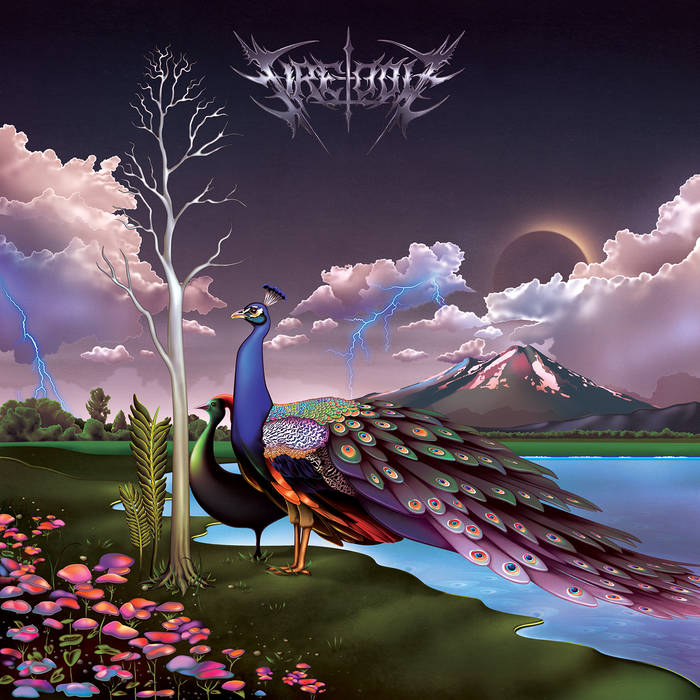
SOUNDTRACK: FIRE-TOOLZ-“mailto:spasm@swamp.god?subject=Mind-Body Parallels” (2019).

Every year Lars Gotrich publishes his list of favorite music in an NPR podcast called Viking’s Choice: The Year In The Loud And The Weird.  I always listen to these songs because I’ll never hear them anywhere else (he mostly seems to scour bandcamp for unknown music.

One that he especially liked was by this band Fire-Toolz.  He says:

When I try to describe the simultaneously fantastical and obliterating sounds of Fire-Toolz to folks, I usually throw my hands up — not out of frustration, but from awe. Angel Marcloid has clashed New Age synthscapes, clubby raves, jazz fusion and metal shrieks for a few years now, but Field Whispers (Into the Crystal Palace) goes beyond the mash-up, into an idiosyncratic master’s pure creation.

The album credits indicate: Angel Marcloid: voice, drums, electric & acoustic guitar, fretless bass, virtual studio technology, field recordings, circuit-bent junk, composition, lyrics, recording, production, mixing, mastering.

The only other musician is Ian Smith: who plays what can only be described as a smooth-jazz saxophone solo.  Oh, and her cat, Breakfast, gets a vocal turn.

I have listened to some of the whole record, (a lot of tape manipulation on track 2), but nothing sums up the project like the first song, “mailto:spasm@swamp.god?subject=Mind-Body Parallels” (yes, that’s the title).  In 2 minutes and 11 seconds, she includes more genres than I can name.  And the amazing thing is that unlike other artists who squeeze many genres into one song (there are those who do this well and those who do not), these shifts feel at once hairpin but also natural. 

The song starts with a skittery electric melody that almost sounds like digital pipe organ.  It’s very new-agey, but with heavier drums than you might expect.  The quiet death metal growling is certainly unexpected, but somehow it doesn’t feel out of place (and is low enough in the mix to feel more like another sound than vocals–I have no idea what she’s saying).

After the first verse the music shifts to a kind of jazzy new age followed by a punishingly fast electronic drum and a scorching heavy metal solo and the song devolves or crescendos with inhuman growls.

Welcome to 2020!

[READ: May 2019] The Long Mars

I found the first book in this series rather compelling–almost surprisingly so given that it’s not a fast-paced book and, to be honest, not a lot happens.

But it was really well written and the things that do happen are compelling and fascinating.  And I couldn’t wait to read more.

In the first book:

A man creates an invention (The Stepper) which allows one to step into a parallel world that is next to ours.  There are a possibly infinite numbers of parallel worlds in each direction (East or West).  The worlds that are closer to ours are almost identical to our Earth (known as Datum Earth).  The further you go, the greater the differences.  But none of them have experienced humanity before Step Day (aside from earlier hominids).

The main character is Joshua Valienté.  Joshua is a natural “Stepper.”  He doesn’t need the device to Step from one word to the next, nor does he feel the nausea and other side effects that most people feel as they travel.  Most of the book follows his exploits.

The Black corporate has a ship with an entity known as Lobsang who claims that he was a human reincarnated as artificial intelligence.  Joshua is sure that Lobsang is a computer, but Lobsang’s human skills are uncanny.  This ship has managed to Step as an entity, meaning everything in the ship can go with them.  Normally you can only bring what you can carry (aside from metal).

The novel more or less is an exploratory one with Joshua and Lobsang Stepping through millions of Earths.  Not a lot happens, but the novel never grows boring.  The interactions between Joshua and Lobsang are often funny.  And the writers have infused the Earths that they stop in with just enough differences to make each stop strangely compelling (this must be Baxter’s hard science leanings).

I found the second book less compelling on a story level, but no less compelling on a conceptual level.  There was still some cool stuff going on.

Joshua Valienté has settled down in a town called Hell-Knows-Where.  He has a wife, Helen, and a child, Daniel, and lots of regrets about what happened at the end of book one.  He is embedded with the rest of the community.  They show off what a successful community can be way out in the Long Earth.  It is more or less cut off from Datum Earth, which means that everyone needs to work for the community to survive.  Since trust and companionship are key to survival, people don’t really try to take advantage of others and crime is pretty much nonexistent.

This independence is a major concern for the governments of Datum Earth.  In fact, some of the more thriving distant communities (like Valhalla) want to declare independence from Datum Earth altogether.

Another issue is human (or alien) rights.  The trolls from the first book have become a part of most communities at this point.  And yet, the way they are treated seems largely dependent on who they are with.  Some are welcomed like family members, other are treated like animals, slaves or worse.   And the mistreatment of a mother and son troll are what set a series of events in motion.   Maggie Kauffman is a new character introduced to speak on behalf of the trolls.  Before their otherwise peaceful nature gets pushed too far.

Another plot line (and there are quite a few) concerns Roberta Golding, a young genius who goes on an exploratory mission with the Chinese.  The Chinese are exploring the “East Earths” (most of the other travelers went West).  Roberta is an odd child, who anticipated jokes and therefore finds nothing funny. She is cold and emotionless.  Her story remains unresolved by the end of the book.  But her crew managed to get to Earth East 20,000,000 with the crew.

When Sally tries to get Joshua involved in an adventure once again, he is reluctant, but Helen is the one who spurs him on–as long as she and Dan go with him. This adventure is a bit of backtracking, though–an attempt to use Joshua’s name and status back on Datum Earth–where he is not welcomed by everyone.  He tries to prevent the government from harming trolls–because he knows what is at stake if the trolls grow angry.

In their adventure, they also encounter a race of beings known as Beagles.  It is a pretty dark and disturbing world, with Joshua getting tortured and Sally and Monica being the only things keeping him from a brutal death.   There’s a lot of brutality now, which is not unexpected given the reality of the situation, but it does often seem rather harsh

That’s a lot of summary to prepare for Book Three.  But book three does continue the saga, just another twenty years or so later.

(more…)

Read Full Post »

SOUNDTRACK: THE FOUR LADS-“The Bus Stop Song (A Paper of Pins)” (1956).

Given the content of this book, I thought it might be fun to pick a song that was popular in Canada in, say 1956.

I was pretty fascinated to learn from the Canadian Music Blog:

National charts did not begin in Canada until the launch of RPM Magazine in 1964. Below, from Oh Canada What a Feeling A Musical Odyssey by Martin Melhuish are lists of popular songs in Canada through the 1950s. We have also included big hits by Canadian artists that made the year-end charts of U.S. Billboard Magazine with their year-end positions on the chart.

Some popular artists back then were

Guy Lombardo & His Royal Canadians: Enjoy Yourself, The Third Man Theme, Dearie, Our Little Ranch House, All My Love, Harbour Lights, Tennessee Waltz. (all 1950) If, Because of You (1951) Crazy Heart, Blue Tango, Auf Wiederseh’n Sweetheart, Half as Much (1952) Hernando’s Hideaway (1954)

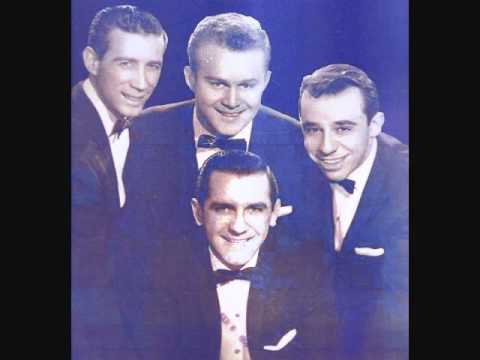
The Four Lads: Moments to Remember (#17) (1955) My Little Angel, A House with Love In It, The Bus Stop Song (A Paper of Pins) (1956) Who Needs You, I Just Don’t Know, Put a Light in the Window (1957) There’s Only One of You, Enchanted Island, The Mocking Bird (1958)

The Crew-Cuts: Earth Angel, Ko Ko Mo, Don’t Be Angry, Chop Chop Boom, A Story Untold, Gum Drop, Angels in the Sky (1955) Mostly Martha, Seven Days (1956)

Paul Anka Diana (#24) (1957) You Are My Destiny, Crazy Love, Let the Bells Keep Ringing, The Teen Commandments (1958) Lonely Boy (#5) Put Your Head On My Shoulder (#12) My Heart Sings, I Miss You So, It’s Time to Cry (1959)

My dad was really into big band music of this ilk and he had records from Guy Lombardo and The Four Lads.  To me the switch from that kind of sound to the style of Paul Anka in 1957/1958 seems like a pretty big shift.  I feel like my dad didn’t like the kind of crooner-y music that Paul Anka sang.  It’s interesting that The Four Lads never rose above a chart position of 52 after 1958.

I chose this particular song because I know  The Four Tops a little.  But mostly because this song is very perplexing.  I had no idea what a “paper of pins” could be.  Turns out the lyrics are a traditional English children’s song.  A “paper of pins” is a sheet of paper with different size pins for sewing.  Why on earth would you give them as a sign of your love?

In the original, the song is a call and response, with the second verse being the rejection of the first verse.

I’ll give to you a paper of pins
And that’s the way our love begins
If you will marry me, me, me
If you will marry me

[The original verse two is :
I don’t want your paper of pins,
If that’s the way that love begins,
For I won’t marry,
Marry, marry, marry
I won’t marry you.]

[The original next verse is not a feathery bed but:
I’ll give to you a silver spoon,
Feed the baby in the afternoon]

I’ll give to you a feathery bed
With downy pillows for your head
If you will marry me, me, me
If you will marry me

After a few more verses, the Four Lads end:

But you don’t want my paper of pins
And you don’t want my feathery bed
You want my house and money instead
That is plain to see

Well, here they are take everything
My house, my money, my wedding ring
And in the bargain I’ll throw in me
If you will marry me

But in the original ends like this

If you give me the keys of the chest,
And all the money that you possess,
Then I will marry,
Marry, marry, marry,
I will marry you.

Ah ha ha, now I see,
You love my money but you don’t love me,
So I won’t marry,
Marry, marry, marry,
I won’t marry you.

So The Four Lads made this song kind of sweet, but also kind of pathetic.  Weird choices.

And why in the world is it called The Bus Stop Song?

[READ: November 17, 2019] The Canadians

This is a book of 79 photos taken from The Globe and Mail archives.  The are not art, they are not beautiful.  They are documentation.  Documentation of a specific time and place–Canada in the late 1950s and early 60s.

These are pictures of regular folks working, doing chores, meeting politicians.  There’s no posing, there’s no “beauty.”  It’s just grim reality.  I grabbed this book because Douglas Coupland wrote the introduction (I’m not sure who wrote the copy for the pictures–each picture has one line of information about it).  The collection was edited by Roger Hargreaves, Jill Offenbeck and Stefanie Petrilli.

I love Coupland’s take on these picture because he looks at things from such a different vantage point than I’m used to.  Like the way he opens the book.  He says that the Canada depicted here pretty much didn’t exist anymore by the time he was born.  He describes Canada then as “a country in which, it would seem, people were born, became teenagers, and then magically at the age of 21, turned into chain-smoking fifty year-olds with undiagnosed cancers.”

He observes that few people smiled and those that did had teeth riddled with nicotine stains.  This is by and large true.  The photos with politicians seem to have the biggest smiles although the young members of Chelecos and Lancers Motorcycle Club certainly mug for the camera. (more…)

Read Full Post »

SOUNDTRACK: JOVINO SANTOS NETO-Tiny Desk Concert #904 (October 21, 2019).

Jovino Santos Neto plays piano–and then surprises by playing a lot more.

I have a come and go relationship with jazz.  I like some of it.  I like it sometimes.

But the blurb might explain why I liked this music right away:

Something happens for me when I hear jazz mixing it up with Brazilian rhythms. In the right hands it falls into the realm of magic.  Pianist, multi-instrumentalist and composer Jovino Santos Neto certainly cast a spell over those who gathered for this joyful turn behind the Tiny Desk.

I loved everything about this performance.

The trio rushed right out of the gate with the samba-influenced “Pantopé” that introduces the concept of the trio: seamless interaction between the musicians that make the band sound like one big, melodic rhythm machine.

“Pontapé” opens with slow piano and woodblocks from drummer Jeff Busch.  Then after about thirty seconds, the song takes off with some amazing piano playing and some great five-string bass from Tim Carey.

There’s a really impressive bass solo–Carey has got some really fast fingers.  Then, midway through the song–and a huge surprise if you’re not watching–Santos Neto pulls out a very solid-looking melodica and plays a really impressively fast solo on it.

It’s a solo that’s interspersed with some fun drum fills–cowbell, snare, wooblocks and a little whistle at the end.  It’s a wild and fun track for sure.

He explains that the name”Pontapé” means kick.  People who can play soccer can do amazing things with their feet.  But we do it with the notes instead.

Up next is “Sempre Sim.”  The song

starts with percussionist Jeff Busch riffing on the traditional percussion instrument called berimbau. 

It looks like a giant fishing rod.  Santos Neto says, “don’t be afraid it isn’t a weapon… I mean in the right hands.”  One plays the berimbau by hitting the instrument with a tiny drum stick (and also hits the cymbals with tiny stick).

its ethereal sound creating the perfect intro to the dreamy melody and solo from Santos Neto on piano, while bassist Tim Carey echoes the double beat on the bass drum that drives Brazilian music.

There’s some great piano and amazing bass.  The middle solo is an astonishing amelodic feast.  By then Busch has switched back to sticks and is playing drums.

They finish and Santos Neto seems to think they are done.  There’s a long pause with everyone looking off at someone.  Then he says Okay!  We’re going to play one more to much chuckling.

The final song is “Festa de Erê.”  He says that

Erê represents the spirits of children in the Brazilian Umbanda tradition, which makes “festa de Erê” an appropriate title for the intensely whimsical tune that weaves in and out of the different traditional rhythms performed by all three musicians.

The song starts bouncy and lively.  But they settle down so Santos Neto can play the main piano melodies.

Then midway through the song he surprises once again by playing a lengthy, pretty flute solo–the end of which consists of him playing the flute one-handed while he plays the piano with his right hand.

All the while Carey is tapping out the notes with both hands, but that impressive feat is overshadowed by the incredible stuff going on behind the piano.

Like the sometimes frenetic energy of the music they play, Jovino Santos Neto and his trio are perfect examples of musicians who have so much music coming from within, sometimes one instrument is just not enough.

Perhaps I like jazz best when it’s mixed with Brazilian rhythms too.

[READ: November 16, 2018] “The Trip”

I’ve only read one other story by Weike–a story of a difficult romance.

This story is also of a difficult romance, but in a very different way.

The story begins

In Beijing, he boiled the water.  It was August, so the hottest month of the year.  He put the water into a thermos and carried the thermos on a sling.  He called himself a cowboy because he thought he looked dumb. Other people in the group carried a thermos too, though he wife did not.

The opening is certainly confusing.  It continues to be so.  He and his wife go to the Great Wall.  She sprints along it to show him a particular spot hat her cousin showed her as a teenager.  Her cousin taught her the Chinese word for cool–imagine not knowing that word– shuang–until you were 13.  Can you imagine how that felt?  He says that she knew the word in English, though right?  She made a face and then sprinted on.

The trip had been a gift from her parents who wanted “her first husband to see China and have good memories from there and sample its regional foods and see the warmth of its people and not hate us civilians should our two great nations ever partake in nuclear war.”  At least that’s how she translated it. (more…)

Read Full Post »

SOUNDTRACK: TINY DESK PLAYLISTS (2019).

As on October 1, NPR has started the Tiny Desk Playlist page.

As of today there are 9 Playlists on the page.  I’m not going to comment on them, as I’ve already posted about all of these shows (except CHAI as of now).  I might disagree with some of these lists, but whatever the case they are a good introduction to Tiny Desks if you haven’t already seen one.

5 Tiny Desk Concerts That Will Literally Make You Cry
• Julien Baker (read more)
• Yusuf/Cat Stevens (read more)
• Bernie and The Believers (read more)
• Rev. Sekou and The Seal Breakers (read more)
• Barbara Hannigan (read more)

The 5 Most Uplifting Tiny Desk Concerts
• Lizzo (read more)
• Superorganism (read more)
• Fragile Rock (read more)
• Dan Deacon (read more)
• Mucca Pazza (read more)

The 5 Wildest Tiny Desk Concerts
• Gogol Bordello (read more)
• Red Baraat (read more)
• The Cristina Pato Trio (read more)
• George Li (read more)
• Dirty Three (read more)

The Best-Sounding Tiny Desk Concerts, Vol. 1 [selected by “the guy mixing the performances and bopping his head along just off (and sometimes on) screen” Josh Rogosin].
• Monsieur Periné (read more)
• Andrew Bird (read more)
• Nick Hakim (read more)
• Tedeschi Trucks Band (read more)
• PJ Morton (read more)

The Best Of The Very Beginning Of Tiny Desk Concerts
• Laura Gibson (read more)
• Vic Chesnutt (read more)
• Tom Jones (read more)
• Thao Nguyen (read more)
• Dr. Dog (read more)

The 5 Best ‘Before They Were Stars’ Tiny Desk Concerts
• Brandi Carlile (read more)
• Anderson .Paak & The Free Nationals (read more)
• Adele (read more)
• H.E.R. (read more)
• Mitski (read more)

Tiny Desk Trick Or Treat: Our 5 Favorite Concerts In Costume
• Neko Case’s Halloween Special (read more)
• Blue Man Group (read more)
• Mucca Pazza (read more)
• CHAI (read more)
• Preservation Hall Jazz Band (read more)

#ElTiny: The Best Latinx Tiny Desk Concerts, Vol. 1
• Natalia Lafourcade (read more)
• Jorge Drexler (read more)
• Juanes & Mon Laferte (read more)
• iLe (read more)
• Café Tacvba (read more)

Lianne La Havas’ 5 Favorite Tiny Desk Concerts
• Tank And The Bangas
• Anderson .Paak & The Free Nationals
• Noname
• Tamino
• Mac Miller

[READ: October 28, 2019] “God’s Caravan”

This story opens with boys crouching in the dirt shooting marbles.  I assumed it was set in the 1950s, so I was surprised to see that the boy knew of Michael Jackson’s moonwalk.  But it is set in Memphis, Tennessee–“Soulsville the black part.”

Earl was kicking butt and winning marbles left and right when the boys heard an ice cream truck trundle up.  But this was no ice cream truck.  Rather it was a van and it was playing “I’ve come from Alabama with a banjo on my knee.”  On the side of the van, painted in “blood of Jesus” red were the words “God’s Caravan.”  The speakers then broadcast “When I say, ‘Ride or die’…you say ‘Amen.'”

The voice said “Ride or Die” and Earl and the other boys all shouted back “Amen.”

The door opened and there was the pastor, dressed in black judge’s robes.  He said he had sweets for their hearts. (more…)

Read Full Post »

SOUNDTRACK: ANTONIO CORA-“The Cellar” (from The Blair Witch Project) (1999).

A lot of the music I listen to is weird and probably creepy to other people, but I don’t necessarily think of songs as appropriate for Halloween or not.  So for this year’s Ghost Box stories, I consulted an “expert”: The Esquire list of Halloween songs you’ll play all year long.  The list has 45 songs–most of which I do not like.  So I picked 11 of them to post about.

I was getting bored of the Esquire list so I found this fun little tidbit of spookiness.

The Blair Witch Project was a low budget, DIY-looking movie.  The soundtrack is a compilation with songs on it (Josh Blair’s Witch Mix), but this track is from the actual movie soundtrack.  I couldn’t exactly tell if there was a release of the actual movie soundtrack, but the last track on the disc is similar to a video I found online for the “end credits theme.”

Excluding the intro, which has 30 seconds of dialogue from the film (“Heather’s Apology”), this track is a five-minute DIY, nightmarish ambient score.

It is largely quiet with rattling, echoing sounds.  An online thread (therefore of dubious truth) says that the score was made with the sound of sticks breaking and being thrown into a culvert (or some such) then slowed down dramatically.

There’s some kind of droning sound throughout (maybe a synth, but who knows).  It seems to slowly percolate while things scrape and bang.  There’s a few louder noises that really stand out, but there’s no momentum or narrative to the soundtrack.  It’s just a sort of endless low grade scare.

Don’t listen at bedtime.

[READ: October 27, 2019] “Last Call for the Sons of Shock”

Just in time for Halloween, from the people who brought me The Short Story Advent Calendar and The Ghost Box. and Ghost Box II. comes Ghost Box III.

This is once again a nifty little box (with a magnetic opening and a ribbon) which contains 11 stories for Halloween.  It is lovingly described thusly:

Oh god, it’s right behind me, isn’t it? There’s no use trying to run from Ghost Box III, the terrifying conclusion to our series of limited-edition horror box sets edited and introduced by Patton Oswalt.

There is no explicit “order” to these books; however, I’m going to read in the order they were stacked.

This story was the most genuinely scary and horrifying in the box because it was the most real.

It was powerful, painful and horrible.  But it was written so well, I couldn’t look away. (more…)

Read Full Post »

« Newer Posts - Older Posts »