Feeds:
Posts
Comments

Archive for the ‘Poetry’ Category

SOUNDTRACK: BEN FOLDS/NICK HORNBY-Lonely Avenue (2010).

As the cover of this album notes: “Ben Folds adds music and melody to Nick Hornby’s words.”  And that is true. The only surprising thing about this combination is that Folds is quite a good lyricist himself, so it’s surprising that he would sacrifice his words.  But regardless, the fit is a good one.

Sometimes it seems like Hornby is challenging Folds to come up with melodies for some of his more difficult lyrics which Folds lives up to).  But they have such similar sensibilities that (aside from occasional references to British things) the words could have come from Folds himself (although, Hornby’s a better writer, so Folds wouldn’t have written exactly the same things).

The big surprise is the diversity of musical styles on the disc.  Folds of course does play lots of different types of music on his previous discs, but I guess since the cohesion is Hornby’s words so Folds can really let loose.

The opener, “A Working Day” is a keyboard pop confection, a surprisingly 80s sounding synth song with some wry lyrics about being a writer/performer (“some guy on the net thinks I suck and he should know, he’s got his own blog”).  “Picture Window” is a beautiful downer, a string-filled song that seems like a companion to Folds’ “Brick” (“You know what hope is, hope is a bastard”).  It’s just as sad but the melody is gorgeous.

“Levi Johnson’s Blues” is a strangely topical song (in fact, it took me a minute to remember who he was when I first listened to the song.  Anyhow, it’s a silly song about what happened to the father of Sarah Palin’s grandchild.  And yet, despite the novelty of it, it’s actually a somewhat sympathetic portrait of the guy (sure he’s a redneck, but he’s just a normal guy thrust into a ridiculous spotlight–the liner notes say the chorus came from Levis (redacted) Facebook page).

“Doc Pomus” feels like a classic piano song.  While “Young Dogs: is a fast romper (with great vocals) and more keyboards.  “Practical Amanda” is a slow ballad (and Hornby says it’s not autobiographical at all).  While “Claire’s Ninth” is a story about a young girl of divorced parents who hates having two birthdays.  (With sweeping choruses!) Hornby states that this was his first accepted short story (modified for the song, of course) but the magazine that accepted it stopped publishing before his appeared.  D’oh!

“Password” is a wonderful song which only makes sense when you know the name of it (which I didn’t at first, as I usually don’t look at titles right away).  Throughout the song Ben spells words which leads to a cool conclusion–it’s wonderfully clever writing and it’s done in a fascinating R&B-lite style.

“From Above” is a jaunty rocker about people who never meet, although their paths cross quite often.  “Saskia Hamilton” is the “single” from the record.  It’s another great 80’s keyboard fueled romp.  Since I have a friend named Saskia (hi, Saskia) I’m fond of this song–her name is fun to say.  They have a bunch of fun in the recording too.

The final track, “Belinda” is designed like a classic 70s piano ballad (there’s a lengthy email printed in the notes that explains the construction of the song–reading that makes the song even more impressive).

It’s a great Ben Folds album.  It’s not as tidy as some of his other ones–but all of that experimentation leads to some new avenues of melody. It’s a risk that paid off.

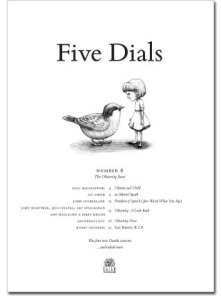
[READ: May 10, 2011] Five Dials Number 7

This issue of Five Dials was primarily about Memoir.  Typically, I don’t like memoirs, but I’m finding (and this coincides with what one of the memoirs below states), that I just don’t like celebrity memoirs.  Or perhaps I just like three page accounts of an incident in someone’s life (which these are).

Each of the writers below is given an introduction in which they summarize WHY they write memoirs.  It’s interesting to see that many of them do, in fact, take other people’s feeling into consideration (not as seriously as Mark Twain who waited 100 years for the publication of his), but they try to do something or other to spare people’s feelings.  I was intrigued also that several of the writers also talk about finding themselves through writing.  One or two of them make the exercise of writing memoir sound obnoxiously solipsistic (which of course it is), but it’s nice to read ones that are interesting and not too self-centered.

CRAIG TAYLOR-A Letter from the Editor: “On Audio Detective Work and Memoir”
This letter explains the extent of the audio detective work that went into the interview (presented later) between Raymond Chandler and Ian Fleming.  Since I love playing with audio software, this was of especial interest to me.  And it made me really look forward to the interview. (more…)

Read Full Post »

SOUNDTRACK: BATTLES-“Ice Cream” (2011).

My friend Lar told me about Battles way back in 2007.  I listened to the concert he sent me, and it was great. But my memory of the band was that they were really heavy (the drummer was in Helmet and Tomahawk for cripessakes).

But they’re not so much heavy as noisy and crazy.  And this track is a head-spinning amalgam of keybaords, unsettling rhythms, processed guitars and singing from Argentinean techno producer Matias Aguayo.  The lyrics sound like they are not English, but they are (with heavy effects on them).

The song is weird, indeed. But after just one listen, I was totally hooked.  It’s catchy and bouncy and very sunny and it’s a real joy to listen to.   I absolutely must go back and check out their debut Mirrored.

Listen at NPR.

[READ: April 28, 2011] Five Dials Number 6

Five Dials Number 5 was an excellent issue that I enjoyed immensely.  They followed it up with Number 6, which deals with a subject that I was very passionate about in the early 90s: censorship/obscenity.  When I was in high school and college, the PMRC was the big bogeyman for advocates of free speech (of which I am one).  I still advocate passionately for freedom of speech (now that I’m in a library, the issue can be part of my daily life), but it seems like there are so many more important issues in the world, that stickers on a record seem kind of silly.

Nevetheless, as this issue reminds us, those who control what is said control what we hear.  And that’s true for music and books, as well as our everyday news.  So, free speech should never be taken lightly.  Although this issue looks largely at obscenity in England, they also pull up some good information from Jello Biafra as well.

CRAIG TAYLOR-A Letter from the Editor: On John Mortimer and Obscenity
John Mortimer appears later in the issue. He was the lawyer who defended Lady Chatterly’s Lover against accusations of obscenity.  And Taylor points out that Mortimer’s attitude was that he “understood the silliness of censorship.”  And with that attitude, he was able to work to convince juries of that silliness.  The rest of the issue looks at important cases of censorship over the years, from The Dead Kennedys to NWA (it’s nice to be reminded about how “dangerous” they were when they came out).  He also laughs at the lame attempts at putting adult content on network TV (Fudge you!). (more…)

Read Full Post »

SOUNDTRACK: PJ HARVEY-Live at the Warfield Theater, San Francisco, April 14, 2011 (2011).

NPR was given permission to share this PJ Harvey concert.  However, they were only allowed to share about half of it.  The show is fairly short to begin with (about 75 minutes) but the downloadable portion is barely 40 minutes.  It turns out that NPR was given the rights to all of the songs from the new album, Let England Shake.

Now, I have no idea how things like this work, why they are only given access to these songs as opposed to the other ones, or why an artist (or management) would not let her fans hear the ten or so other songs she played that night.  Legal restrictions are weird and usually stupid. But as I’ve mentioned before, you shouldn’t complain about free stuff.

So, what we get here is a spliced together concert (it sounds seamless, although they have removed all of the banter (if there was any)).  The album is played in its entirety (although we were not given “Written on the Forehead” which happens to be the song they are playing the most on the radio here), but it’s not played in order.  It was also interspersed with older songs “The Devil” and “Silence” from White Chalk, “The Sky Lit Up” and Angeline” from Is This Desire, “Pocket Knife” from Uh Huh Her, “Down by the Water” and “C’mon Billy” from To Bring Her My Love, (I’d like to hear how she handles the older songs, now that’s she’s singing primarily in the higher register).  And, “Big Exit” from Stories from the City.

It’s pretty clear that Harvey is no longer the young woman who made those first couple albums.  And she sounds strong and confident here.  It’s a great set; the autoharp never sounded better.

[READ: April 20, 2011] Five Dials Number 5

I have been enjoying all of the Five Dials, but this issue is easily my favorite so far.  The “theme” of this issue is translation.  Translators are the unheralded workers in literature, and while I have been trying to give them credit in my posts, I don’t always pay them enough attention (except when a translation is awkward or clunky).

But in addition to the theme (and the really cool interviews with some translators, I thought the fiction was outstanding and I loved Alain de Botton’s Advice column.  The whole issue was great. (more…)

Read Full Post »

SOUNDTRACK: WEAKERTHANS-World Cafe Live, December 5, 2007 (2007).

I really like the Weakerthans, and they are surprisingly unknown here in the States.  I say surprisingly because they write exceptionally catchy (almost absurdly poppy) songs which would fit on many radio stations’ playlists.  But what sets them apart is John K. Samson’s lyrics which are clever and interesting and about people and loss (maybe that’s why they never made it down here).

This World Cafe set came about shortly after the release of their last studio album, Reunion Tour.  David Dye asks some great questions (I’ve never really seen/heard any interviews with them, so it’s all new to me) and the band plays three songs from the album.

We learn that Reunion Tour was initially inspired by Edward Hopper paintings (and the whole album was going to be devoted to Hopper until Samson grew sensible again).  We also learn the official pronunciation of the recurring cat on the Weakerthans albums is Virtute (Vir-too-tay) which comes from the city of Winnipeg’s crest.

They play “Night Windows,” “Civil Twilight” (and talk about the video, which I watched and it’s very cool), and “Virtute the Cat Explains Her Departure.”  The interesting things about the Weakerthans is that they don’t sound all that different live than on record.  So, these songs aren’t terribly revelatory.  There are some effects that are changed, and the tempos feel slightly different as well.  But nevertheless, the songs sound great.  The only problem is that the set seems mixed rather loudly, so there’s distortion (unintended, I assume) on some of the tracks.

Nevertheless, this is a great introduction to a relatively unknown band.

[READ: April 19, 2011] Five Dials Number 2

After just one issue, Five Dials has already lied to us.  In Number One, they said that all of the artwork would be black and white, but here is Number 2, and we have a host of beautiful color pictures (perhaps they only meant that Number 1 would be in black and white).   Of course, I’m only teasing them because the color pictures are really nice, and they really bring a new aspect to the magazine.

Number Two is a bit larger than Number 1 (twenty pages).  This issue has a vague sort of theme as well (it’s unclear if the issues will be thematic in the future), but this one has a general theme of adventure/nature/environmentalism. (more…)

Read Full Post »

SOUNDTRACK: PETER BJORN AND JOHN-SXSW May 26, 2009 (2009).

This brief set at SXSW (available from NPR & KEXP) showcases the band’s (then) new record Living Thing.  The album was just about to be released, so these are all previews of the album (“New music is the best music”).  The album itself is very sparse and these live songs are equally sparse, but are slightly different in construction (some songs have different instrumentation live than on record).

The crowd is very responsive, and the band is really funny.  During “Just the Past” there’s a section where the song sounds like it ends, but it is just a pause, and the band tsk tsks the audience for applauding too early.  There’s also a joke about John being Joaquin Phoenix and taking up a career in rap.

It’s a wonderfully lively set, even if it is a bit short (the gripe with almost every SXSW download).  It’s a good introduction to the album and a great introduction to a band who has been around for ten years and just started making inroads into American consciousness a few years ago.

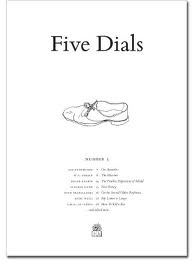
[READ: April 16, 2011] Five Dials #1

Five Dials is an online magazine.  It is free to subscribe (and to download).  All previous issues are available on the site in PDF format.  I learned about it because they printed the eulogies for David Foster Wallace in Issue 10.  But the magazine looked interesting in itself, so I decided to go back and read the whole run (the most recent issue is #18).

The only real complaint I have with the magazine is that they don’t put a publication date anywhere on it.  Which is a shame if you’re anal retentive like me. According to Wikipedia, the inaugural issue came out in June of 2008.   It’s a monthly (ish) publication and, although I originally thought it would be a literary magazine, it proves to be very much of a magazine-magazine.  And a good one at that.

There’s a letter from the editor, there’s Current-ish Events, there’s essays, reviews and even fiction.  There’s also a “classic” letter from a “classic” author.  The magazine also has some very cool black and white art in it.  The style is very crisp and one that I find quite agreeable. (more…)

Read Full Post »

SOUNDTRACK: RADIOHEAD-The King of Limbs (2011).

I finally had a chance to really listen to this CD and I have some mixed feeling about it.  It doesn’t excite me as much as previous Radiohead releases have and yet, at the same time I can’t stop listening to it.  But I find that I’m listening to it a lot as background music, so I haven’t been able to fully appreciate what’s happening on all the tracks.  Now that I’ve really listened, my appreciation for the disc is higher, although I don’t find it as overall exciting as In Rainbows.

The opener, “Bloom” is a really spare song.  And although I like it, there’s a part of me that wonders almost what’s the point of making an electronica song that is so spare when many others have done much the same.  (It’s interesting to me that iTunes declares that this album is in the genre Electronica).  Of course, with some closer listening, there are some interesting Radiohead things happening, but for me the album doesn’t really start until “Morning Mr. Magpie,” a wonderful weird little song with a great opening guitar riff and excellent use of noisy drumming.  The drumming is really amazing.  It seems to be off-beat and then it speeds up to get on the beat–in every line!  Disorienting and compelling.  But it’s the guitar, I think, that was really missing from the opener.  (Of course, having said that I did like Radiohead’s previous forays into electronica that was sans guitar).

“Little By Little” proves that you can make a weird electronica song that is full of crazy noises and still have a supremely catchy chorus too.  “Feral” is, as far as I can tell, an instrumental (there are lots of sounds that could be voices, but I’m not sure).  It also features one of the great spooky keyboard type sound in a Radiohead song.  Its pretty cool.

“Lotus Flower” is the “obvious” single from the disc (and the radio by me is actually playing it!).  Even though it’s not radically different from the rest of the album, it stands out as the most melodic, the most catchy, the most, well, “single.”  It’s really great.

“Codex” slows things down with, if not a traditional piano ballad, something of a traditional Radiohead piano ballad.  My 5-year-old son made his first venture into music criticism when this song came on.  He said: “Why are you listening to a sad song?”  And when I asked if he liked sad songs he said, “No, sad songs make me feel sad.”  This is a pretty sad song, but it has Thom Yorke’s vocals of redemption pulling through at the end, even while the song retains its sadness.

My son really liked “Give Up the Ghost” though.  He said it sounding like the music at the end of a film, in fact, he was certain it was the music from the end of The Land Before Time movies. (That song is actually a James Horner song, sung by Diana Ross called “If We Hold On Together”).

The final song is a more drum filled track.  Yet despite the manic percussion, the song itself is actually kind of mellow and slow.  It’s pretty much a quintessential late Radiohead song.  Clark’s final review came with this song: “I love this song!  It sounds like someone bonking bananas on your head.”  So there ya go.

So overall, I enjoy the album, but I don’t think it will have as much staying power for me as their other discs.  It’s also surprisingly short (about 35 minutes–although just the other day they released two more tracks).  However, having said that, I’ve since listened again, and I find that I notice something new with each listen, so maybe it will continue to grow and grow on me.

Two of the more interesting things on the album though are the liner notes.  I can’t imagine what inspired, “A big thank you very much indeed to Drew Barrymore”.  And I’m intrigued at “Fluegelhorn on “Bloom” and “Codex” performed by Noel Langley and Yazz Ahmed.”  I’m intrigued that a) there is a fluegelhorn and b) that they needed two people!

[READ: April 10, 2011] The Universal Sigh

This “newspaper” was distributed at some record stores around the world as a tie-in to the new Radiohead album’s release in hard format.  I found out about it from my friend Lar.  He comments that he is too old to be hanging around in the streets waiting for this kind of titbit, and I couldn’t agree more.  He is too old.  As am I.  So it’s nice that there’s a digital version of the paper available.  (Remember when Radiohead snuck little things like this into the backs of their CD cases?)

Now just what is this thing?  Well, it is a newspaper of sorts.  There is a tenuous connection to Radiohead (in other words if you didn’t know they made it, you wouldn’t find out from looking at it). But the main focus seems to be environmental causes.  (Which means that since I printed out the PDF, I have undermined the band’s intention of producing a low carbon footprint product–but hey at least I printed it double-sided). (more…)

Read Full Post »

SOUNDTRACK: WAVVES-Live at the 9:30 Club (2010).

Wavves opened for Best Coast (what a great double bill).  Wavves play a raucous, rowdy set of bratty punk.  Unlike Best Coast, the lead singer seems like he might be something of a jerk.  But it played pretty well into the personality of the music (sloppy, abrasive).  And I wonder just how many times he said he was drunk?

Personalities aside, the was a really fun set.  I have the newest Wavves album, but I think their live show was more engaging.  For all of their sloppiness, the band was always together, with no missed notes (except when the drummer was apparently not paying attention).

They play 16 songs, including a cover of Black Flag’s “Nervous Breakdown” (which the play very well).  And even if you’re not won over by the singer’s personality (which is kind of funny), you’ll be won over by the simple, punky music.  You can listen here.

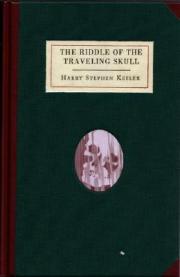
[READ: March 29, 2011] The Riddle of the Traveling Skull

This is the 4th book in McSweeney’s Collins Library Series.  It’s the final book in the series that I’ve read and I have to say that once again, Paul Collins has blown me away with this selection.  Collins apparently stopped his library after 6 volumes.  I wondered if there were more coming, but the Collins Library website is rather confusing.  There’s an almanac with updates as recent as March 1st, and yet the Biography of Paul Collins says: Paul Collins is currently on tour in support of his memoir, Sixpence House, which recounts his time spent living in the Welsh town of Hay-on-Wye, known as the “Town of Books.”  But Sixpence House came out in 2003 (and it sounds awesome!).

Anyhow, back to this book, which was my favorite of the bunch.  It is a genuine mystery from 1939.  Indeed, Harry Stephen Keeler was even more prolific than Agatha Christie (they were born in the same year).  The thing about Keeler though is that his stories are, well, crazy.  Many of his stories were just his attempts to meld disparate ideas into one story.  He includes crazy dialect.  He seems to have no concern for conventional storytelling.  Indeed, he has little concern for conventional mystery storytelling (in one of his stories, he introduced the murderer on the last page).

And this story has similar improbable elements.

In sum: Clay Calthorpe, a salesman returning from the Philipines picks up the wrong bag on the trolley.  When he gets home he finds a skull inside it.  The skull has a name plate affixed to it, a bullet inside it and, in the wads of paper that are keeping the bullet from rattling around, he finds the carbon copy of a poem. (more…)

Read Full Post »

Bolaño’s poems had a pretty powerful effect on me.  Not the content so much, but just how powerful and not precious they could be.  This is not to say that Bolaño is the only one who writes like this at all–I had just locked poetry out of my life for so long, that this was a nice wake up call.

And so, I have written this poem as a thank you.

(more…)

Read Full Post »

SOUNDTRACK: BEN FOLDS-University A Capella (2009).
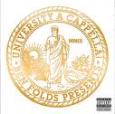
The story goes that Ben Folds heard some a capella bands and decided to give them some airtime.  So he had them record a bunch of his songs.

I have been surprised at how much I enjoy some kinds of a capella music.  Ed Helms’ stuff on The Office is certain fun, but on a more serious level, it’s amazing what these singers can do with their voices in terms of diversity, range and even sounds.

But at the same time, it’s the lead vocalist on most a capella tracks that sell the song.  And, on this disc there are a lot of lead singers I don’t like. Part of it is because I don’t like R&B vocal stylings, which I find too over the top at times.  Although I do admit that there;s one or two on here that work very well.

Overall, I enjoy this disc.  It’s fun to hear different interpretations of songs that I know and like.  Although I think realistically its the songs that Ben himself sings that I enjoy the most.

[READ: April 25, 2010] Romantic Dogs

This is the final Bolaño book that I’m going to read before finishing 2666 (Savage Detectives you’re next).  And it happens to be a collection of Bolaño’s poetry.

I have a complicated relationship with poetry.  I have written (and had published) a few poems.  I dated a woman who was (and I suppose still is?) an excellent poet (hi, Paula).   When I worked for a literary magazine, I learned how to judge poetry.  And yet, I don’t really read it.  And I think the reason for that is that, in my head, poetry deserves more attention than I’m usually willing to give it.  I feel like a poem should be pored over, read and re-read and, if good enough, memorized.

I have memorized about two poems in my life.  And since I often don’t feel like devoting a ton of time to poems,  I just don’t really read them.  And that’s a shame for me, because while poetry does demand a closer look, it’s not a precious item that should be put on a pedestal and looked at only when company comes over.

And Bolaño is as good a poet as anyone to demonstrate that. (more…)

Read Full Post »

SOUNDTRACK: THE DEAD MILKMEN-Chaos Rules: Live at the Trocadero (1994).

It wouldn’t be a complete look at the Dead Milkmen without mentioning their one live release.

Chaos Rules is a surprisingly good live set (taken from two separate concerts).  They had to leave all of the songs from their Hollywood Records discs off this collection, so this comes across more as a classic concert rather than a comprehensive one.

The band sounds great and the songs sound pretty close to the originals.  Not that the originals were hard but it wasn’t always obvious whether the Milkmen were doing what they were doing on purpose.  This set suggests that they were.

As any good live band, they play around with their songs, being surprisingly angry about local politics and changing the (by then twenty year old) “Bitchin Camaro” intro to reflect that.

The only reason it would have been nice if they had been allowed to include some of the Hollywood Records songs (they do sneak one in under a different name) would be to see if they played them any differently.  Since the early tracks are pretty chaotic, I wonder what would happen to the latter, more mellow songs.  Did they stand up under the weight of the nonsense or did they become more ramshackle as well?

I guess I’ll never know.  This is not essential by any means, but it is an interesting artifact for the curious and is totally enjoyable for DM fans.

[READ: April 23, 2010] Distant Star

Because Bolaño never does anything typical, this novella is a spin-off of sorts to Nazi Literature in America.  The introduction states that “in the final chapter of my novel Nazi Literature in America I recounted, in less than twenty pages and perhaps too schematically, the story of Lieutenant Ramirez Hoffman…which I heard from Arturo B.  He was not satisfied with my version…So we took that final chapter and shut ourselves up for a month a half in my house in Blanes, … where we composed the present novel.  My role was limited to preparing refreshments, consulting a few books and discussing the rest of numerous paragraphs with Artuto…”

Okay, there is so much wonderful deception in just this introduction to this book it totally cracks me up.  (Arturo B has long been a stand in for Bolaño himself). In the original, the narrator is named Bolaño (he is the narrator in jail who eventually helps the detective locate the poet).

For yes, the story is the life of a poet who is also a murderer.  And, the story is pretty much the same as the 20 or so pages of Nazi Literature.  It is now an extended meditation on this particular poet.  All of the events that were present in the short version are here, they are all just fleshed out with Bolaño’s wonderful details and full biographies of other characters.

The big, weird thing though is that almost all of the names have been changed (to protect the guilty?).  So even though the poet of this book has the same exact  life story as Lieutenant Ramirez Hoffman, he never has that name in Distant Star (and he goes through several pseudonyms).  There are twins in the short version who now get new names.  Even the poetry teachers have different names.  However, the detective who hunts him down at the end has the same name.  Weird.

The book works as a critical assessment of the Allende administration (which is why the real Bolaño was imprisoned).  But on to the story. (more…)

Read Full Post »

« Newer Posts - Older Posts »