Feeds:
Posts
Comments

Archive for the ‘NPR/PRI/PBS’ Category

SOUNDTRACK: MAC MILLER-Tiny Desk Concert #773 (August 6, 2018).

Man, I hate Mac Miller’s delivery on “Smaaaaaall Worlds.”  The way he drags out those words, the fact that his mouth i full of gauze,  The way he pauses from time to time which makes it seem like he forgot the words.  Although as with a lot of rappers at Tiny Desk, the live band including Alexander “Justus” West (Guitar) and Kendall Lewis (Drums) really make the music sound good.

The best part is when Thundercat comes over decked out ion his colorful regalia and plays the shaker midway through the song.  And when Mac acknowledges Thundercat on the shaker–why is Mac’s speaking voice so much clearer than his rapping voice?

Mac real name Malcolm James Meyers McCormick is pretty funny when he’s just talking, too.  I was wondering how a young guy I’d never heard of could be so cocky at this Tiny Desk, then I saw

With nearly a decade under his belt at 26 years old, these words ring like an artist twice his age.  We were introduced to Mac Miller via 2011’s XXL Freshman Class, which featured a special crop of MCs such as Kendrick Lamar, Meek Mill and YG, all of whom are now considered in the upper echelon of hip-hop. After his big splash, he’s been able to find a groove and consistently release quality rap records, ultimately keeping his name in the conversation with the other young greats. These consecutive triumphs amassed plenty of fame, fortune and insurmountable obstacles, causing a stumble here and there. Throughout the years, however, Mac has brushed himself off and put it in the music.

The real star of “What’s the Use” is Thundercat on bass.  I don’t even follow the words I’m so focused on Thundercat’s amazing six string bass work.  And when Thundercat sings “I Just Wanna Fly” and takes a credit, it wins over the room.

The other bassist Joseph Cleveland is also great, when Thundercat trades off for the final song.

For the final song, “2009” he says he wanted to have strings on this song but they couldn’t travel with strings.  So they sent the music to these guys (Robin Fay-Massie (Violin), YaShauna Swan (2nd Violin), Lelia Walker (Viola), Melanie Hsu (Cello)).  They just played it for the first time 20 minutes ago.  The strings are lovely with the piano (Javad Day).  The music deserves better than his lame drawl for a vocal line.  Even if the lyrics are introspective and “mature.”

[READ: November 11, 2018] “The Poor Girl”

F. Scott Fitzgerald kept a notebook for stories ideas.  This story comes from idea he never wrote about.  Nunez and other authors wrote stories from these ideas for McSweeney’s 22.  I didn’t write about individual stories in that post, so I get to here.

Nunez chose”Girl marries a dissipated man and keeps him in healthy seclusion.  She meanwhile grows restless and raises hell on the side.”

And she conveys it well, with some delicious details.

This is told by a third party, a friend of the dissipated man.  He explains that Calvin Trent had been a writer, now well into his decline, when he met the girl (more…)


Read Full Post »

SOUNDTRACK: THE DEL McCOURY BAND-Tiny Desk Concert #771 (August 1, 2018). 

I have really grown to like bluegrass a lot over the years.  And yet I still dislike country.  Never shall the twain meet.

Del McCoury is a bluegrass legend, singing, playing guitar and writing songs for the past 60 years, including his days with the “father of bluegrass,” Mr. Bill Monroe. The Del McCoury Band itself is 50 years strong, and these days includes Del’s sons Robbie on banjo and Ronnie on mandolin and vocals. All are astonishing players, here joined by the five-time award-winning fiddling of Jason Carter and this year’s International Bluegrass Music Association bass player of the year Alan Bartram.

The Band plays three songs (their session runs to nearly 20 minutes because Del talks a lot between songs!).  As the blurb notes:

These are story songs; Del is, of course, quite the storyteller, taking his time between them to reminisce. At 79 years old, he’s got a lot of them tell.

For their visit to the Tiny Desk, the group brought along some traveling songs. The first (of two) train tunes, “That Ol’ Train,” comes from their new album Del McCoury Still Sings Bluegrass, while their closing gospel tale “All Aboard” is a staple from 2001’s Del and the Boys. The other (a motorcycle song), “1952 Vincent Black Lightning,” was written by another master of his craft, British folk icon Richard Thompson, and has been a part of Del’s repertoire for a while now. It shows not only the deep connection that bluegrass has to British folk music, but also Del McCoury’s willingness to keep his sound fresh all these years on.

“That Ol’ Train” is a great introduction (for me) to the group.  The song sounds timeless, even though it is new, with the age old sentiment: “I’d cover every mile of track / I’d bring my baby back / and put a happy ending to this song.”  There’s a wonderful set of solos.  Fiddle then banjo then fiddle and then mandolin solo.  The fiddle player is really amazing, even making the instrument sound like a train whistle.  And the harmonies are pretty sweet as well.

There is a moment, near the top of this Tiny Desk concert — when three voices gather ’round a single microphone to deliver the chorus of “That Ol’ Train” — that is so pure and beautiful

Del introduces the band.  He mentions that Jason Carter has won fiddle player of the year countless times.  But he didn’t win this year.  I don’t know what happened to him.

On the banjo is his son.  He has a new album called “The Five String Flamethrower” because when he plays at night with low stage lights he plays really fast and you can see sparks on the strings because uses metal picks.

He talks about his son on mandolin.  Back in 1983, they were going to tour Europe and he wanted to bring his son along while he was still in high school.   The principal called Del in to talk about the show wondering where they were going.  Del told him, British Isles, Germany, Holland and more.  The principal said he would allow Ronnie to go and he;s not going to have to make up any work he’ll learn a lot over there.

Del says his boys have their own band The Travelin’ McCourys who released an album on the same day at heir bluegrass Festival in Cumberland, Maryland.  Richard Thompson was there this year.  And they played the following song together (which Del and his band have been laying for years).

“1952 Vincent Black Lightning” is done on the banjo with a very different tone.  McCoury sings it wonderfully, but again, it’s doesn’t have the same tone, exactly.  But it still works.  The end of the song is banjo only, and it’s pretty amazing.

Before the final song, Del says, it’s just a little to early to sing.  We usually sing late night, at least 6 o clock. Then he says he has new strings on an old Martin guitar that’s why they’re out of tune.

Del says “I used to write songs myself but I got lazy because people in Nashville give them such good songs.”

“All Aboard” starts with furious banjo picking.  It’s intense and fast.  Del seems to be straining, but in a good way  as he sings the lyrics.  When the harmonies come in mid way through its really powerful.

I’m totally sold on Del McCoury and his family.

[READ: August 22, 2017] “An Evening Out”

This is a simple story with a lot going on in it.

The bulk of the story is about an American teacher in Bulgaria.  He has been there for seven years and has decided to call it quits.

So he is going out for the night with some former students, Z. and N.  There is much drinking.  Since he is leaving Sofia (the capital) they wanted to give him a real Bulgarian night out.

The teacher is very attracted to Z.–a forbidden thing in the country and a far more forbidden thing if he was his teacher (which he no longer is).  In fact Z. and N. both graduated some time ago.  N. had gone to America to be lawyer and had a miserable time.  Z, knew he would and even the teacher knew he would.  But that’s what N.’s mother wanted for him.  He tells them that after the bad year he has decided to student literature.  How did he convince his mother?

I just failed all my classes. (more…)

Read Full Post »

SOUNDTRACK: FLASHER-Tiny Desk Concert #770 (July 30, 2018).

I haven’t heard of Flasher, but the description of the band (noisy) makes me think I’d like them.  I’m also intrigued by the various guitar and bass lines.  The vocals are also really nice–wonder just how buried they are on record:

For its visit to the Tiny Desk, this young Washington trio set aside the distortion and worked up a semi-acoustic set of three songs — taken from its debut album, Constant Image.  Voices sometimes in unison, sometimes swapping leads, adding a shifting point of view to songs that, on record, give equal footing to a precise noise.

These three high school friends, Taylor Mulitz (guitar, vocals), Daniel Saperstein (bass, guitar) and Emma Baker (drums) have been bouncing around the D.C. punk scene of house shows and DIY venues for some time.

I rather got a kick out of this little “How Bob knows the band”

I’ve been aware of Taylor’s work for a while…in the potent D.C. band Priests; Daniel I’ve known (a bit) since he was a child, mostly from Hanukkah parties with his family (his mom was the executive producer at All Things Considered when I was the show’s director); Emma can be seen playing around town with another band, Big Hush.

I really enjoyed the stops and starts of “Pressure” I imagine it’s really fun when they rock.  It also has some really clever word play: “saving face / self-effacing / keeping pace / in a stasis.”  Most of the delicate harmony vocals come from the bassist (who is actually playing acoustic guitar), although when all three of them sing it sounds even better.

The interchange of electric and acoustic guitar works great on “XYZ.”  All three sing in tight harmony.

I love the way “Who’s Got Time?” seems to be constantly catching up on itself, like they are running out of time to finish the song–even though it never sounds like they are out of sync with each other.

Their overall sound is wonderful acoustic shoegaze.  At least at the Tiny Desk.

[READ: August 15, 2018] “A Refugee Crisis”

I didn’t love Wink’s last story (about killing cats), but I found this one fascinating because of how many elements were included here.

The narrator is a writer living in a place where one can cross-country ski regularly (Bozeman, MT).  The trail is mostly unused except for a guy who runs tours by dogsled–and there is plenty of dog shit on the trail to show where the sled went.

When he gets home, M is lying on his couch.  She says she let herself in since she knew the key was still under the mat.  She says she just came back from Serbia.  (She had been in Athens, Budapest and Frankfurt among other places).  The refugee camps there were really bad–people are trying to get across Hungary and the military is beating them, shooting at them.

She is twenty-three but looks forty and her personal hygiene is atrocious.  They have sex anyhow.  She says they can’t get pregnant because she already is–from a nineteen year old boy from Raqqa.  She didn’t tell the guy.  She is planning to get an abortion shortly. (more…)

Read Full Post »

SOUNDTRACK: LALAH HATHAWAY-Tiny Desk Concert #769 (July 25, 2018).

I have no idea who Lalah Hathaway is.  The blurb doesn’t really help, giving her familiar lineage but not much more.

Lalah Hathaway comes from royalty: Her late father Donny Hathaway’s … set the bar for inspired, old-school soul singing. But living in that kind of shadow can also be a burden, robbing the offspring of an identity apart from that of the famous parent.

This was by my estimation, the most boring Tiny Desk Concert I’ve seen.  The blurb raves about her once but I found it dull and flat.  Her lyrics were uninspired and the music was spare to the point of nothingness.

I always watch a Tiny Desk twice to see if I miss anything the first time.  This one was painful to watch twice. At least it was only 11 minutes.

The younger Hathaway’s appearance behind the Tiny Desk pulls back the curtain a bit for a close-up encounter with her powerfully expressive voice  [powerfully expressive?]

In “Change Ya Life,” Hathaway’s dusky contralto paints an exciting portrait of blissful cohabitation — but on her terms. “I’m going to teach you how to treat me like I deserve,” she sings, adding, “I’ll give you the world.” She draws on a tradition of romance and sensuality in the best soul music, but with a feminist twist that eschews old-school, male-centric lyrics and attitudes.

I like the feminist twist, but when a song has twinkling keys (Lynnette Williams) and a cheesy bass line (Eric Smith) the line “I can fuck around and change your life” just doesn’t seem to fit.

“Boston,” her ode to her second home (she’s from Chicago), is a meditation on self-discovery and longing. The band perfectly straddles slow-jam R&B and a jazz-ballad sensibility.

She was signed in college and told to move to L.A. because Arsenio is there (did she work with him?).  She wrote this song about Boston .  It’s a slow torch song type of song (tikki tikki drums) that name checks tons of Boston area locations (Charles River, Cambridge, Downtown Crossing)

So much of the most powerful music from the Civil Rights Era wasn’t about literal accounting of injustices; many of those songs enshrouded morality plays in the guise of romantic longing. Hathaway introduces the set-closing title track of her new album Honestly as an explicit reflection “of my country at this time.” If you heard it for the first time without the introduction, it comes across as a lover’s lament. But Hathaway’s soaring vocals infuse it with the passion of resistance to bring her set to a close on a hopeful, joyous note.

I love the premise of this song and how it was written.  But even a cool, angry song like this is so tepid.  She asks the audience to sing along to these great lines:   “I don’t even want you no more.  You can walk out that door.”  And you can barely hear them (and the audience is certainly loud between songs).  She does a little of that R&B vocal gymnastics that I dislike at the end just to cap it off.

Not my thing, I guess.

[READ: January 15, 2018] “Family Means Nothing to Me”

This is an except from a story called “Family Means Nothing to Me and I Dislike Children.” I can’t really imagine what the context of the rest of the piece is, but this is  a funny/honest appraisal of the narrator’s self.

She says she finds her nephews and nieces odious.

She has had pets in the past but when she breaks up with a boyfriend she makes him keep the pet. (more…)

Read Full Post »

SOUNDTRACKÓLAFUR ARNALDS-Tiny Desk Concert #767 (July 19, 2018).

Arnalds plays four songs in this Tiny Desk.  For most of them he uses his prepared piano.  But it’s prepared in a very different way.

“Árbakkinn” opens with Arnalds on the piano.  After about a minute, three of the four strings (Unnur Jónsdóttir (cello), Katie Hyun (violin), Karl James Pestka (viola)), enter the song followed shortly by Viktor Arnason on lead violin playing a haunting melody over the top.

Up next is “Unfold,” which is a bit happier a bit poppier.  It starts with pizzicato strings and has percussion by Manu Delago.   Arnalds at the electronic keyboard but when he plays it, the two pianos behind him start playing.  I’ll let the blurb fill in:

Somewhere about midway through this Tiny Desk, as Icelandic composer Ólafur Arnalds performed on his electronic keyboard, two upright pianos were playing lilting melodies behind him, absent any performer at the keys. …  About ten minutes into the performance Ólafur looked behind him at the two pianos, looked to the NPR crowd and said, “well I guess you’re all wondering ‘what and why,’ to which there’s no easy answer.” He hit the keys on his electronic keyboard and the two pianos behind responded with cascading, raindrop-like notes. “What I can say,” he continued, “is that I’ve spent two years and all of my money on this — to make my pianos go bleep-bloop.” What Ólafur was referring to is software that he and his coder friend, Halldór Eldjárn developed. A computer, loaded with this musical software (which Ólafur calls the Stratus system), “listens” to Ólafur’s keyboard performance and responds by creating patterns that are musically in tune with the chord or notes Ólafur performed.

So why do this? Basically, it’s a way to break out of the box musicians often fall back on as performers — the familiar responses that years of playing can reinforce. With that is the hope that the computer will create a response that is unfamiliar and, in some cases through speed of performance and the sheer number of notes played, impossible for a human to have made. So, it breathes new life into the music for the listener and the performer.

Arnalds can play the pianos while they are being remotely controlled as well, as he plinked out piano melodies while the computer was playing those raindrop notes.  The end of the song has a very interesting electronic tympani sound as well.

As the second song fades, “Saman” begins with Arnalds back at the piano to play this beautiful and haunting solo piano melody.

“Doria” is a tribute to Halldór Eldjárn the creator of the programming “and his beautiful code.” It was the first song he wrote using this new technology.  Arnalds plays the beginning on the keyboard while the other pianos play along.  The strings accompany him and then about half way through, while the pianos are continuing to play, he jumps in the middle and plays the main melody on one of the pianos.  It’s really quite lovely.

It was a gently stunning and memorable Tiny Desk. More of these creations can be heard on Ólafur Arnalds’ brilliant, fourth solo album re: member.

[READ: January 31, 2018] “Colin Kelly’s Kids”

This story was written after Elkin had a heart attack (he lived for almost 30 years after the heart attack).

The tale is basically one of an old man playing pickup baseball.  It had been a superb spring. This had been his fifth week playing and the teams (rotating payers every week) seemed to get used to him.  He wasn’t very good–had a lot of power but couldn’t connect.

But they did allow him to play first. He always played first whatever the teams, so he felt coldly like he was being traded to a new team each week–professional. (more…)

Read Full Post »

SOUNDTRACK: THE MIDNIGHT HOUR-Tiny Desk Concert #766 (July 18, 2018).

After a countdown of 1-2-3-4-5-6-7-8, Adrian Younge, with an undone satin bow tie, plays a cool melody on the keys.

Then the strings (Stephanie Yu (violin), Bryan Hernandez-Luch) ring out, followed by the bass notes from Ali Shaheed Muhammad in a blue pinstriped suit and deep violet Fender guitar.

Drummer David Henderson (in a rose satin shirt) adds some beats before the sax (Jordan Pettay) and trumpet (DeAndre Shaifer) add o the “sultry jazz fusion.”  That’s how “Black Beacon,” an instrumental with a great 70s vibe starts out.  I love it.

So who is The Midnight Hour?

After years of produced releases and jam sessions, A Tribe Called Quest’s Ali Shaheed Muhammad and composer Adrian Younge formed The Midnight Hour in 2018 and released a 20-track album of hip-hop, R&B and jazz.

Younge says that “In creating The Midnight Hour we selected singers we love.”  This leads to Loren Oden and Saudia Mills singing “There is No Greater Love.”  Again with an 8 point countdown, this song has a cool funky bass but the vocals have an authentic lite-FM 1970s vibe that I don’t care for, although the accuracy is right on. It’s also really short.

Next up was 16-year-old Angela Muñoz.  Younge says she reached out to them on Instagram and said “hey guys, I make music” and there was something about this girl that was real.   She wrote  a song and we wanted it to be a part of the album.  She plays “Bitches Do Voodoo” her vocals are great but terribly affected–she’s been listening to way too much pop music with a delivery like that.  The song is short and there are a lot of repeats of the lyrics “Don’t let her get your heart, shes doing voodoo in the dark.”  The problem for me is that ‘dark’ is pronounced: “dah-eye-ah-eye-ark”

The group ended with the hopeful and key-heavy “Mission.”  It opens with a cool bass line and rumbling drums.  And a quick shoutout to guitarist Jack Waterson.

I prefer the instrumentals on this album, they write some tasty music.  A final thought o the way out:

“You know what the best time to listen to this is?”

[READ: January 28, 2018] “Crepuscule with Mickey”

This is an excerpt from a longer story.  The narrator of this story is a “wise guy,” with accent and mannerisms to go along with it.  It feels crazy and over the top.  I found it a little annoying at first but I started to enjoy him by the end.

The popular press says he is an heir to the gambling empire of Bugsy (which nobody called him anything but Ben), Siegel, which I do not care to dispute because it would involve splitting hair.

They all say Mickey Cohen lives extravagantly. Well, he sees no point in personal discomfort.

Kids, as they say, is a pain in the tuchis by trade, and while those belonging to others is something I ordinarily do no care to become involved with and generally speaking I am….

greatly opposed to guys who stick their nose into the business of other families, as I grow older I find it a pleasure to extend my authoritativeness on account of longevity into realms I might have
avoided in my youth.

Two people have come to see him, they are desperate.  He is using his best manners–picking the couple up at the airport in a Fleetwood–a limousine being unsociable. (more…)

Read Full Post »

SOUNDTRACK: MUMU FRESH Feat. Black Thought & DJ Dummy-Tiny Desk Concert #765 (July 11, 2018).

I recognized Mumu Fresh from when she appeared at a Tiny Desk with August Greene a few months ago.  Mumu Fresh was a true highlight of that show–her rap was political and personal and powerful.

Here she’s got her own concert (and DJ Dummy is back with her for this as well).

A regal combination of black power and Native American pride, Mumu Fresh — also known by her birth name Maimouna Youssef — is an abundantly gifted singer and emcee who prances between genres and styles. The Baltimore native fuses her rich multi-octave range and ferocious rap delivery with spiritually inclined lyrics so potent and mindful they precipitated a wellspring of emotion throughout the room.

Mumu began her own Tiny Desk in her native Lakota tongue with “Ink Pata,” signaling a call to prayer in a sacred ritual. Looped tribal chants of her own harmonies set the mood as delivered a stirring spoken word performance that journeyed through her ancestral lineage to the struggles of the present day.

Her looping is outstanding–she harmonized with herself perfectly.  After a minute and a half she speak/raps/reads a lengthy piece that is really powerful.

With a buoyant and thoughtful spirit, Mumu and her band transitioned into the classic-sounding “Miracles” from Vintage Babies, her collaborative album with group mate DJ Dummy. Declaring it a celebration of soul music, she mixed sweet tender melodies with lyrics to empower those devoid of hope.

She introduces “Miracles” by saying, we are always waiting for something to happen.  But what if your miracle is waiting for you to be prepared: “the teacher arrives when the student is ready.”  It was great having live strings on this track: Chelsey Green (violin), Monique Brooks-Roberts (violin), Kevin Jones (cello) and the backing singers (Amber Harmon) gave an excellent soul sound.

This song segued into the awesome “Work in Progress.”  Accented by the feel-good chords of The Roots keyboardist Ray Angry, and Chris Dave (drums) and Romier Mendez (bass), Mumu speaks t he truth.  With some of my favorite lyrics:

I wanna be a good role model to girls coming after
but sometimes I slip up and say some shit that’s wretched
Forgive me, I’m a work in progress

I don’t give a fuck about what you’re saying to me.
If I’m too big for my britches then give me a sheet.
I need room to grow I’m still figuring it out,
If you say you ain’t, you lying–what you talking about?

and my personal favorite

I’ve been through so much shit I’m surprised I’m still standing
so every time I see a mirror I pose dammit!

The set concludes with a new version of “Say My Name,” a song Mumu wrote about Sandra Bland, who died in police custody in 2015, and the impact it had on her. Starting off with a 1950s doo-wop circle, she blends traditional soul elements with politically relevant lyrics.

It opens with doo wop vocals and lovely pizzicato strings:

If I should die tomorrow at the hands of the policeman
and the papers say, hey, we’re going to call it as suicide
would you even question why?

We watched a woman get drug out and beaten
filmed on a highway
and all y’all could say was black women too mouthy
I’m vexed searching my timeline
See if people find time to criticize and villainize, call that shit a suicide.
What if Sandra Bland was your child

Audacity of hope
to believe you can succeed when everybody and their momma say no
Well fuck y’all. I’m different descendant of the fittest
I’ve been reincarnated just so i can handle business.

Black Thought comes out for a final verse, but it’s hard to hold a candle to what Mumu just laid down.  His flow is great though.  And she even tacks on an extra verse after the credits.

[READ: February 1, 2018] “The Requirement”

I rather enjoyed this simple story, told simply.  It begins with the narrator talking about how when you get older, you lose people.  You don’t care about people who have died until people your own age start leaving.

He says that when people who mattered to him died, he began to feel something was required of him. If he could do it, he did, but sometimes he didn’t know what the requirement was.

When his good friend Bog Ellis got sick he felt a requirement but had no idea what it could be or how to do it.

She tells us some great Big Ellis stories. (more…)

Read Full Post »

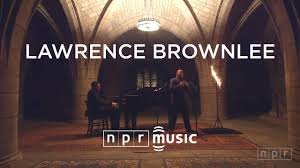
SOUNDTRACK: LAWRENCE BROWNLEE AND JASON MORAN-“There’s A Man Going ‘Round Taking Names” (Field Recordings, February 17, 2016). 

I know of Brownlee from a Tiny Desk Concert.  But this is a whole other order of magnitude.  He and pianist Jason Moran are playing a spiritual about death in an active crypt.

Brownlee’s voice is powerful and soaring, but full of anguish.  And Moran’s piano is so intense, especially at the end.  He plays the melody but he allows for a lot of overtones and echo to nearly overpower the music.

At the very end, he plays some high notes by literally chopping at the keys like a karate chop–powerful, sharp and dissonant.

Here’s the blurb for more context:

Opera singer Lawrence Brownlee is known for portraying kings and princes. But lately he’s been thinking about real people: Trayvon Martin, Michael Brown and Freddie Gray, to name a few.

He’s been thinking about the Black Lives Matter movement and an old spiritual called “There’s a Man Going ‘Round Taking Names.” Decades ago, singers like Paul Robeson and Lead Belly recorded it. Brownlee, with jazz pianist Jason Moran, revives the old song to tell a new story for the 21st century.

“Jason and I chose this song because we felt it accurately captures a growing sentiment that’s in society today,” Brownlee says. “So many senseless deaths of young African-American men.”

A crypt, they thought, would be an appropriate setting to perform their version of the song. So we took our cameras and microphones — and a lovely piano — deep into the active crypt below the historic Church of the Intercession in Harlem. The 1915 structure at 155th Street and Broadway is a New York City landmark and a dramatic setting for occasional concerts, including a December 2015 recital by Brownlee.

“I know that the ashes of the parishioners of this church are here in this crypt,” Brownlee explains. “You can feel the weight of death, you can feel the sting. It adequately captures the atmosphere, the somber mood that we are trying to capture with this song.”

In this arrangement, an already solemn song becomes even more dark and agitated.

“What [Jason] has done with the piano part has made it build, and you feel the unrest, the turmoil, the tension that is underneath,” Brownlee says. “This is something that is painful and difficult to deal with.”

Woah.

[READ: January 31, 2018] “Self-Portrait with Beach”

This is the story of an older couple who have been together for a while.

They go to the beach, she removes her top and asks “Is the body the house for the soul or are body and soul and one and inseparable.?”  He looks at her and says, “Your body is my soul.”

She laughs that his soul is bound for decay but he continues, ‘Nothing of you will decay as long as I am alive.”

Out of nowhere a man in white comes and offers his homemade beverages.  He says they have unique powers. (more…)

Read Full Post »

SOUNDTRACK: DUA LIPA-“Thinking ‘Bout You” (Field Recordings, August 31, 2016). 

The title “Field Recordings” seems to be a catchall for videos that they’re not really sure what to do with.  This video clip is from a show called Noteworthy (which ran all of ten episodes from July 2016-September 2016).

Dua does sing from the balcony [Watch Dua Lipa Perform ‘Thinking Bout You’ On A Balcony In New York City] and the sound is pretty great (I like that you can hear sirens at one point).   But the video is apparently clips from the documentary because there’s scenes of her walking around the city.

A day after performing “Hotter Than Hell” on The Tonight Show, rising pop star Dua Lipa performed another one of her songs, “Thinking Bout You,” for a much smaller audience: our Noteworthy video crew. Enjoy this extra from our Noteworthy documentary on Dua Lipa and be sure to watch the entire documentary here.

I can’t imagine why this particular singer whom I have never heard of in any other place has a documentary made about her.

Her voice is fine, a rough edged pop singer. And the song is pleasant enough.

[READ: January 31, 2018] “The Revisionist”

This is an excerpt from Mellis’ novel The Revisionist. And boy what a gloomy depressing book this sounds like.

The narrator’s last assignment was to conduct surveillance of the weather and report that everything was fine.  She was set up outside of the city in a lighthouse. She was tempted to take her own observations, so she did.

Now how about this for a paragraph

I saw a family driving to the country on vacation. Behind them, a bomb went off. Through my headphones, I noted the rushing sound of radiation cruising low across the land. The father, who was driving, saw the mushroom cloud in his rearview mirror. The others didn’t turn around, so they never noticed.

What? (more…)

Read Full Post »

SOUNDTRACK: LOCAL NATIVES-“Fountain of Youth” (Field Recordings, October 5, 2016). 

I know and like Local Natives, although I didn’t know this song.

In 2010, Local Natives came clattering into the indie firmament with the U.S. release of Gorilla Manor, an irresistible blend of in-vogue sonic signifiers like Afropop guitars, rich harmonies and the hint of a folk sensibility. In 2016, the band’s run has continued with the synth-heavy Sunlit Youth.

For their Field Recording, Local Natives played one of the singles off that album, “Fountain of Youth.” Though the recorded version is lush and electronic, Local Natives stripped the song to a driving core. The band played, and then it was off again — guitars in hand, headed for the evening’s show elsewhere in Brooklyn.

They sound great stripped to just two guitars and a tambourine standing on the water’s edge. [Local Natives Strips Down Its Sound For A Riverside Show].  I love this introduction:

The East River Ferry is a very fast boat. Local Natives came hurtling toward our crew up the river one overcast evening this summer, shouting three-part harmonies over roaring engines for a surprised clutch of fans. When the ferry docked, three of the band’s members hurried over to our pier off WNYC Transmitter Park to play this Field Recording.

I’m not sure which of the five Natives these are, but they harmonize wonderfully. And I really like that the main singer is playing his guitar while the second guitar is silent until later in the song when his higher notes are used as an excellent accent.

[READ: January 15, 2018] “Kinderscenen”

This was a fascinating story because of how much detail was given and how little plot there was.

This is the story of a boy, Toby.  It is written in a kind of childish third person, almost by a benevolent guardian.

Sentences like:

What he does know is how Daddy’s cigarette looks in the evening when sitting on a wicker chair with the other grown-ups softly talking in a row, he flips it away its red star tracing lopsided loops before shattering into sparks on the bricks.

In his heart he knows that this is the best town in the world.

In the story, Toby helps his mother garden (by lifting the prickery bushes “holding up the bushes’ skirts” which has a naughty sound that nevertheless doesn’t make it fun. (more…)

Read Full Post »

« Newer Posts - Older Posts »