Feeds:
Posts
Comments

Archive for the ‘NPR/PRI/PBS’ Category

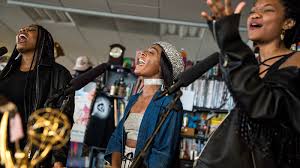
SOUNDTRACK: TECH N9NE featuring KRIZZ KALIKO-Tiny Desk Concert  #780 (August 29, 2018).

I am constantly amazed at how many rappers this show has on that I have never heard of even though they’ve been around for decades.  I’m not really a rap follower, but you’d think I’d at least have heard of them.  Tech N9ne has 20 albums out and he’s got a number 9 in his name.  I’d think I’d have heard of him at least.

During a career nearly three decades in the making, Tech N9ne has dodged the fickle rap industry while surfing his own wave, stylistically and professionally. The Kansas City native has been a beast for years now, a musical misfit who laid a track record of underground success and struggle before building his own independent empire with Strange Music.

Especially since he is awesome.  He and Krizz Kaliko performed the best rap Tiny Desk Concert I’ve seen. [“Together, they’ve carved out an unorthodox niche: chopper-style speed rap that often plumbs dark, emotional depths”].  The band is awesome.  The two of them are awesome and they have a great rapport with each other and the audience.

Their playful banter between songs personifies that creative connection, as Krizz delivers backing vocals and guest verses from the soul. Backed by a guitar, drums and bass for their Tiny Desk, the trio brought out the rock-tinged hues of such definitive Tech N9ne songs as “Dysfunctional,” “Aw Yeah? (interVENTion)” – dedicated to his mother who died from lupus in 2014 – and “Fragile,” originally assisted by Kendrick Lamar, Mayday and Kendall Morgan.

I also love both of their deliveries which is often fast (yet comprehensible) with excellent inflection to really let the words flow (is that “chopper-style speed rap”?).  It’s a great fun set (with some great metal-inspired guitars).  These start off with the first song, “Dysfunctional.”  There’s inspired lyrics, there’s funny lyrics.  I particularly enjoy this couplet

[They both rap] Listen they call me genius, I run the show
[Then Tech N9ne demurs shyly so Krizz can sing, with emotion] Women on my penis…. it’s wonderful

Krizz sings the chorus with a great heavy metal riff.  He also takes lead on the second verse with Tech N9ne supporting him.

After the song Tech N9ne says, Oh yea, the boy can sing.  He can rap too.
Krizz: I learned it from him.  he taught me something like this: “Dommmmmm inae.” which is a lead into

“Aw Yeah? (interVENTion)” this song has some great lyrics, powerful and political with a very cool Middle-Eastern-ish guitar riff running through it

They gotta suffer the penalty cause of our education
Nobody wanna say nothing but I gotta call it abomination
Pissed off thinkin’ what this cost
What these babies blood drippin’ for?
So I say in Latin, listen Lord!
Audire DOMINE! (Audire DOMINE)
Only way people are gonna be able to kill off a demon is
Pick up a gun and be ready to put it between him
My nigga be screamin’
Audire DOMINE! (Audire domine)

Who the hell a brother gonna trust when it’s always dishonor
Hate me like Obama
And I ain’t even gotta run and askin’ you the question: God what about my
Mama!

Tech N9ne asks for a moment, says he’s shaky.  Krizz explains: he lost his mom on my son’s birthday.  She’s been sick all of his life.  That’s a super emotional song

Tech N9ne segues: “That’s why I’m so “Fragile.”  This song is also excellent with some rapid fire delivery.  I also love hoe exposed he is:

Amateur writer dissin’
He’s a beginner and hopes for your demise, folks some may despise
Never do try to listen
It’s real, I’m mad
Clueless when you scribble on your pad
How you gonna criticize with a chisel on your nads sizzling your ad
You don’t really get why I’m so pissed? Understand this (Understand this)
I’m an artist, and I’m sensitive about my shit, yes I’m Fragile

To close the set, Tech and Krizz performed “Speedom (Worldwide Choppers 2),” a song inspired by folk rocker Richie Havens’ original classic “Freedom.” They laugh over Krizz’ excellent Richie Havens’ delivery.  It’s an excellent conclusion to a fantastic Tiny Desk.

Now off to investigate these guys some more.

[READ: August 31, 2017] “The Metal Bowl”

Miranda July writes strangely personal (but who knows if they are actually personal) and introspective pieces that are often overtly sad graphically sexual.  But she’s also not all that vulgar, even in a story about amateur porn.

It even made me laugh as the story begins.

He cupped the two halves of my tush and spoke directly to them.  “Run away with me, girls,” he whispered. She doesn’t understand our love.”

(more…)

Read Full Post »

SOUNDTRACK: THE McCRARY SISTERS AND THE FAIRFIELD FOUR-“Rock My Soul” (Field Recordings, September 20, 2015).

Hearing these eight voices intertwine so beautifully is wonderful (I especially love the bass voice).  Knowing how the voices are connected is pretty cool, too.

The original Fairfield Four was founded nearly 95 years ago in Nashville, and has remained relevant into the present day; many current listeners know the group from its appearance in the Coen Brothers’ 2000 film O, Brother, Where Art Thou? The McCrary Sisters are the daughters of the now-deceased longtime Fairfield Four lead voice, Samuel McCrary; together, they’ve made a major impact as that rare thing in a mostly masculine preserve, a female gospel quartet. To hear these voices perform “Rock My Soul” together is to feel the power of living history and the timelessness of family connection.

“Rock My Soul,” powered by their persistent clapping is just wonderful.  Their voices sound amazing, their harmonies are wonderful. It’s a joyful three minutes.

[READ: August 29, 2018] “The Wind Cave”

This is a somber story from Murakami.

It concerns a boy and the death of his younger sister when she was 12.  She was born with a malfunctioning heart valve and although she was never robust, it was still a surprise that she died so young.

His parents told him to watch over her, to look after her because she was so delicate.  The fact hat he couldn’t save her from death (no one could) has hung over him.

He hated seeing her in the coffin and he grew claustrophobic even thinking about her in that tiny box.  The symptoms didn’t start right away but occurred after he had been locked in a box truck.  He was working a part time job and was accidentally locked into the back of the truck when people wanted to leave early.  (Frankly I would think that might trigger claustrophobia more than anything having to do with his sister).

But now he can no longer ride in elevators or watch movies about submarines. (more…)

Read Full Post »

SOUNDTRACK: JESSE BOYKINS III-“4 U 2 B Free” (Field Recordings, October 8, 2014).

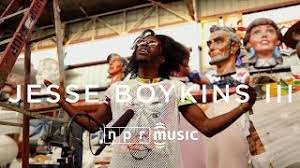
This Field Recording [Jesse Boykins III Breaks It Down] starts with a lot of ambient noise–a giant overhead fan–which I thought might be an interesting component to the song.  But once Boykins starts singing, it’s just his voice. And that’s all–it’s a lovely a capella performance.

The day after playing a set at the Superdome during the Essence Music Festival this summer, eclectic R&B singer Jesse Boykins III wandered into Mardi Gras World — an expansive, airy warehouse packed wall to wall with floats used in New Orleans’ infamous parades. The floats are built from the ground up in-house, so Boykins found himself surrounded by unfinished works and spare parts.

It’s creepy and unsettling to see these giant heads–eyeballs at eyeball height, but just a head–staring at you.  It’s also surreal with the various colors and shapes and the head of Abraham Lincoln looking on as Jesse sings.

He sang one of the most emotional tracks from his latest album a cappella. While singing “4 U 2 B Free,” Boykins pulled back the layers of his own creation, matching his performance to the exposed, oddly vulnerable characters surrounding him.

But Boykins’ performance is really powerful especially at the end as his wonderful high notes as if no no one is watching.

[READ: October 4, 2017] “Enter the Ford: Lost Chapters from A Death in the Family”

I knew nothing about this book, so I had to look it up.

The first chapter sees a young by, Rufus, waking up wearily with his dad.  The boy is very excited and the father seems pretty delighted to be awake with his son so early.  They try their best not to wake the baby girl or the mom.  Of course the mom wakes up and asks for the dad to do some things before he leaves.  The dad makes breakfast–with stern admonitions to the boy not get burnt by the coffee pot, bacon or stove–and then he helps the boy with the difficult buttons.

We don’t know too much about the dad yet, but this exchange is interesting:

“You’re getting pretty good, buttoning yourself.” he said.  Rufus said nothing.
His father thought damn fool thing to tell a child; dumb as a fish.

In the second chapter they head out to Chilhowee Park and the entire chapter is given over to the most exquisite descriptions of this amusement park through the eyes of Rufus.  Everything is amazing and wonderful and the language is of a person taking everything in–from the color of the lake to the swans on the water to the roller coaster and the fairy’s wheel.

And then came the merry-go-round.  We learn how first Rufus rode only on the bench.  And then was allowed to ride the horses that did not go up and down.  And then on the up and down horses only if his dad was holding on.  And finally, today, to ride the up and down one by himself.  The amount of detail about the merry-go round is wonderful.

The only thing more wonderful than the merry-go-round was the little train.  We hear his father’s kind words about how amazing the train is.

Then things go sour a little because there’s also the arcades–where adults play games of chance.  There’s games that one never won–like the seventeen jewel watch.  But the worst was a place where there was “a darky with his head through a hole.”  And the people were meant to, as the carny said, “hit the nigger in the head and you get a cigar.”

Rufus’ mom hated this game.  And Jay wasn’t too keen on it either.  The one time they were there, Jay conceded that the man’s got to make money some way.  Jay tried to ease his wife’s concerns by showing her that the ball wasn’t that hard.  He lifted it up but she refused to even touch it.  The carny got mad at him for touching the ball. And Jay got huffy back.  She calmed him and he walked away.

But on this visit, he did not back down. the carny did. And that made Jay’s day even better.

Chapter 3

This chapter opens with Jay and his wife, Laura, talking about something extravagant.  She wants it, he doesn’t seem to want it and he seems to twist her words against her.

It comes out that he wants to get a car so that they can visit the in-laws once in a while.  She is nervous that cars are dangerous.  He admits they are but sometimes living in a house is dangerous.  But he says that having a wife and kids means he will be even more careful than everyone else out there who has nothing to be careful about.

She agrees to the car.  But in the middle of the night she has a premonition of something bad happening to the family in the car.  He says that they won’t get one.  Then later she gets over the premonition and agrees that they should go ahead and get one.

Chapter Four.

And then daddy drove home in a gas buggy–a new ford  Rufus is thrilled.  Laura can’t believe he drove it there all by himself.  And the neighbors all come out to gawk.

“Course they got an awful name for breaking down… But where Ford’s ahead, he supplies you the parts.”

They go for a before-dinner ride.  Jay drives very well and everyone is enjoying themselves.  Laura is nervous and says so, but he is careful and considerate of them.  He pulls over when another car comes by and he is very cautious around a horse and buggy–the horse is not spooked at all.  But their joy ridge is somewhat ruined by a speed demon who comes buzzing by them scaring them all half to death.

As the excerpt ends, Jay and Rufus take the car out for a spin and Jay really lets the speed fly.  They almost have an accident but Jay is able to handle it and he confides in the boy that they must never tell their mom that they went fast.  He agrees.

I don’t actually know much else about this story.  Between the title and what kind of tension a scene like this builds I expected something bad to happen.  It never did (hooray), but i assume it does),

The writing in this story was exceptional.

Read Full Post »

SOUNDTRACK: STEVE GUNN-Plays Between the Ties of an Abandoned Railroad (Field Recordings, October 12, 2016).

I don’t know Steve Gunn and I am surprised to see that he has released fourteen albums and has worked with Kurt Vile.

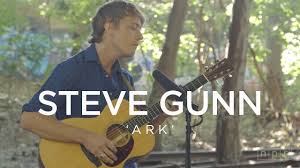
For this Field Recording, Gunn headed out to the woods to play three beautiful songs.

 In Forest Park, Queens, N.Y., an old relic suits Gunn’s sound. The Long Island Railroad’s Rockaway Beach Branch used to run through the park. It’s been abandoned for over a half-century, and trees have grown between the ties, skewing the rails and jarring the lines. Late this past summer, Gunn stood on the tracks of this worn American symbol and sang three songs off his latest album — songs about meandering, home and the crooked paths that take us wherever we’re meant to be.

Once again I am really impressed by the quality of the sound.  His guitar is absolutely clear and his voice is perfectly mic’d, but you can also hear ambient sounds–birds and such–making this recording unique.

Gunn has a pretty picking style (using thumb and fingers independently to get strums and picked notes simultaneously).  This enables him to keep the song moving forward while he plays the pretty guitar melodies.

“Full Moon Tide” has a great melody and a delightful chorus.

He walks further into the woods to play “Night Wander.”  It has a kind of circular feel in which the chorus feels like a part of the verse.  I’d say that Gunn’s voice is nothing special, but I like the deeper resonances he gets on this song.

For the final song, “Ark” he walks further down the tracks to a bridge.  Whether it is having the surface above him or just the style of his playing, this song feels warmer, and quite different from the others.

It’s a great introduction to this excellent guitarist.

[READ: January 9, 2017] “The Apartment”

This story is a fascinating look at a woman convincing herself that something must be true.

The apartment across from hers has been vacant for sometime–since the woman living there died.  But recently there was movement inside.  The person’s last name was Jahani.

Louise knew a man named Jahani when she was studying at Stockholm University.  Arman Jahani was the second man she’d slept with (her husband Martin was the first).  Martin, did not know about Arman.

While she is having lunch (sushi) with her adult son Jonas, she intersperses his conversation with memories of Arman.  The two most resonating thoughts are that he died in the early nineties and was survived by a son and a daughter.  Or so she believed.

She tells Jonas that the vacant apartment has been filled.  Jonas hasn’t lived at home for quite some time.  He wasn’t there when the woman died.  “You can;t imagine the smell” she tells him.  It was actually her husband who discovered her and was shocked that no one has mentioned the smell. (more…)

Read Full Post »

SOUNDRACK: T.I.-Tiny Desk Concert #780 (August 27, 2018).

Sarah asked me to describe trap music and I couldn’t.

So Wikipedia tells me:

Trap music is defined by its ominous, bleak and gritty lyrical content which varies widely according to the artist. Typical lyrical themes portrayed include observations of hardship in the “trap”, street life, poverty, violence and harsh experiences that artists have faced in their urban surroundings.

It’s interesting that the music isn’t really mentioned in this description.  Because it was the music that I was most attracted to in this Tiny Desk Concert.  The riffs and melodies are really interesting–especially in this concert in which he brought along high school students from a non-profit Atlanta Music Project, who put a classical twist on his street anthems, adding strings and brass in place of 808 bass.

Tip “T.I.” Harris has lived the last 15 years of his life on the big stage. Fans have watched him rise, fall and ascend to new heights again, remaking himself each step of the way. From dope boy to dope emcee. From inmate to activist. From reality star and box-office draw to real estate developer and film producer.

Rapping along to a group of high school string players instead of his classic tracks. Without his usual audio prompts, he kept lyric sheets close at hand while running through the definitive street hits “Rubber Band Man,” “What You Know” and the Billboard 100 chart topper featuring Rihanna, “Live Your Life.” He may have stumbled a few times, but when you’ve successfully reinvented your career as often as Tip has had to it’s probably hard to stick to the same old script.

This Tiny Desk Concert is barely 8 minutes long–one of the shortest I can think of and certainly the shortest for a major act like this.  I didn’t know any of his songs before this, so I was puzzled why each song appears to be barely a minute long (he is either using only his verses because he has guests on the record, or he is only doing a verse and chorus).

The first song, “Rubber Band Man” has a great melody–made even better by the live instruments.  But he seriously plays it for one minute (the band plays it for two).  After a verse or so he

kept his set funky with off-the-cuff stories of the drama behind his music — like the time when he found out, after shooting the video for “Rubber Band Man” with Puff Daddy, that his home had been raided by police. “This music was about the elements that people have to endure in their lives every day and find a brighter side and make a way out of no way,” he said. “That’s what this music represents.”

I love the melody of “What You Know” (I listened to the recording and like this version much better).  The crowd really responds to him as if he were a preacher.  Again, this is a short song, just a verse, and at the end he says he goes into the studio to  bring some soul and funk to get you through the day–to reach the best side of yourselves.

He is super polite and friendly and is very kind to the kids:  “That’s a true example that really says that you’re never defined by your environment unless you want to be,” Tip said, crediting the youngsters for their commitment to craft.

Introducing “Live Your Life” he says that Rihanna ain’t here so…and the crowd responds “we got you!”  It’s fascinating that his original songs are some 4 or 5 minutes long.  This one is reduced once again to a minute or so.

[READ: January 22, 2018] “Thirteen Dreams”

This is indeed a list of thirteen dreams.  They were translated from the Arabic by Raymond Stock.  The full book is described that in his final years, Egyptian Nobel Laureate Naguib Mahfouz distilled his storyteller’s art to its most essential level. Written with the compression and power of dreams, these poetic vignettes… telescope epic tales into tersely haunting miniatures.

I’m not sure why they chose these 13, but I’m summarizing without the endings.

Dream 105
All men get their beard trimmed at Uncle Abduh’s salon by a beautiful woman.  One day he was walking down the street and she came close to him.  He had to stare, but she soon turned into a block of wood.  When he turned around…

Dream 106
There was a coup d’etat and an older man said he’d heard such a thing once in his youth.  The dreamer said he knew who started the coup and he laughed with pride.  But the old man said he once laughed with pride about such things…. (more…)

Read Full Post »

SOUNDTRACK: DERMOT KENNEDY-Tiny Desk Concert #779 (August 24, 2018).

NPR likes Dermot Kennedy (they made him one of their Slingshot artists for 2018).  The thing that they seem to like about him is what I didn’t.

He has a powerful raspy voice–he could sing for miles.  A voice that works wonderfully with a style of music (folk or rock, primarily).  But the songs I’d heard from him were tinged with hip-hop.  And, frankly, it’s hard to work a powerful singing voice and hip-hop into the same verse.  So to me, it didn’t work, it was like the worst of both worlds.

But at the Tiny Desk, he removes all of that with a live band and, as the blurb says, a gospel choir.

Kennedy took this assignment seriously. The Dublin singer-songwriter wasn’t content with merely re-creating his songs as they sound in the studio, or stripping lavish productions down to simple acoustic arrangements. So he got himself a gospel choir.

More specifically, Kennedy and his band flew in from Ireland a day ahead of time to meet and rehearse with members of Washington, D.C.’s Howard Gospel Choir (Keila Mumphord, Taylor Nevels, Chamille Boyd, Jazmine Thomas). Every arrangement was painstakingly plotted ahead of time, so that every note would be perfect.

Two of the songs Kennedy performs here (“Moments Passed” and “An Evening I Will Not Forget”) pop up on an EP he released this year with hip-hop producer Mike Dean, and both sound radically different in this performance. They’re still forceful — and still centered on the singer’s elastic, bombastic voice — but also looser, warmer, more open.

And I suspect that’s why I like them much more.   Without all of that trapping, he sounds, yes, like Hozier or Glen Hansard.  And of course he was a busker.

They open with “Moments Passed.”  It was weird that the song and concert opens the way it does with the choir and Kennedy singing at the same time.  His voice is the centerpiece of the music and it was obscured not only by four other voices but also but a disconcerting echo effect (from Kieran Jones on keys).  But as soon as that ends, his voice works very well with the piano (Jonny Coote) and drums (Micheál Quinn).

And so when the chorus comes in and he songs his only lines while the choir sings, it works very well.  You can also hear his accent a lot more than other Irish singers, it seems.

“An Evening I Will Not Forget” has more of a hip hop delivery style, at least the way he sings, but he doesn’t try to cram it all in, he lets his voice and melody flow over the dense lyrics.  The song is one of regret and it works perfectly as just piano and his powerful voice.

After the song he jokingly asks for a towel and he laughs when he gets one (and gives it to Jones, “you;re a sweaty guy”).

For the final song, “Glory” he plays guitar on this it’s a pretty melody.  The drums are weirdly electronic and big and I like the big boom but not the ticky ticky electronics.  However, the high female voice in the chorus more than makes up for it.  The way all of the music swells together on this track is really terrific.

Sometimes you need to hear a musician live to really appreciate him.

[READ: January 3, 2017] “Gender Studies”

Sarah loves Curtis Sittenfeld, although I had never read her work before this.

I really enjoyed this short story both for its story and for its politics.

The plot is quite simple.  Nell is an almost divorced woman (she was with Henry for years with the intention of getting married, then he up and left her for a younger woman).  I really enjoyed this self-description of her and Henry “because of the kind of people they were (insufferable people, Nell thinks now).”  She is a professor of gender studies and is going to a convention in Kansas City.  Though she lives in Wisconsin, she has never been to Kansas City or even to Missouri.

The shuttle driver starts talking to her about donald trump.  He says “He’s not afraid to speak his mind, huh?”  And I love this description of her reply:

Nell makes a nonverbal sound to acknowledge that, in the most literal sense, she heard the comment.

Despite her obvious discomfort talking to him (when he calls Hillary “Shrillary” you know she is fuming), she can’t be bothered to say anything more than “There’s no way that donald trump will be the Republican nominee for President” (this was written after he was, of course). (more…)

Read Full Post »

SOUNDTRACK: CAMP COPE-Tiny Desk Concert #778 (August 22, 2018).

Camp Cope recently played PhilaMOCA, but it sold out so quickly I didn’t even have a chance of going.  Camp Cope plays a deceptively simple poppy punk that really allows the excellent lyrics to shine through.  I love the sound of Kelly-Dawn “Kelso” Hellmrich’s bass lines, which contribute a great melody while singer guitarist Georgia “Maq” McDonald plays a somewhat muted guitar, with a ton of power in here voice.

Camp Cope’s Tiny Desk performance opened — fittingly — with “The Opener,” a song about overcoming the obnoxious, exhausting and all-too-common sexism endemic to the music industry.

Great lyrics:

You worked so hard but we were ‘just lucky’
To ride those coat tails into infinity
And all my success has got nothing to do with me
Yeah, tell me again how there just aren’t that many girls in the music scene

It’s another all-male tour preaching equality
It’s another straight cis man who knows more about this than me
It’s another man telling us we’re missing a frequency, love ya Kelly

[Lyrics genius explains this last line: The bass lines in many Camp Cope songs, contributed by bassist Kelly-Dawn Helmrich, are played primarily in the upper register of that instrument, so there are few low bass frequencies in their music. On the average Camp Cope clip on Youtube, you can usually find a dozen or so dudes helpfully pointing this out in the comments.].

It’s a stunning and deeply gratifying performance; Maq lists off what exes, industry insiders and fellow musicians have said to undermine the band with a measured determination that sometimes tips into a full-throated, impassioned cry. Bands like Camp Cope get told they’re “just lucky,” that they “can’t fill up a room,” that they should “book a smaller venue.” But when Maq roars from behind the Tiny Desk, “See how far we’ve come not listening to you,” she makes it clear which voice deserves the attention.

I love the dismissive final line:

“Yeah, just get a female opener, that’ll fill the quota.”

The second song, “The Face of God” features complex guitar patterns from Maq and (at the start) a simpler bass line).  But once the song takes off, the bass starts throwing in notes all over the instrument.

is a stunning, delicate song about feeling lonely and distraught in the aftermath of sexual violence. It’s a standout from the band’s debut album, How to Socialise & Make Friends, and shows what Camp Cope does so well: using tiny moments of introspection to illuminate life’s bewildering, terrifying, isolating aspects — especially as they apply to women. You can hear equal parts conviction and desperation in Maq’s voice as she sings:

I saw it, the face of god
And he turned himself away from me and said I did something wrong
That somehow what happened to me was my fault.

Camp Cope must usually play more raucously live since after “Face of God” Maq  laughed, “We’ve never done this before — we’ve never been quiet. Not once in our entire lives!” Hellmrich joked that it was perhaps a “good lesson” to “rock out in your mind.”

The band closed its set with “Keep Growing,” an older track about autonomy and heartache.   It opens with Sarah “Thomo” Thompson’s drums, simply and direct and then Hellmrich’s bass is at the fore once again, playing a cool melody.

Elsewhere, it might be too easy to tune into Camp Cope’s powerful message and overlook the strength of the band’s songcraft. But at the Tiny Desk, you can’t miss it: Maq’s gargantuan voice; Hellmrich’s clever, melodic basslines; Thompson’s stoic drumming.

I wish even more that I’d seen them in a small venue while I had the chance.

[READ: August 21, 2017] “Dogs Go Wolf”

This was a peculiar story that felt like it was part of a larger story.  It felt incomplete and yet also that it had accomplished everything it intended.  Which was odd.  In the same way that the title makes sense but only when you think about it.

I enjoyed the way the story worked its way backwards.  Two sisters are on an island.  They are young (four and seven) and they are alone.  Even the dog that was with them has been strangely quiet lately.  The dog was mean and although they missed its companionship they weren’t sad to see it go.

The big sister tells the little sister stories to comfort her.  But they can only go so far when food is scarce, when the generator has run out and when they have little else to do.

(more…)

Read Full Post »

SOUNDTRACK:  YO-YO-MA-Tiny Desk Concert #777 (August 17, 2018).

One needs to say very little to introduce Yo-Yo Ma, probably the most famous cellist in the world.  He is here because he has recorded Six Suites for Unaccompanied Cello by Johann Sebastian Bach.  Again.  For the third time.

Obsessed or awestruck, artists revisit great inspirations because they believe there is yet another story to tell – about life, about themselves.  Cellist Yo-Yo Ma brought his great inspiration, and in turn part of his own life story, to an enthusiastic audience packed around the Tiny Desk on a hot summer day. Ma is returning, yet again, to the Six Suites for Unaccompanied Cello by Johann Sebastian Bach, a Mount Everest for any cellist. He has just released Six Evolutions – Bach: Cello Suites, his third studio recording of the complete set and is taking the music on a two-year, six-continent tour. Ma’s first recording of the Suites, released in 1983, earned him his first Grammy.

Certainly one of the most brilliant cellists of modern times, he’s also a thoughtful, curious humanitarian, with an endless thirst to understand, celebrate, and connect disparate cultures of the world.

He plays three pieces from the Suites

J.S. Bach: “Prelude (from Suite No. 1 for Solo Cello)”  It is so beautiful and familiar, it sounds amazing on his cello.  he says “This was the very first piece of music I started on the cello… when I was 4 years old.  One measure a day.  It’s not painful to learn something incrementally.”  He describes how he recognized that the second measure was similar to the first and the third was just a variation.  He says, “I lived with this music for 58 years (plus 4, that’s my age).”

Ma has played the music for 58 years and along the way it’s become something of a practical guide to living, pulling him through hardships and celebrating times of joy. “It’s like forensic musicology,” Ma told the Tiny Desk audience. “Embedded in the way I play is actually, in many ways, everything I’ve experienced.”

J.S. Bach: “Sarabande (from Suite No. 6 for Solo Cello)”  The sarabande comes from many places.   All of these places have claimed it:  Guatemala, Mexico, Moorish Spain, via Portugal or Morocco.  He says the sarabande is the heart of the suites.

It has served dual purposes, Ma explained. “I’ve played this piece both at friends’ weddings, and unfortunately also at their memorial services.”

J.S. Bach: “Gigue (from Suite No. 3 for Solo Cello)”  He says for the last piece at the Tiny Desk, I’m going to play a tiny jig.  He says Bach goes from old dances to folk or popular dance.  Here is this German composer working a jog into the third suite.

The exuberant “Gigue,” from the Third Suite, with its toe-tapping beat, reminds us that Bach was far from a stuffed wig. Such is this sturdy, versatile and benevolent music, offering a full range of the human condition.

Ma is happy to teach the listeners what he is doing, to share the joy and love of music.  Sometimes literally

As soon as he arrived at our office to play, Ma unpacked his cello – a famed 1712 Stradivarius – and immediately handed it over, with his bow, and said, “Here play something.” It didn’t matter that I’d never held a cello. It was just another one of Yo-Yo Ma’s warm and welcoming gestures, another way to open up music to anyone and everyone.

It’s all beautiful!

[READ: August 27, 2018] “Ways and Means”

This story tackles sexual harassment at the workplace from an interesting angle (and is written in a great, fluid style that makes the story utterly compelling).

Hal (short for Haley-Ann, a name she always hated) is an engineer at a public radio station.  She was one of the first women to work in such a position and has been there for over a decade.  The story opens with her reading a public apology from an on-air personality, Oliver.  Oliver had worked at he station for over three decades and was a huge draw for both audience and pledges.

The apology went to everyone’s inbox and then went public.  She felt it was trite with words that he, Oliver, would never have said in real life like invalidated).

The accuser was unnamed but everyone in the building knew it was Molly, a 26-year-old podcast producer. (more…)

Read Full Post »

SOUNDTRACK: ERYKAH BADU-Tiny Desk Concert #776 (August 15, 2018).

I remember when Erykah Badu released “On & On.”  It was such a great, catchy song, but it felt really different.  And then I basically lost track of her.  I didn’t realize she was still making music (and she hadn’t made much) until 2008’s New Amerykah Part One was a huge hit.

So I hadn’t followed her transformation into an incredibly iconic and powerful woman.  Back in 1997 she wore large turbans.  Now, some twenty years later she looks amazing but also kind of scary–the pink eyeshadow and pale purple lipstick makes her look almost dead or perhaps reborn.  And when she points at the camera and stares “you tricked me,” watch out!

She sounds almost otherworldly as well.  Instead of the turban she has massive dreads (with butterflies in them).  She looks like an earth goddess.

Some folks around the NPR Music office said they felt an almost spiritual connection to Erykah Badu during her visit to the Tiny Desk. And that was before she and her band even played a single note. It came from the waft of earthly scents that followed in her wake, to the flowing dreads and clothes that hung on her like robes.

After her self-introduction, which included a rundown of her spiritual and creative aliases: Badoula Oblongata, Sara Bellum,  Silly E, Manuela Maria Mexico, Fat Belly Bella, she introduced her band, including on drums, “that’s my son, Seven.”  I’m just kidding that’s not Seven, his name is Delta 9.

The band, a collection of great jazz players launches into a brief (2 minute) version of 1997’s “Rimshot.”  She does some wonderful improv with it and it sounds terrific–particularly her voice.

For the song, Badu

play[s] with time — stretching it, stopping it, suspending it. Propelled by jazz chords on the piano and the steady pulse of the acoustic bass, the playful performance unfolded in the tradition of the best bebop.

She plays only one more track, a 12 minute panoramic song “Green Eyes.”  ….  It’s wide-ranging in scope and musical arrangement and brilliantly executed by the jazz and hip-hop musicians in her backing band. The story of heartbreak is striking enough, but her interpretation showcases her formidable vocal skills. By the time it was over, we were all just as emotionally and spiritually spent as she was from the experience.

There is so much in this song, it’s hard to take it all in.

It opens with a bouncy piano melody: “My eyes are green because I eat a lot of vegetables–it don’t have nothing to do with your new friend.”  A muted trumpet adds to the jazzy feel.  She hits a powerful high note and it feels like another short song, but the piano changes tempo and the song is only just getting underway.

I love the melody and the riff that follows certain verses.  Around 9 minutes into the show, the song feels like its ending again, but a flute picks up and the song moves along with a new urgency.  Until she says Wait and sings

Just make love to me
Just one more time
And then you’ll see
I can’t believe I made a desperate plea
What’s with me?

And the pain and power in her voice as she sings me is wonderful.  As the song nears its conclusion, she hits some incredible notes–showing just how amazing her voice still sounds.

Her music has been described as neo-soul, but to me this felt like old school jazz.  As the blurb concurs

Erykah Badu is an artist for the ages. To old-school jazz fans like myself, names like Nina Simone, Betty Carter and Shirley Horn come to mind as much as Billie Holiday because of Badu’s singular approach to a lyric. They all cut their own creative path and left behind a legacy that you can identify with just one note. Erykah Badu is on that same path, and one day her name will be mentioned along with the other Elders who share her spirit of musical adventure.

Erykah Badu (lead vocals), RC Williams (Keys), Braylon Lacy (bass), Cleon Edwards (Drums), Frank Moka (Percussion), Kenneth Whalum (Sax), Keyon Harrold (Trumpet), Dwayne Kerr (Flute).

[READ: January 19, 2018] “Why Are We in Zefra?”

This excerpt was published in Harper’s.  The blurb about the book gave some basic information, but it was on Karl Schroeder’s website that I found this more detailed explanation of the book:

In spring 2005, the Directorate of Land Strategic Concepts of National Defense Canada (that is to say, the army) hired me to write a dramatized future military scenario.  The book-length work, Crisis in Zefra, was set in a mythical African city-state, about 20 years in the future, and concerned a group of Canadian peacekeepers who are trying to ready the city for its first democratic vote while fighting an insurgency.  Both the peacekeepers and the insurgents use a range of new technologies, some fantastic-sounding, but all in development in 2005.  Needless to say, the good guys win, but not without consequences; the document explores everything from the evolution of individual soldiers’ kits to strategic considerations in world of pervasive instant communications.  The project ran to 27,000 words and was published by the army as a bound paperback book.

That’s pretty fascinating.

The excerpt was pretty compelling as well. (more…)

Read Full Post »

SOUNDTRACK: DAWN-Tiny Desk Concert #774 (August 10, 2018).

I had no idea who DAWN (all caps, please) was.  According to the blurb

Dawn Richard–who went by D∆WN for a while, and now just prefers DAWN–Dawn Richard has a breathless enthusiasm for shape-shifting pop music.  Her discography is a bedazzled collage of heart-bursting rave and extraterrestrial dance-pop — but for her Tiny Desk, the L.A.-based singer and producer strips three songs to just the essentials, illuminating the impeccable songwriting behind the wild combination of sounds.

I love the verses of “Waves,” about female empowerment.  The blurb says she transforms “the trap-laced anthem for “underpaid, underappreciated, undervalued and undermined” women into a classic girl group song, flanked by two harmonizing vocalists” (Kene Alexander and Chaynler Stewart).  The music is just not my thing at all.

I love this:

“If you feelin’ stress up in yo chest / Cause they forgot that you the best / Wave ya money,”

But really “wave ya money, wave, wave ya money?”

“Waves” is followed by two songs. Both “Vines (Interlude)” and a funky revitalization of “Lazarus,” speak to Richard’s mission to expand our preconceptions about who gets to make what kind of music.

I like the way “Vines (Interlude)” starts a capella.  But I don’t like the R&B vocalizing throughout.  The electronic percussion is pretty fun though–William DeLelles is working really hard to get those little dinky sounds–he’s also playing the “synth” with his drumsticks.

DAWN explains that she was on a huge label and is now totally indie–no label, no promoter, no nothing.  She says

“I find it interesting when you’re a brown or black girl and you try to do something beyond R&B and hip-hop, it’s not always cool,” Richard says before performing “Lazarus.” “They don’t get it. They think you’re trying too hard. They don’t know where to place you. I wrote this record because sometimes you’re misunderstood. You know exactly who you are, but everyone else can’t quite figure you out. I wrote this record for that person.”

It’s interesting that she jokes, “You’re a folk singer and they label you as alternative R&B.” This song is not alternative or folkie at all, although it does have some cool sounding electronics to start.  But once that guitar (Ben Epand) comes in, you know its back to pop.  I do enjoy when she gets some attitude: “you all could snap a little bit–you aren’t too cute to snap.”

So I won’t be listening to DAWN, but I hope others do.

[READ: February 9, 2018] “From the Desk of Daniel Varsky”

This story started out as one thing–a break up of a long-term relationship.  And turned into something else–the story of a poet who was captured in Chile.

As the story opens, we see that the narrator is thinking about the winter of 1972 when R had just left her.   He had vague reasons but said something about a secret self, that she didn’t buy.

Things got worse but then were okay.  The hardest part was when they lowered his grand piano out the window–it was his last possession and was so large it was like he hadn’t left:  “I would sometimes pat it as I passed, in just the same way that I hadn’t patted R.  The only difference is that R always did, eventually, speak.”

After a few day, she had a phone call from a friend, Paul.  He told her about a crazy dream involving César Vallejo (she and Paul were both poets and they bonded in class over the poets whom others hated).  In the dream, Vallejo had put a mud mustache on Paul’s upper lip. (more…)

Read Full Post »

« Newer Posts - Older Posts »