Feeds:
Posts
Comments

Archive for the ‘NPR/PRI/PBS’ Category

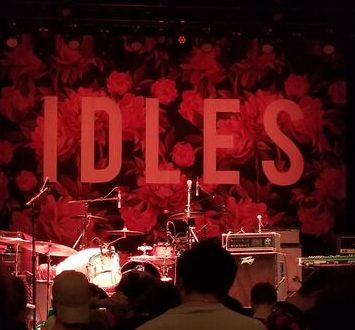
[ATTENDED: October 15, 2019] Idles

I learned about Idles through NPR (of course).  I can recall Bob Boilen talking about their live show (I think at SXSW) and how amazing it was.  He said that they were very high on his must-see list.  And since then I have wanted to see them.  When they announced the show at Union Transfer I bought a ticket immediately.

I never really understand how bands become popular over here.  Most people I know have not heard of Idles.  And yet this show sold out very quickly.  I don’t understand why, given how many other bands that I think are bigger don’t sell out.  Maybe Philly just loves punk.

I know that Philly loves a mosh pit.  And boy did they ever get one.  Well, technically it wasn’t so much a mosh pit as a pogoing, bouncing, swarming mass of bodies.  And lots of crowd surfing–including from the band!

I knew a couple of Idles songs pretty well, but I didn’t know a lot of their songs.  However, I knew their basic style: lead vocalist Joe Talbot kind of speak/sings/screams lyrics of disaffection and the band alternates between quiet sections and full-on mayhem. (more…)

Read Full Post »

SOUNDTRACK: DAN TEPFER-Tiny Desk Concert #885 (August 29, 2019).

Most of the time, a Tiny Desk Concert is an opportunity to see an artist in a quiet almost unplugged setting.  Sometimes, it’s an opportunity to see a band really show off in a close space.  And sometimes a Tiny Desk Concert will blow your freaking mind.

Like this one.

I have never seen anything like this.

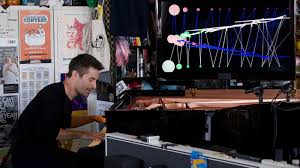
Dan Tepfer has created a program that plays the piano along with him.  It’s for a project he calls Natural Machines.

Watch the keys and you’ll see this Disklavier — a player piano — plucking notes on its own. But it’s not a prerecorded script.

Here’s how it works: Tepfer plays a note, and a computer program he authored reads those notes and tells the piano what to play in response. Tepfer can load different algorithms into the program that determine the pattern of playback, like one that returns the same note, only an octave higher. Another will play the inverted note based on the center of the piano keys. These rules create interesting restrictions that Tepfer says make room for thoughtful improvisation. In his words, he’s not writing these songs, so much as writing the way they work.

Tepfer plays free improvisation–he “makes things up and tries to be present in the moment” but the computer responds to him in real time based on rules.

He says for “Canon At The Octave” theres’ an axis of symmetry on the piano and “everything I play on one side if reflected on the other side.  Super simple, but it leads to musical problems that lead to real music.”

Since he is improvising, he is also reacting to what the computer makes.

He explains that “Tremolo” is when a note is repeated very quickly.  He gives the example of a violin player playing a note quickly.  It’s much harder on piano than a violin and it’s impossible to do more than ten notes at once.

He plays single notes that generate a series of chords playing quickly all at once–it’s really cool to watch the piano take off as if with a mind of its own.

But watching the piano isn’t the only cool thing

To better communicate what’s happening between him and the piano, Tepfer converted these audio-impulse data into visualizations on the screen behind him, displaying in real time the notes he plays followed by the piano’s feedback. [We dive even deeper into this project in a recent Jazz Night in America video piece].

He explains that these improvs are super short versions to show off how the programs work.

“TriadSculpture” is all about harmonic ratios.  Pythagoras discovered that sounds work with whole numbers.  The math behind music.  So Tepfer has mapped numbers as a 3-D object and he has been printing them–even more mind blowing.  The computer program generates these shapes–  everything he plays on his left hand creates those shaped in real time on the screen.

Perhaps the trickiest part here, unlike a human-to-human duo, is that the computer plays along with 100 percent accuracy based solely on Tepfer’s moves. He compares it to dancing with a robot that never misses a beat. Tepfer has to play in kind to keep the train on the tracks, but if he falls out of step, so does the computer.

Fortunately he never falls out of time (or at least it’s hard to tell since it’s all improvised.

The final piece is “Constant Motion” in which he plays a note and the computer responds to it by playing a note either up or down.  This creates a fun fast piece that explores the full range of the piano.  The visuals for it are very cool too.

I’m not sure if this would be fun to see live (at least any more fun than an improvising pianist is) because listening to it you don’t always really know what’s happening or that the piano is doing the work.  But seeing it up close like this is awesome.

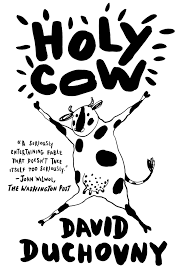
[READ: August 21, 2019] Holy Cow

Like most people, ever since watching The X-Files, I’ve liked David Duchovny (why don’t you love me?).

I watched some of the Red Shoes Diaries just for him.  I watched some of Californication just for him (Didn’t have whatever network it was on, so never watched more than a bit of it).  But I’m always willing to give him a shot because I think he’s smart but goofy.

Enter Holy Cow.

This is Duchovny’s first novel and just what a pitch it must have been.

Hi, this is David Duchovny.  Yup, that one.  I’d like to write an adult book about a cow that wants to go to India once she finds out cows are worshiped there.  Yes, David Duchovny.

I had no idea he had written this book.  I just happened to see it on my library shelf when I was looking for something else.  The book was short and had (terrible) drawings in it and seemed like it would be absurdly funny.

So, with the caveat that if you think that a talking cow buying a plane ticket and going to Jerusalem with a pig and to Turkey with a turkey sounds stupid and juvenile.  Well, you’d be right.  But you’d be missing out on an enjoyable, silly romp if that kept you from reading it. (more…)

Read Full Post »

  SOUNDTRACK: THE-DREAM-Tiny Desk Concert #886 (August 30, 2019).

I had never heard of The-Dream and couldn’t imagine why the name was hyphenated.  Turns out The-Dream is an R&B singer with a kind of gentle falsetto (not too high, but higher than expected).  The blurb says: “The-Dream delivered his lyrics with that signature high-pitched whisper, just shy of a falsetto..”

He’s also written hits

for the likes of Beyoncé (“Single Ladies”) and Rihanna (“Umbrella”).

and apparently he is a big deal.

R&B hasn’t sounded the same since The-Dream changed the game. Maybe growing up off Bankhead on Atlanta’s west side gifted him with a hip-hop swag native to the soil. Indeed, it’s worth remembering that he preceded the current era of melodic, sing-songy rappers who disregard traditional lyricism for raw, heart-rending delivery.

All three songs here are about getting into the bedroom as one might guess from the title of his album: Ménage à Trois: Sextape Vol. 1, 2, 3.

The first song “Bedroom” (calling all bodies to the bedroom) is soft and steamy.  It’s also got some humor

All ladies read before 11
So you got all day to get your mother-n’ nails done
I know you soak that thing ’round 7
And it’s already 4, go get your mother-n’ hair done
Ooh, you look so sexy
Come and bless me

[I found out later that these lyrics are cleaned up for Tiny Desk].

There’s gentle horns from DeAndre Shaifer and Theljon Allen (trumpet) and Elijah Jamal Balbed (saxophone) and a smooth bass line from Justin Raines.

He is also amusing at the end of the song:

“It’s kinda hard to sing like that with the daylight out,” The-Dream said after finishing the first number in a steamy set of songs more appropriate for the bedroom than the sunlit cubicles of NPR.

“Back In Love” has more simple echoing synths (from Carlos McKinney) and spare drums (from Larone “Skeeter” McMillian) and with some clever rhyming:

I miss that body in the hallway
I used to meet that body in the foyer
If you were right here, we’d have to skip the foreplay

and

I was mad at you, you was mad at me
C’est la vie, arrivederci
Still, all I loved was you

“I Luv Your Girl” is a less of a sexy song and more of a stealing-your-shawtie kind of song.

I hate the adenoidal “ahhhhh.” that apparently indicate sex, but the lyrics are pretty funny nonetheless.  Actually in looking at the actual lyrics I see that he has really made himself more PG-13 than X-Rated on these songs.

And she runnin’ Fingers through her hair, tryin ta call her over there but she like, Na Na Na Na!
She drop it down to the floor, I’m sayin shorty you should go, and she like Na Na Na Na!

Those na na’s are an amusingly safe version of the actual lyrics.  And after listening to the actual song, I found even the original to be kind of funny-while he’s stealing your woman.

As with a lot of R&B I prefer the Tiny Desk version because it’s much less produced.  Of course I still don’t know why there’s a hyphen in his name.

[READ: October 14, 2019] “Sinners in the Hands of an Angry God”

This is a dark story (very Joyce Carol Oates) about the environment and how you can no longer flee to the country to get away from pollution–or worse.

It begins enigmatically with

“This matter of the mask for instance.”

Luce sometimes wears the mask–a half mask, green gauze mask–but never outside of the home.  She wore it any time the wind “smelled funny,” “smelled wrong.”  Especially from the industrial cities to the South.

She removes it if Andrew comes home. When he sees her he claims she is “catastrophizing” (Is that even a word?). (more…)

Read Full Post »

SOUNDTRACK: A-WA-Tiny Desk Concert #8876 (September 3, 2019).

I knew of A-WA and had seen them in a South X Lullaby this year.  But  that song was performed quietly, with just a guitarist.  This session is full band with all kinds of dancey accouterments.

Liron, Tair, and Tagel Haim [left to right] are behind my desk with a full band of keyboards, bass, guitar and drums, singing more forlorn tunes in their unique three-part harmony.  Their songs mix Yemenite and Arabic traditions with splashes of reggae and hip-hop.

These songs also have the lyrics translated at the bottom of the screen.  Since Bob says the songs are sad, I haven’t been reading too much, just enjoying the melodies [I’ll let Bob talk about the song in brackets]

The first song is “Habib Galbi” (“Love of My Heart”), [a heartbreaking song that went viral for A-WA in 2016].

I don’t know much of anything in the languages they are singing, but back in 1988 Israeli singer Ofra Haza released an album that I really liked and one of the great songs was “Galbi.”  So here it is again and it means “mt heart.”

‘Habib Galbi” opens with Middle Eastern melodies played on a synth (by Noam Havkin)–it’s a cool combination of traditional and modern almost futuristic.  It even has some electronic percussion (from Tal Cohen) and some great bass from Nitzan Eisenberg.  I love that there’s an occasional “Woo!” and lots of hand claps.  It is so dancey, how can it be heartbreaking?

 A-WA have recently released a second album, Bayti Fi Rasi (in Yemenite it means My Home is in My Head). The record tells the story of their grandmother traveling from Yemen to Israel.  The final two songs come from that recent album.

The second song “Al Asad” (“The Lion”) has the reggae feel in with the staccato guitar and a cool guitar solo from Yiftach Shachaf.  It “is a metaphorical tale of facing down a lion in your path.”

Once again, their movements and tone belie the story, as they move so almost sensually to the music as they sing (in fairness, it’s hard not to).

The last song “Hana Mash Hu Al Yaman,” (“Here is Not Yemen”) features some amazing rolling of r’s as they sing–I’m thinking it’s the word for “wheat.”  Once again, despite the music, this song

paints the struggles of coming to a new land, learning the language, finding work, a place to live and making it a home.

Although this song starts out more somber, as the song moves on it picks up a more danceable beat with more interesting synthy sounds.

I couldn’t help but be interested in the lyrics for this one with the way they sang “wheat” I had to find out what the rolled r word was.  This led me to see “Land of wheat and barely, grape and olive / fig, pomegranate date and home.”

And then further on:

Where will I stake a home? (You have a tent for now)
Or at least a small shack (along with four other families)
And here I will raise a family (Don’t let them take your daughter)
I’ll find myself a job with an income (either in cleaning or working the earth)
And I will learn the language (Lose the accent)
With time I’ll feel like I belong (Here is not Yemen).

Dang, draw me in with fun music and beautiful voices and then wow me with powerful lyrics.  Well done, A-WA.

[READ: September 3, 2019] Herbert’s Wormhole

We listened to this book on our summer road trip.  When I saw that it was a novel “in cartoons,” I decided to check out the print to see if it was any different as a story.

The cartoons certainly add to it. The drawings are done in a very stylized way (by Rohitash Rao).  The cartoons are indeed very cartoony but that befits a story about squid aliens who wear fake mustaches and toupees.

I’m glad I listened to the audio first because it was fun having the experience of hearing the Australian accents in my head while reading the text.  I’m sure I could have imagined the accents myself, but since Jonathan Davis did such a good job, it was nice having them in place.

The other interesting thing is how much I evidently missed during the listening (if you’re driving you have to pay attention to the world around you as well).  So the book version filled in some details that I clearly missed and a few things made a bit more sense.

The opening is fairly simple: Alex Filby is 11 years old and loves video games.  He is just about to defeat all the aliens in Alien Slayer 2 which is pretty great,.  Except he promised his parents that when he beat the game, he would stop playing video games for the summer and start playing outside.  So when he destroys the final alien, his parents tell him that they have set up a play date with the weird kid next store: Herbert Slewg. (more…)

Read Full Post »

SOUNDTRACK: THE TALLEST MAN ON EARTH-Tiny Desk Concert #888 (September 6, 2019).

I watched the first Tiny Desk Concert from The Tallest Man on Earth about five years ago and I’ve been a fan ever since.  He looks pretty different than he did back then.  But that’s because even though I watched it five years ago,

It’s 10 years almost to the day since we published The Tallest Man On Earth’s Tiny Desk in 2009. What I remember most about that performance was the intensity of Kristian Matsson and how astonished our audience was to discover him. I think of it as one of our very first viral videos.

It wasn’t viral for me in 2009, but I did really enjoy it.

Since then I have planned to see him on two occasions.  Back in 2018 I had a ticket for him at Union Transfer, but I wound up going on a Boy Scout hike that weekend.  This year, on October 2, he was supposed to play the Met Philly, but he cancelled the entire American tour.

So, maybe in 2020, it will finally happen, especially since he doesn’t live in Sweden exclusively.

The Swedish singer now splits his time between Djurås, Sweden and Brooklyn, N.Y., and has just put out his fifth studio album titled, I Love You. It’s a Fever Dream. 

I don’t honestly recall what first attracted me to his music (his voice and guitar playing, i suspect) although this observation is fascinating:

I think Kristian Matsson’s words are more focused, more observational and more appreciative of life than in the past.

I suppose it would have been interesting if he played one song that he played ten years ago to see if he did it any differently.  But it’s probably better that he plays three new songs with C.J. Camerieri on French horn and muted trumpet.

“What I’ve Been Kicking Around” opens with his fast finger-picking–there’s really quite a lot going on in this song.  He plays this one on electric guitar  and C.J is on French horn.  His voice is gruff but inviting with a vaguely Bob Dylanesque delivery.  There’s something about the way that minimal French horn accompaniment fills in the spaces between the songs that allows him to play his complex fingering and the song still feels full.

For “I’ll Be A Sky,” he switches to acoustic guitar and C.J. plays muted trumpet.  His fingerpicking style doesn’t change, but the song is a lot warmer.  I love the way he delivers these lines almost conversationally

I feel that I’m a little lost most of the time
But I don’t really mind, oh, when my heart feels young
I travel through the storms but then I hang to dry
And I don’t really mind, oh, when my arm is in the rain and the sun

For the the final song “”The Running Styles of New York,” he switches back to the electric guitar.  He has to tune it and jokes that he was trying to dumb it down by bringing fewer guitars.  The song

begins with, “I hear beauty in things / Like the neighbors return / To their love and pride / Their day like a wicked ride / But then to belong.”

Continuing with the muted trumpet, C.J. plays some solo melodies while Kristian plays his complicated fingerpicking.  There’s some really lovely harmonics on this song, too.

I hope all is well and he’s able to tour again soon.

[READ: August 14, 2019] Gone with the Mind

I’ve enjoyed most of what Mark Leyner has written to varying degrees.  He tends to be an over-the-top satirist of himself, of pop culture and of concepts like the novel.

He wrote two novels and three collections of short stories in the 1990s, was celebrated and vilified and then kind of disappeared.

He was primarily writing for magazines and TV and stuff behind the scenes.  Then he came back in 2012 with The Sugar Frosted Nutsack which I have yet to read.   Then he wrote this one.  I grabbed it from work a couple years back and finally got around to it and it was much like what I was expecting and miles away from what I imagined.

The book beings with an introduction from Mark’s mother Muriel.  She is reading aloud and explains that she is coordinating director of the Nonfiction and the Food Court Reading Series at the Woodcreek Plaza Mall.  She thanks various people for giving them such a nice location at the mall as well as the sponsors Panda Express, Master Wok, Au Bon Pain, Auntie Anne’s Pretzels, etc. (more…)

Read Full Post »

SOUNDTRACK: DAMIAN ‘JR. GONG’ MARLEY: Tiny Desk Concert #889 (September 8, 2019).

I’m not sure if everyone with the last name Marley becomes a singer, but it sure seems like it.

I had not heard of Damian “Jr. Gong” Marley before, but of all of the Marleys, I think I like his music best (he is Bob’s son).  I had no idea where the “Jr. Gong” came from, but the blurb helpfully says “Jr. Gong” is after his father’s nickname of “Tuff Gong.”

Even though the blurb describes the music as reggae, this set is pretty far from what I consider reggae.  Some components of reggae are there, but it’s mostly in his delivery (and accent) and the backing female vocals–from Roselyn Williams and Sherieta Lewis.

But the main element of reggae–the beat/rhythm/staccato guitar–is completely absent.

“Slave Mill” starts with delicate keys from Sean “Pow” Diedrick.  The song is catchy with great lyrics.  I really like the percussion from Courtney “Bam” Diedrick.  I assume those are brothers known as Bam and Pow, which is great.

I like that the blurb addresses the issue of Bob Marley and yet I feel like Damian is his own musician, with a distinct (if slightly familiar) voice.

Damian’s father cast a giant, magnificent shadow on the world and it can’t be easy to follow in those footsteps as a songwriter and musician.  Damian seems to be undaunted by that legacy and instead draws on it for inspiration and guidance. Not to mention there is more than a hint of his father’s unmistakable singing voice that so often preached the same messages of self-identity and self-determination that his youngest son is now doing so successfully.

He says the second song “So A Child May Follow” is one of his favorite tracks on the album.  He thinks about his nephews and nieces who are young adults now.  The song:

addresses the troubles youth confront around the globe and how to persevere to succeed.

It’s an acoustic ballad.  I like watching Bam play, because after each piano melody, he stops and pounds his fists in the air as the song pauses and resumes.  The main verses features a gentle acoustic guitar from Elton “Elly B” Brown.  It’s a lovely song of optimism in the face of trouble.

They end the set with “Speak Life” which “sums up the message of his music: live a life that will enable us to survive life’s slings and arrows with dignity and love.”

speak life and lead a humble and meek life.

All three songs feature great bass work by Shiah Coore.  I also really love the backing “woah ohs” in the song.

Damian says that they made a video of this song which was shot in Ethiopia and is subtitled in Amharic.  He says that as Rastas, Ethiopia is very close to their hearts.

The end of the blurb makes me wonder if I would enjoy the recorded versions less, since that what I enjoyed so much:

But what makes his music stand out on this session is the prominence of the acoustic guitar and piano in the arrangements, which makes the familiar sound somewhat new.

But he is very charming and funny and he ends the set talking about boxing Babylon vs Natty Dreadlocks.  Then he shouts, “We did it boys.  In the big leagues baby!”

[READ: July 21, 2019] This Was Our Pact

I really enjoyed this graphic novel.  S. had told me about it and told me I’d really like it.  She was right!

The pact of the title is simple.  There are two rules: No one turns for home and No one looks back.

The narrator is Ben.  He is one of five young boys who have made this pact.  The pact revolves around the Equinox Festival, in which the townsfolk send hundreds of lanterns down the river.  Every year a group of kids hopped on their bikes to follow the lanterns.  Usually everyone petered out.  But this year they were going to go all the way. The wondered, “Did they really journey far into the stars, like the old song sang?”

The boys set out following the lanterns.  As soon as they head out, they are followed by, “nerd alert!” Nathaniel.  None of the boys (except Ben) is friendly with him.  Even when Nathaniel says his mom made Rice Krispie treats, they don’t turn around and let him join.

The imagery of the book is beautiful.  It’s largely in blues because the story takes place at night.  The lanterns are little white spots in the blue and black rivers. (more…)

Read Full Post »

SOUNDTRACK. COME FROM AWAY: Tiny Desk Concert #890 (September 11, 2019).

When I first heard about story of Come From Away, I was intrigued.  Could you make a musical–a musical–about the events of September 11, 2001?

At the end of this performance, the narrator says that this is really a story about September 12, 2001.  And that is true.  And the story is powerful and fascinating and really really interesting.  And yes, the music is fantastic.

So is this story about the attacks?  No.  The story is set

In the aftermath of the Sep. 11 attacks, 38 planes carrying thousands of passengers were grounded in remote Gander, Newfoundland in Canada for five days. The creators of Come From Away traveled to Gander 10 years later and collected the tales that make up the musical.

In Gander there’s an expression that, if you’re visiting, you’ve “come from away.” The people of Gander took in the come-from-aways, and their stories have resonated with audiences worldwide. The Broadway cast recently celebrated 1,000 performances and there are simultaneous productions running in London, Toronto, Melbourne and a national tour.

I listened to the soundtrack when it was streaming on NPR.  I was able to get through about half of it–the songs were great and the kindness shown was incredible.  I have yet to hear the end and I sort of imagine I might try to see the performance someday.  So for now, I’ll just enjoy these excerpts.

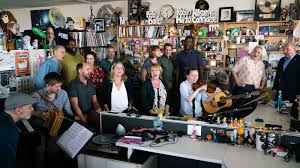
Sixteen performers from the Broadway production of Come From Away recently climbed out of a chartered bus in front of NPR and crammed behind Bob Boilen’s desk. They condensed their nearly two-hour show about the days following 9/11 into a relatively tiny 17 minutes. By the end of the diminutive set, there were more than a few tears shed.

In the show, the songs have full orchestration.  But here, the songs are played with great Irish instrumentation: keys, accordion (Chris Ranney); fiddle, fiddle in Gb; (Caitlin Warbelow); high whistles, low whistles, flute (Ben Power); bodhran, cajon (Romano DiNillo) and acoustic guitar (Alec Berlin:)

I don’t know who the lead vocalists are.  But two women take the majority of the songs.  And one of the men narrates the truncated version of the story.  The vocalists here include:

Petrina Bromley; Holly Ann Butler; Geno Carr; De’Lon Grant; Joel Hatch; Chad Kimball; Kevin McAllister; Happy McPartlin; Julie Reiber; Astrid Van Wieren and Jim Walton.

They sing five tracks:

“28 Hours/Wherever We Are” sets the stage–people were on the planes for 28 hours–just imagine that.

“I Am Here” is wonderful. The way the singer has to interrupt herself as if she were on a phone call–it’s a great performance.

“Me and the Sky” is based on an interview with Beverly Bass the first female pilot for American Airlines.  She was flying from Dallas to Paris when she was grounded.  It’s an amazingly personal story–I’ll bet she loves it.

“Something’s Missing” is a song I hadn’t heard before. It’s amazingly powerful–the reactions of people who returned to New York and New Jersey to see what they didn’t know anything about–and to see what’s left.  The most incredible line:

I go down to Ground Zero which… its like the end of the world.  It’s literally still burning.  My dad asks were you okay when you were stranded?  How do I tell him I wasn’t just okay. I was so much better.

They end with the uplifting “Finale.”

As one of the actors explains, “The story we tell is not a 9/11 story, it’s a 9/12 story. It’s a story about the power of kindness in response to a terrible event, and how we can each live, leading with kindness.”

This is a great tribute to not only Gander, but also to the victims of the attacks.

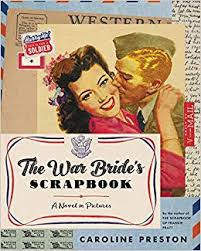
[READ: June 20, 2019] The War Bride’s Scrapbook 

Seven years ago, Caroline Preston created The Scrapbook of Frankie Pratt.

I summarized it:

it’s a biography of a lady named Frankie Pratt from the ten or so years after she gets out of high school.  She went to high school in Cornish, New Hampshire in the early 1920s; that’s when this scrapbook starts.  Over the decade, Frankie goes to college, gets a job in New York City, travels to Paris and then returns home.  That is the basic plot, but that simple summary does a grave, grave injustice to this book.

For Preston has created a wondrous scrapbook.  Each page has several images of vintage cutouts which not only accentuate the scene, they often move the action along.  It feels like a genuine scrapbook of a young romantic girl in the 1920s.

For this book, take that premise and move it forward twenty years.

This is the scrapbook of a woman, Lila Jerome, who was a bit of a wallflower, who then married a soldier just before he went off to World War II.  The book is structured in four parts: (more…)

Read Full Post »

SOUNDTRACK: RHIANNON GIDDENS-Tiny Desk Concert #891 (September 16, 2019).

I have been aware of Rhiannon Giddens for some time.  I knew she played the banjo, but I didn’t know much else about her.  I saw her (as part of an ensemble) at the Newport Folk Festival.

For some reason I was sure that she had performed a Tiny Desk Concert before, but evidently not.  Maybe I watched this when it came out?  That doesn’t seem right either.

So I’ll stop thinking about it and write about this Tiny Desk Concert instead.

There is an intensity to Rhiannon Giddens I could feel from the moment she arrived at the Tiny Desk, and her songs reflect that spirit.

Giddens is a founding member of the Carolina Chocolate Drops (and Our Native Daughters, who played at Newport), an old-timey string band.  But for this Tiny Desk Concert, she is accompanied by upright bass (Jason Sypher) and a whole bunch of other instruments played by Francesco Turrisi.

Giddens and Turrisi had recently collaborated on an album which World Cafe Live describes:

While Rhiannon’s work has focused on the influence of African traditions on what we think of as American music, Francesco is an expert in the often unacknowledged influence of Arabic and Middle Eastern music on what we think of as European sound. They found common ground in their quest to dispel false cultural narratives and turned it into gorgeous music on a new collaborative album called there is no Other.

For the first song, Turrisi plays banjo (although this one looks different from a typical banjo) while Giddens sings and Sypher adds deep slow resonating bass notes.

“Ten Thousand Voices,” the first song in the set, was inspired by Rhiannon reading about the sub-Saharan slave trade.

The combination of Giddens’ lyrics with Turrisi’s middle-eastern sounding banjo is wonderfully compelling.

She explains that the second song, “At the Purchaser’s Option”

was inspired by the American slave trade and a New England newspaper ad in the late 1700s of a young woman “for sale” and her 9-month old baby who was “at the purchaser’s option.” Rhiannon Giddens’ thoughts of this young woman and how her life and her child were not under her control.

That is a pretty intense introduction and inspiration for a song.

Despite its weightiness, Rhiannon Giddens’ music is entertaining, and her voice, the melodies, and her accompaniment are engaging. But it is music infused with lessons and deep purpose — something all too rare in popular music in my opinion.

Turrisi switches to piano which really changes the texture of the music. Sypher plucks the strings on this songs which gives it a bit more of a “song” feel than a “composition” feel.  The chorus is also memorable both for the melody and the powerful lyrics.

My favorite track is the third one, “I’m On My Way.”

Rhiannon picks up a replica of an 1858 banjo for “I’m On My Way,” which she says helps her access her ancestors. “So much beauty and so much horribleness wrapped up together seems to be our story,” she says.

While Turrisi is certainly an excellent banjo player, it’s great to hear Giddens play as well.  Especially this fascinating fretless banjo.  Turrisi plays the frame drum–different from an Irish bodhran in that it seems to have snares in it.  The plucked bass along with the addition of percussion and the great banjo melody are just fantastic. When Sypher switches to bowing, for a solo, it adds a whole new dimension–especially when he slides all the way up the neck to get the highest note possible.

T final song is the gospel tune, “He Will See You Through.”  Giddens puts down the banjo again (awww).

For her closing number, she focuses on the beauty. “You can call it whatever you want, ‘gravity,’ ‘God,’ whatever. There’s a force that I believe in, and that’s what I focus on.”

[READ: July 3, 2019] “Stuart”

I love the way that this story unfolded.  It begins in one location and moves only a few blocks by the end.  But the kicker is that it starts with one character and ends with someone else.  It read kind of like an early David Foster Wallace story.

The story opens by telling us about two Greek immigrants working at a hot dog truck.  They are described in vivid (rather unflattering) detail.  While they get their food ready, three teenage boys walk up.  They are pretty much identical except for the color of their shirts  She describes them vividly as well.

They have man-sized hands sprouting from elongated, spindly limbs like the extremities of flamingos, and their feet are so huge they might be prehensile.  There’s nothing in the backside of their immense, baggy jeans.

They boys order hot dogs and ask for them quickly “before they fucking catch up with us, eh?” (more…)

Read Full Post »

SOUNDTRACK: NILÜFER YANYA-Tiny Desk Concert #892 (September 18, 2019).

I saw Nilüfer Yanya open for Sharon Van Etten.  I was pretty excited to see her because of all the buzz that I was hearing about her.  Her set was good, although I feel like she seemed a bit nervous (maybe not, who knows).

This past summer, I was happy to see she was playing at Newport Folk Festival, but we arrived too late to see her (bummer).

This Tiny Desk Concert doesn’t really make her music quieter–it’s pretty quiet to begin with.  Maybe not quiet, exactly, but restrained.

There’s a hush to the music of Nilüfer Yanya that made the Tiny Desk the perfect stage for her sound. On a hot summer day, the British singer and her band — made up of Jazzi Bobbi primarily on sax, Lucy Lu on bass, Ellis Dupuy on drums and Nilüfer on guitar and vocals — performed their three-song set with restraint and subtlety. At moments, the music felt like an eruption waiting to happen, though the suave, refined sound left an indelible vibe in the room.

Yanya plays three songs (all from her album Miss Universe.)  Only one of those song had I heard live.  And surprisingly to me, she didn’t play what I think of as her biggest hit (and the one I like most), “In My Head.”

The set starts with “Baby Luv,” her first single.  I like the staccato feel of everything in this song–from the guitars to her vocal style.  I also really like the gentle synth notes from Jazzi Bobbi.  Bob Boilen seems to really like the lyrics, although I don’t really get it:

“Do you like pain?
Again, again, again, again
Again, oh, again
Do you like pain?”

I thin what’s most interesting (and polariziang I guess) is her vocal delivery: “thickly accented, laid-back vocals”

I don’t know anyone who sings like Nilüfer, but I’m reminded of Astrud Gilberto singing bossa nova. There’s a sophisticated sensibility rough enough around the edges that I find captivating.


I really like the chord progression of “The Unordained.”  There’s a lot more jaggedness in the middle section with some cymbal crashes and loud chords.  Jazzi Bobbi plays a quiet sax solo over the end.

For “Angels” Lucy Lu moves to synth while Jazzi Bobbi intros with a jazzi solo.  This song builds the most and is the least spare of her songs.  The end of the song includes some nice backing vocals and more of Jazzi’s quiet sax.

[READ: October 6, 2019] “Shape-Ups at Delilah’s”

This is a story about a barber.  A lady barber!

It starts with the barber, Tiny, giving her boyfriend Jerome a haircut.  Jerome’s brother was beaten up and hospitalized and Jerome bawled his eyes out.  Tiny made him sit on a stool and while he cried, she sheared his knotty beads for two hours.  His hair looked great.  And they were both spent.

He looked in the mirror and his eyes said Where in the hell did a woman, a W-O-M-A-N, learn to cut like that? (more…)

Read Full Post »

SOUNDTRACK: Y LA BAMBA-Tiny Desk Concert #893 (September 20, 2019).

It used to be that no one was invited back to play a Tiny Desk Concert.  The rules have been relaxed somewhat as of late (I would have thought that maybe they’d wait until 1000 shows).

The blurb explains why they (she) was invited back though.

Luz Elena Mendoza has such a far-reaching creative spirit that it’s almost impossible to confine her to a single musical identity. Which is why she’s one of just a handful of artists who’ve been invited back to the Tiny Desk to offer a revised musical vision.

Y La Bamba was on back in 2011 and they played a more acoustic style of music–accordion, percussion, guitar and lot of singers.  For this show, lead Bamba, Luz Elena Mendoza looks quite different.  In 2011, her hair was black and long, here it is silver and short–the neck tattoo is the same, though.

When she was here last with the band Y La Bamba, it was a vocal-heavy, folk outfit. The band’s sound has always been about vocals and her music has become even more so over the years.

Back in May, Y La Bamba played Non-Comm and Mendoza was pretty confrontational.  She is less so here, allowing the music to speak for her.

And the music is quite different.  It’s almost all in Spanish this time.  There’s a second guitarist (Ryan Oxford), a bass (Zachary Teran), and a drummer (Miguel Jimenez-Cruz).  She also has two backing singers, Julia Mendiolea who also plays keyboard and Isabeau Waia’u Walker.

I knew that Y La Bamba was the project of Mendoza, but i didn’t realize she did everything herself:

Y La Bamba’s albums are meticulously crafted sonic treats with her vocals layered like a choir made with a single voice. But in our offices, she called on vocalist Isabeau Waia’u Walker to replicate their distinct sound.

There’s a great variety of styles in this Tiny Desk.

“Paloma Negra” (“Black Pigeon”) [also played at Non-Comm] benefits from the voices of the entire band in a high-energy mediation on rhythm and voice.

It’s got a groovy, funky bassline and some cool echoing guitars.  There’s a tension in the verses that is totally relieved in the super catchy chorus.

This song segues into “Rios Sueltos” which is a kind of rap–but sung.  It’s bouncy and catchy but I sense is probably not a happy song, despite the catchy “hey ey ey heys” in the middle.

The song ends with a rumbling from Mendoza’s guitar as she starts up “Bruja de Brujas” [also played at Non-Comm].

There is a bruja energy and spirit to their performance, and not in the negative connotation that is the Spanish word for “witch.” In Luz Elena Mendoza’s hands a brujeria spirit is all about conjuring the kind of magic that took place on this video.

The song opens with a cool bass line and a somewhat menacing feel.  It starts quietly, but when all three vocalists sing together it’s really lovely.

At the end of the song she sinks to the ground to play with her effects as the song fades out with trippy sounds.   She jokes, “And aliens came down.:

Then she realizes, “we forgot to do one more.  Sorry the aliens did come down… and took my brain.”

The final song is the fantastic “Cuatro Crazy” [also played at Non-Comm].  It is sweet and pretty and has echoing guitars and a vocal style not unlike a Cocteau Twins song.  It even ends with a lot of “dah dah dah dahs.”

I really enjoy their music quite a lot and should really look into their stuff more.

[READ: October 6, 2019] “Abandoning a Cat”

This essay is, indeed, about abandoning a cat.  The cat story has a happy ending (although another one might not).  But mostly the essay is about how mundane events trigger memories of our parents.

He says that when he was little, his family had an older cat and they needed to get rid of it.  “Getting rid of cats back then was a common occurrence, not something that anyone would criticize you for.  The idea of neutering cats never crossed anyone’s mind.”

His father took the bike and he sat on the back with the cat in a box.  They rode to the beach about 2 km from their house, put the box down, and headed back.

When they returned home, they opened the door and there was the cat “greeting us with a friendly meow, its tail standing tall.”  His father’s expression of blank amazement “changed to one of admiration and, finally, to an expression of relief.  And the cat went back to being out pet.” (more…)

Read Full Post »
« Newer Posts - Older Posts »