Feeds:
Posts
Comments

Archive for the ‘NPR/PRI/PBS’ Category

SOUNDTRACK: …AND YOU WILL KNOW US BY THE TRAIL OF DEAD-Live on KEXP, March 12, 2009 (2009).

Back in 2009, …And You Will Know Us by the Trail of Dead had been hit by a truck.  Really.  Evidently no one was hurt too bad, but they did have to cancel a show in Salt Lake City. 

Nevertheless, they managed to get to KEXP to play a four song set from their latest album The Century of Self.  The opener “The Giant’s Causeway” is full of bombast and noise  and has a surprisingly catchy melody in the middle.  It merges into “The Far Pavillion” (just like on the album) which sounds like pretty typical Trail of Dead–rocking and yet melodic, with some good screaming parts.

“Luna Park” is something of a surprise to me as it’s a piano-based ballad (which I suppose Trail of Dead plays, but which I don’t associate with them).   “Bells of Creation” also opens with a piano, but it quickly grows very loud.  It’s a cool song with lots of depth.

I had actually stopped listening to Trail of Dead after Worlds Apart (and album I liked, but I guess the band fell off my radar) so it’s nice to hear they’ve still got it.  At least as of three years ago.

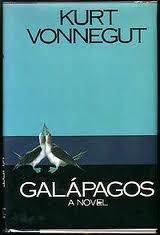
[READ: September 17, 2012] Galápagos

Each of these 1980’s era Vonnegut books gets darker than the last.  In this one the entire human race is wiped out (except for a few people who spawn what eventually becomes of the human race in a million years).  For indeed, this book is set one million years in the future and it is written by a person who was there, one million years in the past when the human race destroyed itself.  It’s not till very late in the book that we learn who the narrator is and, hilariously, what his relationship is to the Vonnegut canon.

In typically Vonnegut fashion, the story is told in that spiral style in which he tells you a bit of something and then circles back to it again later and comes back again later until finally 200 or so pages into the book you get all the details of what is happening.  Interspersed with the respawning f the human race (and flippers) is the story of the Adam and Eve and Eve and Eve and Eve and Eve who created the human race–how they got to be together, what their lives were like before and what contribution they made to humanity, such as it is now.

In another bizarre and fascinating twist, every character who is going to die in the near future gets a star next to his name so that the reader knows that that person is going to die.  We get a lot of things like ★Andrew MacIntosh for many pages until the character finally dies.  And pretty much everybody does die.  Well, obviously if it is set a million years in the future, but aside from that part, only a few of the characters survive.

So here’s how these few people managed to create a new human race in the Galápagos Islands.   (more…)

Read Full Post »

SOUNDTRACK: KISHI BASHI-Tiny Desk Concert #215 (May 10, 2012).

A few days after the concert at the 9:30 Club, K Ishibashi stopped in at the NPR offices to record a Tiny Desk concert.  The Tiny Desk  concerts are always fun–incredibly intimate and always well recorded.  He plays three of the five songs that he played at the 9:30 Club, and while they sound quite the same, there are little differences.

I find it very cool how similar they sound–since most of the sounds he makes are with his voice, it’s quite cool that he has that much control.  But I also like that he varies things a bit (although it sounds like a slightly flat note that plagues “Atticus in the Desert”).

What’s interesting is that although he doesn’t play things very differently, the feel of “I am the Antichrist to You” is quite different in the Tiny Desk setting.  I don’t really understand why, but it sounds very different, and equally wonderful.

Watching the Tiny Desk show is also neat–I’ve never seen anyone strum chords on a violin before.   And watching all of the technical adjustments is very cool too.  I’ve definitely become a fan of Kishi Bashi.

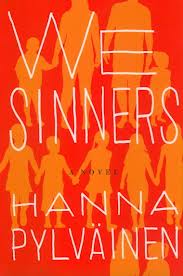
[READ: August 28, 2012] We Sinners

This has got to be the fastest turnover I’ve ever had where I read a short story and then read the author’s novel.  Well, it turns out that “Jonas Chan” was not a short story, but an excerpt from this novel.

The novel is a series of short stories about the same family.  I’m reluctant to brand it one of those connected-short story novels, but I think it really is.  Each chapter has a title and a specific focus and, as the excerpt showed, each chapter can work independently–although having all of the information certainly fills out the story.  (Unless I am mistaken, a few things that really depend upon the rest of the book were left out of the excerpt).

The novel is about the Rovaniemi family.  They are a very traditional Finnish family living in the midwest United States.  More than just Finnish, they practice Laestadianism, a very conservative kind of Lutheranism that is unique to the Finns.  There are nine children in the family (and 11 chapters in the book), and the novel follows them through about 18 years (the youngest, Uppu, is born in the first chapter and the second to last chapter is about her leaving for college.

There’s even a handy family tree:

WARREN  –  PIRJO  (parents)

BRITA  TIINA  NELS  PAULA  SIMON  JULIA  LEENA ANNI  UPPU

There isn’t an overall plot so much as an evaluation of this traditional family and how modern life impacts them.   And wisely, the book opens with the oldest daughter.  This (as opposed to first looking at the parents) allows us to see what kind of difficulties the kids will have with their religion.  We see Brita in school facing a tough decision.  The Laestadian religion doesn’t permit dancing (or TV, or much of anything).  And Brita has to inform her “boyfriend” that she can’t go to the dance because she isn’t allowed.  When Tiina finds out that Brita revealed their religious secret she freaks out that people will know about her too. (more…)

Read Full Post »

SOUNDTRACK: KISHI BASHI-Live at the 9:30 Club May 1, 2012 (2012).

I had never heard of Kishi Bashi before this concert.  Kishi Bashi is a one man band headed by K. Ishibashi.  He plays violin and sings and, as is the trend it seems, he records and loops his own beats and melodies.  Whether or not this is overdone by others, Kishi Bashi does an amazing job.  His songs are powerful and his soaring falsetto is fantastic.

I find myself singing lines from “Atticus in the Dessert” all the time.  And who could resist the title “I am the Antichrist to You.”  Hearing him pull this stuff off live is really impressive.  When he’s not sampling and beatboxing, his violin is gorgeous–I never really understood the folks who could violin and sing at the same time, but he does it wonderfully.  He’s got a funny, charming stage presence and this whole brief set is really enjoyable.  Check it out (audio and video!).

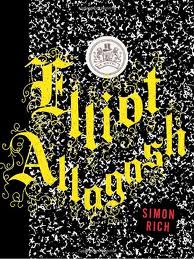
[READ: September 1, 2012] Elliot Allagash

I really enjoy Simon Rich’s humorous pieces.  But somehow I totally missed that he had written a novel (or two–the second one came out in August).

This novel eschews Rich’s humor style–there’s no absurdist takes on life–and focuses on a plot. The plot is pretty straightforward.  Seymour Herson is a middle school loser–everyone picks on him.  In a nice twist on the high school loser, Seymour’s family is pretty cool.  They play Monopoly every Friday night, they eat together and are generally supportive of each other.  While they might be somewhat geeky, they are not played as straw men for Seymour’s problems.

At his school there are three rows of lunch tables.  The popular kids sit at the first row.  The rest of the kids sit at the second row.  And Seymour sits in the final row.  By himself.  In part that is his plan, so he can score a minimum of 5 chocolate milks at lunchtime without the other kids seeing.  Then one day Elliot Allagash sits next to him. (more…)

Read Full Post »

SOUNDTRACK: CIRCLE TAKES THE SQUARE Live at Black Cat Washington DC, August 31, 2011 (2011).

I had never heard of Circle Takes the Square before seeing the link to this show on NPR (Thank you, Viking!).  I like the band name (Hollywood Squares reference), and couldn’t imagine what they sounded like.

Song titles like “In the Nervous Light of Sunday” and “We’re Sustained by the Corpse of a Fallen Constellation” and even “Non-Objective Portrait of Karma” lead one in many possible directions.  But it turns out that the band is sort of pigeonholed as screamo, a post-hardcore style that allows mostly for screamed vocals.  And yet these guys also incorporate intricate playing, odd time signatures and some beautiful instrumental passages.

Even though the band plays fast, they don’t play only short songs.  The shortest songs run about three minutes but they have two songs that are over 6 minutes, with several different sections.

I listened to this show a few times and I confess I never really got into it.  I liked some of it but I was never fully able to grasp what was going on.  It could have been the recording quality.  Usually NPR shows are crystal clear, but this one was a bit muddy–which may have been intentional from the band as they are pretty raw sounding.  I did like  the split male/female vocals which added a cool depth to the songs.  But mostly I was impressed by the kind and almost sweet attitude of the lead singer.  He was polite and thankful to the audience (thanking them for braving the weather–the show was during Hurricane Irene–thanking them for coming from both far and near and talking about how excited he was about Pg. 99, the headliners.  It’s funny to hear polite thankfulness and then screaming lyrics like: “Embrace the sweet sound of self-destruction.”

I’d like to hear a studio release before passing final judgment, because there was a lot to like here.

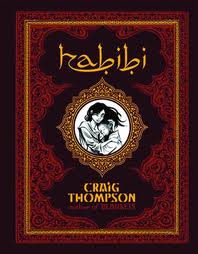
[READ: August 29, 2012] Habibi

I saw this book in a review by Zadie Smith in Harper’s a while back.  I didn’t realize at the time that the author was the same person who did the wonderful Blankets.

This book is an amazing piece of art.  And the story is very good too.

So this massive book (almost 700 pages) is the story of  a woman born into a fictional Middle Eastern country called where the Qur’an is studied and women are more or less chattel.  As the story opens Dodola is sold by her father to a wealthy man who becomes her husband.  The scene of her deflowering, while not graphic at all, is very disturbing nonetheless.  She is afraid of this man and cowers in the fear until they gradually start to see each other as human beings.  And although their age difference is substantial (and yes, gross), she learns to appreciate him.

Until he his killed by the king’s men and Dodola is taken away to the king’s palace to be sold as a slave–her hair is tied to another girl’s hair so they cannot escape.

Through a series of events, she does escape, and when she is hiding out she manages to save the life of a black baby named Cham.  She calls him Zam after the Well of Zamzam (Arabic: زمزم‎) in Mecca, the holiest place in Islam.  And while she is only 12, she takes care of this 3-year-old boy and raises him as her own child. (more…)

Read Full Post »

SOUNDTRACK: DIVINE FITS-“Would That Not Be Nice” (2012).

This song was KCRW’s Today’s Top Tune on August 13, 2012.  Divine Fits are a supergroup of sorts with Spoon’s Britt Daniels, New Bomb Turks drummer Sam Brown and Wolf Parade/Handsome Furs member Dan Boeckner.  When I heard who was in the band, I was pretty excited to hear the track.  But I have to say that this sounds kind of like a over-polished Spoon song with keyboards.  Daniels’ voice and musical style are individual enough that he pretty much dominates whatever he does.  But at the same time, I feel like the jagged edges that make Spoon so interesting have been removed.

I assume that Boeckner is responsible for the keyboards and the interesting echo effect on the vocals.  They add an interesting balance to Daniels, but this doesn’t excite me the way Spoon does.

[READ: August 10, 2012] “Signs and Symbols”

I discovered this story because in my post of Lorrie Moore’s “Referential” someone commented that her story was plagiarized from this one.  I had intended to read this Nabokov story immediately so Moore’s would be fresh and I could lay down the “J’accuse.”  It’s been a couple of months but I can say that while her story is obviously inspired by this Nabokov–to the point where she uses elements from this story in her own, it’s a different take on the same idea.

But before we do any comparison, let’s look at this story.  The story begins by stating that for the fourth time in as many years, a young man’s parents don’t know what to take him for his birthday.  The problem is that he is in an institution and many things are forbidden.  And also, for their son man-made objects are either hives of evil or gross comforts–more on that shortly.  They knew they couldn’t get him a gadget of any kind, so they settled on a basket with a set of colorful jellies.  When they travel to him with the gift, everything goes wrong–the train breaks down, there are no busses, and when they finally get there, the nurses inform them that there has been an incident and he cannot see them now.  So they return home with the jellies.

The story describes what is wrong with their son as referential mania.  It’s an interesting situation, and an article about him had appeared in a scientific monthly.  It says that the patient believes that everything happening around him is somehow related to himself.  So clouds transmit details about him, trees talk about him, etc.  And this was driving him crazy (obviously).  He had even tried to kill himself via, what the doctor described as “a masterpiece of inventiveness.” (more…)

Read Full Post »

SOUNDTRACK: THE FLAMING LIPS-“Smoke on the Water” (2012).

There’s a new Deep Purple tribute album coming out shortly (is this the year of tributes?  what’s going on?).  Anyway, the lineup isn’t all that inspired, but I was curious to see what the Flaming Lips would do with that song

As with their recent reinterpretation of Dark Side of the Moon, this cover is respectful and utterly disrespectful.  Musically the song is pretty accurate. Well, the notes are the same.  But the style is very different, kind of wahwahed delicate chords–no heavy bass or anything.  But it’s the vocals that are the contentious point–he recites the entire song (which kind of works because it is a story) in a stilted, faux British accent.

The second verse has a very computerized voice singing an autotuned melody along with the recitation–sort of a harmony but not.  This voice continues through to the chorus (which the main vocals also simply recite).

I appreciate the Flaming Lips’ approaches to popular songs, but this version renders a big loud song kind of anemic.  Which is so weird because the last few Lips albums were so loud and bass-heavy.  I listened twice, I probably don’t need to listen again.

So, this is yet another tribute I won’t be buying.

[READ: August 22, 2012] Don’t Get Too Comfortable

I’m already making good on my promise to read more David Rakoff.  Indeed, as soon as I heard that he died, I put this book on hold at the library.  The strange thing about this book is that I feel like I read parts of it already.  I don’t feel like I read the whole book because some things were unfamiliar to me, and yet there was a strange feeling of déjà vu throughout the book.  But I looked in the front of the book to see where these essays had appeared and I don’t read any of the magazines where they initially showed up.  And while I like This American Life, I don’t really listen to it very often.  So either I read this book seven years ago or these pieces are inspirations for other pieces I have read (which is possible–two or three articles in here reminded me of things that A.J .Jacobs has since done).

So this collection of essays takes place during the early 2000s, George W. Bush’s first term (not the happiest time to be a gay Canadian living in New York).  But in addition to the first essay which is all about his quest for citizenship, it seems that Rakoff was now gainfully employed as a freelance writer.  Most of these essays seem to have been requested for magazines–like they sought him out to write them.  So his fame was clearly growing.  And, again, like A.J. Jacobs, he seems to have been picked as a guinea pig for certain pieces.   I don’t really know if this is a “genre” per se, I mean lots of un-knowledgeable people have gone into new experiences to write about them (insert inevitable David Foster Wallace reference here–but of course he wasn’t the first either).  But Rakoff’s subjects in the last couple essays seem to be closer to what Wikipedia calls Jacob’s “stunt” journalism. (more…)

Read Full Post »

SOUNDTRACK: DEER TICK-“Main Street” (Field Recordings, July 18, 2012).

NPR created a bunch of Field Recordings at Sasquatch Music Festival.  I picked this one [Deer Tick Among the Honey Buckets]  primarily because it featured Deer Tick front man John McCauley singing front of a bunch of porta potties.

I actually don’t know much about Deer Tick, so I don’t know if they normally sound folky or what.  But this song, in its acoustic setting is very good.  John McCauley’s voice works great here.  There’s even a nice shout out to MCA.

There’s not a ton to it, and this alone won’t make me a fan, but I’ll certainly check out more by them.  It’s also a nice video to watch, especially for the amusing encore.

[READ: August 1, 2012] “The Use of Myth in History”

Most of the articles in Colonial Williamsburg have to do with, well, Colonial Williamsburg.  This one, however, talks about myths that we as Americans have created and continue to believe, from colonial times to more days.

The article opens by explaining that Patrick Henry’s famous “give me liberty or give me death” speech was written down forty-two years after the fact by William Wirt.  And he wrote it down from memory, so who knows what words Henry actually spoke.  But no doubt Wird got the gist right.  So the Henry speech is a myth–not necessarily wrong but not exactly true either.

Klein explains that some historians would like to remove the myths from history and focus only on the facts, but stories like Henry’s are so popular, so ingrained in our memories, that removing them would do more damage than the beloved myths do.  Indeed, some historians believe that myths are very important.  Micheal Gerson wrote, “We know that myths are not the same as lies” and John Thorn said “Historians have an obligation to embrace myth as the people’s history”

Klein writes that America’s mythology was largely created by writers from the early 1800s.  Pressure was building towards the War of 1812 and they needed support.  The mythology was designed to get people to forget about the ugly Revolutionary War.  And so stories were created just in time for the birth of public education in America to disseminate the stories.  And so mythological stories like George Washington and the cherry tree or the midnight ride of Paul Revere or Plymouth Rock or even Pocahontas became enshrined in textbooks.  Now, most myths are based on facts, but the truths were embellished and made more romantic and given a moral.  So, yes Patrick Henry did give a speech, the Pilgrims settled in Plymouth and Paul Revere did ride into the countryside to warn of the British invasion. but probably not exactly as we think they did.  So nineteenth century writers made George Washington the symbol of our country–a unifying power to embody a nation. (more…)

Read Full Post »

SOUNDTRACK: METRIC-“Synthetica” (Field Recordings, June 20, 2012).

After playing the Sasquatch festival, Emily Haines and James Shaw of Metric went behind the stadium and played a beautiful acoustic rendition of the title song from their latest album.  This Field Recording [Metric In A Non-Synthetic Situation] is just so wide open as to be inconceivable–especially since they’d just played a festival.

Metric make beautiful music which is rocking and usually full of all manner of electronic noises.  To hear Haines’ voice stripped from any effects shows just what a great and interesting voice she has.   It’s always nice to hear the song underneath the song.  This is a great version of the song.  Watch it here.

[READ: July 25, 2012] “Putting the Red in Redcoats”

Have you ever thought about how the redcoats’ coats became red?  No, me either.  Well, amazingly, it came from the Cochineal, the same bug that is still used today to color foods.

Cochineal bugs are pretty bizarre.  The female lives her entire life on a prickly pear cactus.  When she hatches, she clamps onto the prickly pear and starts feeding.  She grows to the size of a head of a pin. but never leaves the spot.  The male flies around, but only lives for a week.  The female lays eggs and the babies continue the process.

Although she is immobile, she is also armed with carminic acid, which predators don’t like.  Carminic acid is a vibrant red colorant.  Aztecs first mined this amazing color, which naturally impressed Spanish conquistadores who wanted to take it for themselves.  And they made a lot of money selling it to Europe.  But the Spanish never told anyone that the color came from bugs–they kept the secret for themselves.

Of course pirates and privateers would often hijack ships (one score captured 27 tons of cochineal!). (more…)

Read Full Post »

SOUNDTRACK: NOW, NOW-“But I Do” (Field Recordings, August 8, 2012).

This is an NPR Field Recording, [Now Now at Graffiti Park]which means they brought equipment to Graffiti Park in Texas and recorded Now, Now playing this song live.  You can watch the video here.

The video opens with the band lugging their gear into the weird little foundation of space.  (This explains why there are no drums, clearly).  And so the band with two guitars and a xylophone (and a shaker) play their song and sound great doing it.  This is something of a stripped down version of the bands usually more shoegazery sound, but even in this format the band sounds great–the song is catchy, the melody is pretty and their harmonies are great.

I haven’t heard the original of this, but this is now the third Now, Now song that I’ve really enjoyed.

[READ: August 1, 2012] “Mecklenburg’s Declaration of Independence”

The previous issue of Colonial Williamsburg surprised me with several articles that I found really interesting.  Although this issue was filled with a little more about current local happenings (bulldozers and updates) they still managed to pack in a number of interesting articles.

According to this article, in 1775 Captain James Jack delivered a document to the Second Continental Congress.  On May 19, 1775, select officers from North Carolina, seeing the kind of fighting that was happening against the British in Massachusetts made up several resolves.  The fist stated:

We hearby absolve ourselves from all allegiance to the British Crown, and abjure all political connection, contract, or association, with that nation, who have wantonly trampled on our rights and liberties, and inhumanely shed the blood of American patriots at Lexington.

This “declaration of independence:” preceded Thomas Jefferson’s Declaration of Independence by fourteen months.  The document never reached its destination in the intended form and it was almost forgotten.

But then in 1819, the editor of the Raleigh Register and North Carolina Gazette wrote about this “Mecklenburg Declaration.”  The news surprised John Adams who had never heard of the document.  Adams praised the document (Adams didn’t really like Jefferson).  But Jefferson called it questionable: “I believe it spurious.”  This led to an intrastate rivalry with Virginia claiming the Declaration of Independence as the true one and North Carolina claiming the Declaration of Independence a plagiarism!  Jefferson even went as far as to question the patriotism of North Carolinians.

The controversy is complicated by a document from May 31 a facsimile of which seems to show signatures cut from court records and imitations of the designer’s handwriting.

It’s all somewhat moot as the Continental Congress applauded the intention of the letter but felt that adopting the Mecklenburg resolves was premature.  And therefore it was not a usurper of the actual Declaration of Independence.  But in North Carolina, the document is held up as official.  It became a page of official North Carolina history in 1831 and in 1861, the state voted  to add the date to the state flag.

American history caught up in 1954 when President Eisenhower acknowledged the men who signed the “Mecklenburg Declaration.”  Who knew?

Read Full Post »

David Rakoff (1964-2012)

David Rakoff died Thursday from a resurgence of cancer.  For those unfamiliar with his work, think of darker, more cynical David Sedaris (did you think that was possible?).  The biggest difference between Rakoff and Sedaris is that Rakoff is Canadian.  And he is more of a world traveler.  I say this not really knowing anything about how much they actually traveled.  I mean, sure, Sedaris travels the world for book tours and such, but Rakoff actually lived in foreign lands.  Wait, you say, Sedaris lives in France.  Yes, but Rakoff lived in Tokyo (which automatically makes him more exotic).  And he actually knew Japanese (kind of) whereas Sedaris seems to have not learned any French in the years he has lived there–if his essays are to be believed.

All of this is by way of introduction to using Rakoff’s description of himself as a “New York writer” who also happened to be a “Canadian writer”, a “Jewish writer”, a “gay writer'” and an “East Asian Studies major who has forgotten most of his Japanese” writer.

I’ve only read one of Rakoff’s three books, Fraud.  And about that I said: (more…)

Read Full Post »

« Newer Posts - Older Posts »