Feeds:
Posts
Comments

Archive for the ‘NPR/PRI/PBS’ Category

neuroSOUNDTRACK: CHVRCHES-Tiny Desk Concert #356 (May 12, 2014).

chvChvrches are just on this side of the kind of synth pop that I like.  I simply can’t deny the awesomely catchiness of “Recover” which must be due to Lauren Mayberry’s wonderful voice, or perhaps the bubbly synth sounds that the three of them generate.  In this Tiny Desk version, they brought all kinds of synths along with them.  I don’t know what they normally play live, but this is an amusing sight to see 4 keyboards (for three players)—all of the musicians with their arms hanging down as they play their instruments (synths that are about a foot long and boxes with lots and lots of dials).

“Gun” is a darker sounding song, but again Mayberry’s voice is so clear it cuts through the dark sounds.

I enjoyed that before they played “The Mother We Share” she asked if she could curse.  NPR says yes and she says good for them.  (There is a parental advisory for that one curse word too).  She also says this is the nicest but oddest gig that they have played.  She is charming and it just makes me like them even more.

[READ: June 3, 2014] Neurocomic

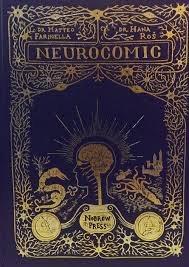
First I saw the name of the publisher–Nobrow Press–then I saw the name of the graphic novel–“Neurocomic” and I imagined some sort of sci-fi riff on Gibson’s Neuromancer.  Then I saw that both authors were doctors and I thought that it was going to be some kind of science book.  But the cover has a drawing of a brain and a squid and some other kind of creature and from there I just decided I had better see what this was.

So, this actually proves to be a very basic history of neuroscience.  With a plot.

As the story opens our hero, a rather generic looking fellow, is walking along a landscape when he sees a woman (presumably beautiful) with whom he seems to fall in love.  He is suddenly sucked into someone’s brain and then onto a forest floor.  He is confused and upset and has to find a way out.

Welcome to chapter 1: Morphology.  Our hero learns he is not in a forest, he is in a brain and those trees are neurons.  And he has run into Santiago Ramon y Cajal (1852-1934) and Camillo Golgi (1843-1926).  They explain to our guy about neurons and axons, but really he just wants out.  So they tell him to enter a neuron and on we go… (more…)

Read Full Post »

CV1_TNY_McCall_HorseCarriage.inddSOUNDTRACK: AGES AND AGES-Tiny Desk Concert #358 (May 20, 2014).

ages I knew one song from Ages And Ages so far (the wonderful song “Divisionary (Do The Right Thing)”), and I was interested to hear what else the band did.  Well, they open this Tiny Desk Concert with a great burst of multiple harmonies and fugues—when you have 8 people in your band you can really showcase diversity in vocals (there’s only 6 here at the Tiny Desk and there’s 7 in the band photo but NPR says 8 so, your guess is as good as mine). “Light Goes Out” has that great opening and then it turns into a pretty quick indie rock song.  I really enjoy the way the different vocalists (and three guitars and one piano) really pile on the sounds.  Even the percussion elements add something to this joyful song.

“Divisionary (Do The Right Thing)” sound great in this context—the way the women play with harmonies is just fantastic.  It starts slowly, with a strummed acoustic guitar, then more and more voices join the mix.  The harmonies that the women sing (which I don’t think are on the record sound great).  “No Nostalgia” has a traditional folk sound (with that shaker as a cool percussive element).  It’s probably the most traditional sounding song of the bunch, but again those many voices of harmonies sound great.

They are one of the few bands to stretch out to 4 songs on a recent Tiny Desk, and their fourth is “Our Demons” a great song with more great voices coming in.

If I was unsure just how good Ages and Ages is, this tiny Desk Concert sold me.

[READ: June 1, 2014] “The Man in the Woods”

This is the second of a group of recently uncovered stories from Shirley Jackson’s papers which the New Yorker has published.

Even though this story is timeless–there is really no indication of when it is set, and any clues seem to be more mythological than real–when reading it I assumed it was written a while ago.  There’s something about the language that just reads “not contemporary.”  And I think that’s interesting in and of itself.

But as I said, this story feels timeless–it has a mythological/fairy tale mystique about it which starts right off the bat when we see the main character, Christopher, walking in a very deep, very dark forest.  He has been walking for countless days and the forest has been getting more and more close–as if the trees were leaning in on him.  He is all alone until a cat starts following him “trotting along in the casual acceptance of human company that cats exhibit when they are frightened.”  And thus, the two continue deeper into the woods with Christopher saying to the cat that the path must lead somewhere.

And it does, an hour or so later, they come upon a bend in the path which leads to a small house.  He approaches cautiously but is quickly welcomed by the young “not so young as he would have liked, but too young, seemingly, to be living in the heart of a forest” lady named Phyllis.  There is another lady called Circe who is making food.  The warmth of the cabin and the smell of the food warms Christopher to his core.  And the cat makes himself at home quickly as well.  But the ladies are a little odd, and Christopher dare not make himself too comfortable.  Especially when they call out the head of the house. (more…)

Read Full Post »

shatterSOUNDTRACK: IESTYN DAVIES-Tiny Desk Concert #357 (May 17, 2014).

falsettoIestyn Davies (pronounced YES-tin DAY-vis) is a countertenor, which means he sings in s striking falsetto (especially when you hear his deep speaking voice).  Davies sings three songs from  Elizabethan composer John Dowland. Joining Davies is Thomas Dunford, who has been affectionately dubbed “the Eric Clapton of the lute” by the BBC.  They play this early music and it sounds amazing (I am super impressed by his voice, but the lute blows me away).

The songs are very melancholy about lost love.  Like this wonderful line that would make Morrissey jealous: “I sit, I sigh, I weep, I faint, I die/In deadly pain and endless misery” (all done is in a staggering falsetto in a beautiful ascending melody).

He plays three songs (none of which had I heard before) “Come again, sweet love doth now invite,” “Now, O now I needs must part” and “Can she excuse my wrongs.”

I loved listening to these and to watching the lutist wail on that instrument.

[READ: May 25, 2014] Shatterproof

Much to my discomfort, this series is getting darker and darker.  I’m almost not sure if my 9 year old is ready for the intensity (and the death) in this book.

While there was real danger in the first series, people we know have actually died in this one.  And there is another (shocking) causality in this book as well.

As soon as the four kids (Amy and Dan Cahill and their friends Atticus and Jake Rosenbloom) land in Germany, they are set upon by police.  Since the four of them are wanted by Interpol, they assume that they are caught, done.  But it turns out that these are not real police, they are employed by Vesper One, to let them know that he knows exactly where they are.  And to give them their next clue.

Which is that they must steal a diamond from a heavily guarded museum that is about to close in two hours.

Meanwhile Hamilton and Phoenix are still tailing Luna Amato.  They are being assisted by Erasmus who is really calling the shots and using the boys as a kind of decoy.  Luna seems oblivious to the pursuit, which makes Erasmus even more suspicious.  So while the boys follow her, Erasmus sneaks in to what he believes is a Vesper stronghold.

The other real plot in the book coes from the prisoners.  The clever Cahill clan has devised a way to get out of their prison cell.  And it works–at a price.  Although their story evolves over the book, suffice it to say that they do escape, but at the risk of losing one of their number and at Nellie getting bitten by attack dogs.  By the end of the book, some of them have been brought to new facility where the consequences are all the more severe.

But back to the diamond heist. (more…)

Read Full Post »

CV1_TNY_03_17_14Liniers.inddSOUNDTRACK: YASMINE HAMDAN-Tiny Desk Concert #359 (May 24, 2014).

Yysamineasmine Hamdan is a Lebanese singer-songwriter.  The three songs she plays here are sung in Lebanese (I assume).  Sung with just the accompaniment of one guitar, Yasmine sings and sways her way through these beautiful songs.  It’s actually fun to just see her move while she sings, she’s so loose and relaxed and yes, sensuous.

The most interesting thing is that Hamdan had only just met guitarist Gabriel Gordon when they traveled down together from New York that morning. They’d never rehearsed together, so the interesting guitar lines he’s playing sound great even though they might not be what she intended.  (I wish there was a little more information about this partnership in the blurb).

“Beirut” is a song form the 1940s and she does some interesting vocal things by using her hands around her mouth.  “Deny” and “Shouei” are beautiful songs that Hamdan has written and the two of them sound just great together.

[READ: May 27, 2014] “Long Story Short”

I have been one of those readers who doesn’t really know what to make of Lydia Davis, so I found this article very interesting and helpful.  It allowed me to appreciate her super short stories a lot more.  For yes I have mused about why “she doesn’t call them poems or fragments.”  The answer: “She prefers the deeper associations of the word ‘story’.”

I was interested that she is considered “one of the most original minds in American fiction today,” and I tend to agree that she is because no one else really writes like her.  Her Collected Stories has “some two hundred pieces” in just over 700 pages.  This is thirty years worth of work.

But I also liked seeing the succinct comment “like many things that Davis writes, [a letter] had started out sincere and then turned weird.”  In this case the letter she wrote to a frozen peas manufacturer was published as the story “Letter to a Frozen Peas Manufacturer.”

I didn’t know much if anything about Davis, so this article acted as a biography as well.  She dated writer Paul Auster and while he write his traditional stories, Davis struggled to do the same.  Her stories never came together or seemed to be about normal things, as her mother commented: “Why don’t you write about your travels or something more cheerful?”  But it was when she started reading very short stories by the poet Russell Edson (of whom I’ve never heard), that she hit upon the idea of writing very short stories and “The Thirteenth Woman” was her first successful attempt. (more…)

Read Full Post »

CV1_TNY_03_17_14Liniers.inddSOUNDTRACK: HOZIER-Tiny Desk Concert #360 (May 27, 2014).

hozierI had been cataloging the Tiny Desk Concerts from the beginning, but in recent days they have had so many good bands that I didn’t want to wait until I caught up with them.  So, for the next few posts there will be current Concerts (I have no idea what number they are, but I hope to fix them retroactively).

Hozier is responsible for the insanely catchy song “Take Me to Church.”  WXPN plays this song all the time.  I didn’t like it at first but then when I really listened to it I was hooked.  Of course I had no idea that the guy who was singing this powerful soulful song was a soft-spoken Irishman.  Hozier is Andrew Hozier-Byrne, a 24 year old from County Wicklow.  And while he’s singing this song here he makes it seems so easy to belt out those big notes.

Although it doesn’t quite reach the gravitas of the recorded version in this stripped down live session, he sounds great and the keyboard, cello and drums (and backing vocals) really bring this song to life.

The next two songs Hozier plays by himself.  “To Be Alone” is a very old-sounding blues—the sound of his guitar and the way his plays combined with the way he sings really hearkens back to early blues.  Typically I don’t especially like early blues but I do like this song quite a bit.

The final song is an acoustic ballad.  (So he plays three different guitars in this set).  It has a kind of Richard Thompson guitar feel and is a rather touching ballad.

Hozier has only released two EPs thus far, but with this amount of diversity I am looking forward to lots of other things from him.

[READ: May 29, 2014] “The Relive Box”

This story made me think of what the “Entertainment” in David Foster Wallace’s Infinite Jest might actually be like.  In Infinite Jest, the “Entertainment” is a video so intoxicating, you watch it–ignoring all other needs–until you die.  In this story, the “relive box” is a machine that plays back any memory that you have in full 3D. And people get so absorbed in their past that they forget about the present.

Specifically, the narrator is so intent on reliving that he ignores his daughter and his job.  As the story opens, the narrator’s daughter Katie says she wants to relive.  They just recently got this new relive box–it cost a fortune–and Katie wants to visit with her mother.  Her mother left them and Katie seems to have lost friends and impetus to do much else, so she would like to relive some good times.  But the narrator was planning on reliving for several hours that night, so he can’t have her hogging the machine.  So he sends her to bed, crying heavily, so he can have the machine to himself.

And what’s so important that the narrator has to relive?  After reliving his best sex moments, he goes back in time to the night he met Lisa, his first girlfriend.  She was a goth girl in a club and the narrator had the nerve to buy her a drink and ask her to dance.  Which ultimately let to sex and eventually to a relationship. And he relieves all of the highlights of their time together–something he has done several times this week already.  In fact, he has been doing this so much that he has been late for work twice and when he’s there he’s bleary-eyed and pretty much out of it.  So he says he’ll only do it once more this week.  And just for a few hours. (more…)

Read Full Post »

CV1_TNY_05_05_14Berberian.inddSOUNDTRACK: AUSTRALIAN CHAMBER ORCHESTRA-Tiny Desk Concert #40 (December 21, 2009).

chmaberThis was a very nice classical Tiny Desk Concert.  The Orchestra plays three songs.  The first two are a Ravel String Quartet, and a Kaddish based on Ravel written by one of the members of the Orchestra.

Then comes a surprise.  Composer Joseph Tawadros accompanies them on the Egyptian oud and his brother James plays percussion on Tawadros’ song “Oasis.”  I love the addition of the oud to the orchestra–it brings a wonderfully alien sound to the piece.  You can see the whole show here.

This was the final Tiny Desk Concert of 2009.

[READ: May 29, 2014] “The Naturals”

I have enjoyed just about everything that Sam Lipsyte has written and this story was no exception.  As with many of Lipsyte’s stories, the main character has an unusual name: Caperton.  Caperton works as a consultant for a marketing firm.  He is trying to secure a job for a lakefront property.  The man in charge of the meeting keeps calling the kiosk that they are going to install a “koisk” (this alone made me love the story).

Caperton has recently broken up with his girlfriend because he confirmed to her that he did not want to have children.  He’s a little bummed but not heartbroken.

But the main action of the story is that Caperton’s father is dying and his stepmother has called him to come home.  Evidently Caperton’s father has been on the verge of death many times so Caperton’s not entirely sad about the situation.  But he goes nonetheless.  And we learn that Stell, his stepmother is nice enough but has always had one rule–stay out of her refrigerator.  She is happy to fix anything for anyone as long as they keep out of the fridge.  (This also made me love the story).

(more…)

Read Full Post »

CV1_TNY_05_19_14Drooker.inddSOUNDTRACK: FANFARLO-Tiny Desk Concert #39 (December 16, 2009).

fanfarloThis is a Christmas-themed Tiny Desk Concert, with a yule log in the TV and everything.  I’ve liked most of what I’ve heard from Fanfarlo.   I think of the band as synthy, but this version is acoustic guitar and mandolin (and three backing vocalists).  The male singer has a unique voice.  “Drowning Men” sounds great and they make quite a lot of noise for just the two instruments–when the xylophone solo kicks in, it quite a nice touch.

For song two (“Comets”) they bust out a harpist–she is not part of the band, but is a friend from New York.  She plays excellent accompaniment and the melodica is a nice touch as well.   Perhaps most interesting was hearing their biographies.  The band is based in London, and they have members from Sweden, Belgium, someone who lived in Abu Dabi, Scottish/Samoan, half Polish/half English and half English half Icelandic.  Cool.

For the final song it’s a cover of Low’s “Just Like Christmas.” It’s a simple stripped down version with guitar and melodica and it is quite beautiful.  And they don’t stop until everyone sings along.

[READ: May 27, 2014] “The Waitress”

In “The Waitress,” Coover takes a fairy tale premise and brings into the contemporary world.

This is a concept that Coover plays with a lot (with different degrees of success) and I found this one to be very good.  It is only a page long, which may have had something to do with why I liked it–it didn’t overstay its welcome.

It was also not terribly ambitious.  And, as with all stories like this I kind of have to wonder what’s the point.  Nevertheless, I enjoyed it. (more…)

Read Full Post »

CV1_TNY_05_26_14Steinberg.inddSOUNDTRACK: LIGHTNING DUST-Tiny Desk Concert #38 (December 7, 2009).

lightingLightning Dust is a side project of heavy psychedelic band Black Mountain.  Lightning Dust is a kind of folk version of the band (with Amber Webber on vocals instead of Joshua Wells).  Her voice is full of vibrato (she almost sounds nervous at times).  The songs are simple, as folk songs tend to be, performed mainly on the acoustic guitar with organ backing tones.

“Antonia Jane” is very pretty, especially the tone of the organ that accompanies the acoustic guitar.  “History” has a nice unexpected chord change when the chorus rolls around.  For the final song, “I Knew”, Wells switches to 12 string guitar instead of keyboard–something he says he never does.  The song is faster and more upbeat, not necessarily because of the extra guitar, but it really broadens the sound a lot and makes it even catchier (even if it does give it a more countryish feeling).  And the backing vocals are quite wonderful.

I prefer Black Mountain to Lightning Dust but the songwriting is quite good.

[READ: May 27, 2014] “Camilo”

I don’t know Zambra’s work. This one was translated from the Spanish by Megan McDowell and I thought it was terrific.

The story is fairly simple, although it is revealed via a lot of layers which is very interesting.  It opens with a young man yelling “I’m Camilo…your daddy’s godson” and the narrator being suspicious of this statement.  But it turns out to be true.   This boy is his father’s godson.

The narrator’s father had been good friends with Camilo’s father Big Camilo.  They were best friends until they had a huge fight and never spoke again.  That was (obviously) after Camilo was born.  But in addition to this fight and lack of talking, Big Camilo later left the country all together and moved to Paris where he started a new family, leaving Camilo and Camilo’s mother back in Chile.

Soon the narrator and Camilo became almost inseparable.  Camilo was a few years older and was something of a protective presence for him.  Even the narrator’s older sister was infatuated with him.  In fact, even the narrator’s father liked him, although he did remind him a bit too much of Big Camilo.  The one difference was that Big Camilo (and the narrator’s family) loved soccer, but Camilo didn’t know a thing about it. (more…)

Read Full Post »

boxersSOUNDTRACK: ANDREW W.K.-Tiny Desk Concert #37 (November 30, 2009).

wkWhen I saw Andrew W.K. on the list of Tiny Desk players I was intrigued to say the least. W.K. is a maniac.  His first album was packed with full throttle, really dumb party anthems.  Later he made an albums of… piano instrumentals.  Then he became a motivational speaker.  He’s done children’s shows and he recently did an anthem for an internet cat.  He even played drums for 24 hours straight–setting a world record.  So who knew what to expect.

Well, I didn’t expect two lengthy piano improvisations (quite pretty, if a little scattered).  Holy cow, does he attack that keyboard!  The improvs are really unexpected–meandering and interesting (mostly), especially at the end where they kind of decay.

Then he plays a keyboard version of “I Get Wet” which sounds almost symphonic especially compared to the pummeling version on the record.

He ends with a faithful cover of “The Moon Is a Harsh Mistress” made famous by Linda Ronstadt.  He sings in a proper voice and if you didn’t know it was Andrew W.K., it would be a pretty normal song.

Nothing like what I expected, this is a most unusual (and slightly awkward–for a motivational speaker, Andrew seems a little distracted) Tiny Desk.

 [READ: February 19, 2014] Boxers & Saints

Gene Luen Yang is a wonderful artist and storyteller.  He has written several books that I’ve enjoyed quite a lot.  This is a two volume set that is meant to be read together (although each story is more or less independent).  I assume that Boxers should be read first since Saints has an epilogue, at least that’s the order I read them.

This story is about the Boxer Rebellion.  I knew literally nothing about the Boxer Rebellion, so for those who don’t, here’s Britannica: (more…)

Read Full Post »

tomboSOUNDTRACK: ZEE AVI-Tiny Desk Concert #36 (November 23, 2009).

zeeZee Avi is a Malaysian born singer songwriter who was discovered via YouTube.  After a few videos were forwarded around, she was signed and then released an album full of simple, delicate guitar driven acoustic songs.

“Honey Bee” is a very pretty, sweet song in which she accompanies herself on guitar.  The second song is a cover of a Morrissey’s “First of the Gang” and while it is far slower than the original, Zee sings it perfectly—her voice is very well suited to Morrissey’s style.  (I enjoyed that she swooned a little when she said his name).  She doesn’t play guitar on this one and there’s a funny moment where the guitarist doesn’t end when she does and she says thanks for giving me the heads up (he says was going to text her but…).

She plays the final song “Just You and me” on ukulele and as with anyone who plays the uke well, this song sounds great.  I don’t know much more about her but I’d be interested to hear what an album of hers sounds like.

 Check it out here.

[READ: February 12, 2014] Tombo

This is the sixth book in the McSweeney’s poetry series.  Even though the series descriptors talk about the beautiful covers on the books, this one is resolutely not beautifully covered, although it is a handsome volume.

Di Piero is a prolific author, with ten books of poetry, a column on the visual arts and several collections of essays.

This collection of poems seems to be about place.  There’s a lot of descriptors of locations and places, but none of them grabbed me strongly.  I enjoyed the last few poems in the collection much more than the early ones.

In particular I thought that the title poem “Tombo” was quite enjoyable because it was so concrete.  And the sequence with the hawk in the poorly named “So It Goes” was visually arresting as well.  (more…)

Read Full Post »

« Newer Posts - Older Posts »