Feeds:
Posts
Comments

Archive for the ‘Tindersticks’ Category

SOUNDTRACK: TINDERSTICKS-Claire Denis Film Scores 1996-2009: L’Intrus [CST077] (2004).

This score comes from Claire Denis’ 2004 film L’Intrus.  The soundtrack was done by Stuart Staples.  In the booklet he talks about how conventional scoring just didn’t seem appropriate for the film, so he chose this rather noise-filled style.

It is a noisy, menacing work (L’Intrus means The Intruder, so that makes sense).  The sounds are clanky and squeaking, creating an ominous atmosphere.

But what’s most interesting about the score is that despite this limited collection of sounds, he creates a musical work out of it that is interesting to listen to on its own.  The track “Horse Dreams” is full of discordant notes and screeches.  While “The Black Mountain” features a solo horn over the noises.  It’s not easy listening, but it is certainly evocative.

This score is also very short about 25 minutes or so).  The movie is 130 minutes.  I wonder what other sounds are in the film?

[READ: June 15 2011] “Madame Poirer’s Dog”

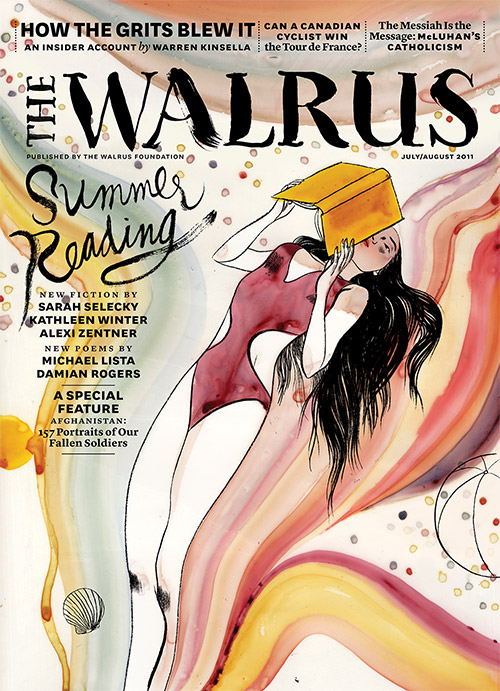
This is the second story in The Walrus’ Summer Reading issue.  As I mentioned, the intro states: “We asked five celebrated writers to devise five guidelines for composing a short story or poem. They all traded lists–and played by the rules.”  Kathleen Winter was given rules by Alexi Zenther (which I posted below).

I didn’t enjoy this story all that much.  More specifically, I enjoyed the story within the story, but the full, proper story was a little too indistinct to me: It felt kind of all over the place.  In some ways this is appropriate as the story is set in an old folks’ home.  The titular dog comes into play throughout the story and the hard and fast facts of the dog’s tale give some grounding to the story.

The dog’s story is told in a just-the-facts, not-the-details style.  And the dog’s story is a funny story.  It involves a chastity belt (for the dog), and another dog’s skill at the belt’s removal.  But  the funniest part came at the end when the narrator criticized her son’s wife because she would be the kind of person who would ask for details “that no one cares to remember: what exactly does it look like, a chastity belt for digs, and of what material is such a thing made?”

The bookend parts that surrounded the story just kind of fade from my memory.

The five rules from Alexi Zenther: (more…)

Read Full Post »

SOUNDTRACK: TINDERSTICKS-Claire Denis Film Scores 1996-2009: Vendredi Soir [CST077] (2002).

This score was created by Dickon Hinchliffe and the liner notes indicate that it was something of a jumping off point for his future film scores.  This was the third score that the band created for Denis (after Nenette & Trouble).  Stuart Staples was working on the latest Tindersticks album so Dickon took over all of the duties on this one.

This is a beautiful, melancholy soundtrack, full of gorgeous swelling strings and simple piano notes.  It doesn’t remind one all that much of  Tindersticks, but it’s not terribly far removed from their sound either.

The whole score (which is paired here with the score from L’Intrus) is 25 minutes, which made me wonder whether this is a full length film, or just a film with lots of silence (or, perhaps non-Hinchcliffe music that wasn’t included here).  [The film is 90 minutes long].

Pairing it with L’Intrus makes sense in terms of space, but the two scores could not be more different from each other.

[READ: June 15, 2011] “The Cat”

This is the first story in The Walrus’ Summer Reading issue.  As I mentioned, the intro states: “We asked five celebrated writers to devise five guidelines for composing a short story or poem. They all traded lists–and played by the rules.”  Sarah Selecky was given rules by Kathleen Winter (which I posted below).

The first line of the story really sets up the whole thing: “I am not at all surprised that my father has come back to earth in the form of a grey and white cat.”  And indeed, the rest of the story discusses her relationship with her father (those awful fishing trips when she could neither speak nor move) and how he never seemed to be pleased about her.

Now that he’s back as a cat, the dynamic has changed.  Although there’s still fish in their relationship.

I really enjoyed this story,  For although it was brief, it was wonderfully evocative.

Kathleen Winter imposed these rules on the story: (more…)

Read Full Post »

SOUNDTRACK: TINDERSTICKS-Claire Denis Film Scores 1996-2009 [CST077] (2011).

Constellation Records just released a 5 disc box set of Tindersticks movie scores.  Fans of the band will know the soundtracks for Nenette et Boni and Trouble Every Day which were released years ago.  Those are included here, along with four other soundtracks (on 3 discs).  The entire set includes Nenette et Boni (1996) White Material (2009), 35 rhum (2008), Trouble Every Day (2001) and two solo soundtracks: Stuart Staples’ score for L’intrus (2004) and Dickon Hinchliffe’s score for Vendredi Soir (2002).

As with most Constellation releases, this one is packaged beautifully.  The box is lovely with an opening for the top cover to show though. Each disc gets a cardboard sleeve with a cool still from the film.  And the booklet that accompanies the set is bilingual with lots and lots of still from the films and a cool interview with Denis and members of the band.

I have never seen any of Denis’ films.  So I was confused that some of these scores were only half an hour.  I thought maybe they were short films.  But indeed they are not.  35 Shots of Rum is 100 minutes for instance, even if the soundtrack is a third of that.

I’m going to review each score shortly, but since I’ve already discussed Nenette et Boni and Trouble Every Day, I’ll just put links to them.  In the meantime, the scores are really beautiful and moving.  Tindersticks are a very cinematic band to begin with, so it’s no surprise that they would make good soundtracks.

And the booklet is really interesting, showing how the band was introudced to Denis in the first place.  She loved the music of ‘My Sister’ and asked if she could use it for a film.  They said, well, maybe we can make a soundtrack for you instead.  And they began working together.  The combination proved so successful that they have scored virtually all of her movies since.  I really must get around to watching them some day.

In the meantime, I can just imagine what they are like from the music.

Here’s the opening credits for Trouble Every Day

[READ: June 24, 2011] Five Dials: Your Valentine’s Day Card

This Five Dials special issue doesn’t appear on the Five Dials home page.  I only found it while reading their news feed.  It’s not an issue per se.  Indeed, all that this valentine’s card is is one poem from Joe Dunthorne, and a cool cover illustration from Sophia Augusta. (more…)

Read Full Post »

SOUNDTRACK: TINDERSTICKS-BBC Sessions (2007).

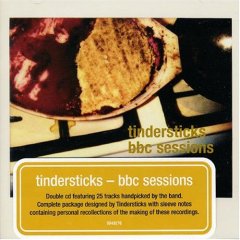
Another great entry in the BBC Sessions series, this collection of 26 recordings, shows the band in fine form.  This works as a pretty excellent Greatest Hits collections (and surprisingly for a BBC Sessions recording there is only one duplicate song).

On the other hand, there’s not a whole lot of difference between these recordings and the originals.   Some notable exceptions include “Traveling Light” and “Buried Bones” which do not feature the female duet.  “Her” is also notably different since it’s on piano and not guitar.

But I have no criticism about the quality of the recordings. The band sounds wonderful.  Staples’ voice is great and the orchestration is perfect.  And, of course the recording quality is superb (as are all of the BBC sessions that I have are).

If you have the Tindersticks records already, there’s no compelling reason to get this set, but if you’re a fan of the band, it’s nice to have some slightly different versions of these great songs.

[READ: May 18, 2011] 2 book reviews

This month’s review is of two books.  The first is Paula Fox’s new book, News from the World: Stories and Essays.  (The book is also reviewed by Joan Acocella in The New Yorker, May 16, 2011 issue–she takes a much different angle than Zadie, and has a lot more biographical background, so the reviews work in conjunction very nicely).  I don’t know Fox (although perhaps I should, she has written a number of adult books and tons of children’s books), but Fox’s Desperate Characters has been championed by Jonathan Franzen and David Foster Wallace.

Fox sounds like an interesting character (her father was “a writer and a drunk”) and her granddaughter is Courtney Love.  And Zadie asserts that Fox has cultivated self-control and empathy and (in Fox’s own words) “a living interest in all living creatures.”  And in this new collection the interest spreads across fiction, memoir, lecture and essays (with no formal distinction between genres).

Although Zadie is fond of Fox (especially her fiction) she’s harder on Fox the essayist.  She suggests that many of Fox’s essays seem to boil down to the cliché: things were better back then.  But Zadie does make her fiction sound wonderful.  Acocella’s review is similar, saying that no one should start reading Paula Fox with this collection–the reader should go back and start with Fox’s earlier, better works. (more…)

Read Full Post »

SOUNDTRACK: A HOUSE-I am the Greatest (1991).

A House were a Dublin band that released a number of great songs and a few good albums from the mid 1980’s until the late 1990s.  I loved A House (but never knew whether to file them under A or H).  They were a smart, often sarcastic, occasionally poppy college rock band who played dissonant songs more often than not and wrote lyrics which could be off-putting more often than not, but which, in the right mind frame, were simply, as the album says, the greatest.

It opens with a nice jangly guitar which is quickly interrupted by a strange feedback sound and Dave Couse’s somewhat unsettling voice.  And he gives a litany of things about which he does not care, but mostly because nobody else does.  It’s followed by the sweet tender ballad “Too Young.”  The next track was the single, of all things.  “Endless Art” a simple riff which name checks dozens of dead artists that bridges with Beethoven’s Fifth.  It gets tedious after about 200 listens, but since I haven’t heard it in a while, I found myself really grooving to it again.

In keeping with the “let ’em guess” attitude of the disc, the next song is a plaintive moan of longing called “When I First Saw You.”  I’m fairly certain he’s singing out of tune for the whole track.

“Take It Easy on Me” opens with a great wah-wah’d guitar sound that should have been a left-field hit like The Flaming Lips had.  But it’s their simple acoustic songs that pack the most punch like “I am Afraid.”  It’s followed by what sounds like a Tindersticks song, until Couse’s voice kicks in, and we get a great questioning song about religion called “Blind Faith”.

He seems back to his old tricks on “I Lied” (“When I said that I loved you, I lied.”) Then the full band kicks in (with great harmonies) “When I said, when I vowed, I don’t love you anymore, I lied.  I adore you!”

The rest of the songs play with this formula: off kilter yet poppy, harmonies on top of dissonant leads.  The pace never slackens, and the albums stays strong through the brilliant final track, “I am the Greatest” (a spoken word folk track that is all smackdown which devolves into a bunch of blokes shouting “I am!”).

Check out the fantastic stop motion video for “Endless Art” on YouTube, and let me know if you can find a version that’s better than this one.

[READ: Week of August 23, 2010] Ulysses: Episodes 16-17

Nearing the end of the book, still recuperating from the insanity of the Circe episode, we get two episodes that are considerably mellower.  I enjoyed the beginning of Episode 16, but felt a little at sea when it was hijacked by the sailor.  Episode 17 on the other hand is definitely my favorite.  Even though I love the surrealism of Circe, there’s something about the catechism of Episode 17, with its question and answer format–its own sort of surrealism–that I find fascinating, funny and surprisingly informative.  It fills in a ton of details that were left out of the beginning (or that were hidden) and yet still retains a bizarre stream of consciousness. It also offers incredible insight into the man who is Leopold Bloom. (more…)

Read Full Post »

SOUNDTRACK: BBC Sessions (various).

Many many bands that I like have recorded tracks for the BBC.  And after several sessions, they tend to get released as BBC Live or BBC Sessions discs.  In the last few years, I’ve gotten discs from the Cocteau Twins, Tindersticks, The Beautiful South, Belle and Sebastian and Therapy?  One of the first ones I’d every gotten was The Smiths’ Hatful of Hollow.

I’ve always loved these releases.  The recordings are “live,” even though they’re not in front of an audience.  For the most part they don’t vary greatly from the originals (that’s not always the case, mind you, but most of the time it’s true.)

What makes these releases so great is that by the time the bands do these recordings for the BBC, the original album has been out a while and the band has toured a bit.  So, they know the song backwards at this point, and they usually record a version that’s faithful to the original but a little more playful.  I always thought that the Hatful of Hollow versions of songs were better than the originals.  It was many years before I understood why there were two “official” releases of the same songs.

There are so many BBC recordings out there (this is an incomplete list).  If you like a British band, chances are they recorded some sessions.  And I don’t know if the BBC is hard pressed for money or what, but they seem to be releasing them by the handful lately.  The biggest problem of course is that most of them are not available in the States (at least for a reasonable price).  And that’s a drag.  So find them used and enjoy!

[READ: May 19, 2010] Girl with Curious Hair

This is DFW’s first collection of short stories.  I clearly bought this copy soon after finishing Infinite Jest.  I was delighted to find as a bookmark an old stub from a sub shop that I used to go to all the time when I worked in Cambridge, Ma.  I wonder if that sub shop is still open.  It was in Brighton, was more or less on my way to work, had a predominance of Irish products and had delicious subs that were almost cheaper than buying the stuff yourself.  I had checked off a few stories in the table of contents (most of the shorter ones) but that stub brought back more memories than the stories did.  I didn’t even recognize the ones that I had apparently read.

And the stories are pretty memorable.  So I wonder if I didn’t read them at all.

The first story is “Little Expressionless Animals” (or, the Jeopardy! story).  In fact, if I may back up, the whole collection is really rife with pop culture, especially television references.  In David Lipsky’s book, Although of Course You End Up Becoming Yourself , DFW states matter-of-factly that he has an obsession with TV and pop culture, so this shouldn’t be surprising.  But for me it was disconcerting to have the pop culture not incidental or as a set dressing, but absolutely central to the stories. (more…)

Read Full Post »

socSOUNDTRACK: TINDERSTICKS-The Hungry Saw [CST055] (2008).

hungryIt was the releases of this Tindersticks disc (their first in 5 years) on the venerable Constellation Records (in North America) that inspired my trip through their back catalog. I was completely surprised to see them released on Constellation, as the band doesn’t exactly fit with the label’s stereotypical style (although, realistically with the last dozen or so releases, Constellation has really expanded the kind of music they release).

And this is a fantastic Tindersticks release!  There’s not a bad song on the disc. And, even though nothing is as immediately gripping as say “Can We Start Again,” the disc contains some of the band’s strongest songs.  “The Hungry Saw” is simply amazing, both lyrically and in its catchy (yet creepy) chorus.  But the highlight is probably “Boobar, Come Back to Me,” a song that begins slowly and builds gloriously, including a call and response segment that makes this song really swagger.

“Mother Dear” features a strangely comical musical episode.  In an otherwise very mellow piano based track, right in the middle of the song, come slashing, somewhat atonal guitar chords.  It’s as if a more rocking song is trying to overtake the mellow track.  (The coup is rebuffed, though).

The biggest thing to note about the disc is that longtime co-songwriter Dickon has left the band.  And so, some of the co-writing duties have been taken up by David Boulter.  While it is obviously sad that Dickon has left, Staples seems revitalized on this disc, and Boulter’s additions (especially his quirky instrumentals) bring a new point of view to the proceedings.  Also of note is something of a return to the orchestral style (albeit a much more understated version).  However, different songs emphasize different aspects: horns on one, strings on another, but always underscored by the ubiquitous Hammond organ.

It’s not a radical departure or anything like that.  It’s more of a continuation after a well earned vacation.  And it’s certainly their strongest release since their first four.

[READ & WATCHED: October 2009] Souvenir of Canada, Souvenir of Canada 2 & Souvenir of Canada (the movie)

I got the first Souvenir of Canada when it came out.  (I was on a big Coupland kick and may have even bought it in Montreal).  I didn’t get #2 when it came out, probably because I didn’t really invest a lot of effort into the first one.  But after recently reading City of Glass, I wanted to get a little more involved in Coupland’s visual art.  So, I picked up #2 and, while investigating this second book, I discovered that he had made a film of the books, too.

Coupland explains in the introduction that this book is his personal vision of what Canada is like. It is designed for Canadians as something of a nostalgia trip, but it is also something of an introduction to unseen Canada for non-Canadians.  And so, what you don’t get is pictures of mounties and Tim Hortons and other things that fit the stereotypical Canadian bill. Rather, you get things that are significant to Coupland (and maybe the average Canadian born on the West Coast in the 60s). (more…)

Read Full Post »

harpersaugSOUNDTRACK: TINDERSTICKS-Donkeys 92-97 (1998).
donkeysDonkeys is a collection of singles, rarities and unreleased recordings.  It came out just before Simple Pleasure, and has tracks from the era of the first four discs.

With the reissue of those first four discs (and all the bonus tracks therein) and the Greatest Hits collection, it’s not really necessary to get this for these rare tracks.  (I admit that I haven’t actually checked to see if all of the tracks here are now available elsewhere…there seems to be a number of different mixes and versions of songs, so I’ll let someone else do the legwork).

However, if you’re disinclined to get the reissued discs for whatever reason, this is a great collection of songs that are worth having for any Tindersticks fan.  And, interestingly, it works quite well as an introduction for the newbie: it features several of the most accessible songs from the first few discs.  But, for fans, the highlights include their great cover of “I’ve Been Loving You Too Long.”  Also “Plus de Liaisons” a French version of  “No More Affairs.”  It also has the fabulous duet with Isabella Rossilini (“A Marriage Made in Heaven”) and another version of “For Those”  (I’m not entirely sure how many versions of that song exist, but there’s got to be about 3 or 4.

This disc is probably easy to track down cheaply since all the tracks are available elsewhere now (although my copy came from my friend Lar and has the Euro symbol on the Used sticker to prove it). Or, maybe it’s now totally rare and out of print and is hugely expensive.  Either way, it’s still a great collection of tracks.

[READ: November 5, 2009] “Too Much Happiness”

It’s a little lame to lump these two pieces together, but the Charles Foran article isn’t something I would review on its own.  Nevertheless, it is a very interesting look at Alice Munro’s hometown, and the Self-Guided Tour of Points of Interest in the Town of Wingham Relating to Alice Munro sounds like a fun thing to do if you’re in Ontario.  (Even if Munro herself is never actually there).

But onto Munro’s story.

I’ve only read a few stories by Alice Munro (they’ve all been reviewed here).  And yet, I’ve come to think of her as writing a certain type of story.  And this one does not conform to any of my notions of a Munro story.

First, it’s rather long. Second, it’s not set in Canada.  And third, it’s a historical piece about a real person.  There’s an author’s note at the end of the story which informs us that she learned about Sophia Kovalesky when she was looking up something else in the Encyclopedia Britannica (which I find charming in and of itself).  So, all of this seems to be something of a departure for her (at least from what I’ve read). (more…)

Read Full Post »

uriSOUNDTRACK: TINDERSTICKS-Waiting for the Moon (2003).

moonThis Tindersticks disc shows a bit of a departure for them.  Two of the first three songs are not sung by Stuart Staples (which is nice for diversity, but it is shocking to hear the first sung words on a Tindersticks disc be in the relatively high register of Dickon).  Not to mention, the song opens with lines about killing someone (!), which is a bit more drastic than most of their lovelorn lyrics.

The fourth song “4.48 Psychosis” is the most guitar heavy/rocking song in the band’s catalog, I think.  And the rest of the disc falls into a fairly traditional Tindersticks camp.

I’ve read a lot of reviews of this disc that describe it as a grower.  It’s entirely possible that I haven’t allowed this disc to grow on me enough, but I’m not as enamored of this one as I am with the rest.  The problem for me is that the first batch of discs are so magical that it just feels like this one is simply not as exciting.  Of course, any Tindersticks record is a good one, this one just isn’t quite as good as the rest.

Mayhaps I need to go back and try it a few more times?

[READ: October 31, 2009] Etidorhpa

I found out about this story when a patron requested it.  I’d never heard of it, and when I looked for it, it was very hard to find in our library system.  But when I Googled it, it was available as a Google Book.  They had scanned the entire thing and (since it was old and out of copyright) it was available free online!  Awesome.

I printed out the whole thing (double sided) and figured I would read it fairly quickly.  [Oh, and just to ruin my cool story about Google books, I see now that it is available in paperback for about $10 from Amazon.  Doh!]

Of course, I’m not just going to read something because it’s available as a Google Book.  The patron said that it was like Jule’s Verne’s Journey to the Center of the Earth.  I had just read “Symmes Hole” in McSweeney’s #4, so Hollow Earthers were already floating around my mind.  It all seemed to work out quite well.

By the time I started reading it, I had forgotten about the Hollow Earth ideas.  Which is fine, since the first 100 pages or so are given up solely to the ideas of occult sciences.  But, let me back up a bit first.

First there is a Preface.  Lloyd claims to have found this manuscript which was hidden by Llewellyn Drury.  Before he gets to the manuscript, though, he gives a little background about himself.   He also relates a lengthy story about the value of libraries and shared knowledge.  He concludes with speculation about Drury, and the revelation that although he is unwilling to specify how he came into possession of the manuscript, he has had it for seven years (as of 1894) and is finally convinced that it’s time to get it published.

My edition also contains a Preface about Daniel Vaughn. Vaughn is mentioned as a character in the story (but he was a real person as well).  In the story, Drury sought Vaughn’s assistance with some scientific matters.  So there’s a brief biography about the man.

AND THEN, there is a section called “A Valuable and Unique Library” which is another preface about the value of libraries.  I’m not even clear about who wrote it, if it’s supposed to be a plug for this book itself or if it’s just an ad for something.

Finally, the story proper begins.  But not without a preface by Drury himself, giving his own life story (his full name is Johannes Llewellyn Llongollyn Drury) but he decided to remove those two ugly names. (more…)

Read Full Post »

prospectSOUNDTRACK: TINDERSTICKS-can our love… (2001).

loveAfter Simple Pleasure, Tindersticks continued in this looser, less chamber-pop vein.  This disc features more organ fueled songs.  And– in something of a departure–they made many of the songs quite long (two are over seven minutes, one is almost nine!).  You could almost say these are jams, but that would give the wrong impression.

The band still sounds like Tindersticks (there’s no mistaking that voice), but they feel looser, less intense.  Yet they’re still passionate.  In fact, “People Keep Coming Round” and “Can Our Love” are two of their best tracks.  “People” has this really long keyboard section that my wife said sounded like the Doors, and she’s quite right about that.  But it’s more than just a Doors-keyboard solo.  It’s a catchy yet haunting single.

It’s easy to be feel disappointed about the latter Tindertsicks discs because they don’t rival the crazed intensity of their earlier ones.  And yet, Tindersticks is now a different band, playing a different kind of music.  It’s still beautiful, still affecting, it’s just different.

“No Man of the World,” the second to last song is a slow, meandering, deceptively simple song.  It features spoken lyrics and gently sung backing vocals.  And on first listen it’s nothing special, but the more you listen, the more elements you notice: strings, horns, sadness.  It’s really quite moving.

The disc ends with “Chiletime” another deceptively simple song that begins with an organ drone and simple strings.  Staples whispers his way through the first few bars.  But then the track builds to a full band with gorgeous vocals.  Then it slows down as if coming to and end, but it builds once more, this time to a beautiful finish.  It’s a perfect ending to this disc.

[READ: November 3, 2009] “The Girt Pike”

De Bernières wrote Captain Corelli’s Mandolin (which I’ve neither read nor seen the film).  In fact, this is the first story by him that I’ve read, and I’m fascinated by his style.  I don’t know if his other works are like this but I’m rather intrigued by this one.

This is a fairly simply story of a boy going fishing.  (I don’t fish myself, and I don’t really care all that much about fishing, but I’ve gotten a great deal of pleasure out of fishing stories (Paul Quarrington’s Fishing with My Old Guy was a surprise treat)).

The story opens with an endearing style that I would consider almost fairy-tale-like.  (The second sentence does indeed open with “Once upon a time”).  But the words are not of fairy-tales, rather, they reflect a somewhat nostalgic past: when boys fished in ponds with sticks and then threw the sticks to their dogs who splashed in the ponds.  Such an idyllic set up is altered somewhat once the “action” starts with the sentence: “On the morning that concerns us, however….” (more…)

Read Full Post »

« Newer Posts - Older Posts »