Feeds:
Posts
Comments

Archive for the ‘Talking Heads’ Category

arborSOUNDTRACK: DAVID BYRNE-uh oh (1992).

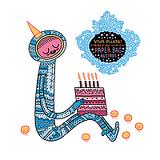
uhohI received this CD free when it came out (radio station perk), and I listened to it a few times, but not really all that much.  I never really thought that much about it because I didn’t really like the cover–it looked too babyish.  It’s been a while since I listened to it and I am delighted at what a good, solid, Talking Heads-ish album this is (with David Byrne, you never know exactly what you’ll get from a record, but this is poppy).

“Now I’m Your Mom” opens with an early 90s funky electronic bass and some crazy guitar sounds.  But as soon as the bridge kicks in, the song is pure Byrne/Talking Heads.  And that world music style chorus means that this song could have been huge (even if it is about a transvestite or transgendered person–I didn’t listen that carefully).  However, the extended section at the end makes the song feel a little long.  “Girls on My Mind” is a strange (but good) song from start to finish—a weird cheesy synth sound pervades the song, and yet once again, it’s very Byrne—especially the crazy singing of the chorus.

“Something Ain’t Right” opens with an odd chant but then turns very conventional—with choral voices giving big oohs.  “She’s Mad” opens as a kind of sinister song.  And yet, after some verses about her being mad, the chorus is as bright as anything else on the record—a very schizophrenic song.  “Hanging Upside Down” has a very commercial Talking Heads Feel, like “Stay Up Late.”

“Twistin’ in the Wind” has more of those big choruses of voices to “well well well” up the song.  “The Cowboy Mambo” has another weird sound that circulates through the song, but it’s got a good beat and a great chorus and it would be fun to dance to.  “Monkey man” is a horn-heavy track that opens in a sinister vein once again.  “A Million Miles Away” just gets stuck with you and makes you want to sing along.  “Somebody” ends the disc with more Latin horns and rhythms.  It’s a fun song, and a good ending.

Overall, this is a surprisingly good record.  All of the songs are a little long–Byrne songs should really max out around 4 minutes.  For that extra time, he either tends to repeat himself or add superfluous codas that drag out the end.  But aside from that, this is a real treat, especially for Talking Heads fans.

[READ: May 20 2013] Arboretum

The back of the book describes this as a collection of enigmatic, enchanting mental maps.

And that is kind of what the book is.  It is a collection of drawings–tree and branch-style drawings mostly–that endeavor to map relationships.  But the subject matter is crazily diverse–oftentimes nonsensical or at the very least unparseable.  The good news is that many of the drawings have an explanatory text in the back of the book.  I acknowledge that ideally the drawings should make sense without needing an explanation, but the explanations were really useful–they really give you the frame of mind that Byrne was trying to explain through the pictures. (more…)

Read Full Post »

mystrugglSOUNDTRACK: TRICKY-“Christiansands” (1996).

christiansandsThis book is set in Kristiansands, and so naturally this song was ringing through my head the whole while I was reading it.  I’ve known this song for ages, but had no idea that Chirstiansands was an actual place in Norway.

This song is dark and tense.  Over a slinky beat, a spare guitar riff introduces Tricky’s voice as he rasps (his voice is slightly modified to give him a weird echo).  And while he’s reciting his verses, the gorgeous voice of Martina Topley-Bird, repeats what he’s saying in a whispered voice until she sings out the chorus “I met a Christian in Christiansands.”

The verses repeat with Tricky emphasizing, “master your language and in the meantime I create my own.  It means we’ll manage.”

I honestly don’t know what the song is about, and it feels like it never properly ends–that riff, at once menacing and gripping never seems to conclude.  It’s a masterful track and hard to forget once you’ve heard it.

[READ: May 11, 2013] My Struggle Book One

I read an excerpt of Book Two from this series in Harper’s.  And despite the fact that nothing really happened in it, I was drawn in by the writing style.  This first novel is very similar in that not a lot happens but the voice is very captivating.  The translation is by Don Bartlett and it is fantastic–I can only assume the original Norwegian is just as compelling.  So, despite the fact that this autobiographical series contain six books (six!) and totals over 4,000 pages (how could this be if Book one is a mere 400?  Books 4-6 are over 1,000 pages each), I decided to give it a try.  (Incidentally, Book Two has just been translated into English this month).

This series has caused some controversy because it is given the same title as Hitler’s Mein Kampf (Min Kamp in Norwegian), and also because he says some pretty means stuff about people who are still alive (like his ex-wife).  Although there isn’t much of that in Book One.

death in the familyIndeed, Book One basically talks about two things–a New Year’s Eve party when Karl Ove was youngish and, as the bracketed title indicates, the death of his father.  (The title A Death in the Family is the same book as My Struggle Book One–from a different publisher.  It has a totally different cover but is the same translation.  I don’t quite get that).  But indeed, these two events take 430 pages to write about.

How is this possible?  Because Karl Ove writes about every single detail.  (I assume this why the books are considered novels, because there is no way he could remember so much detail about every event).  I’m going to quote a lengthy section from a New Yorker review (by James Wood) because he really captures the feeling of reading the book:

There is a flatness and a prolixity to the prose; the long sentences have about them an almost careless avant-gardism, with their conversational additions and splayed run-ons. The writer seems not to be selecting or shaping anything, or even pausing to draw breath….  There is something ceaselessly compelling about Knausgaard’s book: even when I was bored, I was interested. This striking readability has something to do with the unconventionality of “My Struggle.” It looks, at first sight, familiar enough: one of those highly personal modern or postmodern works, narrated by a writer, usually having the form if not the veracity of memoir and thus plotted somewhat accidentally, concerned with the writing of a book that turns out to be the text we are reading.  But there is also a simplicity, an openness, and an innocence in his relation to life, and thus in his relation to the reader. Where many contemporary writers would reflexively turn to irony, Knausgaard is intense and utterly honest, unafraid to voice universal anxieties, unafraid to appear naïve or awkward. Although his sentences are long and loose, they are not cutely or aimlessly digressive: truth is repeatedly being struck at, not chatted up.

That idea of being bored but interested is really right on–and it may sound like a bad thing, but it’s not.  You can read along thinking that there’s no way he is going to give so much unimportant detail.  But you get this description of drinking a cup of tea: (more…)

Read Full Post »

ookSOUNDTRACK: “WEIRD AL” YANKOVIC-“Polka Party!” (1986).

Weird_Al_Yankovic_-_Polka_Party!Despite how much I loved Weird Al, I turned up my nose at this album when it came out.  I distinctly remember seeing it in the Ridgewood books and records store (records in the basement) where I bought my vinyl and dismissing the platter.  It’s a little unfair to have dismissed it based on the cover since Al was all about the accordion but I thought it was a serious polka album and I was too cool by half for that nonsense.  Interestingly, the album sold very very poorly, and I’m not sure if it was because of the cover.

As a result I don’t really know these songs all that well.  Those first three discs I listened to all the time but I didn’t get this one till much much later.  And it seems that four albums so quickly may have sapped some of Al;s creativity or at the very least eroded the good songs to parody (his more recent releases come every three years or so and they are really solid).

“Living with a Hernia” I like because the video is funny, although I did not care for the original.  “Dog Eat Dog” is a Talking Heads style parody and it’s really good–sounds a lot like the Talking Heads, although I’m not sure it’s all that funny (at least not any funnier than a Talking Heads song). Sometimes the original songs that Al parodies are so bad that I don’t want to like the parodies.  “Addicted to Spuds” is one of those songs.  The parody is very funny, but I hate the original so much that I can’t entirely enjoy this song.  “One of Those Days” is another of his earlier generic rockers (piano and simple structures that don’t lend itself to a lot of fun) and lyrically, it’s a little blah.  “Polka Party!” is what the album was named for and it’s another medley of tracks.  Peter Gabriel’s “Sledgehammer” sounds so different here, totally removed from it’s original music.  It’s amazing, though, how many of these original songs I didn’t know (what was going on in 1986?).  I do like the little sneak of INXS.  This song is also the first one where Al’s lyrics became racey because of the songs that were so popular (“Nasty,” “Venus”).

“Here’s Johnny” is  parody of  a song I don’t know at all although I can tell immediately that he sounds just like the original–he manipulated his voice perfectly.    “Don’t Wear Those Shoes” is another blah song.  Al tends to use really over the top violent imagery but it’s  unfortunate when it seems to be the only thing funny in a song like this one.  “Toothless People” is a parody of “Ruthless People” which I don’t even remember being a song.  I don’t even remember the movie being all that popular.  I couldn’t even tell who the original was by even though Al is putting on a good voice (it was Mick Jagger).  “Good Enough for Now” is a decent country song–pretty funny, and yet really not that far from country songs that you hear now (and maybe then, too–I’m not much of a country fan).

The lackluster side 2 is utterly redeemed by the fantastic and awesome “Christmas at Ground Zero” a stellar and hilarious song about nuclear panic it even includes a sample from Ronald Reagan (in the video).  Outstanding.

Overall this disc is pretty disappointing   Al took two years to make the next one and whatever he did on the break certainly worked because the next album was Even Worse!

[READ: January 22, 2013] The Adventures of Ook and Gluk Kung-Fu Cavemen from the Future

This is a pretty surprising book.  It is drawn by George and Harold who made the hilarious Super Diaper Baby which was based on an incredibly childish premise.  But this book, even though the spelling is awful like when George and Harold make comics, is book is pretty smart and intense.  And very Zen.

So Ook and Gluk are cavemen.  They are in a tribe whose king is King Goppernopper (the fact that everyone gets his name wrong cracks me up, I love that kind of juvenile joke).  Goppernopper hates Ook and Gluk (the fact that he gets their names wrong and his minions help him to pronounce it is very funny as well).  Ook and Gluk rescue a dinosaur who is trapped in quicksand (and yes there is a scientists disclaimer that cavemen and dinosaurs did not live at the same time, but George and Harold offer a disclaimer that the scientist is dumb and their story tells the truth).  And the dinosaur and her baby (Lily) make the King look foolish.   The King promises revenge.

Which he gets in Chapter Two when a Goppernopper from the future comes back in a time machine to 500,001 B.C and steals natural resources from the cavemen (to sell at a huge profit in 2222 AD.  Future Goppernopper traps Ook and Gluk in the future and King Goppernopper promises to bring the rest of the cavemen to the future to work as slaves. (more…)

Read Full Post »

booger1SOUNDTRACK: “WEIRD AL” YANKOVIC in 3-D (1984).

in3dAfter Al’s debut he came roaring back the next year with In 3-D a disc which opens with his first Michael Jackson parody “Eat It.”  The song was leaps and bounds above anything on the debut (even if there are still hand farts in it).  The song actually sounds like the original (if a little less “full” and a little goofier and on the whoo hoos).  But the solo by Rick Derringer rocks and the whole song works very well.  The rest of the album is a solid mix of originals and parodies

I didn’t really understand that “Midnight Star” was meant to parody the Weekly World News and such (I didn’t really know those papers at the time) but I thought the headlines were funny.  And yes its a lot of fun to sing a long to.  It’s always funny when Al parodies a song that is already rather stupid (My Sharona, or in this case Safety Dance), and “The Brady Bunch” opens with a general overview of stupid TV shows and then morphs into the The Bunch’s theme song to the music of “Safety Dance.”  “Gonna Buy Me  A Condo” is a reggae song which I never really got the joke of as a kid.  I mean, I knew it was reggae but I didn’t know enough about reggae to know that this song is kinda funny, about selling out for the mainstream life.  It’s not genius or anything but it’s kinda funny–in fact I think it’s funnier now than I ever did as a kid.

“Jeopardy” works perfectly as a parody.  It retains all of the weird sounds and “drama” of the original and yet it works entirely unto itself.  It’s definitely an early highlight.  This disc also introduces what would be come a staple on all his later albums:  “Polkas on 45” where he mashes together a string of songs into a polka beat.  They are always fun and clever.  This one is a mix of new wave and classic rock bands Devo, Deep Purple,  Berlin, The Beatles,  The Doors,  Iron Butterfly, Jimi Hendrix, Talking Heads, Foreigner, The Police,  The Clash,  The Rolling Stones,  and The Who.

“Mr Popeil” is another one that I didn’t full get until later (why did i like Al if I didn’t get any of the jokes?).  Ron Popeil is the king of the As Seen on TV  product (as listed in the song).  The thing that I really didn’t get was that this is was a parody of the B-52s–one of the first parodies he’d done that’s a parody of band but not really a song.  This is not a parody of Rock Lobster exactly, but it sounds quite a lot like it–and that’s a neat trick.

“King of Suede” is a parody of The Police–I never really liked it even though it does work as a parody–perhaps the original isn’t a very string song.    “That Boy Could Dance” is instantly forgettable, so much so that I had forgotten all about it.  “Theme from Rocky XIII” is a pretty funny parody of “The Eye of the Tiger.”  But it doesn’t prepare you for the genius that is “Nature Trail to Hell.”  An epic song about horror movies with the great line “if you lie the 6 o clock news you’ll love Nature Trail to Hell (in 3D).”  It’s over the top and very silly–the music escalates  with screams and strings and several different sections (although the solo section is a little anemic).  I can’t imagine what he would do with it today if he rerecorded it.

So In 3-D was a big jump in quality for “Weird Al” and was actually a pretty big hit (charting at #17).

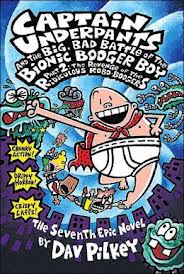
[READ: February 22, 2013] Captain Underpants and the Big Bad Battle of the Bionic Booger Boy Part 2

Since it is 2013 and not 2003, I don’t have to wait several months for Part 2.  Huzzah!

The opening comic in this book not only gives all of the Captain Underpants background that it usually does, it also includes what happened in Part 1.  At the end of the book, the robotic booger monsters (Carl, Trixie and Frankenbooger) were on the attack.  They destroyed the Combine-O-Tron 2000 so it would not reverse the effects of the machine on Captain and Melvin.  But Sulu the hamster rescued them by hurling the boogers into space (with his mouth, ew).

The boys want to get things back to normal.  But Professor Krupp (who is in Melvin’s body) is going about his business getting everyone in trouble.  Except that since he looks like Melvin people are getting angry at him rather than listening to him.  This book features a wonderful letter swap from “Check out our school’s big internet website at http://www.jhes.com” to “We shake our big butts when we swim in the toilet.”

The boys give up on trying to fix the Combine-O-Tron and decide to use the Purple Potty Time Machine that is in the library and go back in time.  There’s a great sequence in which the librarian has banned every book but one and I love the posters that are up encouraging the banning of books–it’s another awesome dig at those who censor.  And the librarian is named Miss Singerbrains. (more…)

Read Full Post »

CV1_TNY_12_17_12Sorel.inddSOUNDTRACK: JONI MITCHELL-“The River” (2002).

joniMuch like Zadie Smith in the article, I was never much of a Joni Mitchell fan.  We may be one of the only houses in America without a copy of Blue somewhere.  Much of my ignorance about her comes from simply not being exposed to her.  Which also seems absurd and yet it is true.

I know her from covers, which should establish her as a great songwriter, if nothing else.  And by now I know a number of her songs, like this one.  This is kind of a Christmas song (it has the word Christmas in it), although it’s not very Christmassy.  I have a hard time believing that Zadie Smith’s husband never noticed that she is quoting the music from Jingle Bells in the beginning of the song though, as it’s really quite obvious.

It’s a  pretty song, and hey maybe it’s time to see what else is on Blue.

[READ: December 20, 2012] “Some Notes on Attunement”

I love hearing about Zadie Smith’s family–her hip black mother and her dorky white father.  I love that she embraces both sides of her life.  And when she writes about it, she presents it so fully.  So growing up her parents listened to Burning Spear and Chaka Khan and Duke Ellington and James Taylor and Bob Dylan and yet somehow never Joni Mitchell.  And she wonders how they didn’t know or perhaps why they didn’t like her.  [My parents were to old for folk music, so that’s my excuse].

She talks about the first time she heard Joni, at a college party (it was Blue, of course) and frowned at it.  Her friends, both black and white said, “You don’t like Joni?”  But, she explains, “Aged twenty, I listened to Joni Mitchell–a singer whom millions enjoy, who does not, after all, make an especially unusual or esoteric sound–and found he incomprehensible.”

And then at 33 she had another experience–listening to Joni Mitchell in a car with her husband on the way to Wales.  Which is where we hear her saying “And that bit’s just Jingle Bells.”  She says she didn’t expect to get much out of that line “and was surprised to see my husband smile, and pause for a moment to listen intently: “Actually that but is Jingle Bells–I never noticed that before.  It’s a song about winter…makes sense.”  Wait, how could he not hear that before??? (more…)

Read Full Post »

SOUNDTRACK: THE BEAUTIFUL SOUTH-“Dumb” (1988).

About five years ago I mentioned all of The Beautiful South records in one post.  But I didn’t really talk about them all that much.

This comes from one of my favorite Beautiful South records–I like all the songs equally, but I often have this song in my head.  And the reason I picked it right now is because Paul Heaton sings about a bunch of things each one ending with “either you are simply beautiful or I am simply dumb.”

And these are: “It doesn’t take a mathematician to add a simple sum”; “It doesn’t take a labrador to show a blind man sun”; and this one: “It doesn’t take Robert The Bruce to see the web you’ve spun.”

I had no idea who Robert the Bruce was and I never bothered to look it up.  And yet, as you will see below in the post, Robert the Bruce is mentioned in JR!  I was flabbergasted.  And this song immediately popped into my head.

And that’s not a bad thing.  It’s a pretty piano ballad with a seemingly negative chorus (dumb, dumb, dumb) despite its positive message.  There’s also a beautiful ending: “The sun, the sky, the moon, the stars/Jupiter, Neptune and Mars/All these things I clearly see/It don’t take a telescope for you to love me.”  The songs ends with Jacqui Abbot’s lovely echo of this stanza.

The Beautiful South were a great band, they broke up a few years ago.  Paul Heaton has a number of solo albums out but they’re not available in the states, so…

[READ: Week of August 6, 2012] JR Week 8

This week’s read finds us primarily in the apartment.  We see bast return home and fool around with Rhoda before he goes off on his trip to the funeral.  We see Gibbs come in and try (in vain) to get work done.  We actually get to see Gibbs’ magnum opus (or parts of it), and we see him fall off the high that he felt with Emily.

There’s a lot of funny stuff in this week’s read.  It seems like the darker the story gets, the more childish jokes Gaddis throws in there.  Seeing Gibbs unable to work on his manuscript because of all of the (real and fake) distractions is simultaneously hilarious and spot on.  And also, the plotlines are really revving up now.  JR Corp is starting to see some pushback on their deals, and a number of outsiders are starting to get angry.  There’s bound to be a collapse of some sort soon.  I’m also starting to think that with all of the ellipses in the book that it will end with a dot dot dot.

As we resume, Davidoff and Bast are still talking.  Davidoff tells Bast “Don’t worry about” something [Thanks to Simon for pointing out this expression–I recognized that Davidoff always says “brush fires,” but not the don’t worry about it].  He is concerned that Bast’s hearing aid isn’t turned up (ha), but that the Boss [JR] wants Bast’s signature on any expenditures over $2,000 (It was originally $200, but Davidoff said Bast would get writer’s cramp).  He explains the title change in the magazine from Her to She–passive to active readership–will cost $14,000.  There’s also $27,000 for a new logo.  And the logos are awesomely cheesy–hard to believe they paid $27,000 for them.  They revolve around the dollar sign, with the least offensive one making a J and R out of the top and bottom of the S–the others have a snake, or breasts or thumbing your nose or even someone behind bars.  They pick the least offensive one that says Just Rite in a dollar sign (“something patriotic about the dollar sign”).  They’re going to put them on half a million matchbooks. (more…)

Read Full Post »

SOUNDTRACK: TALKING HEADS-“Life During Wartime” (1979).

I ain’t got time for that now.

Talking heads were many things, a weird band, a noisy band, a new wave band with poppy hits, and underneath it all, a punk band that rocked.  If you know Talking Heads from their great later songs, it might be hard to imagine how raw this song is. Byrnes’ voice is intense, the melody is staggered and frantic and the whole enterprise just feels like it could fall apart at any moment.

It’s a great rocking song, and if you haven’t heard it for a while it’s worth checking out again.

Heard about Pittsburgh, PA?

[READ: Week of July 23, 2012] JR Week 6

This week’s read was the first time so far that I found a section tedious.  True, it could have been the time of night that I read it, but the whole section with Gibbs and Tom (which I call the “God damn” section) while providing some recap–and some very useful stuff at one point), was also rather redundant, both internally and in the story as a whole.  It was also quite a downer.  (Infinite Zombies has a post about this book being a comedy or a drama, so I won’t get into that here–I will get into it there though).  Although as with most Gaddis, it was a very accurate portrait of two men wallowing (and would probably be funny to hear out loud), I was happy when Tom finally left the scene.

When we left off last week, Gibbs was coming into Bast’s room holding a bottle.  Bast was just finishing up his videophone conversation with JR (Bast says he was just talking to himself).  Gibbs says he is meeting a man named Beamish here in a little bit. But he interrupts himself “Listen!”  Bast explains that the tub is running non-stop as well.  And Gibbs launches into a poem:

Through caverns measureless to, where the hell…   Bosom where the bright waters meet, like living in Pittsburgh Bast  –confluence of the Mongahela [sic–should be Monongahela] and the vale in whose bosom the bright waters meet to form the mighty Ohio (383).

I’m not entire surely where all of this comes from although As the vale in whose bosom the bright waters meet comes from a Thomas Moore song. (more…)

Read Full Post »

SOUNDTRACK: THE ACORN-“The Flood Pt. 1” from Viva Piñata! (2008).

The Acorn are a folk band from Ottawa.  This song sounds a lot like later Talking Heads.  Talking Heads are not really a band that many other bands sound like.  And yet they have such a distinctive sound that when a band sounds like them it’s hard not to think “another Talking Heads.”

Having said that, this is a fun and interesting song.  It has a world music feel in the rhythms.  And the vocals are in the vein of David Byrne (but not aping him or anything like that).  The big difference from the Talking Heads comes near the end of the song when a second voice (who sounds a bit like Bono) comes in to do harmonies.

All in all it is a very satisfying song.

[READ: March 20 2012] “Roy Lichtenstein and the Comic Strip”

This is the first of three new articles that my company send around as samples of interesting articles that we have archived.

I’ve always enjoyed Lichtenstein’s comic-book-style art.  It’s kind of pop and very commercial, and I’ve always appreciated it, even if I didn’t really like the comics that he took his inspiration from.

Despite my enjoyment of his work, I never really bothered to investigate how he did it.  I wasn’t sure if he just took a comic page and blew it up or added color or what.  But it turns out that he did actually recreate the pictures from scratch.  This article shows side by side some original cartoon panels and then Lichtenstein’s version.

In most of them he keeps things relatively the same.  But even in those it is quite clear that he is redoing the art with his own lines and style–he is not copying the faces, he is simplifying them even further in some cases or making them more beautiful in others.  You can see that he has changed little things to make them more artistically satisfying–stretching out a window to connect characters, removing background images or zooming in more in a frame to make the image more striking–although the are always recognizable as the original.   The most drastic change, and the focus of the article, is his use of the balloon quote. (more…)

Read Full Post »

SOUNDTRACK: BARENAKED LADIES-Buck Naked (1989).

Although The Yellow Tape was the major catapult, their previous cassette (known as Buck Naked) was their first demo tape.  Wikipedia explains that it came in many versions with several covers.

The initial release had 5 songs.  The final release bumped it up to 15.

I wasn’t even aware of this cassette until I was browsing around for The Yellow Tape.  And, thanks YouTube for supplying all of the tracks.

The recording is just Steven Page and Ed Robertson and a couple of acoustic guitars. And it’s totally a home recording.  But for all of that, it’s delightful to see how fully released some of their songs were.  It includes these songs which appeared on later releases” “King of Bedside Manor,” “Great Provider” “Be My Yoko Ono” and “If I Had $1,000,000.”

The rest of the tape is a mix of a few silly things and a lot of not at all silly songs.

“Road Runner” is a cover. But not THAT cover.  Rather, it’s a cover of the Saturday morning Road Runner cartoon theme song: “Road Runner, the coyotes after you….” They also cover “Psycho Killer” which is pretty hard to mess up (their version is a good campfire version, although it devolves into nonsense).  “Rudi, a Message to You” one of the great, mellow ska songs also get something of  an acoustic cover here.  Although it’s more lackluster than the original (no horns).  Finally “Wishing Well” is a cover of the Terence Trent D’arby song and is full of amusing cheap casio sounds.

“Really Don’t Know” also has a delightful excerpt from the Geddy Lee/Bob and Doug MacKenzie song “Take Off”

The other songs are decent folkie songs.  Primarily they seem to be about relationships (but it’s not always easy to tell).  Although “Careless” is a fun pop-culture mocking song (that would probably still work well live).

Sadly, the last track, the 5 second “How’s the Level,” does not seem to have made it to YouTube.  It’s obviously a goof of some sort, but I would have liked to have heard it.

I can’t imagine how many times this cassette was played before it was sent to YouTube, some of the songs sound very faded which is certainly a problem of the tape, not the original recording, but even those song (where the lyrics are hard to decipher) still sound good (and their harmonies were solid back then too).

[READ: September 13, 2010] The Maze of Bones

For two years now, this series has been red hot.  All of the kids want to read these books (probably second only to the Percy Jackson series).  What fascinated me about this series is that it is written by several different authors (which is a nightmare for libraries who shelve their books bu authors). There are ten books in all.   The authors are: Rick Riordan [Book 1], Gordon Korman [Books 2 and 8], Peter Lerangis [Books 3 and 7], Jude Watson [Books 4 and 6], Patrick Carman [Books 5], Linda Sue Park [Book 9] and, and Margaret Peterson Haddix [Books 10].

I’ve not read any of Riordan’s other books, so I don’t know how this compares.  I felt the story opened a little slowly (there’s quite a lot of information to impart) but once it took off I couldn’t put the book down.

Amy and Dan are orphans living with their mean and controlling aunt.  They learn that their grandmother (whom Amy loved and Dan thought was weird but had cool stuff) has just died.  When they go to the funeral, their grandmother Grace has set up a fascinating contest for the surviving families.  They can either take their allotment ($1 million) or they can give it back in exchange for the first of 39 clues.  Solving the clues will give them the secrets they need to become, literally, the most powerful people in the world (although at the stage we don’t even really know what that means). (more…)

Read Full Post »

SOUNDTRACK: KISS-Kiss (1974).

I’ve always loved the first Kiss record.  Everything about it is over the top, and I can’t imagine what people thought of it when it hit shelves back in 1974.

And yet, for such a preposterous looking record, the tracks are really great.  The music is a mixture of pop, Rolling Stones rock swagger, Beatles harmonies, and a sort of proto-heavy metal.

“Strutter” proves to be a great opening track with a great riff and fun vocals.  And it’s just one of thousands of Kiss songs about hot chicks that, because of its metaphorical/obscure lyrics is less offensive than it might have been.  “Nothin’ to Lose” is another lyrically inscrutable song that I’ve always assumed was very dirty: “Before I had a baby, I tried every way.  I thought about the back door.  Didn’t know what to say.”  And yet it is so outrageously poppy that no one minds singing along.  “Firehouse” is a wonderfully over the top song with great falsetto vocals and an awesome solo from Ace. “Cold Gin”  is another rocking classic with cool basswork and guitar solo notes over a standard rocking verse.  Side one ends with”Let Me Know” a pop song hiding under the guise of a heavy rock song.  The song is such a poppy bit of fluff (check out the soulful harmonies before the ending guitar solo kicks in), but it works wonders.

Side Two starts with a silly cover of “Kissin’ Time” that of course is appropriate for this band (and if they went for a more poppy sound overall, this would have been their anthem, no doubt).  “Deuce” follows, and it blasts forth with some heavy stuttering and slighty off-sounding guitars.  It also has the best opening lyric ever: “Get up and get your grandma out of here.” Which is later followed by one of the top ten Huh? choruses off all time, “You know your man is working hard, he’s worth a deuce.”  (Rampant speculation as to what a “deuce” was in 1974 can be found online).  I’ve always loved the “Love Theme from Kiss” which is possibly the most hated pre-disco Kiss song that I can think of.  It’s a weird pseudo-middle-eastern instrumental that I’ve always thought was trippy and funny.  And then comes “100,000 Years,” another one of my favorite songs.  Again, the lyrics are just bizarre (and I’ve always mis-heard them until I looked them up just now: “How could you have waited so long, it must have been a bitch while I was gone” (I’d always thought the “it” was actually “you” which means the song isn’t as nasty as I ‘d always thought).  So, it’s sort of like The Odyssey, then.  But musically the song is just phenomenal: a great guitar riff over simple bass notes and a staggering guitar solo.

The disc ends with the outstanding “Black Diamond.”  There’s so much to love about this song.  It’s a gritty tale about life on the streets.  It opens with a pretty acoustic guitar ballad sung by Paul.  Then, after the awesome “Hit it!” the song kicks in powerfully.  Peter takes over vocals, and his rough voice works perfectly.  It’s only five minutes long, but it feels like a great epic track.  No the least of which is because the song ends with a cool concept: a single note, punctuated with drums, that is slowed down (from the original taped master), getting slower and slower making the notes sound heavier and heavier, slower and slower.  You can even hear the drum riff played at a by-now snail pace.  It’s very cool.

This is really a great album, and it’s somewhat overshadowed by their mid 70’s more famous music.  And if you like 70s rock but don’t think you like Kiss, this is one disc you can sneak into your collection.

[READ: December 20, 2009] The New Sins

I’m not entirely sure what to make of this.  I bought it from McSweeney’s in their attic sale for a couple of bucks.  David Byrne is Talking Heads David Byrne, so everything he makes is arty, avant garde and hard to fathom on a first listen/view.  But I’m unlikely to read this again, so he gets a cursory attempt here.

The New Sins purports to be a collection of what the “new” sins are.  It’s also written as if it were an ancient text that was recently uncovered and translated into English (although obviously, the word choices are laughably not ancient (web design, for instance).  Basically, what you get is a list of behaviors that until recently were not sins but which are now.  The odd thing about the book is that the sins are not an obvious parody of virtues or anything like that.  He doesn’t just say that kindness is a sin, he adds that ambition is a sin as well.  So it’s not even simple inversion. (more…)

Read Full Post »

« Newer Posts - Older Posts »