Feeds:
Posts
Comments

Archive for the ‘Rush’ Category

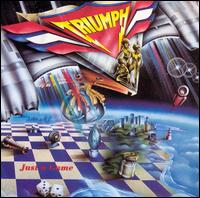
SOUNDTRACK: TRIUMPH-Just a Game (1979).

When I was a kid, my love of Rush was followed closely by my love of Triumph (I had a thing for Canadian power trios).  I’ve recently read a bunch about Triumph and was surprised to hear how acrimonious the band was.  Of course, I didn’t care about any of that back in the 80s.

This album was my favorite (even though Allied Forces was their major breakthrough).  In my gate-fold album the inner foldout was an actual board game.  How thoughtful!

It’s funny listening now, how much I liked this album back then because there is definitely some cheese here.  And I could never decide if I liked drummer Gil Moore’s songs or Rik Emmet’s songs best.  “Movin On” is a great hit but the backing vocals and “on and on” parts are kind of wimpy 70s rock–I must have blocked it out while jamming to the guitar solo.

Rik Emmet has since gone on to a successful solo career.  But on “Lay It On the Line,” the song that got me into them (thanks MTV) Rik rocks like he loves this band and this music.  The song features some serious guitar workouts and some impressive vocal acrobatics.

Perhaps, in hindsight, I like Rik’s songs better, as “Yong Enough to Cry” is pretty cheesy (it was fun to sing along to when I was 13 though–even if I never understood Gil’s pain, man).  But all of that was forgiven for the majesty of “American Girls.”  Sure, it’s also a cheesy song, but man it rocks.  As a young kid, I loved hearing the national anthem in the middle of the song.  And that solo is non-stop.

“Just a Game” is a powerhouse of a song although it’s a little long for what it is.  But then there’s the amazing “Fantasy Serenade” just over 90 second of beautiful classical guitar (a direction he’s go in much more after leaving Triumph).  It’s wonderful as a solo and it works as an amazing intro to the majestic “Hold On” (a song about music that doesn’t suck).  Although admittedly, the single version is better without the weird disco instrumental in the middle that really kind of puts a kibosh on the flow of the song.

The album ends with the strange (and quite long for what is it) “Suitcase Blues,” a 3 minute slow blues about touring.  But hey it showcases diversity, eh?

Even though many people compare Triumph to Rush, I think the more likely comparison is actually Kiss.  “American Girls” has a real Kiss vibe towards the end, and the opening chords of “Movin’ On” have a real Kiss feel.  Regardless, they played great metal/rock/prog and I’ll always love them for it.

[READ: February 12, 2012] Ready Player One

Do you like Rush? Do you like Monty Python?  Do you like the 80s?  (not those 80s, but cool 80s like Blade Runner, coin op video games, Family Ties, Square Pegs?)  Then you absolutely must read this book.  Especially if you like Rush, because how often does Rush form a plot point in a book?

Sarah was reading this book and she insisted that I read it (she has really been passing on the good suggestions lately!).  And when I heard her playing Rush a few days after reading this book (and she doesn’t like Rush), I knew I had to read it.

But what is it?  Well, It is basically the story of an online quest to find a secret egg and win a massive fortune.  The egg was placed in a virtual world by its creator, James Halliday.  Halliday was “a nerd uber-deity on the level of Gygax, Garriott, and Gates.”  He created amazing video games and ultimately the most amazing virtual reality space ever: OASIS.  (For Atari geeks, his inspiration for getting into creating video games in the first place was the Atari game Adventure).  Halliday was obsessed with the 19080s (the decade he grew up in), with technology and with geeky movies.  The only way to find this egg in OASIS is to know a thing or two (or 1,000,000) about the man who created it and the decade he loved.

If you were hooked by the first paragraph, you’ve already put this book on hold.  If you were hooked by the third paragraph, you know you have to put this book on hold.  If you’re not convinced yet let me back up.

It is the year 2044.  The earth is in a hellish state–there’s no fuel, there’s no jobs, people live in trailers that are stacked on top of each other.  Life sucks.  Except for OASIS.  OASIS is the virtual world created by Halliday.  At this stage in the world, OASIS is where most people go to school (cheaper and easier to do virtual teaching) and where many people spend most of their lives.  It’s depressing and horrible (and I actually didn’t enjoy the opening chapters all that much because it was really horrible and at a times a bit more caustic than I was expecting–but that changes quite a lot).

So Halliday invented OASIS as an idealized pace.  It was originally a multi-player game but soon became a new place to live, a kind of Eden.  It was free to join and you didn’t have to pay to play.  Although you needed credits to travel (or to build your own buildings or planets or whatnot), you could stay on the main world (which looks a whole hell of a lot nicer than the real world) and just hang out for free.  You can earn points through various achievements which would let you travel (or you could always hitch a ride with a friend) around the worlds.

Anyhow, when Halliday died, as his last will, he created a contest in OASIS.  Anyone who could find the three keys and unlock the three gates would win his entire fortune (billions of dollars) and total control of OASIS.

The protagonist (Wade in the real world, Perzival in the OASIS world) is telling his tale because he was the first avatar to find the first key to Halliday’s Hunt (it took over five years to find the first key).  If you played D&D, this section will make you smile.

When Perzival found the key he was suddenly famous because everyone on OASIS knew it was found.  Prior to this moment, the “leader board” which previously listed only Halliday, now suddenly lit up with Perzival’s name.  (Good thing OASIS avatars are anonymous, right?) (more…)

Read Full Post »

SOUNDTRACK: ULVER-Themes from William Blake’s The Marriage of Heaven and Hell (1998).

Suffice it to say, if it were not for this album I wouldn’t have read this piece by Blake.  I have been aware of it through the “doors of perception” quote that created the band name The Doors, but I never had any compelling reason to read it before.

Of course when I first listened to this, I had no idea that it was literally the entire work of Blake’s piece set to music.  And I had no idea that there would be so many diverse styles of music on the album.  I’m going to focus more on the music, as I’ll address the “lyrics” later. 

The first song starts out in a kind of synthy way–maybe early Depeche Mode.  But it quickly become more sinister, with a heavy guitar section and then a spoken word over industrial keyboards like early Nine Inch Nails.   Track two, simply called “Plate 3” is a mournful guitar solo which plays behind a woman reciting plate three.  Strangely enough, this plate is split in two parts where Blake references the bible and so Ulver end the spoken part in the middle but keep the ominous music going for the final two minutes of the track.  The next track picks up with “Plate 3, Following,” a slower piece with creepy echoey male vocals that echo the female lead.

“The Voice of the Devil, Plate Four” is a very delicate guitar part.  The female voice introduces the piece and the male voice recites the statements .  It;s the most easily understood of all the tracks (the vocals are crystal clear).  When the parts are done, the song turns in to a heavy metal guitar solo over some heavy chords. It’s a really great mix.  “Plates 5-6” is also a very clearly spoken/sung track.  Over a classical guitar with occasional heavy beats, the voice narrates (with amusing mispronunciations (there are many thoroughout the piece, but hey English isn’t their first language)).

“A Memorable Fancy (Plates 6-7)” is the first of five fancies.  This one has a very electronic feel (later period Nine Inch Nails).  This one even creates its own chorus by repeating “fires of hell” where the words do not belong.  “The Proverbs of Hell” is probably the most complex and multifarious musically.  It goes through many different musical and vocals styles.  The opening is barely audible while later parts are spoken clearly.  Other lines are hidden under a fog of noise.  Musically it’s very engaging, but it’s a shame to miss out on the poetry without a lyric sheet.

“Plate 11” also opens virtually inaudibly, with a crazy echo placed on the female vocals.  Half way through the voice become clearer and the music, which was quiet and mellow, picks up, but retains the simple melody it had.  “Intro” is an instrumental, an odd thing to include if they are following the book so specifically, as there is no intro.  It is simple, repeated waves of chords which grow louder for 3:30.   It ends with some maniacal drumming .  However, it is a nice breather as we head into “A Memorable Fancy Plates 12-13,” which opens with a very slow piano.  It turns into a largely drum-based song with a clear spoken word.  Until about half way through when the voice is heavily distorted until the end.

“Plate 14” is a percussion heavy electronic track with heavily distorted vocals (this is where “the doors of perception” bit comes from).  It leads to “A Memorable Fancy (Plate 15)” which opens with more low rumblings (like “Intro” above).  When the vocals come in, after 3 minutes, they are distant and tinny, but very clear.

Disc 1 (did I mention there were two discs) ends with “Plates 16-17.”   It opens with quiet music that slowly grows louder and more electronic.  The vocals are echoed and distorted and hard to understand.  The end of the track picks up the electronic beat for about a minute.

Disc two opens with the eleven minute “A Memorable Fancy (Plates 17-20)”.  It opens with a cool beat and a dark tone with vocals that are mostly understandable.   After a couple of minutes, the song settles into a late period Depeche Mode style–distorted guitars and vocals that sounds not unlike Dave Gahan’s.  By the end, it’s a pretty standard heavy metal chugging guitar (with a simple but interesting solo).

This is followed by another “Intro,” this time a rather pleasant guitar solo over picked guitars.   “Plates 21-22” is quite enjoyable as the vocals are clear and emphatic over a standard heavy metal song.  It feels like comfort food after all of the different styles of the disc.

“A Memorable Fancy Plates 22-24” has a great weird keyboard style (kind of Marilyn Manson).  The penultimate track is another “Intro.”  This one has some swirly minor-key guitars that sound  a bit like the guitar outro to Rush’s “Cygnus X-1.”   It goes through several iterations before ending in distorted waves that lead to “A Song of Liberty Plates 25-27”.   There are three guest vocalists on this track: Ihsahn and Samoth from Emperor and Fenriz from Darkthrone.  The interesting thing about this is that Garm (the male vocalist on all the tracks) has so many different styles of singing/speaking throughout the album that it’s hard to even notice that there are guests.

It start as mainly electronic piece with heavily distorted vocals (Ihsahn sounds like he is being strangled).  In the second part, the vocals are clearer.  The drums gets louder (sounding like the Revolting Cocks, maybe).  By the third part (Fenriz) the song turns into a guitar solo and the style of recitation reminds me of Allen Ginsbregr’s Howl.  His section ends with a distorted voice chanting the final lines and then twenty minutes of silence (the track is listed as 25 minutes, but there’s only 5 minutes of song and then 30 seconds at the end).  The final “Chorus” of the book is pretty well inaudible.

Despite the complexity of the album and the hard to follow lyrics and all of that, the entre work is really something. It is powerful and complex and runs through so many wonderful pieces and movements.  I have no idea how to classify it as it has pieces of metal and electronica as well as classical.  Perhaps it’s safe to just call it a soundtrack.

I’ve spent a lot of time talking about this CD, but I barely scratch the surface of what could be said about it.  Check out this amazing review from Encyclopaedia Metallum who go into wonderful depth and a thorough comparison of the music to the text.

[READ: November 27, 2011] The Marriage of Heaven and Hell. 

The Blake piece is available online in several places, although I got my copy from the library.  Mine contained several critical essays which I looked at briefly but decides they simply weren’t all that compelling, especially since Blake’s work (aside from details that simple footnotes might hep to clear up) is pretty understandable. 

In total, Blake’s work is 27 plates long. Each plate is hand written (in a fancy script) and many have illustrations (also hand drawn and colored).  There are allusions to many different things and it helps to be familiar with the Bible and with Emanuel Swedenborg’s theological work Heaven and Hell which is directly referenced several times.  Indeed, this work is clearly a response to that one; the opening states “and it is now thirty-three years since its advent” when Swedenborg’s book was published 33 years before Blake’s.

The gist of Blake’s piece is that God did not intend for man to separate the sensual and physical from the spiritual and mental.  It is basically a plea to hedonism, although not even seemingly to excess.  More like an “if it feels good, do it” attitude.  And he lays out these ideals pretty clearly in many of the passages.  True, there are many passages that are inscrutable (like the crazy opening–don’t be put off bu Rintrah), but when he gets to his main points, he is quite clear.  Blake attacks established religion but does not condemn God or endorse atheism.  So we get quotes like this:

“Attraction and Repulsion, Reason and Energy, Love and Hate, are necessary to Human existence.
From these contraries spring what the religious call Good & Evil. Good is the passive that obeys Reason. Evil is the active springing from Energy.
Good is Heaven. Evil is Hell.”  And shortly after: “Energy is Eternal Delight.”  Blake cites Paradise Lost as a history of the separation of these two ideas and concludes “that the Messiah [Reason] fell, & formed a heaven of what he stole from the Abyss.” (more…)

Read Full Post »

SOUNDTRACK: RUSH-“You Can’t Fight It” (1973).

This is the B-Side of the first single Rush ever released (The A Side: a cover of “Not Fade Away”).  It was released briefly but has been long out of print.  Thankfully, people on the internets have access to all kinds of things. It’s pretty clearly Rush–Geddy sounds right, and it sounds like an Alex solo, so I think it’s fair to say that this is genuine.

It’s a pretty decent hard rock song from the 70s.  It sounds like it could be from any of the second tier bands back then.  It’s got some boogie and some swagger and it seems like it’s not about anything important (rock n roll, apparently).

While I’m obviously glad that Rush went on to bigger and better things, it’s fun hearing how confidently they fit into the context of music by their heroes.  This song has a cool riff, it’s quite heavy and it shows promise.

For a band that never releases B-sides or rarities or anything like that, I’ve been pretty surprised to see what is in their internet closet.

Enjoy!

(By the way, I’m not advocating the visuals of the video–I haven’t actually “watched” it–just the audio).

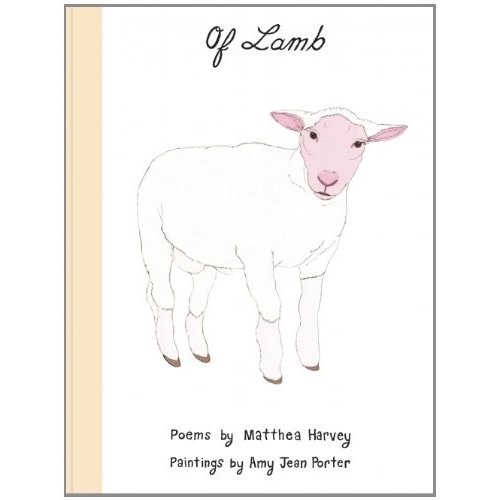
[READ: August 25, 2011] Of Lamb

This book is sort of subtitled: Poems by Matthea Harvey, Painting by Amy Jean Porter.

It’s the “poems” part that I have a hard time with, actually.  But let me get to that in a moment.

This book takes a nifty idea (an idea very similar to one that Jonathan Safran Foer is using in Tree of Codes, which, see tomorrow’s post) and fully realizes it.  But what’s funny is that she doesn’t tell you what this idea is until the afterword of the book.  So while I was reading it I wasn’t really sure what I was seeing.  The afterword made me say Oh, I get it now.  But I don’t feel that I can review it without explaining what she has done.  So, if you don’t want to know anything about the “secret” behind the book, skip the next paragraph.

[Spoiler?  Maybe.]

Okay, so essentially what Matthea has done is, she has taken a book at random (literally one she bought for $3 at a used book store), in this case, A Portrait of Charles Lamb, and she has created her poems out of that book.  In other words, on every page, she would find the words that she wanted to keep and she whited-out everything else (you can see an example in the book).  But rather than presenting the work like that, she had Amy Jean Porter make weird and cool paintings to go with every page’s worth of text (I assume Porter did the lettering as well?).  Since the book is about Charles Lamb, it was very convenient that his sister’s name was Mary.  So there was a Mary and a Lamb on almost every page.  Hence this sort of update of the Mary Had a Little Lamb story.

[end possible spoiler warning] (more…)

Read Full Post »

SOUNDTRACK: RUSH-“Not Fade Away” (1973).

I never understood this song.  Grammatically it drives me nuts.  “Love is real, not fade away.”  Why would someone write that?  Anyone with even a rudimentary grasp of English would know that that is just a horrible way to speak.  Okay, I got that off my chest.

So this is the first single that Rush ever released.  You can find out information about it on the web (of course, I didn’t know it existed until a couple of days ago).

What we get here is a pretty rocking version of this rock n roll standard.  The band has some nice group vocals on the chorus.  I like the echoed chanting of the chorus before the solo kicks in.  And I love the rough sound that Alex’s guitar has as the song opens.

As I noted the other day with the concert from circa 1974, the band was really all about Alex’s guitar work back then.  Geddy doesn’t do anything impressive on the bass (a couple of fills, but nothing special).  But Alex’s guitar solo is amazing (and you can hear snippets of future guitar solos buried in this solo).

It’s funny to me that when they recorded their covers EP Flashback, that they didn’t include this song, too.

Check it out:

The B-side comes tomorrow!

[READ: March 12, 2011] Babymouse: Skater Girl

Well, fair enough, I said that I liked Babymouse: Dragonslayer because it had a plot.  This story has a plot, too.  Interestingly, it ties in kind of nicely to the Dragonslayer story, too.  (It’s all about winning something).

As the story opens, Babymouse feels bad because she never wins anything.  She’s looking at all of the trophies which she has not won; then there’s an amusing fantasy of all the things she has won (honorable mention for spelling the word “the” correctly; honorable mention at the swim competition for “getting wet”; and amusingly, archenemy Felicia Furrypaws’ trophy for worst whiskers).

But despite her complaints about not being good at anything, we quickly see that she is actually very good at ice skating.  She rules the pond in town–until the big hockey players crash into her, that is).  She even daydreams of winning a skating trophy. (more…)

Read Full Post »

SOUNDTRACK: NEIL YOUNG-Trans (1982).

By most standards this Neil Young album is a disaster.  It’s so bad that despite updating his entire catalog and releasing all kinds of bootleg concerts, he has never issued this disc on CD in the States.  So, just what’s so awful about this disc?

Well, mostly it’s awful as a Neil Young disc.  Meaning, if you like Neil Young (either flavor: country/folk or hard rock/grunge) this disc is a big fat HUH??  Neil Young has gone all synthy?  And not just synth but computerized synthy–sometimes his voice is utterly like a computer.  It’s a travesty, it’s a shame, it’s an incredible surprise.  Unless you listen to it without thinking of it as a Neil Young record.

But after all that introduction, the biggest surprise is the first song.  You’ve been prepped for this weird album full of computer nonsense and you get the fairly standard (if a little dull) rockabilly type music of “A Little Thing Called Love.”  It’s a pretty standard Neil Young song for the time.  Hmm, maybe the album isn’t that weird.

Well, then comes “Computer Age” and the keyboards kick in.  Interestingly, to me anyhow, this is the year that Rush released Signals.  Signals was the album where Rush fans said Woah, what’s with the keyboards guys.  Similarly, “Computer Age” makes you say, geez, was there a sale on keyboards in Canada?  The keyboards are kind of thin and wheedly, but the real surprise comes in the processed vocals (Rush never went that far).  The vocals are basically the 1980s equivalent of auto-tune (no idea how they did this back then).  Because the song is all about the computer age it kind of makes sense that he would use this weird robotic voice.  Sometimes it’s the only voice, although he also uses the computer voice as a high-pitched harmony over his normal singing voice.

“We R in Control” sounds like it might be a heavy rocker (anemic production notwithstanding) until we get more computer vocals.  Again, conceptually it works (its all about the dominance of CCTV), but it is pretty weird as a Neil Young song.

And then comes yet another shock, “Transformer Man.”  Yes, THAT “Transformer Man,” except not.  This original version of the song is sung entirely in a processed super high pitched computer voice that is almost hard to understand).  The only “normal’ part of the song is the occasional chorus and the “do do do dos.”  It sounds like a weird cover.  Sarah, who loves Neil Young, practically ran out of the room when she heard this version.

“Computer Cowboy (aka Syscrusher)” continues in that same vein.  Musically it’s a bit more experimental (and the computer vocals are in a much lower register).  Although I think it’s probably the least interesting of these songs.

Just to confuse the listener further, “Hold On to Your Love” is a conventional poppy song–no computer anything (aside from occasional keyboard notes).  Then comes the 8 minute “Sample and Hold” the most computerized song of the bunch and one of the weirder, cooler songs on the disc.  It really feels like a complete song–all vocodered out with multiple layers of vocals, not thin and lacking substance like some of the tracks.  It opens with personal stats (hair: blonde, eyes: blue) and proceeds through a litany of repeated “new design, new design” motifs.

This is followed by a remake of “Mr Soul” previously only on Decade.  This is a new vocodered-harmonies version of the song.

The biggest failure of the disc to me is “Like an Inca” it’s nine minutes of virtually the same guitar riff.  The chorus is pretty wonderful, but it’s a very minor part of the song itself.  It is fairly traditional Neil song, I just wish it were much shorter.

So, this travesty of a disc is actually pretty interesting and, for me, pretty enjoyable.  Most of these synthy songs sound kind of weak but I think that has more to do with the production of the time. I’d love to hear newly recorded versions of these songs (with or without the vocoder) to see what he could do with a great production team behind him.

Trans is not a Neil Young disc in any conventional sense, but as an experiment, as a document of early 80s synth music, it not only holds up, it actually pushes a lot of envelopes.   I’m not saying he was trying to out Kraftwerk Kraftwerk or anything like that, but for a folk/rock singer to take chances like this was pretty admirable.  Shame everybody hated it.

[READ: July 5, 2011] Five Dials 19

Five Dials 19 is the Parenting Issue.  But rather than offering parenting advice, the writers simply talk about what it’s like to be a parent, or to have a parent.  It was one of the most enjoyable Five Dials issues I have read so far.

CRAIG TAYLOR & DIEDRE DOLAN-On Foreign Bureuas and Parenting Issues
I enjoyed Taylor’s introduction, in which he explains that he is not very useful for a parenting issue   That most of the duties will be taken on by Diedre Dolan in NYC.  They are currently in her house working while her daughter plays in the next room.  His ending comment was hilarious:

Also, as is traditional at most newsweeklies, someone just put a plastic tiara on my head and then ran away laughing at me.

I resist Parenting magazines, from Parents to Parenting to Fretful Mother, they all offer some sound advice but only after they offer heaps and heaps of guilt and impossible standards.  So I was delighted to see that Five Dials would take an approach to parenting that I fully approve of.  Dolan writes:

Nobody knows what works. Most people just make some choices and defend them for the next 18 to 50 years – claiming nurture (good manners) or nature (crippling shyness) when it suits them best.

And indeed, the magazine made me feel a lot better about my skills (or lack) as a parent. (more…)

Read Full Post »

SOUNDTRACK: RUSH-“Garden Road” (1974).

So the bootleg that I mentioned yesterday was in fact incomplete.  On the Up the Downstair site, the track list includes “What You’re Doing” and “Garden Road.”  When I wrote to the cool host of Up the Downstair, he said that these two songs were available on You Tube and that he’d try to find them and add them to the site.

So in the meantime, I got to listen to the song on YouTube.  This is a song that the band wrote but which they never recorded (same is true for “Fancy Dancer”).  I have to imagine that they wrote these songs for their second album (along with “In the End” which they kept) around the time that Neil Peart joined the band.  Once they realized that Neil could write better lyrics, they scrapped these two heavy rockers.  Both songs have great riffs, even if lyrically they’re pretty poor.

The song rocks pretty well, although the solo seems to have been put to better use in “Working Man.”  I enjoy how the song breaks for the shouts of the Garden Road chorus (kind of like “Bad Boy”–perhaps it was a “thing” for them).  I rather like this song, and I think I like it better than a couple of the songs on Rush.

Check it out.

Maybe it’s time to release these old chestnuts for the fans?

[READ: August 10, 2011] Life After God

After the success of Shampoo Planet, Douglas Coupland wrote several short books (which were really short stories).  They were compiled in Life After God.  To me this book also stands out as another odd one from DC, because it is very tiny.  Not in length, but in height.  It’s a small book, about the size of a mass market paperback.  But it makes sense that it was made this short because it is written with lots of short paragraphs that lead to page breaks (kind of like Vonnegut).

For instance, the first story contains at most two paragraphs per “chapter” about–16 lines of text and then a page break.  At the top of each page is a drawing from DC himself which illustrates to a small degree the information on the page.  It leads to incredibly fast reading and even though the book is 360 pages, you can polish it off pretty quickly.

But what’s it about?  Well, mostly the stories seem autobiographical (even though they are classified as fiction.  And actually, I don’t know anything about DC’s personal life so I don’t know if they are based on anything real, although I do know he doesn’t have any kids, so those can’t be true at any rate).  There are eight stories.  They are all told from the first person and are more or less directed at “you.”  They all seem to deal with existential crises of some sort.  They are honest and emotional.  To my ear, sometimes they seem a little forced, maybe it’s contextual, but it’s hard to write this kind of massively introspective piece and have it sound “real.”  (But maybe I’m not very introspective about things like this myself). (more…)

Read Full Post »

SOUNDTRACK: RUSH-The Fifth Order of Angels (bootleg from the Agora Ballroom,Cleveland, 26 August 1974) (1974).

I have mentioned this concert before, but I played it again today, and was struck by a couple of things.

1) According to the liner notes, Neil Peart had been in the band about two weeks.  How did they decide that their new drummer was going to be doing a drum solo during the show?  I mean, by now, everyone knows that the solo is its own song.  But, he’s been in the band two weeks.  It’s obvious he’s a good drummer, better than their original drummer, but a drum solo?  Is that just what rock bands did back then?

2) I’m struck by how much this show sounds like early Kiss.  I never really thought that  their first album sounded like Kiss, but in this live setting, a number of the songs, or perhaps just  the way they are recorded make me think of early Kiss.  In particular, during the crazy “one, two, three, FOUR!” of “In the End,” when the guitars kick back in, it sounds like a Kiss show from circa Alive!.

3) It’s amazing how guitar-centric the band was back then.  The mix is a little rough so it’s not entirely clear how insane Geddy is on the bass (when he gets a few solo notes, the bass sounds really tinny).  But the concert is like a showcase for Alex’s solos.  True, the whole first album really demonstrates what a great soloist he is, but it’s really evident here that Alex was the star.

4) Their earlier songs are really not very good.   I mean, every Rush fan knows that the first album is almost not even a real Rush album, but it’s shocking how pedestrian these songs are compared to even what would show up on Fly By Night.  Still, circa 1974 I’ll bet this show kicked ass.

It’s available here.

UPDATE: The missing content has been added!

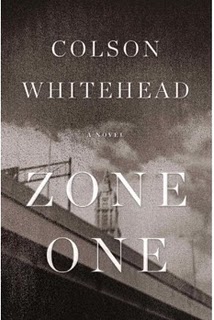
[READ: August 9, 2011] Zone One

After reading the excerpt from Zone One in Harper’s I decided it was time to read the book (which is due to be published in October).

I admit I haven’t read Whitehead’s other works, but I have read excerpts, and I thought I knew the kind of things he wrote.  So it came as a huge surprise when the excerpt ended the way it did. I didn’t want to spoil anything when I wrote the review of the excerpt, but since the entire book is set in the dystopian future and since it explain what has happened right on the back, I can say that Zone One is set in the aftermath of a kind of zombie apocalyptic plague.  And I can’t help but wonder if the rousing success of McCarthy’s The Road has more or less opened up the field of literature to more post apocalyptic, dare I say, zombie fiction.  [I haven’t read The Road, so there will be no comparisons here].

Actually there will be one.  Sarah read The Road and complained that you never learned just what the hell started the end of the world.  Indeed, in this book you don’t either.  There is an event called Last Night, and after that, there’s simply the current state of affairs.  I suppose you don’t really need to know, and since the story is all about dealing with the zombies, I guess it doesn’t really matter how it all started, but I think we’d all like to know.

Now what makes this story different from the typical zombie story is that for the most part there aren’t all that many zombies (or whatever these undead people are called) in the story.  There are some of course, and they are inconvenient to the main characters, but unlike a story like Zombieland, (which was awesome) or the more obvious Night of the Living Dead, the story isn’t really about fighting zombies, it’s more about the rebuilding of the country in a post-zombie world. (more…)

Read Full Post »

SOUNDTRACK: FOO FIGHTERS-Wasting Light (2011).

The Foo Fighters are huge.  Duh.  But when I think of that, it amazes me that a) the Foo Fighters are the band from “the drummer from Nirvana” and that b) while Dave Grohl knows his way around a melody, he is a metal dude at heart, and some of his most popular songs are really heavy.  He can scream with the best of them.

I’ve enjoyed the Foos for many years, but I didn’t listen to their previous discs all that much (or at least I didn’t listen to the mellow disc from In Your Honor and I don’t remember anything off of Echoes…), but this new one is fantastic.  There’s not a dull song on the disc, and Grohl has hit new heights of catchiness and singalong-ness. 

I also like how noisy the disc is.  It opens with some great discord before turning in a majorly heavy rifftastic scream fest in “Bridge Burning.”  Despite the screaming and noise of the opening, the chorus is super catchy.  “Rope” was said to be inspired by Rush.  Knowing that, I can hear a lot of little Rush-isms in the track: The main riff is very Rush-like, there’s a cymbal tapping that reminds me of Neil Peart in the verses, as well as a little drum solo in the middle (with a cowbell!) and the solo is very Alex Lifeson. (It also feels longer than 4 minutes).

“Dear Rosemary” features Bob Mould on backing vocals (but you can hardly tell it’s him).  It’s got a great chorus as well.  “White Limo” is a wonderful punk song, completely incomprehensible lyrics and all.  Meanwhile “Arlandria” (whatever that means) is another totally catchy track (I find myself singing it a lot).

“These Days” should be the next single: catchy and easy on the ears.  I wonder why it hasn’t been released yet.  “Back and Forth” has another great noisy riff.  One thing that I like a lot about the Foos is that they put different things in the same song:  so “A Matter of Time” has a very simple verse and a catchy chorus, but there’s some really buzzing heavy guitars too.  “Miss the Misery” has a kind of sleazy feel which I think is new for the Foos.  And “I Should Have Known” is a kind of angry ballad (I’d like to see Richard Thompson cover it). 

The final track, “Walk” is a fast rocker that sums up the album really well.  Bravo Dave Grohl.  I can’t get enough of this disc, regardless of how popular it is.

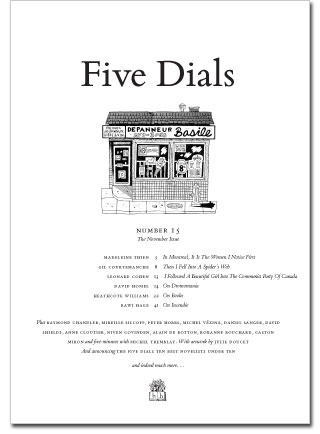
[READ: July 2, 2011] Five Dials Number 15

After the brevity of Number 14, Five Dials Number 15 comes back to a fuller size.  It’s strange to me that the issue is titled The November Issue, in part because they never tell us when the issues were published, but even more because this is actually the Québec Issue.  Most of the authors are Quécbecers and the issue release party was in Québec as well.

I’d like to point out that while I was looking something up about this issue (more later) I discovered the Five Dials News Page.  There are currently 43 pages worth of posts.  But most of them are short.  If there are any especially noteworthy ones, I’ll add them to reviews of future issues, but for the most part so far they’re just announcements of how well received their books are (I’ve already made notes to read two of them).  They also give release dates for the issues, which is how I have been able to retroactively attach dates to some of them.

There are many Québecois writers included in this issue (thoughtfully translated into English), as well as some standard features by Alain De Botton and frequent contributors David Shields and Raymond Chandler.

CRAIG TAYLOR-On Our Québec Issue, and Young Novelists
Taylor’s introduction discusses many Canadian’s attitudes about Québec and their (seemingly perennial) vote concerning separation from the country (“so, let them go”).

creepy beard

The confusing thing here is that it appears that Taylor is Canadian (or at least lived there in 1995/6).   But surely he is British, no?

There’s lots of information about Québec in here but no grand statement (except that Celine Dion’s husband’s beard is still creepy).

He also introduces a new section called “Our Town” which is all about London.  The final section of the note says that

we are releasing our second Five Dials list of Top Ten Novelists Under Ten (or ‘Ten Under Ten’,or ‘Ten-Ten’, or as some of the writers themselves call the list: ‘Tintin.’) As you know, many of the writers we chose for our first Ten Under Ten list went on to things such as high school.

This is how I discovered the Five Dials News page, because there certainly was no Ten Under Ten section in a previous issue of the magazine.  Of course, nor is there any mention in the news that I have seen.  So I can’t decide if the whole thing is just a big joke or what.  I assume it is (but I’d hate to not give credit to the waaaay precocious kids at the end of the issue). (more…)

Read Full Post »

SOUNDTRACK: BIG DIRTY BAND-“I Fought the Law” (2006).

I just found out about this “supergroup” which was created for the Trailer Park Boys Movie.    The group consists of Geddy Lee and Alex Lifeson from Rush, drummer Jeff Burrows from The Tea Party and three people I don’t know: the singer from Three Days Grace, the singer/guitarist from Thornley and on lead vocals Care Failure from Die Mannequin.

I have to say that I’m not that excited by this cover.  The song has been covered so many times (some very good: The Clash, some very clever: The Dead Kennedys, and some terrible: many others).  And frankly there’s not much that you can do with this song.  It’s simple in structure with potential for shouting (which everyone likes), but little else.

For Rush fans, you can’t tell that Geddy or Alex are even on it.  So really it’s just a kind of metal-ish version of this old song.

Oh well, they can’t all be zingers.  You can hear it here.

[READ: February 1, 2011] Polaroids from the Dead

After reading Shampoo Planet, I wanted to see if I remembered any of Coupland’s books.  So I read this one.  It’s entirely possible that when I bought this book I was disappointed that it was not a new novel and never read it.  Because I don’t remember a thing about this book.  (This is seriously calling into question my 90’s Coupland-love!).

But I’m glad I read it now.  It’s an interesting time-capsule of the mid-90s.  It’s funny to see how the mid 90s were a time of questioning authority, of trying to unmask fame and corporate mega-ness.  At the time it seemed so rebellious, like everything was changing, that facades were crumbling.  Now, after the 2000s, that attitude seems so quaint.   Reading these essays really makes me long for that time when people were willing to stand up for what they believed in and write books or music about it (sire nothing changed, but the soundtrack was good).

So, this collection is actually not all non-fiction.  Part One is the titular “Postcards from the Dead.”  It comprises ten vignettes about people at a Grateful Dead concert in California in 1991.  As Coupland points out in the intro to the book, this was right around their Shades of Grey album album In the Dark, and huge hit “Touch of Grey”, when they had inexplicable MTV success and it brought in a new generation of future Deadheads.  He also points out that this is before Jerry Garcia died (which is actually helpful at this removed distance).

These stories are what Coupland does best: character studies and brief exposes about people’s lives.  The stories introduce ten very different people, and he is able to create a very complex web of people in the parking lot of the show (we don’t see the concert at all).  As with most Coupland of this era, the characters fret about reality.  But what’s new is that he focuses on older characters more (in the first two novels adults were sort of peripheral, although as we saw in Shampoo, the mother did have millennial crises as well).  But in some of these stories the focus is on older people (Coupland was 30 in 1991, gasp!).  And the older folks fret about aging and status, just like the young kids do. (more…)

Read Full Post »

[WATCHED: January 3, 2011] Classic Albums: Rush–2112 • Moving Pictures

Sarah got me this disc for Christmas.  Thank you, Sarah!

This DVD is from the Classic Albums series.  The series is shown on VH1 in the states and BBC (and other places) elsewhere).  There’s been about 35 episodes of the series, with Rush being one of the few bands to have two albums for the show (which is an honor, but which also cuts down on the content for each album by half…boo!).

The show is an hour, and there’s almost an hour of bonus footage on the DVD  (which die-hard fans will enjoy more than the actual show).

The main show itself looks at the creation of these two classic albums.  There are interviews with the band members as well as many people associated with the band (and a couple completely random musicians).  We get their manager Ray Daniels and the producer for these albums Terry Brown (his segments are my favorite because he gets behind the mixing console and plays around with the songs).  We also get Cliff Burnstein (the guy with the crazy hair) who was instrumental in getting Rush publicity. (more…)

Read Full Post »

« Newer Posts - Older Posts »