Feeds:
Posts
Comments

Archive for the ‘Pink Floyd’ Category

half pastSOUNDTRACK: FEU THÉRÈSE-Feu Thérèse [CST040] (2006).
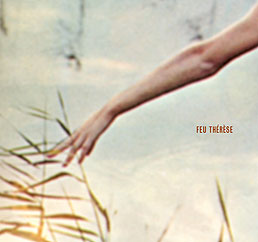
feu1Feu Thérèse is a band created because of the hiatus of Le Fly Pan Am.  They offer a melange of styles, as befits the visual arts origins of several of the members.  And yet, there is a solid rhythm section that grounds the band in a wonderful way.

“Ferrari en Feu” opens with 3 minutes of pulsing waves of synths and electronic bird-call-like sounds. It’s unclear exactly what you’re listening to and it seems like the whole album will be a kind of ambient collection.  Then a proper rock song kicks in with chords and notes and drums–it has a cool psychedelic vibe and feels very late 60s.  “Mademoiselle Gentleman” has pulsing bass notes and staccato guitars with a layers of distorted laughing throughout (there’s no “singing” on the first two songs). At around 4 minutes (out of 6) the feedback squalls too and a simple steady beat.

“Tu n’avais qu’une oreille” seems like a traditional song–with singing (in the Serge Gainsbourg, dirty old man style of whisper/singing) which has a middle section that is quite conventional (with ahh ahhs) but again at 4 minutes, the song shifts into a faster drumming section (with more spoken words).  But then a lengthy trippy guitar solo shatters the mellowness.  “L’homme avec couer avec elle” starts with what sounds like horns.  At around 4 minutes in turns into a kind of western but with a crazy clarinet solo accompanied by sped up noises that sound like Pink Floyd’s Ummagumma.  There’s more psychedelic Pink Floyd styles on the final track, “Ce n’est pas les jardins du Luxembourg.”  The song opens with “drips” that sound like “Echoes.”  And then there’s more Ummagumma birds/animals (possibly distorted seagulls?).   At (yes) 4 minutes it turns into a trippy psychedelic organ based song (with Indian music as well).  The song is 12 minutes and leaves no sound unheard.

The music is experimental but it is not terribly “difficult.”  It’s actually quite a fun album which demands multiple listens.

[READ: April 24, 2014] Half Past Danger

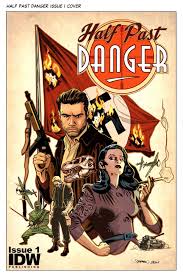
The tagline for this book (which is presented like a movie in a number of ways) is Dames. Dinosaurs. Danger.  And the cover features a giant Nazi flag in flames.  Sounds like pulp genius to me.

And so it is.  Stephen Mooney has been an artist for some great graphic novels over the years and this is his first book that he wrote on his own, based on a labor of love–having Nazis fight dinosaurs.  Like a dream come true.

So obviously, this is a story of an alternate past.  Set in 1943 in the South Pacific, an Army battalion is tracking an area when they discover a secret Nazi base.  There are not supposed to be any Nazis this far east, and yet there they are.   Sergeant Tommy “Irish” Flynn is surprised but he gets his team ready to take pictures and prepare a report.  But that loud rumble sounds like the biggest tank they have ever heard.  And then out steps a T-Rex (in a great reveal).  The T-Rex wipes out all of Irish’s company.  Irish escapes with a few photos and little else.

We jump cut to two months later where Irish is drinking in a bar in New York City.  In walks General Noble of the USMC and Elizabeth Huntington-Moss of British MI6.  They request his service.  He tells them to fuck off.  Actually no, he doesn’t.  This is a PG13 story, there’s a few “shite”s and an occasional “damn” but it is squarely in the realm of comics–implied sex, a lot of blood and a few mild words.  A brawl ensues, in which a Japanese fighter helps out Noble & Moss.  And soon Irish is recovering and being told what’s going on.  After some string reluctance, Irish agrees to go back to the island.

Noble proves to be a supremely tough and string fellow.  The Japanese soldier has defected to the U.S. after the non-respectful attack on Pearl Harbor.  And Moss is an enigma.  As they approach the island, there is plane trouble and a wonderfully cool scene in the water (which I won’t spoil but the art and graphics are terrifying and wonderfully drawn and colored–Mooney did the colors for the first chapter, while Jordie Bellaire did the other five).  (more…)

Read Full Post »

eleanorSOUNDTRACK: BILL CALLAHAN-Tiny Desk Concert #21 (July 13, 2009).

billcBill Callahan (formerly known as Smog) plays beautiful slow ballads.  He has a deep, calming, gorgeous voice.  And his songs have a very traditional acoustic feel (even when he plays electric guitar).  He is excellent at what he does.

But I’m afraid I just don’t really like his style all that much.  I can absolutely appreciate why he is so well-regarded, because even as I’m listening to this Tiny Desk set I keep thinking how good everything he is doing is.  Man, his voice is so interesting, and his music is so pretty (the strings add a very nice touch).

But I just can’t imagine myself ever choosing to listen to his album.

In fairness, a song on a mix tape would probably be awesome, and I did enjoy the three songs here: “Jim Cain,” “Rococo Zephyr” (great title, and my favorite of the three) and “Too Many Birds.”  And I can imagine if I was ever on a mellow music kick that this would be where I’d start.  So if you enjoy pretty, mellow music done incredibly well, Bill Callahan is definitely your guy.  I feel like he is not as well-known as he ought to be, so check him out.

[READ: January 23, 2014] Eleanor Rigby

Completing three Douglas Coupland novels in two weeks may seem daunting, and it is especially so when the books are as dark as these have been.  (With Coupland’s follow up book, JPod, he would go in a different direction and kind of break the darkness somewhat.  And the new book which just came out seems like it is more humorous than dark).  This book is perhaps the most insular of his career and perhaps the most insular book I’ve read.  The title is puzzling (and is ultimately revealed), although Coupland says that he was inspired by wondering what happened to Eleanor Rigby after the (Beatles, duh) song was over.

So in this story, the main character is named Liz Dunn.  Liz is a blank.  She claims that she is so dull that if she were an extra in movies, she would be asked to leave the scene because she is too devoid of character to even be an extra.  (Actually, Liz lays the self-pity on a little too thickly throughout the book–we got the point).  Liz has a brother, who is an accomplished world traveller, and a sister who lives nearby and pops in to check on her once in a while.  Both are married and have their lives together, unlike Liz who lives by herself in a room with no personality at all.

Liz’ sister is beautiful and got up to all kinds of trouble in school and William has always been successful, but Liz was…nothing.  She didn’t like to do much.  And she pretty much holds herself up as the antithesis of her sister.  She watches movies all the time in her living room. And then she goes to sleep.  She works at a well paying but dull job and she has saved a ton of money because she never spends it on anything.

As the story starts, she is getting wisdom teeth out. She takes a week off from work, but he boss (the Dwarf Whom I Report To) calls to say that someone will bring some work over to keep her busy.  She has bought a bunch of tear jerker movies in hopes of riding out the painkillers with them.  And then she gets a phone call.  A man named Jeremy has her name on his medic alert bracelet and he is in the hospital.

Liz doesn’t know who he is, but then takes a guess and goes to see him in the hospital.  And it turns out to be…her son. (more…)

Read Full Post »

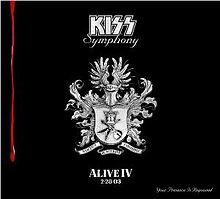
CV1_TNY_09_23_13Brunetti_spine.indd 220px-Alive_IV_KISSSOUNDTRACK: KISS SYMPHONY-Alive IV 2/28/03 (2003)

This CD is a bit out of order in the Kiss chronology, but since I’ve just looked at a few live Kiss albums and looked at “Atom Heart Mother,” the ultimate orchestra rock, it seemed like a good time to throw this in.

This is from a Kiss concert in Melbourne Australia.  The disc (and I assume the concert) is broken into three sections: regular Kiss, Kiss with the Melbourne Symphony Ensemble and Kiss with the Melbourne Symphony Orchestra.

The first six songs rock pretty hard.  It’s an interesting collection of songs from throughout their career.  “Deuce” and “Strutter” sound good.  “Let Me Go, Rock n Roll” is a surprise and one that I like a lot, (although I find it weird that Peter Criss says exactly what he said at the end of the song on Alive! –it was in audible then and it is inaudible now).  Of course I wish they hadn’t chosen “Lick It Up” but it is better than on Alive III (I like the way he turns the “I want you, I need you” into a simple plea “to clap your hands”).  It makes me laugh that Paul is still using the “rock and roll pneumonia” schtick thirty years after I first heard it to open “Calling Dr. Love”.  And then there’s the new song, “Psycho Circus,” I haven’t mentioned that album yet but it’s a new song and they play it with verve.

The one thing about the disc that is especially obnoxious is how proud of themselves they are about doing this tour with an orchestra.  Paul says, ““Some people said we were crazy to attempt this Maybe we are crazy but that’s what makes us Kiss.”  And yet, clearly it’s not an original idea (I mean even Metallica, the most obvious comparison did theirs three years earlier).

When the Ensemble comes out, they play 5 mellow songs.  The first (and most obvious) is “Beth”.  But man does it sound lousy here. Peter doesn’t seem to have any of the oomph to make it sound any good.  (The orchestra sounds good though).  The next obvious song is “Forever.”  What I find odd about these “Ensemble” songs is that it sounds like the band is using acoustic guitars which just add a strange percussive sound (since you can barely hear the guitar over the orchestra).  I understand being unplugged for the Ensemble, but it sounds weird.

The huge surprise comes with “Goin’ Blind” in which Gene sings in a quite pretty falsetto.  He sounds old (for sure), but it’s a surprisingly pleasant voice.  Another huge surprise is the inclusion of “Sure Know Something “ from Dynasty.  And then the craziest surprise of all is “Shandi.”  “Shandi” is one of those songs that I used to joke asking if Kiss played it live.  I cannot believe they played it (even with an orchestra)  I wonder if Australia especially liked the Dynasty/Unmasked era.  Of course, I love that era as well and am thrilled to hear this song live (even if Paul sounds a little stilted singing it).

Then comes the bloat.  Disc two brings in the full orchestra and the sound is…weird.  The orchestra is sort of playing along with the band (mostly like added strings to pop songs and swells as needed). The big surprise is that the strings don’t play the iconic solos—which would be frankly amazing–imagine the whole string section playing the solo to “Detroit Rock City.”  Rather, the sounds that we hear most from the orchestra are the horns, which make it sound kind of like a marching band playing Kiss.  But the real problem is that the band seems to be fighting with the orchestra.  Since the guitar and entire orchestra are playing the same thing, you can’t really hear one or the other very well.  Worse yet, by the end, both Paul and Gene seem to be screaming to be heard over the orchestra, which makes them sound quite bad.

It’s not a total disaster.  Some songs work just fine.

“King of the Night Time World” had orchestration on the album, but in this version, they just seem to be throwing in strings everywhere.  “Do You Love Me?” works great in this setting for the exact opposite reason that I didn’t work in Unplugged—the orchestra brings up the chorus to higher levels.  “Shout It Out Loud” is pretty successful with the orchestra although Gene seems really flat.  The orchestra works well on “God of Thunder” probably because the music itself is so spare that the orchestra fills in the gaps nicely.

I’m always disappointed when Paul plays around with the vocal styling in popular songs—he does it a lot in “Love Gun.”  I’m not saying that every song should sound just like the record, but it’s weird unsettling when he mixes things up in weird ways as he does here. The orchestra is good for this one though.  And, the strings work great with “Black Diamond.”

On the other side of things, It is very creepy to have a children’s choir sing to the groupie-anthem “Great Expectations” but it does sound good—until the end when Gene doesn’t even seem to care a bout the spoken words.  “I Was Made for Lovin’ You” gets less disco and a bit more rock here.   And the set ends with “Rock n Roll All Nite” which is something of a throwaway here.  It’s the inevitable conclusion to the show, with the orchestra being little more than accents.

So the orchestra is not really a very successful addition to the set.  It may have been great to see live (the orchestra in Kiss makeup and all), but the recording leaves something to be desired.  The set list, on the other hand is pretty great and I would love to have these songs in any future show that I see.

[READ: September 25, 2013] “Bad Dreams”

I’ve enjoyed most of the Tessa Hadley stories I’ve read in the New Yorker.  And most of them have had similar themes.  But this one is quite different.

I’ve been finding with a lot of stories lately that I really like the way a story starts out and that I kind of wish it would keep doing whatever the story is doing, but that the author has something else in mind.  It’s hard to complain about that because it is the author’s story, not mine, but it still bums me out a little even if I ultimately like where the author went with the story.

So in this one, a child wakes up in the dark.  We get a glimpse of the house and where she is at, but the crux of her waking up is that she had a dream about her favorite book, “Swallows and Amazons.”  The really cool and spooky thing about the dream is that she dreams an epilogue to this story that she has read so many times.  And the epilogue is disturbing—not horrifically, but just enough to freak out a young girl.  She dreams that that one of the boys drowned, that her least favorite girl, the plainest girl went on to a long happy life, etc.

This is such an interesting idea tha I couldn’t wait to see where it went.  Of course, I can’t even imagine where you could go with that, and maybe Hadley couldn’t either.  Because instead we leave the girl’s room and head to her father’s study.

We learn about her father but during her visit she decides to upend all of the furniture in the room.  Not out of malice, but in a dreamlike state.  And then she imagines her parents’ reaction to this and thinks it will be very funny.   She vows to never admit that she did it.  Then she goes back to sleep. (more…)

Read Full Post »

school spiritSOUNDTRACK: PINK FLOYD-Live BBC 1970-1971 (1970/1971).

pink-floyd-paris-theatre-london-bbc-archives-back-cover-17638Since I am delving deeply into early Pink Floyd, I came across this bootleg of Floyd on the John Peel show.

The first show is Live at Paris Cinema, London 07-16-1970, just before the release of the album Atom Heart Mother (which we know because Peel says the song will be on their forthcoming album).  The first set includes “Embryo” (which only ever appeared on their compilation Works, in a much shorter version), “Fat Old Sun” (from AHM), “Green is the Colour” (from the More soundtrack), “Careful with that Axe, Eugene” (available on Relics and in live formats), “If” (from AHM) and “Atom Heart Mother.”

The version of “AHM” here is interesting  because the cello solo is played by a horn instead.  The reason for this is because it allowed them to have fewer musicians on tour.  It’s the same theme but the horn brings a very different feel than the cello did.  It’s also interesting to hear that the horn players are nowhere near as polished as they might be.  (In Geesin’s book he does talk about the lack of rehearsal the orchestra had for their live shows).

The second show is Live at Paris Cinema 09-30-1971, just over a year later.  They once again do “Fat Old Sun” but in 1970 it was 6 minutes and in 1971 it is now 15 minutes long with a lot of jamming and keyboard stuff thrown on top.  Next up is “One of These Days” (from the forthcoming Meddle) a favorite of mine. From this set I learned that the distorted voice that says “one of these days I’m going to cut  you in to little pieces” is actually that of Nick Mason (and interestingly, in this version, the quote comes at the end of the song rather than the middle).  Then they play “Embryo” again (it was clearly a concert favorite even if it never got a proper release (same length for each show and not drastically different).  Then comes “Echoes,” the big side long epic from Meddle.  And the set ends with “Blues,” which is indeed a blues.  I don’t really expect to hear a blues from Pink Floyd, but here it is, and it’s a good one (Gilmour clearly can jam to anything).

The video below contains the two complete shows running at over 2 hours.

[READ: September 29, 2013] School Spirit

This is the final obscure Douglas Coupland book that I’m aware of and will be the final DC book that I need to hunt down for this blog (I have three other proper novels that I haven’t posted about, but those are proper books and will be dealt with in turn).

This book has about the least amount of information about it that I’ve seen in a book.

The (I assume) official description of the book (which I get from Amazon and Google Books) says

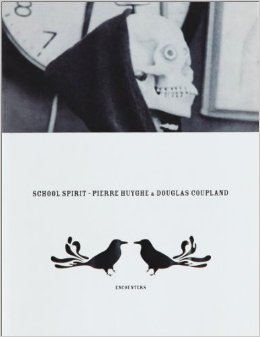
Dis Voir’s Encounters series invites a well-known contemporary artist to choose a subject for a book. The artist also selects a person with “elective affinities”–someone with whom he or she would like to share this exchange. The resulting collaborative volumes serve as an artistic and political laboratory of the present. For this first installment, French artist Pierre Huyghe choose Canadian writer Douglas Coupland, author of Generation X, for the influence that Coupland has had on his generation, and on Huyghe’s own work. Using a high school yearbook as scaffolding for their meditations, they discuss the construction of character, narrative techniques based on chance and the political dimensions of Coupland’s work–themes that are also fundamental questions for Huyghe’s projects.  Using a high school yearbook as the framework for a meditation on memory.

But my copy (which has a different cover and limited publication information so may possibly be a different version) does not have anything to say at all about “the construction of character, narrative techniques based on chance and the political dimensions of Coupland’s work.” (more…)

Read Full Post »

flamingSOUNDTRACK: RON GEESIN & L’ORCHESTRE PHILHARMONIQUE DE RADIO FRANCE-“Atom Heart Mother Suite” (2012).

geesin“Atom Heart Mother” is one of my favorite prog rock songs.  And it’s amazing how much I didn’t know about it (which is what this book is for).  This recording of the “Suite” is an extended version that Ron Geesin created for Radio France.

I’m fascinated by this version of the song because while it is basically the same (Geesin added a few extra measures for the cello solo), it sounds so “professional.”  The original (as the book points out) was kind of slapdash and it has a very loose feel.  This version is almost too perfect (although it’s not perfect as you can tell by the guitar solos).  Nevertheless, I love that this song has broken free of an obscure Pink Floyd album with a cow on the cover.

You can see and hear the extended 2012 version here:

[READ: September 27, 2013] The Flaming Cow

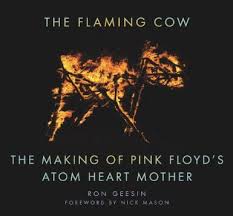
Big news (to me) is that Ron Geesin created the orchestral score for Pink Floyd’s “Atom heart Mother.”  He had nothing to do with side two of the album Atom Heart Mother (although he does say where the album title came from, and shows the proof–the first woman with an atomic pacemaker was in the news that day), but he was instrumental (ha) in creating the 23 minute epic.

I actually knew of Geesin from his score with Roger Waters for The Body (a vinyl album I own from when I was really into Floyd, but which I haven’t listened to in decades).  But so here is the full explanation of how the crazy beast (which my high school friend Kevin deemed the number one “seriously drug induced” song) came to be.

Except that Geesin has a lot to say about himself first.  The book is 120 pages (about half of those pages are pictures) and he doesn’t get to the song until Chapter III.  At first I wasn’t all that interested in his biography, but it actually pays off when you see what his musical background was and how it was ideal for him to create the score for “AHM.”  His musical background is interesting in his DIY approach and “one man band” esthetic.  But really, we got this book to hear about this Epic (which is what it was called first).

And on that front, well, he doesn’t have a ton to say, believe it or not.  We learn that Nick Mason (who was friends with Geesin and who wrote the Foreword to this book) and Waters had created the basic structure of the song.  And they called on Geesin to flesh it out.  So Geesin used his understanding of writing scores to create some really unexpected tones for this otherwise fairly simple song.  It also turns out that (for me) recounting someone else’s recounting of recording a song is kind of boring, especially since there were no astonishing revelations.

I did enjoy reading that the band would make more money if the suite was broken up into various parts rather than one 20 minute song, so that’s where the arbitrary section names came from.  And Geesin does give a fairly detailed explanation of why he did what he did in the score, but it only last for about three pages.  Suffice it to say that although it was a very hectic schedule (and Geesin almost did come to blows with a horn player) the recording was not too dissimilar to other recording sessions that I’ve read about.

What was interesting was that the band had gone from really liking it to dismissing it.  And that the band seemed to want to distance themselves from it because they wanted to go in a different direction (Meddle, their next record, also has a 23 minute song (the awesome “Echoes”) but it is very different from AHM).

Perhaps the most interesting thing to me was the life that the song has taken since the recording.  In 2008 Geesin wrote an extended version of the suite for the Chelsea festival.  The song was performed on two nights and on Sunday,  June 15 2008, David Gilmour played guitar for the piece (he wasn’t able to make the Saturday night show).

There is a lengthy video from this concert as well (just below).  For the first 20 minutes Geesin introduces the piece (which is basically a prelude to the book).  The introduction is a little more dramatic than the book (but not all that much).  In this video, the audio is quiet (and not that great) and there’s no actual video (just stills), but it is still entertaining.  Then there’s the song itself.  And it includes a reprise (with more Gilmour slide guitar) of the end of the song.

Someone also nicely recorded the Gilmour version (and included some video at the end of the piece)

The Radio France version above was commissioned for an entire evening of Geesin works.  As I said above I only have his “music from The Body” which he recorded in 1970 and which was his second album.  I have no idea what the rest of his work sounds like.  But he was on hand to play the piano for “Atom Heart Mother” and the rest is history.

This book proves to be more about Geesin than “AHM,” but it’s still an interesting read.

Read Full Post »

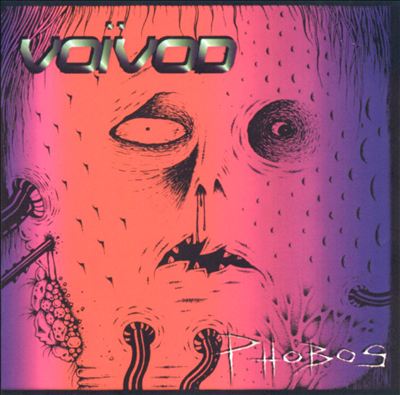
terrySOUNDTRACK: VOIVOD-Phobos (1997).

phobosIt’s tempting to say that Phobos is a carbon copy of Negatron, but that’s not true.  While the line up is the same, and the overall tone is very similar—very heavy, aggressive music—there are subtle differences.  The first is that the album sounds vaguely more electronic, as if they were really flirting with industrial after the experiment with Jim Thirwell on the last album.  E-Force’s vocals, while still abrasive and screamed have a lot of processing on them which makes them far more interesting and actually quite a bit more understandable.  There’s also a lot of weird electronic effects that link the album and make it feel more “spacey.”

And while there are different sections of songs and parts that are actually quiet, this i still a difficult album–the vocals especially are exceedingly harsh and will turn off people who like the instrumental sections.  I hate to sound like the band’s declining popular are all down to E-Force, but he is the weakest link in the band at this point.  Whats weird about thee two E-Force era albums is that although they are very very heavy with several weird parts per song, the basic structure of them is very conventional.  So instead of sounding proggy and weird, they sound more like a bludgeoning metal band.  Which didn’t really work for them.  Indeed, the band intended to if not call it quits at least take a hiatus after this album.

Phobos opens with “Catalepsy I” an introductory song—noises and whatnot.  And indeed, these electronic noises link all of the songs of the record, with different sounds in between the tracks (like the way “Bacteria” opens with spacey effects and electronic drum noises for 35 seconds).  But the first proper song “Rise,” has an opening guitar riff that is quite normal—dark, but normal.  It’s true that the heaviness of the chugging section is heavier than most (like earlier Voivod), but it’s still not that strange. Until the verses come in.  And here’s where E-Force’s vocals are a little different—more processed and robotic sounding.  It actually works a lot better.  And in the middle of the song while the heaviness is ongoing, that opening normal guitar riff comes back.  Rather conventionally.

“Mercury” has a more typical Voivod guitar riff although the pounding heavy chords are still quite heavy.  There’s more of the distorted vocals and weird chords for the bridge.  It also begins a series of increasingly longer songs.  This one is nearly 6 minutes.  While “Phobos” is nearly 7.  It also has an interesting echoing staccato guitar riff with E-Force’s vocals very distorted (like Nine Inch Nails or Skinny Puppy).  The bridge is a crazy noisy monstrosity and yet the middle section is very simple:  loud chords  delivered at a slow pace with interesting effects and fiddly guitar solo noises.  “Bacteria” reaches over 8 minutes long.  But it is unlike any of their earlier prog songs.  It has an interesting echoing guitar opening and a bunch of staggered parts.  But once the song’s major chords start up it sounds probably most like the previous album except for the lengthy instrumental/psychedelic section starting at around 5 minutes.

The album slows down somewhat with the 1:48 “Temps Mort” a short instrumental with what sounds alike an accordion. It’s a weird little time out (which is what the title means), and I like it a lot.

“The Tower” has an underwater kind of feel to it amidst the bludgeoning guitars.  The middle and the end have some very cool heavy trippy/spacey metal which is so radically different from the heavy Voivod chords that make up the proper song.  Indeed the very end is a minute of mellow spacey guitars.  “Quantum” is a pretty straight ahead (for Voivod) metal song with echoed vocals that take some of th edge off (until he screams the chorus).  There’s another cool instrumental section. In fact, the whole album has great instrumental sections, it’s kind of a shame the vocals are so offputting (although at the end of this song they are so distorted and computerized that they sound very cool)

“Neutrino” opens with those big loud slow ringing chords of noise before the simple but creepy solo riff comes in.  It’s 6 minutes long and has another interesting guitar line amid the noise.  It takes 3 minutes (of 7) before the vocals come in and the song gets much darker.  “Forlorn” is the closest thing to a hit on the album.  The chorus is really easy to sing along to.  And the verses are actually pretty straightforward.  It’s very very heavy and isn’t going to make the radio anywhere, but it’s still catchy.  The album proper ends with “Catalepsy II,” more swirling noises that sound like the beginning.

There are two bonus tracks on the CD.  “M-Body” was written by Jason Newsted and is the most industrial mechanized/voiced songs on the album.  It’s certainly out of place, although it does hint at what is to come on their next album.  “21st Century Schizoid Man” is a cover of the King Crimson song.  They’d done Pink Floyd and King Crimson fits pretty nicely.  As with the Floyd covers this one is very heavy.  Piggy gets the guitars right.  But as with the rest of the album, E-Force’s vocals just don’t work. Whereas Snake’s weird pronunciations accented the covers in a cool way, E-Force just seems to be forcing his way through the track (the fact that he puts 3 syllables in “century” is pretty unforgivable.  Overall the song is pretty great, although I’m not so sure about the guitar solo which sounds like Piggy doesn’t really know what to do.

And that’s the end of this Voivod lineup.  Two albums and a lot of lost fans.

[READ: September 20, 2013] Terry

I have known about this book for a pretty long time.  I was never really that interested in reading it because, while I don’t know all that much about Terry Fox, I felt like I knew enough about him to not bother with a full bio.

For those who don’t know (basically anyone from the U.S.), Terry Fox was a young man who developed cancer at the age of 19 in 1977. and had his leg amputated.  To draw attention to cancer research he decided to run (yes run) across Canada on the Trans Canada Highway.  He had a prosthetic leg, he practiced running every day (he was already a natural athlete) and he decided that in 1980 he would run from the Atlantic Ocean to the Pacific (he even had a bottle of water from the Atlantic that he wanted to pour into the Pacific).  His plan was to run between 26 miles a day.  Yes, run a marathon every day.  He called it the Marathon of Hope.

When he started out, the media coverage was nothing but as he progressed and his friend (who drove the van alongside him) started making media attention, Terry’s cause became more well known.  And by the time he made it to Ontario, he was a huge personality—making TV appearances, talking to anyone and, most importantly, making a ton of money for cancer research. (more…)

Read Full Post »

werwolvsSOUNDTRACK: VOIVOD-Nothingface (1989).

nothingI have talked about Nothingface before, but here it is in sequence with the Voivod catalog.

This is the culmination of Voivod’s move toward progressive metal. Even nearly 25 years after its release, this remains one of my favorite albums ever.  The guitar chords are complex and wonderful.  Snakes’ voice is melodic with odd tinges of weirdness thrown in—where he goes up or down a note unexpectedly.  Plus, he has that peculiar pronunciation/emphasis that makes the words sound even more exotic (like “repugnant”).  And despite the fact that they cover Pink Floyd (!), the album is still heavy.

The whole band is in top form here—Away’s drumming is explosive and complex, Blacky has a fantastic rumbling sound that’s not distorted but really fills in the bottom end and Piggy’s guitar is masterful.  “The Unknown Knows” has some cool staggered notes and a great catchy guitar riff during the verses but the time changes come fast and furious.  I love the way the guitar and bass play off each other in this song.  But then comes the cover of “Astronomy Domine”.  Imagine the band from War and Pain who used to cover Slayer and Venom now covering Pink Floyd.  It’s hard to fathom, but man, do they pull it off wonderfully—adding a heavy bass element but keeping it very faithful.  And Away’s drumming is stellar.  It’s a marvelous cover.

“Missing Sequences” starts with a cool bass line and Snake’s great pause… “NOW!” Then when he starts singing again, his voice is phased in a very cool sci-fi kind of way.  There’s also some interesting effects—keyboards maybe–in many of the songs.  There’s also a great part where there’s a rumbling bass and Snake’s scream of “GO!” before a weird guitar solo and then even weirder shifted guitar chords.  It’s magnificent.

As is the guitar playing in the verses for “X-Ray.”  I’m not even sure how Piggy came up with the bizarre chords in “Pre-Ignition.”  And yet despite the harshness, there’s pretty melodies like in the cool catchy “ground and rock and sand” section of the song.  And as for pretty, the quiet beauty that opens “Into My Hypercube” is really impressive for such a dissonant album—Snake whispers his vocals and the guitars are all pretty, major chords.  Until the bridge where dissonance enters and then the post bridge (who even knows what to call these song parts) which is once again a heavy round of dissonant chords.  And then when the “tumult in the dark” section starts, it’s practically a whole new song—until Blacky’s bass section reintroduces the beginning motif.

The final track has a wonderful moment where Snake’s voice follows Piggy’ unusual guitar line perfectly.  And then the very cool almost funky (great bass sound) of Blacky after the “too late for S.O.S.” line.  The album ends abruptly (too late for S.O.S.) and you’re left contemplating everything that just happened (I haven’t even mentioned the lyrics).

It’s a prog metal masterpiece.

[READ: August 26, 2013] Werewolves of Montpellier

I enjoyed Jason’s Lost Cat so much that I went to the library and checked out some other books by him as well.

Werewolves has the same looking characters as in Lost Cat, but they are different people (I assume).  The strange thing about this book is that the werewolves don’t look all that different from the main drawings.  At first I wasn’t even sure that he was wearing the werewolf mask.  But on closer inspection there are subtle differences (the eyes, the ears, the fingers).  Indeed, it took two reads for me to really notice all the subtle details.  Nevertheless, it’s just funny to imagine the characters thinking he was a werewolf when he looks for the most part the same anyway.

But so this story starts with the main character, Sven, dressed like a werwolf and breaking into someone’s house.  When the victim comes home, she catches him, but is frightened and he flees out the window.  In the next scene his next door neighbor, Audrey, (not his girlfriend, as she is dating a woman named Julie) brings him some food and tells him that he was in the paper (unidentified but in costume).

Then we see the main character and a bird looking guy playing chess in the park (and talking about the value of escalators for checking out women’s asses).  The main characters seems to be primarily dog-like and bird-like, but they intermingle freely.

The final new characters are two men talking about the photo.  They say that the werewolf in the photo is not part of their brotherhood and they want to punish this newcomer for causing them trouble. (more…)

Read Full Post »

yitaSOUNDTRACK: WXPN (88.5 Philadelphia) xpnand wxpn.org online-Prog rock Marathon (2012-??).

Every January, Dan Reed plays a prog rock marathon on WXPN.  This year I was able to enjoy portions of it.  I rather wish the playlist was still available (you can search, but only by artist), because I’d love to rave about the tracks they played (like the live “Supper’s Ready.”)

I was delighted by the great mix of songs they played and (as I learned from reading this book) I was surprised by how many prog artists I didn’t even know.

In 2014 I’ll be listening again and maybe this time I’ll copy the playlist to document what I’ve missed.

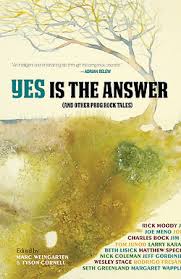
[READ: July 7, 2013] Yes is the Answer

This book was sitting on a cart outside of my cube.  I was intrigued by the title (it didn’t have that trippy cover, so I didn’t know what it was).  But “Yes is the Answer” was calling me.  Especially when I looked at the cover and saw that the cover had an excerpt from a William Vollmann story in which the protagonist plays In the Court of the Crimson King (track 5) for Reepah and watches her face as they band went Ahhhhhhhhhhhhhhhhhhhhhhhhhhhhhhhhhhhhhhhhhhhhhhhhhh!.

Quoting Vollmann (from The Rifles), playing King Crimson?  What could this book be?   Then I saw the subtitle and I knew I had to read it all.

I’m not going to review these essays because that would be like making a radio edit of a side long track, but I’ll mention the band the author focuses on and any other relevant details. (more…)

Read Full Post »

Harpersmaerch13SOUNDTRACK: DEFTONES-White Pony (2000).

Iwhitepony had forgotten how much I loved this album when it came out.  It’s been a while since I listened to it but it still sounds great.  I remembered thinking Around the Fur was the album that blew me away but it proved to be White Pony.  I have the “limited edition” red cover for whatever that’s worth (not much really, although I did get a bonus song).  This album really explores their more alternative side, with quiet guitars and very non-metal sounding songs including some trip-hop drums on a track.  But there are three or four really heavy songs showing they’re not giving up their heavy roots by any means.  It’s a really accomplished and complex album and is definitely a high point in alt-rock.

The album starts with “Fieticeira” which has a cool alt guitar sound (Stephen Carpenter really displays an amazing range on this album) and some lurching verses.  The choruses get big and loud (in the way that the Foo Fighters do now), although there is a weird noisy section that keeps it from being a totally polished track.  “Digital Bath” is a dark creepy song where the guitars are nearly as menacing as Chino Moreno’s whispered voice.  The drums are actually the loudest instrument and you can hear how intricate the Deftones drumming can be.  I haven’t mentioned the other members in the other two write ups and shame on me.  Abe Cunningham’s drumming is great–far beyond most metal drummers.  But when the bridge kicks in the song lifts up and by the chorus it’s a big vocalled song.  “Elite” shows that the Deftones haven’t given up their heavy side–it’s a loud screaming distorted fast thrasher.  It never lets up and by the end the voice is distorted almost beyond human sounds.  “RX Bath” is one of my favorite songs on the disc.  It’s slow but with a cool slinky bass (Chi Cheng, always outstanding).  “Street Carp” is a short song–with loud guitars for the verses and a creepy slow chorus that I’ve always loved: “Here’s my new address…six six four oh I forget.”

“Teenager” is the biggest surprise  it has a slow acoustic guitars and a kind of trip hop drum beat with glitchy effects.  It’s followed by “Knife Party” a song that opens with flanged guitars until the big chords crash in.  It’s probably their most commercial sounding song yet, except when after the second chorus Rodleen Getsic starts singing a wild vocal solo (like a crazed version of Pink Floyd’s “Great Gig in the Sky”), some of the notes she hits are inhuman.  “Korea” returns to the heavy dropped D sound with big noisy guitars and screams.  It’s one of their mist abrasive tracks.

“Passenger” is one of two songs that’s over 6 minutes long.  It’s a duet with Maynard from Tool–it’s unusual how their voices are so similar  They don’t sound alike but they have that same wavery tenor and vulnerability   It’s a perfect match.  “Change (In the House of Flies)” starts as a slow slinky song with a big chorus (and a great chorus of Ah ahs which somehow make the song seem even more claustrophobic.  It proves to be surprisingly catchy.  “Pink Maggit” ends the disc proper with a beautifully, agonizingly slow guitar and vocal intro–the guitars are buzzy and slow and sound almost out of tune (but aren’t).  Chino’s voice strains itself before the song proper starts.  I love songs like this when the chorus does one thing and the vocals play a slightly different melody (as if he;s singing a minor note and the guitars are playing a  major note), it’s very cool and a little spine tingly. At seven minutes this is a wonderfully claustrophobic alt rocker.   The album ends with what sounds like a heart beat (again, another Pink Floyd nod).

The red version has a bonus track called “The Boy’s Republic,” a big heavy song that encapsulates a lot of the album down into one track–the great vocal/guitar interplay, swelling chorus and interesting interplay of the instruments.  Even though it’s clearly a bonus song (you don’t have a song that ends with a slow heartbeat and not have it actually end your album), it fits in perfectly with the set and is a real treat.

Even though this album is 13 years old it still sounds fresh and amazing.  It really is a masterpiece.

[READ: February 25, 2013] “So Who Could I Tell the Story To”

According to Harper’s this is an excerpt from City of Angels: Or, the Overcoat of Dr. Freud.  It was translated by Damion Searls.

The excerpt begins in the middle of a question: “–the story that now needed to be told, even though it wasn’t a story at all?”  A very strange opening to be sure, and not as compelling as one might want.  And that was how I felt about this whole thing.  I wanted to be more excited by it but I never was.

There was something confusing about the whole setup.  The narrator is talking to Francesco.  But the narrator is talking about and apparently to “you.”  So there are lots of you’s floating around but we also know she’s talking to someone.  And while it’s all about clandestine behavior, the whole proceeding was confusing. (more…)

Read Full Post »

SOUNDTRACK: PINK FLOYD-Alan’s Psychedelic Christmas (1970).

I’ve always loved Pink Floyd’s Atom Heart Mother.  I have no recollection of how I stumbled upon this live bootleg, but when I saw that it contained one of the few live recordings of “Alan’s Psychedelic Breakfast” I had to give it a listen.

So this show is from 1970 and was recorded in Sheffield just before Christmas (Nick Mason evidently introduced the show while wearing a Santa Claus suit).  The sound quality is pretty good given that it is 40 some years old.  There’s a bunch of hiss, and the quieter talking bits are hard to understand, but the music sounds fine.

So the show opens with “Alan’s Psychedelic Breakfast” and what is so silly (and I assume funny to watch (a little less funny on bootleg) is that the band made and ate breakfast on stage.  As Collectors Music reviews writes: “This is the only known live recording of ‘Alan’s Psychedelic Breakfast’ but also hosts an amazing performance by the band which included them making morning tea on stage which is audible. Just like most of their earlier performances, the performance of “Alan’s Psychedelic Breakfast” slightly differs from the album version due to some nice jamming done by the band, especially Gilmour with his delay pedal.” As I said, some of the audio is static and hard to make out in this song–the band is conversing during their tea, but who knows what they are saying.  And who know what is o the radio.

Then the band gets down to business.  One of things I love about this period Floyd which is so different from their later work is that the played really long spacey jams often with very few lyrics.  So we get a 12-minute version of “The Embryo” (the only available studio version is a very short one on Works which is quite a shame as the song is really good).  A 14-minute workout of “Fat Old Sun” which is usually only about 5 minutes.

There’s a great version of “Careful with that Axe Eugene” and “Set the Controls for the Heart of the Sun” (15 and 12 minutes respectively).

Then in a killer version of “Saucerful of Secrets,” just as they get to the end, there’s a power failure (at least according to the song title).  The band is rocking out just hitting the climax when suddenly all you can hear are un-miked drums.  Ha. After a couple of minutes, power comes back and they pick up from just before where they left off.

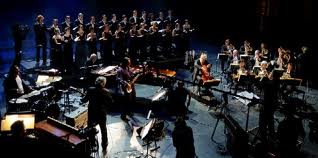
Then the band launches into a full 31-minute version of “Atom Heart Mother” complete with horns and choir  of voices.  It sounds quite good (the horns seem a little sketchy but that might be expected with such staccato music).

The set ends and the band needs an encore.  Apparently they couldn’t remember anything else because they just re-do the last few minutes of “Atom Heart Mother” again.

One of the things that cracks me up about these shows in the 70s in England, is that the audience is so polite. Their applause sounds like a classical theater rather than a rock show.  And with a bootleg you know they didn’t try to make the audience sound bigger than they are.

The whole package is a fun trip.

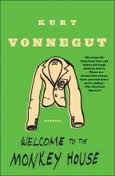
[READ: August 17, 2012] Welcome to the Monkey House

So this book is Vonnegut’s second collection of short stories.  But there’s a twist.  This collection contains all of the short stories from Canary in a Cat House except one. It also contains many of the stories he had written since then as well as stories not collected in Canary.  So you get basically 18 years worth of stories here.  And it’s interesting to see how much he has changed over those years (during which he wrote 5 novels, but not yet Slaughterhouse Five).

Since I read Canary a little while ago (see comments about the stories here), I knew that his 50’s era stories were influenced by WWII.  So it’s interesting to see how his stories from the 690s are not.  They deal more with day to day things and, of course, abstract concepts about humanity, although politics do enter the picture again once Kennedy is elected .

  • Where I Live (1964)

This was a good story to open with because it shows the then-later-period Vonnegut’s mindset and location.  This story is about Barnstable Village on Cape Cod (where I assume Vonnegut lived since there are a number of stories set on the Cape).  This is a very casually written story about an encyclopedia salesman who goes to the local library and sees that their two encyclopedias are from 1910 and 1938.  I enjoyed this line: “He said that many important things had happened since 1938, naming among others, penicillin and Hitler’s invasion of Poland.”  He is told to talk to the library directors who are at the yacht club.  I love the attitude that Vonnegut creates around the village which “has a policy of never accepting anything.  As a happy consequence, it changes about as fast as the rules of chess.” For really, this story is about the Village more than the encyclopedia salesman, and it’s an interesting look at people who move into a new place and want it to never change. (more…)

Read Full Post »

« Newer Posts - Older Posts »