Feeds:
Posts
Comments

Archive for the ‘Mastodon’ Category

withoutSOUNDTRACK: GOJIRA-L’Enfant Sauvage (2012).

gojiraGojira is a French heavy heavy metal band, and this album was highly recommended back in 2012 (I didn’t realize it wasn’t their debut–they have quite a few records out already).  This album is quite heavy, but it has a lot of diverse elements to keep it interesting.

At the same time, they do rely on a couple of guitar effects which make the album weirdly samey (no idea if they do it on other albums too).  The two biggest offenders in this “repeated” scenario are the seeming over-reliance on the open high e string to add contrast to the heavy chugging chords.  It’s a cool effect once or twice but they do it a lot (especially in the song “The Axe” where it happens way too much and which is then followed by “Liquid Fire” where they do it again).  The other thing they do is this weird scraping sound.  It happens in the first few notes as the disc opens (in “Explosia”).  It’s a really cool sound and quite distinctive.  When you do a weird sound like that a lot in one song, it feels like maybe too much, but then to do it in several other songs, it feels like a crutch.

Which is a shame because the rest of the album is really interesting–the vocals are growly but audible and there’s occasionally really cool backing harmony vocals (“Liquid Fire”) and some really unusual different parts to songs.

So “Explosia” opens really heavy with a crazy riff and pounding drums (and that weird scraping sound).  I love that at 2:30 it switches from bludgeoning to slower (but still heavy) and that as the song fades out with another heavy section there are slow guitar notes that remind me of a Western.  It’s really cool. “L’Enfant Sauvage” uses that open high E string in an interesting riff (by doing more than just letting the string ring out).  (The scraping sound appears here too, but in limited quantity). I like the way the song’s volume just drops for the last thirty seconds or so.

“The Axe” opens with a pummeling drum and guitar sound.  “Liquid Fire” alternates between heavy guitars and that open high E sound.  “The Wild Healer” is a simple, pretty instrumental.  It is 2 minutes long and the main riff is simple one (again all on one string).  There’s an interesting solo that plays along behind the main riff which is quite pretty–but it all ends very abruptly.

“Planned Obsolescence” jumps right in with some pummeling guitars (an a scrape sound).  It slows down a bit, but towards the end the pummeling double bass drums resume until the really slow sweet guitar section that comes in around 3:45.  “Mouth of Kala” has a heavy riff which is a cool change (even if the riff is fairly simple).  But there’s some nice melodies that alternate with the heavy stuff.  I also really like the way the song ends with a very different riff and sound than the beginning.  (And the backing vocals are really cool too).

“The Gift of Guilt” has an interesting open E string riff (which is similar to Iron Maiden’s “The Trooper,” although they do something very different with it.  This song is just littered with odd effects, like a big heavy “bowh” sound and some high-pitched guitar pyrotechnics.  But I love the way it alternates parts (the growly vocals work really well here, too) and then ends so melodically.

“Pain is a Master” opens with a slow guitar riff and whispered voices, it’s a great change of pace for the disc.  Once the slow part ends, the guitars and drums pound furiously and we get some more odd effects–a siren sound (from the guitar) alternating with the ubiquitous scrape.  But the middle parts are really quite different, slower, slightly more menacing.  “Born in Winter” opens and closes with a slow and atmospheric section (delicate vocals even).  In the middle it gets heavier (and has some really fast drumming).

“The Fall” has an Alice in Chains vibe in one section and then a more cookie monster type vocal on another.  The scraping sound returns for a final showing. I really like the way the album just sort of disintegrated into random sounds as it ends.

So overall I really enjoyed this album. It’s probably nitpicky to complain about the overuse of certain sounds, especially since they are cool.  But they have so much creativity on the disc, that to hear the same things a few times just seems redundant.  Nevertheless the album rocks and is a really enjoyable metal album.  I was supposed to see them open for Mastadon earlier in the month but something came up and I had to eat the tickets (who knew you couldn’t even give away Mastadon/Gojira tickets, come on!).

[READ: November 21, 2014] Without Blood

I’ve been enjoying Baricco so much that I decided to grab this book while I was in the library too. I had already read this book a couple of years ago, or actually, I had read the version that appeared in the New Yorker.  The Wikipedia entry says that the New Yorker version is a”revised form” of the novel.  I didn’t know what that meant exactly.  But basically I gather it means that Ann Goldstein (who translated the New Yorker version) has re-translated the story (or that they edited it for the magazine the first time).

The New Yorker version is really long for a New Yorker story (it is practically the whole novel), so it’s understandable why things were a little shorter for the magazine.  But she hasn’t changed very much for the book.  There’s a lot of little modifications–tenses of verbs (in flashback situations), word phrases are altered, additional details seems to have been added and there is at least one small section in this novel that was not in the New Yorker version.

This “new” section is about a woman who is sitting in the cafe with them.  She asks the waiter about the two main characters and we learn a little about her past as well (it’s not relevant to the story and I can see why it was omitted, but it does flesh out the scene).  I am not willing to do a page by page comparison of the two (even though that is something I tend to do). But suffice it to say that the stories are virtually identical, although I found it more satisfying reading the novel version.

Since my original recap is basically how I would summarize it this time as well, I am including it here almost verbatim.  But in the spirit of the updated version of the novel, I am modifying this post from the original in small details–see if you can spot the differences. (more…)


Read Full Post »

may20014SOUNDTRACK: CRYPTOPSY-“Slit Your Guts” (1996).

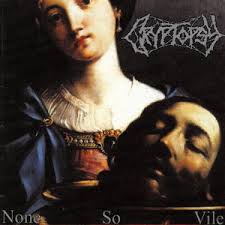
cryptI had never heard of this band until I saw the song mentioned in the article.  The song is impossibly fast with speeding guitars, super fast (inhuman) drums and an indecipherable growl as vocal.  In other words, a typical cookie monster metal song.  And yet, there is a lot more to it and, indeed it took me several listens before I could even figure out what was happening here, by which time I had really fallen for the song.

There’s a middle section which is just as punishing and fast but which is basically an instrumental break–not for showing off exactly but for showcasing more than the bands pummel.  It has a short guitar solo followed by a faster more traditional solo (each for one measure, each in a different ear). Then the tempo picks up for an extended instrumental section.  The melody is slightly more sinister, but it sounds great.  There’s even a (very short) bass solo that sticks out as a totally unexpected (and fun) surprise.

Then the growls come back in, staying with the new melody.  The vocals are so low and growly that they are almost another distorted instrument rather than a voice.

After that there’s a lengthy proper guitar solo.  As the song comes to a close,  it repeats some previous sections before suddenly halting.  It’s quite a trip. And it definitely makes me want to hear more from them (whatever their name means).

[READ: April 14, 2014] “Destroy Your Safe and Happy Lives”

Robbins, who is a poet, but about whom I know little else, takes us on a sort of literary tour of heavy metal.  His tone is interesting–he is clearly into metal, like in a big way (at the end of the article he talks about taking his writing students to see Converge (although he doesn’t exactly say why)), but he’s also not afraid to make fun of the preposterousness of, well, most of the bands–even the ones he likes.  It’s a kind of warts and all appreciation for what metal is and isn’t.  many people have written about metal from many different angles, so there’s not a lot “new” here, but it is interesting to hear the different bands discussed in such a thoughtful (and not just in a fanboy) way.

His first footnote is interesting both for metal followers and metal disdainers: “Genre classification doesn’t interest me.  Listen to Poison Idea’s Feel the Darkness followed by Repulsion’s Horrified and tell me the main difference between hardcore punk and metal isn’t that one has a bullshit positive message and one has a bullshit negative message.”

But since Robbins is a poet, he is interested in metal’s connection to poetry.  And in the article he cites William Blake (of course), but also Rilke and John Ashbery and (naturally) Milton’s Paradise Lost, as well as Shelley, Lord Byron and Charles Baudelaire.  He talks about them not because they are cool poets, but because they have also talked about because of metal’s “most familiar trope…duh, Satanism, which might be silly–okay, its’ definitely silly, but has a distinguished literary pedigree”.  Besides, he notes that Satan has the best lines in Paradise Lost (and I note that just as Judas has the best songs in Jesus Christ Superstar).

But sometimes this Satanism turns into a  form of paganism which then turns into nature worship.  From Voivod’s “Killing Technology” to black metal’s romanticism of nature (sometimes to crazy extremes–but that’s what a band needs to do to stand out sometimes).  Metal is all about the dark and primordial, a”rebuke to our soft lives.”

And yet, as a poet, Robbins has some quibbles with metal: (more…)

Read Full Post »

[WATCHED October-November 2012] Metal Evolution

metal evolutionVH1 aired this series last year and I was intrigued by it but figured I had no time to watch an 11 hour series on the history of heavy metal.  Of course, this being VH1, they have since re-aired the series on an almost continual loop.  So, if you’re interested, you can always catch it.

This series was created by Sam Dunn, the documentary filmmaker who made the movie Metal: A Headbanger’s Journey.  I had heard good things about the movie, but never saw it.  After watching the series, I’m definitely interested in the movie.  Dunn is a keener–A Canadian heavy metal fan who is really into his subject.  He knows his stuff and he knows what he likes (heavy metal) and what he doesn’t like (glam metal, nu metal).

The sheer number of people he interviews is impressive (as are the number of locations he travels to).  Part of me says “wow, I can’t believe he was able to interview X,” and then I remember, “X is really old and is nowhere near the level of fame that he once had.”  Given that, the few hold-outs seem surprising–did they not want to have anything to do with VH1?  Are they embarrassed at how uncool they are now?  Just watch the show guys, you can’t be as low as some.

The only mild criticism I have is that the show relies a lot on the same talking heads over and over.  Scott Ian from Anthrax, whom I love, is in every episode.  Indeed, he may be a paid VH1 spokesman at this point.  There are a few other dudes who show up a little more than they warrant, but hey, you use what you got, right?

What is impressive is the volume of music he includes with the show.  I assume that he couldn’t  get the rights to any studio recordings because every clip is live.  This is good for fans in that we get to see some cool unfamiliar live footage, but some of it is current live footage which often doesn’t compare to the heyday.  Having said that, there’s a lot of live footage from the early 80s–of bands that I never saw live anywhere.  And that’s pretty awesome.

With an 11-part documentary there’s the possibility of exhaustion and overkill, but Dunn is an excellent craftsman  he jumps around from old to new, talks about how the history impacts the current and, because of his own interests, he makes it personal rather than just informative. (more…)

Read Full Post »

SOUNDTRACK: MASTODON-Crack the Skye (2009).

I’ve really enjoyed Mastodon’s previous records, and this one ranks way up there in intensity and songsmanship. There are 7 songs on the disc, with two over ten minutes long.  “Oblivion” opens with a great minor key chord plucked with single notes and a dropped E.  And when the vocals come in, they highlight the different vocals styles in the band–from a more screamy, almost punk voice to the more melodic/echoey voice of the chorus (kinda like Alice in Chains).  At about 4 minutes the solos play off each other wonderfully, both blistering and then melodic (with almost a Pink Floyd feel at one point).  “Divination” has some amazing guitar play both in the intro and the way the bridge soars with great guitar lines underneath the vocals.  “Quintessence” opens with furious drums and a great prog rock kind of guitar opener.  I love the way the bridge is a gentle (albeit fast) almost trippy section before the chorus bursts in with heavy, heavy chords and chants of “let it go let it go let it go”  It’s the kind of song where the parts work so perfectly together but which wouldn’t seem to.

“The Czar” is a four-part, ten-minute epic.  It opens with a creepy keyboard melody.  The first section is slow and heavy, and when part two comes in the guitars are loud and fast.  Part three has a great riff.  And the end has some gorgeous solos.  It amazes me that ten minutes can pass so quickly. It’s followed by the very heavy (lots of double bass drums) “Ghost of Karelia” the pretty much heaviest song on the record (with a nod to Voivod in the descending guitar solo about three minutes in).  “Crack the Skye” opens dark, but throws in some contradictory keyboard notes that lead to another cool extended guitar riff before jumping into a super heavy death metal verse.  This gives way to some more soaring vocals–the juxtaposition of these two vocalists is amazing.  Imagine the surprise then when the last third of the record has the vocals sounding completely robotic and phased–followed by a mess of guitar solos and concluding with some pretty guitars.

They fade into the final epic, the 13-minute “The Last Baron,” which is one of my favorite metal songs.  It opens with some great guitars and some really cool singing.  The vocals soar, the bass plays a great melody.  There’s a great heavy instrumental section but it keeps returning to the wonderful rising vocal melody line that will get stuck in your head for days.  It’s an amazing end to a great album.

The disc also comes with a DVD that’s all about the recording of the album.   I watched a few minutes and it seemed kind of fun, so I hope to watch it more soon.

[READ: June 17, 2012] The Architect

In the past, Connell’s books have explored all manner of depravity. His books were violent, often sexual and dealt with an otherworldliness that may or may not be internalized. Despite all of this transgressive material, his work was never schlocky, especially his later pieces which show an amazing growth in topics, word choices and imagination.

Connell’s previous books The Life of Polycrates and Metrophilias featured short stories that dealt with all manner of topics.   In Metrophilias, the stories were very short, and it allowed Connell to really explore an idea to its fullest without having to make a “book” about of each one. The short length also allowed him to make the words choices and descriptions more effective.

All of the benefits are reaped in this book, a novella.

Although I enjoyed Connell’s previous longer works, I really loved the way this story started with one idea and stayed with it. Some of his other books are a bit more episodic, which worked for those stories, but in this one, we’re in one place and we are pretty much going to stay there.  And that focus makes this story all the more powerful.

The one thing that hasn’t changed is Connell’s scholarship (both real and fake). For this book is a celebration of Dr Peter Körn (1849-1924), visionary and spiritual scientist. As the story opens, four members of the Körn Society are discussing plans for the new Meeting Place, a central location where all members of the Körn society can gather. They are disgusted by the pedestrian, commercial and rather offensive submissions that they have received for their building—a building that should reflect the spiritual visions of Körn.

Dismayed at the architects who have submitted, one of the members of the Society, Maria Venezuela tells the other three that her nephew Peter De la Tour will soon be arriving with something special.  Peter brings them a book of architecture designs by Herr Nachtmann.  These designs are bizarre and wonderful–organic, amoebic, gravity-defying gorgeous monstrosities–exactly the kind of thing the Society is looking for.  Although one member feels that they are impossible to build, the others are firmly on board.

The challenge then is to find the man. There is some history about the man himself–his genius in and out of school followed by his utter inability to have his work taken seriously by the establishment.  He even had one of his more ingenious ideas stolen by the very teacher who said it was terrible.  And so, when Peter finds him, he is little more than a drunk at the end of the bar.

Yet his ego has never been diminished, and when he is presented to the Society he dismisses their concerns and even tells them that he will not wait for their decision–they have 30 minutes to say yes or he walks.  They agree and he begins working on his masterpiece.

The Society loves the sketch–they know it will be expensive, but Nachtmann promises fast work, effective designs and world-wide acclaim.  Amazingly, he delivers.  He works his men hard.  All through the spring and summer and into the fall, the men work carelessness and the building rises at a phenomenal rate.  Even if it seems to be growing larger than designed. (more…)

Read Full Post »

SOUNDTRACK: MASTODON-Leviathan (2004).

This is the CD that started it all.  Well, for me and Moby Dick- related music, anyhow. My friend Andrew asked if I would be reviewing it along with Moby Dick.  And, yes I am.

Leviathan is sort of a concept album about Moby Dick. I say sort of because it’s not entirely about Moby Dick.  The opener, “Blood and Thunder” features the chorus: “White Whale.  Holy Grail.  And it also features lyrics that seem to come straight from the book: “break your backs and crack your oars, men.”  There’s also the tracks “I am Ahab” and “Seabeast,” the latter features the lyrics: “Dear Mr Queequeg you have been informed your life’s been saved”

And yet, not everything is about Melville’s saga: “Island” bears no resemblance that I can see and the final track, a slow instrumental is called Joseph Merrick (who was the elephant man).

Musically the disc runs from bludgeoning metal (“Island”) to complex and intricate bludgeoning metal (“Iron Tusk,” which features a stereophonic drum solo opening).  “Blood and Thunder” has some great catchy riffs with some vocals that demand a lyric sheet for clarity.  “I am Ahab” features some extended vocal notes!  But there’s more to it than that.  “Seabeast” has a great slow intro guitar solo and features a two different vocalists to very good effect.

And the whole disc is chock full of time changes, crazy drum fills (how can he play so many different drums so quickly?).  “Megalodon” has a great odd guitar riff in the middle break section (and has nothing to do with Moby Dick at all).

As you near the middle of the album you get a couple of amazingly complex tracks.  “Naked Burn” features a great melodic middle section (coupled with really catchy vocals, too).  And the highlight is the thirteen plus minute “Hearts Alive.”  It begins as a very pretty acoustic guitar piece.  After about two minutes the heavy guitars kick in and there’s several different middle sections with varying degrees of melody.  By the midway point we’ve heard a few more very beautiful picked guitar sections, until it ends with some strong heavy guitar chords that slowly fade away.

So it’s a super heavy progressive rock/speed metal concept album for people who don’t like real concept albums (but who like their metal literate).  Who would have guessed it would have made so many best of the year lists?

[READ: Week of June 28, 2010] Moby-Dick [Chapters 111-End]

The end is here and BOY did I not see that coming.  I honestly had no idea how the book ended (how is it I knew the basics of the story but didn’t know the ending?  Talk about everyone agreeing to the spoiler alert!).  The other thing that surprised me was how damned exciting those last 70 pages were.  Now it could be a simple build up from the slowly paced early chapters–we were all lulled by the waves and the diversions–but man, when Melville wanted to, he produced the goods.  If you want young people to read this book, just assign them the last 70 pages.  I realize that all the art and such will be lost, but if they read just the end parts, they’ll come away with a much better perception of the book, and maybe they’ll want to read the rest later.  [I’m not a fan of abridged things of course, so I’d want them to read the original full text, just the end of it].

And I absolutely cannot believe [spoiler alert–okay the whole post is a spoiler, even if I didn’t know, the book is over 150 years old, so chances are you may have heard…] (more…)

Read Full Post »

SOUNDTRACK: THE DECEMBERISTS-“The Mariner’s Revenge Song” (2005).

This was the hardest week for music tied to Moby-Dick. (I’m saving Mastodon for the grand finale).  I don’t really have anything that relates directly to the book.   I have a number of nautical-themed songs, but very little in the way of albums.  And, it’s true that this song doesn’t have anything to do with Moby-Dick directly.

However, it’s a 9 minute song about a mariner getting swallowed by a whale just for revenge.  So, it’s sort of related.

The Decemberists are one of your more nautical bands (and I’ve reviewed all of the albums here somewhere).  Their first album, Castaways and Cutouts featured an album cover with a ship with ghosts drifting from it.
This song has an accordion fueled shanty feel as we follow the tale of a young lad who seeks revenge on the rake who used and abused his mother and left her a poor consumptive wretch.  After fifteen years, he finally hears tale of the rake–he’s now a captain at sea.

So the lad hires on with a privateer and hunts down the captain’s ship.  As he is about to fire muskets upon him, a giant whale crashes on their ships, swallowing the two men whole (tell me, Ishmael, what kind of whale might do that?).

And it’s from inside the whale the we hear this tale.  The lad’s mother’s dying words echoing among the ribs of the beast:

“Find him, bind him
Tie him to a pole and break
His fingers to splinters
Drag him to a hole until he
Wakes up naked
Clawing at the ceiling
Of his grave
*sigh*”

And it’s catchy as all heck, too!

[READ: Week of June 21, 2010] Moby-Dick [Chapters 87-110 ]

Pirates!  I didn’t expect pirates in the book.  Week 5 opens with Ishmael discussing pirates in the low shaded coves of Sumatra.  Ahab intends to sail right through those piratical waters to get to Java because sperm whales are known to frequent the area.  And indeed they do.  A whole fleet of sperm whales is seen but at about the same time, the pirates come out and give chase.  My notes in the margins are a little diagram of a fleet of whales with an arrow and then a tiny Pequod and another arrow and then a jolly roger.

The Pequod easily outruns the pirates and still manages to keep the whales in sight.  So, they jump into the fray and start harpooning away.  However, as the saying goes, “The more whales the less fish” (389). (more…)

Read Full Post »

SOUNDTRACK: LED ZEPPELIN-The Song Remains the Same (1978).

I don’t normally try to have my soundtracks correspond to the book. But since Andrew suggested that Mastodon’s Leviathan was a good match, I decided I’d try to have all six Soundtracks relate to the book some how.

The obvious starting point was Led Zeppelin’s “Moby Dick” and where better to look than at the over-the-top live version contained here.

As a classic rock guy, I grew up worshiping Led Zeppelin.  And I have no way of objectively talking about their music, really.  However, when I was in college, some guys in my dorm played this particular release all the time and claimed it to be the best CD in the history of music.

And thus, I have a delightfully convoluted relationship to this live album.  I used to really dislike it: extended jams of silliness rather than rocking live tracks.  However, as I’ve gotten older, and I’ve begun enjoying jam bands more, I see the enjoyment of this kind of show.  And yet I read a review of this very disc the other day that described it as being a few shows past Led Zep’s prime, and I think that’s pretty valid.

I haven’t heard any of the other recently released live discs (which are supposed to be amazing).  But this one feels overblown and pretentious.  And there’s nothing wrong with that if that’s the kind of band you are, but Led Zep was not that (until later);  they were meaty and heavy.

This version of “Moby Dick” is 12-minutes long.  Over 10 minutes of it is a drum solo.  This always reminds me of the line from Dazed & Confused: “Man, I ain’t belivin’ that shit about Bonham’s 1-hour drum solo…I mean, 1 hour on drums…you couldn’t handle that shit on strong acid, man.”  The rest of the disc is the same way: long solos that don’t really showcase virtuosity, they just sort of go on and on.  I do like the kevboard solo in one of the songs, but the “ah ah” part in “Dazed and Confused” is pretty silly.

In some ways, the song “Moby-Dick” (and the album itself) is like the book: a product of its time.  In 2010 , if you played a ten-minute drum solo (even Rush have added electronic horns and a swing number  to Neil’s drum solo) you’d be mocked.  But back in the 70s, it was a badge or honor.  Similarly, Moby-Dick seems quaint and weird to most contemporary readers.  And yet, put in context, it’s funny and surprisingly forward thinking.  And I suppose the music does make a good background for reading it, too.

[READ: Week of May 24, 2010] Moby-Dick [Chapters 1-18]

So, the instigators at Infinite Zombies are hosting a read along for Moby-Dick (and yes, the hyphen is supposed to be there).  I’m going to be a contributing writer to this shindig, so I’m going to curtail what I say here somewhat [see my post about religion, here]. Also, unlike Infinite Jest and 2666 which had difficult, multi-charactered, multi-layered, confusing plots, Moby-Dick is fairly straightforward.  And so, there’s not a great need for in-depth story summary (not to mention each of the 100+ chapters is titled, so you know what’s going to happen in each one!).

But with that out of the way, let’s see what I can say about this book.  Oh, one more thing, I’ve been trying to include page numbers in my citations, but there are just too many versions of this book (and I am using one for my reading and another for my copy-and-paste-quotes–the whole book is available at that link), so I’m just going with Chapters.

I was joking with some friends recently that their sister thinks Moby-Dick is very funny.  And I have to say I was surprised about how funny it was, too.  Not gut-busting funny, mind you, but funny enough. (more…)

Read Full Post »

SOUNDTRACK: MASTODON-Blood Mountain (2006).

As I was in a metal/Black Sabbath kick, and Mastodon is always mentioned as a fantastic metal band, I figured I’d give them a try. As with The Sword, I saw no resemblance to Black Sabbath, and at first I was afraid it was just another sludgy death metal record.

[DIGRESSION]: I just read a great article in The Believer about the USBM (United States Black Metal) scene, and how it compares to the black metal in Norway and other European countries where the bands take the music seriously enough to burn churches and such. The article was really interesting. I knew some of the bands that he talked about, but the only ones I had heard were the “grandfathers” of the genre, like Venom and Bathory. Any of the new bands that he focused on, if I’d heard of them at all, I certainly hadn’t heard them. Regardless, it was a great read, and really got me hankering for a band like Mastodon, even though they’re not really in the genre at all.

Anyway, after two listens, I really got into the Mastodon album. I don’t know anything about their previous releases (except that they are heavy), but Blood Mountain is all over the map. It is a fascinating mix of thrash metal, hardcore, beautiful melodies, prog rock, and total chaos. In fact, the song “Bladecatcher,” is three and a half minutes of total insanity. I haven’t heard anything lie it since John Zorn’s Naked City. There’s a beautiful melody which progresses into a screaming guitar riff, which morphs into a headbanging thrash part which basically just unravels into a noisy spasm, wherein the high-pitched noises might be voices, or might by keyboards, or might just be the machine melting. (more…)

Read Full Post »

« Newer Posts