Feeds:
Posts
Comments

Archive for the ‘Frank Zappa’ Category

SOUNDTRACK: RHEOSTATICS-The Horseshoe Tavern, Toronto Ontario (August 11 1994).

This is a monster show.  Nearly three hours long!  I’ve said before that I’d love to have professional recordings of certain shows and this would absolutely be one of them. Most of the show sounds pretty good although near the end the audience starts talking a little too loud. But man, what a set list.

This is one of the last shows Dave Clark played before leaving the band. This show was on the same day Introducing Happiness was reviewed as a new release in Now Magazine. (See the review below right).  The Setlist was a carefully constructed chronologically arranged 36 song, 2-set night.

They open the showing by thanking everyone for coming out on short notice, whatever that means.  Dave says they had 35 songs on the list  (they play 36 in total).

The first four songs are from Greatest Hits
Higher & Higher, Crescent Moon, Canadian Dream (which hasn’t gotten much play in the available shows) and Ditch Pigs.  They joke about their older songs: because we play some older music sometimes, like now, we forget the words, right Tim?  They also thank “anybody who helped us last night to cut our live track and video of Claire.”

The next song is “Royal Albert (Joey II)” which never appeared on an album, formally, so who knows how old it actually is.

Then there are five from Melville  (+1 later on)

A slow “Saskatchewan” builds very big by the end with Dave taking some of the last verse.  Tim observes that it’s a rough start tonight, although it all sounds quite good.  “Chanson sans Ruelles” has a quiet middle with a brushed section on drums.  When the song is over, because it is sung in French, Clark chimes: Tim Vesely for Governor General.  Bidini agrees saying, “he is Ray Hnatyshyn of rock.”  Upon assigning the rest of the cabinet: Bidini would be minister of sport; Tielli would be Finance Minister (of course) and Clark would be Minister of National Resources he is a national resource unto himself.

They start “When Winter Comes” and then they state:   at this point in When Winter Comes we’d like to express individually what the review in Now Magazine meant to us (if you click on the image it seems to come out a little more clearly).  Each of the four sings something.  Bidini: “nothing sweet nothing.”  Clark recites to the rhythm of his drum beats: “you know, Dave, I really like the things that they say all day but I got to know so I can tell you.”  Giving up he says, I love that Sloan album they gave one N–it’s better than the last one it’s better it’s cooler… why be mean to such a good band?  Bidini chimes in: “So the reason our album sucked is because Dave Clark listened to Sloan too much, obviously.”  Martin kind of mumbles his response but it’s something along the lines of, “I guess it mad me sad but it’s just another thing for a shirt.”  Tim says 1) we have to work really hard to complete that hoser rock opera.  The other thing is that its my weekly paycheck … 120 bucks?”  The rest of the song sounds great.

Clark: the next song [“It”] is one of my favorites and we don’t play it enough.  It’s followed by a fairly slow version of “Record Body Count” that gets the crowd really riled up.

“Woodstuck” is also not on a record.  But it’s a great song which they introduce as an “ode to a friend of ours who was really really into the hippie culture.”  1994 is the 25th anniversary of Woodstock (and the Woodstock ’94 concert).  Dave says to someone “you got that at the original Woodstock at the Pizza Pizza kiosk. Woodstock ’94 is brought to you by Pizza Pizza and their new… herbal pizza.”   In the “intermission” of the song Bidini throws in the lyrics to “Blitzkrieg Bop” with the same melody as the main song.

Referencing something, Bidini says Dan Aykroyd walked by and he was really polite, he said “excuse me,” which is pretty nice.  Clark jokes, “Did you say Ghostbusters?”

Next there’s 8 from whale music (+2 songs later)

“Sickening Song” sounds great and bright.  Afterward Dave sees “Matthew” and says “You got engaged?  Cool, congratulations young lovers. It’s our second Green Sprouts anulmen….no engagement.”

“Who” sounds good but they have a little trouble with those last few thump thump notes.  Soul Glue adds a heavy rocking coda to it.

Dave starts “Queer” by chanting “We’re here, we’re queer, we will not go away.”  At the end, Dave recite sa poem that ends, “Acceptance, forgiveness, and love.” which he says is from Broadway Danny Rose.  They also throw in a verse from “Good Guys and Bad Guys” from Camper Van Beethoven.

During he first verse of “Self Serve Gas Station,” the tape gets a little wonky.  And Martin’s changes the line: “What went wrong with Martin?  Is he stoned?” Someone shouts “yeaahh” and there’s the retort: “how do you know?”

Martin plays the blistering riff to RDA a few times before they take off with the song.  And then it’s time for a short break.

Clark announces, “we’re back.  This song is called “You Shook Me All Night Long with a Shaved Head.”  “Shaved Head” is quite pretty and slow.  They introduce James Gray of Blue Rodeo on keyboards and Tim plays accordion for “What’s Going On?”

They play 2 from the Whale Music Soundtrack.  About “Song of Flight” Dave says, “we played that song in Kingston and a smallish college student did a bird dance in 7/8.”  And then for those who got a free single at the Bathurst Street Theater, they play “Torque, Torque.”

Then there’s 10 from Introducing Happiness (+1 song later).  They introduce “Claire” as “Wet Home Alabama.”  After Fan Letter to Michael Jackson, they say, “The king is dead long live Lisa Marie and Michael.  Congrats to Michael on his wedding… that’s three Green Sprouts weddings.”

After mentioning a convoy, Bidini asks Clark “What was your CB handle?”  “Fuzzy Wuzzy.  I played CB with my best friend–it was strictly platonic.”

As Earth/Monstrous Hummingbird opens, you can hear a lot more crowd noise.  Talk of “I’d like to hear that recording.”

After “Me and Stupid,” Dave says “I’m afraid that when we go to England and play in front of  packed house of 150 British screaming Moxy Fruvous fans and we get up there to play California Dreamline” this is all that’ll come out  (some crazy nonsense noises) and they’ll love us and we’ll be on the cover of all the music magazines and we’ll never be able to face anybody in Canada again.”  Clark disagrees: “bullshit don’t believe your own mythology.”

“The Woods Are Full of Cuckoos” is “about a great Canadian band.”  And “Artenings Full of Gold” is weirder than ever, the “digging a hole” section sounds very much like Zappa (with high-pitched laughing whoooos).

Really fast PROD after which Clark asks, “how’s it feel to be in Ontario after the legal drinking hour?”

In the beginning of “California Dreamline,”Martin messes up and has to start over.  And then they all mess up…hold on false start.  Someone jokes, “Sounded like the Stones alright.”  They resume mid-song.  Martin says, “Stop.  Fuck this song let’s move on.”

So they pick right up with “Horses.”  Its fast and powerful and at the end he chants: “help break the owners of Major League Baseball, boycott professional sports.”  Speaking of sports, “Might as well award the Montreal Expos works series champion right here and now, ok.”  Then Dave says, “to my friend Steve from Hamilton…that didn’t count the CFL in that boycott of professional sports, all teams except the Hamilton Tigers.”

Bidini continues, “You braved the cold and blizzard conditions… oh it’s August, sorry.  So our record came out Tuesday with general release in October when they’ll play the Bathurst Theater.  He gives a plea to “Help Canadians music dominate worldwide in the 1990s.”   Clark, “And don’t forget those condoms when they’re at the Commonwealth Games.”

They come back for an encore with “Row.”  It’s sweet and quiet—not a really exciting encore, honestly.  But it’s followed by a romping “Legal Age Life,” which gets everyone really moving.

Such a great show.  It’s shows like this that make me wish that a) I knew about the band back then and b) I had actually seen them live.

[READ: June 5, 2017] Clean, Cleaner, Cleanest

This short story is a brief description of an older woman’s life.  Not a lot happens in terms of plot, but it is a wonderful story full of detail and character with a satisfying ending.

Marie is a maid at a motel.  She has worked there for nearly 30 years.  She is Catholic and goes to confession often.  But “she was more flexibly Catholic than strictly Catholic, so she did believe in birth control.”  The condoms she found stopped bothering her because safe sex was better than abortion.

Over the years she had seen the drug users go from needles to pipes to meth and now back to needles.

She also learned to be clinical about the messes she cleaned up: feces and urine to made it sound like she was helping people rather than dealing with the worst of them. (more…)


Read Full Post »

6616 SOUNDTRACK: CHUCK BROWN-Tiny Desk Concert #217 (May 16, 2012).

chuckI’m puzzled by a few things with this Tiny Desk Concert.  The first is a note that This story originally ran on Sept. 28, 2010.  The second is the note that Chuck Brown, the Godfather of Go-Go music, died Wednesday. In 2010, he brought his full band to the NPR Music office — and put on a party like no one else.

That isn’t confusing in itself, but I have to wonder why it took them two years to air this concert, which is quite a fun rave up.  Are there other shows they didn’t air?

Okay, so I had no idea who Chuck Brown was.  And the blurb anticipated that

The name Chuck Brown might not mean a whole lot to people outside the Washington, D.C., area. … In D.C., Brown is widely known, even revered, as the Godfather of Go-Go, a title he’s held since the late ’70s. Though he started out as a jazz guitarist, Brown invented go-go, a style that incorporates funk, jazz, R&B, hip-hop and dancehall, and has mostly stuck with it ever since.

So, Go-Go, huh?  I never heard of that either.

No one in D.C. can really explain why go-go hasn’t traveled beyond the city’s environs — we love it here, it’s all over our commercial R&B and hip-hop radio stations and, at least when I was in high school, a go-go in a school’s gym was the most packed party of the weekend. Chuck Brown is a local hero. A few days after he played our offices, Brown and his whole band played at the Redskins’ stadium for the halftime show.  So to have Brown play a corner of our office — not a 90,000-capacity football stadium — was like a dream come true for a lot of NPR staffers. Sweat started pouring immediately, between the 11 musicians (that’s congas and a stripped-down kit; saxophone, trumpet and trombone; two backup singers and a rapper) and all the go-go-heads in our building.

Brown played four songs for about 25 minutes.

Go-go is mostly about the groove, though, and Chuck Brown just settles in and leans back. He showed up looking like a million bucks in a vest, Dior shades and his signature hat, and then he did what he does best — get the crowd on his side and hand its members something to dance to.

Go-go is based on a syncopated beat and the use of congas in addition to drums.  So “Senorita” is like a combination of reggae salsa and 50s singing (I can’t help but think he sounds like Frank Zappa when Zappa does his rather funny voice).  The song is slow but smoldering and fun to sing along to.  There’s a Santana guitar vibe too.

“Chuck Baby” is the hip hop element of his music.  His rapper is not very inspiring though.  She seems a little stiff.  And the song is a little flat when he’s doing the call and response–he sounds cool and seductive and they sound more bored than “naughty.”

Before the third song everyone starts chanting “wind me up chuck!” which he lets everyone know www.windmeupchuck.com is his website. “Wind Me Up!” / “Bustin’ Loose” starts with lots of call and response.  “Bustin’ Loose,” is a funky song with very James Brown accents and everyone singing the refrain: “Gimmethebridgenow, gimmethebridgenow.”  The song has been a hit in D.C. since 1979.  The backing vocalist on this song feels a bit looser (apparent as she sings “I feel like bustin’ loose).

The crowd was yelling out requests, too: “Chuck Baby” and “Run Joe,” a go-go cover of the Louis Jordan song.  “Run Joe” / “It Don’t Mean A Thing.”  “Run Joe” has a Jamaican flair “Policeman is on the premises.  What is he doin’ here?”  His guitar playing is really inspired throughout the set, but especially at the end of this song.   He does a lot of playing the same melody as he sings.  The song segues into a version of “It Don’t Mean a Thing” in which he slips in “It don’t mean a thing if it ain’t got that go-go swing.”

This set was really a party.  And Brown was just full of energy.

[READ: January 12, 2017] “Surrendering”

The June 6 & 13, 2016 issue of the New Yorker was the Fiction Issue.  It also contained five one page reflections about “Childhood Reading.” 

This reflection beings with Vuong explaining that his family moved to the U.S. from Vietnam when he was two.  He was an ESL student from a family of illiterate rice farmers who saw reading as snobby.

When he entered kindergarten, he found himself immersed in a new language.  He quickly became fluent in speech but not in the written word.  In fourth grade his class was given an assignment to write a poem in honor of National Poetry Month.  Normally his poor writing skills would mean that he was excused from such assignments.  He would spend time copying sentences out of books in the classroom.  But this time he decided to be ambitious and write a poem. (more…)
Read Full Post »

zweigSOUNDTRACK: TERENCE BLANCHARD FEAT. THE E-COLLECTIVE-Tiny Desk Concert #460 (August 5, 2014).

blnachAfter a few quiet Tiny Desk Concerts, it was fun to get something big and bouncy.  I don’t know Blanchard, but I really enjoyed his band set up.  Blanchard plays trumpet, and with the E-Collective, he’s got a guitarist, bassist, pianist and drummer.

In the first song “Soldiers”, I was sort of amused because when Charles Altura (a guitarist he met online) plays his 2 minute guitar solo, Blanchard isn’t doing anything.  It was  funny way to start the concert with the main guy doing nothing.  But Altura has a great sound–jazzy and interesting with a flair not unlike Frank Zappa.  It continues with a lengthy solo from Blanchard.  I like the jagged edges of this song–the funky bass and the angular rhythms.  It’s about 8 minutes long and it’s fun to watch Blanchard just digging the music when he’s not actually playing.

“Confident Selflessness” begins with a cool drum setup by Englishman Chris Bailey.  Over the great beat, Donald Ramsey, (Blanchard’s high-school classmate) lays down a great funky bass line.  And then it’s a wild solo from pianist Fabian Almazan.  I love the way the song switches back to that angular/funky sound during the refrains.  Blanchard seems to be playing the trumpet with some kind of effect on it during the first part–or he’s playing very quietly.  But later, he gets a good solo in.  Bailey also plays some wild drums fills while the rest of the band repeats the staccato motif.  This song is also about 8 minutes long.

He introduces the final song, “Breathless” by saying that there is typically a spoken word section, but he’s not going to do that.  The title references the police brutality and the dying words “I Can’t Breathe.”  This song is much more mellow, with a lengthy piano solo.  There’s a soaring, uplifting trumpet solo in the middle of the song (which is about 10 minutes long in total).  It’s a really pretty song, although I do prefer the more lively bouncy tracks.

As I was saying after the last two, quieter Tiny Desks, it’s fun to hear the audience whoop it up so much.  And Blanchard even plays a jokey riff at the end.

[READ: May 15, 2015] The Last Days of Stefan Zweig

This is one of those interesting books that I find at work whose pedigree takes some time to unravel.  This is a graphic novel.  It is based on the novel by Laurent Seksik called  “Les Dernier Jours de Stefan Zweig” (2010) which was released in English as “The Last Days.”  This graphic novel was illustrated by Guillaume Sorel and translated by Joel Anderson.

I didn’t know who Stefan Zweig was when I read this book (more shame on me, i suppose).  Zweig was an Austrian novelist, playwright, journalist and biographer.  According to Wikipedia, in the 1920s and 1930s he was one of the most popular writers in the world.

When Hitler came to power, Zweig left Austria for London (where he was considered an enemy because he was German). He was Jewish, although in an interview he said “My mother and father were Jewish only through accident of birth.”  Yet he did not renounce his Jewish faith and wrote repeatedly on Jews and Jewish themes.

He traveled with his second wife Lotte to Petrópolis, a German-colonized mountain town 68 kilometers north of Rio de Janeiro known for historical reasons as Brazil’s Imperial city.  And this is where the story actually begins. (more…)

Read Full Post »

greatestSOUNDTRACK: PINK FLOYD-“The Hard Way” and “Wine Glasses” (1974).

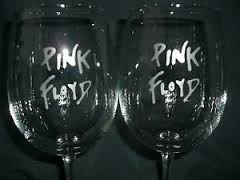
glassThis book informed me about these two unreleased Pink Floyd songs (there’s a Wikipedia site that lists some fifty more !).  While the were unreleased in 1974 (from the abandoned Household Objects album), they were eventually released in 2011 on expanded versions of albums.

“The Hard Way” features some “percussion” that sounds like someone taking steps.  There’s a bass riff which I gather is from rubber bands (but very well tuned).  There’s clocks ticking and chiming and tape being unspooled.  It’s a neat idea and while it is absurd to think you could make a whole album with this kind of stuff (in 1974), it’s a surprisingly good sounding track.

“Wine Glasses” was apparently made with wine glasses.  It is all of 2 minutes long.  It was designed to be a full song but was eventually used in the introduction to “Shine on You Crazy Diamond.”  I never really considered that there were wine glasses making the sounds (and clearly there are synths added on top), but yeah, so that ‘s kinda neat.

[READ: November 25, 2014] The Greatest Albums You’ll Never Hear

I found this book at work and knew I had to read it.  I was actually surprised at how long it took me to read (there’s a lot of entries).

The title and subtitle pretty much say everything you need to know about this book (and if you need to read it or not).  This book collects a series of writers who give a brief history of some of the more famous (and some not so famous) albums that were never released.  It explains (as best they can) why the albums weren’t released and even gives a percentage chance of likelihood of the album ever seeing the light of day (interestingly, most seem to be a 3/10–they may have been able to use a 5 point scale).

I knew some of the records they talked about (The Beach Boys’ Smile, Neil Young’s Chrome Dreams), but was ignorant of quite a lot of them. And while big fans of the artists may know all of the details about their favorite lost album already (these are sketches, not exhaustive research), there will certainly be some new information.  For instance, I’m a huge Pink Floyd fan but had no idea about the two shelved works mentioned here.

I liked the way the book was done chronologically and grouped by decade.  It was also interesting to see how the “reasons” for the non-release morphed over the decades from “the record label didn’t like it” to “it was leaked online.”

The one major gripe I have with the book is that it is chock full of “imagined” album covers.  This in itself is okay, but it is not made explicitly clear that they are all imagined (credits are given at the bottom of each image, but it took me a few entries to realize these were just people’s ideas of what the covers could look like).  And most of them are gawdawful.  Just really lame and dull (as if they had 20 minutes to come up with an idea).  They mar an otherwise cool collection,especially since some of the unreleased records actually do have proposed covers (even if they were never released).  I see that there is in fact a paragraph about the covers in the front pages of the book, but it is almost hidden away.

In addition to the albums I’ve listed below, I learned some fascinating things.  That Bruce Springsteen has hundreds of songs that he wrote but never released for various reasons.  That Pink Floyd did try to make an album out of household objects (with no instruments).  That the Sex Pistols’ Never Mind the Bollocks was almost simultaneously released illicitly as Spunk.  And that Danger Mouse’s The Grey Album was recently remastered.

The end of the book includes two small sections: other favorites that were never released.  Not sure why they earned only a small column instead of a full entry, but that’s okay.  The second was albums that we eventually did see, like My Bloody Valentine’s MBV and Guns N’ Roses’ Chinese Democracy.

So if you ever wondered what happened to that long lost album, this may be the book for you.

A sampling of the unreleased records include:

  • The Beach Boys-Smile
  • Buffalo Springfield-Stampede
  • The Kinks-Four Respected Gentlemen
  • The Beatles-Get Back
  • Jeff Beck-The Motown Album
  • Jimi Hendrix-Black Gold
  • The Who-Lifehouse
  • Wicked Lester
  • Rolling Stones-American Tour ’72
  • CSN&Y-Human Highway
  • Pink Floyd-Household Objects (1974), Spare Brick 1982
  • Dusty Springfield-Longing
  • David Bowie-The Gouster (1975), Toy (2001)
  • Sex Pistols-Spunk
  • Neil Young -Homegrown (1975), Chrome Dreams (1976)
  • Frank Zappa-Läther
  • Beastie Boys-Country Mike’s Greatest Hits
  • Weezer-Songs from the Black Hole
  • Jeff Buckley-My Sweeetheart the Drunk
  • Van Halen-IV
  • Foo Fighters-The Million Dollar Demos
  • Green Day-Cigarettes and Valentines (the author doesn’t believe it was actually stolen)
  • Tapeworm (Trent Reznor and Maynard James Keenan among others)
  • Deftones-Eros
  • U2-Songs of Ascent
  • Beck-The Song Reader


Read Full Post »

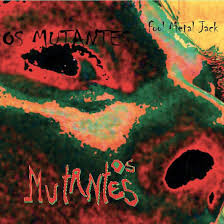
enchanteSOUNDTRACK: OS MUTANTES-Fool Metal Jack (2013).

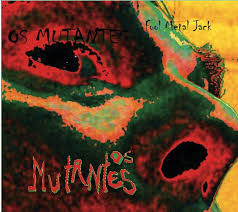
jackI first heard this album streaming on NPR.  I really enjoyed it and was surprised by how diverse and yet still kinda 1970s hippie-feeling it was.

I didn’t know anything about the music of Os Mutantes before hearing this disc.  In a nutshell (and the details seem pretty complicated), they released 6 albums from 1968-1974 and then broke up.  They reunited in 2009 and this is their second album after reuniting.

I don’t know what any of them did during the intervening years, but it is clear that the psychedelic vibe they explored the first time around never fully left them.  Because even though there are rocking numbers, there are plenty of groovy organs and songs about love on the disc.  And yet the first songs I heard from the album were really quite rocking, so I was surprised by the mellow vibe as the album progresses.

There’s precious little information about the record on the record jacket, but I do know that Sérgio Dias wrote all the music and is the lead singer.  The disc opens with a kind of introductory song, “The Dream is Gone.”  It has a slow opening with cool bass lines and Dias’ voice which is soft and kind of worn sounding.  There are some cool electronic effects sprinkled around and big harmonies.  This leads to the second song, the stomping anti-war track, “Fool Metal Jack” (which I talked about here).  It’s got a big fat bass and menacing riff (as befits a war song). The song is graphic and ugly (with a loud cough in the midst of a verse).  It’s followed by the big old sloppy sounding rocker “Picadilly Willie” with big 70s sounding vocals (I’ve mentioned before that it sounds like Frank Zappa song to me, and it still does). These two songs are so loud and noisy they really belie the psychedelic vibe that the rest of the disc presents.

“Gangjaman” has a reggae feel (with a big round bass) and fun backing vocals.  While “Lookout” has a kind of Santana live at Woodstock vibe–a slinky rocking guitar and big chords.  There’s also some traditional (I assume) Brazilian native singers.  “Eu Descobri” is sung by a female vocalist (in Portuguese I assume) it is a pretty, slinky song with flutes and a cello and echoed vocals.  It hearkens back to the late 60s but still sounds contemporary.

“Time and Space” has more big bass (the bass really sounds great on this disc), but this one is a slow acoustic umber with excellent harmonies.  I love the layered vocals that reminds me of good prog.  “To Make It Beautiful” is an absolute hippie track with lyrics like: “I need to create love with you my love.” It has his great falsetto and buzzy guitars.  It is so far away from the early rockers and yet to me the album doesn’t feel disjointed.  “Once Upon a Flight” is a synthy/guitar rocker, but in a very 70s style. It’s also got a big cello solo at the end.  “Into Limbo” is a jangly slow guitar song with Dias’ voice sounding great.

“Bangladesh” has a long acoustic guitar intro with a very middle eastern feel.  By the middle it turns into a kind of prayer with a repeated chorus of: “Hare Jesus Hare Buddha Hare Judas Hare Rama Hare Krishna Hare Lucifer.”  The final song “Valse LSD” is a complex acoustic song with male and female vocals.  It’s quite pretty.  It doesn’t really feel like the end of the disc (I would have ended with “Bangladesh”), but it’s a good summary of the album as a whole.

 Since I am unfamiliar with Os Mutantes’ earlier work, I can’t really say how this fits into their discography, but I think this is just a great album and I’m looking forward to hearing more of their earlier works.

[READ: October 2, 2014] The Enchanter

naboI have had Nabokov on my list of authors to read for a long time.  I have read and enjoyed a few of his books and planned to read his oeuvre at some point, just not quite yet.  And then, as serendipity would have it, I stumbled on a book of his novellas (the Penguin classic edition) and decided to read them.  Because they aren’t really meant to be taken as one item, I’m going to mention them individually.

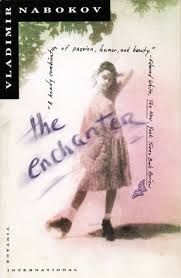
The Enchanter was Nabokov’s final work written in Russian.  It was never published during his lifetime.  The Notes to the story in the book suggests that Nabokov had a vague recollection of the story (with many details incorrect), but that he believed he discarded the original version when he moved to America.  He evidently found it after publishing Lolita, but did not feel compelled to publish it.  It was his son who translated and published it after his death.

The Enchanter is something of a precursor to Lolita in that it involves a man who is obsessed with adolescent girls.  What separates this from Lolita (although there are many similar plot contrivances) is the mental state of the protagonist.  He is disgusted by himself.  He knows what he does is wrong, he even imagines himself in animalistic ways.  And yet he cannot help himself.  (This is not to say that that is not present in Lolita, just that it is more or less the focus here). (more…)

Read Full Post »

april 2002SOUNDTRACK: PHISH-The Siket Disc (1999).

siketThis is an (almost) entirely instrumental disc.  It’s exactly the kind of thing that people think of when they imagine Phish—long jams with no structure.  But unlike some of their more frenetic jams, this is a kind of enjoyable chilling out disc.  The compositions are actually select excerpts from the long-form improvisations of the “Ghost Sessions.”

There are 9 songs and most of them are short.  Except for “Whats the Use” which is an 11 minute track with a very cool guitar riff (that reminds me again of Frank Zappa) and some cool accompanying keyboard sounds.

“Me Left Toe” is about 5 minutes and has a nice build up within  it.  And “The Name is Slick” is a bit more staccato and less smooth than the other songs and it holds up for 4 minutes.

Most of the other songs are short jams (with 4 tracks being about 2 minutes or less).  Although there are a couple of weird, nonsensey tracks like “Fish Bass” which is just a weird series of noises.  Or “Quadrophonic Toppling” which has some spoken words (just the title repeated) as does “Title Track” which has the repeated word “Siket”and laughing.  “Insects” is a little unsettling as well.

“The Happy Whip and Dung Song” is 5 minutes long and, despite some weird effect on the keyboards, feels like a full song.  “Albert” is a short, pretty, gentle ballad.  It’s a nice ending to this disc.  While this is by no means an essential Phish disc, it is an interesting insight into their recording process and is as I said, a good chill out album.

[READ: October 28, 2013] “Eternal Winter”

I had never heard of the Aral Sea before reading this article and I am surprised that I haven’t and I’m shocked by what has happened there.  Near the city of Karalpakistan (no connection to Pakistan), near Uzbekistan and Kazakhstan, lies the Aral Sea. It was once the fourth largest body of water on Earth, larger than lake Michigan.  It is now shrunk by approximately 74%.

It was through the Soviet Union’s thirst for development and “progress” that canals were built which diverted water away from the Sea.  This effectively slowly dried out the lake (which the Soviet Union knew would happen).  The Soviet Union also dumped insecticides and toxic waste into it, rendering what is left of the sea bed largely poisonous. Anything that is not poisonous is heavily salinated making it worse than useless.  And to make it worse (if that is possible), the windstorms that frequently occur simply pick up the toxic dirt and dust and blow it all around the land.  Without the water, the temperature soars in the region–often reaching 120 degrees.

One of the reasons for the diversion of the water was cotton.  Cotton is a thirsty crop and it was discovered that Uzbekistan was well suited to the climate for the crop.  They just needed more water.  And so in the 1950s, the Amu Darya river was diverted away from the Aral Sea and into the Uzbekistan deserts.  And cotton flourished there.  Then in 1960, the Aral Sea began to shrink. (more…)

Read Full Post »

zita2SOUNDTRACK:poodle “WEIRD AL” YANKOVIC–Poodle Hat (2003).

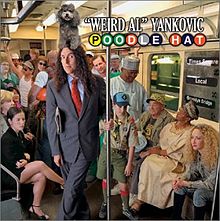
I think of Poodle hat as a good Al album.  It won a Grammy even (the true sign of quality, right?).  But its the only one of his albums (along with Polka arty) to not even go gold!  That’s pretty amazing given that he’s usually platinum.  I read that stat before listening again and I wondered why this album tanked so bad.  Was it the title or the cover or what?  And why do I think fondly of the record?  Well, it turns out I think fondly of the record because of the final track, “Genius in France” a Frank Zappa style parody (which I assume was not terribly endearing to many people either).  But what about the rest of the album:

Couch Potato.  It’s a good parody of Eminem, but I never thought the original was that good to begin with–it’s pretty repetitive with no real drama.  And while the lyrics are funny, so as a lead off track it’s not that great.  “Hardware Store” is a weird song–lots of crazy sound effects and backing vocalists.  I want to like it more than I do–the fast singing is great the lyrics are all kinda funny but it doesn’t really resonate–the chorus, perhaps is not that great.  “Trash Day” is a parody of a song by Nelly, which I don’t know.  I’ll now show off my musical prejudice by saying that a lot of these aggressive R&B/rap songs sound very similar with no real hook, which I think makes the parodies harder to enjoy.  “Party at the Leper Colony” just seems like a bad idea (especially for Al’s umpeenth album).  It’s a rockabilly type song (a style I don’t like anyway), so another thumbs down.

“Angry White Boy Polka”is the first bright ray on the disc–mixing aggressive metal songs in the polka style is a pretty great idea, especially System of a Down, The Hives and The White Stripes.  Twisting the style of The Strokes twist is a pretty great idea too.  I really enjoyed the way the angry songs are utterly lightened with silly sound effects.  It’s very funny.

“Wanna Be Ur Lovr” is a song I never much liked until seeing him perform it live.  It’s a sexy song made up entirely of lame come on lines.  It’s petty funny but the live version utterly blows it away.  “A Complicated Song” is a parody of Avril Lavigne’s “Complicated”.  It seems like it might be just a silly parody until the first verse turns out to be about eating too much cheese.  I laughed so hard to find that the first rhyme was “constipated”  The other two verses can’t possibly live it to it but that first one is a big highlight (toilet humor it may be, but it’s good toilet humor).  “Why Does This Always Happen to Me?” features Ben Folds on piano (the piano is very good).  The song is a series of complaints about minor things within the context of real tragedy.  It’s a funny idea but the presentation doesn’t seem to work somehow.

“Ode to a Superhero” is a surprise because it uses Billy Joel’s “Piano Man” as the musical basis for a song about Spiderman.  It seems like a sure fire hit after “The Saga Begins.”  And it works quite well.  “Bob” is a series of palindromes (see the title) done in the style of Bob Dylan.  It’s very clever.  “Ebay” has been mocked for being so similar to an actual eBay commercial, but I think its very funny.  I never liked the original but I find myself singing this every time I think of eBay.  “Genius in France” features Dweezil Zappa on guitar, and beyond that it gets so many Frank Zappa things right.  It is weird and crazy and spot-on.  I love to think that it may have made some Zappa fans out of Weird Al fans.  And if you’re a Zappa fan, you must listen to this to see just how many great Zappa musical moments he throws in here (including vocals styles and potty jokes).

It’s pretty interesting how the back half of the album is so much better than the first half (that’s no way to sell albums, Al).  I can totally see why this album didn’t sell all that well. And I’m a little bummed that I didn’t enjoy it as much as I thought I would.

[READ: June 19, 2013] Legends of Zita the Spacegirl

I actually read this book first of the two (didn’t realize it was the second book in the series and, frankly from the title, how could I?).  But I’ll treat it like I read it second.

So this story picks up soon after the first ended.  But rather than Zita, we see a robot crawling through a junkyard.  The robot’s box says RECALLED and the name is Imprint-o-tron.  The robot sees a poster of Zita and is immediately overwhelmed by a crowd who is rushing to see her.  Imprint-o-tron paints itself to look like Zita as the crowd assembles.

And there we see, Piper introducing Zita, the girl who saved Scriptorius.  But she is nervous, and intimidated by the crowd and tells the truth, that it was Randy who blew up the bad guys.  But they aren’t buying it.  She signs autographs, gets exhausted and hides behind a rock where Imprint-o-tron sees her and immediately becomes her (but with circles instead of dots for eyes).  Zita delights in this doppelgänger and sends it out to do her singing work while she and Mouse run off to have fun.

But then the ambassador of the planet Lumponia informs them that  swarm of star hearts are heading for their planet and they as Zita for help.  Robot Zita agrees and when real Zita returns to the ship, robot Zita pushes her away and takes off with the crew. (more…)

Read Full Post »

bartelbySOUNDTRACKOS MUTANTES-” Picadilly Willie” (2013).

Iosmut enjoyed this album so much (thanks NPR for the stream) that I had to talk about this song and how radically different it was from yesterday’s track.  “Picadilly Willie” is this wonderful old-sounding rock song.  It’s got a very classic rock riff, but there’s something slightly off-kilter which makes it sounds more like Frank Zappa classic than radio classic.  And when the vocals come in (with a sinister laugh) it sounds more like Mr Bungle than anything else (I wouldn’t be surprised if Mike Patton was a fan of Os Mutantes).

The song ends with what sounds to me like Middle Eastern sitar music and echoed chants of “Bra-zil!”

And these are just two of the styles of music on this wonderfully wild and diverse CD.  I can’t wait for its release.

[READ: April 22, 2013] Bartelby & Co.

I read about this book in the Bolaño interview book.  Vila-Matas was one of many authors that Bolaño highly recommended–this book in particular.  And, it was one of the few books on that extensive list that has been translated into English.

This book follows in the rich tradition of books that are more or less lists about people and not really novels at all. (This seems like a peculiarly Latin American pastime, at least in my experience, as there are nearly a half dozen books that seem to do this, including several by Bolaño).

The key to this book is in the title: Bartelby.  The narrator is a hunchbacked loner, and he decides to catalog all of the instances of writers who have in the grand tradition of Herman Melville’s Bartelby the Scrivener said “no, I would prefer not to” write anymore.  And so this book becomes a series of notes without a text.  The glorious list includes many famous and not so famous writers (the most famous being Salinger) who whether famous or not, decided to write no more.  And thus we have 86 “sections” in which the narrator writes about writers who stopped writing.  For most of the he gives their reason for no longer writing, for others he simply likes talking about how they stopped writing or what their circumstances were before they stopped. (more…)

Read Full Post »

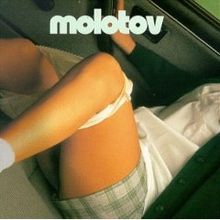
SOUNDTRACKMOLOTOV-¿Dónde Jugarán las Niñas? (1998).

Molotov was the last Rock en Español band that I really bothered to check out.  They were probably most notorious for the cover of the album.  Interestingly, the cover is actually a four sided cover which you can flip to three other far less sexist scenes, so yes, that was pretty much a sales gimmick.  And it certainly attracted attention (and a law suit!).  So they reissued the title with the far less offensive, but very different cover below.

My Spanish is poor at best, but this album is a mix of Spanish and English.  And, of course, I know some bad Spanish words, so I get a sense of what this album is about. But here’s the thing–it rocks really hard and has some really great elements of the metal/rap/funk hybrid genre, regardless of whether you know what they’re talking about (although don’t go singing “Chinga Tu Madre” around the office, capiche?).

The opening song  “Que no te haga bobo Jacobo” has a very Rage Against the Machine vibe–heavy guitars and sound effects with militant rapped lyrics.  The riff is great and the vocals are smoother than Rage’s Zach–“Tito” Fuentes has great flow.  There’s also some good funky bass in the middle section.  “Molotov Cocktail Party” is a mix of English and Spanish, a pretty straightforward rap, not unlike Kid Rock.

“Voto Latino” has a more alt rock vibe in the guitars, although the vocals are pretty straightforward rap style.  The song title means Latino Vote, so perhaps there’s a politics context to it.  And “Gimme Tha Power” is a political song, too.  A rap (in Spanish) over some nice acoustic guitars.

There definitely isn’t in “Chinga Tu Madre” which has more of those cool guitar effects and group chanting, although it’ probably not worth investigating the lyrics much more.  But the chorus is catchy as anything.  “Matata Tete” and “Mas Vale Cholo” return to that Rage Against the Machine style, with vocals that are a bit more cookie monster-y (I’m not sure who sings lead on which songs, actually) although “Mas Vale Cholo” has some fun with the vocal delivery.  And there’s a spirit of early Red Hot Chili Peppers at work, too.

“Use It or Lose It” is rapped in mostly English.  It has a very cool acoutsic-feeling chorus (and a quote of the line, “what cha gonna do rap is not afraid of you.”).  “Puto” is presumably an anti-gay song (I suppose I should find that out before I say so).  “Porque No Te Haces Para Alla?…Al Mas Alla!” has a fun chorus and cool guitar effects once again.  “Cerdo” has a cool 70s vibe, with funky bass and scratchy guitars–it’s got a sexy feel, although the title means “pig,” so who knows.

The final track also rocks very well.  According to Wikipedia, the translated title of “Quitate Que Ma’sturbas (Perro Arrabalera)” is “Stay Away Because You Masturbate (Suburban Bitch)” which seems weird .  But maybe they had nothing better to write about.  Sometimes ignorance of a subject is not a bad thing.

¿Dónde Jugarán las Niñas? is not the classiest album around, but it’s got some really interesting sonics.  And I’m led to believe their later albums are even better.

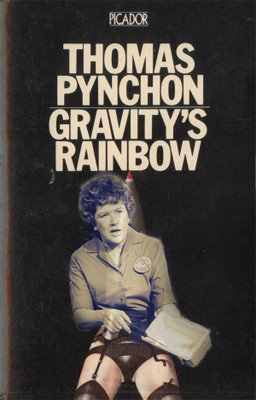
[READ: Week of April 9] Gravity’s Rainbow 3.16-3.24

Last week ended with sex and this week opens with the way I felt–like a voyeur who can’t look away.  The exhausting orgy was exhausting to read about as well.  And I’m starting to wonder if Pynchon is making a point about sex rather than just enjoying writing about it.

This week’s read also brings back two characters from way way ago.  Well, one from not too long ago, but another from what seems like an eternity.  I assumed we’d see Pirate Prentice again, but I assumed that it wouldn’t be until Section 4. So that was a nice treat, even if it’s a less than happy return for him. (more…)

Read Full Post »

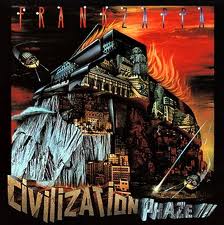
SOUNDTRACK: FRANK ZAPPA-Civilization Phaze III (1994).

There were a number of choices for soundtracks for this week’s read.  I could have chosen the Andrew Sisters (and their wonderful “Don’t Sit Under the Apple Tree”) who get a mention in the book.  And, of course, I could have chosen Elton John’s “Rocket Man.”  But, when I read Trudi tell Magda about her boyfriend Gustav who wants to live inside a piano, well, it was hard not to think of this, Frank Zappa’s final work.

Civilization Phaze III is an opera-pantomime.  According to the libretto, “The speaking characters all wear oversized masks, gloves and shoes.  They live in an abstracted grand piano….”  And musically opens with this introductory spoken passage:

FZ: The audience sits inside of a big piano and they listen to it grow.
Spider: People are going to sit inside of a piano. They’re going to listen to this piano grow.
John: They’re going to listen to the piano grow?

Civilization Phaze III was released posthumously in 1994.  But here’s the weird thing.  Most of the sessions of “piano people” dialogue were recorded in 1967.  Zappa had a bunch of people come into the studio, sit under a piano that was miked and improvise dialogue (sounds like the 60s to me).  He released some of this dialogue on his  late 60s albums, but as far as I can tell, the parts about the piano were never included (in Lumpy Gravy someone talks about wanting to live in a drum).  I’m also not sure how well-known the “piano sessions” were at the time.

So, here’s the question…did Zappa influence Pynchon or did these two people come up with the same idea at roughly  the same time.  The reason Zappa put off using the material recorded in 1966 was because technologies were simply not advanced enough to let him manipulate the dialogue so it would sound decent, much less coherent.  So Civilization Phaze III became his exploration of the past with contemporary technology.

He also recorded new spoken dialogue in 1991 and merged the two.  It’s an interesting idea, but I fear that the new dialogue absolutely misses the vibe of the earlier dialogue.  In the early dialogue, they all sounds like they’re stoned and are talking crazy nonsense about horses, smoke and music.  The later dialogue is much more abrasive (especially Michael Rappaport, the only person who has since gone on to renown).  At the time, Rappaport had been on one TV show as a guest, but by now he is too famous for this.  I find him a distraction (not Zappa’s fault obviously), even more so because he talks as if he is black (he says “Nobody said nothin’ when y’all bought my people, right?”) while he is demonstrably not.  And then ruins it contextually by mentioning Yo MTV Raps, the only thing that places the story in time.  It’s weird that Frank wouldn’t have a black person say these lines, especially since he has so many other races and nationalities represented in his music.  But maybe that’s me intellectualizing that I just don’t like Rappaport.

So, what’s this monstrosity about?  I have no idea.  Improvised stoner dialogue from the 60s is pieced together into a kind of story.  Occasionally Frank’s voice chimes in and prompts them to talk about certain things (which is quite  disorienting).  And the whole “plot” well, I’m not even sure if it can be called a plot, but Frank tries to cobble something together–again, the 1991 dialogue seems to be more pointed, more about conflict, possibly something about overcrowding and racism, and there’s certainly some social criticism at work, but as for a story, well, not so much.

The music, on the other hand, is the culmination of Zappa’s more experimental, atonal “classical” music.  Most of the first disc is performed on the synclavier while most of the second disc contains more actual musicians.  The music is difficult and not to everyone’s tastes, for sure.

Atonal music is far more intellectual than visceral, so it’s hard to “enjoy” this music.   Zappa obviously knew how to write catchy poppy friendly music, so this is a deliberate attempt to write something more challenging.  I like Zappa’s crazy music in small dozes, so listening to this entire thing (over 2 hours) can be a tough in one sitting.  But each piece (especially the two really long pieces “N-Lite” (18 minutes) and “Beat the Reaper” (15 minutes) ) showcases something interesting or satisfying.

The libretto that Zappa includes with the discs explains the story in far more detail and shape than one would ever get from listening to the music.  Without the book, you would know that this is a dark and moody piece, but with the book, you can actually see what the music is showing.  That may be a flaw, or that may be the way of a staged performance.  I have no idea if it was ever staged.

There are certainly easier introductions to Zappa’s music.

[READ: Week of March 26] Gravity’s Rainbow 3.6-3.10

Last week was a bear of a read for me, but this week was so fast (and short) that I just kept going because I was so into the Slothrop story (I won’t go past the spoiler line, I promise).  And yes, it’s (almost) all Slothrop this week.

Section 3.6 begins with Slothrop violently ill.  [I admit I don’t think of novel characters as getting ill very much–unless it’s a plot point–but surely characters get colds and tummy aches just like everyone else, right?].  He drank out of an ornamental pond in the Tiergarten–but, duh, everyone knows to boil water before drinking these days.  This also introduces Slothrop as Rocketman, something we won’t get more details on until later. (more…)

Read Full Post »

« Newer Posts - Older Posts »