SOUNDTRACK: THE INTERNET-Tiny Desk Concert #474 (September 29, 2015).
The Internet are an offshoot of Odd Future. This is an R&B group fronted by Syd the Kid, and the music is really delicate–almost easy-listening-sounding keys and a ropey bass line.
Syd’s voice is beautiful and soulful and she raps and sing delicately. Which is why it’s surprising that the first words of the first song are “now she wanna fuck with me / live a life of luxury.” But after the surprise of these lyrics the chill music is kind of soothing: “roll up an L and light it.” And I love her falsetto for the chorus”
“She blowin up my phone. All I hear is wha wha, wha wha (Band: wha wha).”
“Under Control” is a song dedicated to her band: she promises she’ll be there for all of them “when I’m a legend baby and we’re all rich”
Her confidence and casualness is totally infectious. And I love the the wah-wahs effects on the keys as the song nears the end.
The last song is called “Dontcha” which gets a “yes!” from the crowd when she says she’s going to play it. (That makes her very happy). She says she’s never done an acoustic version before. I gather it’s a single, although I enjoyed the other two songs a bit more.
The veering into R&B territory is not my thing, but it’s cool to hear her branch into different genres in one song.
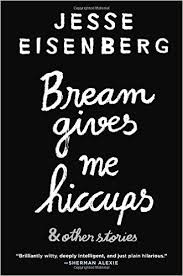
[READ: May 15, 2016] Bream Gives Me Hiccups and Other Stories.
I’ve really enjoyed the comic pieces that I’ve read by Eisenberg–he writes a lot for the New Yorker. In fact, I had recently decided that I would read and post about all of Eisenberg’s New Yorker pieces at some point in the future. Well, it turns out that nearly every one of those New Yorker pieces has turned up in this book (there’s three that didn’t). So that saved some time.
What that means is that most of these pieces are quite short. And that very few of them are stories in the conventional sense. They tend to be a few pages long, or sometimes longer pieces done as diary entries.
What is most interesting about Eisenberg’s writing is that most of these stories are funny–some are very funny–but there is also a lot of pathos and sadness in them. Many of the characters come from broken homes and many of the situations are rather bleak. And yet he manages to make them funny. (more…)
SOUNDTRACK: NICK BUZZ-Arnold Schoenberg and the Berlin Cabaret (2003).
In 1901, Arnold Schoenberg wrote eight Brettl-Lieder (Cabaret Songs). The songs were short and fun with naughty (cabaret influenced) lyrics. Some 100 years later, inspired by the Art of Time Ensemble who commissioned Nick Buzz to play pieces for their Schoenberg show.
So the guys from Nick Buzz got together and recorded four of the eight pieces. Then Martin Tielli released this disc as number 2 of his Subscription Series. Some of us were a little disappointed when this came out since it was only 15 minutes of music, but the art is wonderful and I have recently rediscovered this disc and have enjoyed it immensely.
Basically the Buzz guys have interpreted the songs in their own style, but they have remained faithful to the original melodies and lyrics (which were in German but are now in English).
“Gigerlette” explores electronic manipulations (presumably by Hugh Marsh) and offers lots of fun samples (what I assume is some earlier recordings of the song in German). It opens with sampled female singing and staccato piano as well as other unusual effects. Then Martin’s vocals come in and the effects clear out and the song becomes simple piano ballad for a brief moment. Then the noises come back in again, playing around with this amusing song. It’s a song of romance and love with the sweet punchline being that cupid is driving their coach and four. At over 5 minutes this is the longest song by far, even if the basic song is just over two minutes.
“Der genugsame Liebhaber” (The Modest Lover) opens with what sounds like a distorted harp (presumably the piano) and scratchy records (from Marsh). This song is about a man going to see his lover, but his over’s pussy loves his bald head so much that she continually climbs atop it. It is charmingly naughty. There’s some wonderful violin from Hugh Marsh on this song
“Galathea” is the most conventional of the three songs. A lovely piano ballad to Galatea.
“Arie aus dem Spiegel von Arcadien” (Aria from the Arcadian Mirror) is super fun. The music is weird and goofy with a very drunken feel. And the chorus is just wonderful “my heart begins to thump and dance just like a hammer’s blow it goes boom boom boom boom boom boom boom boom boom (getting faster and faster). I’ve listened to the original and it is very much the same, although Nick Buzz’s version is much better.
You can find some of these songs on line from a recording at Lula’s Lounge (Dec 9, 2010)
It’s cool to see how they recreate the album so faithfully in a live setting. It’s only a shame that the video isn’t a little closer so you could see just what they are doing.
Nick Buzz-December 9 2010 Lula’s Lounge
[READ: September 1, 2015] My Documents
I have enjoyed some of Zambra’s stories in other locations, so I was pretty excited that McSweeney’s released this collection (translated by Megan McDowell). The book is pretty much all short stories, although the first items feels a bit less fictional and more memoirish.
“My Documents”
This is a brief historical account of Alejandro as a child and as a writer. He talks about when he started working on computers and what happens when the computer dies with the information inside. He explains that this file is in his My Documents folder and he’s going to publish it “even though it’s not finished. Even though it’s impossible to finish it.”
“Camilo”
I read this story in the New Yorker. It concerns the relation of a man and his godfather, whom he has not seen since his father and godfather had a falling out years ago. See my link for a more complete synopsis. I enjoyed it just as much the second time.
“Long Distance”
The narrator worked as a phone operator in 1998. He liked the job–his boss was cool and would let him do anything he wanted so long as he answered the phones quickly. The job was in a travel insurance office and one day he received a call from a man named Juan Emilio. After speaking for a time about various things, the narrator realized it had been 40 minutes since they first started talking. They were expected to call clients back 14 days later as a follow-up and this time Juan Emilio talked with him foe a while and, upon learning that the narrator studied literature, asked if they could meet and discuss books. The narrator was already teaching classes at night, and these two situations overlapped somewhat. I loved the way all of this information is used as backdrop to a romance he has with a student known as Pamela. And the final line is great.
“True or False”
The titular phrase is uttered by a boy, Lucas, who declared, based on an inscrutable internal feeling, that things were True or False. An armchair might be true, while a lamp might be false. Hid father Daniel had a cat, Pedra, even though pets were forbidden in his building. Lucas loved the cat. Then the cat had kittens. There is a metaphor at work about the fatherless kittens and Daniel’s own behavior toward his son. I really enjoyed this story and the strangeness of the true or false brought a fascinating childlike quality to the story
“Memories of a Personal Computer”
The conceit of this story is great. A PC remembers what it was like to observe a relationship as it begins and then ebbs–and how the PC was moved around into different rooms as things changed in the relationship.
“National Institute”
At the school where the narrator went, they were called by number. He was 45. The main subject of his story was 34, although he doesn’t know the boy’s real name. 34 had failed the grade and was made to repeat it, but rather than being sullen about it, he was popular and fun. All of the students were worried about failing–the final test was very hard. But one day 34 approached 45 and told him he had nothing to worry about. The other students didn’t know what to make of it, but he slowly assessed everyone and told them whether they had anything to worry about. By the end of the story, when 45 is brought to the inspector of schools, he is told a lesson he will should never forget.
“I Smoked Very Well”
A look back on smoking and how quitting smoking made him a different (though not necessarily better) person.
“Thank You”
She is Argentine, he is Chilean and they are not together (even though they sleep together). They were in Mexico City when they were kidnapped together. The incident has unexpected moments. It’s a weird story (with some really unexpected moments) but a really good one.
“The Most Chilean Man in the World”
A Chilean couple has decided to separate once she was accepted to school in Belgium. After several months he is convinced that she wants him to visit, so he spends a ton of money and heads out to Belgium. Without telling her. And it goes very badly. But he can’t just leave Belgium, now can he? So he goes to a pub where he meets some new friends who call him the chilliest man in the world. The story hinges on a joke, but the story itself is not a punchline.
“Family Life”
I read this story in Harper’s. I thought it was fantastic–it was one of the stories that made me want to read more of his works. This is story of a man house sitting and the false life that he constructs around him. It was surprisingly moving.
“Artist’s Rendition”
I loved the way this story began. It tells us that Yasna has killed her father. But we slowly learn that Yasna is character in a detective story that an author is trying to write. We learn how the author constructs details about this character and the things that she has experienced which make her who she is. As this story unfolds we see how those first lines proved to be true after all.
This was a great collection fo short works and I really hope to see more from him translated into English.
Starting this month, Matt Bucher and David Laird, scholars and fans of David Foster Wallace have created the first regular Podcast devoted to Wallace. And the intro and closing music is from Parquet Courts’ “Instant Disassembly” which is also pretty cool.
This introductory episode serves as an introduction to Bucher and Laird, their love of Wallace’s work, and what they hope to do in future episodes.
Matt Bucher lives in Texas, not far from the Ransom Center where the Wallace archives have been settled (he assures us that he moved there before the site was selected). David Laird is from Kelowna, in British Colombia (4 hours east of Vancouver). The claim to fame of Kelowna is the mythical lake monster Ogopogo. But in Infinite Jest, a character is spoken of as being addicted to a thick apple juice that comes from BC.
Bucher also runs Sideshow Media Group which published Elegant Complexity, Nature’s Nightmare, and Consider David Foster Wallace. He says he and his brother founded the press because no one would publish Elegant Complexity, and he felt it needed to get out there. (more…)
SOUNDTRACK: THE HOLMES BROTHERS-Tiny Desk Concert #71 (August 2, 2010).
I’ve never heard of The Holmes Brothers. So I was a little surprised to hear that they have been playing together for 30 years.
The trio consists of Sherman Holmes on bass, Wendell Holmes on guitar and Popsy Dixon on drums (in this case, just a snare and a lot of rim shots).
They play soul music steeped in Baptist hymns, blues and spirituals. Wendell is a great guitarist, playing effortless solos–playing with the volume and creating interesting effects. Sherman plays a fun bass with some cool bass lines (although felt he may have been a tad too loud in the mix). And Dixon keeps the beat–nothing fancy, but he propels the song along and it would never sound as good without him.
They play three songs from their then new album. Sherman sings lead on “Dark Cloud” while Wendell sings lead on “Pledging My Love” and “Feed My Soul.” Especially noteworthy on the latter two tracks is Dixon’s falsetto which is really amazing (I thought they had a female backing vocalist hidden somewhere). In fact, the three of them sound like there might be four or five people in the band.
They put on quite a show.
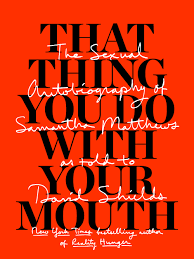
[READ: August 7, 2015] That Thing You Do with Your Mouth
I often don’t know what McSweeney’s books are about before I read them. I had a vague inkling that this book was about sex (I’d read that Matthews did voice over for Italian porn), but I didn’t know that this was going to be a kind of biography of Matthews and her history of sexual abuse.
According to the introduction, Matthews told her story to David Shields (author and also Matthews’ cousin) who says that the interview garnered 700 pages worth of material. Thank goodness he edited it. I felt this book (which comes in at 113 large print pages) was way too long as it is.
Despite all of the accolades on the cover, Matthews is not a very compelling individual. It’s strange to read personal incidents from a person that you’ve never heard of or, for that matter, was someone who hadn’t done anything terribly interesting. (more…)
SOUNDTRACK: BELA FLECK, EDGAR MEYER, ZAKIR HUSSAIN-Tiny Desk Concert #70 (July 26, 2010).
Bela Fleck is a rather legendary musician, and yet I realized I don’t really know that much about him. And somehow I never knew he was a banjo player (that’s a pretty serious omission on my part). I had never heard of the other two musicians, although they are apparently world-class masters of the bass fiddle and the tabla.
I also didn’t expect this Tiny Desk Concert to be so interestingly world-musicy.
This set is only two songs but each is about 7 minutes long and they are both very cool (and from the album The Melody of Rhythm).
Fleck’s playing is amazing, with a tone that is often unlike a standard banjo sound. And I absolutely love the tabla–I am fascinated by this instrument. The first song, “Bubbles” is an amazing demonstration of Fleck’s banjo. About midway through he is playing in a decidedly middle eastern style (which works great with the tabla). And when the bass starts getting bowed around 1:50, it adds an amazing richness to this already cool song. There’s a cool bass solo (I love that the tabla pauses a few times during the solo). The ending is just wonderful.
Before the second song, “Bahar” (which means “springtime”) they talk about being nervous, which is pretty funny. This song opens with the bass fiddle’s bowed notes (including a very very high note). This one seems to be a more solo-centered, with some elaborate work from Fleck after the introduction. And the tabla solo, while brief, is really cool to watch. I prefer the first song, but the more traditional nature of the second song is a nice counterpart to the first.
[READ: August 24, 2015] Grantland #12
I enjoyed this issue as well. This was mostly the spring and summer of 2014, which sounds so long ago, and yet so many things seem so current.
CHUCK KLOSTERMAN-“The Life and Times of Kiss”
I love this article about Kiss. And I wrote about it back here.
WESLEY MORRIS-“Poison Candy”
This is about the disastrous state of female comedies. It focuses on the movie The Other Woman which is ostensibly a female centered comedy but is entirely other.
BILL SIMMONS-“Sterling’s Fold”
A drumming down of Donald Sterling. It’s hard for me to believe that this happened over a year ago.
ZACH LOWE-“Building the Brow”
An article about Anthony Davis of the Pelicans, who is proving to be better than anyone imagined. (more…)
The final 10 episodes of The Organist’s second season were of the same caliber of podcast. I was surprised to see that it ended in March. And, in a recent Kickstarter from McSweeney’s, the talk about getting funding to make more episodes. I’d be bummed if they ran out of money to make more of these. Even if I have griped about the repeating, the quality of each episode is really quite good.
Episode 40: Cosmo’s Factory (December 30, 2014)
I was fascinated by this piece because I found the drumming in the song to be nothing special. I never would have noticed all of the nuances that he fixated on. And the song really isn’t that interesting. Drummer Neal Morgan, who has supported Joanna Newsom, Bill Callahan, Robin Pecknold, and others, sat down with Creedence Clearwater Revival’s Doug Clifford to dive into ecstatic detail on the arrangement of “Long as I Can See The Light.”
Episode 41: A Funeral for Everyone I Knew (January 6, 2015)
This week they finally get around to the Greta Gerwig piece they mentioned in Episode 38. It is Funeral for Everyone I Knew, a new radio play by novelist Jesse Ball. Starring Greta Gerwig and Whip Hubley, the play follows the dark machinations of a dying man, and his elaborate plans for his own funeral. Frankly it wasn’t really worth the wait, and Gerwig isn’t in it enough. (more…)
On the inside cover of this book it says that you can download The Coup’s new record online. Evidently that was a limited time only because the link no longer works. Every time I tried recently, the download failed. I was therefore unable to follow the request:
Let it be known that the editors will look favorable upon those who listen to the soundtrack and read the script at the same time.
Which I would like to have done, since I like The Coup and have Party Music.
You can listen to some of their songs (which are quite dancey even when they are subversive) on their website. (and streaming as well).
I have been listening to the disc online while writing this post and I like the way The Coup makes their songs catchy and the way Riley’s rapping is fast but clear. “Violet” which is rapped over a lovely violin and strings piece.
My one gripe about the album is a consistent gripe with a lot of rap albums–there’s too many guests. I don’t listen to The Coup to hear other singers, I listen for Riley and his band. If I can get the download to work I’ll review the album properly in the future.
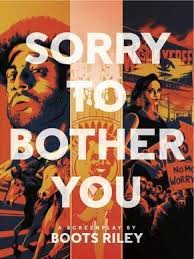
[READ: August 15, 2015] Sorry to Bother You
Sorry to Bother You came with McSweeney’s Issue #48. I have just gotten around to reading it and I’m bummed that I waited because this screenplay is fantastic.
Boots Riley is the creator of The Coup and an activist in general (I love the quote that “a Fox contributor (whose name I simply don’t want to appear on my blog) called his work ‘a stomach-turning example of anti-Americanism disguised as high-brow intellectualism.’ Boots was surprised and elated by the compliment”).
The opening of the screenplay is a note from Boots himself in which he explains that “every scene, every character, every word–is true.” And that McSweeney’s has forced him to change the names of those mentioned.
And then the screenplay begins. Cassius Green (known as Cash) lives in a garage bedroom (in which the garage door opens some time unintentionally). He has just scored a job at a telemarketing office (his faked resume was hilarious). His girlfriend, Detroit, is an artist. She wants what’s best for him, but also doesn’t want him to suck up to the man. But at the same time, they do need some money.
In their neighborhood there are billboards everywhere for WorryFree. There’s also a TV ad that plays during the movie in which we learn that WorryFree “guarantees you employment and housing for life” (the TV shows six bunk beds, like a prison done up by a hip interior decorator). The concept of WorryFree permeates the movie. (more…)
SOUNDTRACK: DAN BEHAR-Songs from All Our Happy Days Are Stupid (2002).
In the book, it says that you can hear all of Behar’s songs from the book here. But that link takes you nowhere. Bummer. You can hear newer versions of four of the eight songs on Destroyer’s Your Blues album.
[READ: August 2, 2015] All Our Happy Days Are Stupid
Pretty much the only reason I read works by Heti is because she is often published by McSweeney’s (and since I subscribe to their book series, I’m going to read what they send me). I tend to not really like her books–they often feel arbitrary and neither funny nor thoughtful enough to warrant the arbitrariness of the characters’ actions. But this was a ply, written much earlier in her career.
This play was conceived in 2001. She tinkered with it and rewrote it and it eventually became a convoluted mess. She gave up on it and wrote her novel How Should a Person Be, in the mean time. Then Jordan Tannahill read the novel and talked to her and learned about this play. He asked to see the first draft and he liked it, so he put the play on. Initially it was done a in small theater (about 30 people max) and since then it has been performed in larger venues. This release corresponded with a joint Toronto and New York City series of performances in February 2015.
So this play is ostensibly about two families, the Oddis (who have a 12-year-old daughter, Jenny) and the Sings who have a 12-year-old son, Daniel). They are both from Cedarvale (which I assume is in Canada) and they both happened to take a vacation to Paris at the same time. The kids know each other from school but aren’t exactly friends. Nevertheless, Jenny is super excited to see someone she knows. In part that’s because she is generally pretty happy (even though her parents tend to shoot down her happiness), but also because she is sick of Paris because it appears that there is a parade every day and she hasn’t seen anything authentically French.
The families talk and immediately fail to hit it off. Mrs Sing is intolerant of Ms Oddi and frankly none of the grown up appear to be very thoughtful or even nice. By the end of their meeting, Daniel has run off. And he remains missing for most of the play. (more…)
After Tales, Rick Wakeman left and the band decided to get back to business. So they made an album kind of like Close to Edge. Relayer is a dark album which didn’t quite bring the band back from the brink (even if there were only 3 songs and one was 20 minutes long). It did sell well, though, even if there wasn’t any real radio airplay.
I happened to really like this album in college (my friend Sean introduced me to it). And there are moments here that I think are great, but I can also see that it is not quite as user friendly as CttE.
I love the way “The Gates of Delirium” opens with guitar harmonics and some loud bashes of noise (good to see Squire and White asserting themselves again). The lyrics come in around 2 minutes in and it’s a very sweet and interesting opening. The guitar lines grow more complex as the song progresses. Anderson says that it is a war song, with a prelude, a charge, a victory tune, and peace at the end, with hope for the future. The “listen” section is quite catchy and moves along very well.
Around 5 minutes, the song changes into more of an instrumental sound (the charge, perhaps?) A great riff begins at 8 minutes with a very heavy section (the battle?) beginning as well. Squire takes over around 10 minutes and then the chaos befalls the song. Anderson and White stopped by a scrap yard and bought metal car parts which were used as percussion during the song’s battle section. During the battle section, White formed a tower of the parts and pushed it over to make a crashing sound.
Patrick Moraz (who later played with the Moody Blues) took over for Rick Wakeman on this album and the difference is notable. Moraz adds good keyboard sounds, but it is so clearly not Wakeman–there’s no flourishes or frills (one imagines he would have added some pretty impressive things to this battle scene).
At around 13 the battle ends and a new riff comes out–uplifting but not overtly so. Then things mellow out at around 15 minutes, with some washes of sound. The biggest surprise comes around 16 minutes when the song turns very pretty with a slow echoey section known as the “Soon” section. This section, which is about 5 minutes, was released as a single.
Track 2 “Sound Chaser” opens with a weird keyboard sound and then some chaotic drumming and bass (it’s loud and cool). This is their jazz fusion song with drumming that’s all over the place and some cool riffs. There are vocals (it’s hard to imagine them fitting vocals on to the riffage). And then around 3 minutes the song turns into a big time guitar section with a lengthy dramatic solo and then Moraz’ keys underneath. At 5 and a half minutes the songs mellow out an Anderson begins singing a gentle passage. Then a little after 6 minutes the songs repeats with the chaos of the opening and that cool riff. But this time, a noisy guitar picks up afterwards and a new riff begins and slows down until the unusual “cha cha cha/cha cha” section begins. It’s followed by a wild keyboard solo from Moraz.
“To Be Over” opens with some more gentle notes as it slowly builds. Sitar plays over the notes. This is a mellow track with lovely harmony vocals. There’s an interesting slide guitar section in the middle of the song. It shifts to a very typical Steve Howe guitar solo after that (very staccato and interesting). By 5 and half minutes there’s big harmony vocals and then around 7 and a half minutes the song breaks into a new, catchier section, with a cool keyboard outro.
It’s not as immediate and grabbing as previous Yes albums, but I still think it’s pretty great.
Since almost every Yes album had different personnel, I’m going to keep a running tally here. Here we have a new keyboardist, although Wakeman would soon be back.
Chris Squire-bass
John Anderson-vocals
Alan White (#2)-drums
Patrick Moraz (#3 replaced Rick Wakeman)-keyboards
Steve Howe (#2)-guitar
[READ: March 24, 2015] “The Route”
I’m generally puzzled about the fiction in Lucky Peach. It’s usually food related, which makes sense. But this one wasn’t especially. And then at the end of the story to see that it was originally published in Escapes in 1990 just makes the whole thing seem odd. But hey, they can publish what they want, right?
The story is about a married couple–she is a youngster and he is middle-aged. Their marriage is poor and so they go on a road trip from New York.
Each entry in the story is about a spot and what they did that day–traveling through Connecticut and Spotsylvania, Virginia. Until they get to North Carolina where he is bitten by a bat.
And this is evidently, fatal.
They continue on South, with this soon to be fatality proving to be an aphrodisiac. They go through Georgia and into Florida. And they finally get to Mile 0 in Key West.
The whole story was strange and unsettling and I really didn’t get a lot out of it. It seems odd that they would bother to reprint it here.
~~~~~~~~
The rest of the issue was, as usual, excellent.
There were several articles about wheat and other grains and interviews with different chefs.
But my favorite article was the one about Colonial Chocolate (and how Mars got involved). And my second was about the Monopoly game at McDonalds which I’ve never played and had no idea was over 25 years old.
The theme of the issue is obsession, and there are obsessions about endives (pronounced ondeev) and Pizza (including the guy with the record for most pizza boxes) and so much more.
The story about a Jewish man and his love of pork was interesting, especially the part about pork roll:
She takes a bite and her eyes roll back. Then she hands it to me.
As I dig into my first Taylor Pork Roll I realize that everything I appreciated in the ham… is more concentrated in this superior sandwich. It’s saltier porkier and smokier and the flavor lingers on the tongue…. It’s like a ham sandwich squared.
There’s also a fascinating look at Ranch dressing and its belovedness in West Virginia.
I may not always love the stories, but Lucky Peach continues to be a great magazine.
Aurelio is from West Africa. He plays a nylon stringed guitar (finger picking and chords) and is accompanied by traditional Garifuna musicians and an electric guitar. The Tiny Desk blurb says he “weaves together intricate layers of acoustic guitar to capture the polyrhythms of West African and the Caribbean.”
He sings in what I assume is Garifuna. He is not young and his voice sounds like it. From his chat, I believe he may also have been mayor once.
They play three songs: “Lándini,” “Funa Tugudirugu,” and “Nari Golu” The guitar solos are (surprisingly to me) provided by the electric guitar while the acoustic keeps the rhythms. The maracas and drum (box) keep the beat. This is my introduction Garifuna music, which doesn’t sound too different from any other music (except the vocals of course).
[READ: March 22, 2015] “Keeping Time”
I’ve read somethings from Manguso before, in particular her McSweeney’s book of flash fiction.
This is an excerpt from a book called Ongoingness: The End of a Diary. At first I found the entry a little annoying. “I started keeping a diary twenty-five years ago. It’s 800,000 words long.” Manguso basically got into a frame of mind where she felt like she had to record everything–the perpetual loop of recording things as they happen and then recording how you feel about when you are recording them.
She says “I couldn’t face the end of a day without a record of everything that had ever happened.” The fact that this was 25 years ago certainly predates the live bloggers and the daily diarists who tape everything. And it is interesting to see that her rather unhealthy obsession has been around longer than the technology allowed for it.
Manguso says she didn’t want to miss anything and by writing it down it was proof that she hadn’t. She says that “the trouble was that there was so much I failed to record.” (more…)
 SOUNDTRACK: THE INTERNET-Tiny Desk Concert #474 (September 29, 2015).
 The Internet are an offshoot of Odd Future. This is an R&B group fronted by Syd the Kid, and the music is really delicate–almost easy-listening-sounding keys and a ropey bass line.













 I Just Read About That...