Feeds:
Posts
Comments

Archive for the ‘Marriage Trouble’ Category

SOUNDTRACK: FRANK BLACK-“Headache” (1994).

Frank Black is Black Francis from the Pixies.  When the Pixies disbanded, Black set out on  a solo career.  He’s got some great songs under the Frank Black moniker and this is one of them.

This is an acoustic guitar rocker, that sounds perfectly nineties.  It builds over a series of verses, getting louder and faster with backing vocals added as the song goes along.  What’s interesting is that there’s no real chorus to the song.  The verses are more or less the choruses, although that doesn’t quite seem right either.  But after the verses, there are these quieter interlude pieces that are kind of bridges but not really.

But regardless of all of that, the song is catchy as anything (especially for a song that includes the word cranium–incorrectly used–“My heart’s crammed in my cranium”).

Wow, i thought that Black Francis has been quiet all these years, and yet I see that he has been releasing an album a year for a decade.  Talk about under the radar.

[READ: Week of August 20, 2012] JR Week 9

Holy cow, this week starts off with a lot of fun chaos in the Grynzspan apartment.  And there’s a return of lots of characters, too!  The long story arc seems to return to whence it started–the “Bast apartment,” although there are many changes afoot there.  And, for those keeping score at home, we finally get to return to the original Bast House–where kids have sex and shit in pianos.

But first the poor delivery man is back with his gross flowers.  [Simon’s comments from last week have some great ideas about the plastic flowers, too, by the way].  But before that goes anywhere, Eigen shows up to the apartment–the first time he’s been here in a while.  And as he’s coming in the door, he is given a summons for Mr Grynzspan (whom the police assume he is).  Eigen tries to control the crowd and his temper, but he’s fighting with everyone.  In particular, he’s fighting with Rhoda, who has some great lines here.  When asked if she is Mr Bast: “Man look at these I mean do I look like Mister anybody?”  When Eigen says her name “was Rhoda right,” she says “What do you mean was,” and every time Eigen puts his hands near or on her, “I said I can dry there myself.”  Things settle down and Rhoda regales Tom with the story of the shipwreck they had last night, and she’s glad that Chairman Meow isn’t drownded (610).

Then Amy calls looking for jack.  She’s back from Geneva but needs a few days to straighten out things before seeing him.  Rhoda says that Emily is someone Jack doesn’t want to see   Eigen says she’s the only think holding him together.  They repeat the same statements about Gibbs’ book.  Rhoda says that Tom is this “big important novelist” but he can’t see that Gibbs hates his own book and feels pressure from Emily/Amy. (more…)

Read Full Post »

SOUNDTRACK: KISS-Asylum (1985).

This series of mid-80s Kiss CDs is regarded pretty poorly.  In fact, I believe that Gene and Paul have distanced themselves from Asylum.  And yet, despite its pop metal vine and really dayglo appearance, there’s some good stuff on it.  The solos are really notable on this disc.  Bruce Kulick has taken over lead guitar duties and he is wailing maniac.  He has speed and flash and he, frankly, really stand out (not always in a good way) in these songs.  His solos seem to signal a shift to a more pop heavy metal sound.

The disc opens with a pounding drum salvo and aggressive guitars!  “King of the Mountain” is a classic Kiss song—loud, with a great sing a long chorus from Paul.  “Anyway You Slice It” also rocks pretty hard, one of Gene’s fast, sex songs.  But man I hate songs that break down to just vocals and drums. “Who Wants to Be Lonely” seems like a ballad—lyrically and all—but it’s actually a pretty heavy song, again, perfectly suited for Paul’s voice.  “Trial By Fire” is the first song that really falters.  A generic anthem with the really lame chugga chugga guitars that Kiss would really push in this era.  “I’m Alive” opens with more crazy drumming and wild soloing and for all the world sounds like mid 80s Van Halen.  Until Paul belts out a fast vocal line.  This is a fast, aggressive song with a great chorus.

“Love’s a Dirty Weapon” almost turns into a great song—the chorus is just a little lacking.  And there’s that other part with just drums and a guitar solo—again, very Van Halen, which is good for Van Halen, but sounds really weird for Kiss.  I should hate “Tears Are Falling,” it’s got the chug chug chug guitars, and very little else, but I love a good Paul ballad—when he starts wailing at the end, it’s pretty great.  I am aware that the lyrics suck, yes.  But the solo is more like old school Kiss.  “Secretly Cruel” is cheesy, but delightfully so, and actually sounds like Kiss of old as well.  “Radar for Love” is an awkward song that never quite flows the way it wants.  It’s a good song that shows them branching out, though.  “UH! All Night” is a, well, look at the title.  It’s the kind of throwaway song that is so over-the-top ridiculous that it comes back around to be kind of fun.  And I imagine that some fans are still singing that chorus to themselves.  “When you work all day you gotta Uh all night.”  No one ever said Kiss was classy.  Note:  I listened to this song a week ago and that frikkin chorus is STILL in my head.

[READ: August 11, 2012] McSweeney’s #40

This issue came in a double pack–with a paperback issue of the magazine and a hardback edition of In My Home There Is No More Sorrow by Rick Bass.  I have not yet read Bass’ book [UPDATE: read it at the end of July 2013], because it sounds really depressing [UPDATE: It was].  But I do hope to get to it before the end of the year.  This issue has a few short stories and  a non-fiction at the beginning.  The entire back half of the journal is devoted to the January 25 uprising in Egypt.  It is full of testament and testimony about the event from all kinds of people–bloggers, poets, musicians.  It’s pretty profound–and almost seems like having a silly story in the journal is inappropriate.

As has been the trend lately, the journal also opens up with a series of letters. (more…)

Read Full Post »

SOUNDTRACK: KISS-Animalize (1984).

This year, 1984, was the first time that I saw Kiss live.  Sadly I remember more about the opening band (Loudness) asking if New York was having a good time (and the fans screaming that we were in New Jersey). But I still have my booklet from the show and I do remember a few things from the show (again, sadly they were not in makeup).  So this album holds a special place for me, even though in retrospect it’s not as good as Lick It Up.

“I’ve Had Enough (Into the Fire)” starts the album off with a bang—blistering solos from new guitarist Mark St. John.  But, as with Lick It Up, the album for me is overshadowed by the (massive) single.  “Heaven’s On Fire.”  It’s such a lame little sing-along (and yes I do remember that song from 1984 show—Paul really milked it).  But man it’s such a bad song.  Musically, “Burn Bitch Burn” is interesting, but what were they thinking with those lyrics “I want to put my log in your fire place…burn bitch burn?”  That’s a far cry from “I am the doctor of love.”  “Get All You Can Take” is, to my knowledge, the first time Kiss has said the word fuck in a song (“What fucking difference does it make?” Is sung by the deeper response voices in the chorus.  It’s a catchy song with an interesting riff.  “Lonely is the Hunter” has a kind of 70s southern rock feel.  It also seems to be calling back to some earlier songs in the style of singing—which only reminds you how much better the earlier song was.   The band is relying a lot on call and response vocals on this album.  And they’re okay but seem like a something of a crutch..

“Under the Gun” continues as another sort of generic fast rocker from this era.  “Thrills in the Night” is one of my favorite songs on the disc–it sounds so much like Kiss of the 70s.  And with Paul’s vocals and the guitars, this could have come off of his solo album.  “While the City Sleeps”  is a fairly uninspired Gene song.   None of these songs are bad, really, they’re just not as exciting as they might be.  “Murder in High Heels” has more of that 70s rock swagger that Gene likes to pull off.  It’s just not always clear that the 70s swagger rock works well with the heaviness of other songs on the record, like the band wasn’t sure which direction to go in.  So even though this disc is the one that brought me back to Kiss, it has some good songs, but it doesn’t really hold up all that well.

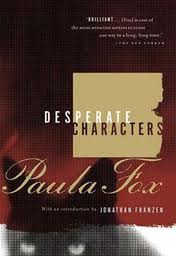
[READ: August 1, 2012] Desperate Characters

David Foster Wallace, Jonathan Franzen and Tom Bissell have all championed this book.  Bissell was instrumental in getting it republished once it went out of print.  Franzen wrote the introduction to the newly published version.  David Foster Wallace blurbed the book: “A towering landmark of postwar Realism….A sustained work of prose so lucid and fine it seems less written than carved.”  It was also on his syllabus.  Zadie Smith has also written favorably about Fox’s fiction.

So why did it take me so long to read this book?  (I read the original version, which is what the library had.  I’m curious about Franzen’s introduction and will get to it eventually).

S. knows Paula Fox as a children’s author, which surprised me even more when I read the grittiness of this book.

It is submerged in downtrodden New York City of the late 60s, where people throw garbage out their windows, where racial tensions run high and where everything feels dirty.  This powerful description late in the book sums up the attitude about the City:

They drove through miles of Queens, where factories, warehouses, and gas stations squeezed up against two-story, two-family houses so mean and shabby that, by contrast, the ranks of uniform and tidy tombstones rising from cemetery islets that thrust up among the dwellings seemed to offer a more humane future. Sidewalks, brutal slabs of cracked cement, ran for a block or two, then inexplicably petered out, and along the center of the tarmac streets, short lengths of old trolley tracks occasionally gleamed among the potholes. Here and there, the skeletons of a vast new apartment complex sat on the rent ground; tree roots and rocks and earth rolled up around its foundation. Cries of boredom and rage were scrawled across the walls of factories, and among these threats and imprecations, invitations and anatomy lessons, the face of an Alabama presidential candidate stared with sooty dead eyes from his campaign posters, claiming this territory as his own. His country, warned the poster – vote for him – pathology calling tenderly to pathology. [For those ignorant of history like me, that candidate was George Wallace.  This was his third time running, this time as part of the American Independent Party].

But that’s just the descriptions.  What is this story about?  Simply, it is about Otto and Sophie Bentwood, a successful childless couple living in Brooklyn.  Otto is a lawyer, and, Sophie is a successful translator (I liked that Sophie was employed and not “just” a housewife).  But Sophie hasn’t felt up to translating lately and Otto’s successful practice hits a bump when long time partner Charley decides to leave to work on more important causes.

Otto is rather cut off emotionally–Charley has been his friend and partner for decades yet he can barely muster a proper goodbye when he steps out the door.  And while Otto and Sophie are mostly happy, he has more or less pushed her into the arms of another man.  She looks back on this brief affair with fondness.  However, the fact that the affair is never suspected and the fact that it ended the way it did are just more indignities that Sophie has to suffer.

But what sets off the action in the story is an act of kindness.  Sophie sees a cat that is hanging around the alley behind their brownstone.  Amid the people throwing garbage out the window and hanging up sheets to act as curtains, Sophie decides to do a nice deed for this cat.  She brings it some milk. It hungrily laps up the milk and when Sophie goes to pet it, it bites her really hard on the hand.  And literally the rest of the story follows the swelling of her hand. (more…)

Read Full Post »

SOUNDTRACK: THE BEAUTIFUL SOUTH-“Dumb” (1988).

About five years ago I mentioned all of The Beautiful South records in one post.  But I didn’t really talk about them all that much.

This comes from one of my favorite Beautiful South records–I like all the songs equally, but I often have this song in my head.  And the reason I picked it right now is because Paul Heaton sings about a bunch of things each one ending with “either you are simply beautiful or I am simply dumb.”

And these are: “It doesn’t take a mathematician to add a simple sum”; “It doesn’t take a labrador to show a blind man sun”; and this one: “It doesn’t take Robert The Bruce to see the web you’ve spun.”

I had no idea who Robert the Bruce was and I never bothered to look it up.  And yet, as you will see below in the post, Robert the Bruce is mentioned in JR!  I was flabbergasted.  And this song immediately popped into my head.

And that’s not a bad thing.  It’s a pretty piano ballad with a seemingly negative chorus (dumb, dumb, dumb) despite its positive message.  There’s also a beautiful ending: “The sun, the sky, the moon, the stars/Jupiter, Neptune and Mars/All these things I clearly see/It don’t take a telescope for you to love me.”  The songs ends with Jacqui Abbot’s lovely echo of this stanza.

The Beautiful South were a great band, they broke up a few years ago.  Paul Heaton has a number of solo albums out but they’re not available in the states, so…

[READ: Week of August 6, 2012] JR Week 8

This week’s read finds us primarily in the apartment.  We see bast return home and fool around with Rhoda before he goes off on his trip to the funeral.  We see Gibbs come in and try (in vain) to get work done.  We actually get to see Gibbs’ magnum opus (or parts of it), and we see him fall off the high that he felt with Emily.

There’s a lot of funny stuff in this week’s read.  It seems like the darker the story gets, the more childish jokes Gaddis throws in there.  Seeing Gibbs unable to work on his manuscript because of all of the (real and fake) distractions is simultaneously hilarious and spot on.  And also, the plotlines are really revving up now.  JR Corp is starting to see some pushback on their deals, and a number of outsiders are starting to get angry.  There’s bound to be a collapse of some sort soon.  I’m also starting to think that with all of the ellipses in the book that it will end with a dot dot dot.

As we resume, Davidoff and Bast are still talking.  Davidoff tells Bast “Don’t worry about” something [Thanks to Simon for pointing out this expression–I recognized that Davidoff always says “brush fires,” but not the don’t worry about it].  He is concerned that Bast’s hearing aid isn’t turned up (ha), but that the Boss [JR] wants Bast’s signature on any expenditures over $2,000 (It was originally $200, but Davidoff said Bast would get writer’s cramp).  He explains the title change in the magazine from Her to She–passive to active readership–will cost $14,000.  There’s also $27,000 for a new logo.  And the logos are awesomely cheesy–hard to believe they paid $27,000 for them.  They revolve around the dollar sign, with the least offensive one making a J and R out of the top and bottom of the S–the others have a snake, or breasts or thumbing your nose or even someone behind bars.  They pick the least offensive one that says Just Rite in a dollar sign (“something patriotic about the dollar sign”).  They’re going to put them on half a million matchbooks. (more…)

Read Full Post »

SOUNDTRACK: GEORGES BIZET-Overture/Habanera (1874), Nocturne in D major (1867).

Bizet is best known (to me anyway) as the creator of Carmen.  And the Overture is utterly recognizable while “Habanera” is probably one of  the more recognizable vocal operas (you know it).  But Bast and co. seem to known Bizet from his piano work, which I didn’t know at all.

I chose “Nocturne in D major” at random.  It’s very pretty, but nowhere near as memorable as say “Habanera.”

I don’t play piano and I’m not a huge classical music fan (although I do know many composers).  Listening to this piece anyhow, I find it hard to understand how people could recognize Bizet in Bast’s work.  Obviously there are dozens of other pieces that may be more representative of a signature sound, but this just sounds like a beautiful (and not overly challenging like Chopin) piano piece to me.  It’s also true that this piano piece was written ten years before Carmen, and maybe they are thinking of the music of Carmen as recognizably Bizet (can you even play Carmen on the piano?).

I forgot how much I enjoy this opera though, (or at least the highlights).

[READ: Week of July 30, 2012] JR Week 7

I enjoyed this week’s read very much.  It had some real emotional scenes–and a scene that stayed with just the same two people for a long time.  It was also interesting to see Gaddis handle sex–in his own detached mechanical way.  And I liked starting to see the pieces (Davidoff, the Waldorf) start falling into place (as they may also be falling apart).

But before we get to that we must look at a doctored photo.  The photo from Mrs Joubert’s class’ interaction with the folks at Diamond Cable has come back and they have added black to the class.  Mr Hyde notices immediately  that his son (“tell by his haircut” (461)) has been darkened, “Blackface in every one of them.”  “Looks like he’s about ready to get down on one knee and sing Mammy” (461).  While Hyde is outraged, the rest of the room is complementing Whiteback and the company for promoting racial diversity.  It’s even suggested that this will help the Major’s image on the other side of town.   Of course underneath all of this is some festering racism: (more…)

Read Full Post »

SOUNDTRACK: MOGWAI-Burning DVD (2010).

What might one expect from a Mogwai DVD?  Well, what one gets is a high contrast black and white concert with excellent sound (I have since burned the audio on a CD).

The film zooms in on the players–the guitar necks, the cymbals–and occasional two or three person shots (but very rarely faces).

The faces come in the interstitials, where the filmmakers show the band walking around (getting on subways–walking in rain), and where they talk to fans.

The film is gorgeously shot, but I have to admit it’s not the kind of live show that I enjoy watching.  It’s a little dull–not in individual moments because just about every shot is gorgeous, but in five-minute blocks.  Don’t get me wrong, I love seeing how these guys make this wall of music.  I love watching Stuart’s hands on the neck of his guitar, but this is not a very mobile bunch.  Indeed, many of the people in the audience seem to just be closing their eyes and absorbing the music rather than watching them.  And I found myself doing the same thing (in which case, I would just get an audio concert, right?).  This is compounded by the fact that the camera is in so tight, any big movements are missed.

This is not to say that there aren’t moments of brilliance to see.  Watching the band wait and wait and wait as the chords from “Fear Satan” fade out before they blast into the finale is pretty darn awesome.  And there are moments like that–crisp clarity where everything comes together.

Some kind souls have put the entire show on YouTube.  Here’s part 3 (with “Fear Satan”)

And the fan who speaks over the closing credits is trippy but cool.

[READ: July 31, 2012] “The Places You Find Yourself”

I found this story because a reader left a comment that Junot Díaz’ story ”The Cheater’s Guide to Love” was just like this one.

I have to disagree almost entirely with that sentiment because Díaz’ story talks about what it is like after someone has broken up with you and this story is about being stuck in a relationship that you feel compelled to get out of.

Edwards’ story (which won the 2009 Open City Rrofihe Trophy) is about settling.  And it’s a very realistic portrayal of the frustrations of life: relationships, job, commute–it’s a rather cathartic story.  It is especially cathartic because there is no main character, only “you.”  And Edwards keeps this second person narrator throughout the story.

The story is set up as a series of monogamous relationships: “Then one morning you’ll wake up and there will be another one lying next to you, maybe this one a brunette…” (more…)

Read Full Post »

SOUNDTRACK: TALKING HEADS-“Life During Wartime” (1979).

I ain’t got time for that now.

Talking heads were many things, a weird band, a noisy band, a new wave band with poppy hits, and underneath it all, a punk band that rocked.  If you know Talking Heads from their great later songs, it might be hard to imagine how raw this song is. Byrnes’ voice is intense, the melody is staggered and frantic and the whole enterprise just feels like it could fall apart at any moment.

It’s a great rocking song, and if you haven’t heard it for a while it’s worth checking out again.

Heard about Pittsburgh, PA?

[READ: Week of July 23, 2012] JR Week 6

This week’s read was the first time so far that I found a section tedious.  True, it could have been the time of night that I read it, but the whole section with Gibbs and Tom (which I call the “God damn” section) while providing some recap–and some very useful stuff at one point), was also rather redundant, both internally and in the story as a whole.  It was also quite a downer.  (Infinite Zombies has a post about this book being a comedy or a drama, so I won’t get into that here–I will get into it there though).  Although as with most Gaddis, it was a very accurate portrait of two men wallowing (and would probably be funny to hear out loud), I was happy when Tom finally left the scene.

When we left off last week, Gibbs was coming into Bast’s room holding a bottle.  Bast was just finishing up his videophone conversation with JR (Bast says he was just talking to himself).  Gibbs says he is meeting a man named Beamish here in a little bit. But he interrupts himself “Listen!”  Bast explains that the tub is running non-stop as well.  And Gibbs launches into a poem:

Through caverns measureless to, where the hell…   Bosom where the bright waters meet, like living in Pittsburgh Bast  –confluence of the Mongahela [sic–should be Monongahela] and the vale in whose bosom the bright waters meet to form the mighty Ohio (383).

I’m not entire surely where all of this comes from although As the vale in whose bosom the bright waters meet comes from a Thomas Moore song. (more…)

Read Full Post »

SOUNDTRACK: ST. VINCENT-Actor (2009).

I had seen St Vincent on Austin City Limits, and her juxtaposition of waif-singer with noise mongering guitar player blew me away.  So I was a little disappointed when this album opened up with this gentle, practically 1950s sounding vocal and string line in “The Strangers.”  It takes two and a half minutes, but the noise eventually comes and it totally changes the texture of the song.  Of course now, “make the black hole blacker” is a fun thing to sing along with (and the lyrics in general are pretty great).  “Save Me from What I Want” is another quiet song with a catchy chorus.  “The Neighbors” has a great melody with interesting strings over the top of it.  “Actor Out of Work” brings in some stranger sounds to the album.

There’s something interesting about the songs on this album, like the way “Black Rainbow” has these sweet string sections but for the end half builds a crescendo of tension. I also love that a seemingly delicate song can be called “Laughing with a Mouth of Blood.”  Perhaps the strangest song on the disc is “Marrow” which has a strange horn section and the chorus: “H.  E.  L.  P.  Help Me Help Me.”  “The Bed,” “The Party” and “Just the Same But Brand New” continue in this vein–like a Disney princess song with a horrible threat underneath: “Don’t Mooooove, Don’t Screeeam.”  But that sense of princess who are slightly askew really resonates on this record.  It’s not as willfully dissonant as her first record, but lyrically it’s a knife covered in cotton candy, it’s still a gem.

[READ: March 20, 2012] McSweeney’s #39

One of the bad things about having a job with actual work is not being able to write complex posts about compilation books.  It’s hard to have your book open while bosses walk by.  So, its been a while since I read this and I’ll do my best to remember it all.  Incidentally, if you’re keeping track I skipped 38, but I’ll get to it.

Issue #39 is a hardcover and a pretty one at that. It has a front cover photo (as well as many interior photos) taken by Tabitha Soren.  Yes, forty-somethings, THAT Tabitha Soren, from MTV who has a new career as a photographer.

This issue continues with the recent return of the Letters column (as the magazine and front matter become more serious the return of the Letters adds an air of silliness). (more…)

Read Full Post »

SOUNDTRACK: WEEN-Push th’ Little Daisies (1992).

So Ween broke up back in May (this is the year of seemingly one-hit-wonder bands breaking up after decades of playing).  I have a bunch of Ween’s earlier stuff, but stopped listening after their hits.  I’m told some of their later records are quite good.  This song from the album Pure Guava was my introduction to them, and it is weird and kind of irritating and strangely catchy and perfectly encapsulates Ween.

The melody is simple and poppy, but the vocals are, if not sped up, then crazily falsettoed.  And the repeated refrain of “push the little daisies and make em come up” is, if not annoying, certainly infectious (in many senses of the word).

The other fun thing about Ween is that in addition to pretty much none of their albums sounding alike, pretty much none of their songs sound alike.  So you can’t tell if you’ll like any other Ween songs based on this one.  A nice trick, that.

And if, like me, you haven’t see the video in twenty years, check it out

And there is a tangential tie in to JR with this post, by the way.

[READ: Week of July 16, 2012] JR Week 5

I realized that, unlike in previously long weekly posts, I haven’t been including tangentially related photos (I rather liked putting them in the Gravity’s Rainbow posts).  I blame it all on my time constraints.  There also aren’t quite as many picture-worthy things in this book.  GR had lots of locations and historical photo-op type things.  JR is more about money and sex, and the internet doesn’t have many pictures of either, right.   So instead, it’s all block text.

When we left off, JR was trying to persuade Bast to help him out some more.  And, holy, he needs Bast to meet Mister Piscator out by the Egyptian stuff in the museum (JR can’t do it himself obviously–I love that he is using a handkerchief on the phone and everyone asks if there’s connection troubles).  Bast barely says anything but JR is on a roll: he got him the briefcase and that alarm clock (which runs backwards) and the business cards (which Simon pointed out I’ve been missing the typo on) and “I’ll call up that Virginia and fix it up where you get her to take telephone calls at the cafet…” (302).  JR is also going on about the kind of massive tax breaks he (and Bast) will be able to declare.  I can’t decide if he’s right or not (or if it simply won’t be relevant for what he has–indeed, a lot of this financial stuff, it seems like JR is more knowledgeable than anyone else because he has actually read the material–something nobody does.  And Bast is a musician, what does he know about money, right?).  Although his ultimate plan (potentially ingenious, but practically preposterous) is that they buy one share of all the big stocks, get their prospectuses and read them all.  And if anyone is doing anything illegal they can file a class action suit like they did with Diamond Cable. (more…)

Read Full Post »

SOUNDTRACK: REGINA SPEKTOR-Soviet Kitsch (2004).

After the poppy, polished joy of Far, I went back and decided to check out the one other Regina Spektor album I knew of–Soviet Kitsch.  This album has always stuck with me as an interesting title.  I ordered it from Amazon and was bummed to get a little cardboard sleeve rather than an entire disc (her artwork is really nice).  So I was a little biased against this disc from the start.  The music also doesn’t have any of the polish and sleekness of Far.  So it took a while for me to see the beauty within.

This album is largely simple piano (with strings and other addition), but it’s a much more raw album (akin to something like Tori Amos’ Little Earthquakes).

“Ode to Divorce” is a quiet piano song with some catchy moments.  “Poor Little Rich Boy” has some interesting percussion to accompany the piano.  And in this song you know that she’s in a slightly different territory than Tori Amos, which is good–the feeling is similar but the end result is unique.  Lyrically the album explores different ideas and on this song the repeated refrain of “you’re so young you’re so god damn young” is a little unsettling.  “Carbon Monoxide” introduces a more full sound (bass and drums).  And Regina shows off yet another side of her personality–playful, flirtatious and now almost childish (“C’mon, daddy.”)

“The Flowers” introduces another new aspect to the disc–more aggressive/borderline classical piano playing (rapid, loud notes).  It suits her style quite well and this song is  a definite highlight.  The end of the song has a very Russian-style nonsense syllable sing along which is very fun.   “Us” adds strings to the song and some great sing along parts.  “Sailor Song” is a funny song from a sailors perspective with the sing-along shanty chorus “Mary Anne’s a bitch” (complete with broken glass sounds).

The next song “****” is a whispered little conversation in which a young girl asks Regina when the next song is coming.  It makes the next song, “Your Honor” even more loud.  It really stands out on this disc because it is a full on punk song with screamed vocals and band work from Kill Kenada (who I don’t know anything about).  The song is about getting in a fight to defend a woman’s honor.  The slow piano middle section features the amusing question “gargle with peroxide a steak for your eye but I’m a vegetarian so it’s a frozen pizza pie…you fight for my honor but I just don’t know why.:”

“Ghost of Corporate Future” has a kind of lullaby feel and some amusing lyrics, ” When he gets to the crowded subway platform/He takes off both of his shoes/He steps right into somebody’s fat loogie/And everyone who sees him says “ew”/Everyone who sees him says “ew”/But he doesn’t care/Cause last night he got a visit/From the ghost of corporate future/The ghost said take off both your shoes/Whatever chances you get/Especially when they’re wet.”  It’s all sung in a manic style over a quiet piano melody.

“Chemo Limo” is certainly the highlight of the disc.  It’s 6 minutes long and is quite dramatic.  The basic premise is that dying from cancer sucks, so she’s going to live instead: “I couldn’t afford chemo like I couldn’t afford a limo/And on any given day I’d rather ride a limousine.”  There are several sections in the song–allowing Regina to show off her dynamic and dramatic vocal range (serious falsettos) and very impassioned sections, “Oh my God Barbara she looks just like my mom”  She even does some (very mild) beatboxing at the end of the song.  “Somedays” is a pretty, simple ballad, with some great vocals although it kind of gets lost at the end of the disc.  Although I was not that into this record when I first got it, repeated listens revealed wonderful surprises inside.

[READ: July 15, 2012] Canary in a Cat House

This is Kurt Vonnegut’s first collection of short stories.  It is currently out of print.  That’s not a big deal because almost all of the stories were later collected in Welcome to the Monkeyhouse.  But I thought it would be fun to read them in the original book.  When it came in from the library I was surprised at how tiny it was.  But what was really surprising was how small the print and how small the margins were.  They really crammed stories into collections back then!

These stories were all written in the 1950s and what was also surprising to me was how serious and unfunny some of those first stories were.  I realize that these were some of his first works, but the Vonnegut voice is so distinctive–a misanthropy tempered by jokes and absurdity, that I was surprised that some of these stories were not only serious but seriously emotional as well.  It’s been clear from all of his stories that WWII impacted his life tremendously (as one would expect), but in these early stories he talks very deliberately about violence and the cold war and the aftermath of WWII.  It’s pretty intense.  By the end of the book the more typical Vonnegut voice surfaces–sci-fi kinds of stories with dark humor involved.  It’s quite a collection. (more…)

Read Full Post »

« Newer Posts - Older Posts »