Feeds:
Posts
Comments

Archive for the ‘Marriage Trouble’ Category

redSOUNDTRACK: LE FLY PAN AM-fpamCeux qui inventent n’ont jamais vécu (?) [CST019] (2002).

After their previous EP, Le Fly Pan am (note the addition of the Le) come back with an album that can be described as funky.  True, it’s weird funky that gets dismantled while its going along, but it’s still pretty funky.

They wouldn’t be them if there weren’t some crazy noises.  And so the first song (parenthetical translations are from Wikipedia), “Jeunesse sonique, tu dors (en cage)” (“Sonic Youth, You Sleep (In a Cage)”) is just noise and static for 90 seconds before leading to the first song proper:

“Rompre l’indifférence de l’inexitable avant que l’on vienne rompre le sommeil de l’inanimé” (“Break the Indifference of the Inevitable Before We Come to Break the Sleep of the Inanimate”) which kicks in with a really funky bass guitar and drum section. It’s really catchy and almost danceable. But throughout the song’s ten minutes there are elements of destruction going on. There’s screeches that sound like a dentist’s drill. About a minute in, the guitars just seems to stop playing riffs and just tart going crazy–playing loosened strings and just random notes like a beginner (even though the original rhythm is still there).  That funkiness stays for about 5 minutes until the songs shifts gear into a loping melody with a big bass and simple repetitive guitar lines. And then it kind of falls apart all together with some sounds like broken strings and lots of chatter (in French).  At 7 and a half minute it resumes at breakneck speed with the drums and bass pounding away and all kinds of effects splashing on top. The song ends with low rumbling noise before jumping into….

“Partially sabotaged distraction partiellement sabotée” (“Partially Sabotaged Distraction Partially Sabotaged”) This song opens with a four-note, slightly off-key guitar and then loping bass riff that reminds me of SST Records bass guitar of the 80s. It switches between this and a slightly funkier sounding section. But the destruction is apparent from the get go as early in the song, the sound just completely drops out on a couple occasions, making you think the disc is broken (it isn’t).  The song starts to get more intense as the notes seem to get faster and more insistent (those repetitive notes and ringing guitars just seem to scream tension).

“Univoque/Équivoque” (“Univocal / Equivocal”) opens with static and then a very funky bass line.  There a music box playing over the top and some quiet guitars. About half way through the bass ends but the music box (tiny and distorted) continues.  At 3:30 a new bass line, similar to the previous but with a new section added pops up.  It’s a simple song showcasing their groove and their noise.

“Arcades-Pamelor” starts with low distorted noises.  Like the first “song” this is mostly sound effects and things slowed down. Until a screaming noisy static takes over about half way through.  It’s really quite unpleasant.

“Sound-support surface noises reaching out to you” opens with another funky bass and drums and some simple guitar notes. About a minute in a sound emerges that sounds like a skipping CD (but it’s not your CD).   And then a new, different bass pattern emerges with lots of noisy percussion(sounds like people banging things). The skipping sounds seems to work as a segue between section, with some great funky parts and and then the final section which opens with what sounds like a mildly out of tune guitar ran and more great bass. This really enjoyable section winds up glitching to a halt with the  sound of a skipping record player.

“Erreur, errance: interdits de par leurs nouvelles possibilités” (“Wandering Error: Prohibited by Their Opportunities”) has the sounds of sticks clacking together and silverware dropping and mechanical sounds.  And they all seem to somehow settle into a rhythm of piano notes. Unlike the other tracks this one is pretty consistent—strange noises and a simple piano motif.  It’s also probably the least interesting of the bunch.

The disc ends with “La vie se doit d’être vécue ou commençons a vivre” (“Life Must Be Lived or Begun to Be Lived”) another great, funky bass and piano line, with some interesting guitar sounds round the corners. This song is so catchy, it’s wonderful.  After about 2 minutes there’s another breakdown. The music all stops except for the guitars which sound like they are getting strangled.   The second half of the song has the same funky bass but very different guitars and lots of squeals and feedback. After a couple more glitches at 6 minutes in, the bass takes off playing fast rocking riff as the guitar tries to keep up. It’s such a satisfying ending that it’s hugely disappointing that it only last 45 seconds before the album ends.

While it was always obvious that Fly Pan Am were going to play weird experimental stuff, it wasn’t clear before just how funky and dancey they could be too.  If you can handle some noise in your dance, this is a great album.

[READ:January 10, 2016] Red Handed

I absolutely loved this graphic novel.

I had never heard of Kindt before and I didn’t really know what to expect from the book, but I certainly didn’t expect the complicated and super clever plot and structure that this book had.

It opens with a newspaper story that tells us about Detective Gould’s ten years on the force.  Since his arrival there have been no unsolved murders.  He credits the rise in technology for his success.  (continued on A12) and then it moves into the graphic format.  It is headed Detective Gould (in black and white).  Then it shows some mug shots of suspects in color.  And it turns out that these people’s stories will comprise the bulk of the book.

The next chapter opens with a woman fleeing a diner with a stool.  She worked there and is told the stool is coming out of her paycheck,.   We learn that stealing chairs is kind of her thing.  And then we see what her next acquisition after this stool is.

The next chapter is called the Jigsaw and it involves a man who is an art dealer.  As the story opens he steals a giant painting form a woman he has picked up at a bar. And then we learn what he did with it and how he made his reputation.

After he is caught, the story shifts to a series of dialogue boxes on a black background in which Sgt Gould is speaking to a woman who Sgt Gould assumes is connected to all of the cases in the book.  She is playing innocent and has explanations for everything.

After this there is another black and white section designed to look like newspaper stories of The Detective’s Wife  (in which the two are sweet together) and then Tess’s True Heart in which we learn that Tess (whoever that is) is a very smart girl.

The next chapter is The Ant in which an artist wants to tell a story told from the point of view of an ant.  But since the ant cannot write, it must collect letters from the newspaper.  This turns into an art installation in which the author’s editor begins finding the words all over town and using them to tell the story (it’s much more convoluted than that and really clever).  Then we learn that Tess is the author’s editor–the first connection is built.

And after that short piece, we see more black and white stories from Detective Gould and Tess’ True Heart.

The next chapter is The Forgotten about a sleight of hand magician who has stopped doing magic and has become a pickpocket.

The Repair Man is about an elevator repair man who takes pictures up women’s skirts when they are stuck between floors.  And then he begins selling them to a smut dealer.  The way these pictures connect to the rest of the story is amazing.

The next section is The Performance Artist in which a woman is set up to look like she is cheating on her husband (elaborate ruse once again).

The Escape Artist tells the story of a car thief and how so many thieves think they are going to stop but they are afraid of losing the rush.  Well, this guy retired for real.  Until he ran into Tess.  He knows from long ago.  And she brings him back to the city.

Finally, The Fire Starter is about a guy who gets paid to start fights with the intention of a payout coming somewhere down the line.

The last fifty or so pages show how all these crimes, all these cases solved by Detective Gould, are tied together.  And the way it is told just gets more and more interesting.

This was an outstanding book.  I loved the art and design–the various ways that the medium was used to tell the story.  I loved that it was confusing but not too confusing and that it unraveled in the way it did.   I really can’t say enough about this book.  This was another big win for First Second in their #10yearsof01 celebration.

Read Full Post »

americusSOUNDTRACK: FLY PAN AM-Sédatif en fréquences et sillons EP [CST011] (2000).

330px-SedatifsEnFrequencesCover This is an EP that works as a kind of remixes and deconstructs further the debut. There are three songs, the first is fourteen minutes, the second is 11 and the final is 4.  As the Constellation site describes the disc:

This 3-song EP of fractured, tape-infested experiments is an intransigent slab of self-referential auto-criticism. The band was sticking to its agenda of acutely self-conscious musical manipulations, re-working its own materials and assumptions to yield new compositions of uncompromising formalism. Side A is a medley of sorts, consisting of phrases and fragments reconfigured and replayed from their self-titled debut (Fly Pan Am). Various melodies are reassembled and played off of one another, creating an extended live remix with blissful passages of layered guitars, drones, sampled backing vocal lines, and the requisite incidental noise break in the middle of the piece. The result is something like a ‘Stars On 45’-style musical encapsulation of the entire debut record.

“De cercle en cercle, ressasser et se perdre dans l’illusion née de la production de distractions et multiplier la statique environnante!” (“From Circle to Circle, Rehash and Get Lost in the Illusion Born of Production and Increase the Static Distractions Surrounding!”) opens with the sounds of machinery rumbling and then slowing to a stop. The song proper opens with a rapid bass line and squalls of feedback.   Some beautiful guitars play over the noise. More guitars come in along with all kinds of crazy noises—scrapes and scratches, radios and distortion.

The propulsive music stops around 3 and half minutes in and the noise takes over. There’s loud noises and static and all kinds of things. Then the noise shifts to what sounds like someone emptying a bag of ball bearings onto a metal table.  And then maybe making microwave popcorn.  About five minutes later (seriously) a drum starts playing in the background and then a guitar line that references the debut album starts up.  It sounds a bit like the two note guitar from “Dans ses cheveux soixante circuits” with the voices from “Nice est en feu!” thrown on top.  And then at 11:20 that two note half-tone thing from “Dans ses cheveux soixante circuits” resumes, but it’s only for 20 or so seconds before different sounds come to take away the repetitiveness (although the guitars do continue that until the end of the song).  It seems like the band wanted to revisit their debut but also wanted to make sure that it was properly buried under chaos as well.

The second song “Éfférant/Afférant” (“Unrelated / Related”) (11 minutes long) is described as “somnambulist clockwork repetition.” The bass and drums are kinda funky with some simple guitar chords playing in the background. While things do change somewhat throughout song (including notes that seem inappropriate at times), the main source of change is the weird electronic sounds that play over the top. The noise starts to grow louder and louder around 9 minutes and just when it gets unbearable it fades out to the end of the song.

“Micro Sillons” (“LPs”) is only 4 minutes long and it opens with static and noises—different ones in each ear.  After about three minutes of that, the noise mutates into a kind of machine-like hum.

This is definitely a challenging listen.  There are rewards to be had, and it s amazing what good songwriters these guys are, if they’d ever let their songs stay unmolested.

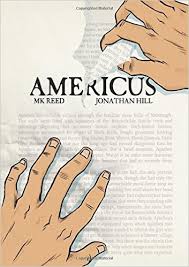
[READ: December 17, 2015] Americus

I didn’t really have any idea what this book was about–the title Americus evokes many different things.

So imagine my surprise to find out that this First Second graphic novel [go First Second!, #10yearof01] tackles the idea of banning books in schools.  It looks at religion, freedom of speech and middle school.

The story is about Neil Barton, an unpopular kid who loves fantasy and books, especially the Apathea Ravenchilde series (such a great name). Neil and his friend Danny race to library after school because the latest volume is out.  Neil is bummed that his library could only afford one copy of the book (budget cuts!) and Danny gets it first.  And as he starts reading, the artistic style switches to the Ravenchilde world (I loved that).

Then we meet Neil’s and Danny’s families.  Neil’s parents are divorced.  He lives with his mom who is harried and exhausted.  Danny’s family is an intact nuclear family, with two younger siblings.  And we learn soon enough that his mother (and father to a degree) are very Christian. (more…)

Read Full Post »

1.14.2008 SOUNDTRACK: IRON & WINE-Tiny Desk Concert #105 (January 21, 2011).

irionwineI have enjoyed Iron & Wine, but not extensively.  I knew that it was more or less a Sam Beam project (until recently, as the band has since grown in size).  And I knew that he sang beautiful folk songs. I did not know that he was such an amiable and sweet fellow.

For this Tiny Desk, Beam plays four songs.  Three are from his then new album, Kiss Each Other Clean, and they are great.  Beam’s voice sounds fantastic and his playing is excellent too.

After the first song, “Half Moon,” Bob Boilen asks him when he has time to write songs and Beam replies that he has less and less time.  He has to get up early to take the kids to school, so he works like a day job for song writing.

For the second song, “Big Burned Hand” he begins with the capo on fret five and then switches it to fret four apologizing that it’s early.  It’s another beautiful song.  At the end he apologizes for the word “fucking” in the final line (“the lion and the lamb are fucking in the back row”) but says that no other word would have had the same impact.  He doesn’t use words like that lightly in his songs.

He says that “Tree By The River” is a song he had been writing for ten years.  He was afraid it was always turning out saccharine, but thinks he finally got it.

Before playing the final song, Robin Hilton requests an old song (I can’t hear it) which Beam says he will butcher.  Robin says he will die happy if Beam plays it, but Beam says he’ll die unhappy if he plays it badly.  So instead, the final song is an older one, “Naked As We Came,” which has become a set-ender for the band.   Stephen Thompson says it’s great to hear this in this stripped down acoustic format instead of the full band version that has been common now.

And speaking of the full band, when Kiss Each Other Clean came out, the full band of Iron & Wine performed it live on WNYC (you can hear all four of these songs with the full band). And NPR has archived that performance, which you can download here.

[READ: January 7, 2015] “Wakefield”

I have always intended to read more from Doctorow, but he always seems to fall off my radar.  So I don’t know how this compares to his other works.  I really enjoyed it even if I felt like I had to suspend my disbelief a number of times in what was otherwise a somewhat realistic story.

Realistic or not, I really loved the conceit behind it.  The narrator and his wife of many years have had a fight about something stupid.  He went off to work as usual, but on the way home strange things happened.  First there is a problem with is train and he winds up arriving home much later than usual.  And then he finds there’s a power failure (it was interesting to read this right after Updike’s power failure story last week).

He gets out of his car and sees that there are raccoons behind the garage so he chases them away.  When he goes upstairs in the garage he sees that there are baby raccoons there too.  He chases them away and, since the power is still out and he is mentally taxed, he sits in a tattered rocking chair.

He only wakes up the next morning.  And he knows that his wife will never believe the truth. (more…)

Read Full Post »

17208SOUNDTRACK: RAPSODY-Tiny Desk Concert #498 (January 5, 2016).

rapsAs part of my New Year’s resolution, I’m going to try to keep up with the Tiny Desk shows as they happen.

This is the first Tiny Desk Concert of 2016, and I’m afraid it was pretty disappointing.

Rapsody is a rapper, but I feel like she doesn’t have a lot of flow.  Or if she does, it’s kind of slow and meandering.  There was nothing really captivating about her style.  And her rhymes weren’t all that exciting either.

“Godzilla” is a very pro-God song (the twist on God and Zilla is interesting), but the song isn’t that inspired.  She spends most of the song asking people to clap (the room is full of students from Howard University).  Her rhymes are just not that interesting in this song.

Her second song (with a horrific cheesy sax solo throughout) has a great premise–a song about the boys who have grown up too fast because they lack strong black fathers.  The problem with it is that a song like this, which could be powerful as a message, has a chorus of “I been the motherfuckin ….”  Which ain’t going garner much airplay.

“Hard to Choose” is about being a black female in hip hop.  She wanted to be a good role model for young girls.  Once again, her flow isn’t that exciting and her rhymes don’t really  do much for me.  Of course, she disses hipsters who don’t understand, and I guess that’s me.

Rapsody has some great messages.  I wish her a lot of success and I hope that her positive messages are heard by millions.  I just wont be listening.

[READ: January 5, 2015] “Outage”

As part of my new year’s resolution, I’m going to read all of the old New Yorker stories from 2008-2015 to fill in any gaps (I’ve missed about 50 stories in seven years).  In a few months I should have all of the stories from 2008-2016 (or close to the current story as possible) read and posted.  How exciting!

This was something of a perfect short story and a great way to start the back issues.

I don’t read a lot of Updike, for no particular reason.  So I don’t really know if this is the kind of thing he typically writes.   But the way it was constructed and the details he put in made this story seem so effortless and very true.

Set in the suburbs of Boston, Brad Morris is working from home when a storm comes through the area.  The weatherpersons had made a huge deal out of it since they are “always eager for ratings-boosting disasters.”  But the actual weather seemed to be on and off heavy rain.

And then just as the storm seemed to be over, the power went our.  The description, “the house seemed to sigh, as all its lights and little engines, its computerized timers and indicators, simultaneously shut down.”  That is exactly right. (more…)

Read Full Post »

dq25SOUNDTRACK: ARCHER PREWITT-“O, KY” (2005).

wikldernessArcher Prewitt formed The Coctails (a kitschy lounge act) in the early 90s, several years before the lounge revival.  Then he joined The Sea and Cake and has been making amazing music with them.  And he has also released several solo albums.

He has also published some comics (Sof’ Boy) with Drawn & Quarterly.

This song comes from his album Wilderness.  The title of the song is clever, too.

It’s upbeat and folky with a little psychedlia and rock thrown in.  I like Prewitt’s voice quite a bit–it’s simple but really strong.  But the selling point on this song (and others from this album that I have listened to) is the composition and arrangement of these songs.

I like the way this one goes from simple guitar to orchestration (although presumably not a real orchestra) for the chorus.  And how post chorus there are flutes and other instruments to pick up the momentum which adds a vaguely psychedelic feel to it.

At four minutes (the song is five) it changes direction entirely and turns into a nearly new song with big guitars and drums. And it rather rocks.

And just to make Archer the all around dude that he is.  He also drew the cover art.  Jeez.  He’s probably super nice and friendly, too.

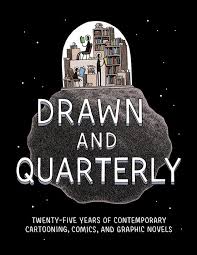
[READ: January 3, 2016] Drawn and Quarterly: Twenty Five Years 

I have liked a lot of D+Q books for a long time, although I never really considered a comprehensive look at their publishing house.  This book–about 775 pages long–is about as comprehensive as it gets.

This book contains a few previously published cartoons and excerpts as well as a whole slew of previously unpublished pieces.  There are essays and histories and reminiscences and love love love for the little Montreal graphic novel publisher.

I didn’t know much about the history of D+Q–that Chris Oliveros started the publisher in 1989 out of his house.  That he was the only employee for years.  And that he was essential in getting the term “graphic novel” used by everyone–including the library of congress!

He weathered distribution problems, he weathered the rise and fall of indie comics in the late 90s and he has come through with some of the most beautiful books published.  D+Q has also brought attention to foreign artists as well as out of print artists.

Really, if you have any respect for graphic novels (that aren’t superhero-based) you owe thanks to D+Q. (more…)

Read Full Post »

rhineSOUNDTRACK: HMSTR-Tiny Desk Concert #413 (December 24, 2014).

hmstrThe only thing I could think of to pair with a complete telling of Wagner’s Ring Cycle (aside from the entire thing itself, which… forget about it), was the smallest, most inconsequential music I could find.

Enter HMSTR.

HMSTR played the Tiny Desk Christmas show in 2014.  And really, they must be seen to be believed.  Not because they are spectacular, but because the joke isn’t really very funny if you just listen to the music.

Starting with some bizarre synth sounds, after 20 seconds the songs bursts into a lo-fi punk anthem.  It’s all buzzing guitars and a simple synth over some majorly lo fi drums.  There’s even a somewhat catchy “chorus” section.  After a minute, the guitars fade and sleigh bells signal the end of the song.

So whats the joke?  See for yourself

All in a tiny Tiny Desk setting.

[READ: May 20, 2015] Richard Wagner’s The Ring of the Nibelung

Yes, this is a massive graphic novel depicting Wagner’s “Music Dramas.”  The text was translated by Patrick Mason and then Russell adapted the whole thing to fit his story.

Everyone loves “Flight of the Valkyries,” but hardly anyone has listened to the entire Ring (it’s 4 operas and 15 hours long).  Except for the Bugs Bunny version, of course.  I have been interested in the Ring for a long time, but I wasn’t willing to devote that much time to it either.  So this book is perfect. (more…)

Read Full Post »

bpSOUNDTRACK: GRIMES-“Kill v. Maim” (2015).

grimesI don’t know Grimes very well at all.  When I first heard this song I didn’t really know what to think, but after repeated listens, I think it’s great.

It opens with a synth riff (and air horns) and one of Grimes’s many voices (this one is kind of childlike).  But by the end of the second line, she screams “they don’t know me” and that seems to set up the various personas in this song.

It’s the pre-chorus that I find so catchy–sung like the cheerleader chant “B-E-H-A-V-E aggressive.  B-E-H-A-V-E nevermore.”  And then the super fast chorus (with her voice lifted to an incredibly high pitch).

There’s a slower section with what I assume is her natural voice (which is quite lovely).  But it’s soon back to the fun chorus.  I need to hear more from her, but if this is her only good song, that’s okay.  It’s angry and you can dance to it.  Welcome to 2016!

[READ: December 20, 2015] Bitch Planet

This series is a great manifesto for the new year–don’t take shit from anybody.

Kelly Sue DeConnick is a force to be reckoned with.  In addition to presenting Captain Marvel as a woman (in the amazing series of that name) and making some other cool looking series that I intend to read, she has created this feminist masterpiece.  Bitch Planet addresses violence and injustice against women and the whole “prison culture” that is always titillating for men.  It pushes Orange is the New Black to even further extreme that a comic book can.

Designed in a retro style by Valentine De Landro, the book comes complete with ads for “crap” in the back of each issue.   Which you may actually be able to buy. (more…)

Read Full Post »

ktelkSOUNDTRACK: NICK BUZZ-Lula Lounge, Toronto ,ON (Mar 23 2011).

NickBuzz-23Mar2011-1There is only one Nick Buzz concert at Rheostaticslive (although there are a number of videos online from an earlier show (from Dec 9, 2010) which could be turned into an audio download, I’m sure.

Anyhow, this show occurred nearly two years before the release of the (thus far) final Nick Buzz album.  It’s interesting that there are some songs that will appear on that album performed here (and there is no mention of it, of course).

As with many of the Tielli solo shows, the band plays songs from Nick Buzz, from Tielli’s solo albums, and even two Rheostatics albums.  But this is primarily a Nick Buzz performance (with Tielli, Goldsmith, Marsh and Piltch).  What I find interesting is that I believe that Martin is only singing (maybe a guitar here or there?) with Pitch on guitar, Goldsmith on piano and Marsh on violin and effects.  It’s a very different dynamic (no drummer!) and really changes the nature of some of these songs.

“Just Because” is a beautiful ballad.  It’s sightly more raucous than on the record, but still sounds beautiful.  Tielli’s solo song “I’ll Never Tear You Apart” sounds very different from the record–the awesome guitar line has been simplified and there’s a piano now.  In fact, piano is the main instrument for most of these songs, which is quite different.

The band then plays three of the four songs from the Arnold Schoenberg record (Martin says he should put on gloves as this is forensic music that’s over 100 years old).  They also sound great–I love they way they can recreate the weirdness from that short album.

When he introduces “Eliza” he says the music is by Schubert, although I don’t believe that is the case (unless the intro is).

In explaining “Milchig” he says that it’s about a dwarf-like creature who taught him “the relax.”  “The relax” is how they describe it in Italy (he wishes he had learned more Italian as a kid but he was too obstinate).

“Spilling the Wonderful” is not as dramatic as on the record–it’s a bit smoother but still really good.  And for “That’s What You Get for Having Fun,” a song which he has played in almost every solo concert, they really pare it down–it’s nowhere near as raucous.

The band goes for a cigarette break for 15 minutes and then comes back with “Beauty On” and the funny moment where Martin sings the intro, “I hate you all.”  When he gets to the “Are you with me Cincinnati are you ready to rock?” rather than singing it, he slurs it.  It’s a great effect.

The only song not on another album is “Now That I’m a Railroad Boy” which was done by John Southwith.  It’s a pretty ballad that fits in perfectly with the other songs.  “The House with Laughing Windows” and “Uncle Bumbo’s Christmas’ sound fanatic live.  And then they play the fourth Schoenberg song “Galathea” which Martin says is his favorite.

“Farmer in the city” has been my least favorite Tielli recording, but this version is fantastic.  It starts on piano and has melodies provided by the violin. Rather than being elliptical and standoffish, this new arrangement really brings you in with some lovely Marsh melodies.  Then the play “Love Streams.”  Martin says that their take on the record was the first time they played it.  It’s gorgeous!  This version is quite different with more violin up front.

“Sane, So Sane” adds a drum machine which is a surprise but a very welcomed one. It really picks up the tempo of the show and creates wonderful new textures.

For their last song Martin says “we’re going to confound you with this one.”  It’s a Jacques Brel song, “If You Go Away.”  It’s not unlike on the future record–slow and pretty.

When they come back out for the encore, Martin says they have played their entire repertoire.  He seems at a loss for what to play so they play a lovely version of “Take Me in Your Hand,” and a shockingly different version of “Shaved Head.”

Check it out here.

The setlist for that 2010 YouTube show is quite similar: Spilling the Wonderful, That’s What You Get For Having Fun, Just Because, Gigerlette, Persian Kitty, Boom, Hymn to the Situation, Milchig, Eliza, L’astronaut [a hilarious explanation of what the song is about], The House with the Laughing Windows, Sane So Sane, Love Streams, Uncle Bumbo [Martin on bass], If You Go Away

[READ: July 12, 2015] Mr Kiss and Tell

I loved Veronica Mars.  The show was great.  We supported the Kickstarter.  And I was pretty psyched when the first post TV show novel came out.  But I never actually read it.  It is still sitting on my shelf (Sarah really liked it).

Well, Sarah got this one from the library and since it was due back soon I decided to push it to the front.  The good news vis a vis the previous book is that they are unrelated.  The better news is that this book follows up the events of the movie!  And it has a new mystery as well.

The new mystery involves a man who has raped a woman and left her for dead. As with any good mystery there are dozens of twists and turns.  And Veronica is not willing to let go.  Unlike the TV show, this mystery lasts for months.  She is fairly certain she has a suspect and even manages to get some DNA but his “confession” reveals a whole new twist to the story that Veronica was not expecting and which really undermines her case. (more…)

Read Full Post »

zambraSOUNDTRACK: NICK BUZZ-Arnold Schoenberg and the Berlin Cabaret (2003).

schoenIn 1901, Arnold Schoenberg wrote eight Brettl-Lieder (Cabaret Songs).  The songs were short and fun with naughty (cabaret influenced) lyrics.  Some 100 years later, inspired by the Art of Time Ensemble who commissioned Nick Buzz to play pieces for their Schoenberg show.

So the guys from Nick Buzz got together and recorded four of the eight pieces.  Then Martin Tielli released this disc as number 2 of his Subscription Series.  Some of us were a little disappointed when this came out since it was only 15 minutes of music, but the art is wonderful and I have recently rediscovered this disc and have enjoyed it immensely.

Basically the Buzz guys have interpreted the songs in their own style, but they have remained faithful to the original melodies and lyrics (which were in German but are now in English).

“Gigerlette” explores electronic manipulations (presumably by Hugh Marsh) and offers lots of fun samples (what I assume is some earlier recordings of the song in German).  It opens with sampled female singing and staccato piano as well as other unusual effects. Then Martin’s vocals come in and the effects clear out and the song becomes simple piano ballad for a brief moment.  Then the noises come back in again, playing around with this amusing song.  It’s a song of romance and love with the sweet punchline being that cupid is driving their coach and four.  At over 5 minutes this is the longest song by far, even if the basic song is just over two minutes.

“Der genugsame Liebhaber” (The Modest Lover) opens with what sounds like a distorted harp (presumably the piano) and scratchy records (from Marsh).  This song is about a man going to see his lover, but his over’s pussy loves his bald head so much that she continually climbs atop it.  It is charmingly naughty. There’s some wonderful violin from Hugh Marsh on this song

“Galathea” is the most conventional of the three songs.  A lovely piano ballad to Galatea.

“Arie aus dem Spiegel von Arcadien” (Aria from the Arcadian Mirror) is super fun. The music is weird and goofy with a very drunken feel.  And the chorus is just wonderful “my heart begins to thump and dance just like a hammer’s blow it goes boom boom boom boom boom boom boom boom boom (getting faster and faster).  I’ve listened to the original and it is very much the same, although Nick Buzz’s version is much better.

You can find some of these songs on line from a recording at Lula’s Lounge (Dec 9, 2010)

It’s cool to see how they recreate the album so faithfully in a live setting. It’s only a shame that the video isn’t a little closer so you could see just what they are doing.

Nick Buzz-December 9 2010 Lula’s Lounge

[READ: September 1, 2015] My Documents

I have enjoyed some of Zambra’s stories in other locations, so I was pretty excited that McSweeney’s released this collection (translated by Megan McDowell).  The book is pretty much all short stories, although the first items feels a bit less fictional and more memoirish.

“My Documents”
This is a brief historical account of Alejandro as a child and as a writer.  He talks about when he started working on computers and what happens when the computer dies with the information inside.  He explains that this file is in his My Documents folder and he’s going to publish it “even though it’s not finished.  Even though it’s impossible to finish it.”

“Camilo”
I read this story in the New Yorker.  It concerns the relation of a man and his godfather, whom he has not seen since his father and godfather had a falling out years ago.  See my link for a more complete synopsis.  I enjoyed it just as much the second time.

“Long Distance”
The narrator worked as a phone operator in 1998.  He liked the job–his boss was cool and would let him do anything he wanted so long as he answered the phones quickly. The job was in a travel insurance office and one day he received a call from a man named Juan Emilio. After speaking for a time about various things, the narrator realized it had been 40 minutes since they first started talking.  They were expected to call clients back 14 days later as a follow-up and this time Juan Emilio talked with him foe a while and, upon learning that the narrator studied literature, asked if they could meet and discuss books.   The narrator was already teaching classes at night, and these two situations overlapped somewhat.  I loved the way all of this information is used as backdrop to a romance he has with a student known as Pamela.  And the final line is great.

“True or False”
The titular phrase is uttered by a boy, Lucas,  who declared, based on an inscrutable internal feeling, that things were True or False.  An armchair might be true, while a lamp might be false.  Hid father Daniel had a cat, Pedra, even though pets were forbidden in his building.  Lucas loved the cat.  Then the cat had kittens.  There is a metaphor at work about the fatherless kittens and Daniel’s own behavior toward his son. I really enjoyed this story and the strangeness of the true or false brought a fascinating childlike quality to the story

“Memories of a Personal Computer”
The conceit of this story is great.  A PC remembers what it was like to observe a relationship as it begins and then ebbs–and how the PC was moved around into different rooms as things changed in the relationship.

“National Institute”
At the school where the narrator went, they were called by number.  He was 45.  The main subject of his story was 34, although he doesn’t know the boy’s real name.  34 had failed the grade and was made to repeat it, but rather than being sullen about it, he was popular and fun.  All of the students were worried about failing–the final test was very hard.  But one day 34 approached 45 and told him he had nothing to worry about.  The other students didn’t know what to make of it, but he slowly assessed everyone and told them whether they had anything to worry about.  By the end of the story, when 45 is brought to the inspector of schools, he is told a lesson he will should never forget.

“I Smoked Very Well”
A look back on smoking and how quitting smoking made him a different (though not necessarily better) person.

“Thank You”
She is Argentine, he is Chilean and they are not together (even though they sleep together).  They were in Mexico City when they were kidnapped together.  The incident has unexpected moments. It’s a weird story (with some really unexpected moments) but a really good one.

“The Most Chilean Man in the World”
A Chilean couple has decided to separate once she was accepted to school in Belgium.  After several months he is convinced that she wants him to visit, so he spends a ton of money and heads out to Belgium.  Without telling her.  And it goes very badly.  But he can’t just leave Belgium, now can he?  So he goes to a pub where he meets some new friends who call him the chilliest man in the world.  The story hinges on a joke, but the story itself is not a punchline.

“Family Life”
I read this story in Harper’s.  I thought it was fantastic–it was one of the stories that made me want to read more of his works.  This is story of a man house sitting and the false life that he constructs around him.  It was surprisingly moving.

“Artist’s Rendition”
I loved the way this story began.  It tells us that Yasna has killed her father.  But we slowly learn that Yasna is character in a detective story that an author is trying to write.  We learn how the author constructs details about this character and the things that she has experienced which make her who she is.  As this story unfolds we see how those first lines proved to be true after all.

This was a great collection fo short works and I really hope to see more from him translated into English.

Read Full Post »

mannersSOUNDTRACK: MARTIN TIELLI-Hugh’s Room Toronto, ON (September 27, 2009).

hughsThis is the final solo show from Martin Tielli on the Rheostaticslive site.  And it’s a great final show.  The sound quality is excellent and the crowd is also really into it.

Martin says that it is the fourth show ever with this band which includes Martin Tielli – vocals, guitar
Selina Martin – acoustic guitar, vocals, bowed saw
Monica Guenter – piano, synth, viola, vocals
Greg Smith – bass, vocals
Ryan Granville-Martin – drums, vocals, glockenspiel

(That’s a lot of Martins).

They open with a Rheostatics song, “Dead is the Drunkest You Can get,” a mellow song that works really well and has outstanding backing vocals from Selina and Monica.  Then they play two Nick Buzz songs, “That’s What You Get for Having Fun” and “Love Streams.”

“Something Wild” introduces a lot of vocoder–his vocals sound very different from on the Danny Gross record.  “Underbrush” is very slow and dramatic.

There’s something about this band that really brings out the best of these songs.  “Voices from the Wilderness” is lovely and “I’ll Never Tear You Apart” is also lovely, done in a slower tempo.  Although Martin keeps correcting himself when he messes up the words.

When they get to “Hymn to the Situation” (an old Nick Buzz song) he says it was an audience request and he thought it was funny.  He asks that the audience cheer wildly when he says the word “axe” (which is what happens on the record).  His description of the song is very funny, saying that it is about love.  Not sex, which is disgusting and which is all you hear in the media.  He concludes, “Never confuse the savory and the sweet.”  The song is played entirely on the piano.

“Saskatchewan” is great.  Big and loud.  Although Martin plays some amazingly bad chords at the end of the song–presumably intentionally.  The guitar solo is played on a violin, which is also pretty neat.

The set list says that the song “Our Keepers” was supposed to be next, but it is not included.  Indeed, the set ends with “Saskatchewan” making this show only 55 minutes.  Nevertheless, it’s a great recording and a wonderful spanning of Martin’s solo career.

[READ: October 10, 2015] The Importance of Manners

I found this book at work and was intrigued by the blurb: a Dali-esque fable, and that it was “in the vein of Evelyn Waugh and PG Wodehouse.”  I was committed to the book when I saw that the print was huge and that the chapters were really short.  Not the best recommendation for reading a book, but if you’re looking for quick read, those are some good markers.

The story is a travelogue farce that involves religion, sex, more religion, death and the end of the world.

There are several main characters, although I suppose the main protagonist is Burt Darwin.  Darwin is concerned for his afterlife and he cycles through a different religion multiple times during the day to make sure he has all of his bases covered.  He also keeps a journal in which he must tell the truth because this will lead to a successful afterlife (according to some healer or another).

We next meet Lady Chanel Malory.  Chanel was a hand model, is quite pretty and is looking for adventure (sexual if possible).  But she is married to Lord Percy, an old stuck up aristocrat who says all the things you’d expect someone like him to say.  He also believes that Lady Chanel is French and she is happy to play up the charade of being French for most of the story (it cracks briefly).  The final main character is Sister Mary.  She is an exiled nun, but she dresses like Mother Theresa, blesses everything and everyone and considers everything including flossing to be blasphemous.

They are all on a cruise ship traveling to Africa (you can probably see already the kinds of jokes and scenes that are going to appear).  They meet angry Kings (one who calls Lord Percy “Hitler”), they meet a talking (at least to us) snake who is mad to be stepped on, we encounter Vodun gods (and sellers of Authentic African knickknacks (most likely made in China) and a spell that makes Sister Mary forget that she is a nun and remember the past that brought her there.

There’s even a couple of authorial interruptions.

While most of the book is made of comic episodes (and some are indeed very funny) there are also some intriguing subplots.  Like Lady Chanel’s connection to pirates (which is sadly never explored fully), there’s even the exorcism of a demon.

Oh, and there’s someone who is about to set off a nuclear bomb destined to blow up the whole word.  Although none of our cast know that, somehow one of them saves the entire world.

H.G. Watt is also known as Hande Zapsu Watt.  She was born in Istanbul but now lives in Scotland.  According to some information, she has published four more novels and four children’s books which have all been translated into several languages, but I can’t find any of them.

So this book was a little broad, with some fairly easy targets, and yet I enjoyed it quite a bit.  There was a lot that made me laugh including  the acknowledgments in which she thanks her editor “who edited all the way to page 42 before writing in the margin: “umm, isn’t this a bit racist?”  [The book is, but it attacks everyone mercilessly, so no one need feel singled out].

Read Full Post »

« Newer Posts - Older Posts »