Feeds:
Posts
Comments

Archive for the ‘Magazines’ Category

SOUNDTRACK: PJ HARVEY-Stories from the City, Stories from the Sea. (2000).  

When this disc came out it was greeted with rounds of praise.  And it’s easy to see why.  It’s a mature album and it seems very New York City (or, perhaps, more specifically, it seems very Patti Smith–“Good Fortune” practically has Smith singing–I mean the way she says “Little Italy” could have been sampled from Smith).
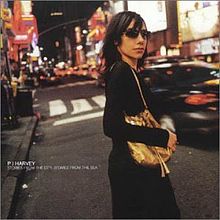
And after the somewhat wispy Is This Desire and the stopgap Dance Hall at Louse Point, it was great to hear PJ back in full swing. These songs are stripped down (but not raw like her early albums) and most of them pack a punch.  And I just read this quite from PJ  in Q Magazine:

I want this album to sing and fly and be full of reverb and lush layers of melody. I want it to be my beautiful, sumptuous, lovely piece of work.

And it is.  It’s very commercially successful. And it was commercially successful without compromising herself.

“Big Exit” and “Good Fortune” are wonderful rockers, catchy without being predictable.  “A Place Called Home” continues in this vein, with a somewhat slower, moodier piece.  It also exhibits some of her higher register (in the bridge), but for the most part she sings in the deep voice she’s been known for (Uh Huh Her came next, and then she switched over to the higher pitch on White Chalk).

“One Line” even made it on the Gilmore Girls (paragons of good musical taste).

“Beautiful Feeling” is a slow brooding number.  Typically, I find that I don’t like these songs from PJ, but this one is fantastic.  It’s followed by the noisy “The Whores Hustle and the Hustlers Whore” which is very dark lyrically.

Midway through the disc, we get a surprise Thom York from Radiohead sings the lead vocals on “This Mess We’re In” (PJ does backing vocals) and it shows that Yorke sounds great doing anything.  It’s a great song.  “You Said Something” is the first real upbeat moment on the disc, with some nice acoustic guitars.  And it’s followed by the absolutely rocker, “Kamikaze” which harkens to some of the noisier aspects from her earlier records (especially her screaming vocals).

The back half of many PJ albums seem to lose momentum, but not this one: “This is Love” is another great single, catchy with some simple but cool sounding guitars.

“Horses in My Dreams” is one of long (5 minute), slow numbers.  It is a kind of languid piece, which I admit I don’t like all that much.  (I find that PJ’s slow pieces aren’t dynamic enough).  But the album closer “We Float” (at 6 minutes, I think the longest track she’s done) is the kind of moody piece that Harvey does right.  There’s some simple drums and piano that comprise the verses, but when she gets to the chorus, the song perks up with her gorgeous singing “We Float.”

Confusingly, the whole album seems like it is more from the “City” than the “Sea” (“We Float” being the exception), but that’s okay.  It’s a wonderful album and the start of another great decade for PJ.

[READ: late March 2011] discussing The Turing Test

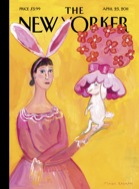
Occasionally things converge in my reading life. And sometimes things converge rapidly.  I had just read an article by Adam Gopnik in the New Yorker that discussed machines becoming (or surpassing) humans.  The timing of this coincides somewhat with the appearance of Watson on Jeopardy! so it’s not entirely surprising to see it.  Watson proved to be very good on Jeopardy!, but that seems mostly because it can buzz in more quickly.  The real test for a computer’s “humanity” is what has been termed “The Turing Test.”

Gopnik’s summary of the Turing Test:

If a program could consistently counterfeit human language in an ongoing exchange, then, many theorists have argued, the threshold of language would have been crossed, and there would be no need for more games to conquer. This is the famous “Turing test,” named for Alan Turing.

The next night I read a story by Ryan Boudinot (in The Littlest Hitler).  The story is not current at all, and yet he also mentions the Turing test.

The third article is another book review.  The subtitle is “What will happen when computers become smarter than people?”  Again, given everything that’s happening in the world technology-wise, it’s not a total surprise, and yet the items are all quite different and it was interesting to read them all so close together. (more…)

Read Full Post »

SOUNDTRACK: BEN FOLDS/NICK HORNBY-Lonely Avenue (2010).

As the cover of this album notes: “Ben Folds adds music and melody to Nick Hornby’s words.”  And that is true. The only surprising thing about this combination is that Folds is quite a good lyricist himself, so it’s surprising that he would sacrifice his words.  But regardless, the fit is a good one.

Sometimes it seems like Hornby is challenging Folds to come up with melodies for some of his more difficult lyrics which Folds lives up to).  But they have such similar sensibilities that (aside from occasional references to British things) the words could have come from Folds himself (although, Hornby’s a better writer, so Folds wouldn’t have written exactly the same things).

The big surprise is the diversity of musical styles on the disc.  Folds of course does play lots of different types of music on his previous discs, but I guess since the cohesion is Hornby’s words so Folds can really let loose.

The opener, “A Working Day” is a keyboard pop confection, a surprisingly 80s sounding synth song with some wry lyrics about being a writer/performer (“some guy on the net thinks I suck and he should know, he’s got his own blog”).  “Picture Window” is a beautiful downer, a string-filled song that seems like a companion to Folds’ “Brick” (“You know what hope is, hope is a bastard”).  It’s just as sad but the melody is gorgeous.

“Levi Johnson’s Blues” is a strangely topical song (in fact, it took me a minute to remember who he was when I first listened to the song.  Anyhow, it’s a silly song about what happened to the father of Sarah Palin’s grandchild.  And yet, despite the novelty of it, it’s actually a somewhat sympathetic portrait of the guy (sure he’s a redneck, but he’s just a normal guy thrust into a ridiculous spotlight–the liner notes say the chorus came from Levis (redacted) Facebook page).

“Doc Pomus” feels like a classic piano song.  While “Young Dogs: is a fast romper (with great vocals) and more keyboards.  “Practical Amanda” is a slow ballad (and Hornby says it’s not autobiographical at all).  While “Claire’s Ninth” is a story about a young girl of divorced parents who hates having two birthdays.  (With sweeping choruses!) Hornby states that this was his first accepted short story (modified for the song, of course) but the magazine that accepted it stopped publishing before his appeared.  D’oh!

“Password” is a wonderful song which only makes sense when you know the name of it (which I didn’t at first, as I usually don’t look at titles right away).  Throughout the song Ben spells words which leads to a cool conclusion–it’s wonderfully clever writing and it’s done in a fascinating R&B-lite style.

“From Above” is a jaunty rocker about people who never meet, although their paths cross quite often.  “Saskia Hamilton” is the “single” from the record.  It’s another great 80’s keyboard fueled romp.  Since I have a friend named Saskia (hi, Saskia) I’m fond of this song–her name is fun to say.  They have a bunch of fun in the recording too.

The final track, “Belinda” is designed like a classic 70s piano ballad (there’s a lengthy email printed in the notes that explains the construction of the song–reading that makes the song even more impressive).

It’s a great Ben Folds album.  It’s not as tidy as some of his other ones–but all of that experimentation leads to some new avenues of melody. It’s a risk that paid off.

[READ: May 10, 2011] Five Dials Number 7

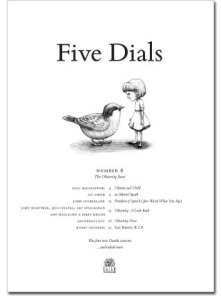
This issue of Five Dials was primarily about Memoir.  Typically, I don’t like memoirs, but I’m finding (and this coincides with what one of the memoirs below states), that I just don’t like celebrity memoirs.  Or perhaps I just like three page accounts of an incident in someone’s life (which these are).

Each of the writers below is given an introduction in which they summarize WHY they write memoirs.  It’s interesting to see that many of them do, in fact, take other people’s feeling into consideration (not as seriously as Mark Twain who waited 100 years for the publication of his), but they try to do something or other to spare people’s feelings.  I was intrigued also that several of the writers also talk about finding themselves through writing.  One or two of them make the exercise of writing memoir sound obnoxiously solipsistic (which of course it is), but it’s nice to read ones that are interesting and not too self-centered.

CRAIG TAYLOR-A Letter from the Editor: “On Audio Detective Work and Memoir”
This letter explains the extent of the audio detective work that went into the interview (presented later) between Raymond Chandler and Ian Fleming.  Since I love playing with audio software, this was of especial interest to me.  And it made me really look forward to the interview. (more…)

Read Full Post »

SOUNDTRACK: FUJIYA AND MIYAGI-Live at the 9:30 Club, Washington, DC April 30, 2007 (2007).

I was turned onto Fujiya & Miyagi through a sampler CD from WXPN (the song “Ankle Injuries” was included).  “Ankle Injuries” has such a simple template.  It’s an electronic song, full of washes and beats–nothing too high or low–with the repeated lyrics (sort of whispered) “Fujiya, Miyagi.”  I kind of forget that there are other lyrics, since that “chorus” is repeated some seventy times during the song.  The rest of the lyrics are also whispered (but mixed loud so they are audible) and are sort of weird, rambling nonsense.

It’s slick and catchy and with the simple lyrics, it’s really easy to sing (or whisper) along.  The problem is that pretty much all of their songs (in this live NPR show, anyhow) sound like this.  That’s dismissive and not entirely true, but they all tend to follow this similar template: smooth, catchy keyboard melodies and whispered vocals.

The thing is that it works quite well, and the show is kind of fun.  And yet, it’s also rather repetitive.  This seems to be the kind of show that I need to be in the mood to enjoy.  It also makes me glad I didn’t buy the album.  I think little doses are enough for me.

This concert (available from )

[READ: April 1, 2011] “Where Are the Men”

This is  another story that, once I was about halfway through, I remembered reading the first time.  This one in particular was quite memorable because of the middle section.  But let’s go back to the beginning.

As the story opens, a woman is talking, out loud, to herself.  Her name is Eye-Dora; she’s in a dark basement and sees searchlights flooding into her room.  But she herself is dark: her skin is dark, her house is dark so she feels safe.

She is from Barbados, a single mother (her husband left many years ago and is now dead) with a son who wears a robe and now goes by a muslim name.  Eye-Dora is pissed.  She is pissed at the state of black men in Toronto.   She is pissed that a black man is going through her garbage and leaving it strewn all around.  She is pissed that a black man was killed for wandering down the street claiming to be Jesus.  She is pissed. (more…)

Read Full Post »

SOUNDTRACK: SHARON VAN ETTEN-Live at SXSW (2011).

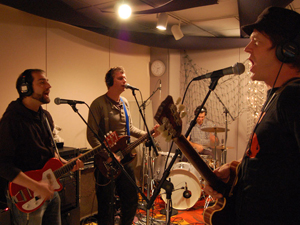
Sharon Van Etten has a lot of sessions at NPR.  Not too many are downloadable, but this one is.  This is a fascinating set because it’s a special breakfast show for KUT. (See in the picture she’s doing Java Jive).  (She also plays a show later that night, but it’s not available here).

The set is four songs (all from Epic) on acoustic guitar.  The really different thing about this set than any of the other things I’ve heard from her is that her voice sounds really gravelly (like she just woke up–which she may have, almost all of her between song banter is about how it’s early–it’s either endearing or annoying).  Normally, Sharon has a really amazing voice–high and soaring.  This time it’s much  raspier.  But the interesting thing is that it works well.  She never misses a note and it brings an interesting growly tone to these (somewhat) angry songs.

It’s a great (although brief) set.

[READ: March 30, 2011] “Mont Royal”

This is a very brief (three column) story that reads like a stream of consciousness piece.  And that is appropriate because it not only references Ulysses, it actually quotes the end of the novel.

There are many fascinating things about this story.  First off, it is written in direct address: “When I moved to the city, ladies, …” but we never find out who the ladies are.  Second, it begins with the humorous idea that the narrator–upon moving to Montreal–believed for many years that the cross on the to of Mont Royal was a plus sign (he is an engineer). (more…)

Read Full Post »

SOUNDTRACK: ROBYN-Body Talk Pt 1 (2010).

Robyn’s Body Talk albums got a lot of praise in 2010.   When I looked at them online, they were really cheap (and considered EPs), so I bought Pt 1.  I was disappointed when I first listened because it seemed like such a sparse album, that I felt there wasn’t much to it.  (Oh, and before I continue, yes, I knew that Robyn was a big time pop singer, but reviewers that I respected–like Sasha Frere Jones raved about the albums).

The opening song “Don’t Fucking Tell Me What to Do” is a really strange song.  The verses are simply Robyn stating that different things are killing her.  It’s strangely compelling despite the repetitiveness.  There’s virtually no music (eventually a single keyboard line keeps a bare melody.  And then the titular chorus.  After two listens I found that I really liked the song even though the first time I heard it I totally blew it off.

“Fembot” is the first proper song, and it’s a simple twist on the stereotype of “woman as robot” since she, the fembot, embraces her sexuality (over a very simple catchy pop melody).  “Dancing On My Own” is an even better song.  Fuller, more complex and with a great chorus.  Two songs seemed like they’d have been destined for Glee: “Cry When You Get Older” & “Hang with Me” they’re a bit too pop for my liking.

The second half of the disk is where it gets odd and interesting.  “Dancehall Queen” has Robyn (a Swedish sing mind you) singing in a Jamaican dancehall accent–which, since I’m infrequently exposed to it, I really like).  It’s super catchy (and I love when she sings “the riddim goes boom boom boom”).  “None of Dem” is another odd song, with a great minor key transition in the chorus and music by Royksopp.

The disc ends with “Jag Vet e Dejlig Rosa” a sweet lullaby sung in Swedish.

The entire EP displays her impressive vocal range and styles.  And even though I really didn’t like it at first it has not only grown on me but gotten my to consider getting Pt 2.  (She released Body Talk Pt 1 (an EP) and Pt 2 (an EP) and then Body Talk which is a combination of some of 1 & 2 with more songs thrown in–a cash in, in my opinion).

[READ: April 30, 2011] “The Good Samaritan”

This was a rather dark story that explores people’s generosity and gullibility.

I was confused through the whole story because the main character’s name was Szabo, and I couldn’t figure out if the ethnicity of the character made a difference (I don’t think so) or even if that was his first or last name.  But that’s a very minor criticism of an otherwise thoroughly engaging story.  I was particularly delighted that while I thought Szabo was going to be a certain kind of character, he turned out to be something else entirely.

As the story opens, it reveals Szabo’s land.  He doesn’t like to call it a ranch (the word is abused by developers), rather he calls it “the property.”  I kind of assumed this story would be about a downtrodden rancher, but that turns out to not be the case at all.  Szabo owns and runs “the property” as a not-very-lucrative side business.  He grows racehorse-quality alfalfa hay for a handful of grateful buyers (he sells in small amounts which most dealers won’t).  It’s true he barely breaks even, but he loves it.  He loves everything about the property–the planting, the reaping and especially the John Deere, which he treats like a baby.

Then one day the baby bites back.  While climbing on the tractor, Szabo slips and dislocates his shoulder.  He calls on his secretary and she assists him to the hospital.  His secretary, Melinda, is from his “real” job, and she is a saintly woman. I was delighted that the story went into so much detail about his “other” life and this woman who helps him.  Szabo’s main career is as a kind of middle man for parts.  He used to manufacture them, but he learned where the money was and took advantage of it  Now he sits in an office (and “the property” is his release).  But Melinda is his saving grace.  She knows everything about him and what he wants and their history together is wonderfully explained. (more…)

Read Full Post »

SOUNDTRACK: FIREWATER-Performance from KEXP, July 3, 2008 (2008).

I loved Firewater when their first two albums came out and I even saw them once open for Letters for Cleo (a great show by both bands).  Then I more or less lost touch with them.  And it turns out that lead Firewater dude Tod A. had been out of the country for a while.

The interview (and concert) with them details his distaste for the Bush administration and his decision to get the hell out of the country for a while.  So he spent three years traveling around India, Turkey, Pakistan and then returned with this album.  I wasn’t aware of any of that, or even that they had a new album out in 2008.

Firewater had a very cool (and reasonably original) sound when they came out back in 1996.  They had a middle eastern vibe even back then which they blended nicely with theatrical pomp and a whole lot of punk.  They threw everything together into a rollicking good time (even if the lyrics were very dark indeed).

The 2008 album The Golden Hour seems a bit more upbeat (touring the world did him good) although it hasn’t changed the overall style of the music.  This live set includes several new musicians for Firewater, and their array of skills (and instruments) is great.  But the most surprising thing to me is how friendly and jovial Tod A. is.  As I said, I knew the band as being kind of angry, so hearing him be fun (and inviting the KEXP volunteers to sing gloriously chaotic backing vocals on “Beirut”) is really cool.

In total the band does four songs: “Hey Clown,” “Electric City,” “6:45,” and “Borneo.”  I think the biggest surprise for me is how short the songs are.  Not punk short, but more like pop song length.  And super catchy as well.

It’s a welcome return to a great band.  Although I see they haven’t released anything else since 2008.

[READ: April 4, 2011] “The Principles of Exile”

This was a fascinating and very sad story which had multiple layers and went in many unexpected directions.  It was really great.

As the story opens, Manny is sent to get some “special” cheese from a shop.  The cheese is called halloumi, and the best kind is made in a bucket behind their counter.  He is sent for this cheese because his mother is making a special dinner.

The dinner is in honor of Monsieur Sarkis’s new book.  There was a fatwa leveled against Sarkis for his previous book.  And that previous book (naturally) went on to be a best seller.  Well, Manny’s father had the publishing rights to the book (normally his publishing house was on the verge of bankruptcy, so a huge best seller was a big deal for them).  They didn’t even mind the fatwa.

Until it started to affect them personally. (more…)

Read Full Post »

SOUNDTRACK: BATTLES-“Ice Cream” (2011).

My friend Lar told me about Battles way back in 2007.  I listened to the concert he sent me, and it was great. But my memory of the band was that they were really heavy (the drummer was in Helmet and Tomahawk for cripessakes).

But they’re not so much heavy as noisy and crazy.  And this track is a head-spinning amalgam of keybaords, unsettling rhythms, processed guitars and singing from Argentinean techno producer Matias Aguayo.  The lyrics sound like they are not English, but they are (with heavy effects on them).

The song is weird, indeed. But after just one listen, I was totally hooked.  It’s catchy and bouncy and very sunny and it’s a real joy to listen to.   I absolutely must go back and check out their debut Mirrored.

Listen at NPR.

[READ: April 28, 2011] Five Dials Number 6

Five Dials Number 5 was an excellent issue that I enjoyed immensely.  They followed it up with Number 6, which deals with a subject that I was very passionate about in the early 90s: censorship/obscenity.  When I was in high school and college, the PMRC was the big bogeyman for advocates of free speech (of which I am one).  I still advocate passionately for freedom of speech (now that I’m in a library, the issue can be part of my daily life), but it seems like there are so many more important issues in the world, that stickers on a record seem kind of silly.

Nevetheless, as this issue reminds us, those who control what is said control what we hear.  And that’s true for music and books, as well as our everyday news.  So, free speech should never be taken lightly.  Although this issue looks largely at obscenity in England, they also pull up some good information from Jello Biafra as well.

CRAIG TAYLOR-A Letter from the Editor: On John Mortimer and Obscenity
John Mortimer appears later in the issue. He was the lawyer who defended Lady Chatterly’s Lover against accusations of obscenity.  And Taylor points out that Mortimer’s attitude was that he “understood the silliness of censorship.”  And with that attitude, he was able to work to convince juries of that silliness.  The rest of the issue looks at important cases of censorship over the years, from The Dead Kennedys to NWA (it’s nice to be reminded about how “dangerous” they were when they came out).  He also laughs at the lame attempts at putting adult content on network TV (Fudge you!). (more…)

Read Full Post »

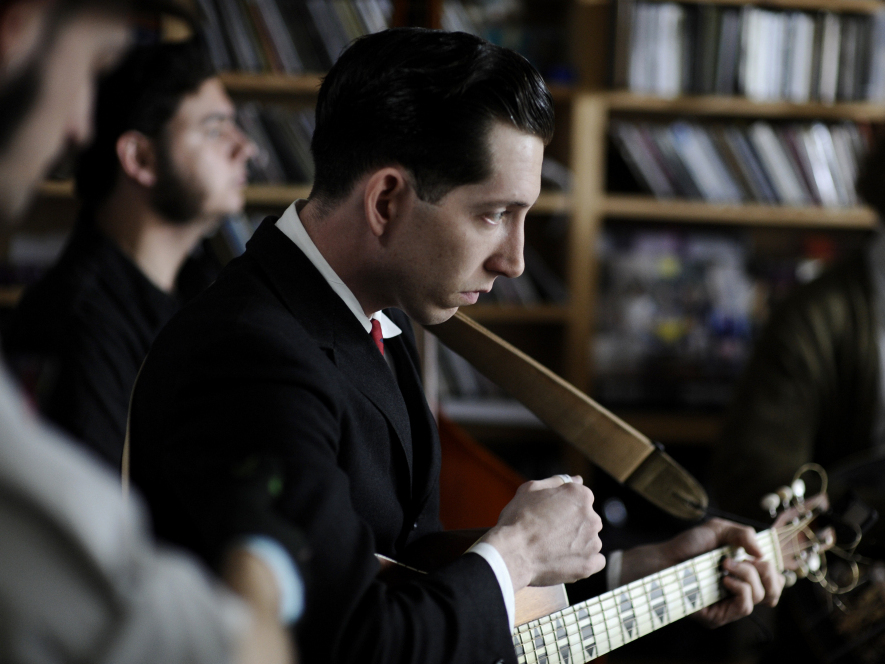
SOUNDTRACK: POKEY LaFARGE-Tiny Desk Concert #122 (April 20, 2011).

I had never heard of Pokey LaFarge before this Tiny Desk concert was sitting in my download folder.  In fact, the notes on the page say that they had never heard of him before they saw him wandering around SXSW.  And then he climbed onstage and played a great set.

LaFarge plays an old-timey style of music.  It’s a kind of Squirrel Nut Zippers retro sound.  As with the Zippers, I love their music in small doses.  And so, this Tiny Desk set is a perfect little sample of LaFarge’s music: happy, bouncy, jazzy.  There’s an upright bass solo, songs about being happy and singing “La La La” and other upbeat stuff.  It’s quite satisfying.

Especially if, as the notes say, you use it as a kind of antidote to the raucous music that you generally listen to.  A Pokey LaFarge song will perk you out of any self-inflicted gloom.  I just don’t need to hear more than three.

[READ: April 15, 2011] 2 book reviews

It looks like Zadie Smith has become a regular fixture at Harper’s.  I’m undecided if I’m going to review all of her book reviews from now on (perhaps I’ll lump some together in one post).  But in the meantime, I’m mentioning this one primarily because she reviews the story that I mentioned in yesterday’s post: Edouard Levé’s Suicide. (more…)

Read Full Post »

SOUNDTRACK: LES CLAYPOOL-5 Gallons of Diesel (DVD) (2005).

I’ve loved Primus for years.  And if you love Primus, chances are you love Les Claypool.  And Les Claypool has created and released music with all manner of bands since Primus broke up (they have since gotten back together and have planned a new release for July).  I don’t love all of his solo releases, but they all have something to commend them, and he’s made some great, unheralded music during those years.

This DVD covers the years from Sausage through to 2005.  At first I was pretty excited by the DVD.  The set opens with the off the wall video for Sausage’s “Riddles Are Abound Tonight” which is followed by a mercifully short “making of” video.

Then things started to go downhill somewhat.  The rest of the DVD is live, which is fine (Les live is a thing of beauty). It’s just that for many of the videos the quality is terrible.  The audio is also not ideal all the way through (that may have been my setup, but there were certainly songs that were much quieter than others).  Now I accept that there weren’t professional film crews out for Les Claypool’s Holy Mackerel tour, and that these videos are basically bootleg, but it  seems like they may have spruced them up a bit for the DVD.

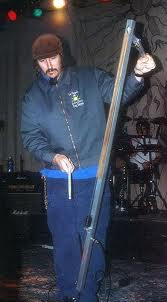
Things change with the switch to Oysterhead.  I could have watched several songs from Oysterhead and I wonder why they chose only one.  This is a professional quality mix (although it is a little dark) and I have to say that the whole song is stolen by Trey Anastasio’s guitar thing.  It’s a guitar (called the MatterHorn) but during the verses of the song it appears to be a kind of theremin on the reverse side (with a full-sized antler sticking out of the bottom) .  He holds the thing upside down and waves at it to generate noise.  It was bewitching.

But Trey wasn’t the only one with a weird instrument. For the Frog Brigade set(s) on one of the songs, Les plays a “bass” which is just one string (called the Whamola). He hits it with a stick and changes the notes with a movable handle that he raises and lowers.  I’ve never seen anything like that, either.  Most of the Frog Brigade set is outside at a festival.  The lighting is good but the sound is awful.  In one song, the poor guy on percussion is banging away at various things and you simply cannot hear them.  Les also uses a secondary microphone (the Sandman–which has a great story behind it) but its volume is also quite low, which is a shame as you can’t hear him for quite a bit.

When Colonel Claypool’s Bucket of Bernie Brains the setting is an odd one (they appear to be on a cruise(?)).  It’s basically two lengthy jams, which is fine.  Buckethead amazes with his skills.  But the Bernie on keyboards, I can’t tell if he was screwing up or messing around during his solos.

There’s two more songs attributed to just Les Claypool, and this version of “Riddles Are Abound Tonight” is especially neat because there is a sitar playing the majority of the riff.

The DVD extras are fun.  There’s a weird set from a band called 3 Guys Name Schmo which is 2 bassists and a drummer.  The other bassist is miked very loud and it’s hard to hear Les (imagine outbassing Les Claypool!).  Then there’s the second official video on the disc for “Buzzards of Green Hill” (very low budget).  This comes with a making of the video video and a making of the audio video.  Both are interesting and brief, giving tidbits of info without overwhelming us.

The final two items come from an actual TV show called Fly Fishing the World.  I don’t fish, so I never knew this show existed.  But sure enough, there’s our Les going to two separate locations and fishing on.  The best part is that they play lots of Primus music between fishing (probably the most Primus music ever played on non-music TV), and they interview him as well (I didn’t know he had such cute kids). Despite my not knowing the show or caring about fishing, I found the whole program enjoyable and fascinating (and they catch and release as well).  It’s well worth the time.

So overall, this is a mixed bag.  There’s not a lot of video of Les’ non-Primus music out there, so in that respect this is great.  I just wish the quality was better.

[READ: March 25, 2011] “Life in Three Houses”

This is an excerpt from Suicide.  The introduction states that days after delivering the manuscript of Suicide, Levé killed himself.  I suspect that that is the main reason that this story was published here.

It opens promisingly and very interestingly in the second person.  The story tells us that you set off to play tennis with your wife, but you backtrack and go into the basement where you shoot yourself.  Your wife finds you moments later but misses the clue you set out for her (that was handled very well).

The rest of the story (and there’s quite a lot) gets confusing.  First off because it stays in the second person (even after death) but it also goes into apparent flashbacks.  Even more confusing is the addition of an I as the narrator.  An I who knows “you” but who was not present for the suicide so how could he have all these details?

The book is being published by Dalkey Archive Press.  It’s possible that the excerpts do an injustice to the full book, but I fear that I will not be reading any more by this author.

It was translated by Jan Steyn.

For ease of searching I include: Leve

Read Full Post »

SOUNDTRACK: BROKEN BELLS Live at SXSW, March 17, 2010 (2010).

The only disappointing thing about this download from NPR’s All Songs Considered is that it consists of only three songs now.  I guess the band (or more likely the label) didn’t want the whole show streaming or downloadable, so they let us have three songs (the original show was ten).

But three is better than nothing.  The excerpt includes “The High Road,” “The Ghost Inside” and “October.”

The band sounds great in this setting.  I’m unclear just who all is playing live, but the page says that the live band is a six piece (with Danger Mouse jumping from drums to keyboards and back again).  They reproduce the songs very well, but at the same time they’re not just mimicking the album.

It’s a nice teaser to want to see them live.

[READ: April 4, 2011] “Bob Dylan Goes Tubing”

Today is Bob Dylan’s 70th birthday.  It’s not often that I get a story that coincides with a day quite so nicely.  Happy birthday, Bob.

This begins as a delightfully weird little story and develops into a strangely profound story about family and celebrity.

A family is renting a vacation home by Lake Sturgeon for the summer.  The mother notices a man on a raft who is floating towards them.  And she says that from a distance the guy looks like Bob Dylan, only older.  (He is older, her husband ponts out).

When the man gets closer, he reveals himself to indeed be Bob Dylan.  Well, he doesn’t reveal himself to be Dylan, he just is Dylan. And he accepts their hospitality and doesn’t make a fuss.  He thinks that he’s on a different lake (Lake Kashagawigamog), but he seems content where he is.

And that’s when their son Ryan, introduces him to the fun of tubing.

There is a lot of humor to the story (it was a National Magazine Award Nominee in the humor category), but it’s not a very funny story.  Obviously the premise of Bob Dylan tubing s quite funny, but as the story continues its proves itself to be not so funny.

For Dylan won’t leave. He stays in their house, and the family is basically paying for his food and cigarettes.  (Okay, that is quite funny).  He’s a good companion for the family (especially Ryan, whom he is teaching to play guitar), but he has never once offered to pay for anything.  (No even a cheque when he leaves?)

As the story and the summer draw to a close, some of Dylan’s loneliness is revealed.  And the story ends on a poignant yet positive note.

It’s really quite a nice story.  I wonder what won the Award that year.

It’s available here.

Read Full Post »

« Newer Posts - Older Posts »