Feeds:
Posts
Comments

Archive for the ‘New Yorker’ Category

CV1_TNY_10_14_13McCall.inddSOUNDTRACK: TOM JONES-Tiny Desk Concert #13 (March 2, 2009).

tomjI never gave a thought about Tom Jones until I worked a warehouse job in Cambridge, MA. My boss used to play Tom Jones all the time and all of us young’uns (I was 22) would get into it.  And soon I was singing Tom Jones songs to myself.  I have his Greatest Hits and it certainly scratches an unexpected itch.

It’s also funny to think of Tom Jones at at Tiny Desk Concert since his voice is so big.  And also because I think of shows as being spectacles.  But here he is, with just a guy on guitar and no microphone to hold on to or anything else.  He stands there sweating and just belting out these songs.

His voice sounds incredible—he can hold those notes like nobody else I know. Although I have to wonder if he has a bit of a cold (he still sounds amazing, but he’s coughing a bit).  The first and third songs, “If He Should Ever Leave You,” and “We Got Love” are from his then new album 24 Hours, so I didn’t know them.  But with the simple electric guitar accompaniment the songs sound clean and energetic (I imagine that with a  full band they’re much bigger, and there must be a horn section, right?).

“Green Green Grass of Home” is wonderful older song that I know from his Greatest Hits.  It sounds wonderful here–it’s all about his voice.  And the final song is a Jerry Lee Lewis song called “The End of the Road.”  I didn’t imagine him fitting this style but he jumps in perfectly and totally manhandles the song.  It’s great.

It never occurred to me to want to see him live (women throwing their underpants and all) but I’ll bet he puts on a great show.  It’s also amazing to see how crowded the offices are for him (they even turned down the lights for extra ambiance).

[READ: January 7, 2014] “Piano Man”

This New Yorker has several small essays about work.  They are primarily from people who I wasn’t familiar with–only Amy Poehler saved the five from being unread.  When after reading all of them I enjoyed them enough to include them all here.

The pieces are labelled under “Work for Hire” and each talks about a humiliating job.

Jeremy Denk is a well-regarded pianist (he won a McArthur Genius Grant).  He talks about his initial success very casually.  He says he had about $4,500 of debt when he won a piano contest in London.  I admit I didn’t know who he was when I read this and I wondered how it was that some guy randomly won a piano contest–are there many piano contests in London?  That cleared away his debt (and apparently must have covered the cost to fly to London, since he is from the Midwest). (more…)


Read Full Post »

CV1_TNY_11_04_13Brunetti.inddSOUNDTRACK: GRIPE-“Man vs Cop” CHULO-“Hombre vs Tombo” Split Single (2012).

chuloI downloaded the Gripe album yesterday and then saw this split single.  It has two songs which total 59 seconds.

Gripe has like a typical grindcore sound–pummeling and tinny.  All 32 seconds of “Man vs Cop” contain a pummeling riff, screamed vocals and even a ride cymbal at some point.

I was more intrigued by Chulo because I was surprised at how different a band could sound within the same limited soundscape of grindcore.  The big difference for me was the real presence of a bass guitar.  As “Hombre vs Tombo” opens, there’s a few seconds of pummeling sound (although their snare drum sounds more like a bongo) and then the sound drops out and there’s a cool heavy bass sound (for two notes).  Then the pummeling resumes, although again, much more bass heavy.  The other big difference is that they sing in Spanish.  I’m curious to know if that slightly different sound is a Latin American sound for grindcore or if it is just their own.

If you have a minute you can listen (or download for free) the single here.

[READ: January 7, 2014] “Weight Watchers”

This story began in a very weird way.  In it, an adult’s father has been kicked out of his house because his wife is mad that he now weighs more than 250 pounds.  Something that she has done on multiple occasions.  I find this reason/excuse so incomprehensible that it really impacted the rest of my reading this story.  This “problem” did put things in motion but was more or less ignored through the story and it seems that there were other more pressing issues that they needed to worry about.

When we meet the father, he has come to stay with his son. He believed that anything “done for pleasure was escapism.”  So we learn he has no tolerance for pleasure, except “when it came to seducing his secretaries and most of my mother’s friends.” Then we learn that his mother got pregnant as soon as she could when his father got back from the war because she figured that would get him to settle down.  his father basically resented him for his whole life.  So I guess the whole family is screwed up.

Especially when we find out that the son has witnessed all manner of “disturbances,” meaning his parents’ infidelities, in their house.  One of them was a very weird scene of food and eroticism.  Ew. (more…)

Read Full Post »

CV1_TNY_09_30_13Blitt.inddSOUNDTRACK:WOVEN HAND-Tiny Desk Concert #11 (January 9, 2009).

wovenWoven Hand is yet another band that I hadn’t heard of until this Tiny Desk concert (and I thought I knew a lot of bands).  They are a band, but for this Tiny Desk Concert David Eugene Edwards plays solo.  He has a cool baritone voice that has a nice ponderous quality.  This suits his chosen instrument–a mandolin-banjo hybrid made in 1887 by the Pullman Train Company (!)–perfectly.  Turns out that Edwards was the voice behind 16 Horsepower, so that explains some of the sound he’s going for.

The opener “Whistling Girl” and the closer “Kingdom of Ice” (which is practically a mini-epic) are beautiful slices of Americana made slightly more esoteric by the instrumentation and his voice.  I like them a lot.  The middle song he plays is a Bob Dylan song “As I Went Out One Morning.”  I know that I’m not a big Dylan fan, but I just can’t get over how many songs he has written that people cover.  I’d never heard this one, which with this instrumentation takes on a kind of fairy tale quality (which I assume the original doesn’t).

This makes me want to bust out my 16 Horsepower CD and to check out more from Woven Hand.  I enjoyed his solo performance so much I can’t imagine what a full band version would sound like.

[READ: January 7, 2014] “The Breeze”

I have really enjoyed Joshua Ferris’ work, so I was excited to read this.  But I was ultimately disappointed by this story.

The construction is interesting, so of.  It looks at multiple possible outcomes of a situation.  But I felt like even that was done a little too vaguely to be really effective.

It also features one of my most hated scenarios in real life and one which I guess I have no patience for in fiction.  It concerns a person who is bored, existentially bored.  So when she wants to do something, she proceeds to ask her partner what he wants to do.  Thus, Sarah asks her husband to come home from work early.  She is sitting on the balcony of their apartment enjoying a perfect spring breeze.  When he gets home, she is excited to have a wonderful excursion with him.  So she asks him “What do you want to do?”  And naturally he hasn’t thought of this at all, so he has no opinion.  But this makes her mad.  She asks if he doesn’t want to do anything.  He says he does. And then she asks him what.  I don’t know if this is a gender-specific scenario, but I have been in it many times in many different relationships and I know my parents went through it as well—my mother always complained about my father’s lack of wanting to do things and he would always say all she had to do was say what she wanted to do and he would do it.  So, I guess Ferris has tapped into something, but I hated reading about it. (more…)

Read Full Post »

CV1_TNY_10_07_13Kalman.inddSOUNDTRACK: DAVID DONDERO-Tiny Desk Concert #10 (December 5, 2008).

donderoBob and Robin at NPR love David Dondero.  I have never heard of him outside of their show (where they play his new songs when they come out).  Apparently he has some kind of connection to Conor Oberst (their voices sound similar—although I gather that Dondero came first).  I don’t care for Oberst in general, although I find that Dondero’s voice is more palatable to me.

He plays four songs on acoustic guitar.  And they’re all enjoyable.  They are simple folks songs “We’re All Just Babies in Our Mama’s Eyes,” is a little fast.  While “Rothko Chapel” is probably my favorite of the four.  I was really intrigued by the Chapel (which is real and which I’d never heard of) and which sounds cool—his song is an interesting look at it. “In Love With the Living and the Dead” and “It’s Peaceful Here” round out the set.

I feel that more than his music (which is good but not especially memorable), it’s his lyrics that Dondero is known for.  his songs are thoughtful and interesting and look at a variety of subjects.

[READ: January 6, 2014] “I’m the Meat, You’re the Knife”

This is an interesting story constructed in a way that lets you know that something big has happened between two people.  But we are never told exactly what happened, we are simply given a lot of stories with which to construct the event ourselves.

Jay is walking home—his father has just died—and he is greeted by an old friend, Ed Hankey.  Jay doesn’t feel like talking to Ed about his father, especially when Ed tells him that Murray Cutler is currently in hospice.  Murray was their English teacher–Jay has become a writer—with Ed emphasizing how important Murray was to them.

The story bounces back and forth between the preparations for Jay’s father’s funeral and his visits to Murray in hospice.  The differences are pronounced but not emphasized: Jay’s family is there to make arrangements, to plan for all of the details.  Meanwhile, Murray has no family, no one to visit him in hospice.  Indeed, when Jay visits him, a volunteer is reading to him. (more…)

Read Full Post »

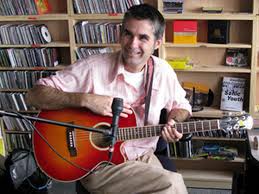
braindeadSOUNDTRACK: JIM WHITE-Tiny Desk Concert #8 (November 7, 2008).

jim whiteI didn’t know who Jim White was before this Tiny Desk Concert.  And I’m still not entirely sure who is he.  But he’s a gifted songwriter and storyteller.

Bob explains how he and Jim tried to work together for All Songs Considered, but that every time Bob asked Jim to do a 3 minute piece, he’d hand in a 15 minute piece.  And then somehow Jim would edit it into a 17 minute piece.  Jim admits that anything can set him off on a tangent (most of which are thoroughly engaging).  He also says that he writes songs not a bout “you” but about “me.”

So with him and a drum machine, he sings some really pretty songs.  “Jailbird” is a slow ballad that is quite beautiful.  I enjoyed that he played his harmonica solo without playing the guitar at the same time (I don’t know if the guitar was prerecorded or looped, I think prerecorded).

Then he gives a funny story about working with the guitarist for P.M. Dawn.  “Turquoise House” is a boppy little number about not fitting in.  It’s a wonderful song.  “Stranger Candy” is a darker song (full of lessons).  He says that it took him several tries to get the music right for this one.

There’s a fascinating story about a gift that Jim sent to Bob.  The story goes on about a racist incident in which his daughter rises above racism.

“Somewhere in the World” is a gentle ballad about finding the person you are waiting for.  I like it (except for that falsetto note at the end).  Then he talks about how for his old songs (like the previous one) he was kind of bummed.  But he has grown up and is happier.  And that has made his songwriting much more difficult.

The final song is called “A Town Called Amen.”  It’s another boppy little song, charming and sweet.  And Jim White seems about the sweetest, nicest musician in the world.

I came away from this Tiny Desk Concert really enjoying Jim White and wanting to hear more from him.

[READ: December 15, 2013] The Braindead Megaphone

This is Saunders’ first collection of essays and non-fiction.  At some point, I stated that I thought I would enjoy his non-fiction more than his fiction.  That is both true and not. I enjoyed his “reporting” essays (from GQ) quite a lot.  But I found his shorter, sillier pieces to be a but too much.  Nevertheless, he is an inquisitive reporter, looking for truth and traveling far and wide to find it (even braving the depths of FOX news). It’s a good collection and only slightly dated.

The Braindead Megaphone
This essay seemed a bit like a blunt instrument hitting a soft object.  Although 2007 is seven years ago, I feel like the subjects (dumb newscasters) were pretty soft even then.  However, it’s entirely possible that people who were apolitical or just simply not that interested in what obnoxious outlets like FOX were doing may not have been entirely aware that the Braindead Megaphone (ie. all news outlets) were not doing us any favors with their spouting of nonsense and being incurious about where stories are really news worthy or even accurate.  I imagine this is mostly just preaching to the converted.  I was a little worried that the whole book would be just as unsubtle, but that proved to be a foundless worry.  This is not to say that I didn’t agree with everything he said in this essay.  He was spot on.  And often he was pretty funny too. (more…)

Read Full Post »

tny6.16&23.03 cvrSOUNDTRACK: SIGUR RÓS-Ba Ba Ti Ki Di Do (2004).

babaI didn’t realize that this was a soundtrack to Merce Cunningham’s dance piece Split Sides.  That doesn’t really change my opinion of the music, although it does make me wonder just what kind of dance this would have been.

There are three tracks on this short EP.  The primary instrument seems to be the music box.  There are no real vocals on the album, except for what sounds like sampled children and a few spoken words in the final track (the words are the title of the EP sampled and thrown around, apparently spoken by Cunningham).  Of course, it’s not all music box, there are synths and interesting percussive sounds (what sounds like the winding up of said music boxes).  The first two songs are quite similar, with the second being a bit more fleshed out.

The final track, with the sampled words, sounds much different and feel a bit more aggressive, although that is all relative of course.  The whole EP is about 20 minutes long.  Of all of Sigur Rós’ varied output (singles and EPs) this is probably the least essential one that is all new music.

[READ: November 8, 2013] “City of Clowns”

I had printed out all of the New Yorker stories that Alarcón had written because I enjoyed his previous ones so much. This was the first and I was blown away by how good it was.

It is a long and somewhat complicated story.

It opens with Oscarcito going to the hospital because his father died the night before.  He finds his mother mopping floors because his father’s bill was unpaid.  And in that very first paragraph, she introduces her son to Carmela—the woman whom his father left them for.  She was mopping the floor with Oscarcito’s  mother.  He is confused and enraged by this.

His half brothers are also there.  He had never met them before, preferring to stay away from his father’s other life.  But he saw them in front of him and clearly saw that they were related to him.  But the most galling thing was that although he was the oldest of all the children, they were clearly the chosen children—after all, his father stayed with them.

Then we learn about his father’s life.  He was born in Cerro de Pasco and moved to Lima when his young family was still young.  He worked hard in semi legitimate businesses and then brought his family to the city.  Young Oscarcito, age 8, loved it.  But his mother hated missing her family in Cerro de Pasco.  And now they we reliving with his father who was practically a stranger. His father worked hard and succeeded, but he was rarely home (more…)

Read Full Post »

[LISTENED TO: November 21, 2013] “You Must Know Everything” podcast

podcastIn the fourth New Yorker fiction podcast, George Saunders reads Isaac Babel.  I know Saunders very well, although I knew next to nothing about Isaac Babel.

Saunders sets up this story very briefly before diving in to the read.  There’s something fantastic about the way Saunders read the story–full of emotion and affect.  He absolutely made the story come to life and his commentary at the end made the story even better.

Babel was 21 when he wrote this story (he was amazingly prolific–his Complete Works is over 1,000 pages), and Saunders is blown away by the amount of depth such a young writer fits into the story.  Saunders says that for him Babel is a combination of Hemingway and Kerouac–Hemingway because Babel edited his storied very intensely and Kerouac because he wasn’t afraid to add the occasional poetic touch.

In the story, a young boy is going to visit his grandmother.  As the story opens, he explains that he was always very observant.  He knew everything about the streets of his city, Odessa.  He knew the stores and the anomalies in the buildings.  He observed every new window.  Until someone teased him for looking in a lingerie store. (more…)

Read Full Post »

[LISTENED TO: November 20, 2013] “Urban Planning” podcast

podcastIn the third New Yorker fiction podcast, Donald Antrim reads Donald Barthelme.  I know both writers, but neither one all that well.

The story is absurdist and very funny.  In it, the narrator buys “a little city,”Galveston, Texas.  He keeps things pretty much the way they are–he doesn’t want anything too imaginative going on.  He tears down several houses and builds new developments (cut in the shape of puzzle pieces).  But he’s a little bored so he goes out and shoots 6,000 dogs, and then makes a front page announcement that he had done it.  This causes some upset (naturally), and he’s appreciative for the excitement.

But overall he is unsatisfied because he is in love with a married woman.  And she won’t leave her husband (and may not even know who the narrator is–except that he owns the city).  Eventually he had to sell the city back (and he took a real soaking financially on that deal).

The story has many many funny lines–laugh out loud funny–and (dog killing aside) it is a funny and delightfully weird story that retains its voice no matter how odd it seems. (more…)

Read Full Post »

[LISTENED TO: November 20, 2013] “The Dating Game” podcast

outkoudIn the second New Yorker fiction podcast, Edwidge Danticat doesn’t read Díaz’s story but rather she discusses it and her connection to Díaz after listening to the audio from the New Yorker Out Loud 2 CD (the story is read by Junot Díaz with Gail Thomas doing the female voices).

I have yet to read Díaz’s Drown (for no real reason, I just haven’t), which is where this story appears.  And I enjoyed that this story is written in the same style as his later stories about Junior (sure, I suppose he will need to move beyond Junior as a character but it seems like he has plenty of stories to tell).  And I found this story unsettling and very enjoyable.

The story is a funny/obnoxious (I mean, re-read the title) story about, as the title suggests, how to date a girl–there are different specifics depending on her race (white girls will put out, but local girls you need to take to the fancy restaurant).  And be sure to take the government cheese out of the fridge so she doesn’t see it–but be damn sure to put it back before your mom gets home.

The reading is wonderful and having Thomas do the female voices really adds a nice touch.  I would say more about the story, but Danticat says a lot of what I was thinking about it.  (more…)

Read Full Post »

2000_05_15_p323

SOUNDTRACK: DR. DOG-Tiny Desk Concert #7 (October 20, 2008).

drdog

I have been hearing a lot about Dr. Dog lately (they are from Philly and the radio station we listen to is from Philly, so that makes sense).  But I had assumed they were a new band.  So imagine my surprise to see that they were the 7th Tiny Desk Concert and the first full band to play the Tiny Desk.  (Their first album came out in 2005!).

It’s fun to watch a five piece band squeeze into the Tiny Desk (the drummer is playing a small pink suitcase) and the fifth member of the band is playing some various percussions (I wonder if he does more in the band).  It’s also funny when one of the guitars breaks a string and the singer says “son of a bitch.”

Dr. Dog proves to be quite interesting.  Their first song is “The Beach.”  It’s a rocking awesome track–the guitar is great and bassist Toby Leaman’s move is raspy and powerful.  I really like this song a lot.  The second song is quite different, it’s a bouncy boppy song that sounds a bit like a more rocking Grateful Dead (that bass).  This song has a different singer–Scott McMicken, who plays lead guitar on “The Beach,” but acoustic guitar here.  (The other guitarist, Frank McElroy  played acoustic on The Beach and electric on this one).

After a lengthy discussion they play the third song (in a different version from the record) “How Dare.”  This song opens with their great harmonies (a wonderful feature of the band).  It also has a jam band quality (Toby’s back on vocals but less raspy and powerful, and more bluesy)/on this track.

The band seemed to think they were only to play two songs, and frankly it’s a shame they only play 3. At 12 minutes it one of the shorter Tiny Desk concerts.  But I am a convert to Dr. Dog, and I need to hear more from them.

[READ: November 10, 2013] “Reunion”

After listening to Richard Ford in yesterday’s podcast, I decided I wanted to read his take on the Cheever story “Reunion.”  And while I can definitely see that it was inspired by a kernel of an idea in Cheever’s story, I probably never would have put the two together had I not known.

Ford’s story opens the same way as Cheever’s with someone waiting in Grand Central Station.  It turns out that the person is Mack Bolger.  Bolger is waiting intently for someone.  We quickly learn that the narrator who spies Bolger had had an affair with Bolger’s wife, Beth about a  year and a half prior to this meeting.  It ended abruptly when Mack confronted them in their hotel room (in St. Louis).  Mack (who is a large man) boxed the narrator’s ears a bit and sent him running from the room in varying stages of dress (and without a precious scarf which his mother had given him).

He had not seen Mack again, although he did see Beth on one final instance–a sort of final closure.  They met in a bar and tied up loose ends, and that was that.

So when the narrator sees Mack he gets this sudden urge to speak to him:

just as you might speak to anyone you casually knew and had unexpectedly but not unhappily encountered. And not to impart anything, or to set in motion any particular action (to clarify history, for instance, or make amends), but just to speak and create an event where before there was none.  (more…)

Read Full Post »

« Newer Posts - Older Posts »