Feeds:
Posts
Comments

Archive for the ‘New Yorker’ Category

CV1_TNY_11_25_13Viva.inddSOUNDTRACK: RHEOSTATICS-Bathurst Street Theatre, Toronto, ON (October 7, 1994).
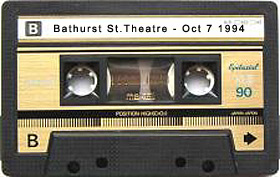
07Oct1994This show was broadcast on the radio, and indeed, this is an encore broadcast that you can download from Rheostatics Live.

Anyhow, it begins with people raving about the Rheos on the radio.  And then the band kicks in.  The set is 45 minutes, although I assume the original must have been longer.  Why?  most of their shows are longer and this feels like it might have some cuts for commercials and whatnot.

They play ten songs, and it’s alike a highlight reel of their earlier music: “Take Me in Your Hand,” “King of the Past,” “Queer,” “California Dreamline,” “Soul Glue,” “Claire,” “Northern Wish.”  But it’s also got its far share of goofiness: some improvs and the resolutely silly “Full Moon Over Russia” and “Alomar” (which sounds really tight here).  It’s a great set and a great introduction to early Rheos live music.

[READ: January 29, 2014] “My Man Jeremy”

Everyone mostly knows Cera as an actor (who I’ll see in anything).  But he’s also a writer.  His previous piece in McSweeney’s was very funny.  And so is this one.  Although now the two published things I’ve read by him were both about being an actor, so maybe its time to broaden the range a bit.

Anyhow, this is basically a set up about text messaging.  He opens by explaining that people ask him is he has any funny stories about texting (this part is in italics).  Then he tells us this tale about Jeremy.  The text messages are written straightforward, with interjected comments by Cera as he “studies” the exchange.

It begins with a text from an unknown number “Sup you coming to this thing?”

Michael writes back.  “Hi oops I don’t know this number.  I’m Michael, who is this?”

Now, this isn’t especially funny, but it did make me smile to think that anyone would respond to a wrong number this way.  At any rate…. (more…)

Read Full Post »

CV1_TNY_11_18_13Tomine.inddSOUNDTRACK: RHEOSTATICS-Kingston, ON (July 7, 1991).

07Jul1991Yesterday I wrote a letter to the Rheostatics.  In part this was inspired because I just found out that the Rheostatics Live site has added some new concerts for download (and a really fancy one for purchase, which I’m pretty excited about). I thought I had posted about a bunch of the free downloads from Rheostatics Live, but evidently I had only done one or two.  And since I’m on an inspired Rheostatics kick, it was time to revisit some of these oldies.

This is the earliest show they have on the site.  And it was, until recently, the only one with Dave Clark on drums.  (A new set of shows that I haven’t heard yet is from that era as well).  I have to admit that I find Dave Clark to be a terribly distracting/borderline really annoying member of the band.

While the Rheostatics songs aren’t “serious,” they are certainly powerful (some of them anyhow).  And Dave seems to put all kinds of silly nonsense in them.  I don’t mind (and it was probably fun to see live) the goofing between the songs.  Like when they begin doing the improv that they call “Jerkin’ Around.”  But to interject nonsense during the songs, especially something as intense as “Horses” (which is not great in this rendition anyhow), it’s a major distraction.

This is an otherwise interesting show, as they introduce some “new” songs (ie. ones that would come out on Whale Music).  And there are some funny things.  Like in the “Green Sprouts” song they throw in some Rush lines (and lines from “Tom Sawyer” in “Jerkin’ Around too).  But otherwise this feels like the Dave Clark show.  We even get “Dave’s Poetry Moment,” about which, whatever.

The sound quality is good, except for some interruptions in the last two songs and a fade out once Dave asks if someone else can sing “When Winter Comes” because his voice is shot.  Overall, this is an interesting historical recording, especially given the era, but it’s not my favorite show to listen to.

[READ: January 29, 2014] “Guy Walks into a Bar”

Simon Rich always makes me laugh.  And he often surprises me by making me laugh about things that seem like they couldn’t be funny.

Many years ago in a writing class I wrote a serious story and I ended it with “and then he turned into a bar.”  I don’t really know why I threw the lame joke at the end of the story, I think I wanted to see if I could get away with it.  (I didn’t).  Well this story/joke is based on the old, old joke about a bartender who has a genie and a twelve-inch pianist. (more…)

Read Full Post »

CV1_TNY_11_18_13Tomine.inddSOUNDTRACK: TALLEST MAN ON EARTH-Tiny Desk Concert #26 (September 14, 2009).

tmoeI was not aware of The Tallest Man on Earth before hearing him on All Songs Considered.  And then WXPN started playing one of his songs, so he became somewhat familiar to me.  I have since listened to some of his concerts and this Tiny Desk Concert and I really like him a lot.

So the Tallest Man on Earth is Kristian Matsson, a Swedish folksinger with a great guitar picking style and a deep powerful gritty voice.  He plays three songs in this set.  “I Won’t Be Found” has wonderful fast guitar picking that contrasts wonderfully with his simple singing melody.  It’s a great song.  As is “The Gardener” which sounds very different.  This one is largely strummed–a bouncy, jaunty strum. It seems to contain the origin of his unusual stage name (or perhaps it just a fun allusion to it).

“Pistol Dreams” has more great finger picking (and reminds me a little of Richard Thompson).  It’s a sweet song, and his gruff voice once again provides excellent contrast.

I hope to hear more from The Tallest Man on Earth.  Check it out.

[READ: January 30, 2014] “Find the Bad Guy”

This story was surprisingly dark (I don’t think of Eugenides as quite so dark).  It starts out with the narrator talking about the house that he and his wife have owned for 12 years.  And yet they still haven’t gotten the smell of the previous owners completely out of it.  (There’s a nice payoff to this idea later in the story).

But that’s not the point.  The point is that he has recently been kicked out of his house—given a restraining order, in fact.  But since he knows the plans of his house he knows that he can stand right where he is—just inside the front fence—and know that he’s not too close.

The story has trappings of being current—he plays Words with Friends with his daughter (her name is mrsbieber), which I found to be just slightly out of touch.  But that’s irrelevant.

The narrator is Charlie Daniels (not that one—he goes by Charlie D to avoid confusion, especially since he works in music).  He met his wife at a radio station.  She worked at a country station, although she didn’t like country music.  Johanna was from Germany (her name was Lübeck, but everyone pronounced it Lubbock).  But the thing about her was that she was very tall (not that tall in Germany, she said).  And Charlie D was suave, so he asked her clever things like how the weather was up there and if she ever played basketball.  She didn’t fall for this, of course, but then one day she asked if they could get married so she could get a green card.  He said sure. (more…)

Read Full Post »

CV1_TNY_11_11_13Blitt.inddSOUNDTRACK: DARK MEAT-Tiny Desk Concert #25 (August 31, 2009).

darkmeatFor those keeping track, I wrote about Tiny Desk Concert #24 (The Swell Season) quite some time ago.

Dark Meat is a ramshackle band which I had not heard of before this Tiny Desk Concert.  The blurb says that they have had as many as 20 people in their band and often play loud rambunctious music.    In this Tiny Desk Concert, there are only 8 of them (they have reduced for this tour), but they’re still a huge band for a Tiny Desk.

This concert is an acoustic jam –mandolin, guitars, trombone and piccolo—and is apparently quite different from their usual show.  As such, I can’t really imagine what they typically sound like, because they sound like a pretty solid folk band.

Initially I wasn’t all that impressed, but after a couple listens I found myself getting into their sloppy fun folk rock.  I enjoyed their first song, “The Faint Smell of Moss” a little more than the others because of the great backing vocals, and the possibly slightly off sounding trombone.  The second song, “Dead Man” is long, but it has a fun middle second in which the singer invites the office to sing along (and howl like dogs).  “When the Shelter Came’ is a rambling track which I think actually suffers from the trombone at the end.

I don’t know anything else about the band, but I imagine them playing folk festivals.  I’ll be they’re fun to see live, although I can admit that i didn’t find their songs all that memorable.

 [READ: January 22, 2014] “Benji”

“Benji” is the story of wealth and idleness.  As the story opens, we learn that Benji, now 40 years old, is the last remaining male in the family.  His mother, Mrs Anyaogu  is telling her guest that Benji must choose someone to marry because anyone who remains unmarried, even a man, is suspect at that age.

Then we meet the guest who Benji’s mother is speaking to—a woman named Alare.  Alare also got married pretty late—in her thirties–to a man who was about 40.  Her husband was not wealthy—he was a gardener.  And this was something of a sore subject in their marriage,  Of course, he must have also felt the embarrassment of his employment, but that was his lot in life.

Alare and Mrs Anyaogu became friends when Alare’s congregation had disintegrated because of a scandal with the pastor and she joined Mrs Anyaogu’s Deep Life church.

Alare was aware of the wealth that the Anyaogus possessed, but she hadn’t witnessed it until today.  While the house was beautiful, she felt that the furnishing were tacky—not entirely, but enough.  Nevertheless, the lunch was nice and the food was delicious.  The groundskeeper, Godwin, kept the garden beautiful and Benji complimented the man on his loyalty and hard work. (more…)

Read Full Post »

SOUNDTRACK: SARAH SISKIND-Tiny Desk Concert #23 (July 27, 2009).

sarahsI don’t know much about Sarah Siskind.  She is a country-ish singer who seems to have gained some fame once Bon Iver started covering her song “Lovin’s for Fools.”  She tells a pretty interesting story about how he came to learn her song (by looping it–thereby missing out on the words to the second chorus.  And yes she did wonder why he didn’t play that chorus).

She plays three songs in this Concert. I like her guitar work, especially on the first song, “Falling Stars.”  But there’s something about either her voice or her delivery that I just don’t really like. I’ve listened a few times ow and I have grown to appreciate her style, but it’s just a matter of personal taste that I don’t really care for her.

Listen for yourself.

[READ: January 17, 2014] “The Bear Came Over the Mountain”

One thing that I like so much about Alice Munro is that her stories are so timeless.  This story was originally published in 1999 (wonder why they didn’t re-publish that first story which I wrote about yesterday), but there are no real indicators of when it was written.  (There are some clues to the time frame of the story, but it was clearly not set in the late 90s).

This is a straightforward but fairly complex story, with a lot of emotional heft.  A married couple, Grant and Fiona, have been together for a long time.  Fiona had always written notes to herself, but Grant sensed recently that the notes were becoming somewhat alarming.  Instead of books to read or appointments to keep, she was writing “cutlery” on the kitchen drawers. Then she started forgetting normal things–like how to drive home or that something which she thought had happened last year had actually happened 12 years ago. Not major problems, but causes for concern.

And so, Fiona was sent, at first temporarily, to Meadowlake.  And Grant was not to show up for the first month–they found that patients settled in better if they were not reminded of their house and old life.  After a month of wondering about her and thinking about her, Grant goes to Meadowlake, excited to see Fiona.  But when he arrives she is not in her room–the touching reuniting scene will not be enacted as he pictured.  And the nurse seems rather impatient with him when he asks where she is. (more…)

Read Full Post »

2014-01SOUNDTRACK: NOBEL PRIZE PLAYLIST-CBC Radio 3 (2013).

cbcIn honor of Alice Munro’s Nobel Prize, CBC radio has a playlist of “Literary Music.” Now, I have made many literary playlists over they years myself (including “My Baby Loves a Bunch of Authors” by Moxy Fruvous which is not included here), but this one consists of a few bands that I don’t know (and two that I do).

  • Library Voices–“Generation Handclap”
  • The Darcys–“Pretty Girls”
  • Kathryn Calder–“Right Book”
  • AroarA–“#6”
  • Arkells–“Book Club”
  • Dan Mangan–“Road Regrets”
  • John K. Samson–“When I Write My Master’s Thesis”

Samson is the only artist I know well, although I know Dan Mangan a little.  It’s a good listen and I’m sure if you scrutinize the lyrics you’ll find their literary worth.

Listen here.

[READ: January 18, 2014] “Her Big Break”

I’ve been a fan of Alice Munro for a while, and I’m always happy to see her in the New Yorker.  Strangely, I have never read any of her collected short stories.  Maybe some day….

When Munro won the Nobel Prize for Literature, I imagined she’d get a lot more press.  And then I realized that it’s a literature prize.  And she’s Canadian.  So, perhaps a few columns in Canada’s The Walrus is all she’ll get.

But this article, which is really entirely this below letter and a brief introduction, explains that on November 18, 1976, Charles McGrath, a fiction editor at The New Yorker, sent Alice Munro her first acceptance letter from the magazine for her story “Royal Beatings.”  Soon after this, she signed a first-reading agreement with the magazine, which I gather means that they will see any of her short stories before she can send them anywhere else.

I am including this letter in its entirety because I assume that most people, like me, have never actually seen an acceptance letter from a magazine for a piece of fiction (I have several rejections).  But even if you have seen an acceptance letter, I can’t imagine that it will every be as thoughtful and considerate as this one.  i also love that as recent as 1976 The NEw Yorker was kind of prudish about their fiction.  I mean, now, the cursing is rampant, but back then the fiction was a more genteel breed.

I have not read “Royal Beatings,” but you can bet I’ve added it to my short list. (more…)

Read Full Post »

CV1_TNY_10_14_13McCall.inddSOUNDTRACK: JASON VIEAUX-Tiny Desk Concert #17 (June 15, 2009).

viaeuxJason Vieaux is the first to break the mold of folk singers playing the Tiny Desk.  Vieaux is a classical guitarist.  I don’t know a lot about classical guitar, but when it’s good I know it’s gorgeous.  And man, is this gorgeous.

I don’t know anything about Vieaux, but in the little blurb, they say that in 2002 they invited him to spend a week as a young-artist-in-residence on their classical-music program Performance Today.

I would have been grossed out by his long fingernail if they hadn’t pointed out that he glues a slice of a ping-pong ball to the underside of his right thumbnail as a kind of extended, “press-on nail” guitar pick.

He plays 3 songs and they are all simply stunning.

Bach: Prelude (from Prelude, Fugue and Allegro, BWV 998)

Maximo Diego Pujol: Candombe en Mi

Francisco Tarrega: Capricho Arabe

You can visit the NPR site to hear about the ping pong ball thing, and you can watch the video below.

[READ: January 7, 2014] “Pure Bleach”

This New Yorker has several small essays about work.  They are primarily from people who I wasn’t familiar with–only Amy Poehler saved the five from being unread.  When after reading all of them I enjoyed them enough to include them all here.

The pieces are labelled under “Work for Hire” and each talks about a humiliating job.

This final installment was the shortest.  Ruscha is an artist, whose name sounds familiar to me–he worked in pop art. His lame job was working in a laundromat “mixing bleach and water together in brown glass bottles for the customers to use”  If you didn’t know better you would say, that sounds like an old job, and you’d be right–that job existed in 1951.  Geez.  He made 50 cents an hour. (more…)

Read Full Post »

CV1_TNY_10_14_13McCall.inddSOUNDTRACK: GREAT LAKE SWIMMERS-Tiny Desk Concert #16 (June 8, 2009).

swimmI knew of the Great Lake Swimmers from NPR, but only a song or two.  I found them to be pretty but a little too mellow for my liking.  In this Tiny Desk Concert, Great Lake Swimmer’s vocalist Tony Dekker stops by for a solo acoustic set.  His voice is delicate sounding and yet is powerful in its own way.

He plays three songs, the first two “Everything Is Moving So Fast” and “Pulling on a Line” both come from Great Lake Swimmers’ then recent album, Lost Channels.  Both Bob and Robin compliment his voice, which is really something (he says he grew comfortable with it about a year ago).   And there’s something about the way he sings that really draws you in here.

He is one of the first performers who talks about working in an office in Toronto. (He liked it and says people brought in guitars from time to time).

Then Bob mentions the “yelp machine”–the harmonica stand that Tony pulls out.  Bob says when a guitarist takes it out it makes fans go crazy, but Tony says that he finds it the banjo that makes people go nuts.  The final song, “Various Stages” features the harmonica, which although he says is easy for anyone to play, sure sounds good here.

[READ: January 7, 2014] “Labors”

This New Yorker has several small essays about work.  They are primarily from people who I wasn’t familiar with–only Amy Poehler saved the five from being unread.  When after reading all of them I enjoyed them enough to include them all here.

The pieces are labelled under “Work for Hire” and each talks about a humiliating job.

Rush is an author.  He has the longest article in this series (four whole columns!)  Rush talks about a number of jobs that he had over the years.  But mostly he says he chose jobs that would offer him free time enough to write.  Like picking cherries (?). (more…)

Read Full Post »

CV1_TNY_10_14_13McCall.inddSOUNDTRACK: BENJY FERREE-Tiny Desk Concert #15 (May 29, 2009).

benjyI had never heard of Benjy Feree before this Tiny Desk Concert, and I have still never heard of him.  I don’t know a thing about him, and I kind of like that.  Where did they find him?  They seem to know him very well.  (He grew up locally to D.C., so I guess that’s it).

He plays four songs and he is very funny.

“I Get No Love” opens with Benjy whistling and playing a guitar in a Spanish style (not fingerpicking but that fast strumming style).  But when the song proper begins, it’s a bouncy acoustic song.  Benjy has a nice voice.  He also encourages everyone to get out their pens a make a beat.  The whistling is truly amazing. It’s strong and powerful and very catchy.

In the second song, “Fear,” Benjy pulls out a great falsetto—it’s a wonderful combination of his regular powerful voice and some cool high notes too.  Then he tells the story of working in an office.  He says his boss looked like Clarence Clemmons.  It’s a very funny story.

Then he starts talking to the “chat room.”  He messes up the tuning of his third song, “When You’re 16.”  But he pulls through with a very solid acoustic song with more good whistling.  After the song he says he’d like to take lessons from Andrew Bird in whistling.  And then he curses which leads to a lengthy and funny story about going to school at a Baptist Church.

“The Grips” is the final song, it’s a slower, very nice song, which really shows his range.

He is a charming and very funny and the end (the David Letterman joke) is especially amusing.  And I have to say that I thought his hair looked totally fake and then I read that it was a wig.  Ha.

[READ: January 7, 2014] “Take Your Licks”

This New Yorker has several small essays about work.  They are primarily from people who I wasn’t familiar with–only Amy Poehler saved the five from being unread.  When after reading all of them I enjoyed them enough to include them all here.

The pieces are labelled under “Work for Hire” and each talks about a humiliating job.

So Poehler’s essay is all about working at an ice cream shoppe as a young girl–a typical summer job.  I’ve often seen young girls working in ice cream shoppes for summer jobs and I always imagined that they would get the hugest arm muscles from scooping out in those awkwardly deep freezers.  But Poehler focuses more on the cleaning–every night anything that wasn’t nailed down got cleaned.  Ugh. (more…)

Read Full Post »

CV1_TNY_10_14_13McCall.inddSOUNDTRACK: HORSE FEATHERS-Tiny Desk Concert #14 (May 8, 2009).

horseI’d never heard of Horse Feathers before this Tiny Desk Concert.  Justin Ringle is the lead singer and guitarist of the band (which in this incarnation includes a violin and cello).  Ringle’s voice is soft and kind of high-pitched.  They seem very well suited to the Tiny Desk, (and are in stark contrast to Tom Jones!).

They play three songs, “Working Poor,” and “Curs in the Weeds” are beautiful with the wonderful strings accenting his voice and guitar.

In their interview they talk a little about their instruments (all of which are very old!).  Indeed the guitar is old, but the violin (one of only 4 made) is even older and the cello is nearly 100 years old.  Very impressive.

For the final song, “Heathen’s Kiss, ” the violinist busts out singing saw.  It’s awesome.

I really enjoyed this simple and beautiful set.

[READ: January 7, 2014] “Caught Napping”

This New Yorker has several small essays about work.  They are primarily from people who I wasn’t familiar with–only Amy Poehler saved the five from being unread.  When after reading all of them I enjoyed them enough to include them all here.

The pieces are labelled under “Work for Hire” and each talks about a humiliating job.

Nicole Holofcenter is a filmmaker.  She has directed a number of films that I have liked (including Walking and Talking) and most recently James Gandolfini’s last movie (which I haven’t seen), Enough Said.

In this essay she talks about a job working for “Mr. Stone” (which I’m not sure if we’re supposed to assume is Oliver Stone or not).  At any rate the job paid a fortune at the time ($500/wk) and all she had to do was answer the phone. (more…)

Read Full Post »

« Newer Posts - Older Posts »