Feeds:
Posts
Comments

Archive for the ‘New Yorker’ Category

SOUNDTRACK: DEE DEE BRIDGEWATER-Tiny Desk Concert #725 (April 2, 2018).
It’s fascinating to read about singers who have been around for a long time about whose names I have never heard before.

Dee Dee Bridgewtaer is such a singer.  Sadly, this blurb, while very informative, doesn’t say anything about her career.  So I don’t know how long she has been singing or what she actually sings.  Although it does say what her new record is about.

When she was just three years old, her family moved from Memphis, Tennessee, to Flint, Michigan. Years later, Bridgewater could still hear the soul sounds of Memphis on WDIA, the first radio station in America programmed entirely by African-Americans for African-Americans. She recalled, “I could catch it when I was in Flint as a teenager and I would listen to it after 11:00 at night, because that was the only time I could get it — when all the other stations were off the air. I know it was real, ’cause I went through it and these were all songs I heard on WDIA.”

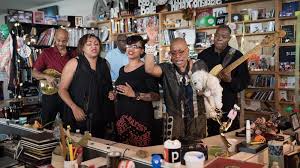
Bridgewater, now 67, brought three of these songs to the Tiny Desk: First, is the celebrated blues hit, “Hound Dog,” first recorded by not by Elvis Presley but by Willie Mae “Big Mama” Thornton in 1952. What makes this presentation special is not only Bridgewater’s sultry and soulful interpretation, but her adorable Daisy, perhaps the cutest “Hound Dog” to ever bless this song.

Bridgewater’s version is great and really puts a different spin on the song if you’re used to the Elvis version.  It’s much more sassy and gives you a sense of what the song was really about a lot more than the standard version.  There’s a cool slide guitar solo too.

Before the next song, she says, “I’ve watched the Tiny Desk before but I’ve never seen this many people.”

Then she explains what this song is about:

The first lines of the next tune will quite actually send chills down your spine. Bridgewater and backup singers Sharisse Norman and Shontelle Norman-Beatty’s close harmonic voicings add a spiritual dimension to the already hallowed song. “Why (Am I Treated So Bad)?” was written by Roebuck “Pops” Staples in response to the harassment of the Little Rock Nine, brave students who decided they had the right to attend an all-white Arkansas high school in 1957.

Their version is excellent and powerful.  The backing vocalists add so much to this song.  There’s also a cool keyboard solo that’s kind of under-documented.

Last here is “B.A.B.Y.” Bridgewater recorded this song and the entire album in Memphis’ historic Royal Studios and told NPR this story, “I stepped outside of the studio right after they started mixing ‘B.A.B.Y.’ and I said a prayer. I said, ‘God I need a sign, that I’m moving in the right direction because I am stepping completely away from jazz music.'” Before Bridgewater could get back into the studio to record the next track she got a surprise visit from Carla Thomas, the Memphis soul queen herself and daughter of Rufus Thomas, influential entertainer, singer-songwriter and former WDIA radio DJ. It was a true return to her Memphis roots, a memorable and beautiful moment for Bridgewater.

The song has a sweet soul sound with the addition of horns.  Bridgewater’s voice is perfect for this song and the other songs, too.  I don’t know what Bridgewater’s other songs sound like but she seems perfectly suited to these.

[READ: April 12, 2016] “Visitation”

This is the story of a man, Loomis, who has made many bad relationship choices and who is now stuck realizing that he is not only not a great father but also stuck in a horrible situation with regard to his son.

Loomis and his wife separated and she moved with their son to Southern California.  Since then, he’d flown out (it doesn’t say from where) every three weeks.  He would go for three to five days and stay in the same hotel each time.  He hated the crappy hotel but his son liked it, so he continued to go there, even as he noticed it got worse with each visit.

His wife and son lived in the basement of an ex-marine’s house.  The marine hated him even though they had never been introduced.  Whenever he would visit, his wife would be sure to not be around.

Their hotel stay is pretty bad.  The boy watches anime while Loomis fixes himself a drink. (more…)

Read Full Post »

SOUNDTRACK: RAUL MIDÓN-Tiny Desk Concert #718 (March 15, 2018).

I had never heard of Raul Midón before this Tiny Desk.  So I’ll use the blurb for an explanation of who he is.

Raul Midón lives in a world of sound — blind since birth, Midón’s interpretation of his surroundings is borderless. He sings with the passion of the best classic soul singers, and his instrumental chops stand along side the most accomplished jazz musicians.

Normally backed by a band that straddles styles just as well as he does, for his turn behind Bob Boilen’s desk Midón stripped it down to just voice and guitar, the musical equivalent of tightrope walking without a net.

You could choose any of the songs he performed, listen on repeat and continuously discover layers of musicality — the nuance of a bent note in his vocals, a burst of perfectly placed guitar notes.

Midón played five songs.

For “Gotta Gotta Give” he primarily uses a kind of slapping guitar style for his chords–he slaps all of the strings with his palm making a kind of gentle but loud sound.  But he also does some great picking on the descending chords.  I love the little harmonics he throws in a the end of the verses.  For this song he plays a trumpet solo with his mouth which is pretty cool.  Later he does a solo duet with his mouth-trumpet and the guitar.  His voice is powerful and soulful.  It’s a great song.

He says that he wondered how to address the fact that he was blind. He wanted people to talk about the issue but no one every would, so he called his new album Badass and Blind and people talk about it now.

“Sound Shadow” has a more abrasive picking style–almost like a slap bass but on all of the strings.  It’s a very different sound form the first song.  The solo is a mixture between very fast picked notes and some really fast pick-less strumming.  Vocally he really mixes things up as well, with some nice falsetto at the end.

“If Only” was inspired by Tin Pan Alley stylings which you can hear in the chords.  “Bad Ass and Blind” has a bluesy sound with some more cool harmonics and some dramatic minor chords.  I like the way the chorus is very different from the staggered melody of the verses.  The second verse is all rapped while he plays that guitar.  And his delivery is solid.  It’s got an even better sounding trumpet solo.

For “Mi Amigo Cubano” he switches to a nylon stringed guitar.  He says he wrote this song with Bill Withers, who wanted a song written sin Spanish–basically Raul translated what Bill wanted He asked how do you say “Hows your wife?” “Como esta tu esposa?”  “Well put that in there!”  This song has Spanish soul.

I really enjoyed this set a lot.

[READ: March 20, 2018] “The State”

I didn’t really enjoy this story.  It felt kind of slow and meandering and the ending was really bland.

But I have learned though, that if I don’t like a New Yorker ending because it doesn’t feel like an ending, it is probably an excerpt–which this was.  Knowing that now changes my opinion of the whole thing.  And reading a bit about the novel it sounds multifaceted and really quite interesting.  Now I feel badly for judging it harshly at first.

It begins “before you were born, you were a head and tail in a milky pool.”  Your history goes back further and further, but then returns to your birth when your heartbeat was arrhythmic.

Your dad said “maybe he as a drummer.”  And in the womb, you did begin to kick to any beat offered.  Your dad is 100 per cent Indian–a recovering alcoholic medicine man from Oklahoma.  Your mom is white but there is too much and not enough whiteness to know what to do with it.  You were raised Christian although you enjoyed your father’s powwows more–but your mother became more and more opposed to them as she got older. (more…)

Read Full Post »

CV1_TNY_06_08_15_09.inddSOUNDTRACKLUCY DACUS-“Historians” NPR’S SOUTH X LULLABY (March 21, 2018).

I’m looking forward to seeing Lucy Dacus live in a few weeks.  Her music is often spare but grows very intense.  For this particular song it is just her and her guitarist who is creating textures and sounds as Lucy sings clearly and starkly.  She plays the (almost) title track from her new album Historian.

The idea behind our South X Lullaby series was to offer intimate moments with musicians as an antidote to the commotion and deluge that is the SXSW music festival. When we met Lucy Dacus for her Lullaby and found out she’d perform “Historians,” a most somber song from her deeply personal and triumphant album Historian, it felt just right. It’s a song of reflection, the story of two intertwined partners and the way they document one another’s lives and preserve each other’s memories.

With simple but compelling swirls of sound, Dacus begins singing clearly with a bit of softness on the edges of her words.  It’s fascinating to watch her face illuminated by the video around her (the same video that Stella Donnelly performed in front of).

The song is warm despite the sadness inherent in it.

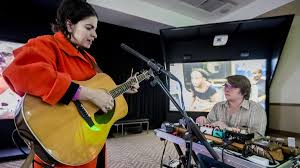
The setting for this performance, by Lucy Dacus and guitarist Jacob Blizard, is an interactive art installation by the multidisciplinary Israeli artist Ronen Sharabani that’s part of the SXSW Art Program. This work, titled “Conductors and Resistance,” explores human-machine interaction in our ever-evolving technological world. The images projected behind Lucy and Jacob are two coffee cups, one empty and one that’s been almost drained, both tangled in and tugged at by a complex series of wires, representing what I think is human communication and miscommunication.  This is just one of three walls onto which images are projected in this installation — you can see another wall behind Stella Donnelly in her South X Lullaby video.

[READ: April 13, 2016] “The Magic Mountain”

Back in June of 2009, The New Yorker had their annual summer fiction issue.  Included in that issue were three short essays under the heading of “Summer Reading.”  I knew all three authors, so I decided to include them here.

This essay was about Aleksander Hemon’s childhood in Sarajevo.

He says that (not unlike Angell) his family had a cabin on the mountain called Jahorina.  His family would spend winter breaks there skiing and partying.  His parents thought it was heaven up there.  But he and his sister hated to go there in the summer. (more…)

Read Full Post »

CV1_TNY_06_08_15_09.inddSOUNDTRACKKEVIN MORBY & KATIE CRUTCHFIELD-“Downtown’s Lights” NPR’S SOUTH X LULLABY (March 20, 2018).

I don’t know if Bob Boilen ever explained how he starte dto get people doing South X Lullabies, but here he explains why he started doing them:

In the midst of all the chaos that is Austin, Texas during the SXSW Music Festival, we seek moments of calm. And so one night, as the week was nearing its end, we made our way to the courtyard of St. David’s Episcopal Church, just a few blocks from the thousands of festival participants and onlookers. There we found a trickling garden-side waterfall, where Katie Crutchfield and Kevin Morby performed “Downtown’s Lights,” from Kevin Morby’s recent album, City Music.

I don’t know Kevin Morby.  I’ve heard of him, but aside from a Tiny Desk Concert, I’ve never explored his music.

“Downtown’s Lights” is a simple folk song.  He’s got a bit of a Bob Dylan delivery in what feels like a very deliberate folk song.  Katie Crutchfield is Waxahatchee who I’m excited to see in a few weeks.  Waxahatchee has been really rocking out the last few albums, so this folk song (and her Southern accent) stand out somewhat.

Their voices work nicely together, and that moment when you hear someone yelling, it almost sounds like a wolf howling.

“Downtown’s Lights” is a song of comfort and prayer for someone who is down and out in the city, and this version, with Katie singing — and the sounds of the city echoing in the background — is wistful and peacefully perfect.

[READ: April 13, 2016] “Two Emmas”

Back in June of 2009, The New Yorker had their annual summer fiction issue.  Included in that issue were three short essays under the heading of “Summer Reading.”  I knew all three authors, so I decided to include them here.

This essay was about Roger Angell’s summer home in Maine.

He says that on late February nights his mind often returns to his family’s cottage in Maine and the books that are on its shelves.

Those books have been there for as long as he can remember, and have been read and re-read every summer.  The list is interesting:

Good Behaviour [Molly Keane], Endurance [Alfred Lansing], Framley Parsonage [Anthony Trollope], Get Shorty [Elmore Leonard], Daisy Miller [Henry James], Dracula [Bram Stoker], Butterfield 8 [John O’Hara], Goodbye to All That [Robert Graves], Why Did I Ever [Mary Robison], Oblomov [Ivan Goncharov], The Heart of the Matter [Graham Greene], Sailing Days on the Penobscot [George Savary Wasson], The Moonstone [Wilkie Collins], Possession [A. S. Byatt], Morte d’Urban [J. F. Powers], Quartet [Jean Rhys], Emma [Jane Austen] and dozens more. [I have to chime in and say that this sounds heavenly].

He says that fat books like Martin Chuzzlewit [Charles Dickens], Orley Farm [Anthony Trollope] and the Forsythe Saga [John Galsworthy] were saved for a tedious week of Down East fog. (more…)

Read Full Post »

CV1_TNY_06_08_15_09.inddSOUNDTRACK: SOUNDTRACKSTELLA DONNELLY-“Talking” NPR’S SOUTH X LULLABY (March 19, 2018).

The South X Lullaby is a really fun way to get to know a new (or familiar, but mostly new) artist in an intimate live setting.  I had heard one of Stella Donnelly’s songs before, but this Lullaby presented her by herself (with a very cool backdrop) with an amazingly clear recording of her voice and guitar.

Stella Donnelly has only one EP to her name, but that’s been enough to make her sharp wit come through in sweet, quiet songs that rage loudly. The Australian singer-songwriter’s Thrush Metal EP was recently reissued in the U.S. with a bonus track, “Talking,” which she performs here surrounded by video of wires, a weaving machine and woolen yarns.

Her voice is clear with big open vowels (you can kind of hear the Australian accent, but it’s somewhat indeterminate).  Despite it being just her electric guitar, she plays a in a couple of slightly different styles throughout the song which adds a lot of texture to the piece.

For the end of the song she really unleashes her voice even as the guitar doesn’t alter all that much.  It’s pretty intense.

I wish you could see the art installation a bit more (I realize this is a video for her, but the installation is pretty neat).  At least they hold the pull-back screen at the end a little long so you can see what’s going on.

Donnelly played “Talking” in Conductors and Resistance, an art installation by the Israeli artist Ronen Sharabani that’s on display as part of the SXSW Art Program. Like Donnelly’s direct and feminist folk songs, Sharabani confronts the viewer to increase action in areas of high resistance, the only way to ensure a strong reaction.

[READ: April 13, 2016] “A Soldier Home”

Back in June of 2009, The New Yorker had their annual summer fiction issue.  Included in that issue were three short essays under the heading of “Summer Reading.”  I knew all three authors, so I decided to include them here.

This essay was about Yiyun Li’s growing up in China.

And I was astonished by the first line: “The summer after my year of involuntary service in the Chinese army….”  I didn’t know that women were made to be in it.  She says that after that summer, she read Hemingway compulsively. (more…)

Read Full Post »

CV1_TNY_06_08_15_09.indd

SOUNDTRACK: MAX RICHTER-“Dream 3 (In The Midst Of My Life)” from Sleep– NPR’S SOUTH X LULLABY (March 17, 2018).

This piece is remarkable.  And the except provided here (all 8 minutes of it) is but a teeny fraction of the entire 8 hour work.

I had heard about this piece on Echoes a few months ago and was very interested in it, but figured there was no way I’d hear it.  I never imagined anyone would hear it quite like this:

Right at the start of the 2018 SXSW Music Festival, Max Richter’s eight-hour composition Sleep was performed overnight to an audience tucked into 150 beds. They — the audience, not the tireless group of musicians who performed the piece — slept, dreamed and sometimes snored through this trance-inducing experience.

Richter has described this piece: “Really, what I wanted to do is provide a landscape or a musical place where people could fall asleep.”

In the video here, you’ll see Richter himself on keyboards and electronics, along with the ACME string ensemble and soprano vocalist Grace Davidson.

What I loved about the story of this piece is not that it is a piece to sleep to exactly but that it is based around the neuroscience of sleep.  He says, “Sleep is an attempt to see how that space when your conscious mind is on holiday can be a place for music to live.”

It’s wonderful and I would love to sleep to it some night.

[READ: April 13, 2016] “Old Wounds”

I thought that I had read more by Edna O’Brien but it appears that I’ve read hardly anything by her.

This story was an interesting look at Irish stubborness and the way families can hate each other over small things (or even big things).

The narrator explains that her family had a falling out and for several years there was no communication at all between them.  Even when they attended funerals they did not acknowledge each other.

Finally all of the older people had died off and it was just her and her cousin Edward (both past middle age) they met and put aside the hostilities. They even visited the family graveyard together.  The graveyard was on an island a short boat ride from Edward’s house. (more…)

Read Full Post »

SOUNDTRACK: BECCA MANCARI-“Dirty Dishes” NPR’S SOUTH X LULLABY (March 15, 2018).

Becca Mancari plays a pretty acosutic guitar melody while Blake’s effects-laden pedal steel guitar soars and echoes around her.

I don’t know the original, but according to the blurb, “Mancari removes the clicking pulse of the studio version to underline the song’s lonely atmospherics.”

The song is simple–one that speaks to a relationship: “‘I can’t face myself,’ Mancari repeats the line like a broken admission spoken through a pinhole camera, a whispered truth so potent it can’t be looked right in the eye. “

At 2:41, the guitarist hits a great effect that turns the soaring pedal steel guitar into a buzzy rocking guitar solo while Becca strums on.  It’s a great interlude that really sells this song.

I also love that the final 30 seconds is just the sound of the guitar(s) fading out.

There are moments in this video where the Nashville-based singer-songwriter turns away from the many faces of the Life Underground installation by Hervé Cohen, which is part of the SXSW Art Program and supported by the Cultural Services of the French Embassy in the United States. What’s being projected onto the screens in the room are interviews with subway passengers from around the world who share their stories and dreams. The installation’s notion is that empathy often comes by just asking a few questions, which, maybe for “Dirty Dishes,” is just too damn hard right now.

[READ: April 12, 2016] “The Tiger’s Wife”

Téa Obreht took the literary world by storm with her debut novel The Tiger’s Wife.  I’ve had a copy of it on my bedside I guess now for 8 years.  I’ve been meaning to read it but other things always jump in first.

So finally I got around to reading this excerpt from the novel.

The excerpt is, I assume, the first few sections of the novel since they are numbered and begin with 1.

The first part is called The Tiger and it talks all about the titular tiger.  The tiger was in a zoo (or a circus) in 1941 when the Germans began bombing the city for three straight days.

The tiger should have died in the concussion and rubble, but he managed to escape and wandered to the village. (more…)

Read Full Post »

SOUNDTRACK: NATALIE PRASS-“Short Court Style” NPR’S SOUTH X LULLABY (March 14, 2018).

I did not enjoy this Lullaby at all.  Prass’ voice is very conventionally poppy and the synth sounds were really cheesy.  I would without question turn this off it was on the radio.

Evidently the original has “a laid-back disco cool and bouncing bassline groove” but then Prass

shows up to her South X Lullaby session with keyboardist Jacob Ungerleider, slows down the tempo just a mood lighting dimmer and turns the song’s breezy funk into the soft murmurs of late-night devotion.

Still doesn’t make me like it.

This version of “Short Court Style” was filmed in an interactive art installation by Caitlin Pickall called FEAST, which is part of the SXSW Art Program and was created as part of the Laboratory Artist Residency program in Spokane, Wash. Prass and Ungerlieder sit at a dinner table set with plates and towers of wine glasses, onto which images and patterns are projected. The projections are triggered by the movements of guests at the table, so the experience changes every time someone sits down.

[READ: March 15, 2018] “No More Maybe”

This story looks at immigrants in the land of trump’s america.  But it also looks at how in-laws can drive us crazy.

The narrator’s in-laws have come to visit them because she is pregnant.

Her mother-in-law has been very busy taking advantage of all that America has to offer (cheaply): blueberries, the clean air, the stars, and English-language classes (which are expensive in China).

She is puzzled by them being free: “America is a capitalist country….  What about so-called ‘invisible hand’s” (She learned about that phrase two days earlier).  The woman is confident (she is a volleyball coach) and is not shy about expressing herself. (more…)

Read Full Post »

SOUNDTRACK: RED BARAAT-Bhangra Pirates (2017).

Although Red Baraat’s first two albums were good, this one leaps beyond the other two.  Perhaps its the addition of the guitar–bringing a(nother) new element to their sound.  Or perhaps it’s that the whole thing just sounds so much bigger.  Half of the songs were recorded live at KEXP which might explain the fresh (and live) sound.

And as one review puts it

Clearer production makes it easier for each of Red Baraat’s chosen musical styles to stand out as they blend together. Jazz, funk, and rock and roll all play important parts on Bhangra Pirates, and it’s clear early on the album, even to newcomers, that Red Baraat is less about sticking to a genre than to doing what makes the whole band – and the whole audience — have a genuinely great time.

It’s here in their discography that I get a little confused.  Before this album, they put out an album called Gaadi of Truth which features about half of the same songs as this one.  There’s also something called Big Talk which seems to be a remix album of sorts.  Talk  is available from their bandcamp site but Gaadi is not (although it did get full on reviews when it came out).

There’s a tremendous riff that opens “Horizon Line” and the moody guitar drones really balance it out nicely.  Plus the dhol and the rest of the percussion sounds really clear–much more obvious than on the past two records.

“Zindabad” opens with a Middle Eastern guitar riff .  After a horn fueled intro the main riff kicks in.  And then the vocals come in.  No idea what they’re singing about and that’s all the better–it’s fun to chant along.  The riff after the first verse is another great brassy one.

There’s some big guitars that open “Banghra Pirates,” and once the song starts the vocals come in.  There’s lots of get your body moving sentiment and then some other words which who knows what they are, but rhythmically they’re great.   The middle has a great heavy almost metal chugging of chords for a nice slow down before the party starts again.

“Tunak Tunak Tun” is a song they recorded on their debut album.  It’s even better here.  It’s a cover of a song made popular worldwide by Daler Mehndi (and how much fun is the original).  “Rang Barse” opens with what sounds like a sitar although it’s not listed in the instruments.  “Bhangale” features guitars from  Delicate Steve.  There’s some great chanting up front that sounds like “Bhangale ooch oolay wah wah wah.”

“Gaadi of Truth” opens with a big guitar and some very cool effects (particularity on the sousaphone which has a cool underwater sound).  The middle has some interjections: “horn please” bwaaaaaaaah  “horn please” bwaaaaaaah.  There’s a pretty wild and noisy guitar solo too.

“Se Hace Camino” adds Spanish/Latin music to their reprtoire.  The song is sung in Spanish and English: “we make the road by walking.”  “Akhiyan Udeek Diyan”  goes through many different sounds and styles over its 6 minutes, ultimately with a fast rollicking pace before ending.

“Layers” ends the dis with an upbeat almost poppy instrumental.  It’s sweet with a kind of call and answer from the horns.  It’s a delightful ending to a party disc.

The lineup is largely the same, although they’ve added the guitarist and have changed a few members:

Sunny Jain – dhol & effects/vocals; Rohin Khemani – percussion; Sonny Singh – trumpet/vocals; Ernest Stuart – trombone; Jonathan Goldberger – guitar (all tracks except 5,10); Delicate Steve – guitar (track 5); MiWi La Lupa – bass trumpet/vocals (tracks 3,5,6,8-10); Chris Eddleton – drumset (tracks 1,2,4,7); Tomas Fujiwara – drumset (tracks 3,5,6,8-10); John Altieri – sousaphone & effects (tracks 3,5,6,8-10); Jon Lampley – sousaphone & effects (tracks 1,2,4,7); Jonathon Haffner – soprano saxophone (tracks 1,2,4,7) / alto saxophone (tracks 3,5,6,8-10); Mike Bomwell – soprano saxophone (tracks 3,5,6,8-10) / baritone saxophone (tracks 3,10);  not on this recording: Arun Luthra – soprano sax ;   Smoota – trombone.

[READ: March 6, 2018] “The Poltroon Husband”

I tend to like Joseph O’Neill stories–there’s usually something in the style and the structure that is pretty enjoyable.

And that was true for this one.  I wasn’t blown away, but I really enjoyed it and there were some parts that I enjoyed a lot.

A man and his wife move from Phoenix to Flagstaff.  They build a house there from shipping containers (I love that details and I’d love to see what it looks like). He tells his wife that it is going to be their “final abode.”  Jayne doesn’t like this designation.  But he defended the merits of the phrase with “an argument from reality.” Jayne said he was using “an argument from being really annoying.”

He says that abode means a residence, of course, but it comes from an Old English verb which means To wait.  Abide comes from the same root.

One night they are in bed and Jayne hears a noise.  They listen, hear a few more noises and what sounds like a cough  However, “although the house has two stories and numerous dedicates zones…only the bathrooms are rooms.  Otherwise the house comprises a single acoustical unit.  Often a noise made in one zone will sound as if it emanated from another.” (more…)

Read Full Post »

SOUNDTRACK: LEE ANN WOMACK-Tiny Desk Concert #711 (February 26, 2018).

Obviously I’ve heard of Lee Ann Womack.  I don’t know much about her, except that I’ve heard of her, like a lot, and that she’s a country music legend.

I wasn’t expcecting to like this Tiny Desk, but I really like the music of the first song, “All the Trouble.”  It’s rocking, the violin (Luke Bullais really moody and it sets a great tone.  But man, I just do not buy this lyric from her.

If you’re a country singer and I’ve heard of you, you certainly ain’t got all the trouble you’re ever gonna need, that’s for sure.  She may sound sincere singing those lines, but I’m not convinced at all.

My favorite part of the song was when the guitar (Jonathan Trebing) and violin played off of each other using the main riff from Phish’ “The Song I Heard The Ocean Sing.”

I also feel like she missed a great opportunity to flip some of the cliched lyrics of the song (and there are many) by making this one little twist:

If you got some good news give me a chance
if you’ve got some good love just put it in my (now, she says “hands,” but the better rhyme is clearly “pants”).

I also find her vowels to be very troubling.  The way she sings the word “more” is rather unsettling to me.

I was rather taken with the first verse of the song “Mama Lost Her Smile.”  I thought it was personal and thoughtful, but I feel like it was ruined somewhat by the overuse of the title phrase (I didn’t realize it was the title when I heard the line

I ain’t got much to go on / just a box of photographs / but every picture tells a story (ugh her vowel) and every story has two halves /
I keep on separating in before and after piles and somewhere in the middle is where mama lost her smile

I thought that was pretty great, but the overuse of it took away the specialness.

And then this chorus.  Why change from “you” to “we” it feels antagonistic.

you don’t take pictures of the bad times / we only want to remember the sunshine
but we don’t live in pictures this is real life / and they’re about as different as black and white

That last line was just painfully obvious.

Of the final song, “Hollywood” she says it is “one of my favorite things I’ve ever written or recorded.  I just like the vibe.  It kind of takes you to a different place.”  Wow, it is so dark, I can;t believe she’s so happy with it because it’s such a bummer song about a couple who have fallen out of love.

i ask you if you mean it you say yes.  I knew you would.
either i’m a fool for askin’ or you belong in Hollywood.

Damn.

The blurb says that although  she is massively popular and has had commercial success and widespread recognition, “these days, she’s working on the fringes of the genre.”

I find that hard to believe, but it’s not my genre.  The rest of the band is Dave Dunseath (drums) and Lex Price (bass).

[READ: February 27, 2018] “Seeing Ershadi”

This story starts with the narrator talking about her work as a dancer.  And while that sets the tone somewhat, it really doesn’t have much to do with the rest of the story.  Except that while she was injured she watched a film called “Taste of Cherry” by the Iranian director Abbas Kiarostami.

I didn’t realize that this was a real film while reading the story.  I have just looked it up and it is very real (and Roger Ebert hated it).  The narrator of this story is mesmerized by the story.

The film opens with the actor Homayoun Ershadi’s face.  Not much happens in the film (which is what Ebert hated) but the narrator is mesmerized by Ershadi.  He is driving an SUV looking for someone.  When he finally picks someone up, the man, a solider, eventually flees the car.  It turns out that Ershadi (as Mr Badii) is looking for someone to bury him.  Badii plans to kill himself and wants to ensure that someone will bury his body.  Suicide is forbidden in the Quran, so obviously no one will be an accomplice to this. (more…)

Read Full Post »

« Newer Posts - Older Posts »